
Life, 1892-12-01 · page 6 of 14
Life — December 1, 1892 — page 6: what you’re looking at
What you’re looking at
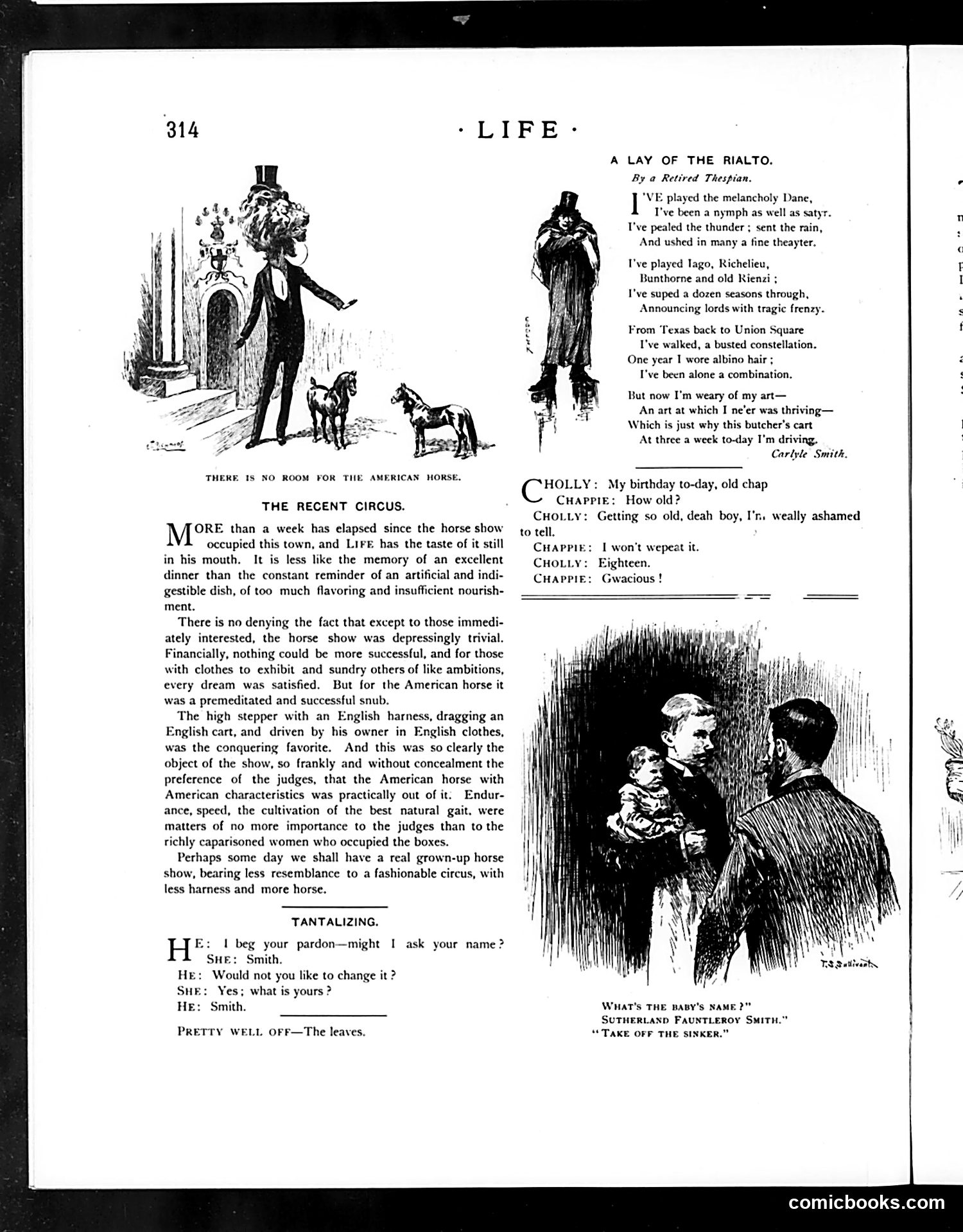
This page from *Life* magazine contains three distinct satirical pieces: **"The Recent Circus"** critiques a horse show where an English horse in English harness was judged superior to American horses. The satire argues that American horses possessed superior "endurance, speed, [and] cultivation of the best natural gait," but judges unfairly favored foreign characteristics. This reflects late-19th/early-20th-century tensions about American versus European standards. **"A Lay of the Rialto"** is a poem by Carlyle Smith lamenting an actor's career decline, performing progressively smaller roles. **"Tantalizing"** and the dialogue with illustration below are light comedic sketches about names and domestic situations, unrelated to political content. The page emphasizes cultural criticism and humor rather than political satire.
📄 Transcribed text from this page (OCR, searchable)
Machine-transcribed from the original scan — historical spelling and the odd misread are preserved.
THERE IS NO ROOM FOR THE AMERICAN HORSE. THE RECENT CIRCUS. ORE than a week has elapsed since the horse show occupied this town, and LIFE has the taste of it still in his mouth, It is less like the memory of an excellent dinner than the constant reminder of an artificial and indi- gestible dish, of too much flavoring and insufficient nourish- ment. There is no denying the fact that except to those immedi- ately interested, the horse show was depressingly trivial. Financially, nothing could be more successful, and for those with clothes to exhibit and sundry others of like ambitions, every dream was satisfied. But for the American horse it was a premeditated and successful snub. The high stepper with an English harness, dragging an English cart, and driven by his owner in English clothes, was the conquering favorite. And this was so clearly the object of the show, so frankly and without concealment the preference of the judges, that the American horse with American characteristics was practically out of it. Endur- ance, speed, the cultivation of the best natural gait. were matters of no more importance to the judges than to the tichly caparisoned women who occupied the boxes. Perhaps some day we shall have a real grown-up horse show, bearing less resemblance to a fashionable circus, with less harness and more horse. TANTALIZING. 1 beg your pardon—might : I ask your name? SHE: Smith. H HE: Would not you like to change it ? SHE: Yes; what is yours ? HE: Smith. PRETTY WELL OFF—The leaves. LAY OF THE RIALTO. By a Retired Thespian. VE played the melancholy Dane, I've been a nymph as well as satyr. I've pealed the thunder ; sent the rain, And ushed in many a fine theayter. I've played Iago, Richelieu, Bunthorne and old Rienzi ; I've suped a dozen seasons through, Announcing lords with tragic frenzy. From ‘Texas back to Union Square I've walked, a busted constellation. One year I wore albino hair ; I've been alone a combination. But now I'm weary of my art— An art at which I ne'er was thriving— Which is just why this butcher's cart At three a week to-day I'm driving. Carlyle Smith. HOLLY: My birthday to-day, old chap Cuappie: How old? CHOLLY: Getting so old, deah boy, I's weally ashamed to tell. CHApPIE: I won't wepeat it. CHOLLY: Eighteen. CuHappPie: Gwacious ! WHatT's THE BABY'S NAME?” SUTHERLAND FAUNTLEROY SMITH.” “TAKE OFF THE SINKER.” comicbooks.com