
Life, 1892-12-01 · page 8 of 14
Life — December 1, 1892 — page 8: what you’re looking at
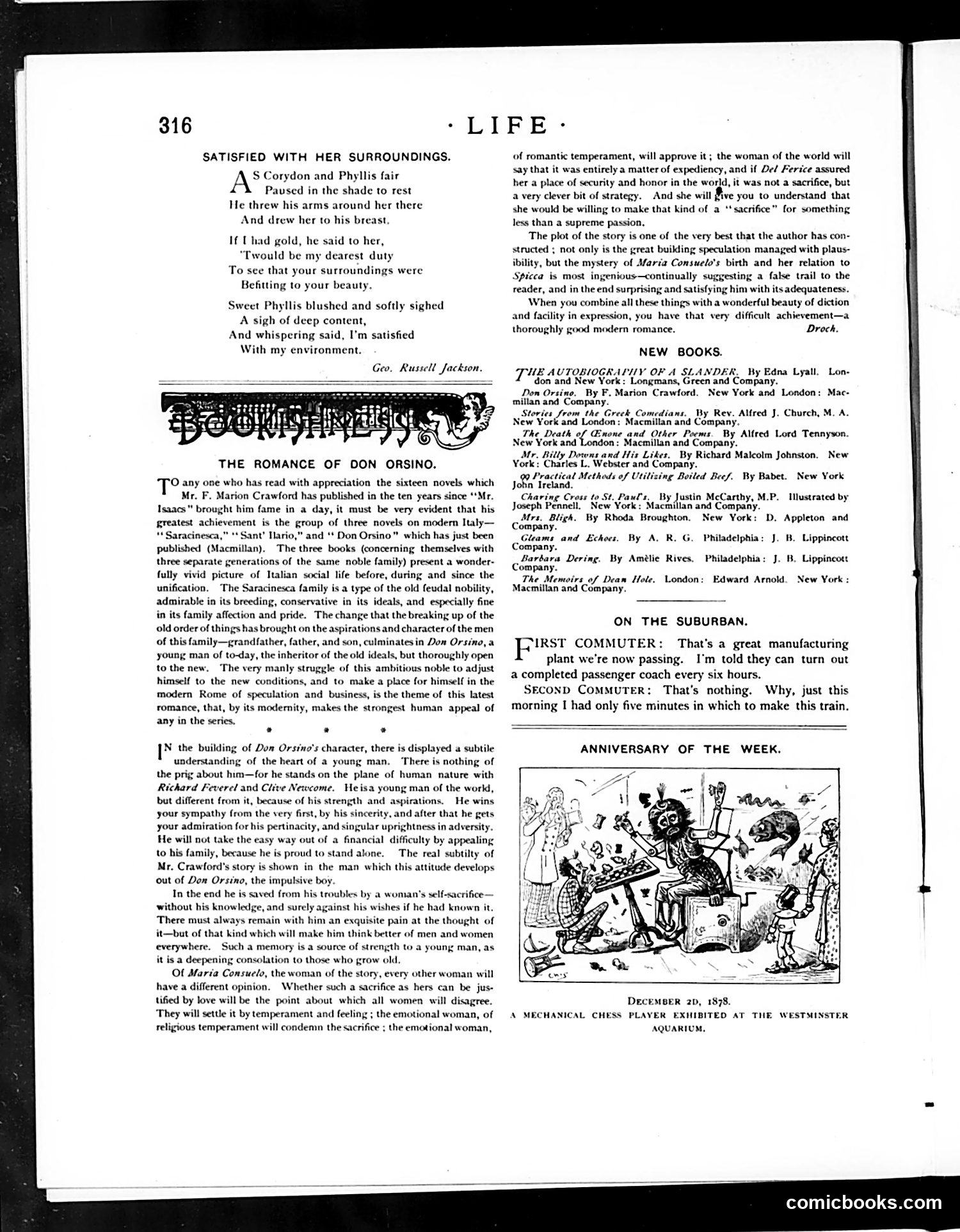
What you’re looking at
This cartoon, dated December 20, 1898, illustrates "A Mechanical Chess Player Exhibited at the Westminster Aquarium." The image depicts an elaborate contraption with gears, levers, and mechanical components operated by hidden machinery. The satire targets the famous "Turk"—a celebrated 18th-century chess-playing automaton later revealed as a hoax operated by a concealed human player inside. The cartoon mocks public fascination with such mechanical "wonders" and the gap between advertised spectacle and reality. By 1898, the original Turk's deception was well-known, making this exhibit's similar claims suspect. The illustration humorously exposes how audiences were willing to suspend disbelief for entertainment, despite historical precedent for mechanical fraud.
📄 Transcribed text from this page (OCR, searchable)
Machine-transcribed from the original scan — historical spelling and the odd misread are preserved.
‘LIFE: SATISFIED WITH HER SURROUNDINGS. S Corydon and Phyllis fair Paused in the shade to rest He threw his arms around her there And drew her to his bre If [had gold, he said to her, “Twould be my dearest duty To see that your s Befitting to your beauty. rroundings were Sweet Phyllis blushed and softly sighed A sigh of deep content, And whispering said, I'm satisfied With my environment. Geo. Russell Jackson. THE ROMANCE OF DON ORSINO. TO any one who has read with appreciation the sixteen novels which Mr. F. Marion Crawford has published in the ten years since “Mr. Isaacs" brought him fame in a day, it must be very evident that his greatest achievement is the group of three novels on modem Italy— ** Saracinesca,” “* Sant’ Hario,” and ‘ Don Orsino” which has just been published (Macmillan). The three books (concerning themselves with three separate generations of the same noble family) present a wonder- fully vivid picture of Italian social life before, during and since the unification. ‘The Saracinesca family is a type of the old feudal nobility, admirable in its breeding, conservative in its ideals, and especially fine in its family affection and pride. The change that the breaking up of the old order of things has brought on the aspirations and character of the men of this family—grandfather, father, and son, culminates in Don Orsino, a young man of to-day, the inheritor of the old ideals, but thoroughly open tothe new. ‘The very manly struggle of this ambitious noble to adjust himself to the new conditions, and to make a place for himself in the modern Rome of speculation and business, is the theme of this latest romance, that, by its modernity, makes the strongest human appeal of any in the series, . * . N the building of Don Orstno's character, there is displayed a subtile understanding of the heart of a young man. ‘There is nothing of the prig about him—for he stands on the plane of human nature with Richard Feverel and Clive Newcome. Heisa young man of the world, but different from it, because of his strength and aspirations. He wins your sympathy from the very first, by his sincerity, and after that he gets your admiration for his pertinacity, and singular uprightness in adversity. He will not take the easy way out of a financial difficulty by appealing to his family, because he is proud to stand alone. The real subtilty of Mr. Crawford's story is shown in the man which this attitude develops out of Don Orsino, the impulsive boy. In the end he is saved from his troubles by a woman's self-sacrifice— without his knowledge, and surely against his wishes if he had known ‘There must always remain with him an exquisite pain at the thought of it—but of that kind which will make him think better of men and women everywhere. Such a memory isa source of strength to a young man, as it is a deepening consolation to those who grow old. Of Maria Consuelo, the woman of the story, every other woman will have a different opinion. Whether such a sacrifice as hers can be jus- tified by love will be the point about which all women will disagree. ‘They will settle it by temperament and feeling ; the emotional woman, of religious temperament will condemn the sacrifice ; the emotional woman, of romantic temperament, will approve it; the woman of the world will say that it was entirely a matter of expediency, and if Del Ferice assured her a place of security and honor in the world, it was not a sacrifice, but a very clever bit of strategy. And she will five you to understand that she would be willing to make that kind of a “sacrifice” for something less than a supreme passion, The plot of the story is one of the very best that the author has con- structed ; not only is the great building speculation managed with plaus- ity, but the mystery of Maria Consuelo's birth and her relation to Spicca is most ingenious—continually suggesting a false trail to the reader, and in the end surprising and satisfying him with its adequateness. When you combine all these things with a wonderful beauty of diction and facility in expression, you have that very difficult achievement—a thoroughly good modern romance. Droch. NEW BOOKS. THE AUTOBIOGKATHY OF A SLANDER, Wy Bana Lyall. don and New York: Longmans, Green and Company. Don Orsino. By F. Marion Crawford. New York and London: Mac- millan and Company. Stories from the Greek Comedians. By Rev. Alfred J. Church, M. A. New York and London: Macmillan and Company. The Death of Enone and Other Poems. By Altred Lord Tennyson. New York and n: Macmillan and Company. Mr. Billy Downs and His Likes. By Richard Malcolm Johnston. New York: Charles L. Webster and Company. Practical Methods of Utilizing Boiled Beef. By Babet. New York Jobn Ireland. 7 eae Charing Cross to St. Paul's. By Justin McCarthy, M.P. Joseph Pennell, New York: Macmillan and Company. Mrs. Bligh. By Rhoda Broughton, New York: Company. Gleams and Echoes. Company. Barbara Dering. By Amilie Rives, ‘Company. The Memoirs of Dean Hote. Macmillan and Company, Lon- Ilustrated by D. Appleton and By A. R. G. Philadelphia: J. B. Lippincott Philadelphia: J. B. Lippincott London: Edward Arnold. New York : ON THE SUBURBAN. pest COMMUTER: That's a great manufacturing plant we're now passing. I'm told they can turn out a completed passenger coach every six hours. SECOND COMMUTER: That’s nothing. Why, just this morning I had only five minutes in which to make this train. ANNIVERSARY OF THE WEEK. DECEMBER 2D, 1878. A MECHANICAL CHESS PLAYER EXHIBITED AT THE WESTMINSTER AQUARIUM, comicbooks.com