
A complete issue · 19 pages · 1892
Life — November 17, 1892
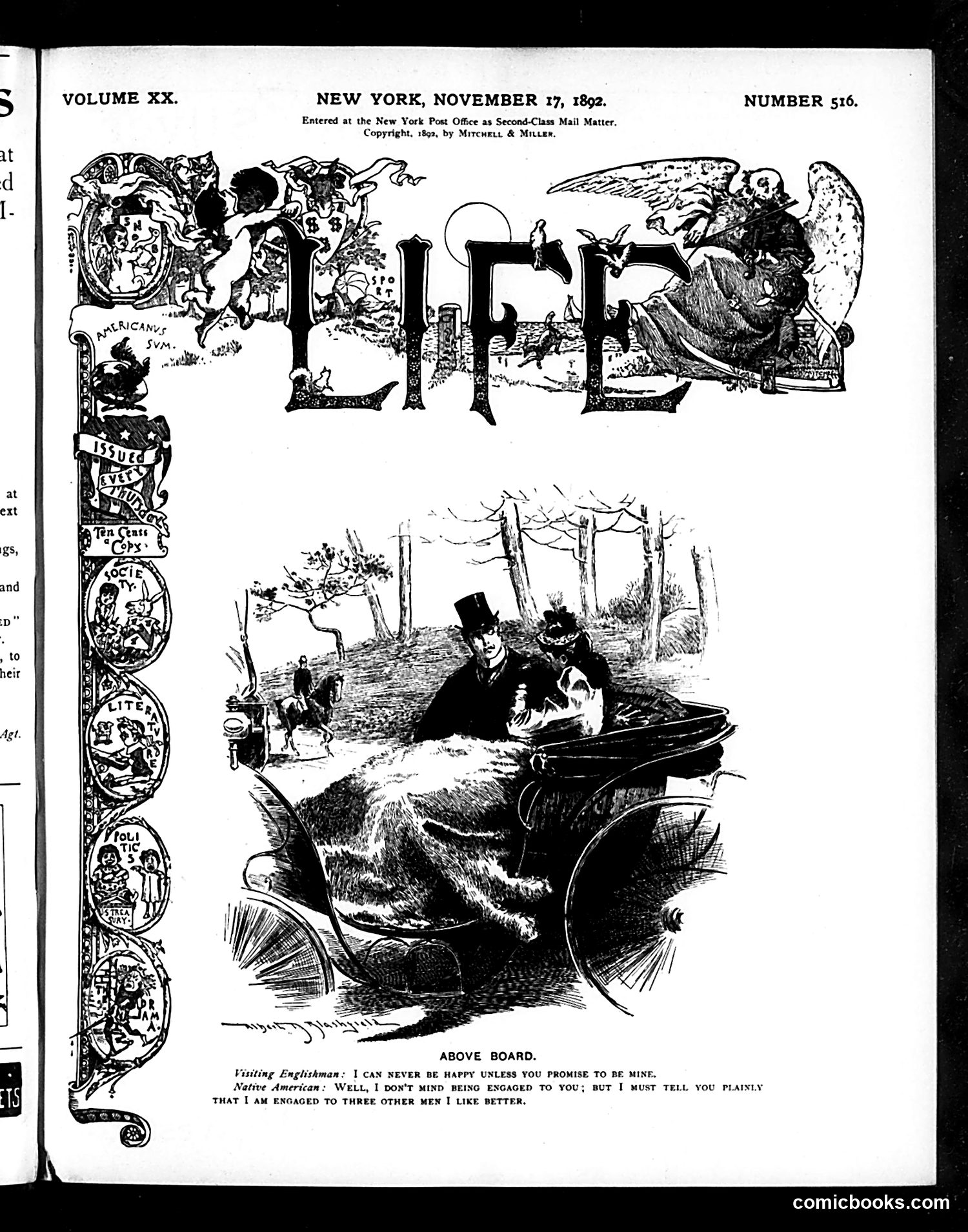
This cartoon satirizes courtship and marriage proposals among the wealthy. Two well-dressed men in a boat encounter a woman, and the dialogue reveals the hypocrisy of "respectable" society. The **Visiting Englishman** demands exclusivity in romance, claiming he cannot be happy unless the woman promises to be his alone. The **Native American** (likely representing an American suitor) responds bluntly: he's already engaged to three other men he likes better, but doesn't mind being engaged to a fourth. The satire mocks the pretense of Victorian courtship—the expectation of feminine virtue and exclusive devotion—while exposing the reality that wealthy women might juggle multiple suitors simultaneously. The title "Above Board" ironically emphasizes the public, seemingly respectable nature of these arrangements.
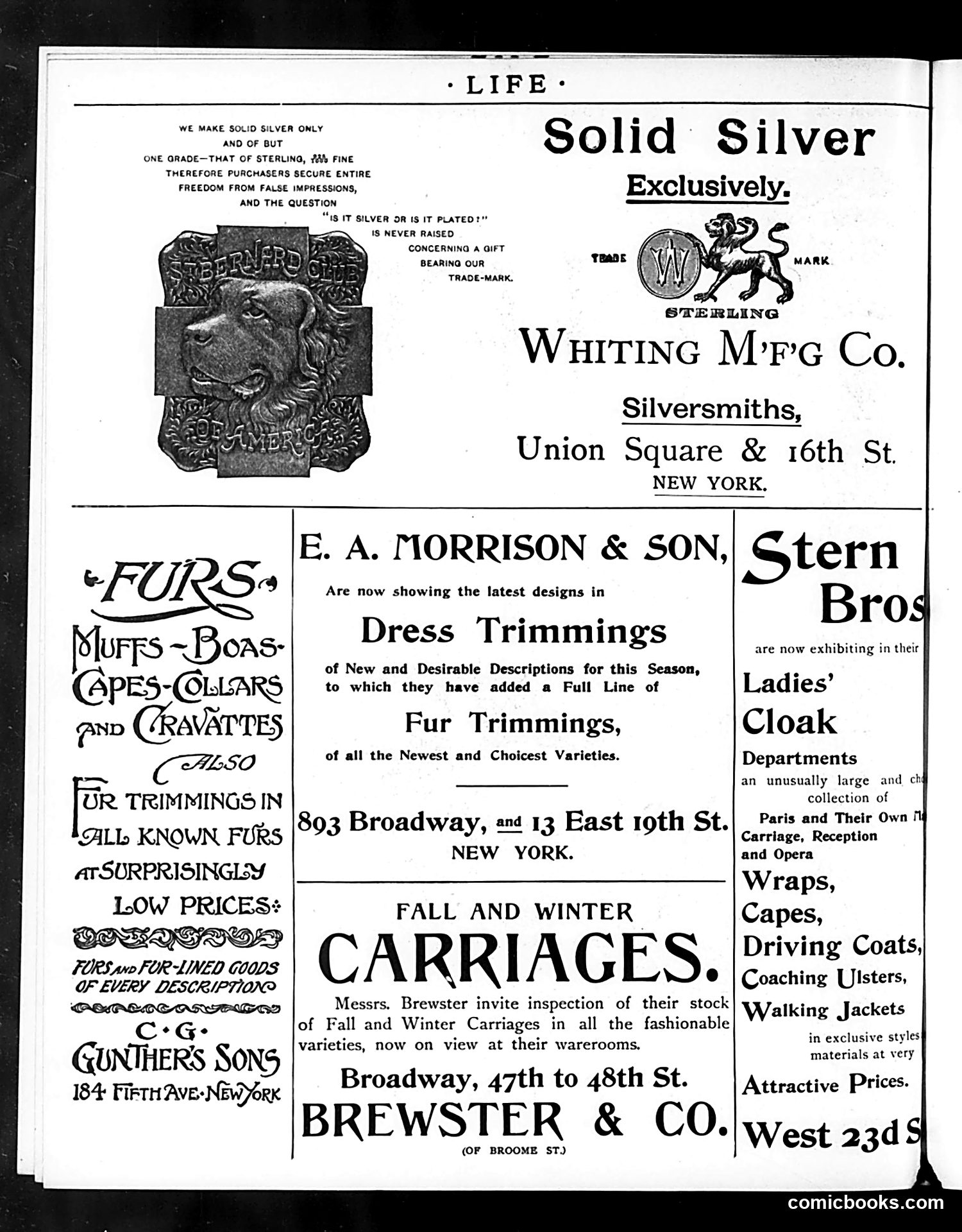
This page is primarily **advertisements**, not editorial content or satire. The ads feature luxury goods typical of late 19th/early 20th-century New York retailers: - **Whiting M'fg Co.**: Sterling silver flatware and serving pieces - **E.A. Morrison & Son**: Dress trimmings and fur accessories - **Brewster & Co.**: Fashionable carriages for fall/winter - **Stern Bros**: Women's cloaks, wraps, and coats - **Gunthers Sons**: Furs and fur-lined goods The left side shows what appears to be a **bearded male portrait** (possibly a trademark or company founder), used to authenticate quality. These ads target wealthy New York consumers and emphasize exclusivity, fashionable design, and "attractive prices"—standard luxury marketing of the era.
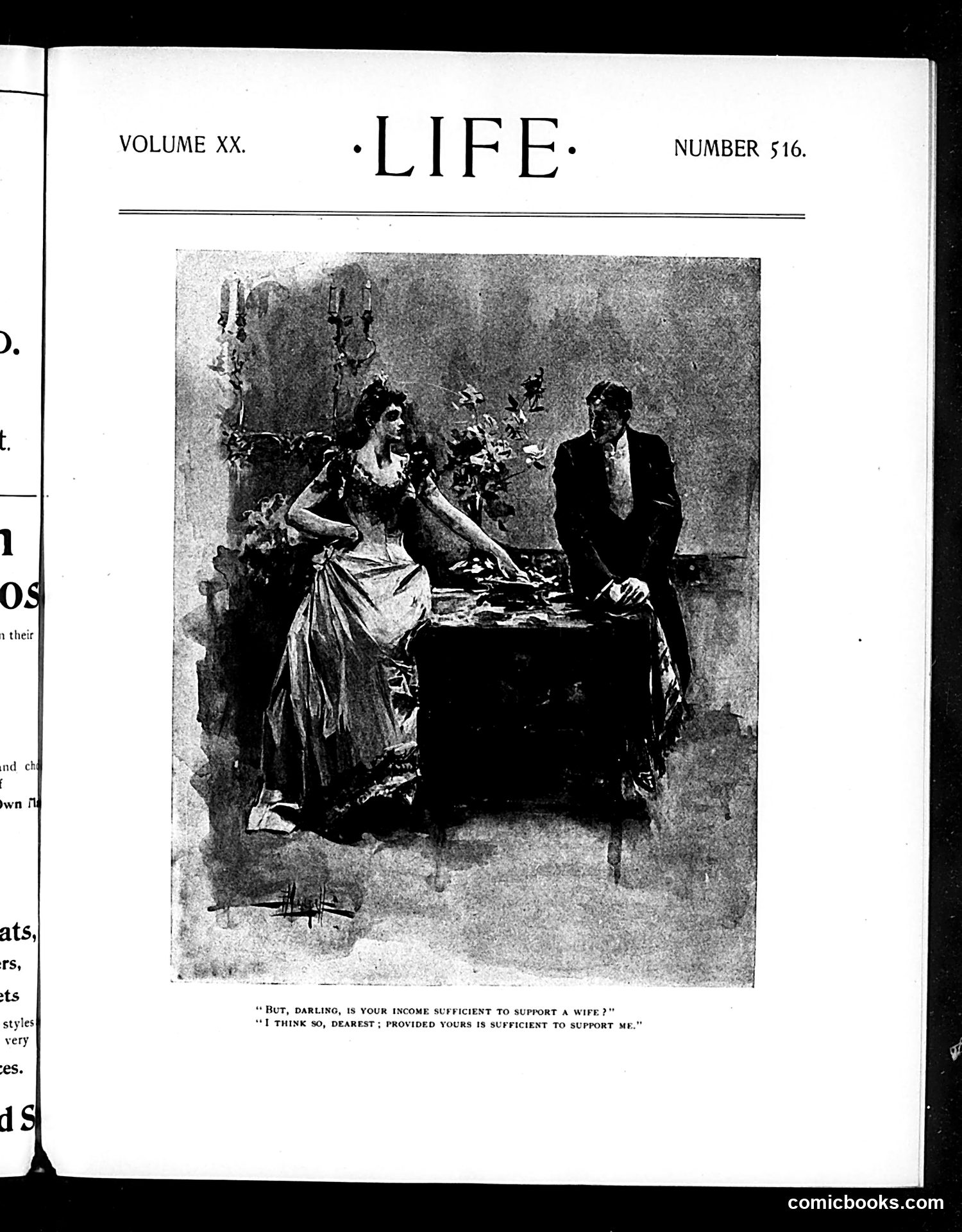
This is a satirical illustration from *Life* magazine (Volume XX, Number 516) showing a domestic scene with a dialogue caption. The image depicts a woman in an elegant dress and a man in formal attire at what appears to be a dining table with flowers and food. The caption reads: "But, darling, is your income sufficient to support a wife?" / "I think so, dearest; provided yours is sufficient to support me." **The satire:** This joke mocks the economic realities of marriage in this era, suggesting that wives were expected to bring substantial wealth to marriages—not just husbands. The humor inverts traditional gender roles regarding financial responsibility, implying that the woman's income would be necessary to sustain their lifestyle. It satirizes both the financial pressures of maintaining upper-class status and contemporary anxieties about women's economic independence and role in marriage.
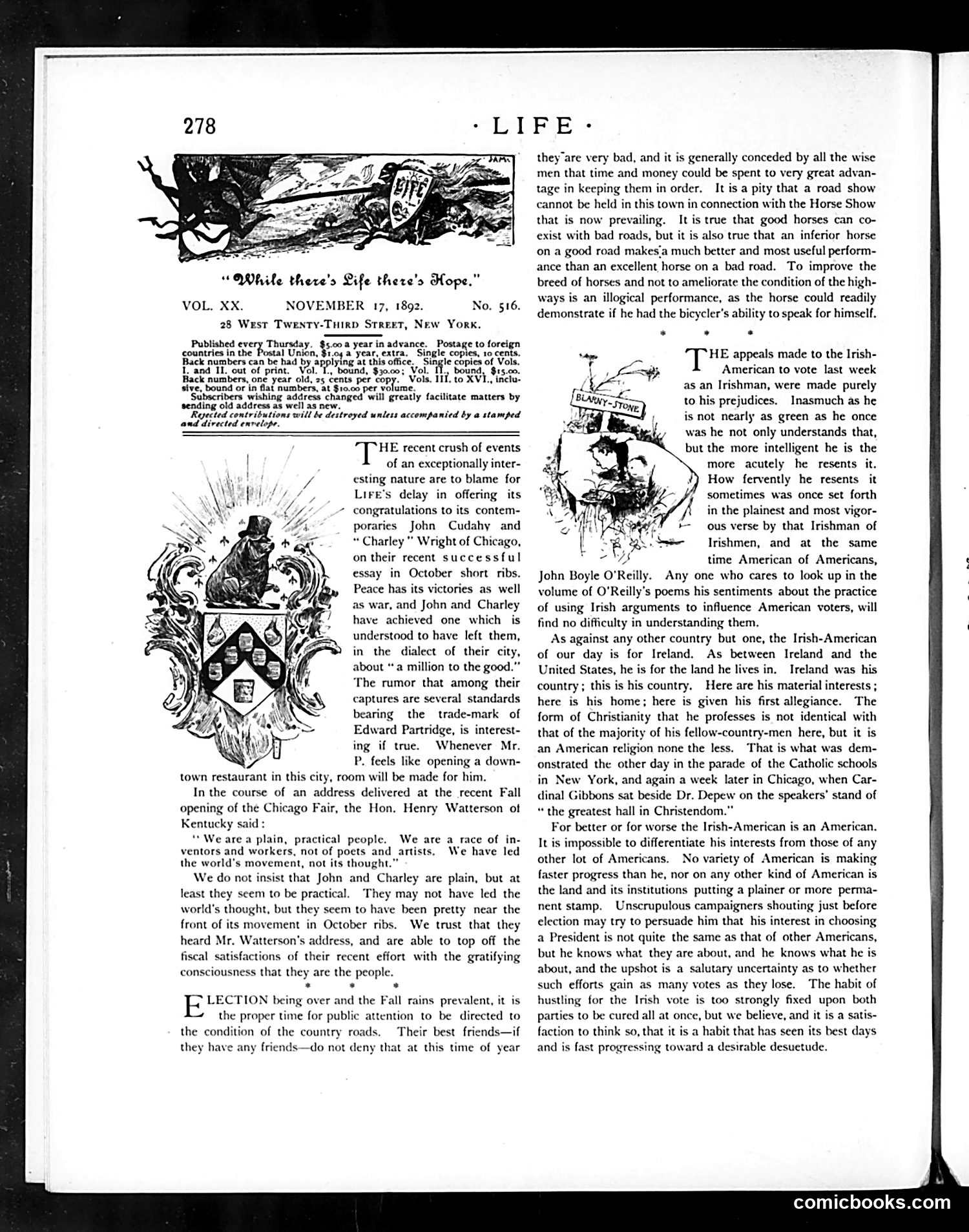
The page contains editorial content rather than political cartoons. The main decorative illustration shows an ornate coat of arms or heraldic design with a dog or similar figure, accompanying text about John Cudahy and "Charley" Wright of Chicago, who apparently achieved success in a recent essay contest in *Life*. The bulk of the page discusses Irish-American voting patterns and identity. The editorial addresses Irish-American voters' political allegiances, arguing they should vote as Americans rather than based on Irish prejudices. It references John Boyle O'Reilly (an Irish-American poet) and mentions tensions between Irish-American ethnic identity and American citizenship during the 1892 election period. The text critiques efforts to manipulate the Irish-American vote through ethnic appeals.
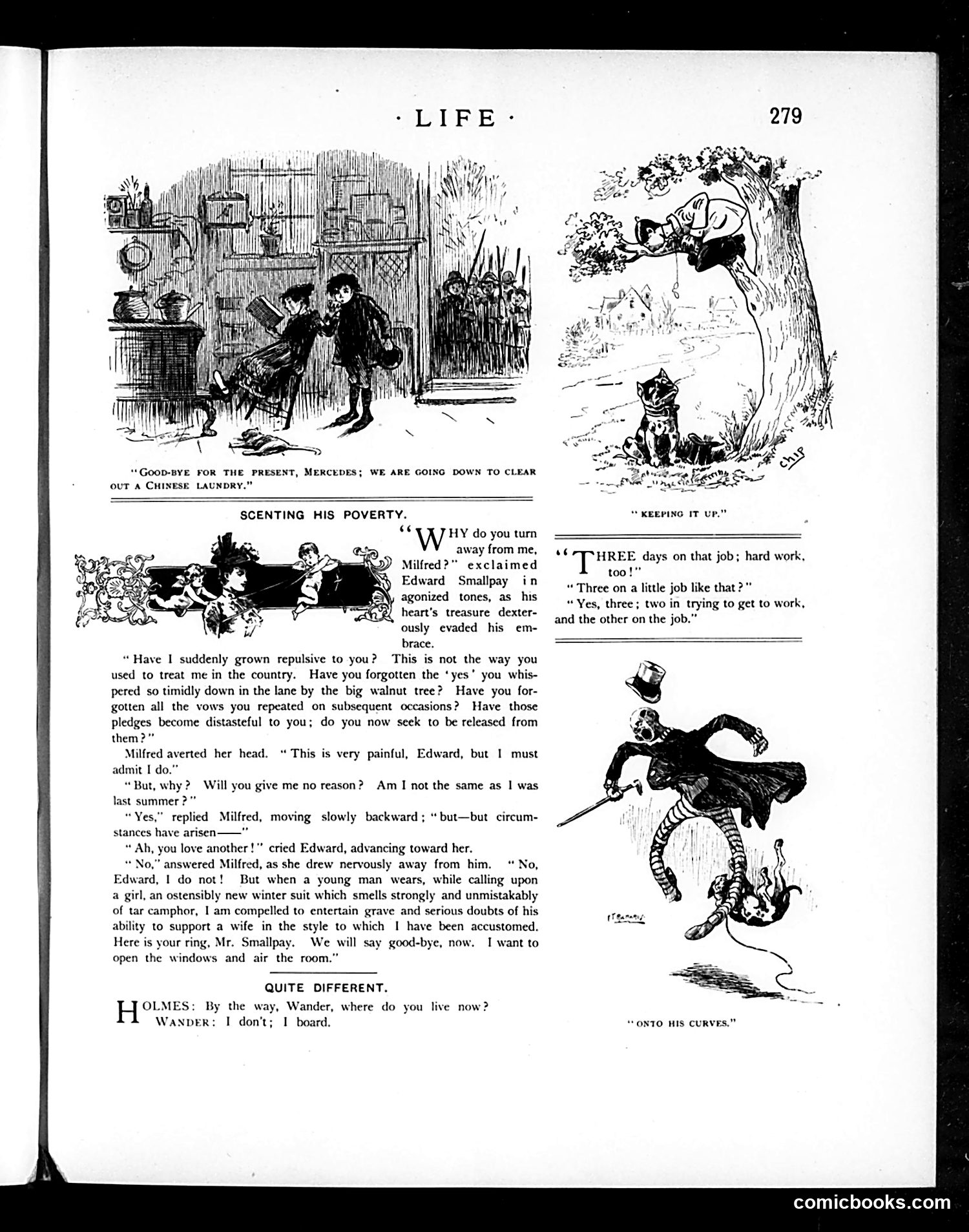
This page contains three separate satirical pieces: 1. **"Good-bye for the Present, Mercedes"** (top left): Shows figures evicting someone from what appears to be a Chinese laundry, satirizing anti-Chinese sentiment and xenophobic business practices of the era. 2. **"Scenting His Poverty"** (center): A dialogue between characters named Milfred and Edward Smallpay, where Milfred rejects Edward's romantic advances, claiming his worn winter suit and lack of financial means make him unsuitable as a husband. This satirizes class-conscious courtship and materialism in society. 3. **"Quite Different"** (bottom): A brief exchange between Holmes and Wander about living arrangements, appearing to be a humorous non-sequitur. The page primarily satirizes economic class anxiety and shallow social values of the period.
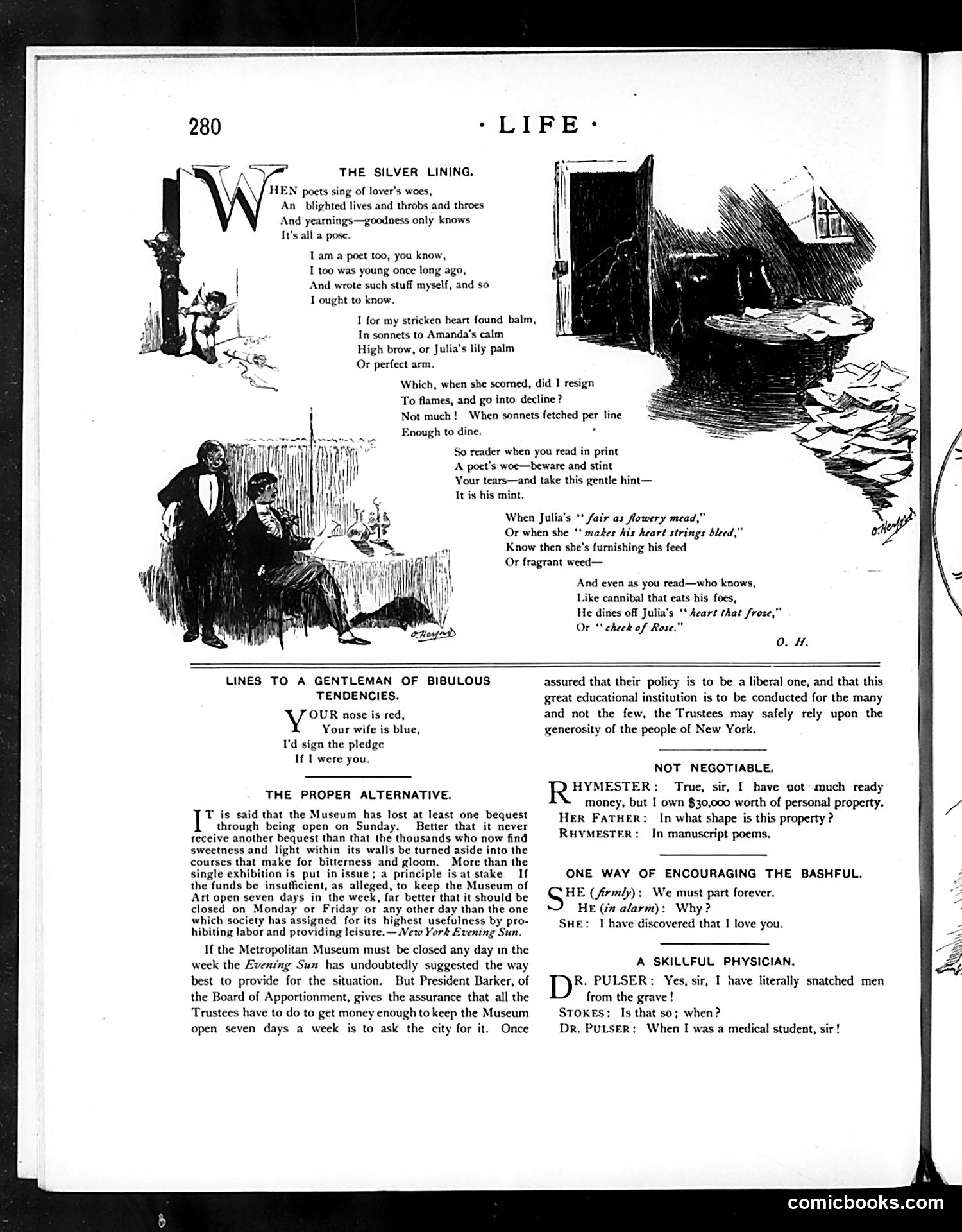
This page contains several satirical pieces typical of early 20th-century Life magazine humor: **"The Silver Lining"** is a poem mocking romantic poetry about love and heartbreak, suggesting poets exaggerate their suffering for artistic effect. The accompanying sketches show a melancholic poet and a couple in domestic discord. **"Lines to a Gentleman of Bibulous Tendencies"** is a brief rhyming jab at a heavy drinker, sarcastically noting his red nose and suggesting marital problems. **"The Proper Alternative"** discusses a debate over whether the Metropolitan Museum should close on Sundays, arguing it should remain open. This reflects actual cultural tensions of the era between religious observance and public access to institutions. The remaining items—"Not Negotiable," "One Way of Encouraging the Bashful," and "A Skillful Physician"—are brief comedic dialogues common to Life's format.
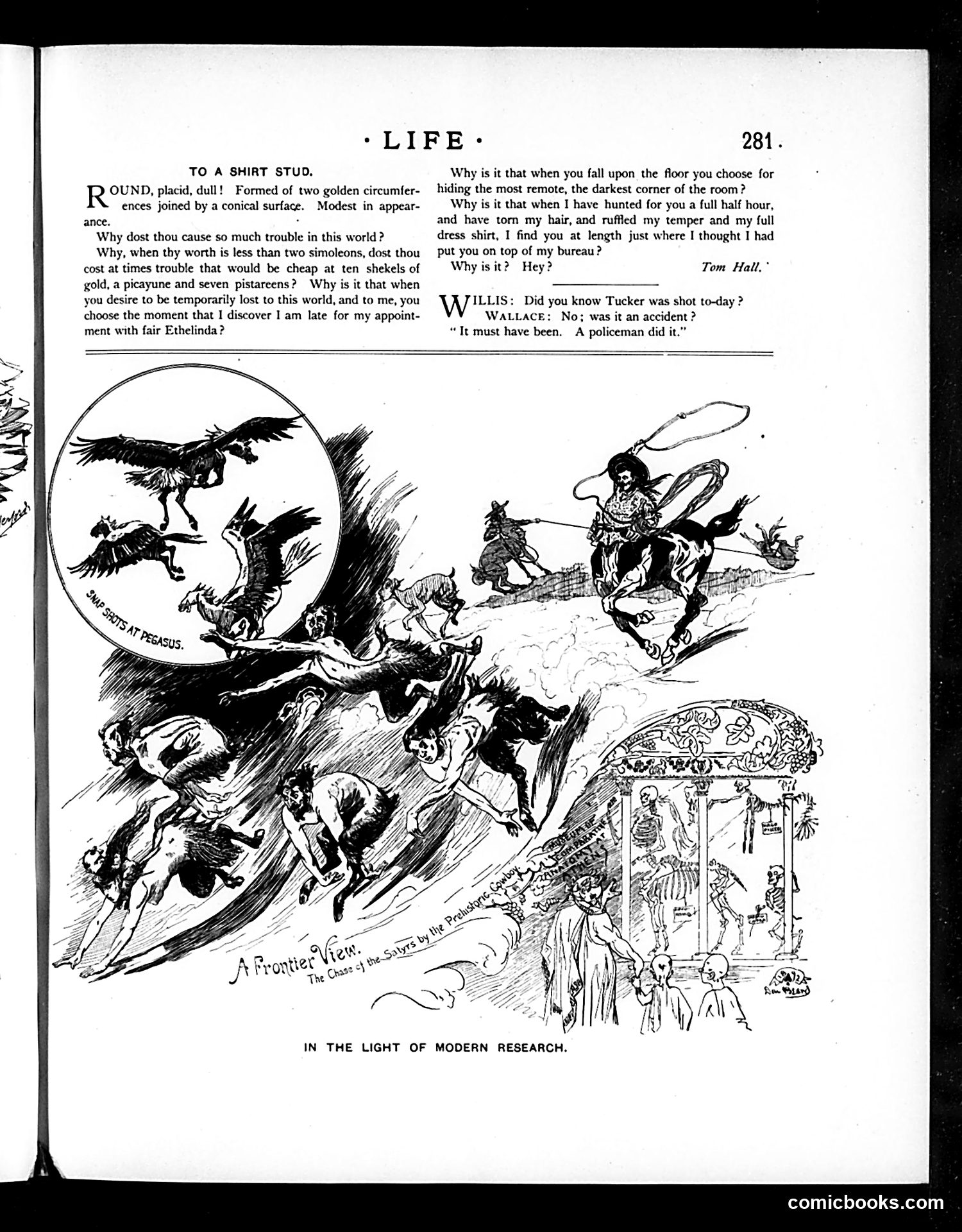
This page contains satirical content mocking evolutionary theory and scientific research. The main cartoon, titled "A Frontier View: The Cause by the Frontier's Light" and captioned "IN THE LIGHT OF MODERN RESEARCH," depicts frontier figures observing what appears to be flying creatures in a circular inset (labeled "Ape-Apes at Pegasus"). The illustration contrasts primitive frontier understanding with contemporary scientific claims. The top section includes humorous dialogue about a lost shirt stud—trivial complaints about everyday inconveniences—juxtaposed with the evolutionary cartoon below, likely satirizing how people dismiss modern scientific research while obsessing over minor matters. The cartoonist appears skeptical of contemporary evolutionary or paleontological theories, presenting them as fantastical frontier mythology rather than legitimate science.
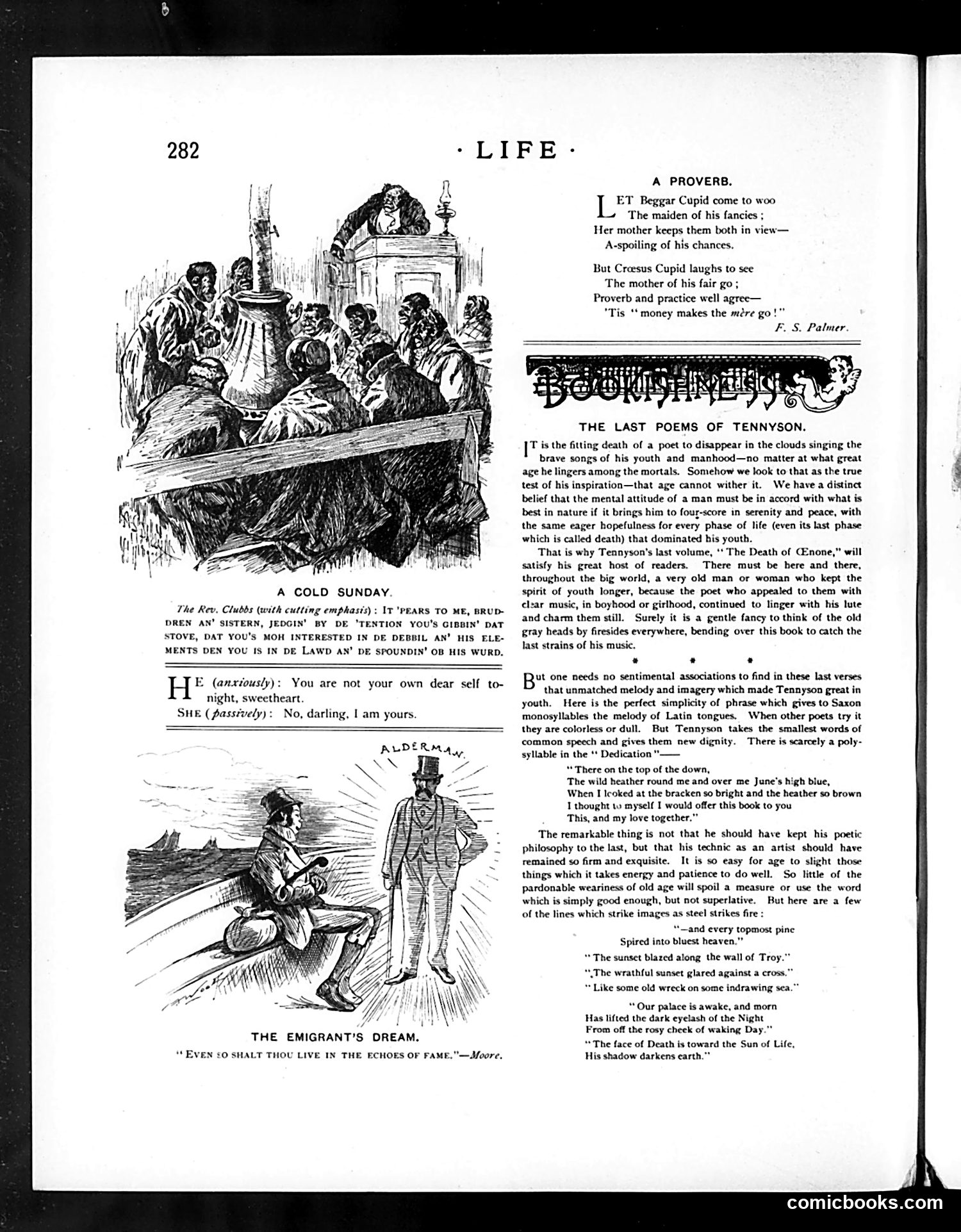
This page contains three separate pieces: 1. **"A Cold Sunday"** - A sketch showing a clergyman delivering a sermon to drowsy parishioners. The dialogue satirizes the disconnect between stern religious instruction and the congregation's actual engagement—the preacher's lengthy warnings about sin contrast with people dozing off. 2. **"The Emigrant's Dream"** - An illustration showing a figure daydreaming of wealth and status (represented by the well-dressed gentleman in top hat), captioned with Moore's quote about living in "echoes of fame." This satirizes immigrants' idealized expectations versus reality. 3. **"The Last Poems of Tennyson"** - A literary essay discussing Tennyson's final works, analyzing his poetic philosophy and aging. This is substantive criticism rather than satire. The page reflects Victorian-era concerns about class, faith, immigration, and literary merit.
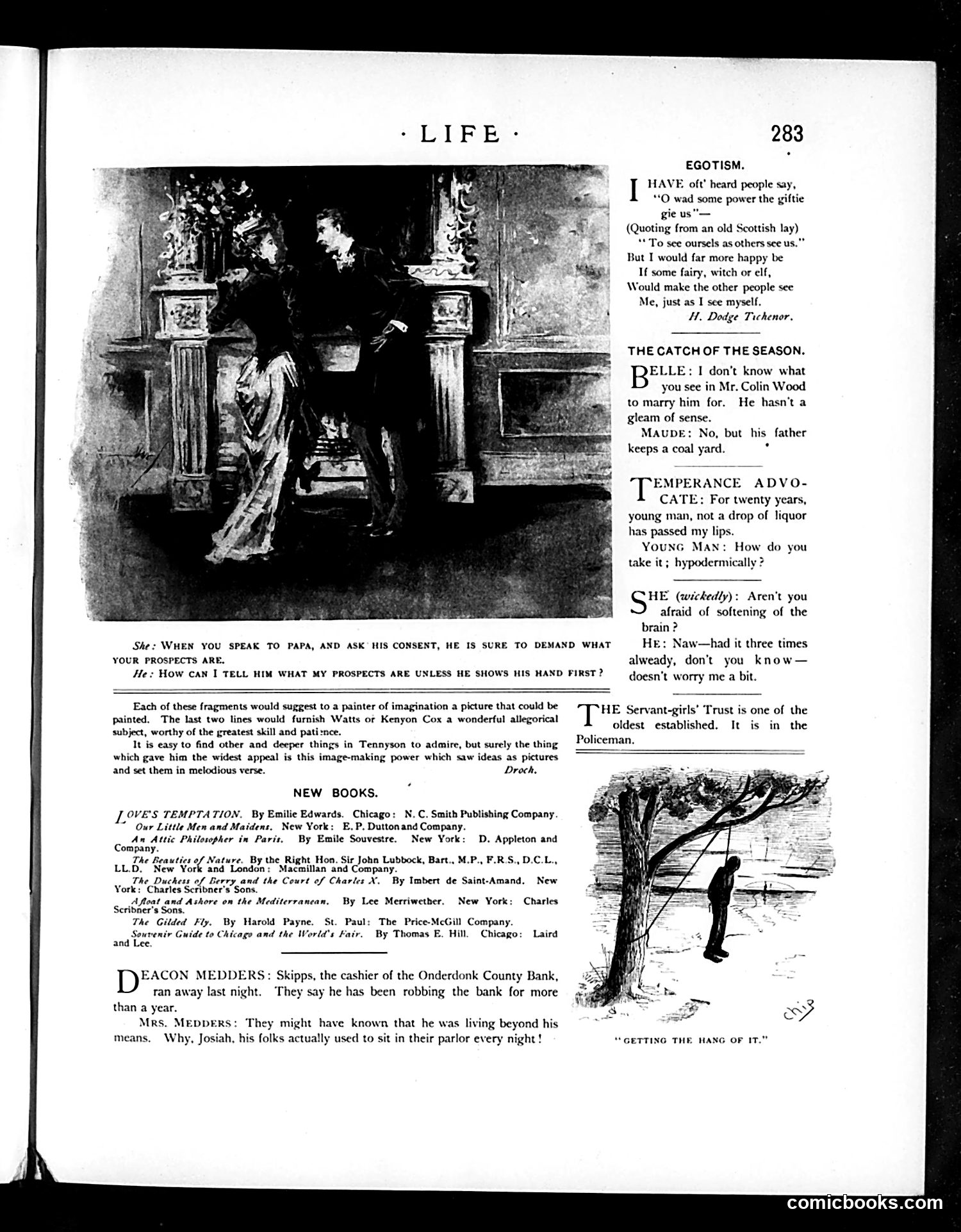
This page contains several disconnected satirical pieces rather than a unified cartoon. **"Egotism"** quotes an old Scottish saying about supernatural intervention, then contrasts it with H. Dodge Ticknor's wish that "some fairy, witch or elf" would make others see him as he sees himself—poking fun at vanity and self-deception. **"The Catch of the Season"** mocks a woman (Belle) considering marrying Colin Wood solely because his father owns a coal yard—satire on mercenary marriages. **"Temperance Advocate"** presents a comedic exchange where a teetotaler's claims are undercut by his casual drug use, satirizing hypocrisy in moral crusades. **"Deacon Medders"** reports a bank cashier's robbery, with commentary suggesting his openly lavish lifestyle should have raised suspicion—satire on obliviousness or complicity. The page appears to be primarily humorous commentary rather than political satire.
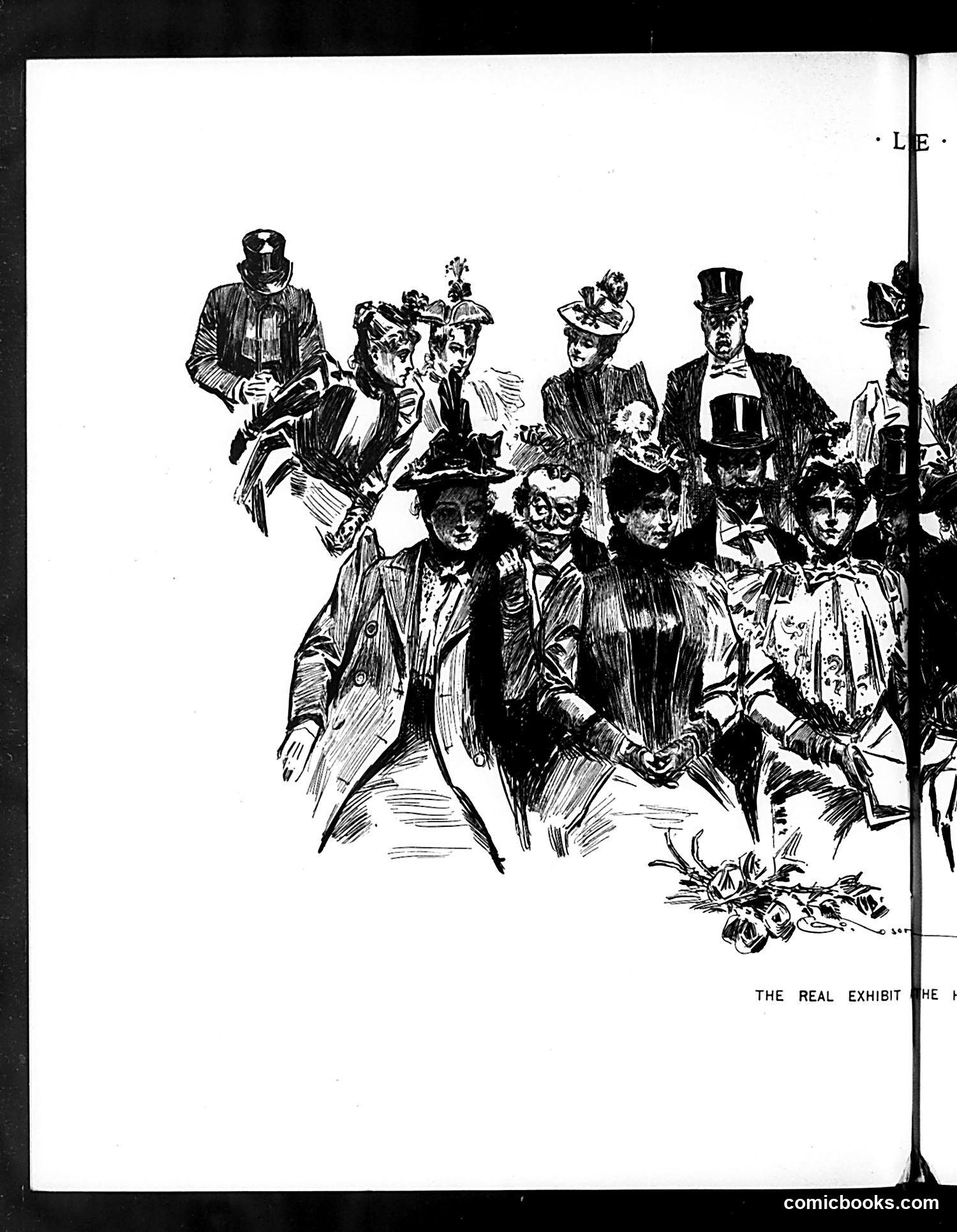
This satirical drawing depicts a social gathering at what appears to be a high-society event or exhibition. The caption reads "THE REAL EXHIBIT HE M[?]" (text is cut off). The cartoon presents elaborately dressed figures in Victorian-era formal wear—top hats, fine coats, ornate hats with feathers and decorations—arranged as if they were specimens on display. The satire seems to mock the artificiality and pretension of high society, suggesting that the fashionably dressed attendees themselves are the "real exhibit" worth observing, rather than whatever artwork or objects the official exhibition might contain. This is typical of *Life* magazine's social satire, using exaggerated caricature to critique upper-class vanity and affectation. The drawing style and formal dress suggest this is from the late 19th or early 20th century.
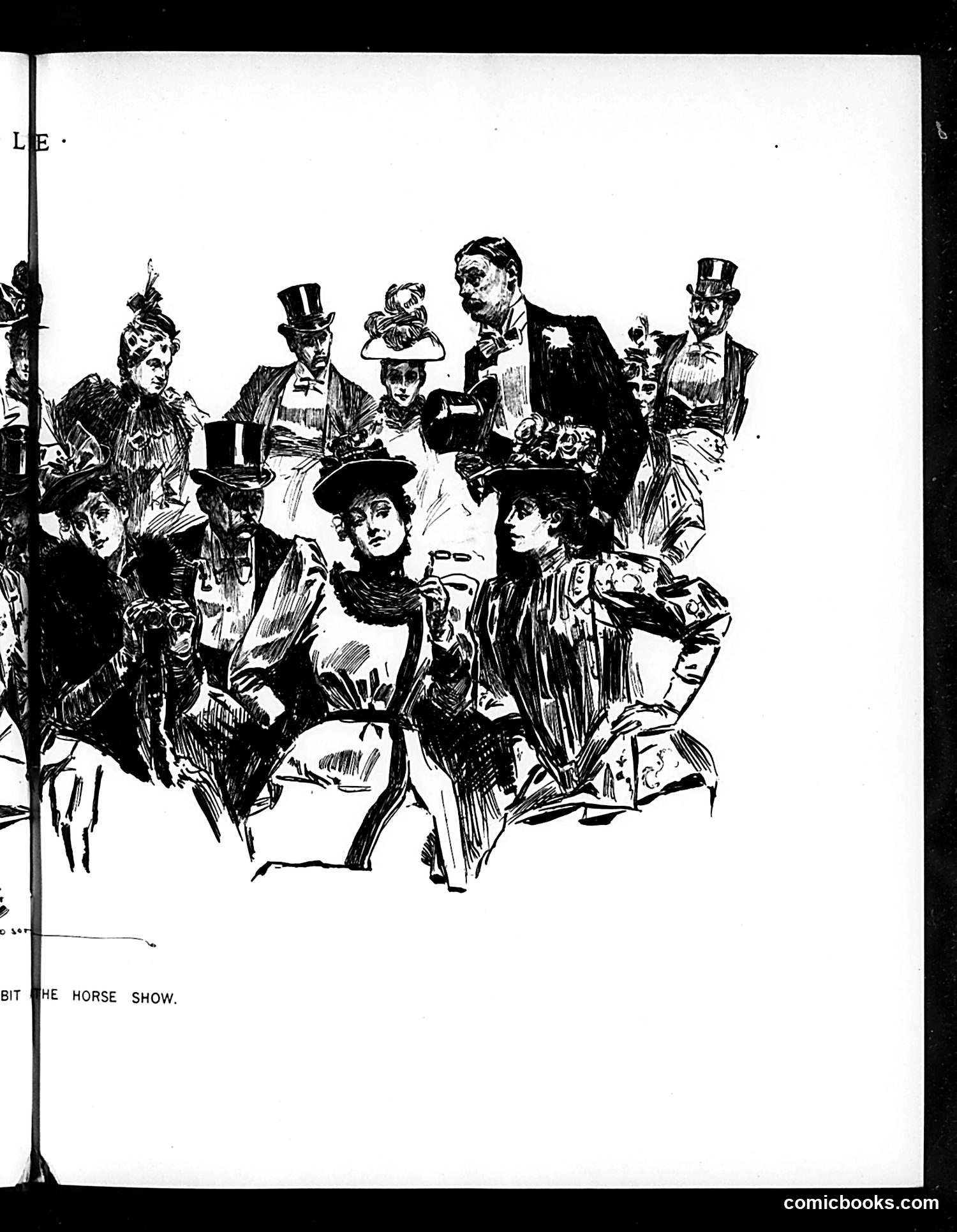
This is a social satire sketch depicting well-dressed attendees at what appears to be an upper-class horse show event. The illustration shows men in top hats and women in elaborate Edwardian-era clothing and accessories, arranged in a group composition typical of early 20th-century Life magazine social commentary. The satire likely mocks the pretension and ostentation of wealthy society figures who attended such exclusive events. The exaggerated facial expressions and careful attention to fashionable dress suggest the cartoonist is ridiculing the vanity and social posturing of the attendees. Without more context, the specific individuals aren't identifiable, but the work exemplifies Life's regular critique of American high society's affectations and class consciousness during this period.
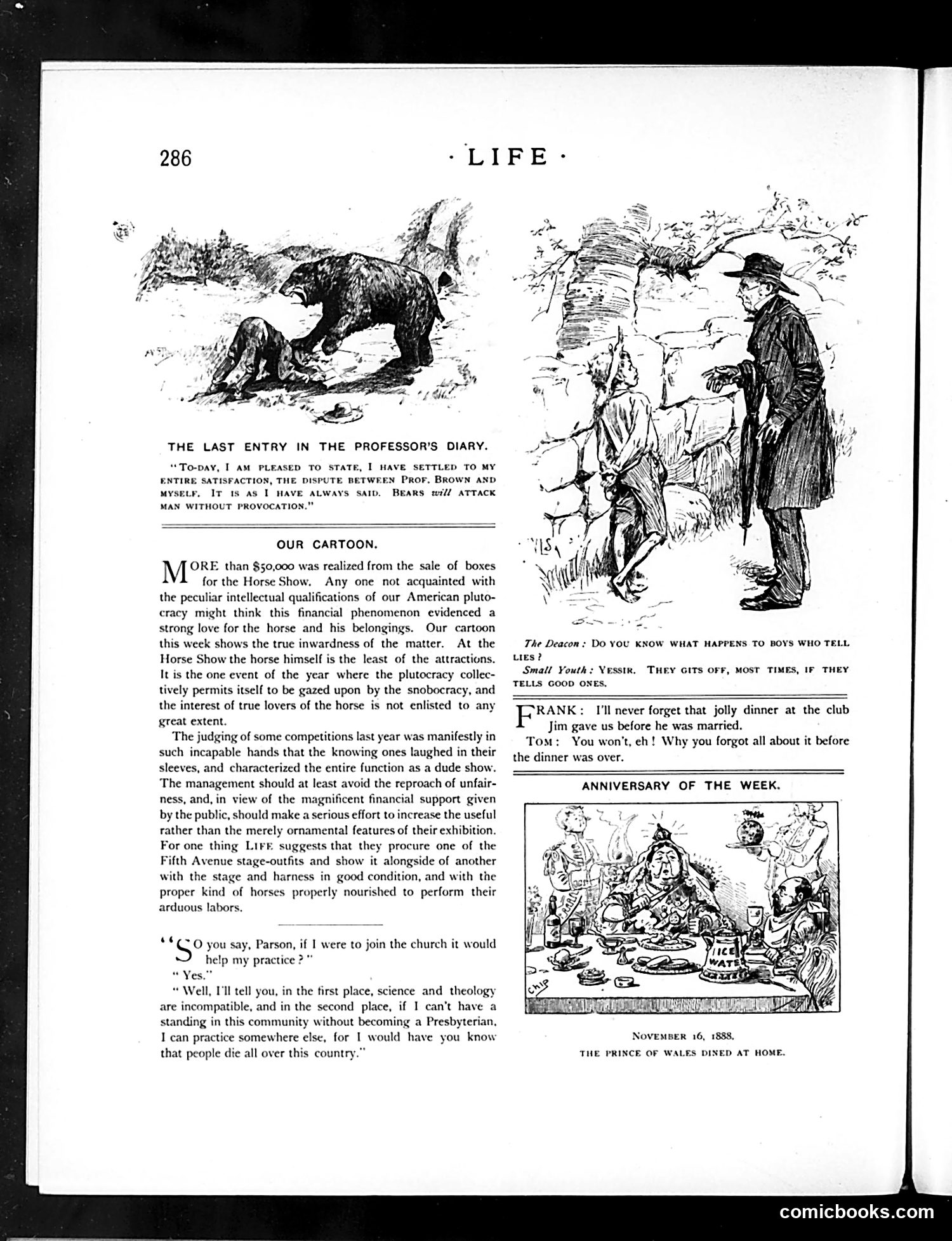
This page contains multiple satirical pieces targeting American social pretension and hypocrisy circa 1888: **"The Last Entry in the Professor's Diary"** (top left): A bear has mauled a man. The professor's smug diary entry claims vindication in a dispute with "Prof. Brown," asserting bears attack without provocation—even as the cartoon shows otherwise. The satire mocks pompous academics who cling to wrong conclusions. **"Our Cartoon"** (main article): Life criticizes the wealthy Horse Show as mere plutocratic vanity, not genuine horsemanship. The commentary attacks how rich New Yorkers use such events for social display rather than actual appreciation of horses or merit-based judging. **Comic dialogues below**: These mock various hypocrisies—a doctor rejecting religion for social standing, a deacon warning against lies while a boy admits lies often succeed, and a man forgetting a dinner he supposedly treasured. **"Anniversary" (bottom)**: References the Prince of Wales dining at home—unclear without fuller context, possibly satirizing royal domesticity or social pretension. Throughout, Life's satirical target is American elite self-deception and the gap between stated values and actual behavior.
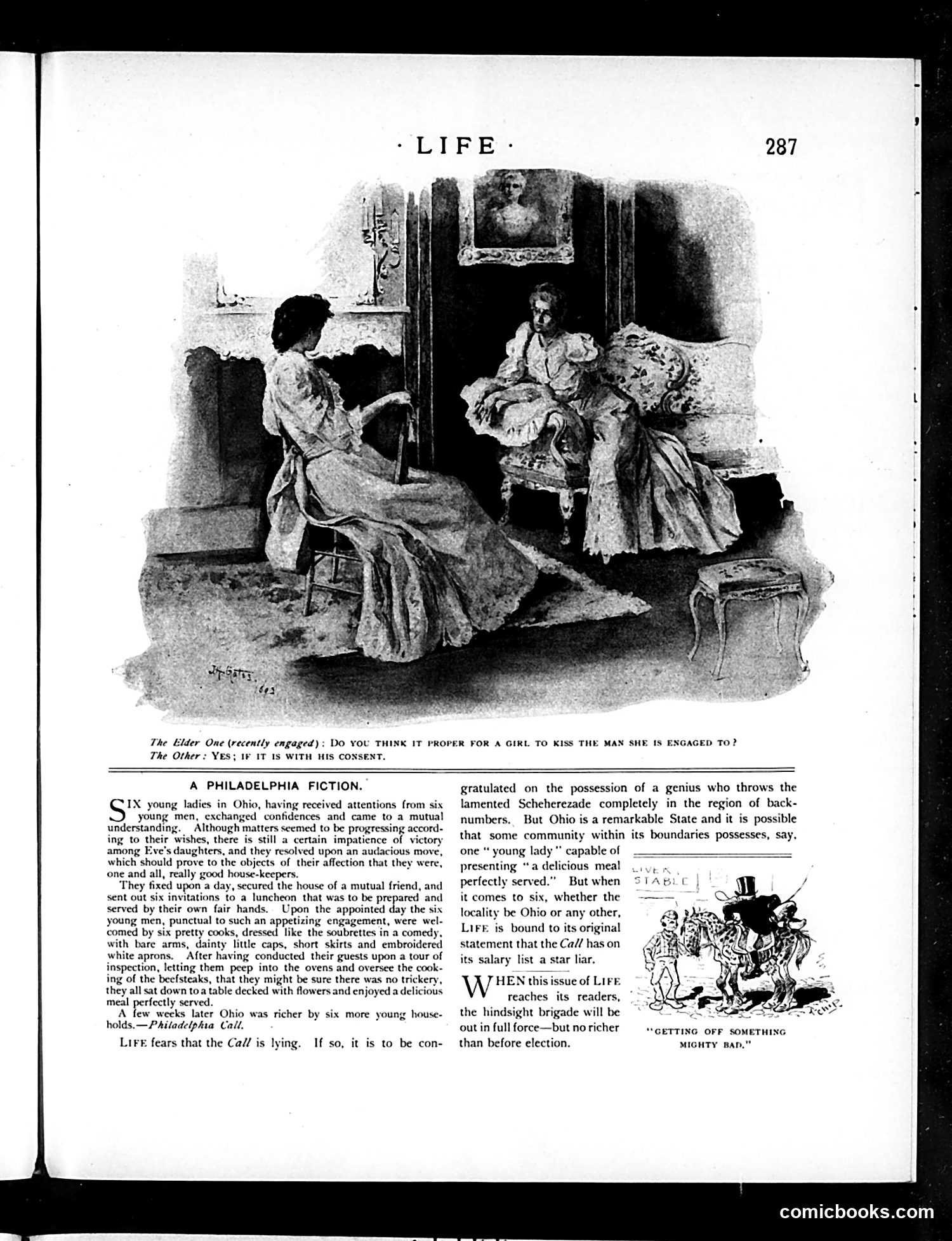
This page contains two satirical pieces from Life magazine: **The Cartoon Caption** (top): A joke about engagement propriety. An older engaged woman asks if it's proper for a girl to kiss her fiancé. The answer—"Yes, if it is with his consent"—is a sarcastic jab at the contradiction: of course consent matters, yet the question itself implies uncertainty about women's agency in romance. **"A Philadelphia Fiction"** (main article): Life ridicules a story from the Philadelphia Call newspaper claiming six Ohio women impressed six suitors by cooking them lunch in their own hands. Life's editor treats this as obviously false—sarcastically praising the Call's "star liar" on staff. The satire mocks both the implausibly perfect domestic fantasy and the newspaper's credibility. **The Editorial Note** references the upcoming election, suggesting Life will critique politicians' predictable hindsight commentary afterward. The overall tone reflects turn-of-century skepticism about romantic fantasies and media reliability.
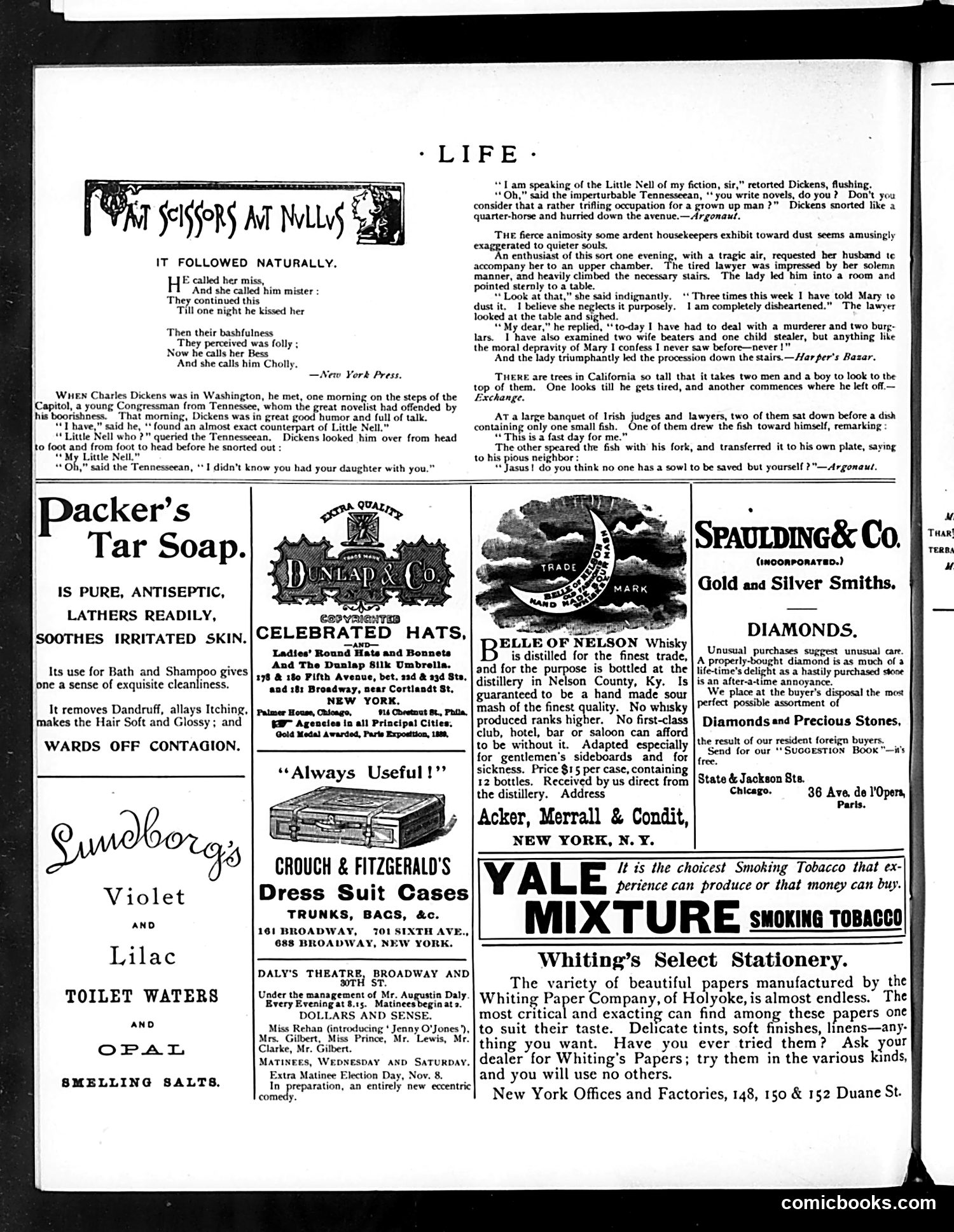
This page contains three brief humorous anecdotes and considerable advertising—typical of Life magazine's format. **The cartoons/stories:** 1. **"Feisgors at Nulls"** and **"It Followed Naturally"**: A simple joke about courtship formality dissolving into familiarity—using "Miss"/"Mister" until a kiss occurs, after which they use casual first names ("Bess"/"Cholly"). 2. **The Dickens anecdote**: Charles Dickens, meeting a Tennessee congressman, claims to have found a real-life counterpart to "Little Nell" (a character from his novel). The congressman insults Dickens by suggesting novel-writing is a "trifling occupation" for a grown man—implying he'd found a better use for his daughter. It's a joke about American rudeness to the famous British author. 3. **The dust-obsessed wife**: A husband, after dealing with murderers and child abusers professionally, must listen to his wife's outrage over a servant's dust-neglect. The satire mocks domestic preoccupations as trivial compared to serious crime. 4. **The Irish lawyers and the fish**: A fast-day joke where one pious judge claims fasting, then steals another's fish—hypocrisy exposed. The page is primarily **advertisements** for soap, hats, whiskey, and stationery.
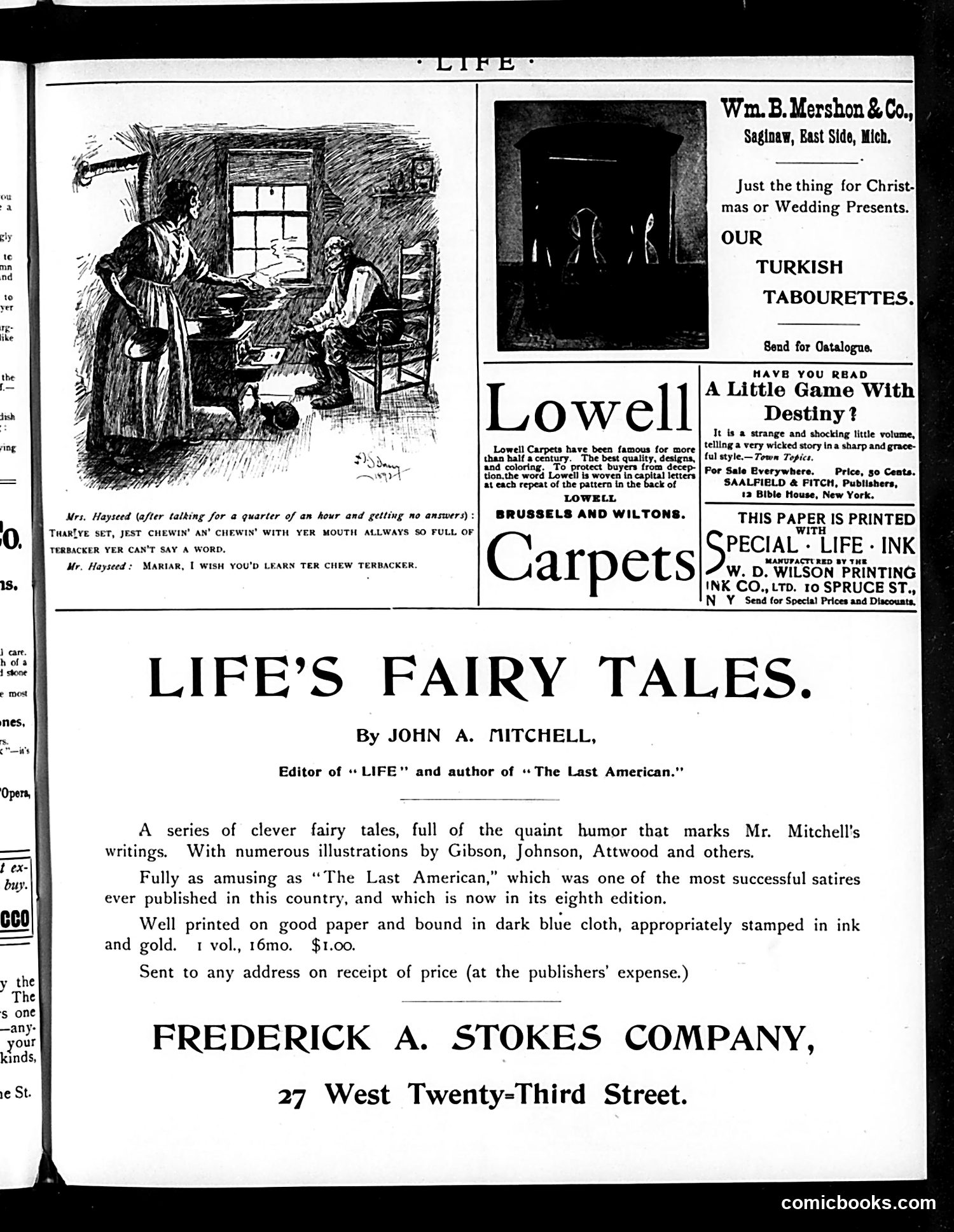
This page is primarily **advertising and promotional content** rather than political satire. The main cartoon depicts a rural couple—"Mrs. Hayseed" and "Mr. Hayseed"—in a humorous domestic scene. Mrs. Hayseed complains that her husband constantly chews tobacco so aggressively ("chewin' an' chewin' with yer mouth allways so full of terbacker") that he cannot speak to her, even after a quarter-hour of conversation. The joke relies on **rural stereotypes** common to the era: poor grammar ("terbacker" for tobacco), unsophisticated manners, and the assumed dirtiness of tobacco-chewing habits. The satire gently mocks working-class Americana and domestic frustration. The page also advertises John A. Mitchell's *Life's Fairy Tales* book and various consumer goods (Turkish furniture, carpets, a Lowell book). This reflects the magazine's dual purpose: **satirical humor alongside commercial promotion**.
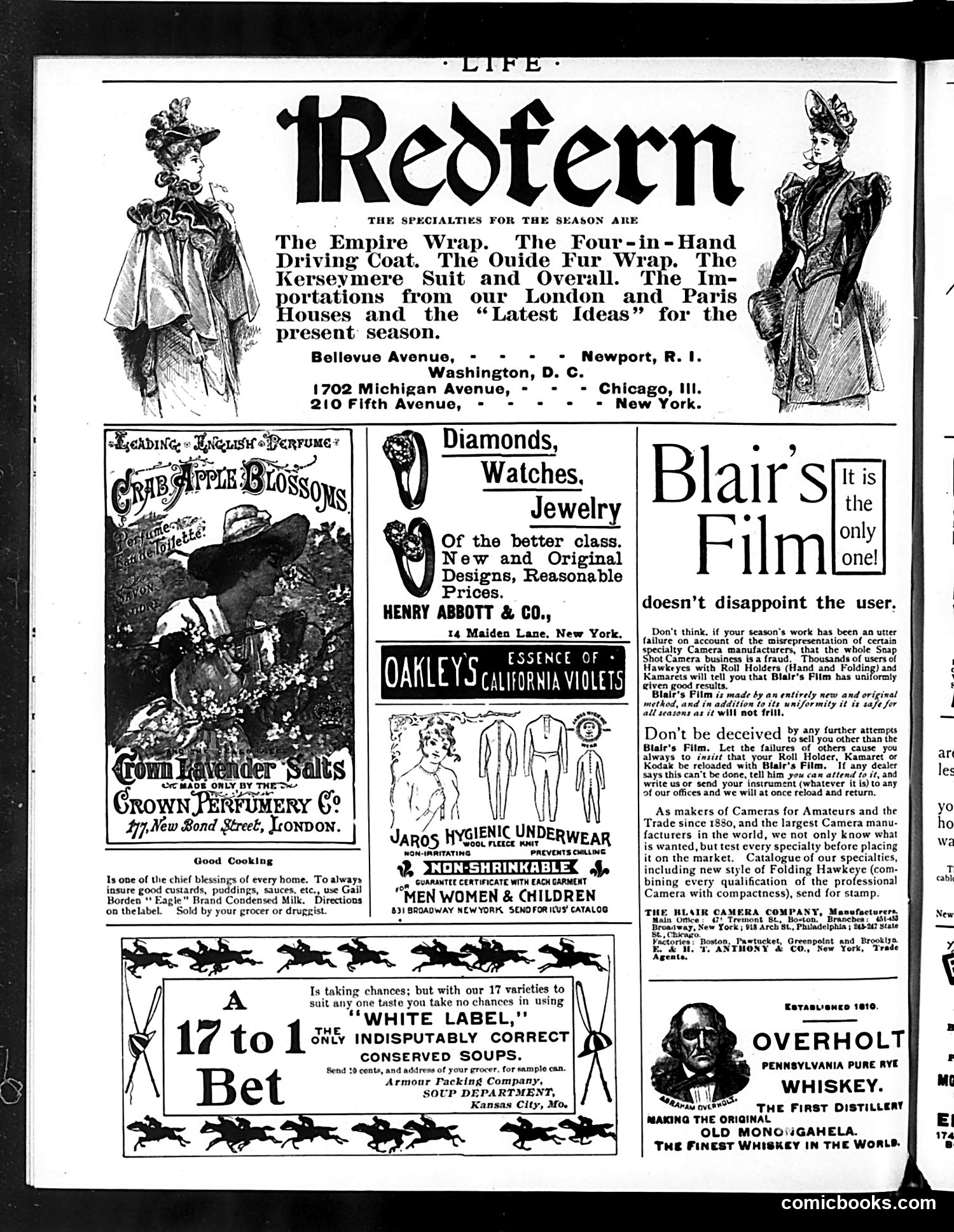
This page is primarily **advertising**, not political satire. It showcases luxury goods and services circa early 1900s, targeting wealthy consumers. The masthead features **Redfern**, a high-end fashion house advertising seasonal specialties (Empire Wrap, driving coats, fur wraps) with locations in Newport, Washington D.C., Chicago, and New York—indicating an affluent clientele. Surrounding advertisements reflect Gilded Age consumer culture: jewelry by Henry Abbott & Co., Blair's Film cameras (marketed to amateur photographers), Armour's canned soups, Jaros hygienic underwear, and Overholt whiskey. The "17 to 1 Bet" advertisement for White Label Conserved Soups uses horse-racing imagery, a popular gambling reference of the era. **No political cartoons appear here.** The page documents period advertising conventions and the goods marketed to America's wealthy class in the early 1900s.
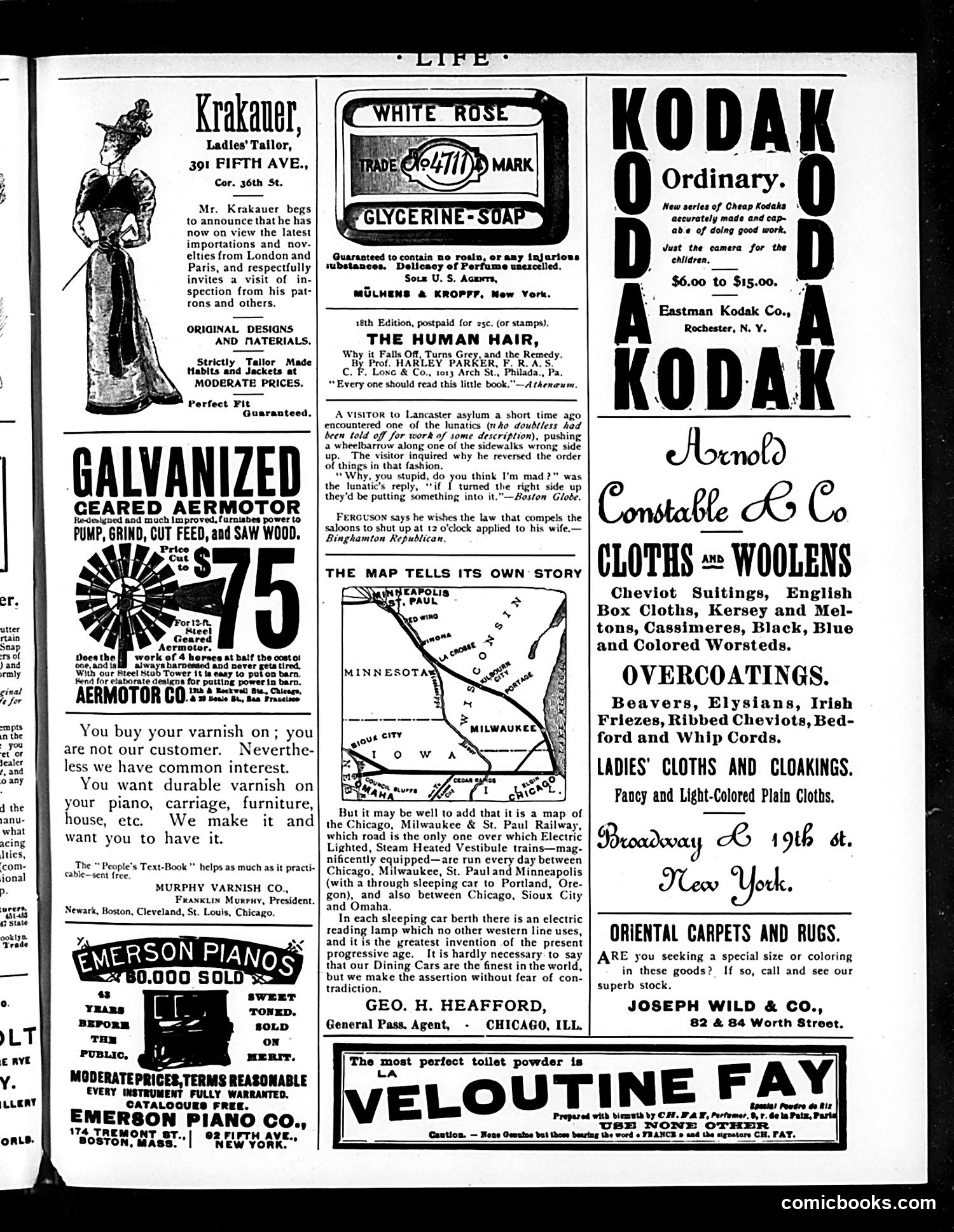
This page is primarily **advertisements**, not political cartoons. It represents a turn-of-the-century American magazine's revenue model. The **humor content** consists of brief jokes scattered among ads: 1. **Lunatic wheelbarrow joke**: A mental asylum patient pushes a wheelbarrow upside-down, claiming he'd be forced to fill it if he turned it right-side up—satirizing the absurd logic of institutions. 2. **Ferguson saloon joke**: A man wishes closing laws applied to his wife instead of bars—reflecting Prohibition-era debates and domestic humor stereotypes. 3. **Map advertisement**: The Chicago, Milwaukee & St. Paul Railway includes a map with commentary about electric-lit train cars as modern luxuries. The page reflects **early 1900s consumer culture**: dress tailoring, farm equipment, pianos, varnish, hair treatments, cameras, and carpets. This was typical *Life* content—mixing social satire with advertising to reach middle and upper-class readers. The jokes are mild domestic/institutional humor rather than sharp political satire.
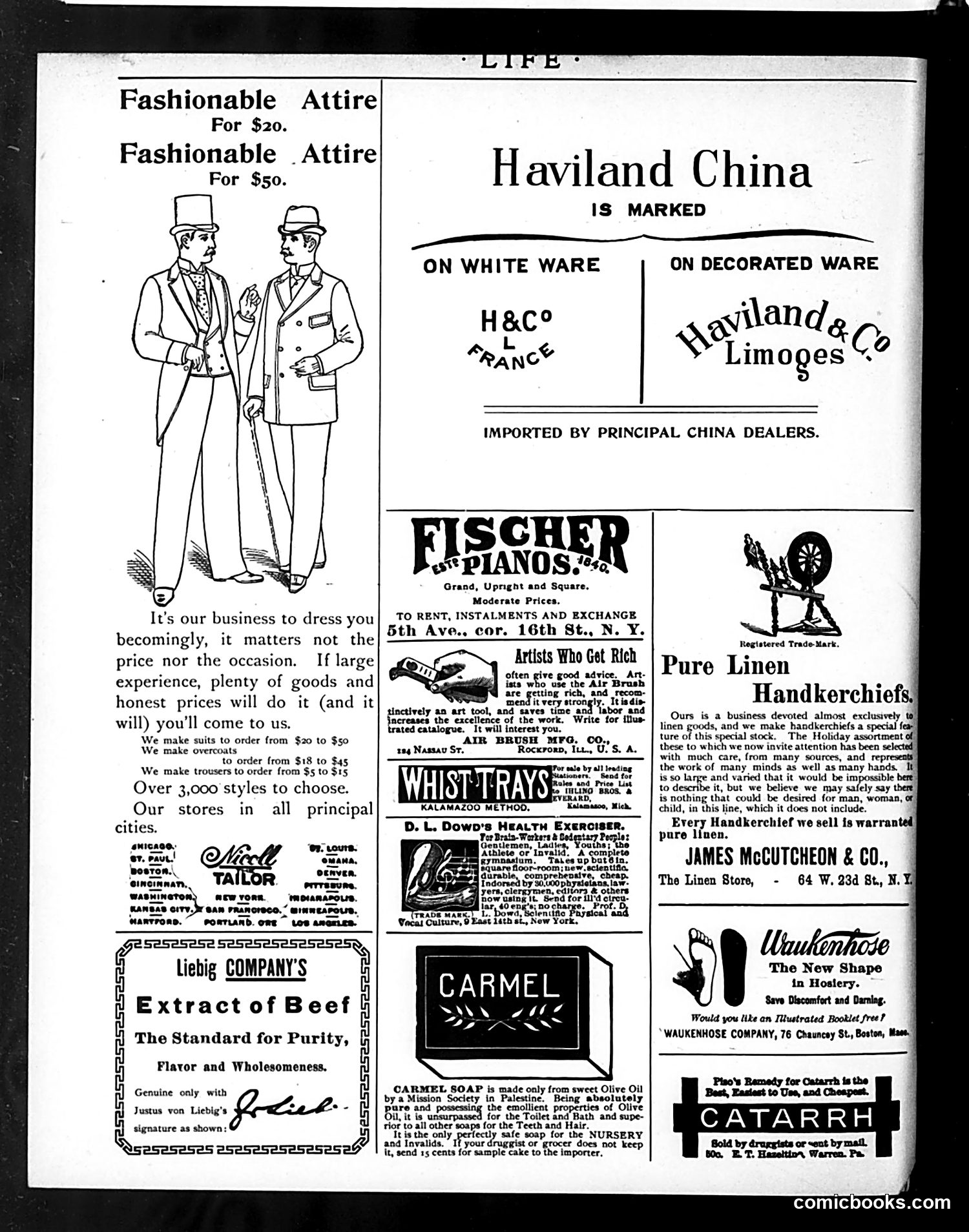
This page is primarily **advertisements**, not editorial content or satire. It's a commercial collection typical of *Life* magazine's revenue model. The largest ad features two well-dressed men in formal attire (top hats, suits) illustrating clothing at different price points ($20 and $50 suits), aimed at middle-class readers seeking respectability. The accompanying text emphasizes affordable quality and accessibility across multiple cities—appealing to urban, aspirational consumers. Other notable ads include: - **Haviland China**: French porcelain for affluent households - **Fischer Pianos**: For cultural refinement - **Liebig's Extract of Beef**: Nutritional products - **James McCutcheon & Co.**: Luxury linens The ads collectively reflect **Gilded Age consumer culture**—products marketed to demonstrate taste, refinement, and social standing. There is **no political satire** visible; this is straightforward commercial messaging targeting prosperous Americans.

I can see this is a page from Life magazine, but the image is almost entirely black with only minimal text visible in the margins and at the bottom. The OCR text only shows "comicbooks.com," which appears to be a watermark rather than original magazine content. The left margin contains some fragmentary text that is too degraded to read reliably, and there are partial letters/text visible on the right side, but insufficient to identify specific political figures, cartoon content, or satirical points. Without legible cartoon imagery or substantive text, I cannot accurately identify what this page was satirizing or explain its historical context to a modern reader. This appears to be a heavily degraded or poorly scanned document page.