
Life, 1892-11-17 · page 4 of 19
Life — November 17, 1892 — page 4: what you’re looking at
What you’re looking at
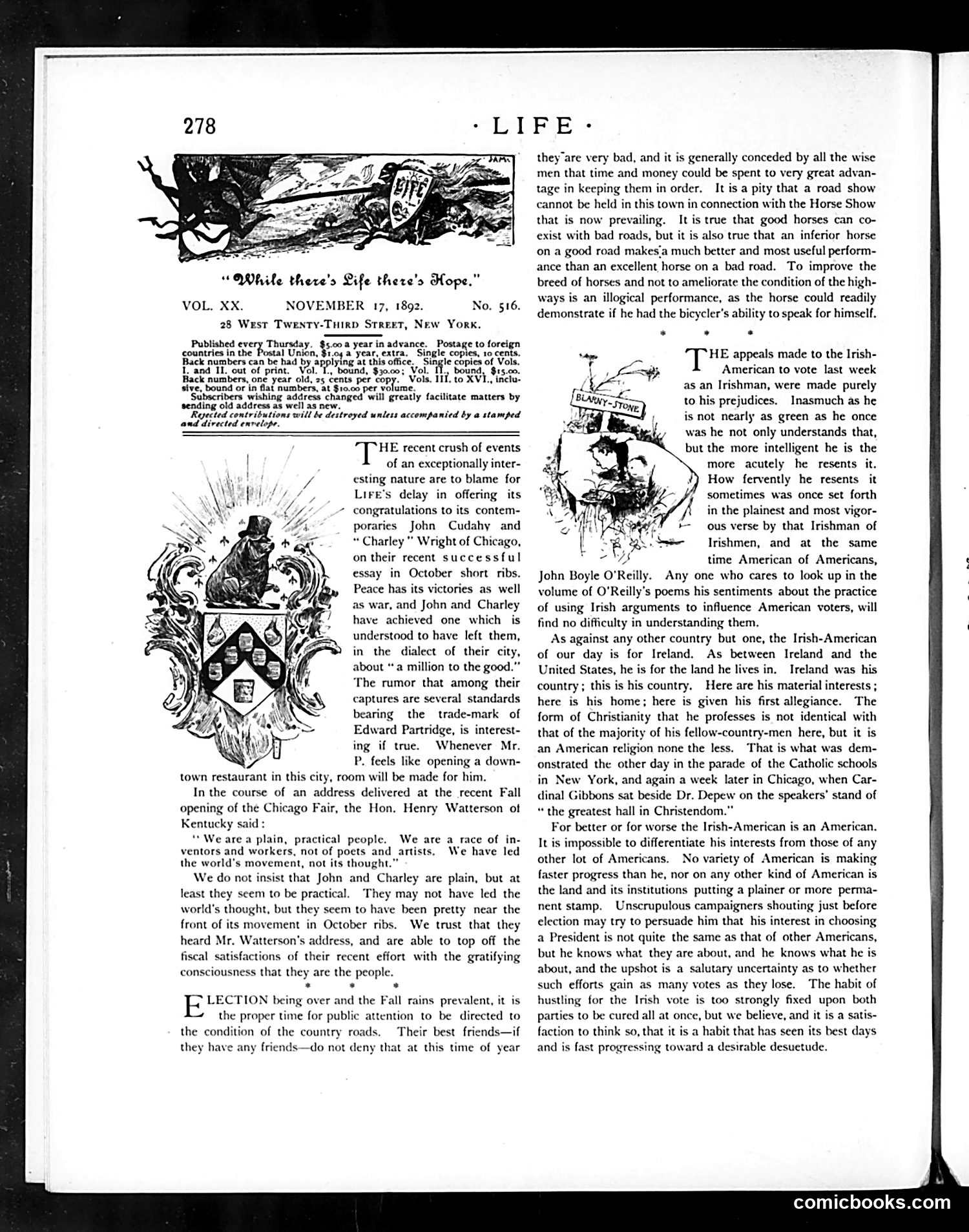
The page contains editorial content rather than political cartoons. The main decorative illustration shows an ornate coat of arms or heraldic design with a dog or similar figure, accompanying text about John Cudahy and "Charley" Wright of Chicago, who apparently achieved success in a recent essay contest in *Life*. The bulk of the page discusses Irish-American voting patterns and identity. The editorial addresses Irish-American voters' political allegiances, arguing they should vote as Americans rather than based on Irish prejudices. It references John Boyle O'Reilly (an Irish-American poet) and mentions tensions between Irish-American ethnic identity and American citizenship during the 1892 election period. The text critiques efforts to manipulate the Irish-American vote through ethnic appeals.
📄 Transcribed text from this page (OCR, searchable)
Machine-transcribed from the original scan — historical spelling and the odd misread are preserved.
LIFE “ODhile there's Life there’s Hope.” XX. NOVEMBER 17, 1892. No. 516. 28 West Twenty-THirp Street, New York. Published ever countries Ga the Pontal Unk Union, VOL. s.00 a year in advance. Postage to foreign a year, extra. Single copies, 10 cents. Back numbers can be had by by sppiying at As tla ofr, Single copies of Vols, and II. out of print. $15.00. Back numbers, one year aa 25 cents Ber copy.” V * Yes. If. to Pex. sell sive, bound or in flat numbers, at $10.00 per volu Subscribers. wishing address changed will greatly facilitate matters by sending old address as well as new. Reyected contributions will be destroyed unless accompanied by a stamped and directed envelope. HE recent crush of events of an exceptionally inter- esting nature are to blame for Lire’s delay in offering its congratulations to its contem- poraries John Cudahy and » Charley" Wright of Chicago, on their recent successful essay in October short ribs. Peace has its victories as well as war, and John and Charley have achieved one which is understood to have left them, in the dialect of their city, about “a million to the good. The rumor that among their captures are several standards bearing the trade-mark of Edward Partridge, is interest- ing if true. Whenever Mr. P. feels like opening a down- town restaurant in this city, room will be made for him. In the course of an address delivered at the recent Fall opening of the Chicago Fair, the Hon. Henry Watterson otf Kentucky said: “We are a plain, practical people. ventors and workers, not of poets and artists, the world’s movement, not its thought.” We do not insist that John and Charley are plain, but at least they seem to be practical. They may not have led the world’s thought, but they seem to have been pretty near the front of its movement in October ribs. We trust that they heard Mr. Watterson’s address, and are able to top off the ‘al satisfactions of their recent effort with the gratifying consciousness that they are the people. * . . We are a race of in- We have led LECTION being over and the Fall rains prevalent, it is the proper time for public attention to be directed to the condition of the country roads. Their best friends—if they have any friends—do not deny that at this time of year they“are very bad, and it is generally conceded by all the wise men that time and money could be spent to very great advan- tage in keeping them in order. It is a pity that a road show cannot be held in this town in connection with the Horse Show that is now prevailing. It is true that good horses can co- exist with bad roads, but it is also true that an inferior horse on a good road makes_a much better and most useful perform- ance than an excellent horse on a bad road. To improve the breed of horses and not to ameliorate the condition of the high- ways is an illogical performance, as the horse could readily demonstrate if he had the bicycler’s ability to speak for himself. HE appeals made to the Irish- American to vote last week as an Irishman, were made purely to his prejudices. Inasmuch as he is not nearly as green as he once was he not only understands that, but the more intelligent he is the more acutely he resents it. How fervently he resents it sometimes was once set forth in the plainest and most vigor- ous verse by that Irishman of Irishmen, and at the same time American of Americans, John Boyle O'Reilly. Any one who cares to look up in the volume of O'Reilly's poems his sentiments about the practice of using Irish arguments to influence American voters, will find no difficulty in understanding them, As against any other country but one, the Irish-American of our day is for Ireland. As between Ireland and the United States, he is for the land he lives in, Ireland was his country; this is his country. Here are his material interests ; here is his home; here is given his first allegiance. The form of Christianity that he professes is not identical with that of the majority of his fellow-country-men here, but it is an American religion none the less. That is what was dem- onstrated the other day in the parade of the Catholic schools in New York, and again a week later in Chicago, when Car- dinal Gibbons sat beside Dr. Depew on the speakers’ stand of “ the greatest hall in Christendom.” For better or for worse the Irish-American is an American. It is impossible to differentiate his interests from those of any other lot of Americans. No variety of American is making faster progress than he, nor on any other kind of American is the land and its institutions putting a plainer or more perma- nent stamp. Unscrupulous campaigners shouting just before election may try to persuade him that his interest in choosing a President is not quite the same as that of other Americans, but he knows what they are about, and he knows what he is about, and the upshot is a salutary uncertainty as to whether such efforts gain as many votes as they lose. The habit of hustling for the Irish vote is too strongly fixed upon both parties to be cured all at once, but we believe, and it is a satis- faction to think so, that it is a habit that has seen its best days and is fast progressing toward a desirable desuetude. comicbooks.com