
Life, 1892-11-17 · page 8 of 19
Life — November 17, 1892 — page 8: what you’re looking at
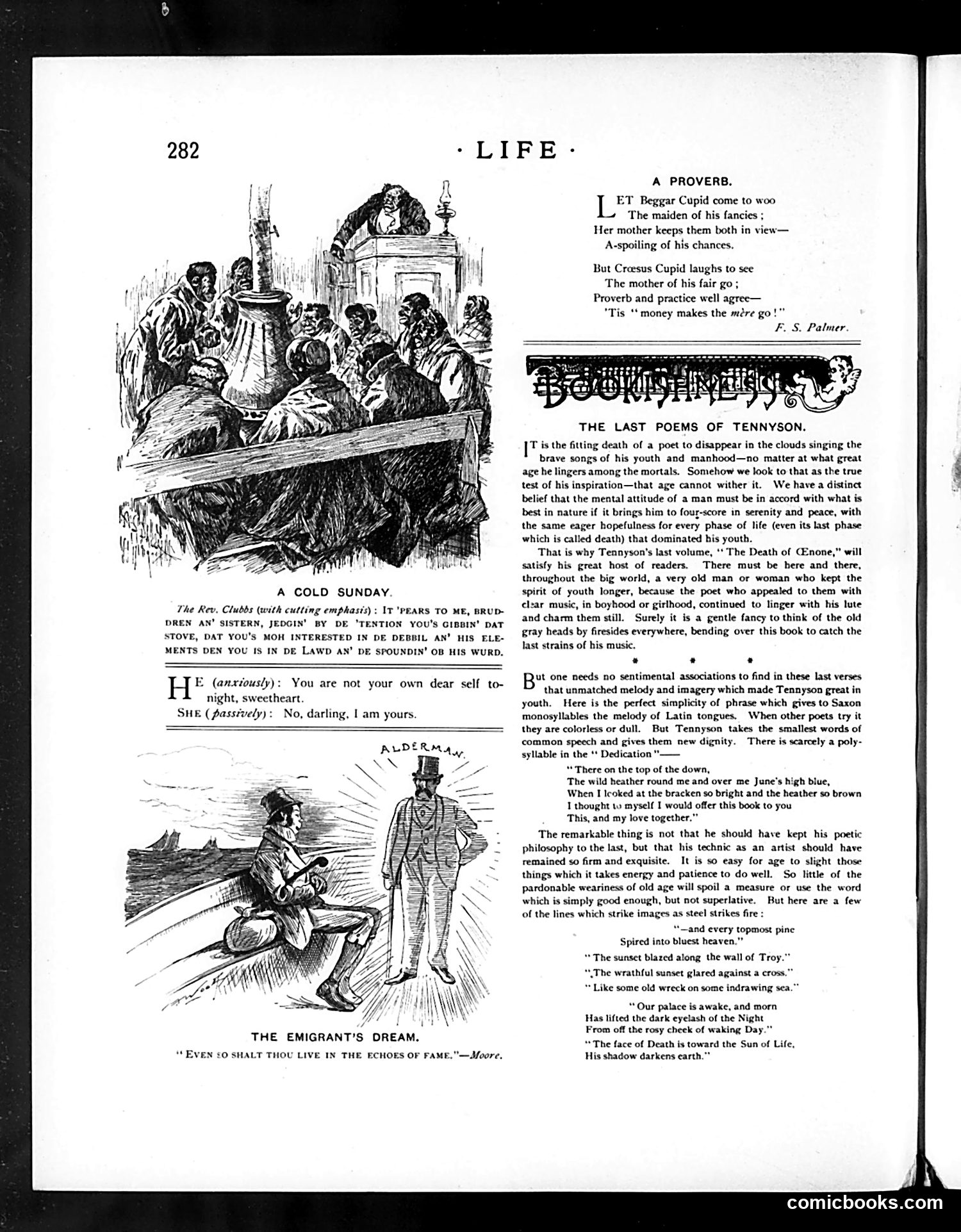
What you’re looking at
This page contains three separate pieces: 1. **"A Cold Sunday"** - A sketch showing a clergyman delivering a sermon to drowsy parishioners. The dialogue satirizes the disconnect between stern religious instruction and the congregation's actual engagement—the preacher's lengthy warnings about sin contrast with people dozing off. 2. **"The Emigrant's Dream"** - An illustration showing a figure daydreaming of wealth and status (represented by the well-dressed gentleman in top hat), captioned with Moore's quote about living in "echoes of fame." This satirizes immigrants' idealized expectations versus reality. 3. **"The Last Poems of Tennyson"** - A literary essay discussing Tennyson's final works, analyzing his poetic philosophy and aging. This is substantive criticism rather than satire. The page reflects Victorian-era concerns about class, faith, immigration, and literary merit.
📄 Transcribed text from this page (OCR, searchable)
Machine-transcribed from the original scan — historical spelling and the odd misread are preserved.
A PROVERB. L T Beggar Cupid come to woo ‘The maiden of his fancies Her mother keeps them both in view— A-spoiling of his chances. But Croesus Cupid laughs to see ‘The mother of his fair go ; Proverb and practice well agree— “money makes the mére go!” F. S. Palmer. THE LAST POEMS OF TENNYSON. [7 isthe fitting death of a poet to disappear in the clouds singing the brave songs of his youth and manhood—no matter at what great age he lingers among the mortals. Somehow we look to that as the true test of his inspiration—that age cannot wither it. We have a distinct belief that the mental attitude of a man must be in accord with what is best in nature if it brings him to four-score in serenity and peace, with the same eager hopefulness for every phase of life (even its last phase which is called death) that dominated his youth. That is why Tennyson's last volume, ** The Death of CEnone,” will satisfy his great host of readers. There must be here and there, throughout the big world, a very old man or woman who kept the A COLD SUNDAY. spirit of youth longer, because the poet who appealed to them with clear music, in boyhood or girlhood, continued to linger with his lute and charm them still. Surely it is a gentle fancy to think of the old gray heads by firesides everywhere, bending over this book to catch the last strains of his music. . * * The Rev. Clubs (with cutting emphasis): \T ‘PEARS TO ME, BRUD- DREN AN’ SISTERN, JEDGIN’ BY DE ‘TENTION YOU'S GIBBIN’ DAT STOVE, DAT YOU'S MOH INTERESTED IN DE DEBBIL AN’ HIS ELE- MENTS DEN YOU IS IN DE LAWD AN’ DE SPOUNDIN' OB HIS WURD. = (anxiously): You are not your own dear self to- ut one needs no sentimental associations to find in these last verses H . 3 . : that unmatched melody and imagery which made Tennyson great in night, sweetheart. youth. Here is the perfect simplicity of phrase which gives to Saxon SHE (passively): No, darling, | am yours. monosyllables the melody of Latin tongues. When other poets try it they are colorless or dull. But Tennyson takes the smallest words of common speech and gives them new dignity. There is scarcely a poly- syllable in the ** Dedication "—— “ There on the top of the down, The wild heather round me and over me June's high blue, When I Icoked at the bracken so bright and the heather so brown I thought tu myself I would offer this book to you This, and my love together.” ‘The remarkable thing is not that he should have kept his poetic philosophy to the last, but that his technic as an artist should have remained so firm and exquisite. It is so easy for age to slight those things which it takes energy and patience to do well. So little of the pardonable weariness of old age will spoil a measure or use the word which is simply good enough, but not superlative. But here are a few of the lines which strike images as steel strikes fire : “—and every topmost pine Spired into bluest heaven.” © The sunset blazed along the wall of Troy.”” “The wrathful sunset glared against a cross.” * Like some old wreck on some indrawing sea.” * Our palace is awake, and morn Has lifted the dark eyelash of the Night ned . 2 From off the rosy cheek of waking Day.”* THE! EMIGRANTS (OREAM: “The face of Death is toward the Sun of Life, ‘EVEN £0 SHALT THOU LIVE IN THE ECHOES OF FAME,"—Joore, His shadow darkens earth.”* comicbooks.com