
A complete issue · 16 pages · 1892
Life — October 20, 1892
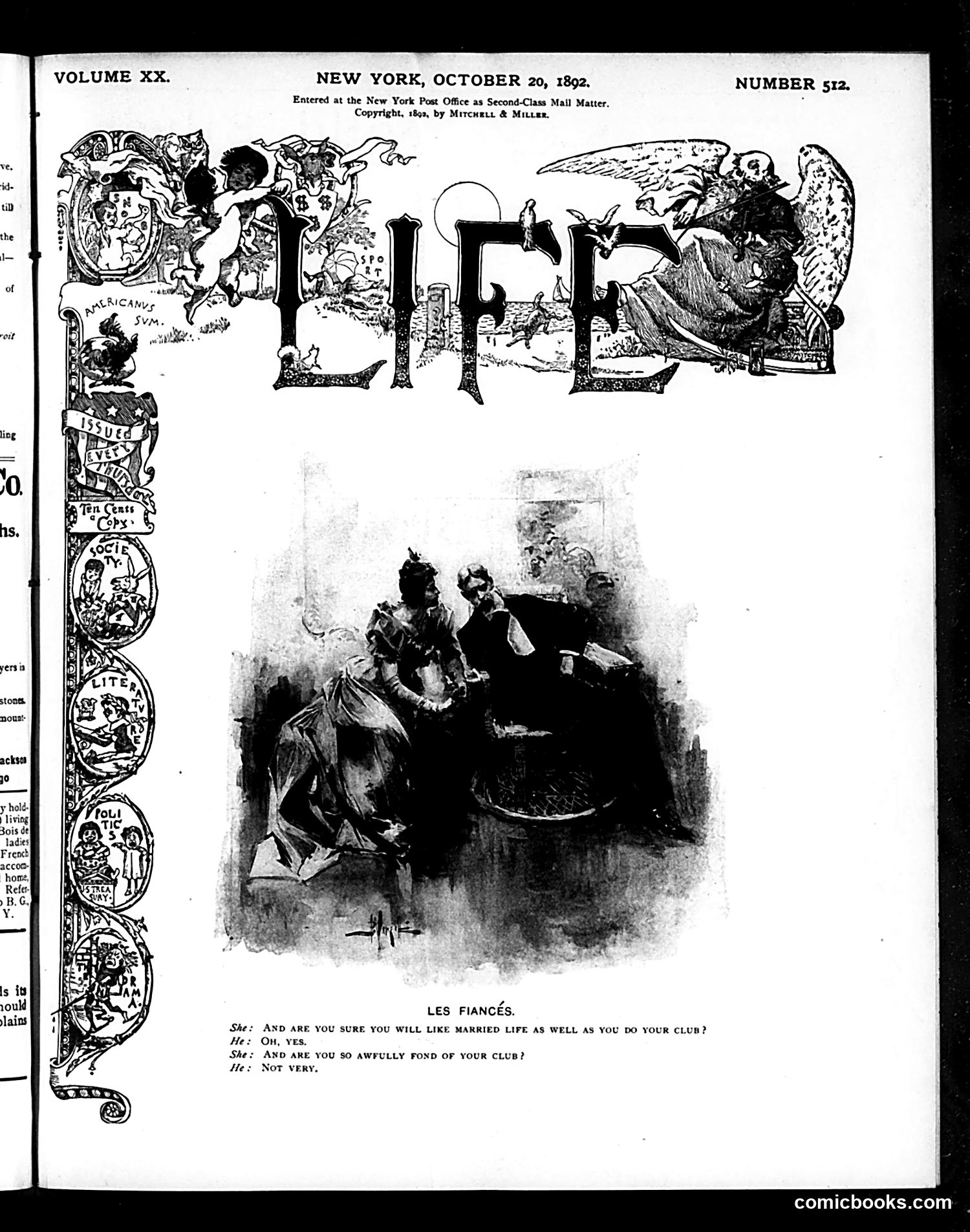
This page features a cartoon titled "Les Fiancés" (The Engaged Couple) depicting two figures in conversation. The dialogue suggests social satire about marriage and club life: **The Joke:** A woman asks her fiancé if he'll enjoy married life as much as his club. He answers "Oh, yes," but when she presses whether he's "awfully fond" of his club, he admits "Not very"—implying he values club membership more than marriage itself, or is being dishonest about his priorities. This satirizes 1890s gender relations and male social culture, where gentlemen's clubs were central to upper-class male identity. The cartoon mocks both the fiancé's transparent lie and broader anxieties about marriage competing with male social obligations. The ornate left border contains period advertising vignettes typical of Life's design.
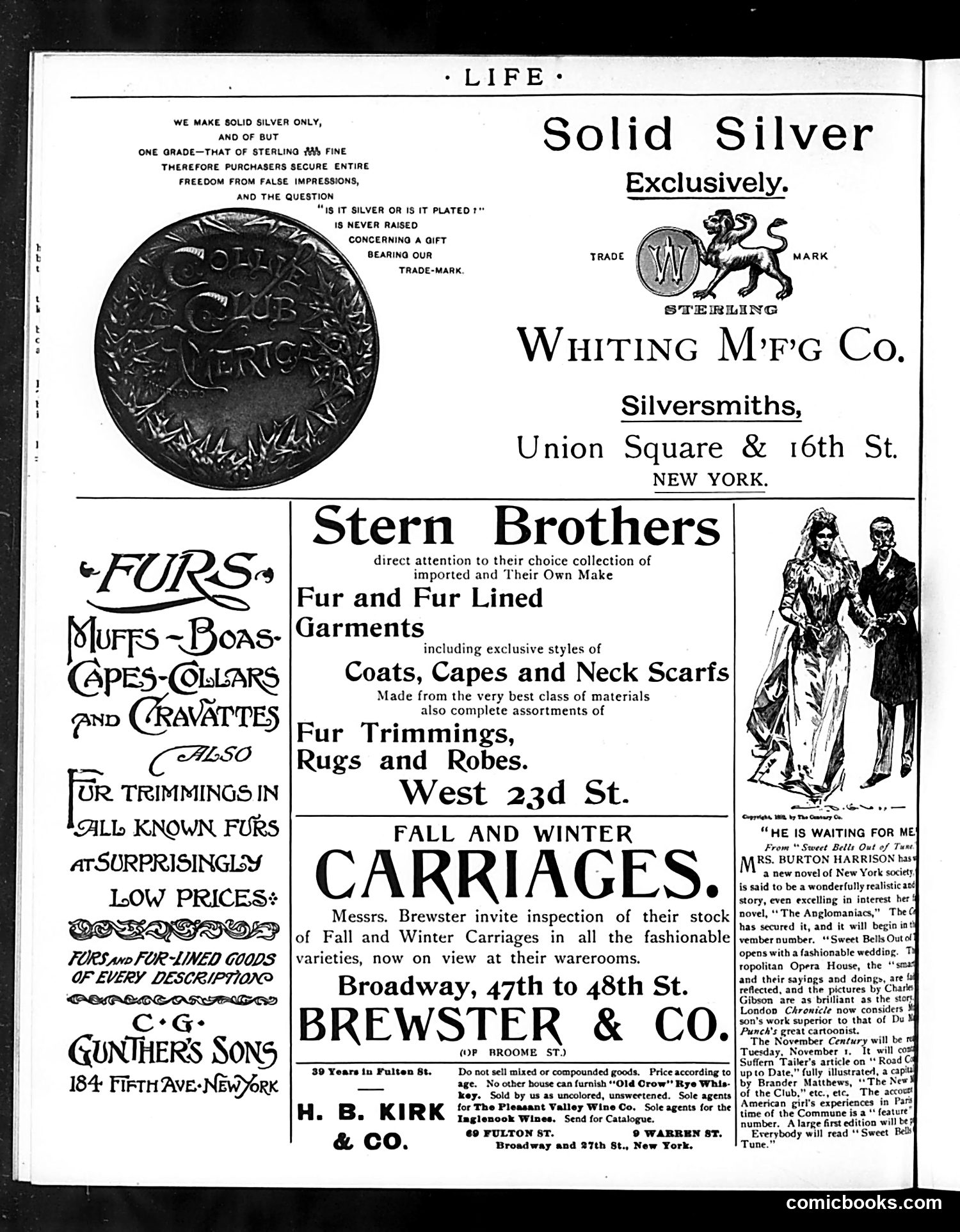
This is primarily an **advertising page** from Life magazine, not a satirical cartoon. The page contains five commercial advertisements: 1. **Whiting M'FG Co.** - Sterling silver flatware and hollowware manufacturer, emphasizing "solid silver" quality to counter consumer concerns about plated goods 2. **Stern Brothers** - Fur garments and trimmings retailer 3. **C.G. Gunthers Sons** - Fur goods merchant 4. **Brewster & Co.** - Carriage manufacturer for the wealthy 5. **H.B. Kirk & Co.** - Wine merchant There's also a small **book advertisement** for "He is Waiting for Me," described as a novel about New York society. The page reflects late 19th/early 20th-century consumer goods marketing. No political satire or significant cartoon content is present—it's standard commercial advertising typical of period magazines.
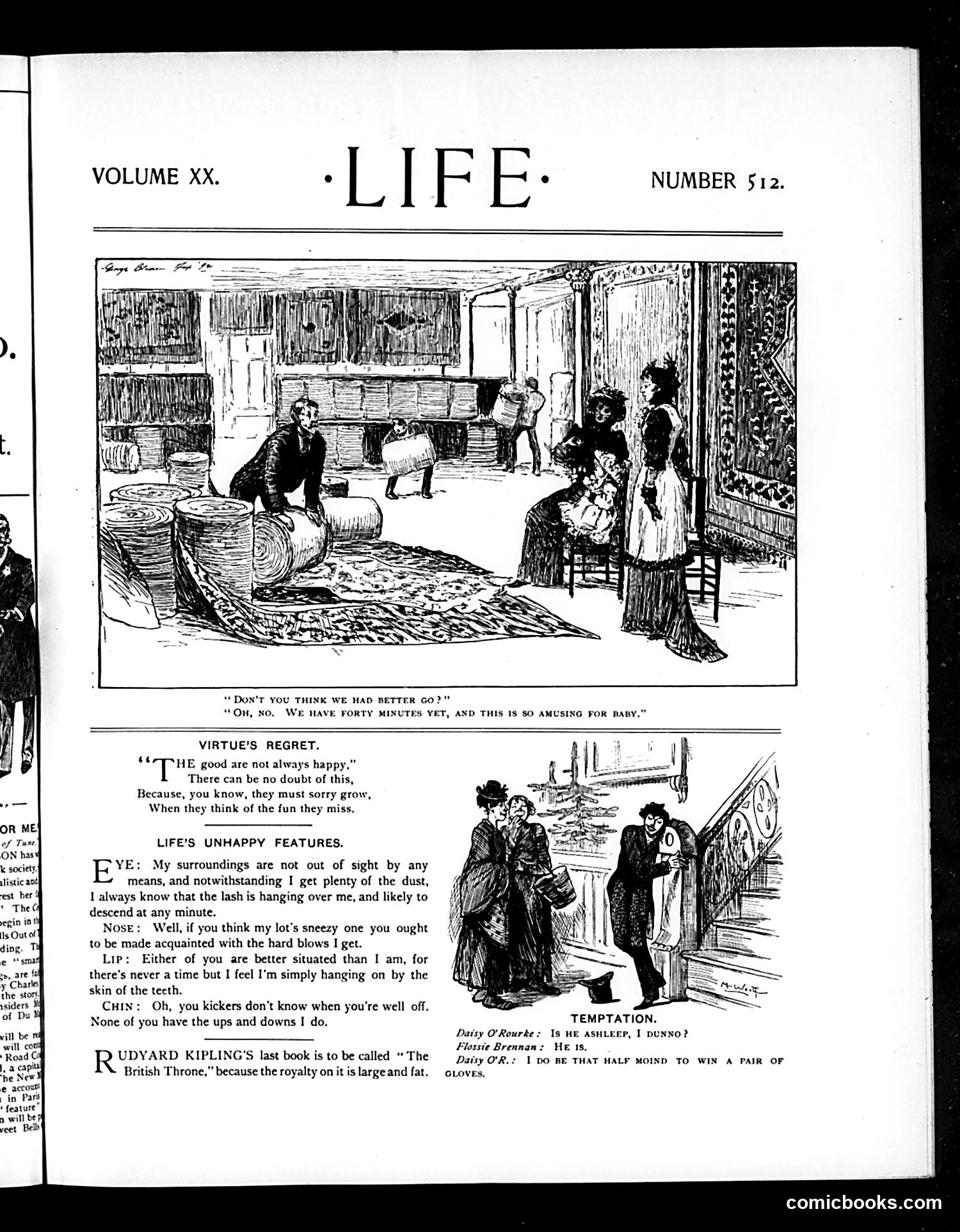
This page contains three satirical pieces typical of early 20th-century humor magazines: **Top cartoon**: Depicts a domestic scene where a woman complains about how long a social visit has lasted—"Don't you think we had better go?" Her host responds they've only been there forty minutes, which he finds amusing for the baby's entertainment. **"Virtue's Regret"**: A dialogue between Eye, Nose, Lip, and Chin—personified facial features—debating the discomforts of their position on a face. **"Life's Unhappy Features"**: Similar personification humor about facial features complaining about their lot. **"Temptation"**: A brief sketch about someone tempted by gloves. **Bottom note**: References Rudyard Kipling's new book "The British Throne," joking that "the royalty on it is large and fat." The humor relies on personification and social observation rather than political commentary.
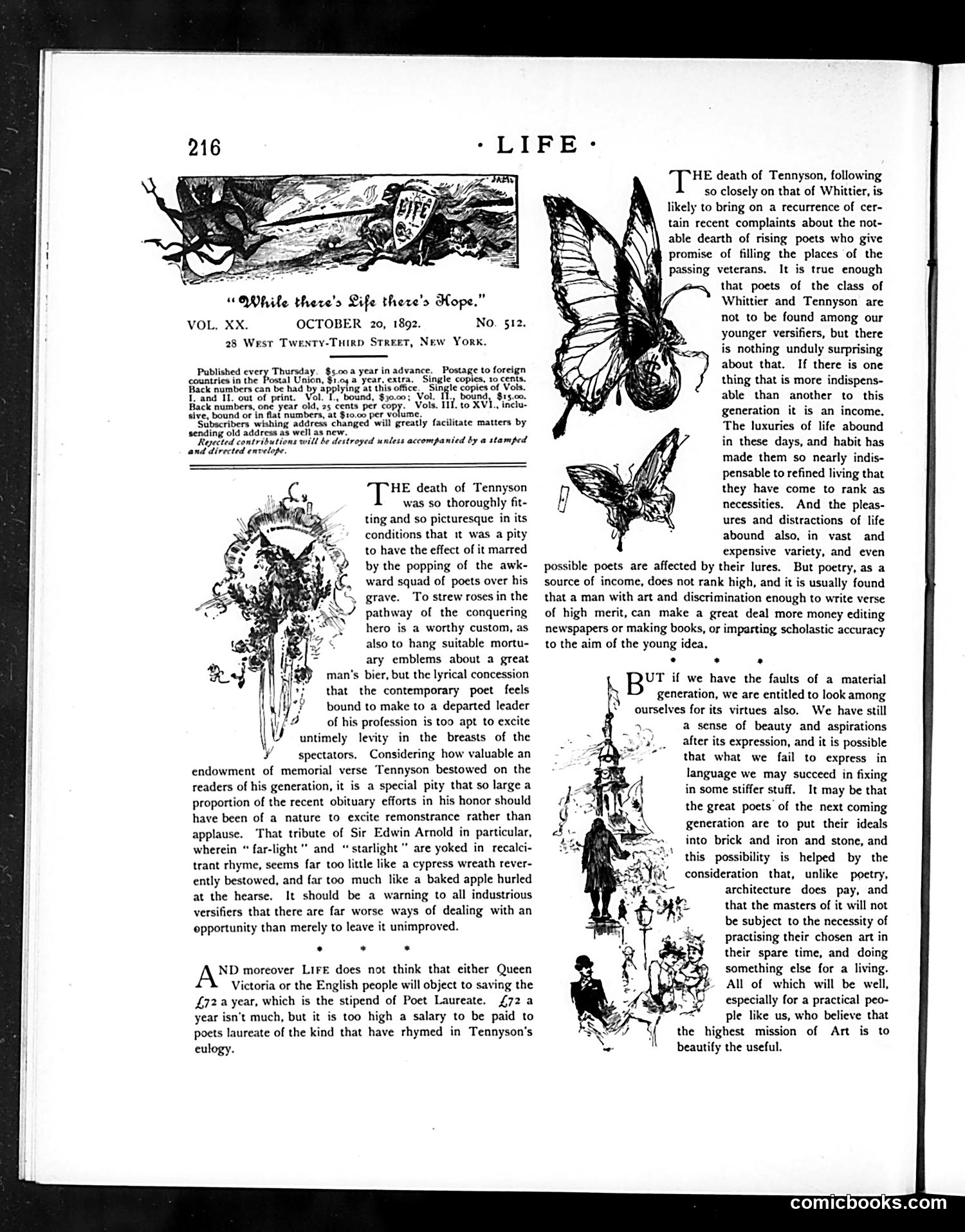
This page is primarily **editorial commentary**, not a political cartoon. It discusses the recent death of poet Alfred, Lord Tennyson and debates whether poets merit financial support as Poet Laureate. The decorative illustrations (butterflies, ornamental designs) are **period artwork**, not satirical caricatures. They're typical Victorian magazine embellishment. The text argues that while Tennyson's death is regrettable, poets like Whittier shouldn't expect high salaries. The writer suggests younger poets should pursue more lucrative careers—architecture, editing, or journalism—rather than rely on poetry's meager income. The editorial concludes that beauty and art should enhance utility, not replace practical living. This reflects **1890s anxieties about artistic viability** in an increasingly commercial age.
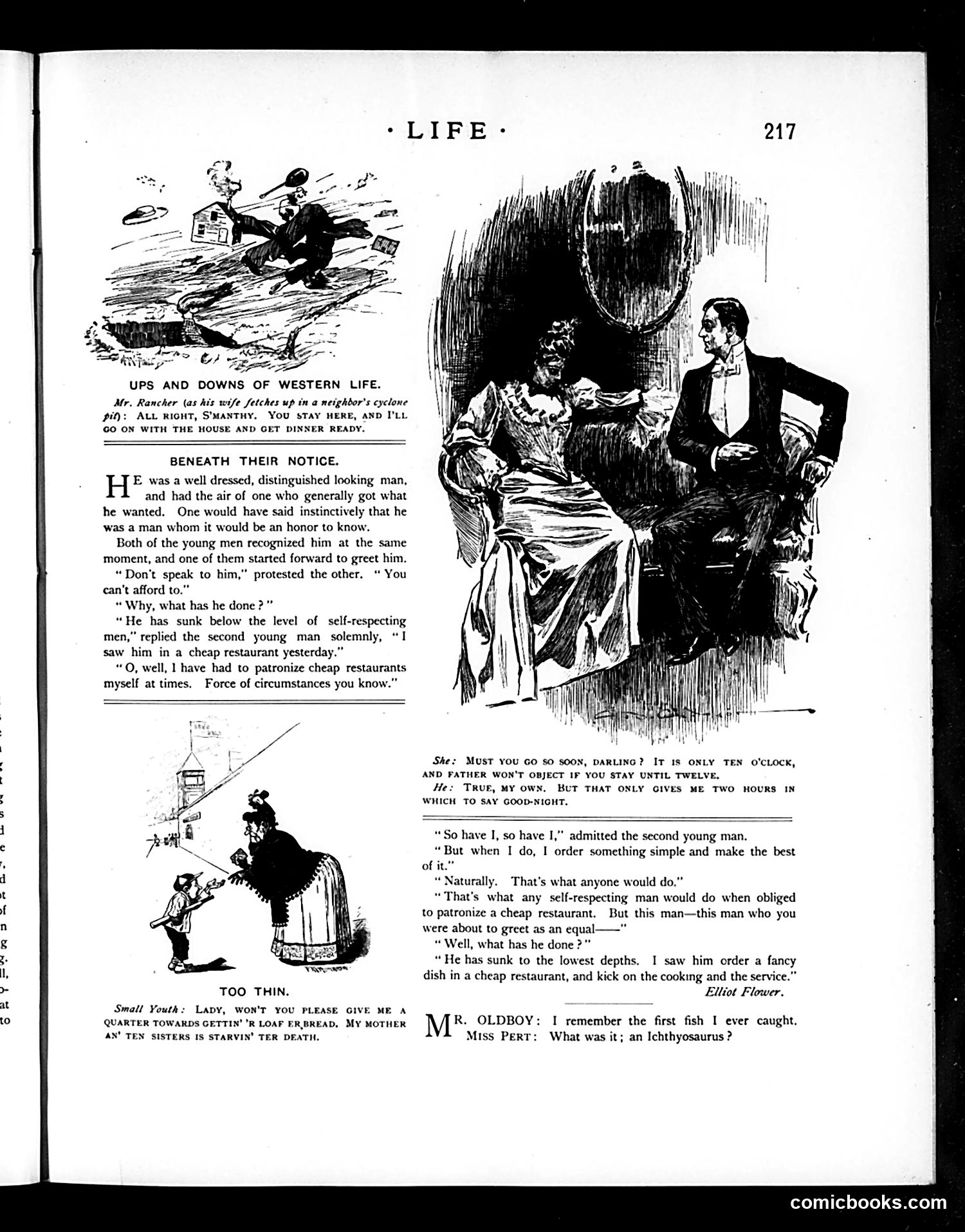
This page contains three satirical pieces about social class and respectability: 1. **"Ups and Downs of Western Life"**: A cartoon mocking a rancher who abandons his wife to chase a cyclone, prioritizing adventure over domestic responsibility. 2. **"Beneath Their Notice"**: A dialogue between two young men discussing a well-dressed man they've encountered. One reveals he saw this man eating at a cheap restaurant and kicking the cook—behavior they view as disreputable. The satire targets men who maintain appearances of wealth and respectability while treating working-class people poorly. It's social commentary on hypocrisy and class consciousness. 3. **"Too Thin"**: A brief sketch of a poor woman begging for bread, adding to the page's theme of economic hardship and social inequality. The page satirizes both Western excess and urban class pretension.
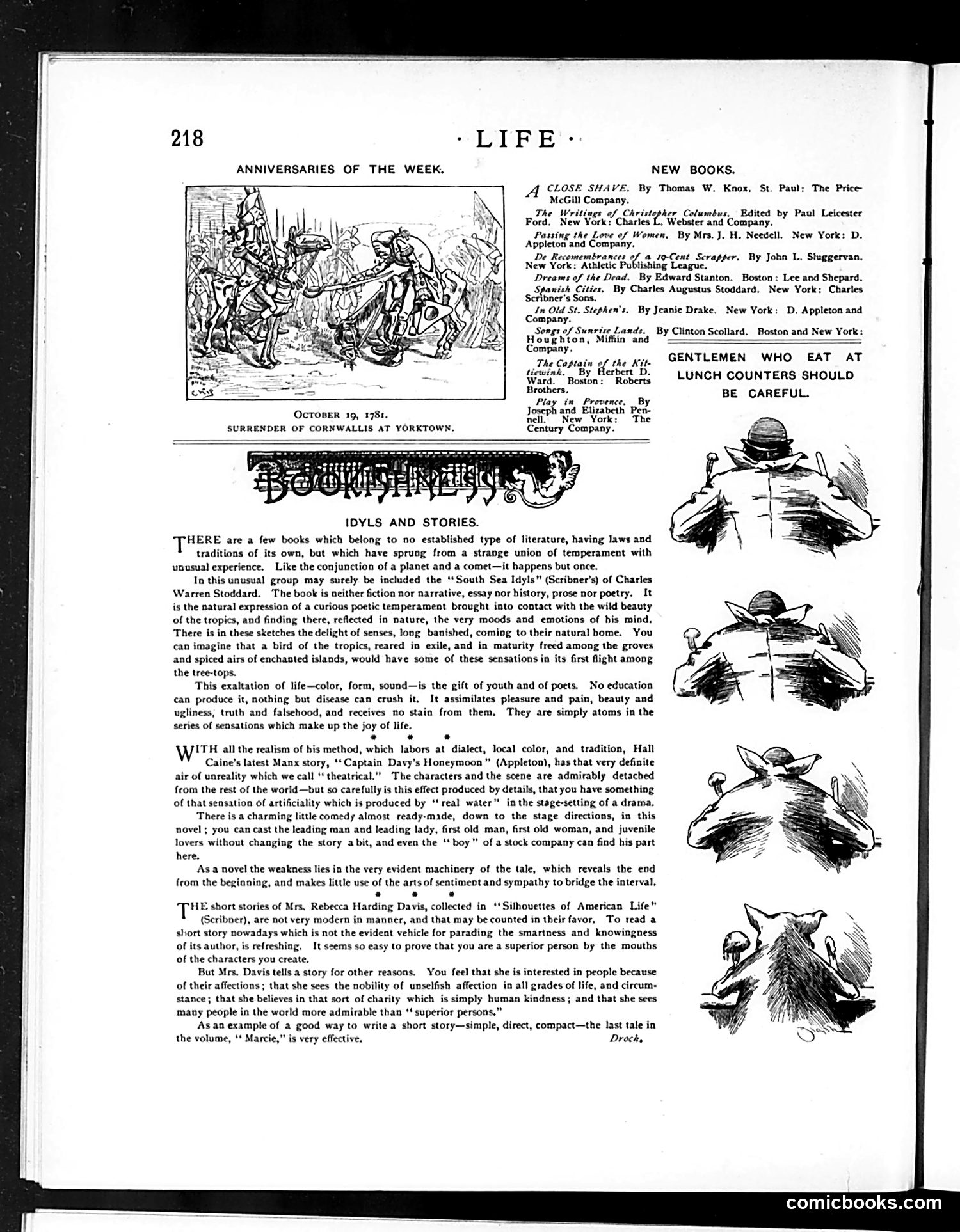
**Top Image:** Shows the "Surrender of Cornwallis at Yorktown" (October 19, 1781)—a historical engraving commemorating a key American Revolutionary War victory. This appears to be an anniversary reference. **Main Content:** "Idyls and Stories" is a book review section discussing literary works, including Charles Warren Stoddard's "South Sea Idyls," Hall Caine's "Captain Day's Honeymoon," and Rebecca Harding Davis's short stories. The text praises these works' artistic merit and emotional authenticity. **Right Side:** A humorous illustration titled "Gentlemen Who Eat at Lunch Counters Should Be Careful" shows men eating messily, with food splashing everywhere. This is workplace/manners satire, likely mocking uncouth dining behavior in public establishments.
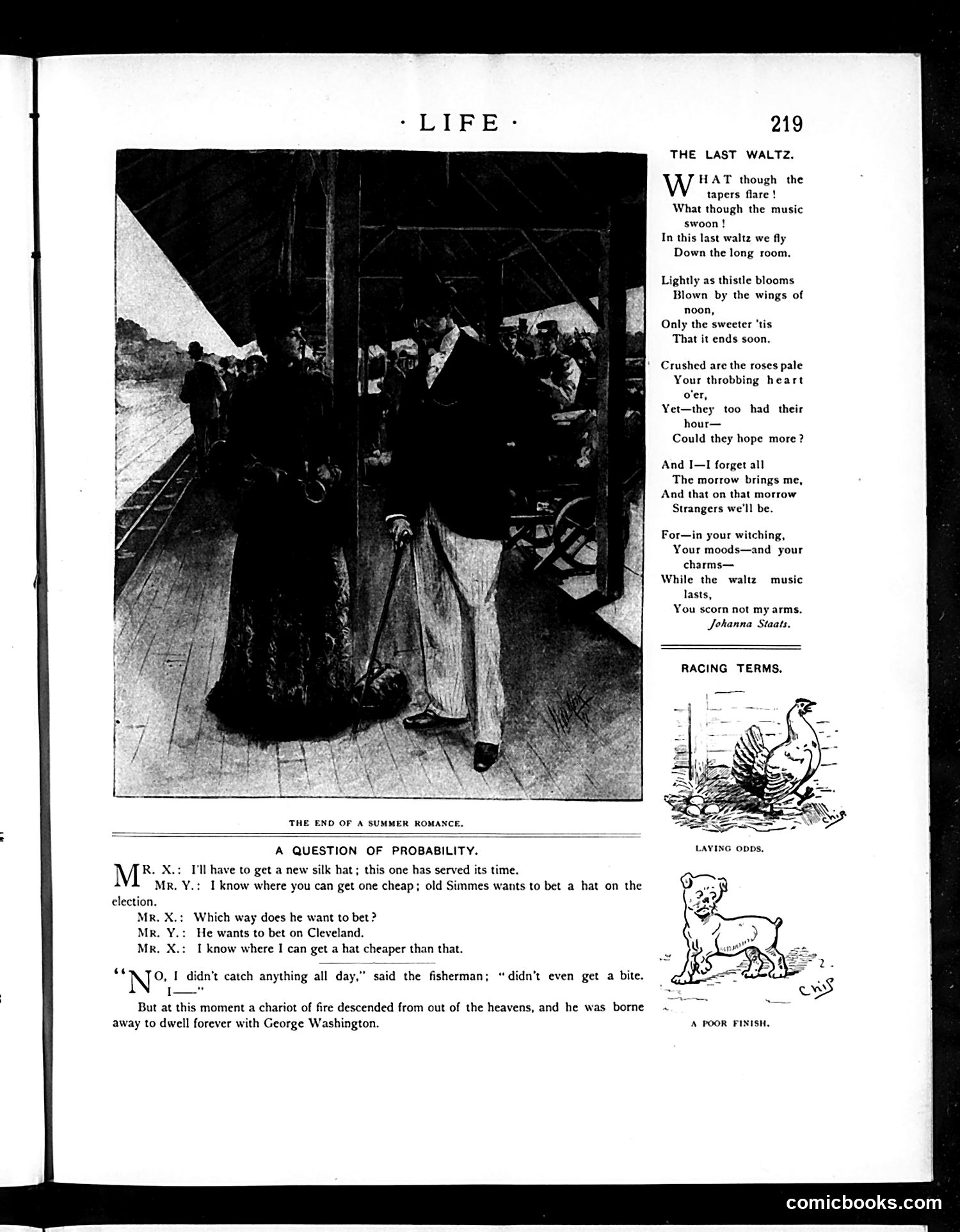
**Main Content:** The page features "The Last Waltz," a romantic poem by Johanna Staats accompanying a photograph of couples dancing. Below is a humorous dialogue titled "A Question of Probability" involving three men (Mr. X, Mr. Y, and Mr. X again) discussing where to obtain cheap hats and betting on a political election concerning Cleveland. The joke concludes absurdly: a fisherman who caught nothing is suddenly transported away "with George Washington" via a "chariot of fire from out of the heavens"—an inexplicable, surreal punchline typical of Life's absurdist humor. **Small Illustrations:** Three captioned drawings appear on the right: "Racing Terms" (a duck), "Laying Odds" (unclear figure), and "A Poor Finish" (a dog). The satire's precise political reference remains unclear without additional context.
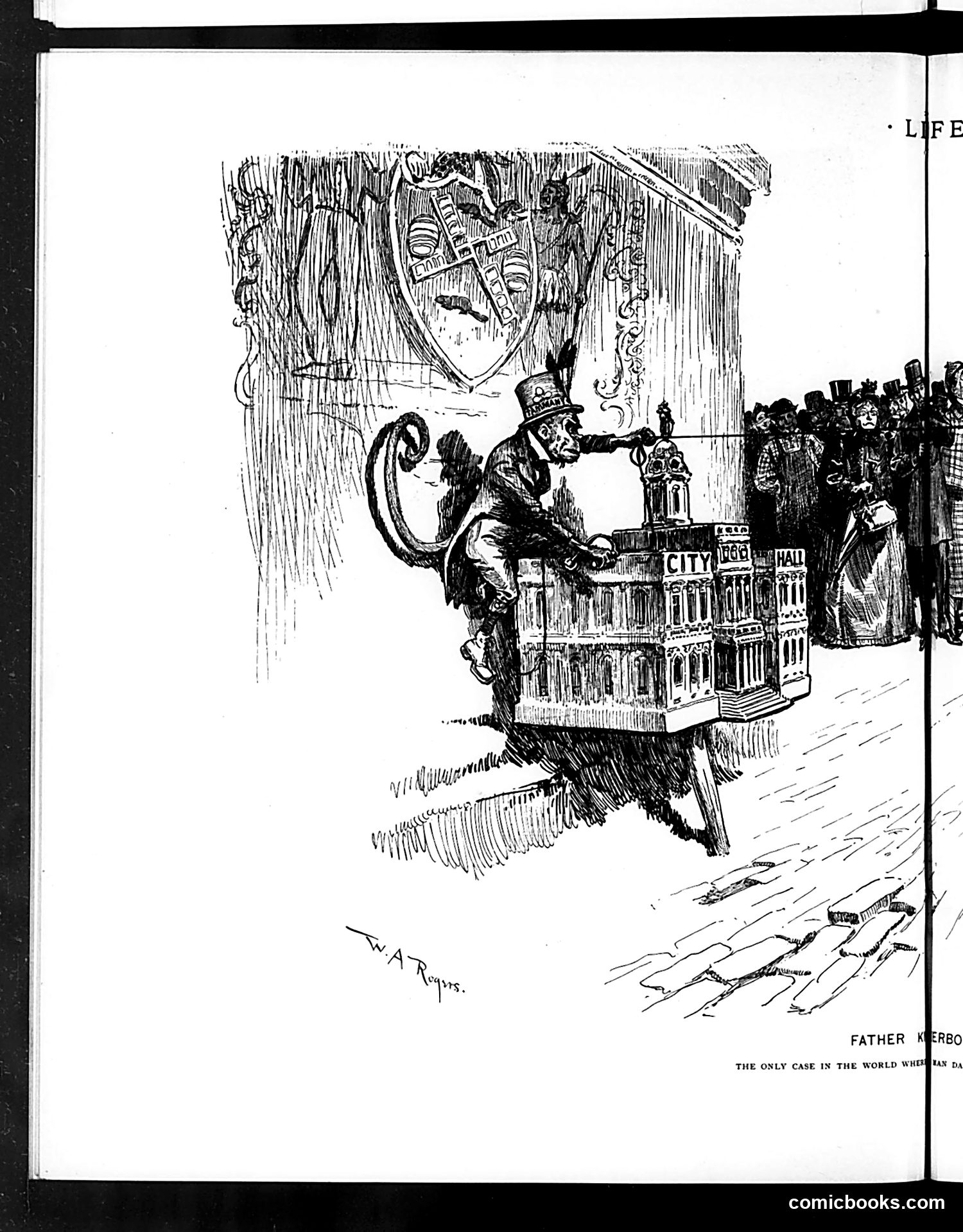
This political cartoon appears to depict **Father Kerbo** (visible in the caption), shown as a rotund, caricatured figure manipulating a city building like a puppet or toy, while a crowd of citizens watches from the right. The figure wears a top hat and appears to control the structure with strings or levers. The satire likely critiques clerical influence over municipal government and urban affairs. The caption mentions "THE ONLY CASE IN THE WORLD WHERE" (text cuts off), suggesting this is commentary on an unusual or problematic situation involving religious authority's control over city matters. The artist is credited as W.A. Rogers (signed lower left). Without the complete caption, the specific incident referenced remains unclear, but the central message concerns inappropriate ecclesiastical power over civic institutions.
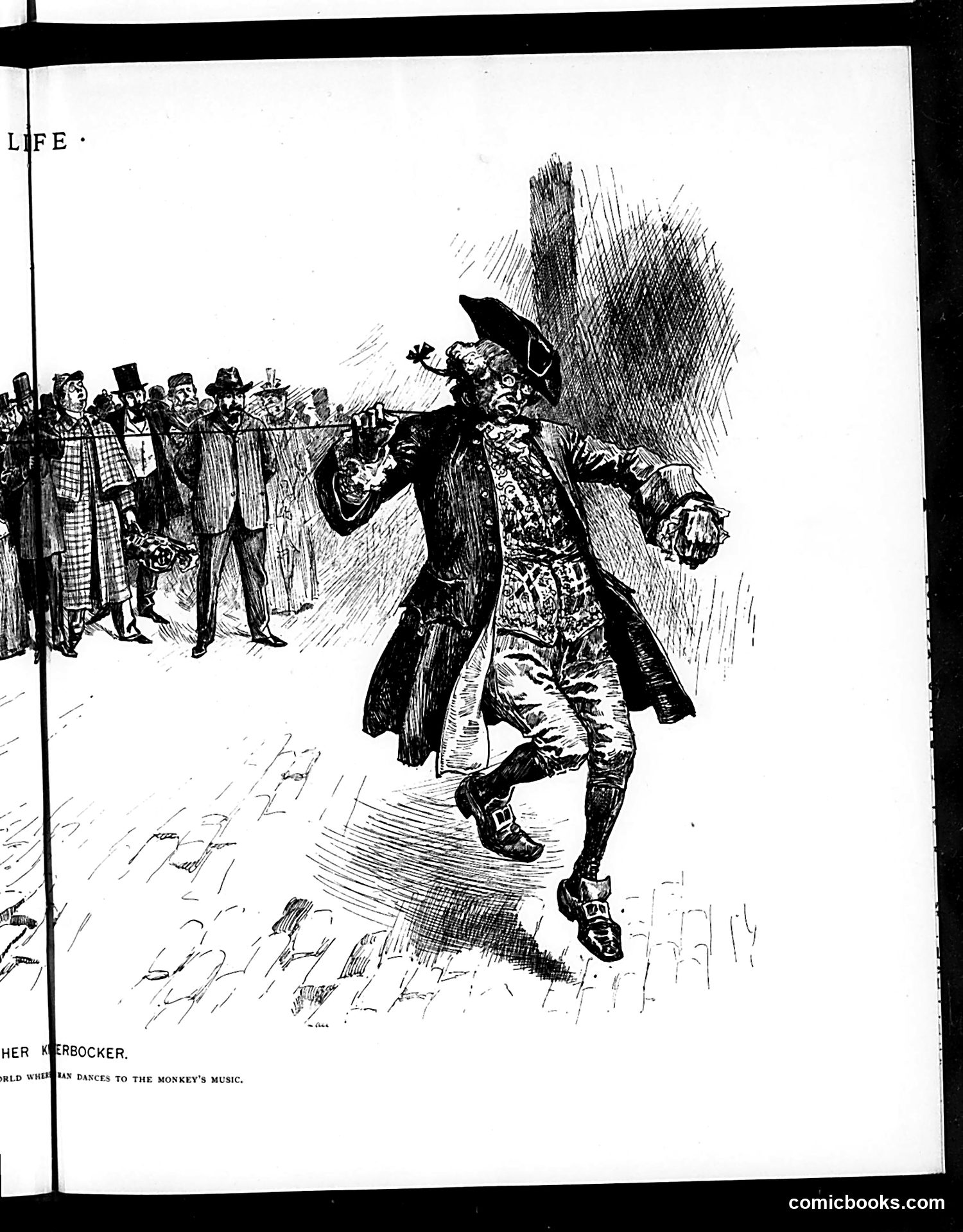
This political cartoon depicts a flamboyantly dressed figure dancing while onlookers watch. The caption reads "Her Kerbocker" with additional text stating he "dances to the monkey's music." The satire appears to target someone associated with the name "Knickerbocker" (or similar), portraying them as a ridiculous, attention-seeking performer who obeys others' commands like a trained animal responding to music. The formal-dressed observers in the background suggest this is commentary on a public or political figure acting foolishly before respectable society. Without additional context, the specific political target remains unclear, but the cartoon's core mockery is clear: ridiculing the subject as an undignified puppet controlled by external forces, presenting his behavior as absurdly performative rather than substantive.
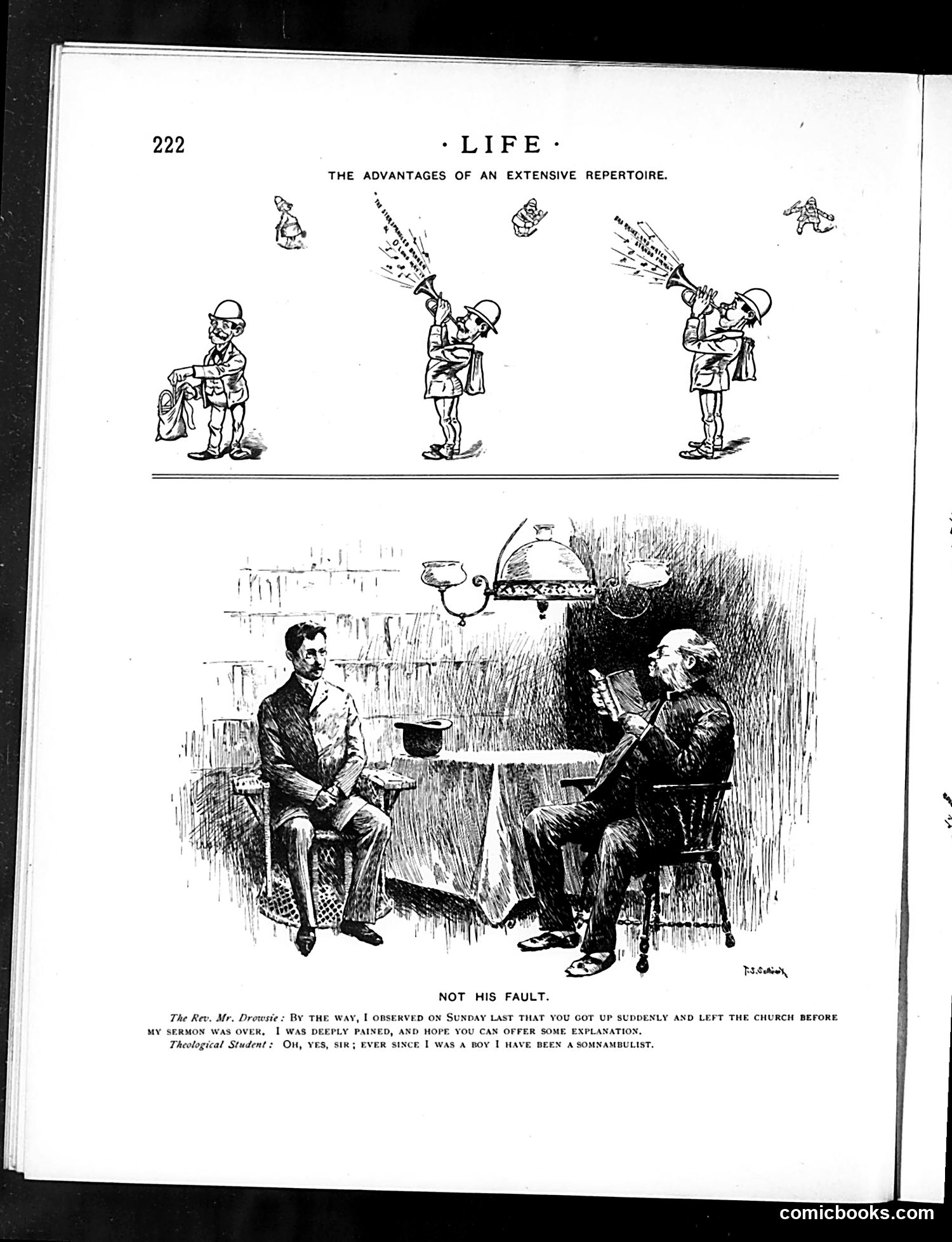
This page contains two distinct satirical pieces: **Top section ("The Advantages of an Extensive Repertoire"):** Three sequential panels show a soldier demonstrating different theatrical poses or gestures with weapons/props, suggesting he can perform multiple "acts" or deceptions—likely satirizing military recruiting or soldiers who exaggerate capabilities. **Bottom cartoon ("Not His Fault"):** A reverend confronts a theological student about leaving church abruptly during the sermon. The student's response—that he's "been a somnambulist" (sleepwalker) since childhood—is the joke's punchline. This satirizes either the student's excuse-making or, possibly, the quality of the sermon itself by implying the student literally fell asleep and walked out unconsciously. The humor relies on the absurdity of blaming sleepwalking for disruptive behavior.
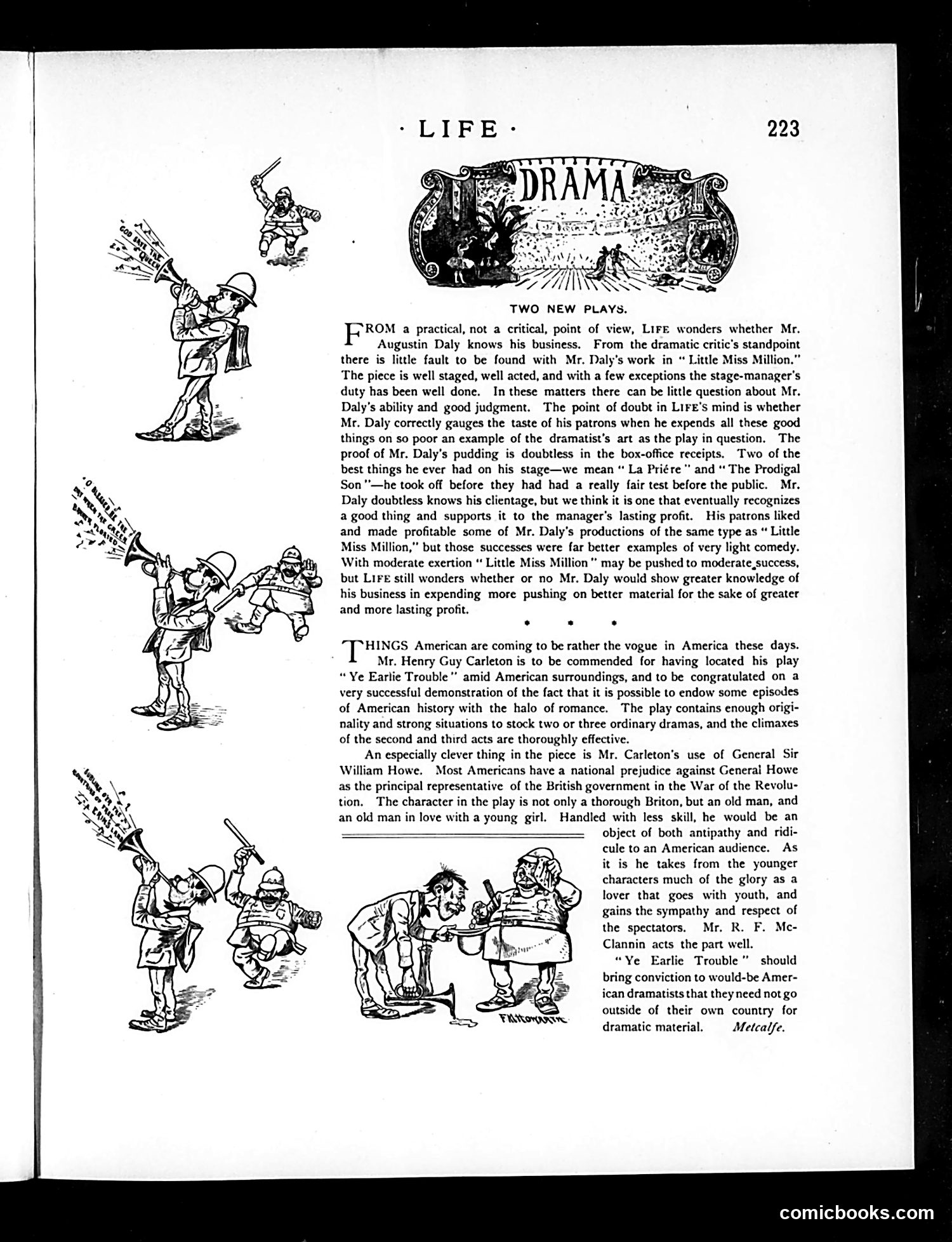
This page reviews two new theatrical productions for a general audience. The left side features cartoonish illustrations of what appear to be theatrical performers or stagehands in comedic poses—likely satirizing backstage chaos or dramatic conventions of the era. The text discusses Augustin Daly's theatrical work, praising his practical business sense and staging ability, though noting he may pursue more profitable "light comedy" over ambitious drama. The second review examines Henry Guy Carleton's "Ye Earlie Trouble," set during the American Revolution. The critic appreciates Carleton's use of General Sir William Howe as a character and the play's romantic elements, praising actor R. F. McClannin's performance. The reviewer suggests American dramatists should develop their own material rather than relying on European subjects.
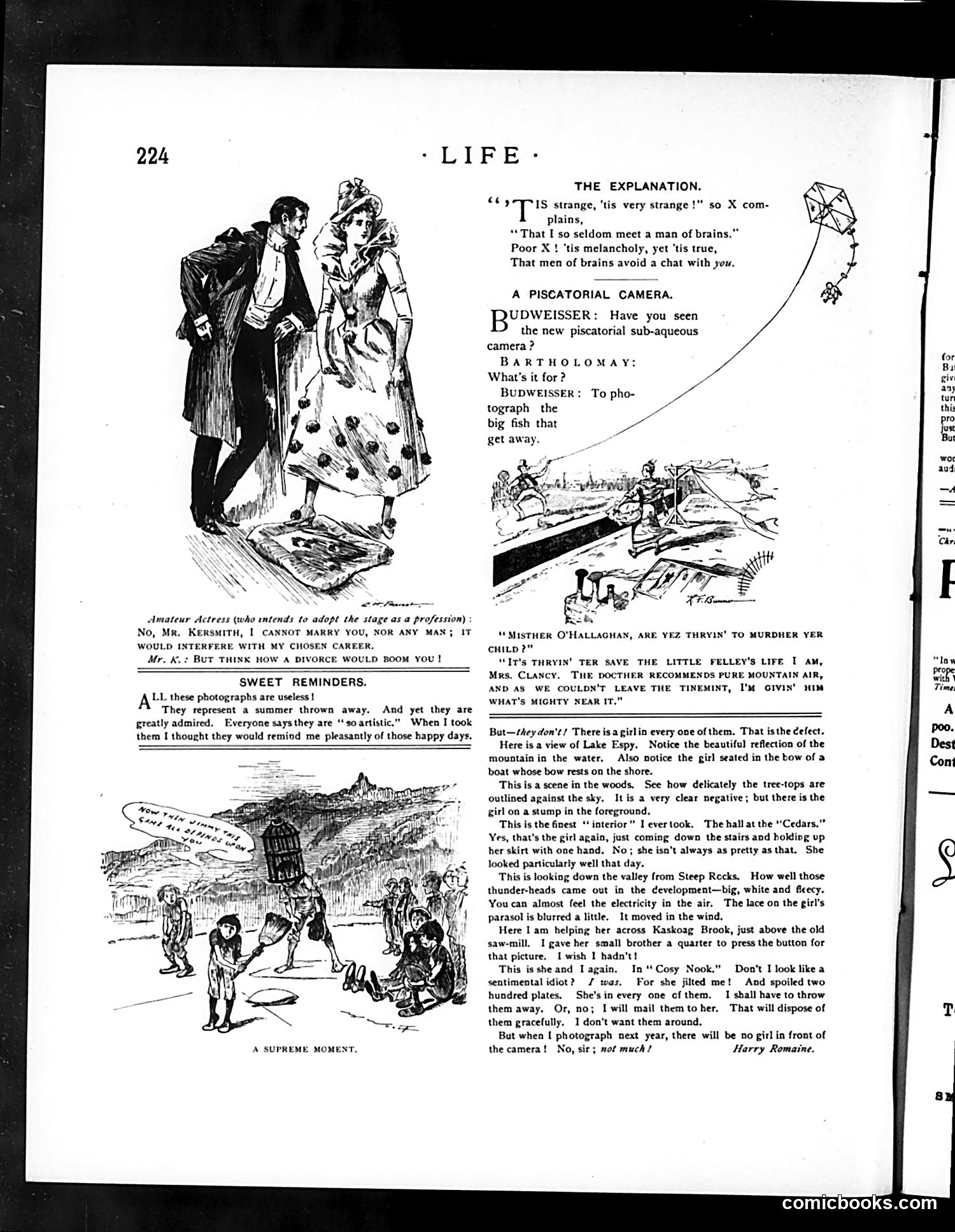
This page contains several satirical vignettes typical of early 20th-century American humor: **Top cartoon**: An aspiring actress rejects a suitor's marriage proposal, claiming it would interfere with her stage career. The man suggests divorce would actually *boost* her fame—satirizing both theatrical self-promotion and the scandal value of divorce in that era. **"The Explanation"**: A man complains he rarely meets intelligent women, yet the caption reveals intelligent men avoid *him*—ironic social commentary on male ego. **"A Piscatorial Camera"**: Two men discuss a underwater camera designed to photograph "big fish that get away"—mocking the fisherman's tall tale of "the one that got away." **"Sweet Reminders"**: A photographer laments his vacation photos are ruined because every single one inexplicably contains his girlfriend. The lengthy text reveals he obsessively photographed her repeatedly, then she jilted him, leaving hundreds of spoiled plates—self-deprecating humor about romantic rejection and artistic failure. The humor relies on everyday situations and mild social observations rather than political content.
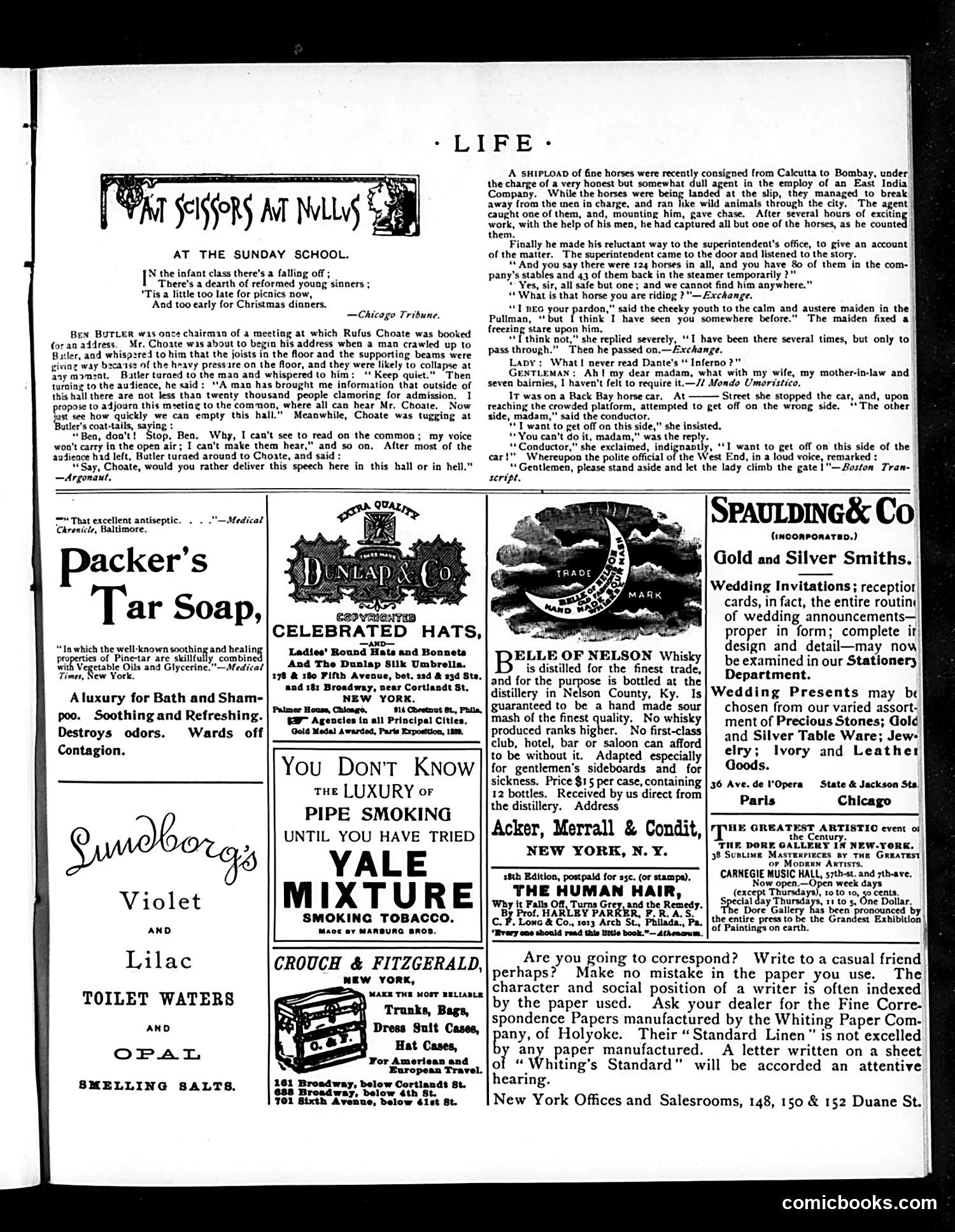
This page from Life magazine contains primarily **humorous anecdotes and advertisements** rather than political cartoons. The humor reflects late 19th-century American society: **Main Comic Stories:** - A Sunday school observation about seasonal attendance patterns - An anecdote about Ben Butler and Rufus Choate (prominent 19th-century political/legal figures), where Butler cleverly evacuates a crowded hall by claiming 20,000 people want admission outside - A story about an East Indian agent who captures all horses except the one he's riding—missing obvious logic - Various brief jokes about social awkwardness, including a woman on a Boston streetcar insisting on exiting the "wrong side" **Context:** These are gentle satirical observations of human folly, social pretension, and bureaucratic absurdity—typical of Life's humor style. The anecdotes mock absent-mindedness, poor reasoning, and Victorian social conventions. The remainder consists of period advertisements for tar soap, hats, whiskey, smoking tobacco, and stationery—standard commercial content with no satirical intent.
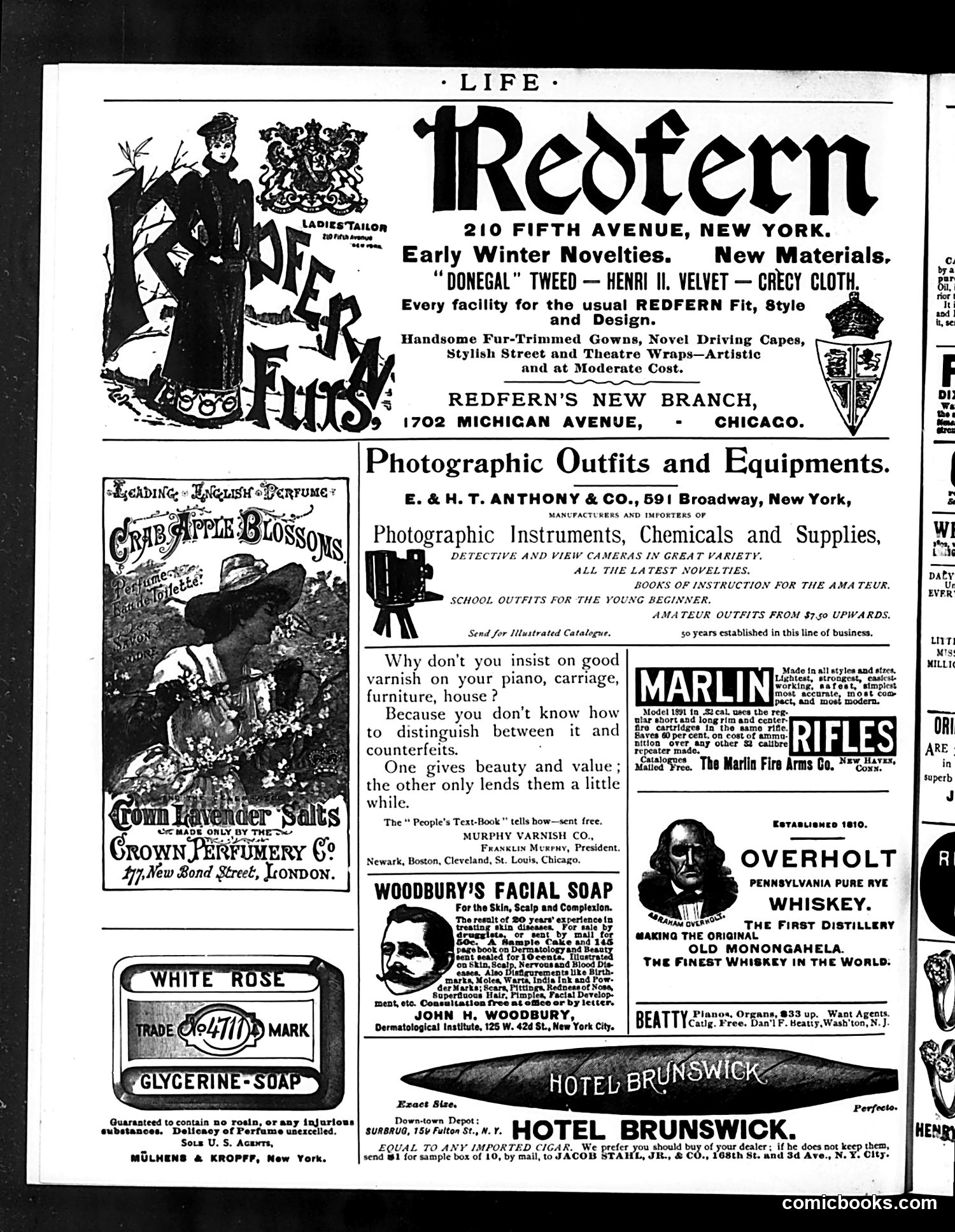
This is primarily an **advertising page** with no satirical cartoon content. It features luxury product advertisements typical of early 1900s Life magazine, including: - **Redfern**: High-end women's fashion (gowns, capes, wraps) at Fifth Avenue, New York - **E. & H. T. Anthony & Co.**: Photography equipment and supplies - **Marlin Rifles**: Firearms advertisement - **Murphy Varnish Co.**: Varnish products for pianos and furniture - **Overholt Whiskey**: "Pennsylvania Pure Rye" spirits - **Woodbury's Facial Soap**: Skincare product - **Hotel Brunswick**: Cigar advertisement The page's one quasi-satirical element is the varnish advertisement's rhetorical question: "Why don't you insist on good varnish?" — a light jab at consumers unable to distinguish quality products from counterfeits. Otherwise, this represents typical **commercial content** aimed at affluent readers, reflecting early 20th-century consumer goods and luxury markets.
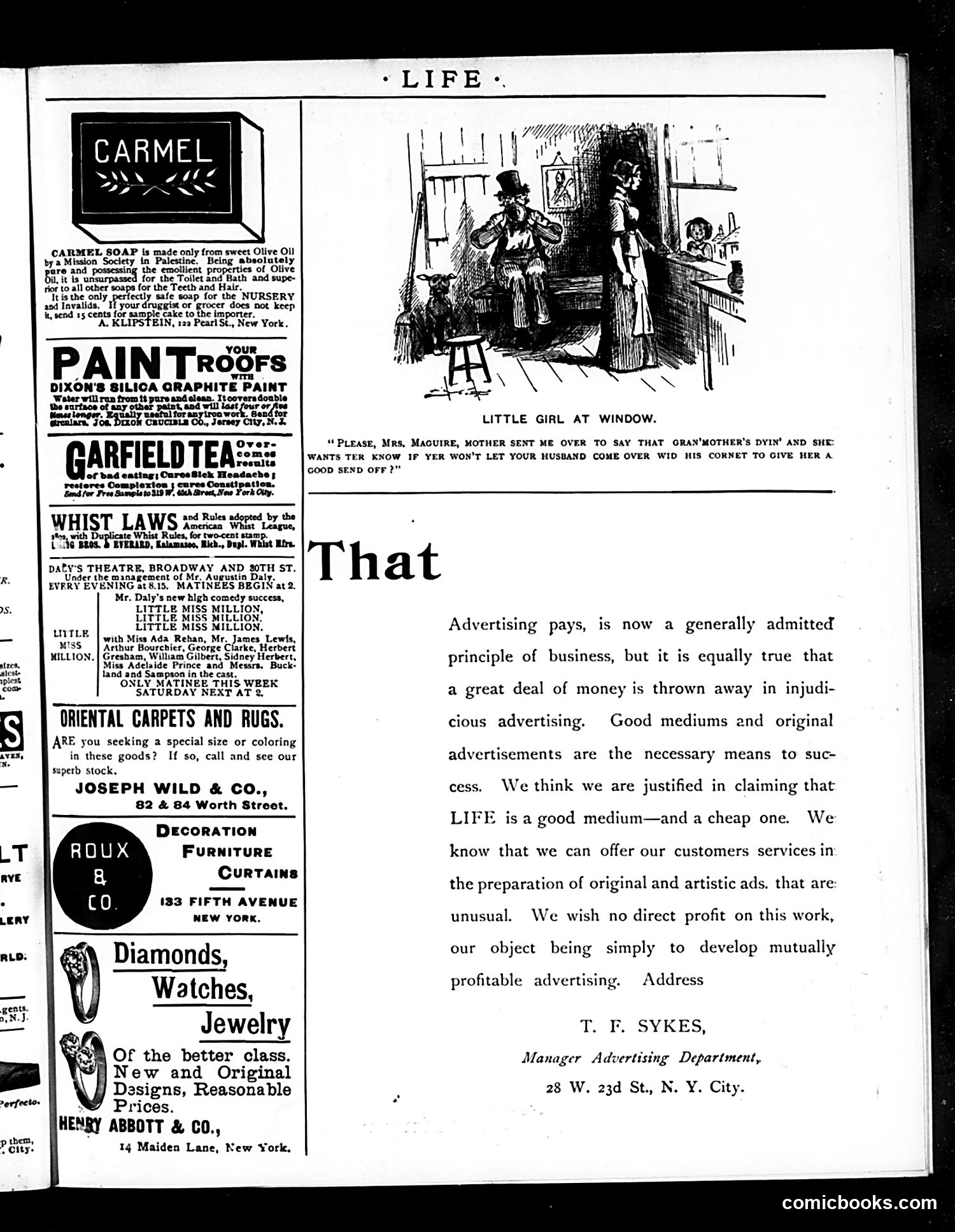
This page combines **advertising and editorial content** typical of late 19th-century American magazines. The cartoon "Little Girl at Window" depicts a working-class child delivering a message to a neighbor. The humor lies in the crude dialect and the absurd situation: the girl's grandmother is dying, but the mother wants to know if the neighbor will lend his husband's cornet so the dying woman can "have a good send off"—suggesting a wake or funeral celebration with music. The joke relies on period Irish-American stereotypes about working-class funeral customs and informal speech patterns. The remainder of the page is **editorial advertising content**, where Life's management pitches their magazine as an effective, economical advertising medium. They claim to offer original, artistic advertisements at low cost—essentially a sales pitch to potential advertisers, positioning Life as superior to competitors. The surrounding **paid advertisements** for soap, paint, tea, theater, carpets, furniture, and jewelry are typical commercial content of the era.
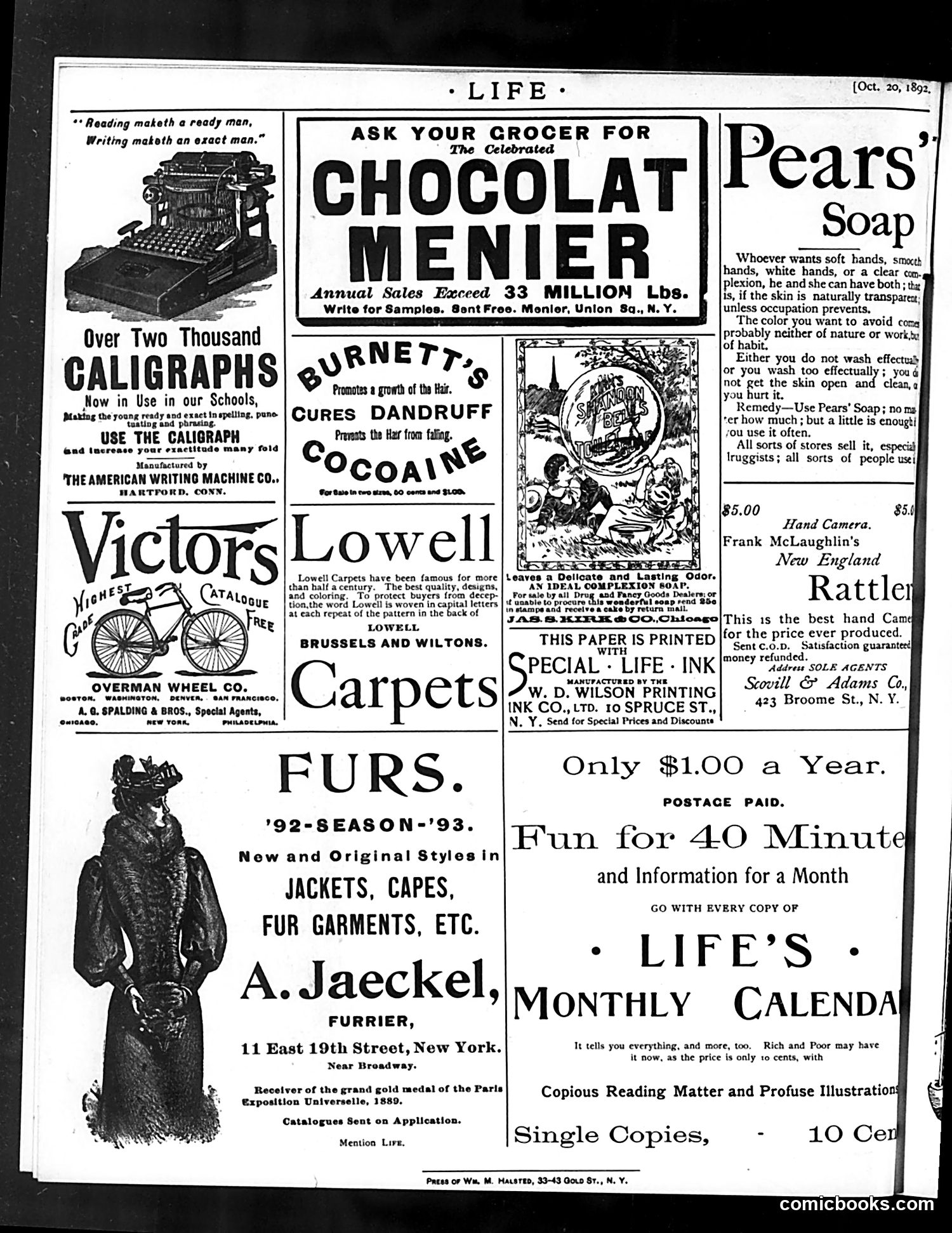
This is primarily an **advertising page** rather than editorial content or political satire. It showcases late-19th-century consumer products through period marketing. Notable advertisements include: - **Caligraphs** (early typewriters) and **Overman Wheel Co.** bicycles—reflecting the technological optimism of the 1890s - **Chocolat Menier**, a French chocolate brand with massive annual sales, and **Burnett's Cocaine**—a hair tonic openly advertising cocaine as an ingredient, legal and marketed without stigma in this era - **Pears' Soap**, promoting idealized beauty standards and skin care - **A. Jaeckel's furs** for the 1892-93 season, shown on a fashionable woman in expensive garments - **Life's Monthly Calendar** subscription offer The page reflects Gilded Age consumer culture: newly available mass-produced goods, international luxury brands, and advertising that would be shocking today (the cocaine tonic). There is **no political cartoon visible**—this is a commercial advertisement layout typical of 1890s magazines.