
Life, 1892-10-20 · page 4 of 16
Life — October 20, 1892 — page 4: what you’re looking at
What you’re looking at
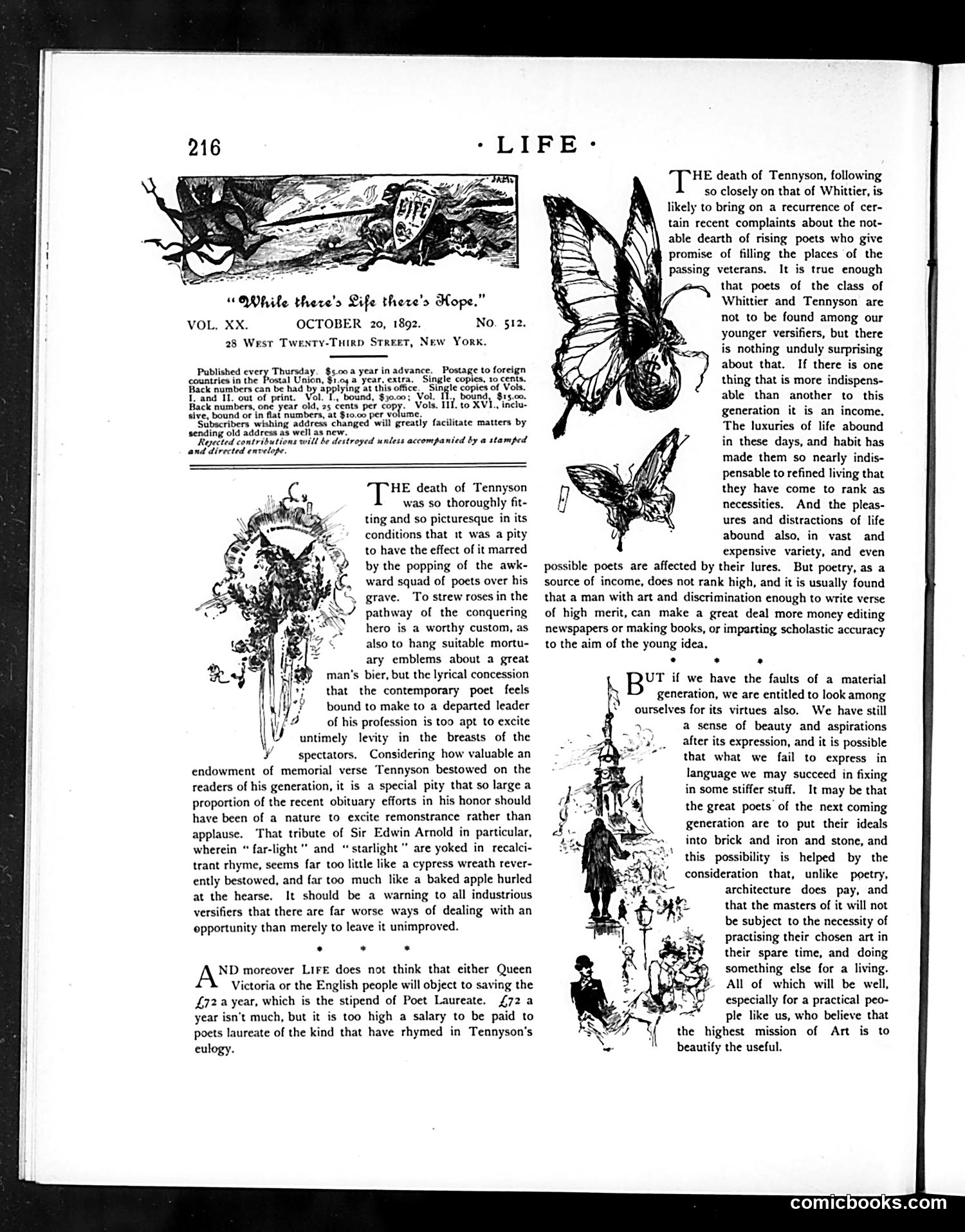
This page is primarily **editorial commentary**, not a political cartoon. It discusses the recent death of poet Alfred, Lord Tennyson and debates whether poets merit financial support as Poet Laureate. The decorative illustrations (butterflies, ornamental designs) are **period artwork**, not satirical caricatures. They're typical Victorian magazine embellishment. The text argues that while Tennyson's death is regrettable, poets like Whittier shouldn't expect high salaries. The writer suggests younger poets should pursue more lucrative careers—architecture, editing, or journalism—rather than rely on poetry's meager income. The editorial concludes that beauty and art should enhance utility, not replace practical living. This reflects **1890s anxieties about artistic viability** in an increasingly commercial age.
📄 Transcribed text from this page (OCR, searchable)
Machine-transcribed from the original scan — historical spelling and the odd misread are preserved.
“OMhile there's Life there's Hope.” VOL. XX. OCTOBER 20, 1892. No. 512. 28 West Twenty-Tuirp Street, New York. Published every Thursday. $5.00 a year in advance. ‘ countries in the Postal Union, $1.04 a year. extra. Single copies, 10 cents. Black numbers can be had by appiying at this office Single copics of Vols. I. and If. out of print. Vol. [., bound, $30.00; Vol. I1., bound, $13.00. Hack numbers, one year old, 25 cents per copy. Vols. IIT. to XVI, inclu sive, bound of in flat numbers, at $10.00 per volume. Subscribers wishing address changed will greatly facilitate matters by sending old address as well as new. ‘Rejected contributions will be destroyed untess accompanied by a stamped and directed envelope. Postage to foreign HE death of Tennyson was so thoroughly fit- ting and so picturesque in its conditions that it was a pity to have the effect of it marred by the popping of the awk- ward squad of poets over his . grave. To strew roses in the pathway of the conquering hero is a worthy custom, as also to hang suitable mortu- ary emblems about a great man’s bier, but the lyrical concession that the contemporary poet feels Vly bound to make to a departed leader \ Wi of his profession is too apt to excite \} untimely levity in the breasts of the y spectators. Considering how valuable an endowment of memorial verse Tennyson bestowed on the readers of his generation, it is a special pity that so large a proportion of the recent obituary efforts in his honor should have been of a nature to excite remonstrance rather than applause. That tribute of Sir Edwin Arnold in particular, wherein “ far-light " and “starlight” are yoked in recalci- trant rhyme, seems far too little like a cypress wreath rever- ently bestowed, and far too much like a baked apple hurled at the hearse. It should be a warning to all industrious versifiers that there are far worse ways of dealing with an opportunity than merely to leave it unimproved. . . * ND moreover LiFe does not think that either Queen Victoria or the English people will object to saving the £72 a year, which is the stipend of Poet Laureate. £72 a year isn't much, but it is too high a salary to be paid to poets laureate of the kind that have rhymed in Tennyson's eulogy. HE death of Tennyson, following so closely on that of Whittier, is likely to bring on a recurrence of cer- tain recent complaints about the not- able dearth of rising poets who give promise of filling the places of the passing veterans. It is true enough that poets of the class of Whittier and Tennyson are not to be found among our younger versifiers, but there is nothing unduly surprising about that. If there is one thing that is more indispens- able than another to this generation it is an income. The luxuries of life abound in these days, and habit has made them so nearly indis- pensable to refined living that they have come to rank as necessities. And the pleas- ures and distractions of life abound also, in vast and expensive variety, and even possible poets are affected by their lures. But poetry, as a source of income, does not rank high, and it is usually found that a man with art and discrimination enough to write verse of high merit, can make a great deal more money editing newspapers or making books, or impasting scholastic accuracy to the aim of the young idea. ° . . UT if we have the faults of a material generation, we are entitled to look among ourselves for its virtues also. We have still a sense of beauty and aspirations after its expression, and it is possible that what we fail to express in language we may succeed in fixing in some stiffer stuff. It may be that the great poets of the next coming generation are to put their ideals into brick and iron and stone, and this possibility is helped by the consideration that, unlike poetry, architecture does pay, and that the masters of it will not be subject to the necessity of practising their chosen art in their spare time, and doing something else for a living. All of which will be well, especially for a practical peo- rm ple like us, who believe that the highest mission of Art is to beautify the useful. comicbooks.com