
Life, 1892-10-20 · page 11 of 16
Life — October 20, 1892 — page 11: what you’re looking at
What you’re looking at
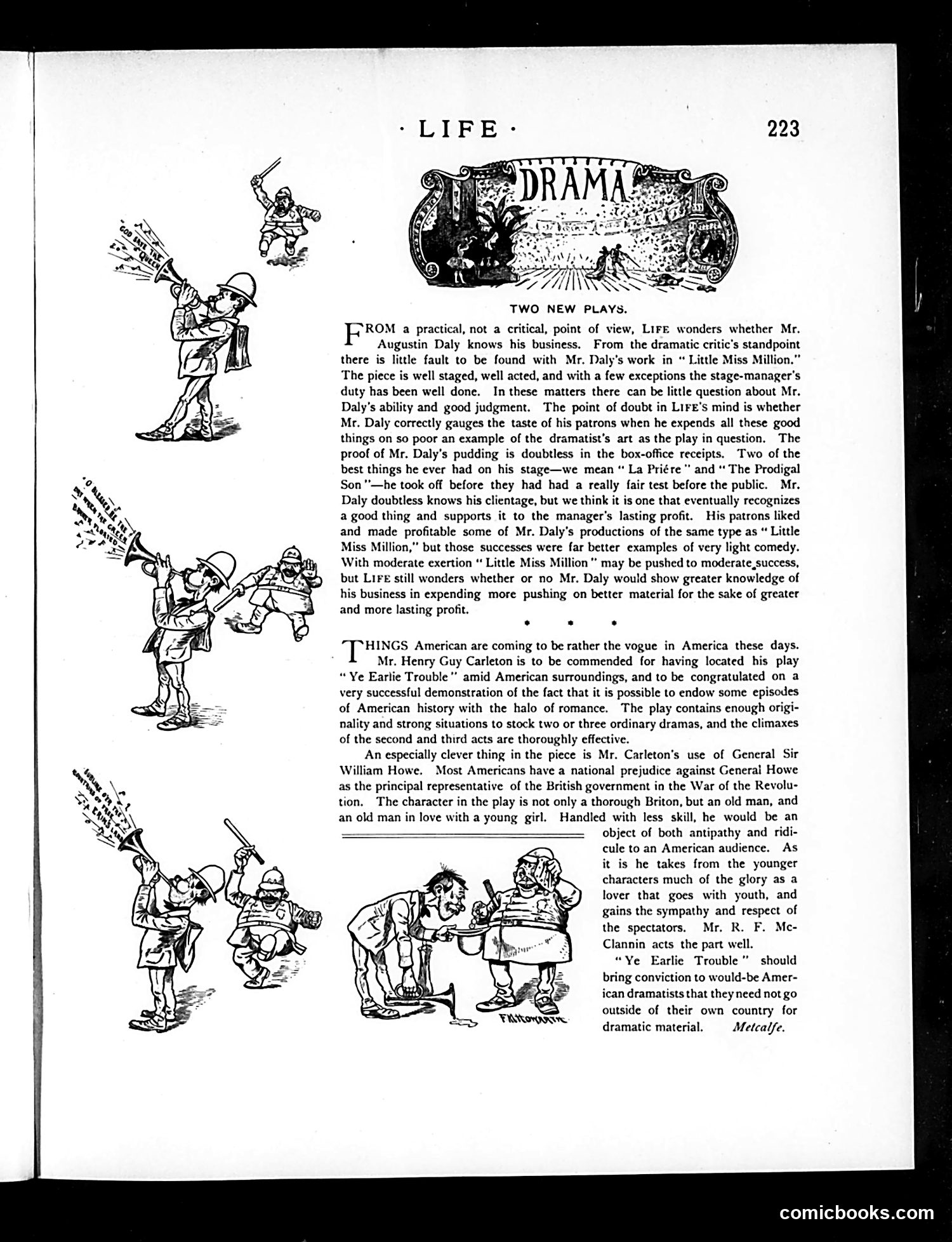
This page reviews two new theatrical productions for a general audience. The left side features cartoonish illustrations of what appear to be theatrical performers or stagehands in comedic poses—likely satirizing backstage chaos or dramatic conventions of the era. The text discusses Augustin Daly's theatrical work, praising his practical business sense and staging ability, though noting he may pursue more profitable "light comedy" over ambitious drama. The second review examines Henry Guy Carleton's "Ye Earlie Trouble," set during the American Revolution. The critic appreciates Carleton's use of General Sir William Howe as a character and the play's romantic elements, praising actor R. F. McClannin's performance. The reviewer suggests American dramatists should develop their own material rather than relying on European subjects.
📄 Transcribed text from this page (OCR, searchable)
Machine-transcribed from the original scan — historical spelling and the odd misread are preserved.
TWO NEW PLAYS. ROM a practical, not a critical, point of view, Lire wonders whether Mr. Augustin Daly knows his business. From the dramatic critic's standpoint there is little fault to be found with Mr. Daly's work in “ Little Miss Million.” The piece is well staged, well acted, and with a few exceptions the stage-manager's duty has been well done. In these matters there can be little question about Mr. Daly’s ability and good judgment. The point of doubt in Lire’s mind is whether Mr. Daly correctly gauges the taste of his patrons when he expends all these good things on so poor an example of the dramatist’s art as the play in question. The proof of Mr. Daly's pudding is doubtless in the box-office receipts. Two of the best things he ever had on his stage—we mean “ La Priére" and ‘* The Prodigal Son "—he took off before they had had a really fair test before the public. Mr. Daly doubtless knows his clientage, but we think it is one that eventually recognizes a good thing and supports it to the manager's lasting profit. His patrons liked and made profitable some of Mr. Daly's productions of the same type as “ Little Miss Million,” but those successes were far better examples of very light comedy. With moderate exertion “ Little Miss Million" may be pushed to moderate,success, but Lire still wonders whether or no Mr. Daly would show greater knowledge of his business in expending more pushing on better material for the sake of greater and more lasting profit. . . . Tines American are coming to be rather the vogue in America these days. Mr. Henry Guy Carleton is to be commended for having located his play “Ye Earlie Trouble” amid American surroundings, and to be congratulated on a very successful demonstration of the fact that it is possible to endow some episodes of American history with the halo of romance. The play contains enough origi- nality and strong situations to stock two or three ordinary dramas, and the climaxes of the second and third acts are thoroughly effective. An especially clever thing in the piece is Mr. Carleton’s use of General Sir William Howe. Most Americans have a national prejudice against General Howe as the principal representative of the British government in the War of the Revolu- tion, The character in the play is not only a thorough Briton, but an old man, and an old man in love with a young girl. Handled with less skill, he would be an object of both antipathy and ridi- cule to an American audience. As it is he takes from the younger characters much of the glory as a lover that goes with youth, and gains the sympathy and respect of the spectators. Mr. R. F. Mc- Clannin acts the part well. “Ye Earlie Trouble” should bring conviction to would-be Amer- ican dramatists that they need not go outside of their own country for dramatic material. Metcalfe. comicbooks.com