
Life, 1892-10-20 · page 6 of 16
Life — October 20, 1892 — page 6: what you’re looking at
What you’re looking at
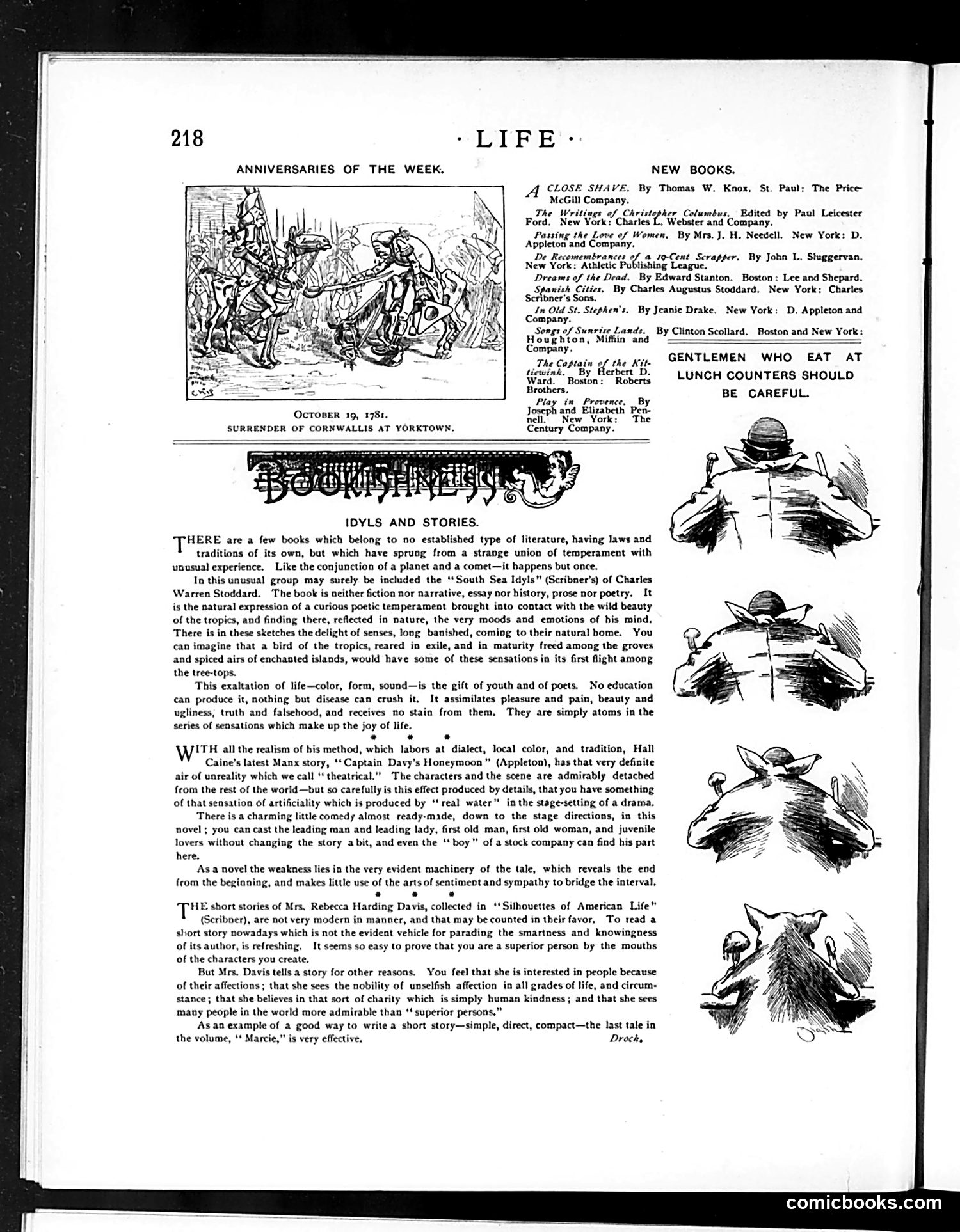
**Top Image:** Shows the "Surrender of Cornwallis at Yorktown" (October 19, 1781)—a historical engraving commemorating a key American Revolutionary War victory. This appears to be an anniversary reference. **Main Content:** "Idyls and Stories" is a book review section discussing literary works, including Charles Warren Stoddard's "South Sea Idyls," Hall Caine's "Captain Day's Honeymoon," and Rebecca Harding Davis's short stories. The text praises these works' artistic merit and emotional authenticity. **Right Side:** A humorous illustration titled "Gentlemen Who Eat at Lunch Counters Should Be Careful" shows men eating messily, with food splashing everywhere. This is workplace/manners satire, likely mocking uncouth dining behavior in public establishments.
📄 Transcribed text from this page (OCR, searchable)
Machine-transcribed from the original scan — historical spelling and the odd misread are preserved.
-LIFE':: ANNIVERSARIES OF THE WEEK. NEW BOOKS. (A CLOSE SHAVE, By Thomas W. Knox. St. Paul: The Price- McGill Company. The Writings of Christopher Columbus, Edited by Paul Leicester Ford. New York: Charles L. Webster and Company. Passing the Love of Women, By Mrs. J. H. Needell. New York: D. Appleton and Company. De Recomembrances of a 19-Cent Sera; ~~ B; hn L. Sh be Nee Nek Atnle Bubluning legac eer Crane to sinawerres. Dreams of the Dead. By Edward Stanton, Boston: Lee and Shepard. Spanish Citics, By Charles Augustus Stoddard. New York: Charl serlbner's Sons.” ee ewe a al a In Old St. Stephen's, By Jeanie Drake. New York: D. Appleton and ‘Company. Songs of Sunvise Lands. Boston and New York: Houghton, Miffin and nen = ‘Company. The Captain of the Kit- GENTLEMEN WHO EAT AT fiewink. | By Herbert D- LUNCH COUNTERS SHOULD 4 BE CAREFUL. in, Provence, pby and Elizabeth Pen- OCTOBER 19, 1278F. nell. New York: The SURRENDER OF CORNWALLIS AT YORKTOWN. Century Company. IDYLS AND STORIES. THERE are a few books which belong to no established type of literature, having laws and traditions of its own, but which have spruog from a strange union of temperament with unusual experience. Like the conjunction of a planet and a comet—it happens but once. In this unusual group may surely be included the ‘South Sea Idyls” (Scribner's) of Charles Warren Stoddard. The book is neither fiction nor narrative, essay nor history, prose nor poetry. It is the natural expression of a curious poetic temperament brought into contact with the wild beauty of the tropics, and finding there, reflected in nature, the very moods and emotions of his mind. There is in these sketches the delight of senses, long banished, coming to their natural home. You can imagine that a bird of the tropics, reared in exile, and in maturity freed among the groves and spiced airs of enchanted islands, would have some of these sensations in its first flight among the tree-tops. This exaltation of life—color, form, sound—is the gift of youth and of poets. No education can produce it, nothing but disease can crush it, It assimilates pleasure and pain, beauty and ugliness, truth and falsehood, and receives no stain from them, They are simply atoms in the series of sensations which make up the joy of life. * * . ITH all the realism of bis method, which labors at dialect, local color, and tradition, Hall Caine’s latest Manx story, ‘Captain Davy's Honeymoon" (Appleton), has that very definite air of unreality which we call “theatrical.” The characters and the scene are admirably detached {com the rest of the world—but so carefully is this effect produced by details, that you have something of that sensation of artificiality which is produced by ‘real water” in the stage-setting of a drama. There is a charming little comedy almost ready-made, down to the stage directions, in this novel ; you can cast the leading man and leading lady, first old man, first od woman, and juvenile lovers without changing the story abit, and even the “ boy" of a stock company can find his part here. Asa novel the weakness lies in the very evident machinery of the tale, which reveals the end from the beginning, and makes little use of the arts of sentiment and sympathy to bridge the interval. * * * [Eston stories of Mrs. Rebecca Harding Davis, collected in ‘*Silhouettes of American Life” (Scribner), are not very modern in manner, and that may be counted in their favor, To read a short story nowadays which is not the evident vehicle for parading the smartness and knowingness of its author, is refreshing. It stems so easy to prove that you are a superior person by the mouths of the characters you create, But Mrs, Davis tells a story for other reasons. You feel that she is interested in people because of their affections ; that she sees the nobility of unselfish affection in all grades of life, and circum- stance; that she believes in that sort of charity which is simply human kindness; and that she sees many people in the world more admirable than “ superior persons.” Asan example of a good way to write a short story—simple, direct, compact—the last tale in the volume, ** Marcie,” is very effective, Droch, comicbooks.com