
A complete issue · 14 pages · 1892
Life — October 13, 1892
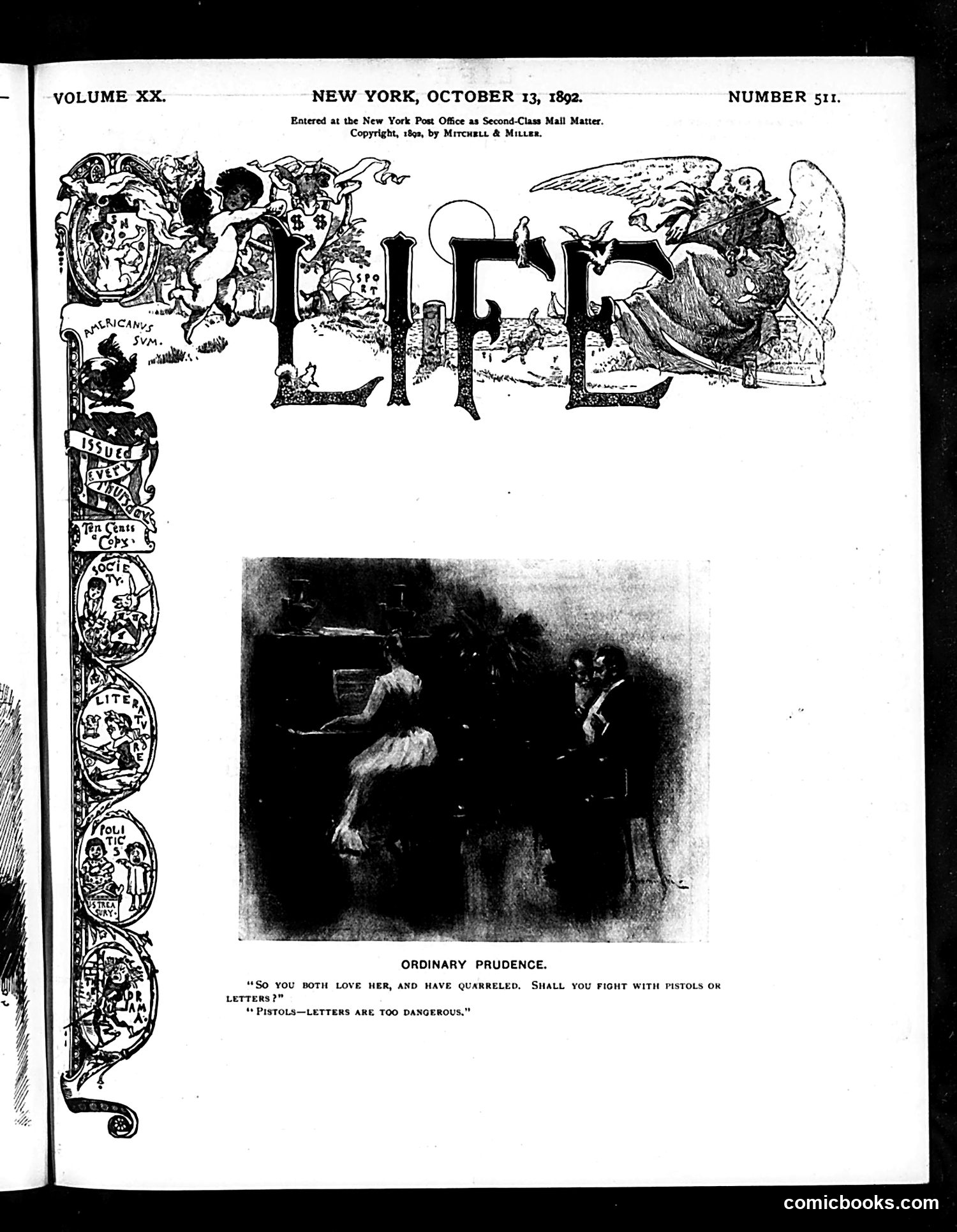
This cartoon satirizes a romantic triangle involving dueling—a practice still culturally relevant in 1892. The caption shows one character asking another whether they'll resolve their love dispute with pistols or letters, with the witty response that "pistols—letters are too dangerous." The joke inverts expected danger: letters (written correspondence, possibly love letters or written challenges) are humorously portrayed as MORE perilous than actual gunfire. This likely mocks the era's anxiety about written evidence in scandals or affairs—letters could expose affairs or impropriety to the public, causing social ruin. The title "Ordinary Prudence" suggests this cowardly avoidance of both fighting and written documentation as a practical, if unheroic, approach to domestic conflicts among the wealthy.
This page is **primarily advertisements**, not satirical content. The main visual element is a decorative circular medallion or seal on the left, likely a company logo or trademark, though its specific meaning isn't clear from context. The advertisements feature upscale merchants catering to wealthy late-19th/early-20th-century customers: a silversmith (Whiting M'fg Co.), fur retailers, dress shops, and carriage makers. The language emphasizes exclusivity, quality materials ("solid silver"), European fashions, and custom tailoring—reflecting the luxurious consumer culture of the Gilded Age. There is no apparent political satire or social commentary on this particular page; it's a straightforward commercial section aimed at affluent readers.
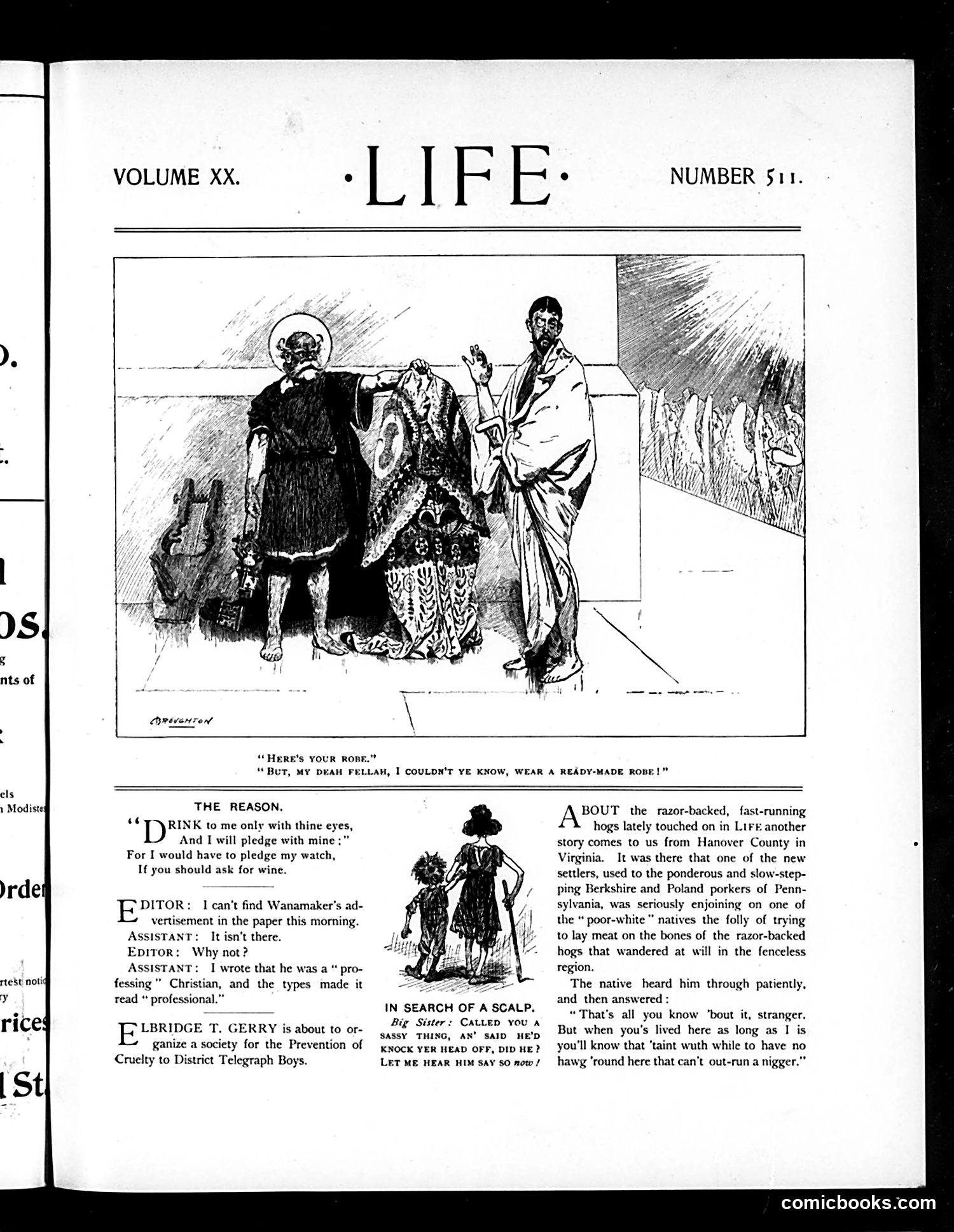
The main illustration satirizes racial attitudes in early 20th-century America. It depicts a settler offering a Black man a ready-made robe, with the caption suggesting the Black man couldn't wear such clothing because he lacked "white" status—a cruel joke about racial exclusion and segregation. The accompanying text story, "The Reason," describes conflicts between settlers and Black residents in Hanover County, Virginia, over loose hogs. A settler asks a Black man about controlling the animals; the Black man's response ("tain't with white folk") reflects the period's racist power dynamics—suggesting Black people had no authority in disputes with white settlers. The other content includes satirical editor-assistant banter about unrelated topics.
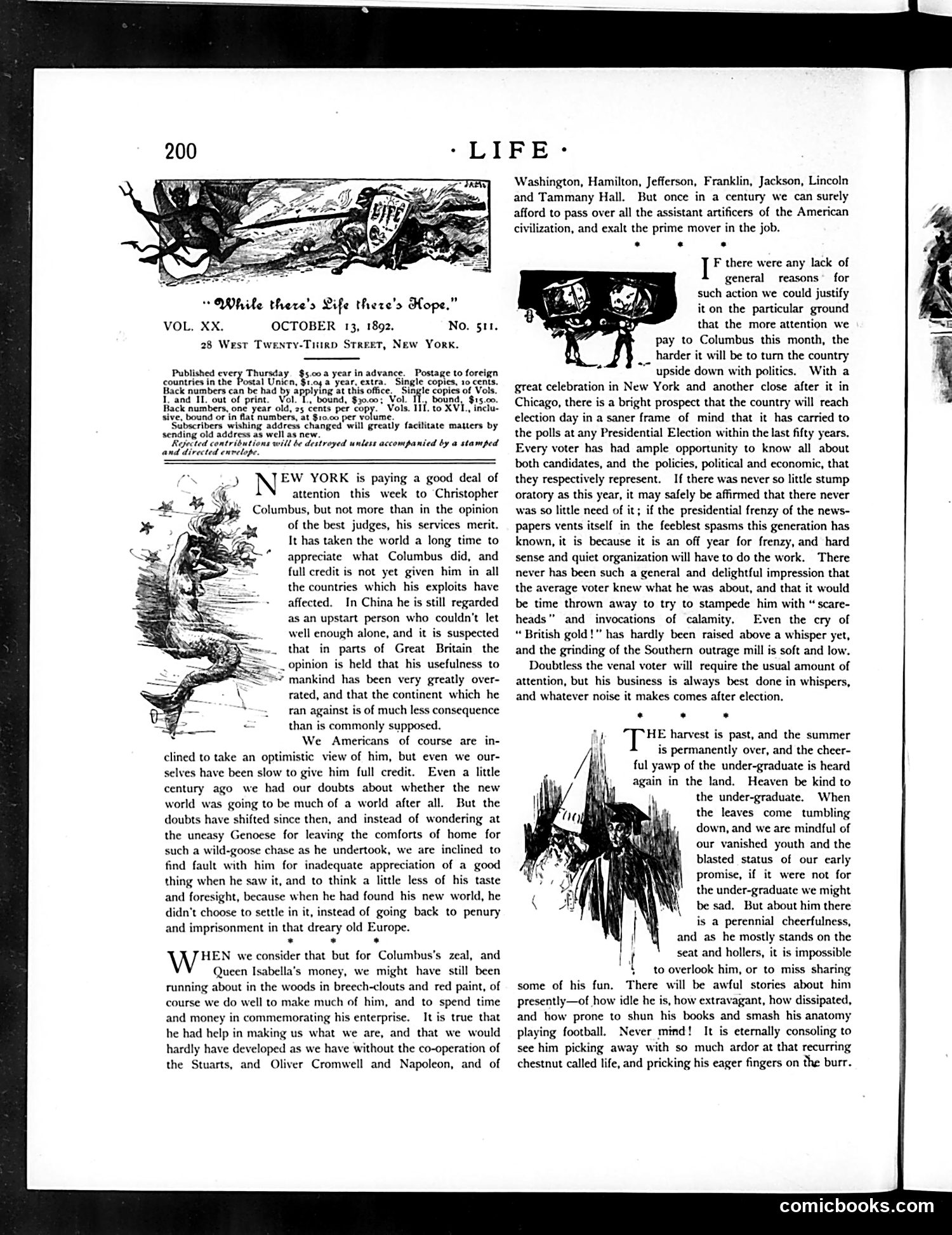
**Publication Details:** This is from Life Vol. XX, No. 511 (October 13, 1892), published in New York. **Main Content:** The page discusses Christopher Columbus and the upcoming presidential election. The text argues Columbus deserves commemoration despite his flaws, using him as a metaphor for American achievement. It advocates for focusing on candidates' actual positions rather than partisan attacks ("scare-heads" and "invocations of calamity"). **Illustrations:** Two sketches appear: one showing Columbus as a bearded historical figure, another depicting what appears to be an undergraduate or young man in casual dress. **Point:** The editorial uses Columbus Day celebration as a frame to urge voters toward rational, issues-focused election discourse—a subtle criticism of sensationalist campaign tactics of the 1892 election era.
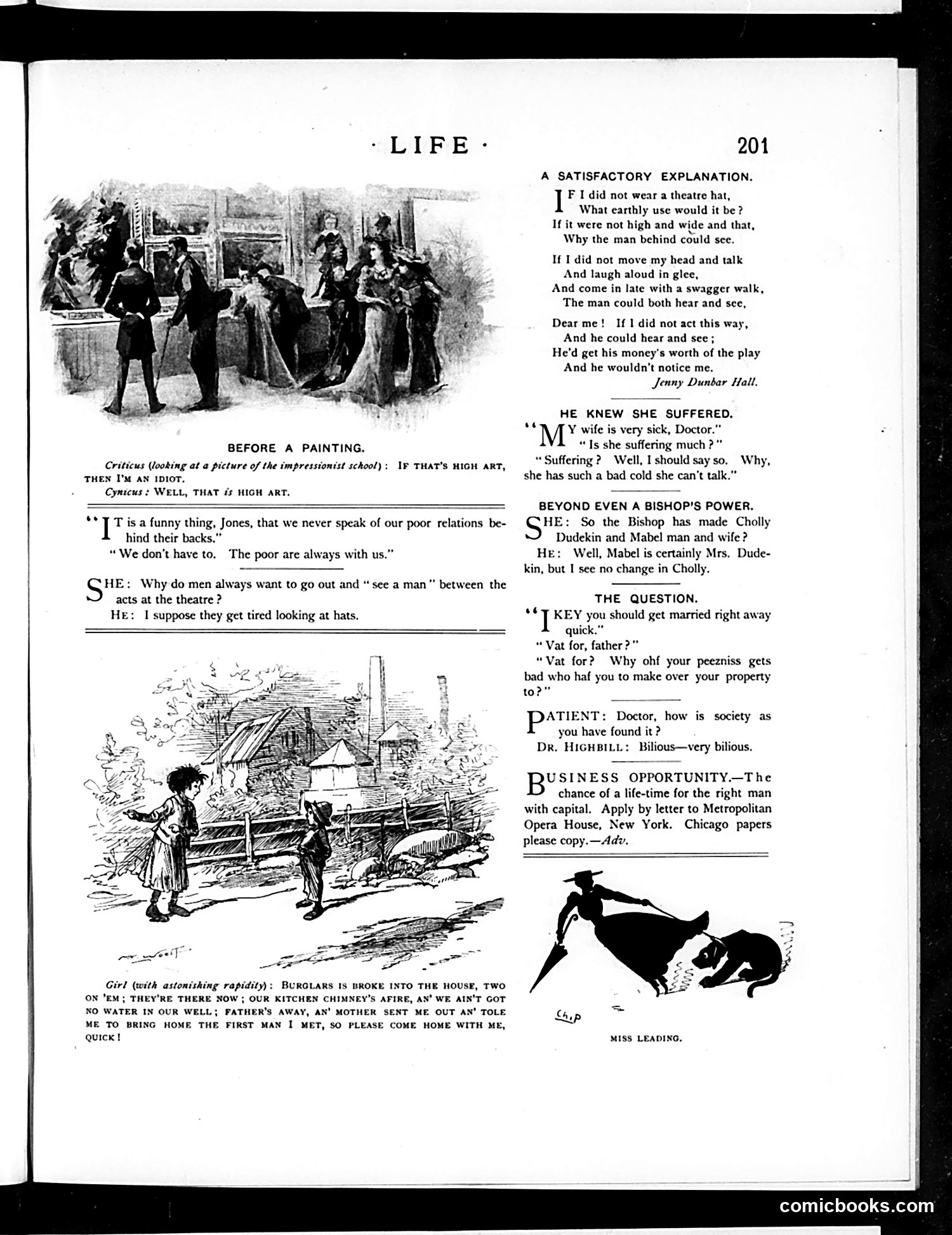
This page contains several satirical sketches and humorous dialogues typical of early 20th-century Life magazine. **"Before a Painting"**: Mocks art critics' pretentious language, showing them debating whether a painting represents "high art" while dismissing the artist as an idiot. **Theatre etiquette**: Jokes about men wanting to leave theater intermissions to "see a man" (likely meaning socializing/smoking), with the explanation that they tire of watching hats. **"A Satisfactory Explanation"**: A poem by Jenny Dunbar justifying theatrical disruption—the author behaved boisterously so people got their money's worth by noticing her. **Other sketches** address class relations, medical complaints, and domestic situations with period-specific humor. The page primarily showcases *social satire* rather than political commentary, mocking contemporary manners, theater culture, and class pretensions.
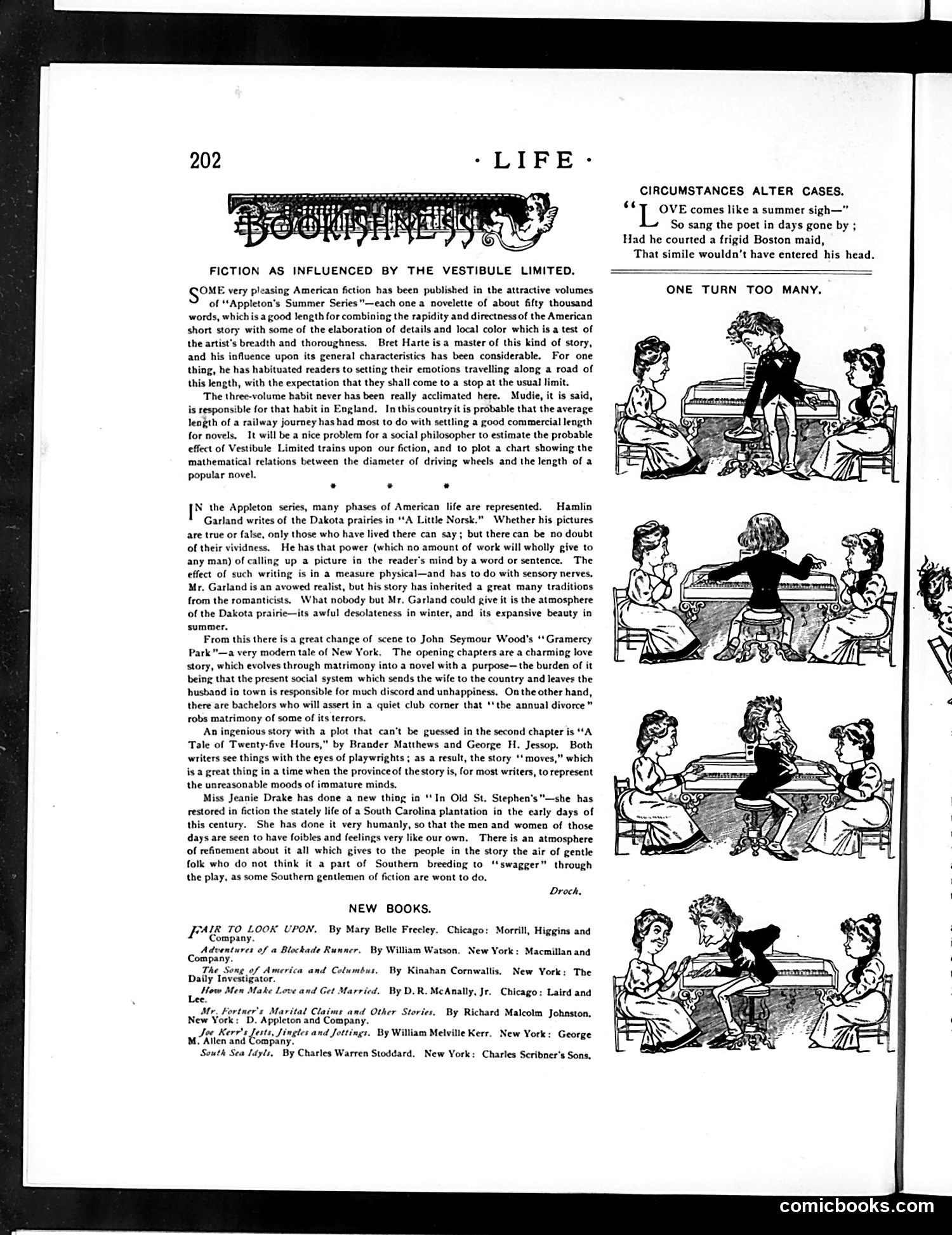
This page features a serialized cartoon titled "One Turn Too Many," showing what appears to be a woman operating a mechanical device or machine (possibly a clothes wringer or similar domestic appliance) with increasing difficulty across multiple panels. The cartoon likely satirizes either: - The hazards of domestic machinery to housewives - Women's struggle with household technology - Or possibly a metaphorical commentary on repetitive domestic labor The accompanying text discusses American fiction influenced by the "Vestibule Limited" (a train), focusing on literary analysis rather than explaining the cartoon directly. Without additional context about the specific domestic device shown or contemporary domestic hazard concerns of this era, the precise satirical point remains somewhat unclear, though the progression suggests comedic escalation of mishap or difficulty.
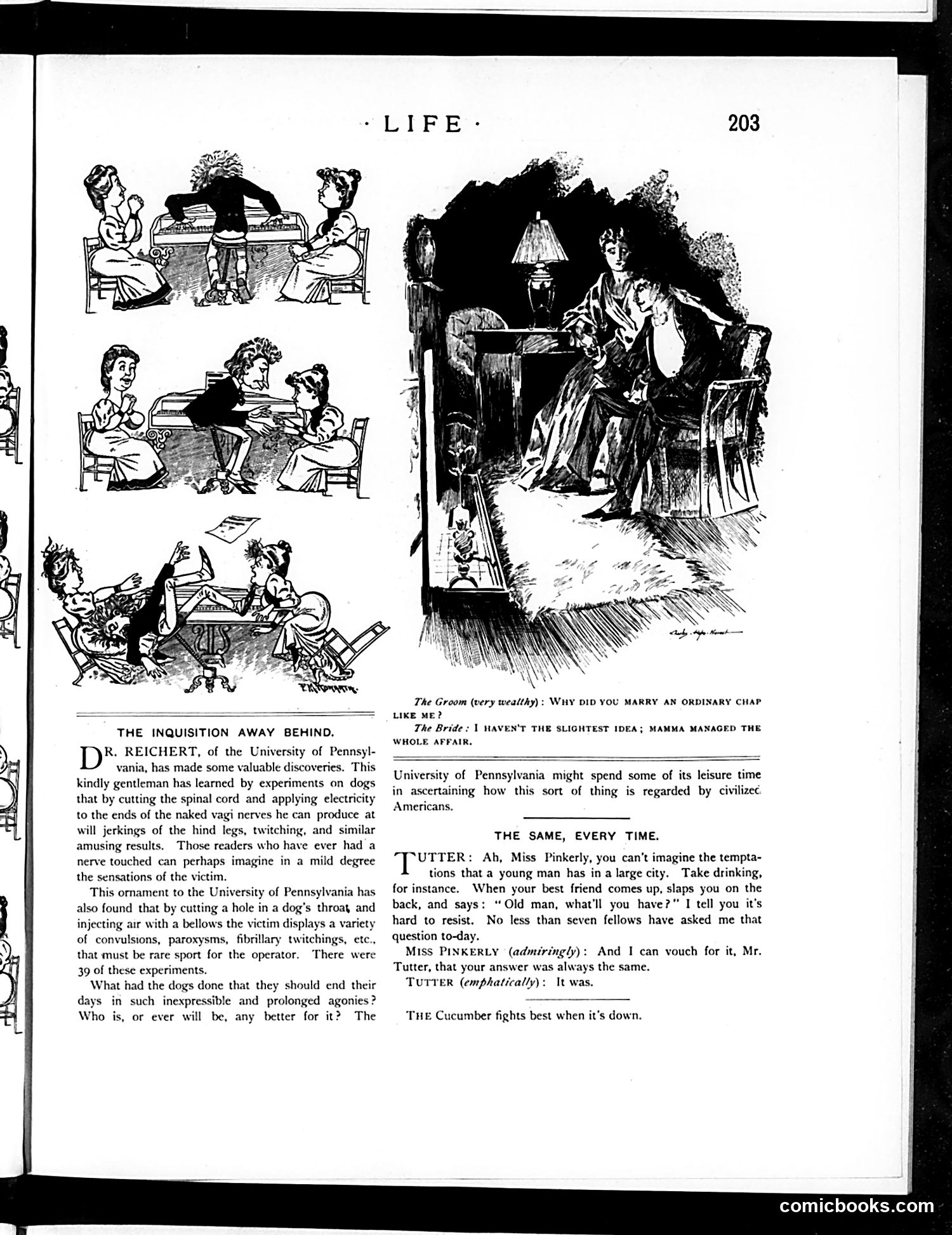
The page contains two distinct sections: **Left side:** Three small comic panels showing domestic scenes at dining tables, illustrating "The Inquisition Away Behind." The article discusses Dr. Reichert from the University of Pennsylvania conducting experiments on dogs—cutting spinal cords and applying electricity to observe nerve responses. The satire suggests these domestic inquiries mirror inquisitorial torture methods. **Right side:** A larger illustration captioned "The Groom (very wearily): Why did you marry an ordinary chap like me?" The bride's response about her mother managing affairs satirizes marriages of convenience or financial arrangement rather than romantic love—a common target of early 20th-century social satire about upper-class courtship. The page critiques both scientific ethics and matrimonial motivations.
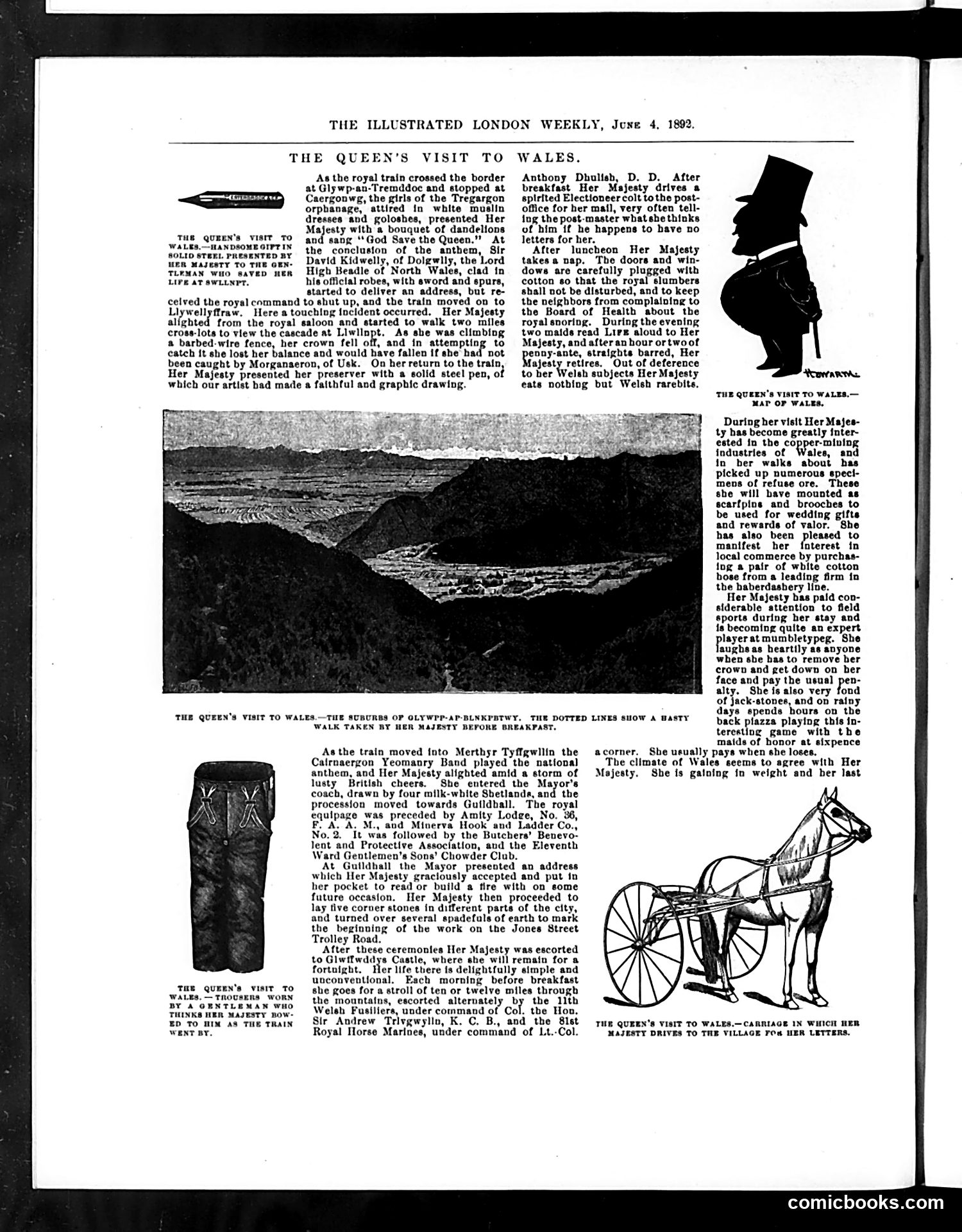
This page from *The Illustrated London Weekly* (June 4, 1893) documents Queen Victoria's royal tour of Wales. The silhouette portrait shows the elderly queen in profile, while accompanying illustrations depict the carriage she used and the Welsh landscape she toured. The text emphasizes the ceremonial nature of the visit: Victoria received bouquets of dandelions (symbolic of Welsh subjects), attended religious services, and visited industrial sites including mines and manufacturing works. An incident is noted where her crown fell off near a barbed-wire fence—a moment of vulnerability for the imperious monarch. The coverage celebrates Victoria's interest in Welsh industries and culture, presenting the tour as a successful demonstration of royal engagement with her subjects, though the modest dandelions as gifts suggest the relatively humble circumstances of the Welsh people she visited.
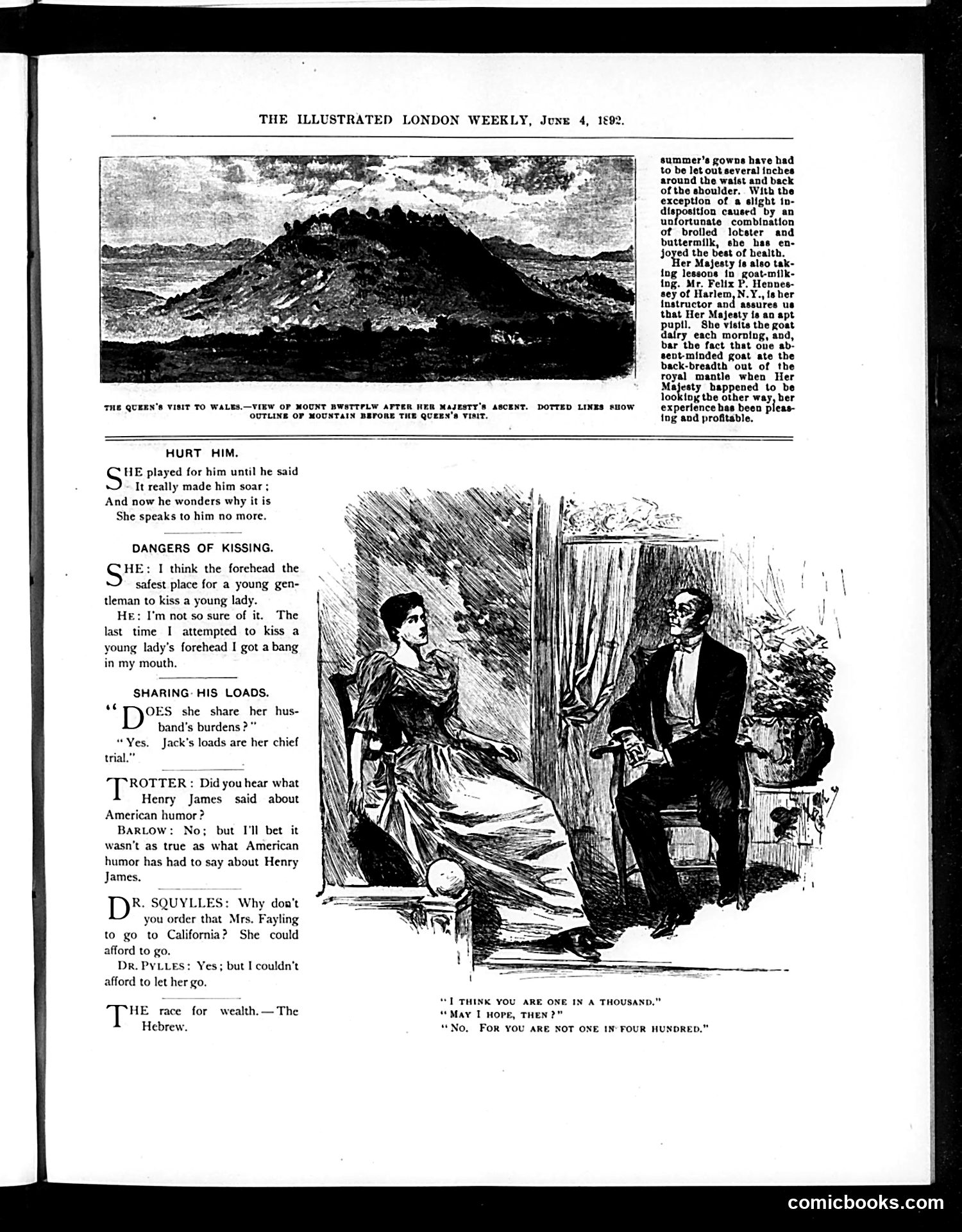
This page from *The Illustrated London Weekly* (June 4, 1892) contains several brief satirical pieces: **Top image**: Shows Mount Snowdon with dotted lines indicating the Queen's route during a royal visit to Wales. **"Hurt Him"**: A brief joke about someone playing or teasing someone until "he made him soar," then wondering why they no longer speak. **"Dangers of Kissing"**: A humorous exchange between a man and woman debating whether the forehead is the safest place to kiss, ending with the man joking he got "a bang in my mouth" from his last attempt. **"Sharing His Loads"** and **"Trotter"** sections: Brief witty dialogues about marital burdens and American humor. **The illustrated scene** shows a well-dressed man and woman in what appears to be a flirtation or romantic moment, with the caption suggesting commentary on attractiveness or romantic appeal. These are typical Victorian-era humor pieces—light social satire about romance, marriage, and manners.
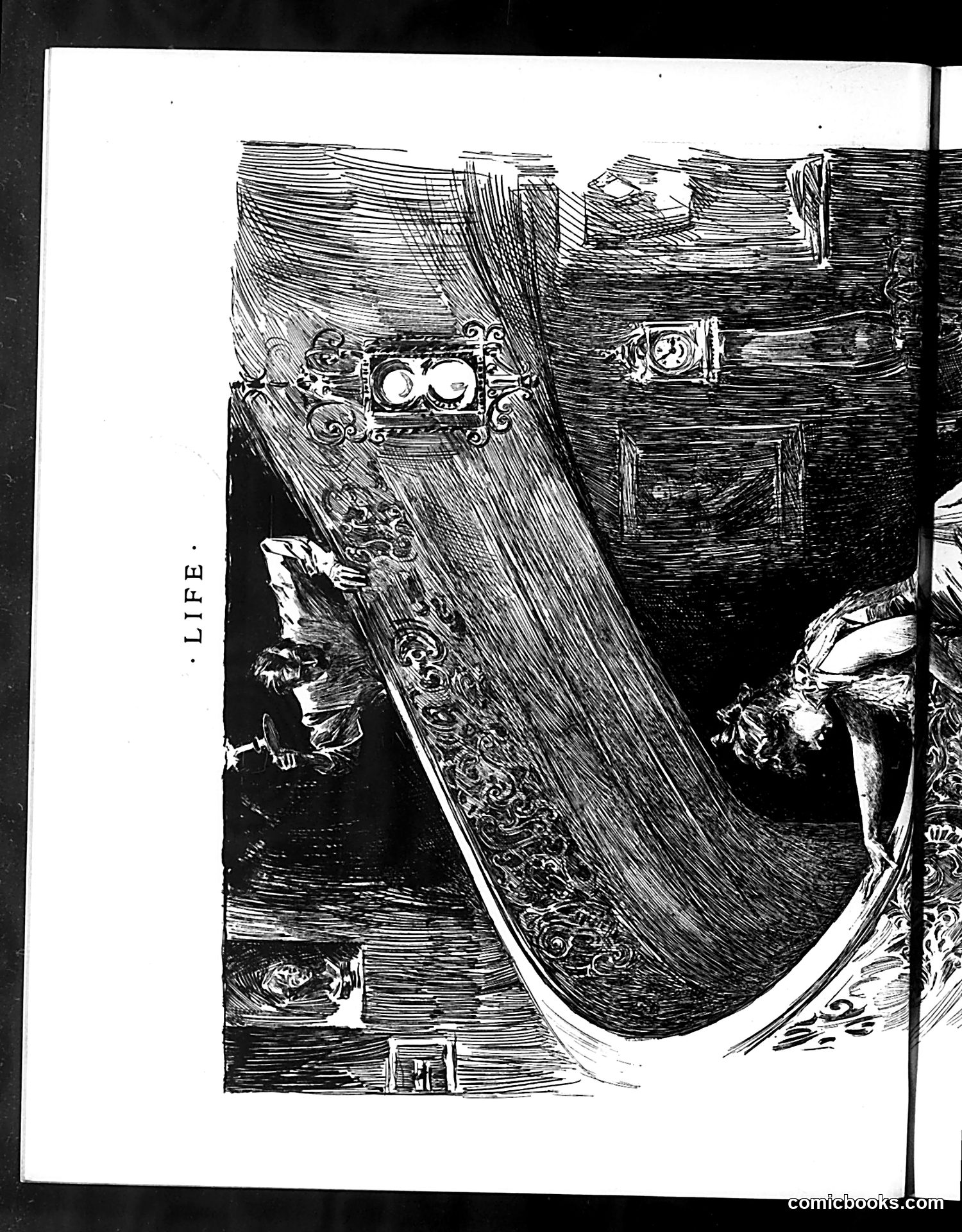
This appears to be a single satirical illustration titled "LIFE" (visible on the left margin). The etching depicts an ornate interior scene with classical architectural details—elaborate woodwork, decorative moldings, and what appears to be a mantelpiece or fireplace. Two figures are shown in period dress (appearing to be 18th or 19th century based on their clothing). The detailed cross-hatching technique suggests this is a commentary on wealth, refined taste, or upper-class social pretension. Without additional context or caption text visible, the specific satirical target remains unclear. However, Life magazine typically mocked contemporary social foibles, so this likely critiques either excessive ornamentation, class affectation, or wealthy society's lifestyle. The ironic title "LIFE" paired with the static, formal scene may suggest commentary on whether such artificial refinement constitutes authentic living.
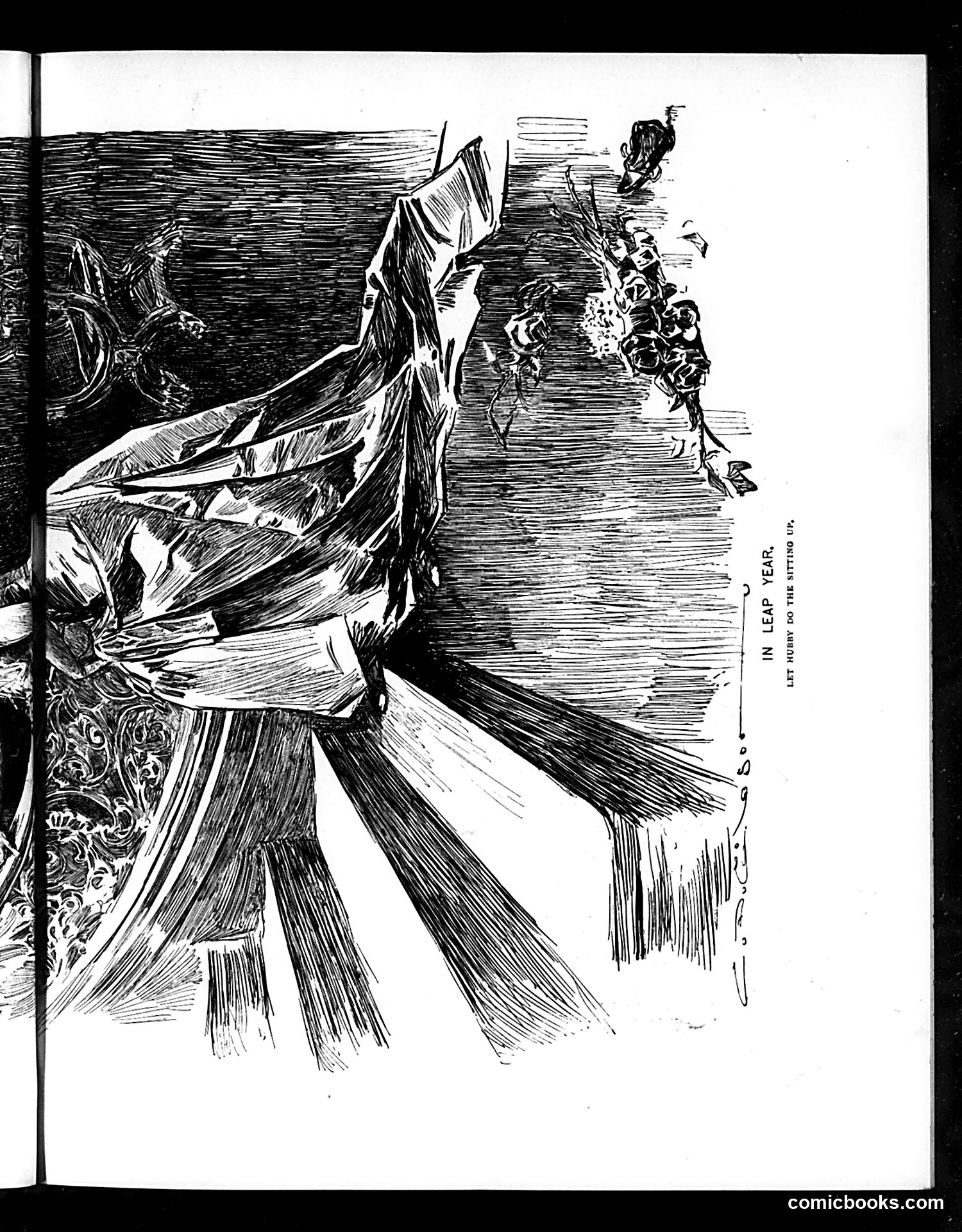
This cartoon satirizes the social convention of Leap Year, when tradition allowed women to propose marriage to men—reversing normal gender roles. The image shows a woman in an elaborate dress with a long train, actively pursuing or "leaping" toward a man on the right who appears to be fleeing or resisting. Several onlookers in the background seem to witness this reversal of courtship norms. The satire mocks both the aggressive female pursuer and the panicked male target, playing on Victorian anxieties about women stepping outside their prescribed passive role in romance. The exaggerated poses and clothing emphasize the perceived unnaturalness of women taking initiative in courtship, treating this temporary social permission as comedic chaos rather than reasonable equality.
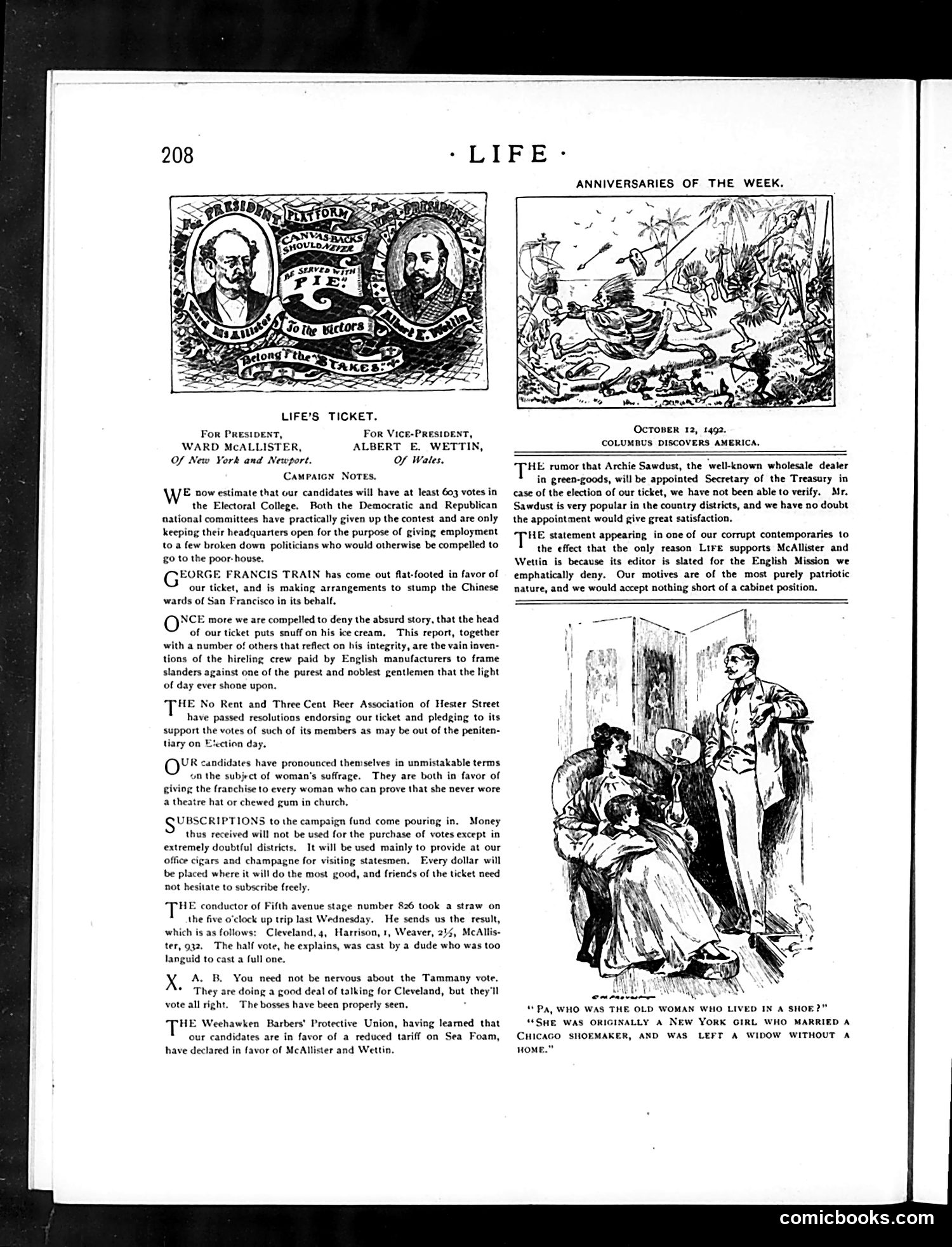
This is a mock endorsement of a satirical presidential ticket featuring Ward McAllister (a wealthy New York socialite) for President and Albert E. Wettin (Prince of Wales) for Vice President. The humor relies on absurdist contrasts between candidates of ridiculous qualifications and real 1880s politics. The "Campaign Notes" mock endorsements from implausible groups: George Francis Train (a known eccentric), a poverty-stricken tenement association, and a barbers' union supporting tariff positions. Life sarcastically claims their Fifth Avenue straw poll shows McAllister winning overwhelmingly, and jokes about election fraud ("bosses have been properly seen"). The Annie Sawdust rumor and editor's denial of wanting a cabinet position are self-referential jokes about Life's own editorial bias and ambitions. The page satirizes both Gilded Age wealth inequality and corruption in contemporary electoral politics through exaggerated, obvious fakery—highlighting how absurd real political compromises actually were.
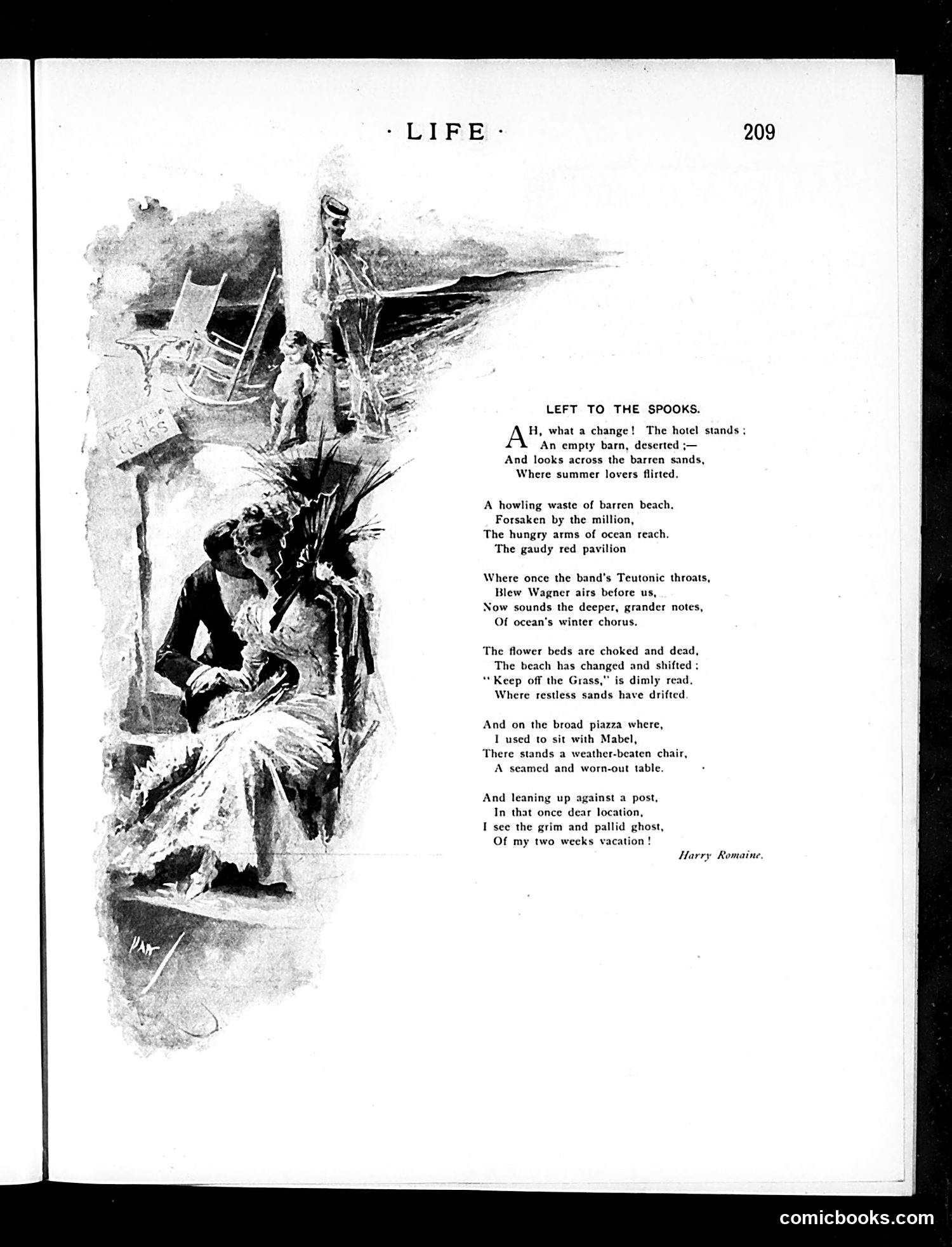
This is a nostalgic poem by Harry Romaine lamenting the decline of a seaside resort, likely after World War I. The reference to "Teutonic throats" playing Wagner suggests German entertainers who would have been present before or during the war. The "spooks" in the title likely refers to ghosts—both literal and figurative. The beach resort that once bustled with summer romance and "Wagner airs" now stands abandoned and deteriorating: flower beds dead, pavilion decaying, grass overgrown. The speaker mourns his past two-week vacation with someone named Mabel, now replaced by only the "grim and pallid ghost" of that memory. This appears to be post-WWI commentary on how war disrupted leisure, tourism, and civilian life. The abandoned resort—with its German entertainment—symbolizes the loss of pre-war gaiety and normalcy.
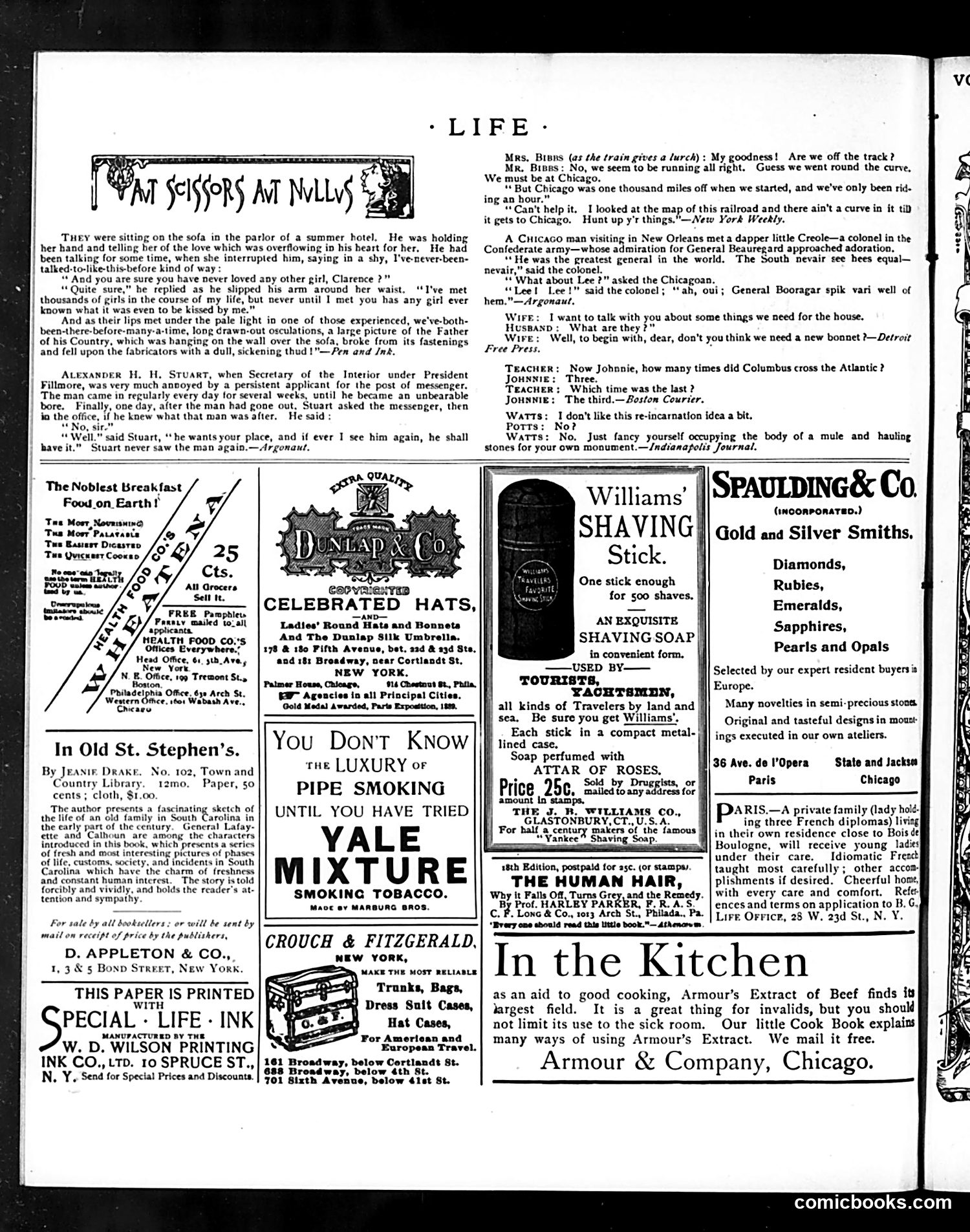
This page from *Life* magazine contains three humorous anecdotes typical of period satirical journalism: 1. **The Fallen Picture**: A young couple kissing on a hotel sofa is interrupted when a portrait of George Washington falls from the wall and hits them. The joke satirizes sentimental romance narratives—the divine intervention literally collapses their dramatic embrace. 2. **The Persistent Applicant**: Alexander H.H. Stuart (a real historical figure, Secretary of Interior) tricks an annoying job-seeker into believing he'll rehire him, but never sees him again. It mocks bureaucratic persistence and administrative annoyance. 3. **The Confederate General**: A Chicago man meets a New Orleans Creole colonel who idolizes General Beauregard but dismisses General Lee. The joke plays on regional Civil War loyalties and Southern pride—suggesting the Creole's judgment is unreliable or shaped by provincial bias. The page is otherwise filled with period advertisements (cereals, hats, shaving products). These brief comedic pieces represent *Life*'s characteristic blend of social observation, romantic comedy, and light satire aimed at middle-class readers.