
Life, 1892-10-13 · page 6 of 14
Life — October 13, 1892 — page 6: what you’re looking at
What you’re looking at
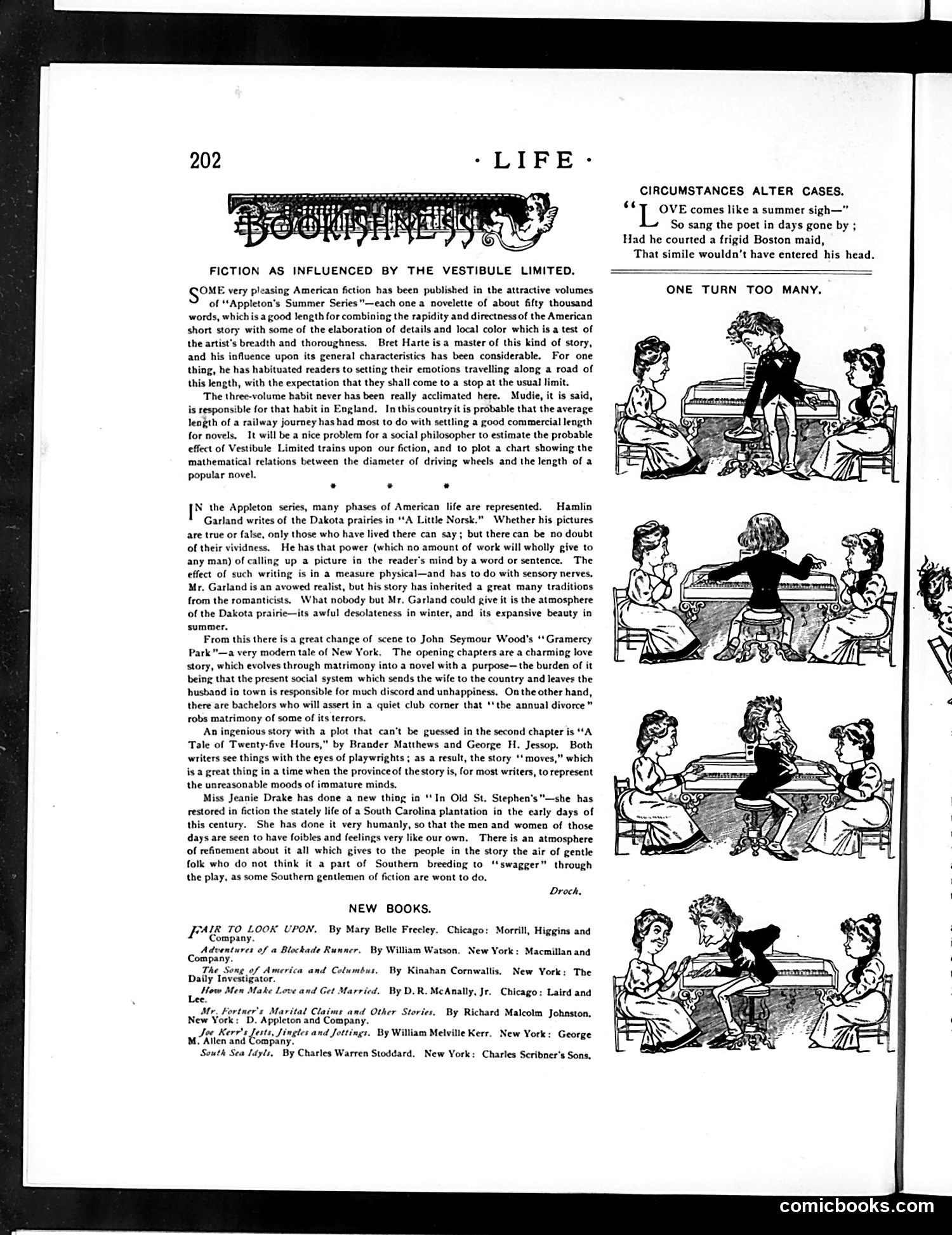
This page features a serialized cartoon titled "One Turn Too Many," showing what appears to be a woman operating a mechanical device or machine (possibly a clothes wringer or similar domestic appliance) with increasing difficulty across multiple panels. The cartoon likely satirizes either: - The hazards of domestic machinery to housewives - Women's struggle with household technology - Or possibly a metaphorical commentary on repetitive domestic labor The accompanying text discusses American fiction influenced by the "Vestibule Limited" (a train), focusing on literary analysis rather than explaining the cartoon directly. Without additional context about the specific domestic device shown or contemporary domestic hazard concerns of this era, the precise satirical point remains somewhat unclear, though the progression suggests comedic escalation of mishap or difficulty.
📄 Transcribed text from this page (OCR, searchable)
Machine-transcribed from the original scan — historical spelling and the odd misread are preserved.
FICTION AS INFLUENCED BY THE VESTIBULE LIMITED. OME very pleasing American fiction has been published in the attractive volumes of “Appleton's Summer Series"—each one a novelette of about fifty thousand words, which is a good length for combining the rapidity and directness of the American short story with some of the elaboration of details and local color which is a test of the artist's breadth and thoroughness. Bret Harte isa master of this kind of story, and his influence upon its general characteristics has been considerable. For one thing, he has habituated readers to setting their emotions travelling along a road of this length, with the expectation that they shall come to a stop at the usual limit. ‘The three-volume habit never has been really acclimated here. Mudie, it is said, is responsible for that habit in England. In this country it is probable that the average length of a railway journey has had most to do with settling a good commercial length for novels, It will be a nice problem for a social philosopher to estimate the probable effect of Vestibule Limited trains upon our fiction, and to plot a chart showing the mathematical relations between the diameter of driving wheels and the length of a popular novel. . . . [¥ the Appleton series, many phases of American life are represented. Hamlin Garland writes of the Dakota prairies in “A Little Norsk.” Whether his pictures are true or false, only those who have lived there can say ; but there can be no doubt of their vividness. He has that power (which no amount of work will wholly give to any man) of calling up a picture in the reader's mind by a word or sentence. The effect of such writing is in a measure physical—and has to do with sensory nerves. Mr. Garland is an avowed realist, but his story has inberited a great many traditions from the romanticists. What nobody but Mr. Garland could give it is the atmosphere of the Dakota prairie—its awful desolateness in winter, and its expansive beauty in summer. From this there is a great change of scene to John Seymour Wood's “Gramercy Park "—a very modem tale of New York. The opening chapters are a charming love story, which evolves through matrimony into a novel with a purpose—the burden of it being that the present social system which sends the wife to the country and leaves the husband in town is responsible for much discord and unhappiness. On the other hand, there are bachelors who will assert in a quiet club comer that ‘the annual divorce" robs matrimony of some of its terrors. An ingenious story with a plot that can’t be guessed in the second chapter is “A Tale of Twenty-five Hours,” by Brander Matthews and George H. Jessop. Both writers see things with the eyes of playwrights ; as a result, the story ‘* moves," which is a great thing in a time when the province of the story is, for most writers, to represent the unreasonable moods of immature minds. Miss Jeanie Drake has done a new thing in ‘In Old St. Stephen's"—she has restored in fiction the stately life of a South Carolina plantation in the early days of this century. She has done it very humanly, so that the men and women of those days are seen to have foibles and feelings very like our own. There is an atmosphere of refinement about it all which gives to the people in the story the air of gentle folk who do not think it a part of Southem breeding to “swagger” through the play, as some Southern gentlemen of fiction are wont to do. Droch, NEW BOOKS. FAIR TO LOOK UPON, By Mary Belle Frecley. Chicago: Morrill, Higgins and Company. Adventures of a Blockade Runner, By William Watson. New York: Macmillan and Company. ep ee and Columbus. By Kinahan Cornwallis. New York: The edie Men Make Love and Get Married. By D.R. MeAnally, Jt. Chicago: Laird and Mr, Fortner's Marital Claims and Other Stories, By Richard Malcol New York: "D, Appleton and Company.” 7"¢" BY Richard Malcolm Johnston, Joe Kerr's Jests, Jingles and Jottings, By William Melville Kerr. New York: George M/Allen and Company, South Sea Idyls, By Charles Warren Stoddard. New York: Charles Scribner's Sons, CIRCUMSTANCES ALTER CASES. OVE comes like a summer sigh— So sang the poet in days gone by ; Had he courted a frigid Boston maid, That simile wouldn’t have entered his head. “ee ONE TURN TOO MANY. comicbooks.com