
Life, 1892-10-13 · page 4 of 14
Life — October 13, 1892 — page 4: what you’re looking at
What you’re looking at
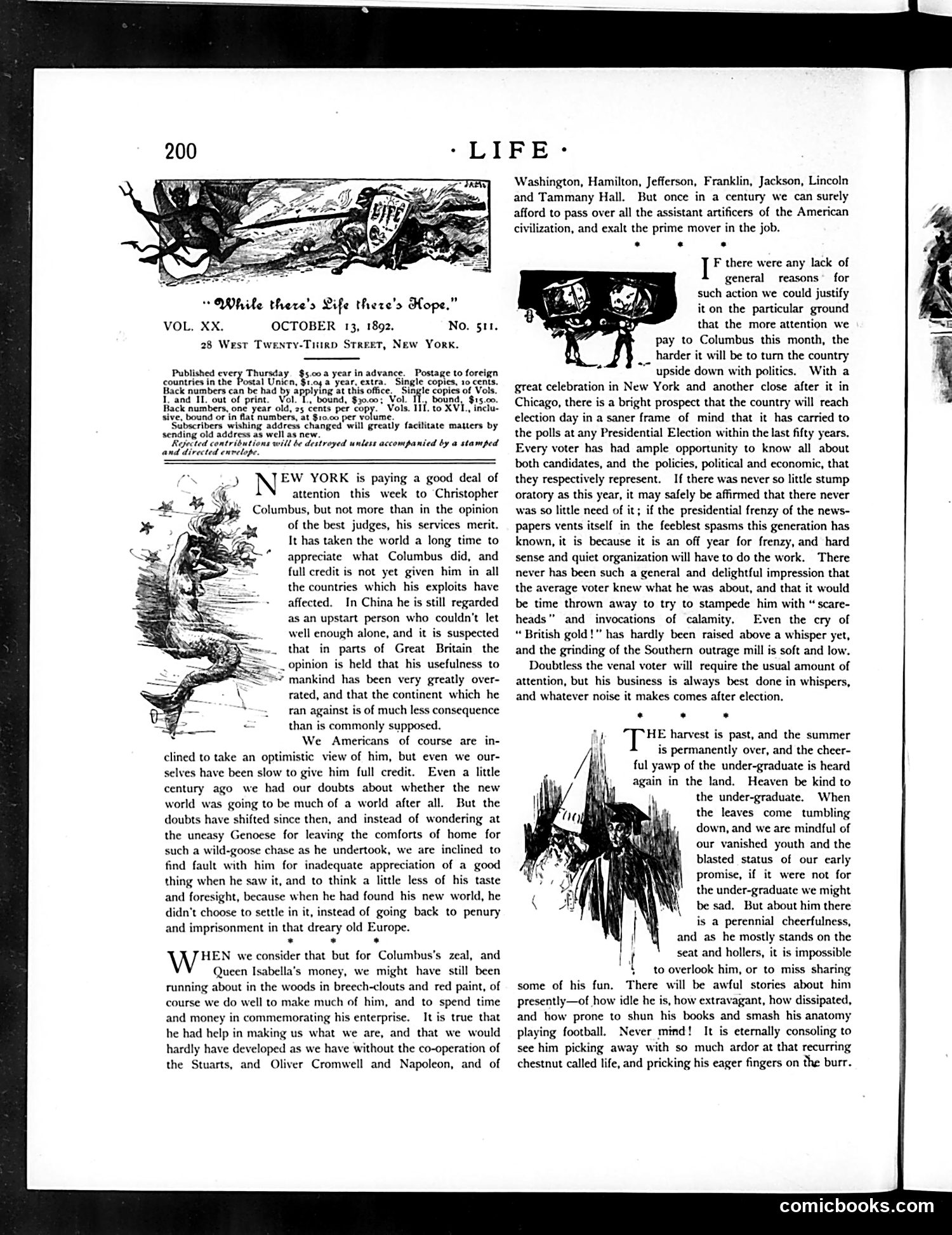
**Publication Details:** This is from Life Vol. XX, No. 511 (October 13, 1892), published in New York. **Main Content:** The page discusses Christopher Columbus and the upcoming presidential election. The text argues Columbus deserves commemoration despite his flaws, using him as a metaphor for American achievement. It advocates for focusing on candidates' actual positions rather than partisan attacks ("scare-heads" and "invocations of calamity"). **Illustrations:** Two sketches appear: one showing Columbus as a bearded historical figure, another depicting what appears to be an undergraduate or young man in casual dress. **Point:** The editorial uses Columbus Day celebration as a frame to urge voters toward rational, issues-focused election discourse—a subtle criticism of sensationalist campaign tactics of the 1892 election era.
📄 Transcribed text from this page (OCR, searchable)
Machine-transcribed from the original scan — historical spelling and the odd misread are preserved.
LIFE “While there's Life there's Hope,” VOL. XX. OCTOBER 13, 1892. No. 511. 28 West Twenty-Tiirp Street, New York. Published ever Thursday $s.00 a year in advance. countries in the ostal Unicn, $1.04 a year, extra. Back numbers can be had by applying at this office, I. and II, out of print. Vol $30.00; V bound, $15. Back numbers, one year old, Dy Cents per copy. Vols. Hi. to XVI, ine! sive, bound or in flat numbers, at $10.00 per volum Subscribers wishing address changed will greatly facilitate matters by sending old address as well as new. Rejected contributions will be destroyed unless accompanied by a stamped and directed envelope. Postage to foreign ‘Single copies, 10 cents. pile copics of Vols EW YORK is paying a good deal of attention this week to Christopher Columbus, but not more than in the opinion of the best judges, his services merit. It has taken the world a long time to appreciate what Columbus did, and full credit is not yet given him in all the countries which his exploits have affected. In China he is still regarded as an upstart person who couldn't let well enough alone, and it is suspected that in parts of Great Britain the opinion is held that his usefulness to mankind has been very greatly over- rated, and that the continent which he ran against is of much less consequence than is commonly supposed. We Americans of course are in- clined to take an optimistic view of him, but even we our- selves have been slow to give him full credit. Even a little century ago we had our doubts about whether the new world was going to be much of a world after all. But the ve shifted since then, and instead of wondering at Genoese for leaving the comforts of home for such a wild-goose chase as he undertook, we are inclined to find fault with him for inadequate appreciation of a good thing when he saw it, and to think a little less of his taste and foresight, because when he had found his new world, he didn’t choose to settle in it, instead of going back to penury and imprisonment in that dreary old Europe. . . . HEN we consider that but for Columbus's zeal, and Queen Isabella’s money, we might have still been running about in the woods in breech-clouts and red paint, of course we do well to make much of him, and to spend time and money in commemorating his enterprise. It is true that he had help in making us what we are, and that we would hardly have developed as we have without the co-operation of the Stuarts, and Oliver Cromwell and Napoleon, and of Washington, Hamilton, Jefferson, Franklin, Jackson, Lincoln and Tammany Hall. But once in a century we can surely afford to pass over all the assistant artificers of the American civilization, and exalt the pam mover in the job. IF F there were any lack of general reasons’ for such action we could justify iton the particular ground that the more attention we pay to Columbus this month, the _ harder it will be to turn the country upside down with politics. With a great celebration in New York and another close after it in Chicago, there is a bright prospect that the country will reach election day in a saner frame of mind that it has carried to the polls at any Presidential Election within the last fifty years. Every voter has had ample opportunity to know all about both candidates, and the policies, political and economic, that they respectively represent. If there was never so little stump oratory as this year, it may safely be affirmed that there never was so little need of it; if the presidential frenzy of the news- papers vents itself in the feeblest spasms this generation has known, it is because it is an off year for frenzy, and hard sense and quiet organization will have to do the work. There never has been such a general and delightful impression that the average voter knew what he was about, and that it would be time thrown away to try to stampede him with “ scare- heads” and invocations of calamity, Even the cry of “ British gold!" has hardly been raised above a whisper yet, and the grinding of the Southern outrage mill is soft and low. Doubtless the venal voter will require the usual amount of attention, but his business is always best done in whispers, and whatever noise it makes comes after election. * . . HE harvest is past, and the summer is permanently over, and the cheer- ful yawp of the under-graduate is heard again in the land. Heaven be kind to the under-graduate. When the leaves come tumbling down, and we are mindful of our vanished youth and the blasted status of our early promise, if it were not for the under-graduate we might be sad, But about him there is a perennial cheerfulness, { and as he mostly stands on the t seat and hollers, it is impossible $ to overlook him, or to miss sharing some of his fun. There will be awful stories about him presently—of how idle he is, how extravagant, how dissipated, and how prone to shun his books and smash his anatomy playing football. Never mind! It is eternally consoling to see him picking away with so much ardor at that recurring chestnut called life, and pricking his eager fingers on the burr. comicbooks.com