
A complete issue · 16 pages · 1892
Life — September 29, 1892
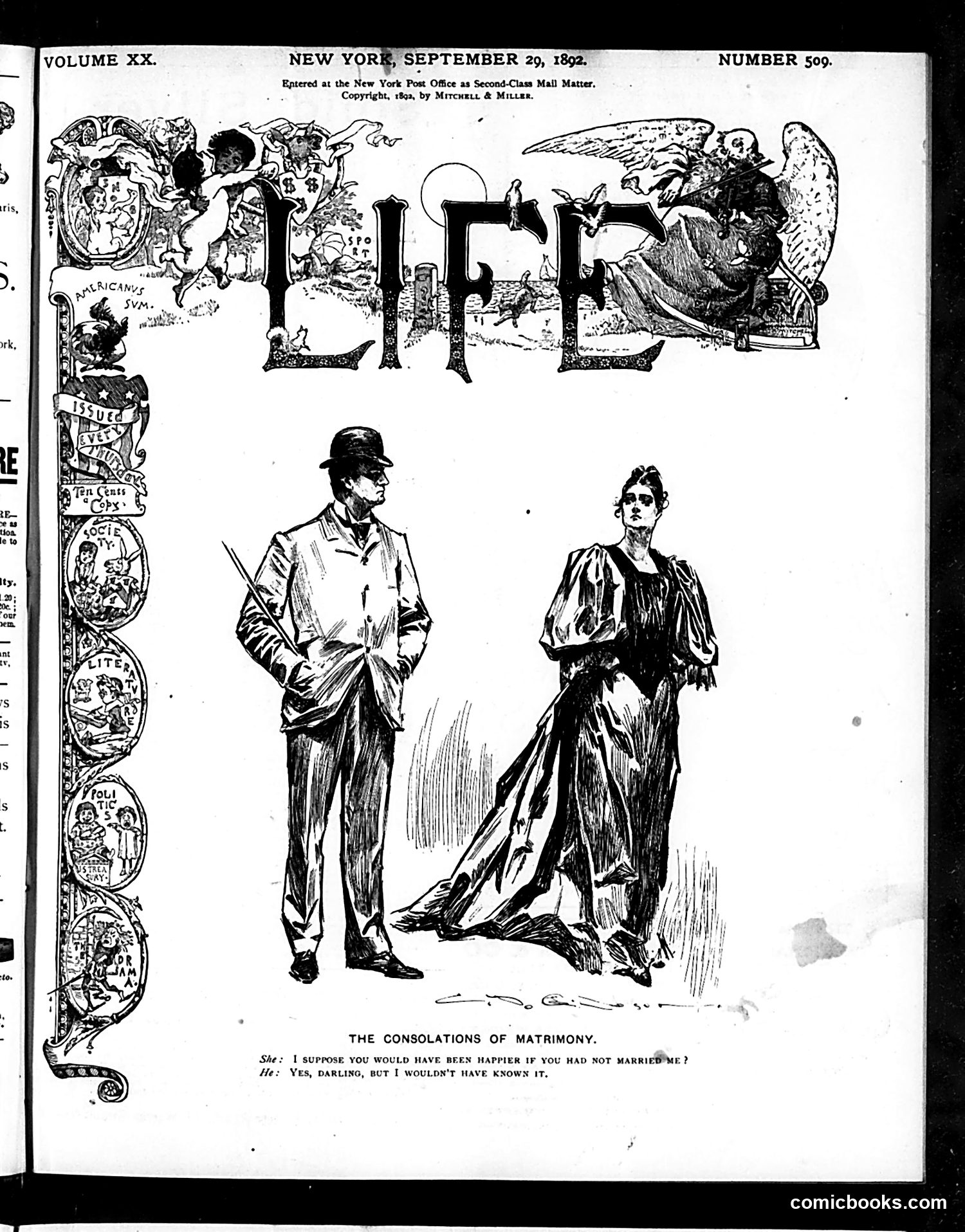
This 1892 *Life* magazine cartoon satirizes marriage through a domestic scene. A man and woman stand together, with the woman's elaborate trailing dress dominating the composition. The dialogue reveals the joke's cynicism: She asks if he would have been happier unmarried. He responds affirmatively but admits he wouldn't have known it—suggesting marriage prevents self-awareness of one's own unhappiness. The satire targets Victorian marriage as a trap that dulls men's perception of their own misery. The woman's fashionable, constraining dress visually reinforces the theme of entrapment. The cartoon reflects late-19th-century skepticism about matrimony's romantic promises, presenting marriage as resigned, mutual discontent disguised by social convention.
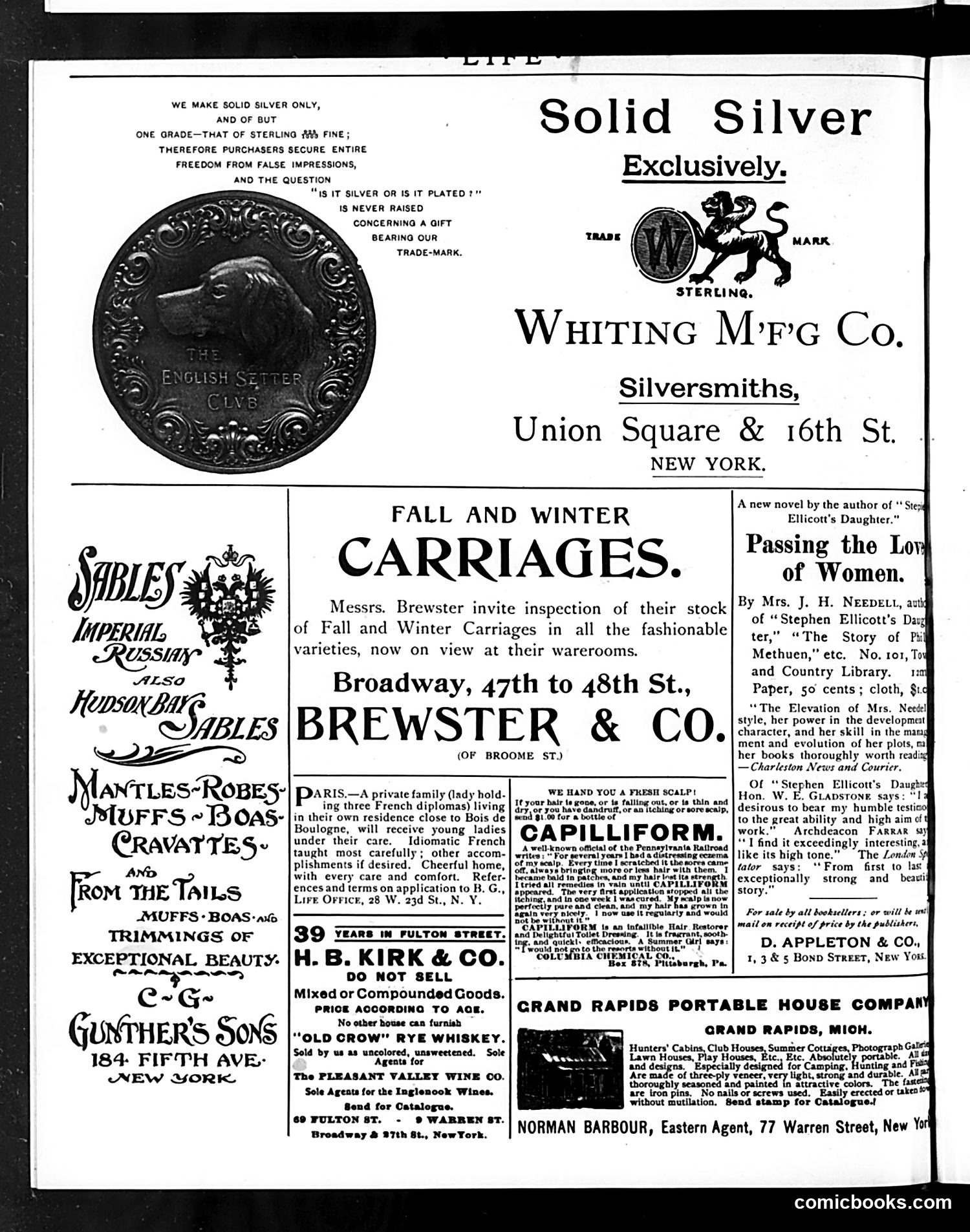
This page is primarily **advertising**, not satire or political commentary. The dominant content consists of commercial advertisements for upscale goods and services in late 19th-century New York: - **Whiting M'FG Co.** promotes sterling silver flatware - **Brewster & Co.** advertises carriages - **H.B. Kirk & Co.** sells furs and trimmings - **Gunther's Sons** offers fashionable clothing - Various other merchants advertise wines, portable houses, and miscellaneous goods The only potentially notable visual element is a circular medallion marked "The English Setter Club," though its satirical purpose, if any, is unclear from context. The page reflects *Life* magazine's business model: revenue generation through luxury goods advertising aimed at wealthy urban readers rather than political satire.
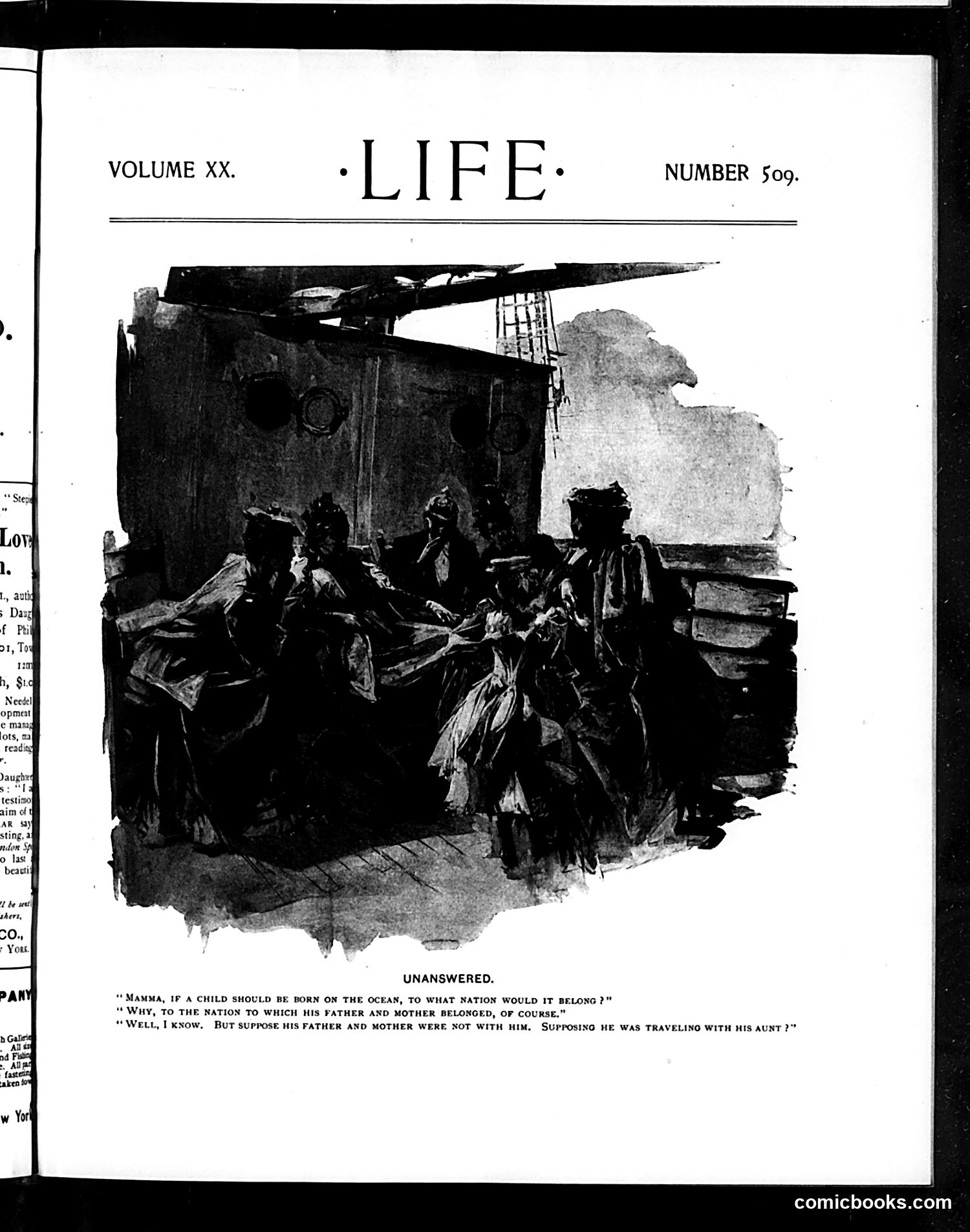
This appears to be a satirical cartoon about citizenship and national identity during travel. The image shows several figures in what seems to be a ship's cabin or vessel interior, with military hardware visible above. The dialogue presents a philosophical dilemma: if a child is born at sea, what nation claims citizenship? The response jokes that the child belongs to the father and mother's nation—but then poses a complication: what if the parents aren't traveling together, and the child is with an aunt instead? The satire likely critiques either immigration complications of the era or the absurdities of determining national identity and citizenship rights. The maritime setting suggests this addresses real concerns faced by travelers and immigrants, making bureaucratic nationality questions seem ridiculous through this domestic scenario.
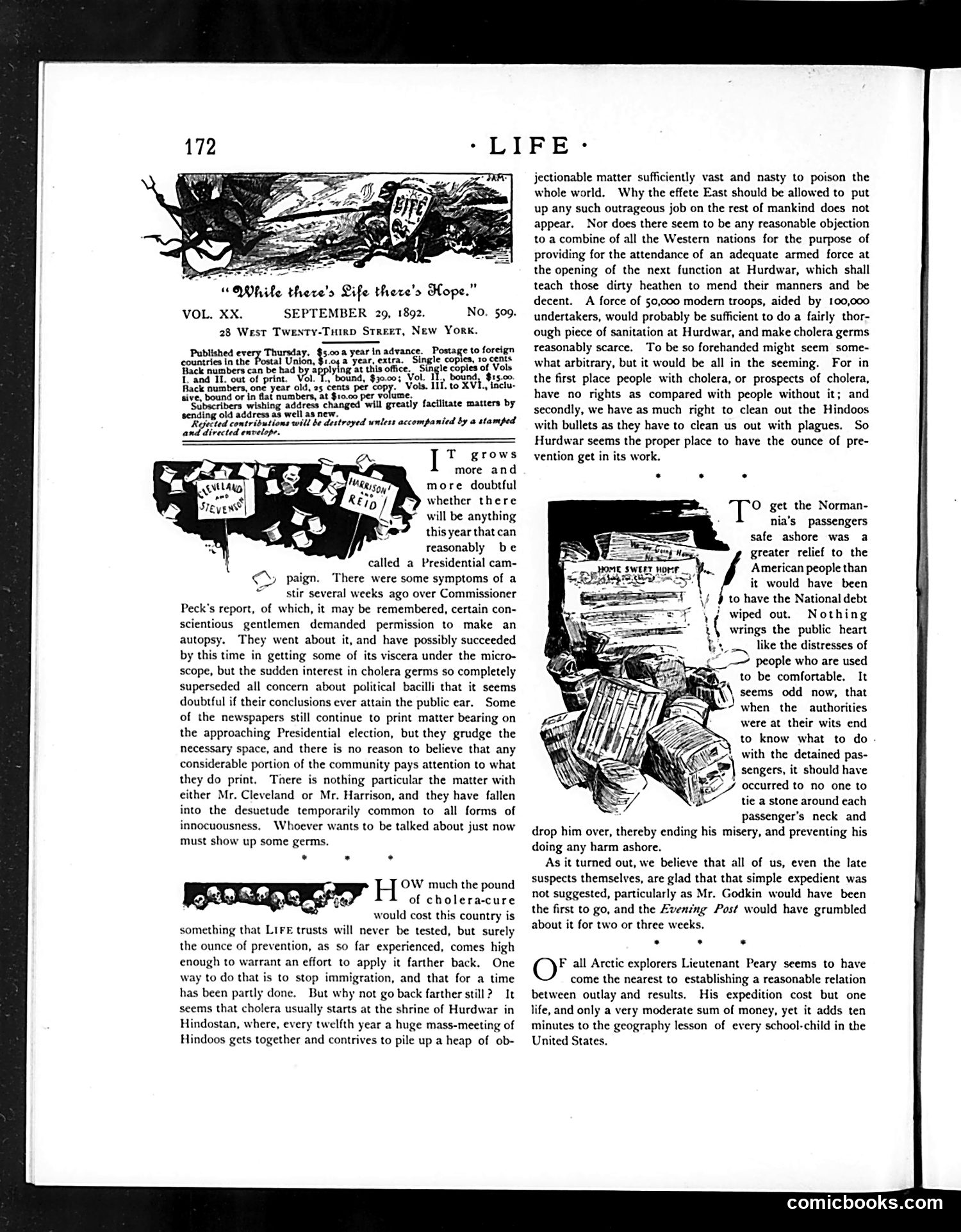
The page contains satirical commentary on the 1892 U.S. Presidential election. The text references Commissioner Peck's report and discusses cholera concerns in relation to immigration policy and the election between Cleveland and Harrison. The cartoon (upper left) shows what appears to be political figures labeled "Cleveland" and "Harrison" amid campaign-related imagery, though the specific caricatures are difficult to identify with certainty from this reproduction. The main satire criticizes how politicians exploit public health fears—specifically cholera and immigration—for electoral advantage. The author argues that stopping immigration would be more effective disease prevention than current measures, and sarcastically suggests the authorities' handling of ship passengers (the Normandia incident referenced in the text) was bungled but fortunately didn't result in worse casualties.
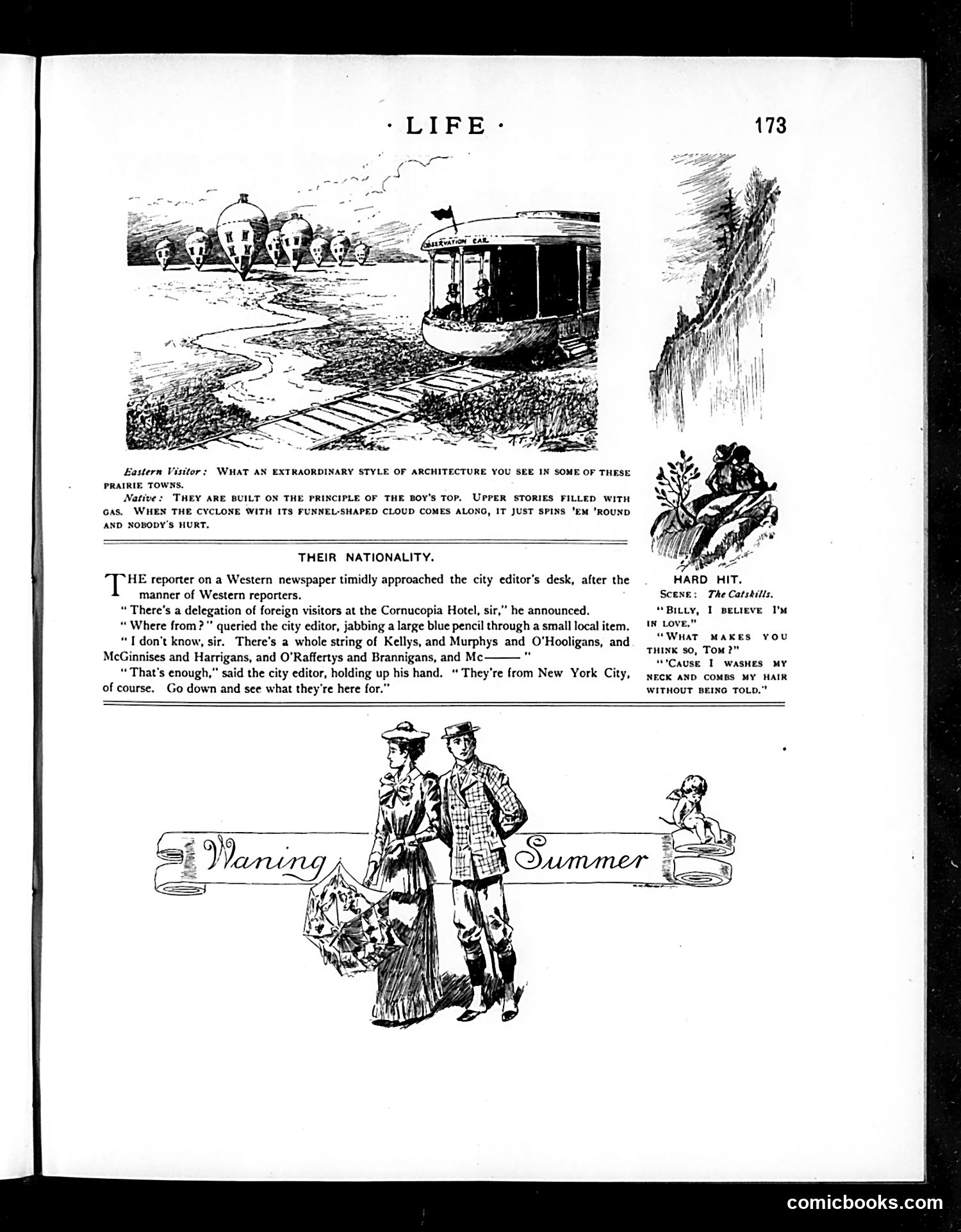
**Top Illustration - "Eastern Visitor"**: Satirizes prairie architecture, specifically sod houses built on the "boy's top" principle with upper stories filled with gas. The joke references cyclones common to the Great Plains—when a funnel cloud passes, it spins these houses around, leaving nobody hurt. This mocks both the peculiar building methods and the region's extreme weather. **Middle Section - "Their Nationality"**: A newspaper editor receives Irish-American visitors (Kellys, Murphys, O'Hooligans, McGinnises, Harrigans, and O'Malorys) from New York City. The satire targets Irish immigration and ethnic stereotyping through exaggerated names—a common trope in early 1900s American humor. **Bottom**: Advertisement or seasonal illustration titled "Waning Summer."
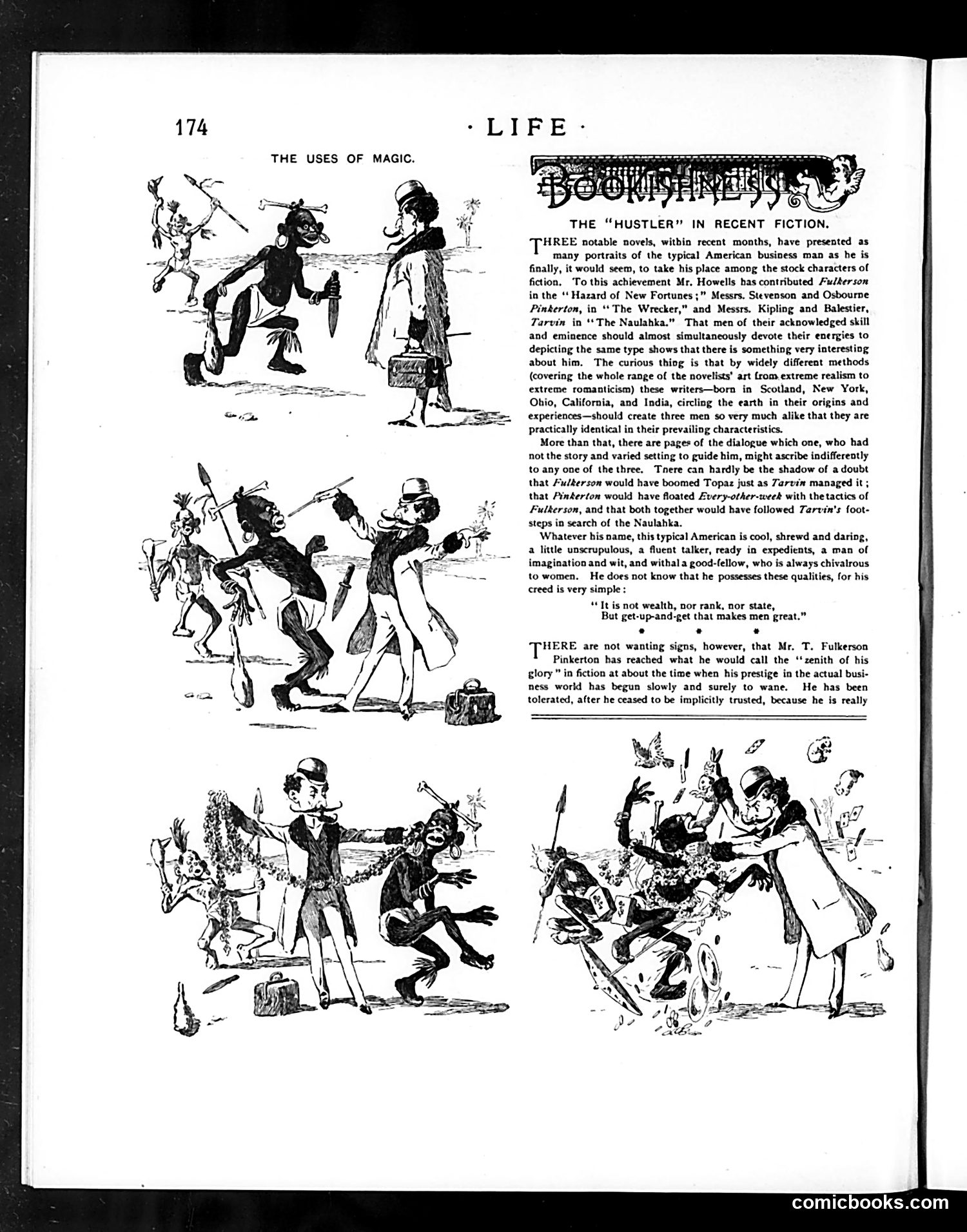
This page satirizes recent American fiction, specifically three novels featuring similar protagonists: T. Fulkerson Pinkerton's "Fullerton," "The Wrecker," and Kipling/Balestier's "Naulahka." The text criticizes how these distinct novels—set in Ohio, California, and India respectively—feature nearly identical "typical American" heroes: cool, shrewd, daring, unscrupulous businessmen who succeed through wit and charm. The cartoons illustrate "magic"—the literary sleight-of-hand by which authors create the illusion of originality while recycling the same character archetype across different settings and plots. The satire mocks both the authors' lack of imagination and publishers' apparent willingness to market identical heroes in different geographical disguises to gullible readers.
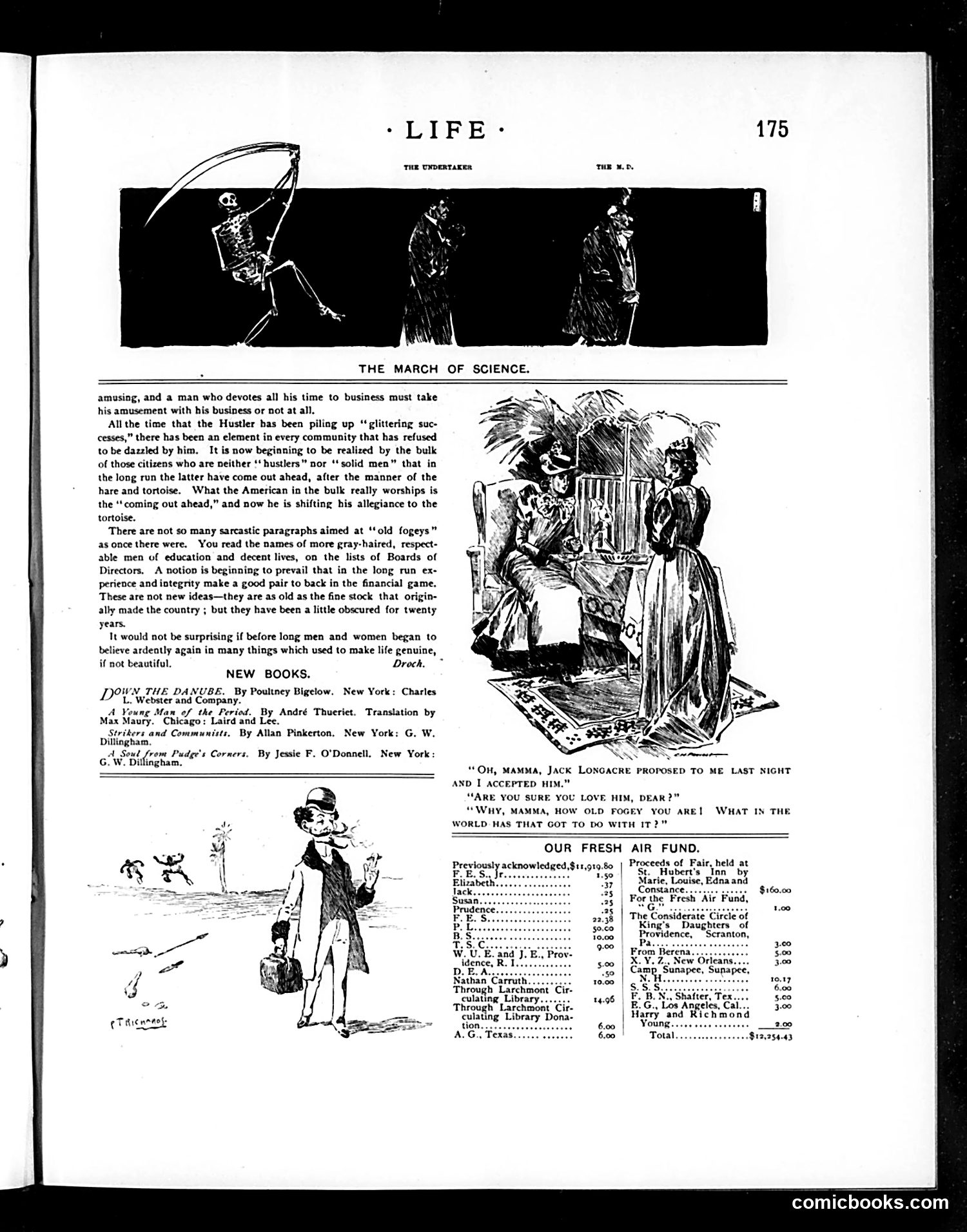
**Top Section ("The March of Science"):** Three panel cartoon showing skeletal figures labeled "The Undertaker" and "The K.D." This appears to be satirizing business practices—likely criticizing "hustlers" and financial manipulators. The text discusses how American businessmen ("the bulk") previously dismissed "hustlers" as unreliable but are now recognizing their success and shifting allegiance accordingly. The skeleton imagery suggests a darker critique of these financial practices. **Middle Section:** A separate cartoon shows a well-dressed man with a suitcase, appearing to represent a traveling businessman or con artist figure. **Bottom Section:** "Our Fresh Air Fund" lists charitable donations to various causes and individuals—a typical fundraising feature common in Life magazine of this era. The page primarily satirizes changing American business culture and attitudes toward financial operators.
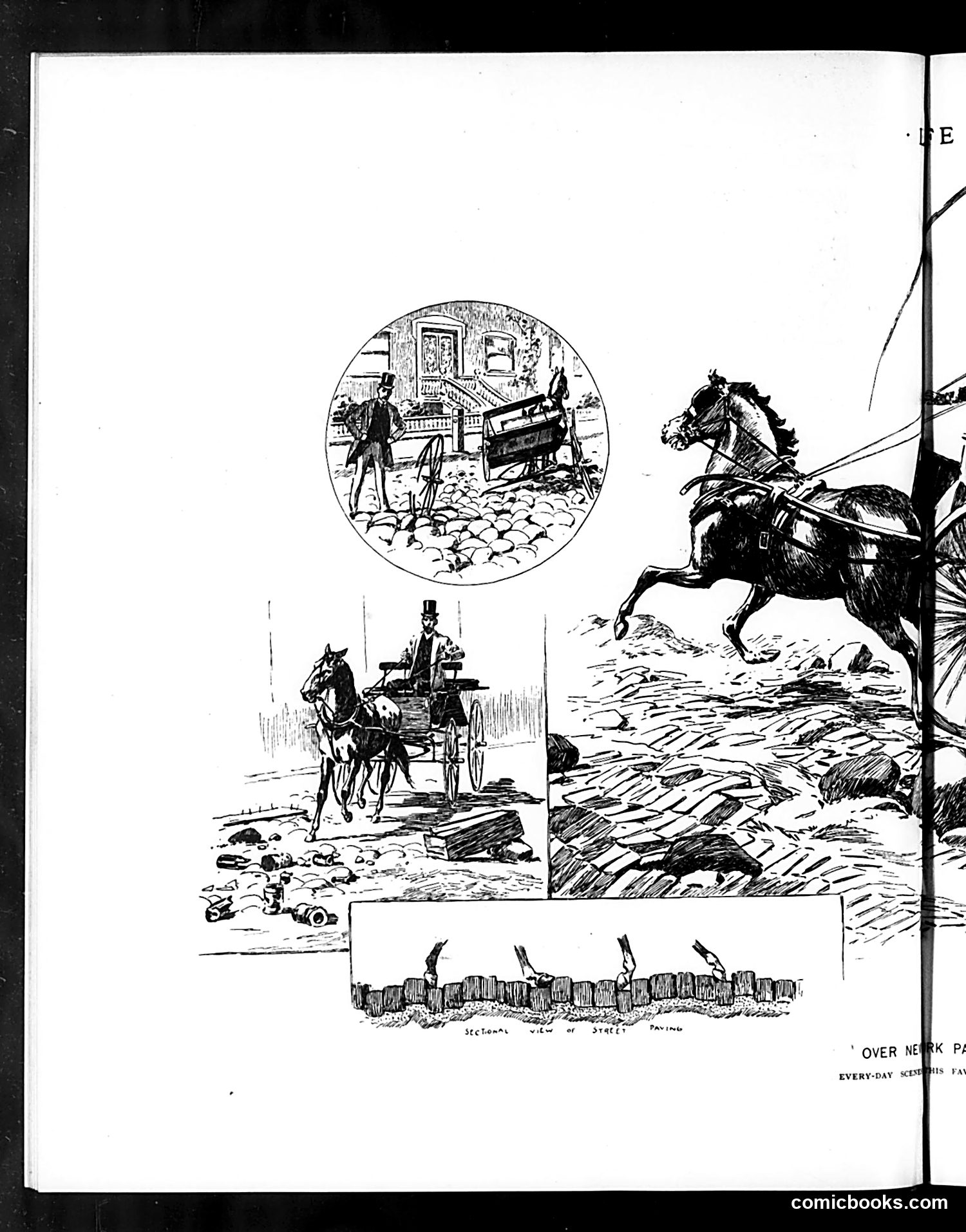
This page contains three black-and-white illustrations depicting scenes of urban life and transportation, likely from an early 20th-century American publication. The circular vignette at top shows an interior domestic scene with figures and furniture. Below are two larger panels: the left depicts a horse-drawn carriage with a formally-dressed driver on a rural road; the right shows a galloping horse near what appears to be a utility pole or street fixture. The bottom panel shows a landscape with fence posts. Text references "OVER NEWORK PA" and "EVERY-DAY SCENES FAV" (partially cut off), suggesting this illustrates everyday rural or suburban American scenes. Without complete text or clearer context, the specific satirical point remains unclear, though the juxtaposition of rural transportation and urban elements suggests commentary on modern change.
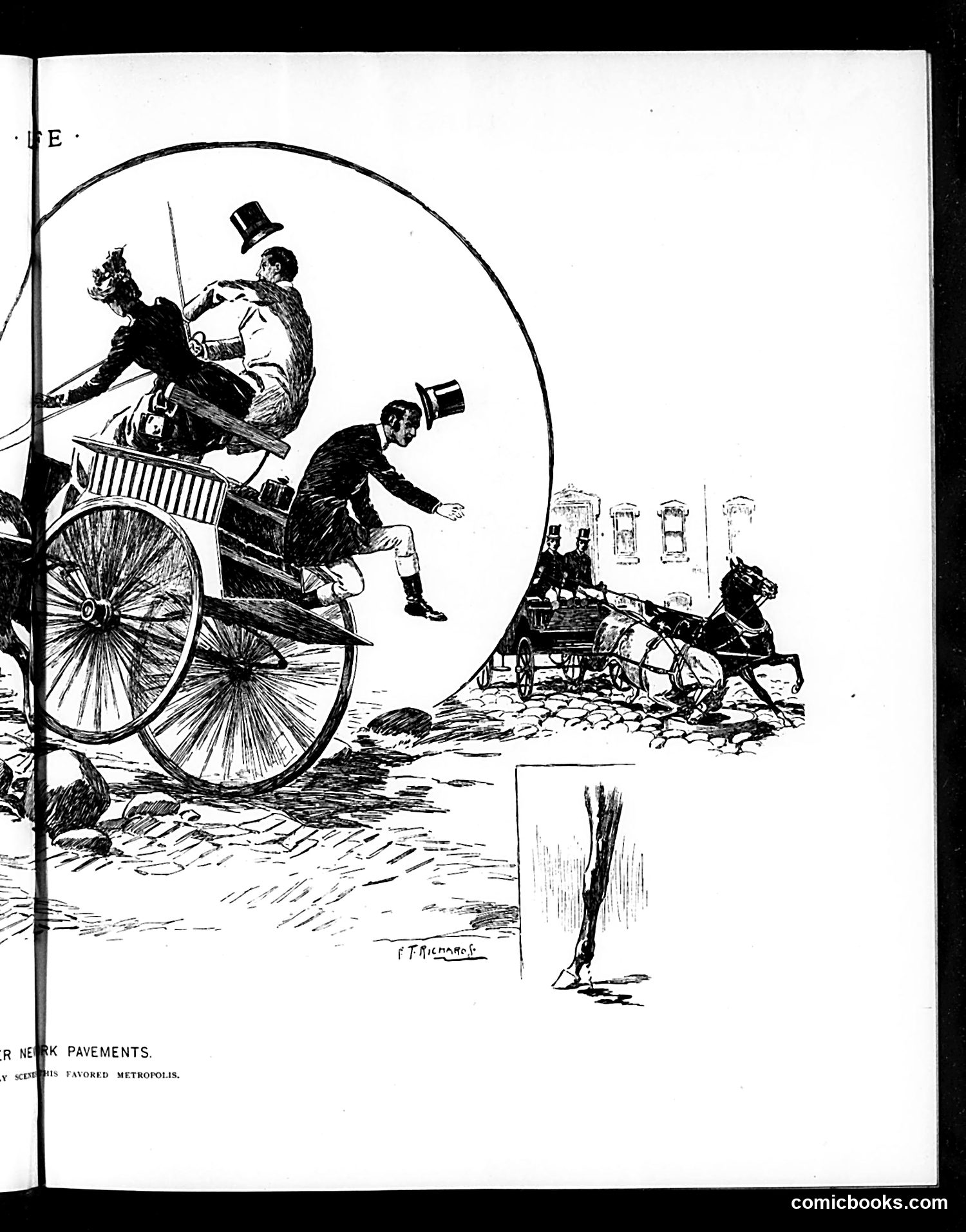
This satirical cartoon depicts a large wheel labeled "E" (likely representing a newspaper or publication) crushing or running over smaller figures and vehicles below. The wheel contains well-dressed gentlemen in top hats inside its rim, appearing to operate or control it, while outside the wheel, figures in formal dress appear to be victims or obstacles in its path. A horse-drawn carriage sits beneath, seemingly crushed or threatened. The visible text references "PAVEMENTS" and mentions "FAVORED METROPOLIS," suggesting this critiques how a powerful publication or institution (the large wheel) dominates and impacts urban life and transportation. The cartoon likely satirizes the outsized influence of a major newspaper or corporate entity on city infrastructure and public welfare.
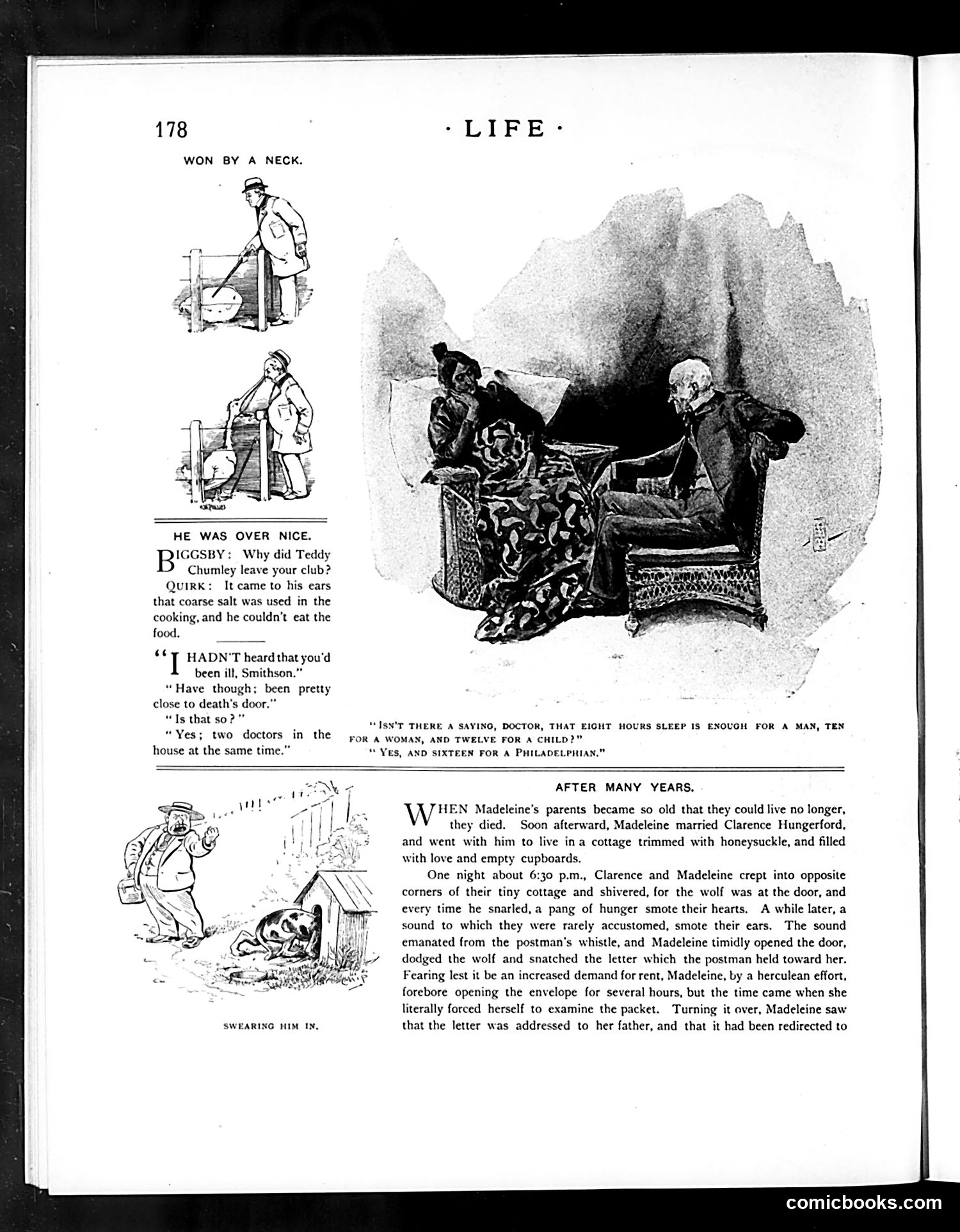
This page contains three distinct humorous pieces: 1. **"Won by a Neck"** - Two cartoon panels showing a man with a woman at what appears to be a racing venue, satirizing competitive courtship or dating. 2. **"He Was Over Nice"** - A dialogue joke where Teddy Chumley left his club because salt used in cooking made him ill and unable to eat—mocking the pretentiousness of wealthy club members and their delicate sensibilities. 3. **"After Many Years"** - A narrative story with illustrations about Madeleine and Clarence, involving a wolf and a redirected letter. The humor appears to turn on mistaken identity or romantic complications resolved through postal mishap. The page exemplifies *Life*'s typical approach: mixing visual gags with conversational humor targeting upper-class social foibles and domestic situations popular with early-20th-century American audiences.
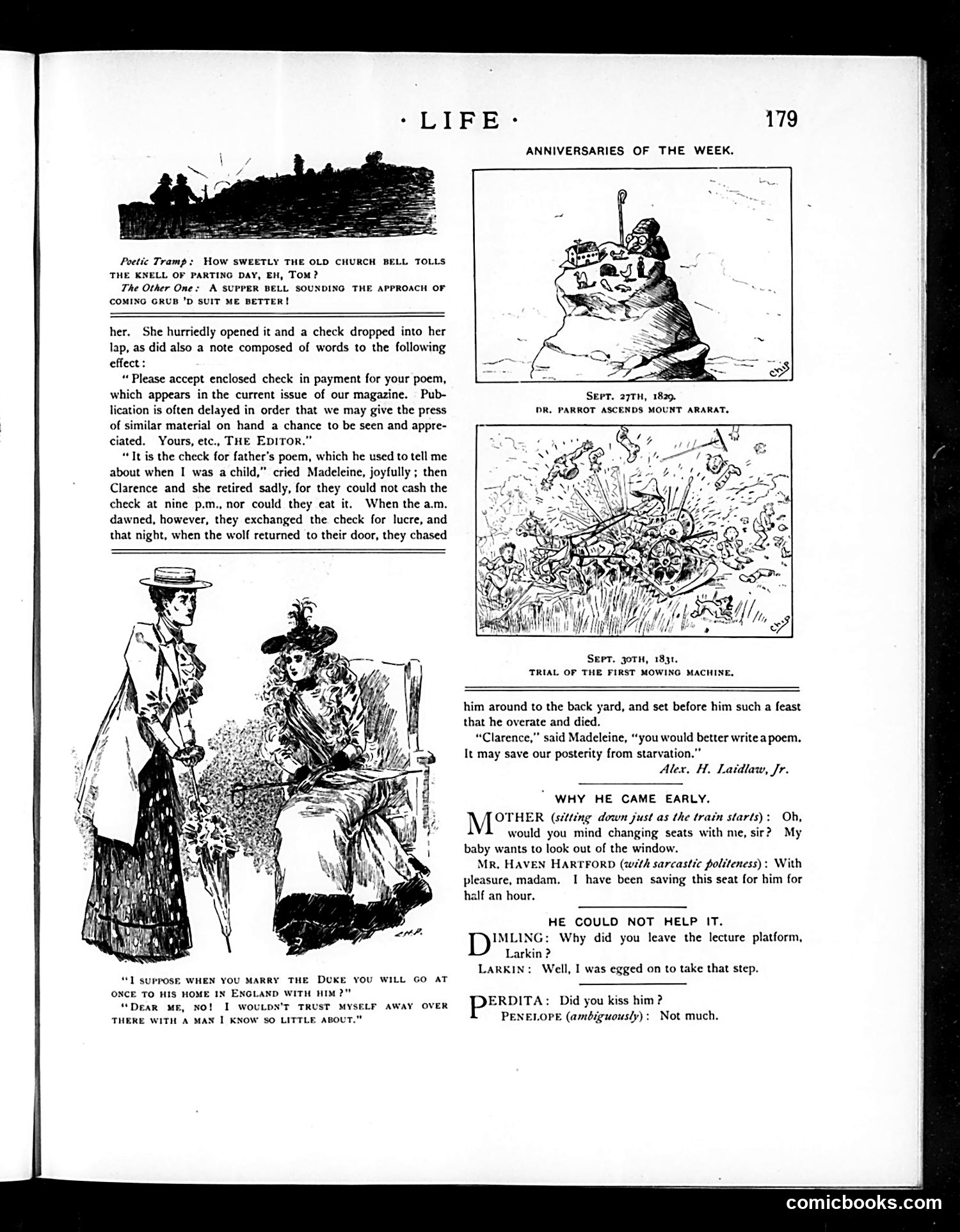
This page contains satirical humor and illustrations typical of early Life magazine. The main cartoon depicts a woman advising a man not to marry a duke, saying "I suppose when you marry the Duke you will go at once to his home in England with him?" with his concerned reply about trusting himself with "a man I know so little about." The page also includes literary selections, including a poem about a church bell and a dialogue titled "Why He Came Early" involving characters like a mother, Mr. Hayes Hartford, and others discussing train schedules and seat-changing. The anniversaries section references historical events from 1829 and 1831, including Dr. Parrot ascending Mount Ararat and the trial of the first mowing machine. The humor relies on period-specific social anxieties about marriage, travel, and Victorian propriety.
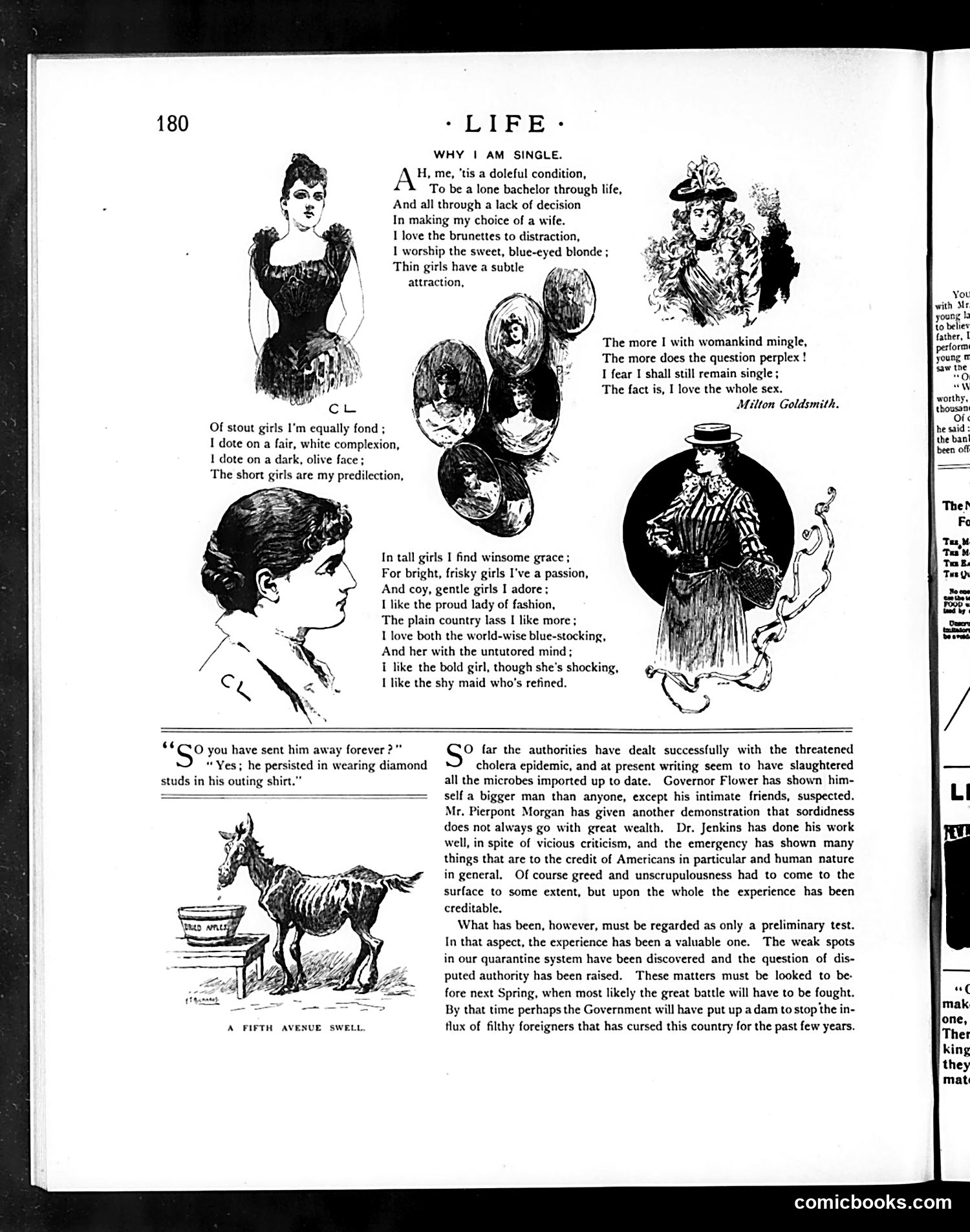
This page satirizes an indecisive bachelor who claims to love *every type* of woman—brunettes and blondes, stout and thin girls, bold and shy women—yet uses this supposed universal appreciation as an excuse for remaining unmarried. The humor lies in the contradiction: his inability to choose stems not from high standards but from lack of decisiveness, making his "love of the whole sex" a transparent rationalization for commitment-phobia. The accompanying text shifts to serious commentary on a cholera epidemic threatening America (likely the 1892 outbreak). It praises officials like Governor Flower and Dr. Jenkins for their response, while criticizing wealthy figures and exposing weaknesses in quarantine systems. The final sentence reveals nativist anxieties: blaming "filthy foreigners" for disease, reflecting period xenophobia about immigration. The cartoon titled "A Fifth Avenue Swell" mocks wealthy New York society types.
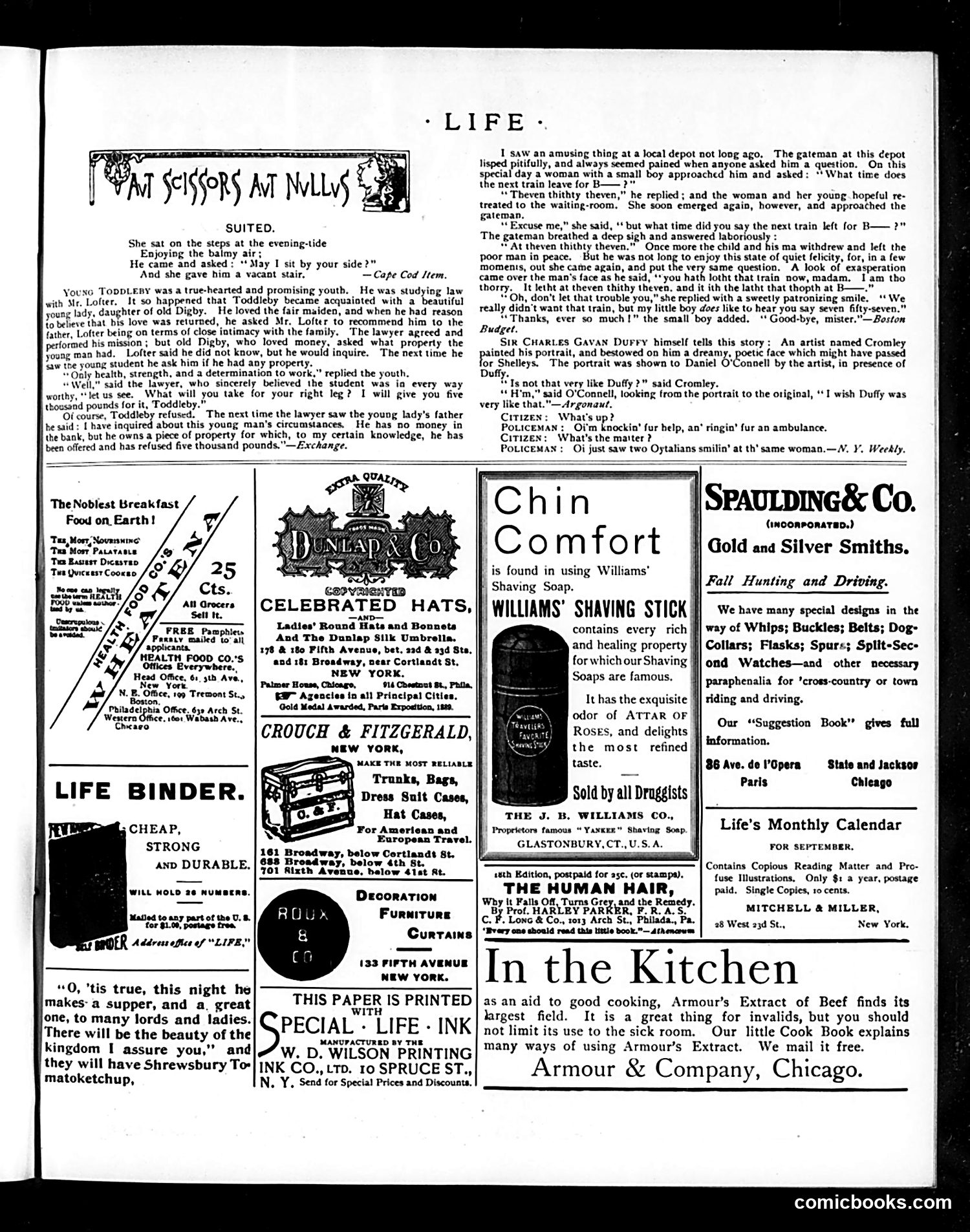
This page contains three separate humorous pieces, all satirizing human behavior: **"At Scissors and Nulls"** (main cartoon): A joke about a train depot gateman with a severe speech impediment (lisping "s" sounds as "th"). A boy and his mother repeatedly ask him train departure times, pretending to misunderstand his lisped response. The humor is cruel: they deliberately torment the disabled man for amusement, claiming the child enjoys hearing him speak. The satire targets meanness disguised as innocent fun. **"Toddleby" story**: A young law student lacks money despite having "health, strength, and determination." A lawyer cynically values him at "five thousand pounds"—for his body parts (right leg, etc.). The satire criticizes greed and the reduction of human worth to commercial value. **Police sketch**: A brief joke about Italians. An officer rings for an ambulance because two Italian men smiled at the same woman—implying Italian jealousy and violence. This reflects casual ethnic stereotyping common in period humor. The page is mostly advertising beneath these pieces.
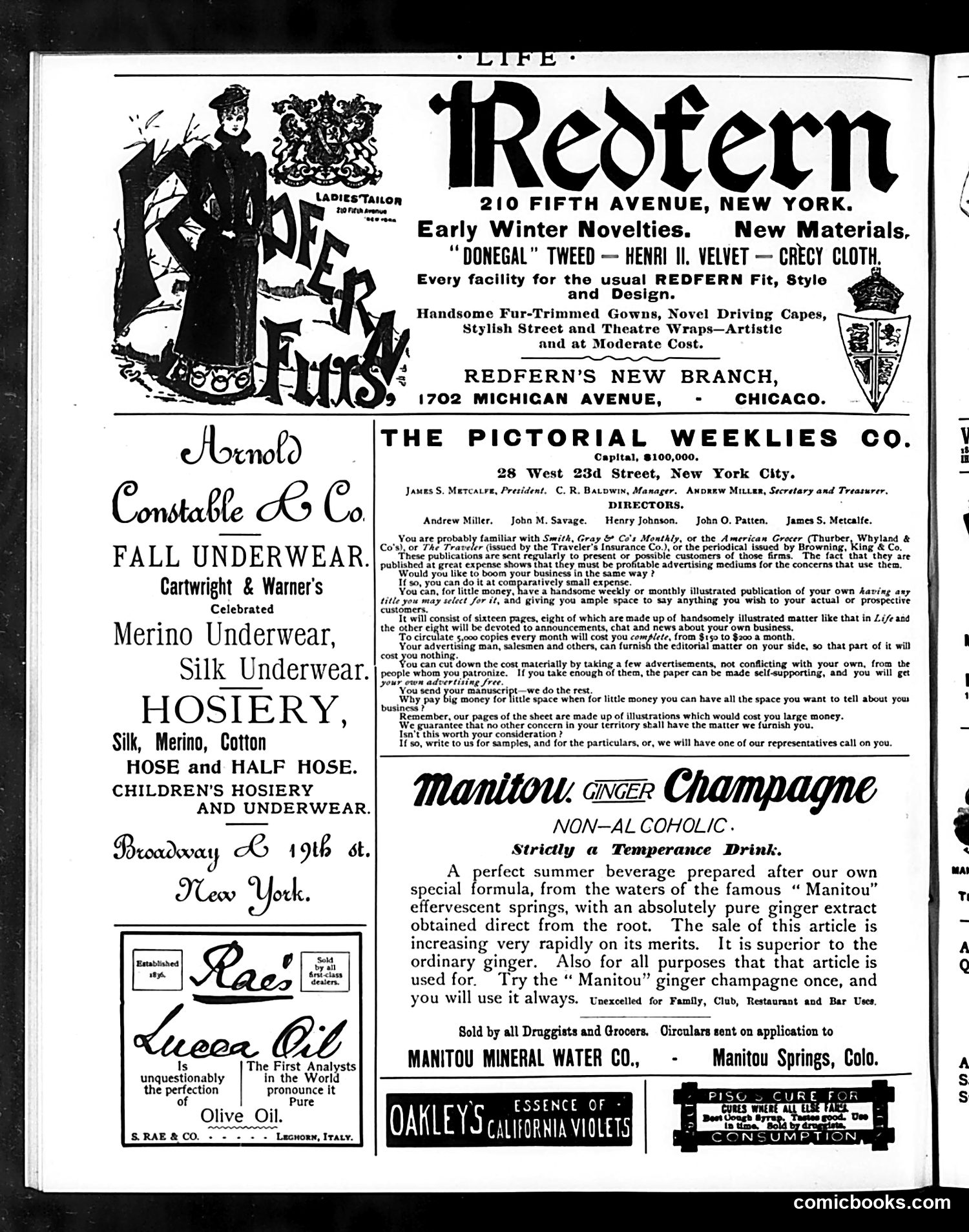
This is primarily an **advertising page** from Life magazine, not a satirical cartoon page. The content consists entirely of commercial advertisements from the early 1900s. **Key advertisements visible:** - **Redfern** (top): A ladies' tailor advertising "Early Winter Novelties" and new clothing materials - **Arnold Constable & Co**: Promoting fall underwear and hosiery - **The Pictorial Weeklies Co**: An extensive pitch explaining how businesses can create their own branded publications cheaply—essentially advertising the service of creating custom house organs/trade publications - **Manitou Ginger Champagne**: A non-alcoholic beverage marketed as a temperance drink - **Raes Lusea Oil**: Olive oil advertisement The page reflects turn-of-the-century consumer culture and the emerging practice of companies creating their own publications to reach customers directly—an early form of branded marketing and content creation.
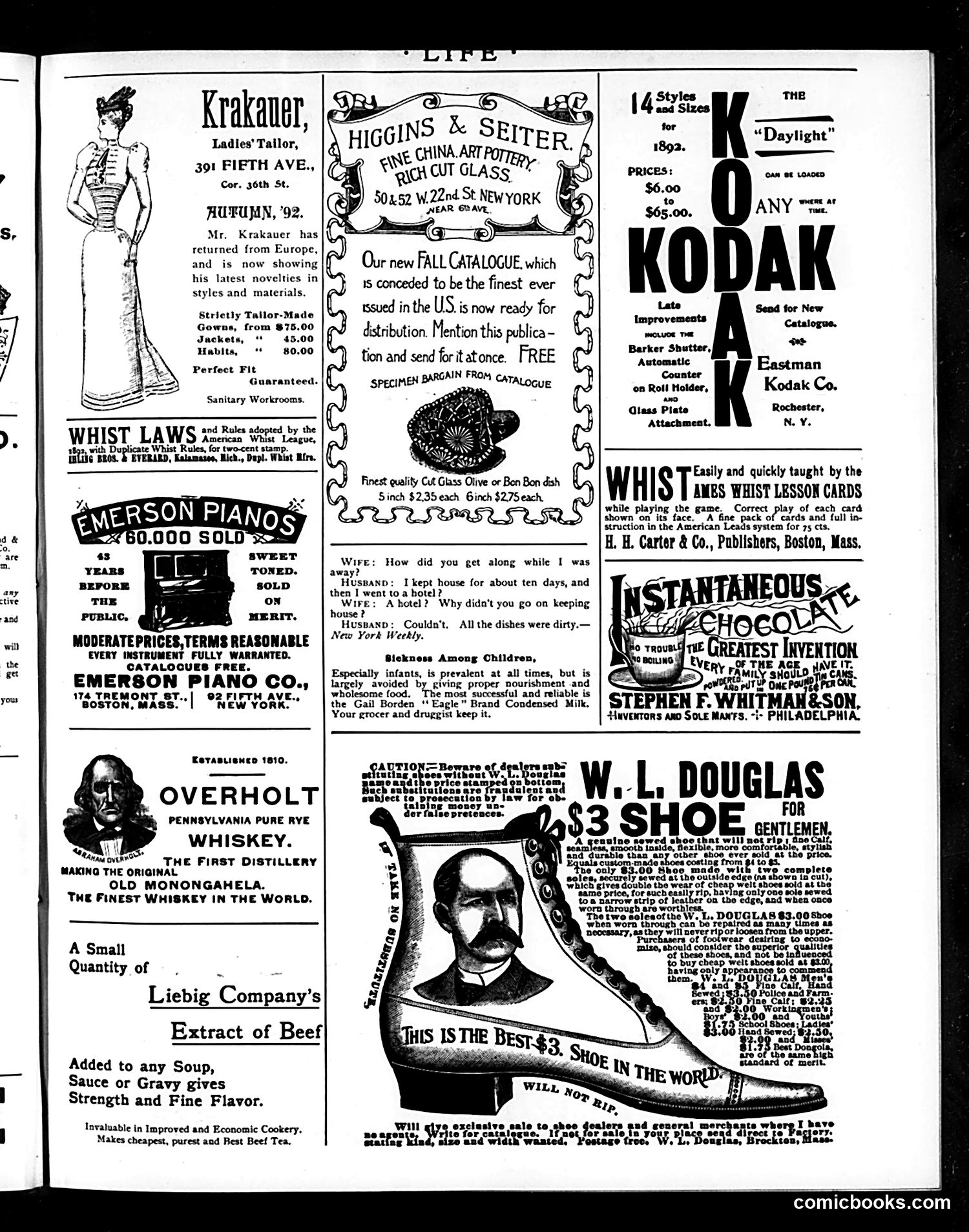
This page is primarily **advertising**, typical of 1890s Life magazine. The content includes: **Notable advertisements:** - **Krakauer, Ladies' Tailor**: Fashion tailoring services, reflecting the era's emphasis on custom-made women's clothing - **Overholt Whiskey**: Claims to be "the finest whiskey in the world," representing Pennsylvania rye whiskey marketing - **W.L. Douglas Shoes ($3)**: A major shoe manufacturer advertising durability and value - **Kodak camera accessories**: Emerging photography technology for consumers - **Emerson Pianos**: Home entertainment products - **Liebig's Extract of Beef**: Convenience food product for cooking **Humor content:** A brief domestic joke about a husband who kept house poorly (dishes remained dirty), satirizing men's domestic incompetence—a common joke format of the period. The page reflects 1892 consumer culture: manufactured goods, mail-order availability, and advertising's growing prominence in magazines. No significant political satire or cartoon appears on this page.
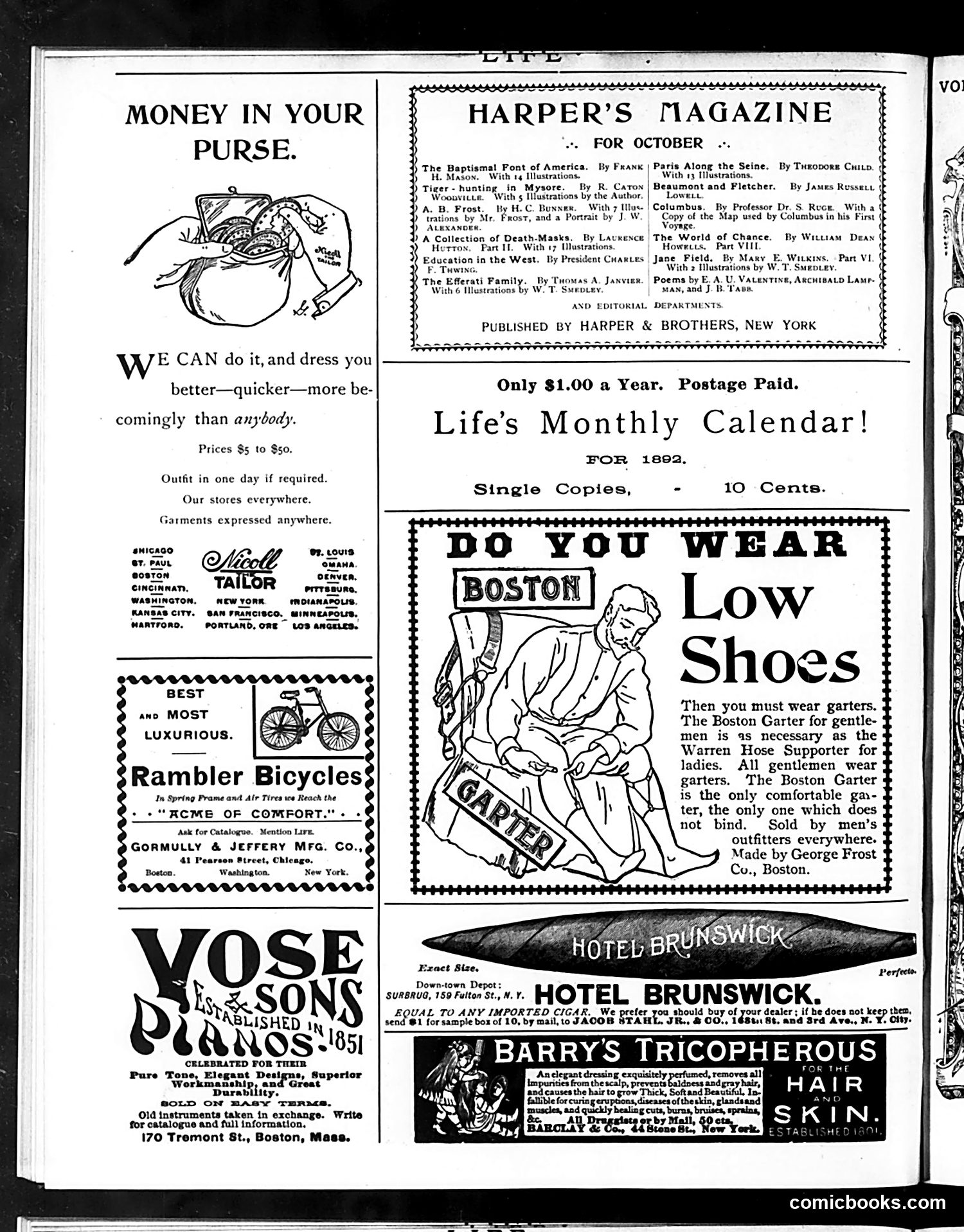
This page is primarily **advertising and magazine content**, not political satire or editorial cartoons. The visible content includes: **Magazine promotions:** - Harper's Magazine's October table of contents (literary articles on topics like Columbus, education, and fiction) - Life's Monthly Calendar for 1892 (10 cents per copy) **Advertisements:** - Nicoll clothing company (tailoring services, $5-$50) - Rambler Bicycles - Vose & Sons pianos - Boston Garter (for men wearing low shoes) - Hotel Brunswick - Barry's Tricopherous (hair/skin product) The only illustration with potential satirical intent is the **Boston Garter ad**, which humorously argues that gentlemen wearing low shoes *must* wear garters—presented as social necessity comparable to women's corset supports. Otherwise, this is a standard magazine page from the 1890s showcasing period products and services with minimal editorial content or political commentary.