
Life, 1892-09-29 · page 6 of 16
Life — September 29, 1892 — page 6: what you’re looking at
What you’re looking at
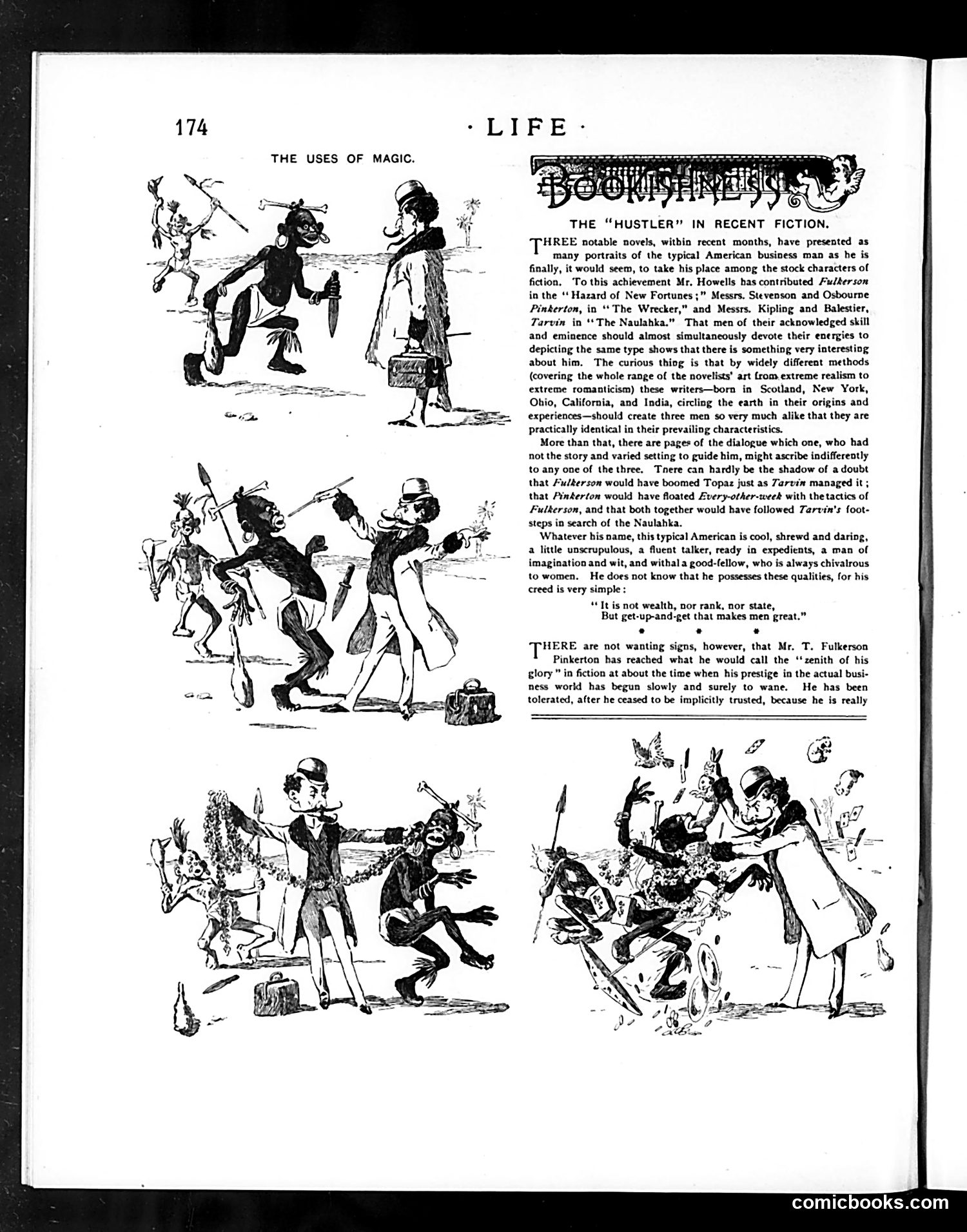
This page satirizes recent American fiction, specifically three novels featuring similar protagonists: T. Fulkerson Pinkerton's "Fullerton," "The Wrecker," and Kipling/Balestier's "Naulahka." The text criticizes how these distinct novels—set in Ohio, California, and India respectively—feature nearly identical "typical American" heroes: cool, shrewd, daring, unscrupulous businessmen who succeed through wit and charm. The cartoons illustrate "magic"—the literary sleight-of-hand by which authors create the illusion of originality while recycling the same character archetype across different settings and plots. The satire mocks both the authors' lack of imagination and publishers' apparent willingness to market identical heroes in different geographical disguises to gullible readers.
📄 Transcribed text from this page (OCR, searchable)
Machine-transcribed from the original scan — historical spelling and the odd misread are preserved.
THE “HUSTLER” IN RECENT FICTION. THREE notable novels, within recent months, have presented as many portraits of the typical American business man as he is finally, it would seem, to take his place among the stock characters of fiction, ‘To this achievement Mr. Howells has contributed Fulkerson in the ‘Hazard of New Fortunes ;” Messrs. Stevenson and Osbourne Pinkerton, in “The Wrecker,” and Messrs. Kipling and Balestier, Tarvin in “The Naulahka.” That men of their acknowledged skill and eminence should almost simultaneously devote their energies to depicting the same type shows that there is something very interesting about him. The curious thiog is that by widely different methods (covering the whole range of the novelists’ art (rom extreme realism to extreme romanticism) these writers—born in Scotland, New York, Ohio, California, and India, circling the earth in their origins and experiences—should create three men so very much alike that they are practically identical in their prevailing characteristics. More than that, there are pages of the dialogue which one, who had not the story and varied setting to guide him, might ascribe indifferently to any one of the three, Tnere can hardly be the shadow of a doubt that Fulkerson would have boomed Topaz just as Tarvin managed it ; that Pinderton would have floated Every-other-week with the tactics of Fulkerson, and that both together would have followed Tarvin's foot- steps in search of the Naulabka. Whatever his name, this typical American is cool, shrewd and daring, a little unscrupulous, a fluent talker, ready in expedients, a man of imagination and wit, and withal a good-fellow, who is always chivalrous to women. He does not know that he possesses these qualities, for his creed is very simple : “Tt is not wealth, nor rank, nor state, But get-up-and-get that makes men great.” . . * THERE are not wanting signs, however, that Mr. T. Fulkerson Pinkerton has reached what he would call the ‘zenith of his glory” in fiction at about the time when his prestige in the actual busi- ness world has begun slowly and surely to wane. He has been tolerated, after he ceased to be implicitly trusted, because he is really comicbooks.com