
Life, 1892-09-29 · page 4 of 16
Life — September 29, 1892 — page 4: what you’re looking at
What you’re looking at
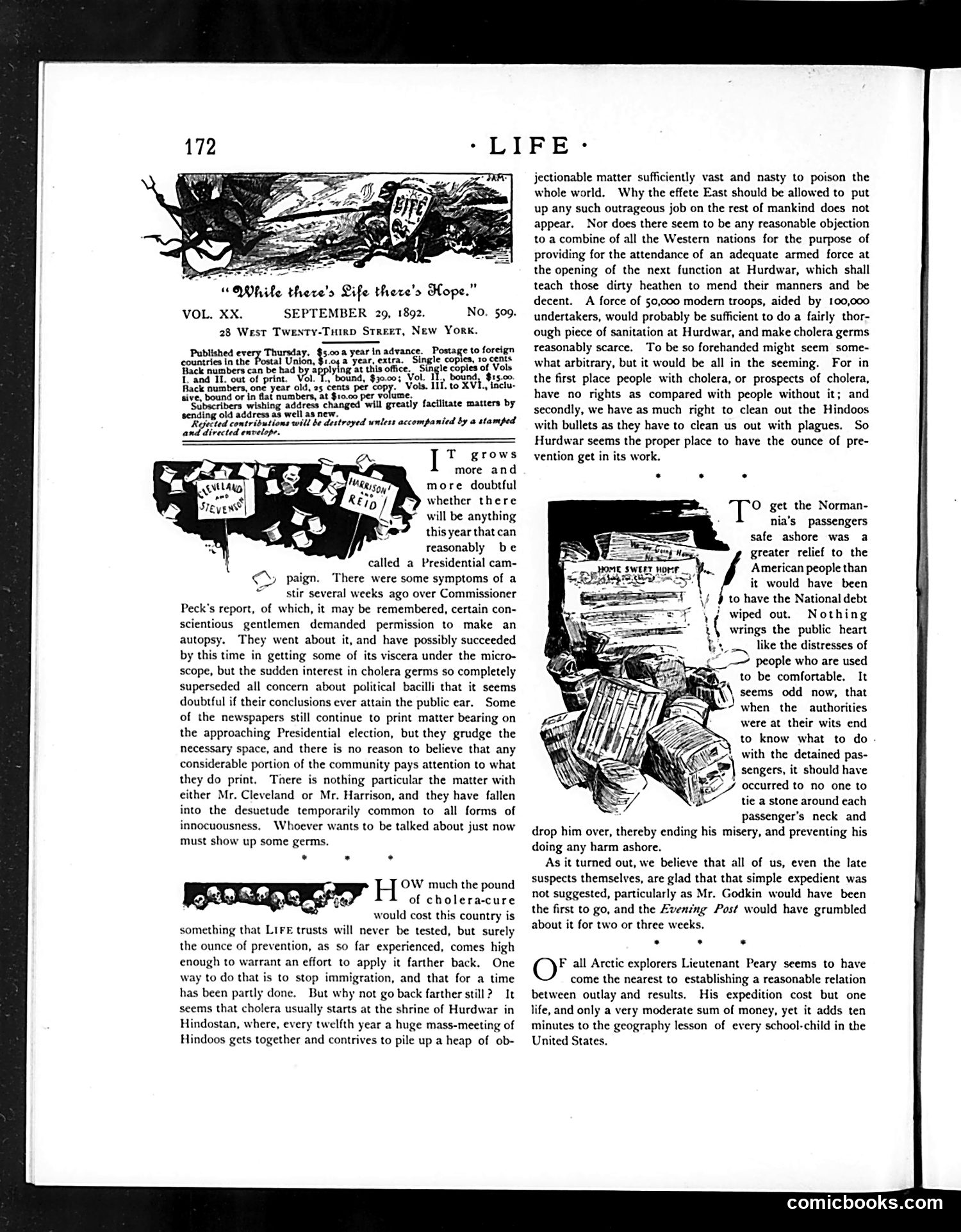
The page contains satirical commentary on the 1892 U.S. Presidential election. The text references Commissioner Peck's report and discusses cholera concerns in relation to immigration policy and the election between Cleveland and Harrison. The cartoon (upper left) shows what appears to be political figures labeled "Cleveland" and "Harrison" amid campaign-related imagery, though the specific caricatures are difficult to identify with certainty from this reproduction. The main satire criticizes how politicians exploit public health fears—specifically cholera and immigration—for electoral advantage. The author argues that stopping immigration would be more effective disease prevention than current measures, and sarcastically suggests the authorities' handling of ship passengers (the Normandia incident referenced in the text) was bungled but fortunately didn't result in worse casualties.
📄 Transcribed text from this page (OCR, searchable)
Machine-transcribed from the original scan — historical spelling and the odd misread are preserved.
LIFE “OMhile there's Life there's Hope.” VOL. XX. SEPTEMBER 29, 1892. NO. 509. 28 West Twenty-THirp STR Street, New York. Published e countries in the Back numbers can be bad by, ay I, and II. out of print. Vol. Hiack numbers, one year old, a5 "tenes per sive, bound or in flat numbers, at $10.00 per vo! Subscribers wishing address cl sending old address as well as new. Reeiied contributions will be destroyed unless accompanied by a stamped and directed envelope. fore }s.00 a year in advance. Postage to foreign ear, extra. Sinj lea, 10 a Uae ida at this office. Si es copies of Vols und, Vet} $15.00. $30? Vota Lit. to XV, taete- ies facilitate matters by T grows more and more doubtful whether there will be anything this year that can reasonably be called a Presidential cam- <> paign. There were some symptoms of a stir several weeks ago over Commissioner Peck’s report, of which, it may be remembered, certain con- scientious gentlemen demanded permission to make an autopsy. They went about it, and have possibly succeeded by this time in getting some of its viscera under the micro- scope, but the sudden interest in cholera germs so completely superseded all concern about political bacilli that it seems doubtful if their conclusions ever attain the public ear. Some of the newspapers still continue to print matter bearing on the approaching Presidential election, but they grudge the necessary space, and there is no reason to believe that any considerable portion of the community pays attention to what they do print, There is nothing particular the matter with either Mr. Cleveland or Mr. Harrison, and they have fallen into the desuetude temporarily common to all forms of innocuousness. Whoever wants to be talked about just now must show up some germs. . OW much the pound of cholera-cure would cost this country is something that LIFE trusts will never be tested, but surely the ounce of prevention, as so far experienced, comes high enough to warrant an effort to apply it farther back. One way to do that is to stop immigration, and that for a time has been partly done. But why not go back farther still? It seems that cholera usually starts at the shrine of Hurdwar in Hindostan, where, every twelfth year a huge mass-meeting of Hindoos gets together and contrives to pile up a heap of ob- jectionable matter sufficiently vast and nasty to poison the whole world. Why the effete East should be allowed to put up any such outrageous job on the rest of mankind does not appear. Nor does there seem to be any reasonable objection to a combine of all the Western nations for the purpose of providing for the attendance of an adequate armed force at the opening of the next function at Hurdwar, which shall teach those dirty heathen to mend their manners and be decent. A force of 50,000 modern troops, aided by 100,000 undertakers, would probably be sufficient to do a fairly thor- ough piece of sanitation at Hurdwar, and make cholera germs reasonably scarce. To be so forehanded might seem some- what arbitrary, but it would be all in the seeming. For in the first place people with cholera, or prospects of cholera, have no rights as compared with people without it; and secondly, we have as much right to clean out the Hindoos with bullets as they have to clean us out with plagues. So Hurdwar seems the proper place to have the ounce of pre- vention get in its work. . i Ba get the Norman- nia’s passengers safe ashore was a greater relief to the American people than it would have been to have the National debt y ¢ Wiped out. Nothing \¢ wrings the public heart ty like the distresses of “_— people who are used H,, be comfortable. It ‘\ seems odd now, that - when the authorities were at their wits end to know what to do with the detained pas- sengers, it should have occurred to no one to tie a stone around each passenger's neck and drop him over, thereby ending his misery, and preventing his doing any harm ashore. As it turned out, we believe that all of us, even the late suspects themselves, are glad that that simple expedient was not suggested, particularly as Mr. Godkin would have been the first to go, and the Evening Post would have grumbled about it for two or three weeks. . . * F all Arctic explorers Lieutenant Peary seems to have come the nearest to establishing a reasonable relation between outlay and results. His expedition cost but one life, and only a very moderate sum of money, yet it adds ten minutes to the geography lesson of every school-child in the United States, comicbooks.com