
A complete issue · 14 pages · 1892
Life — September 22, 1892
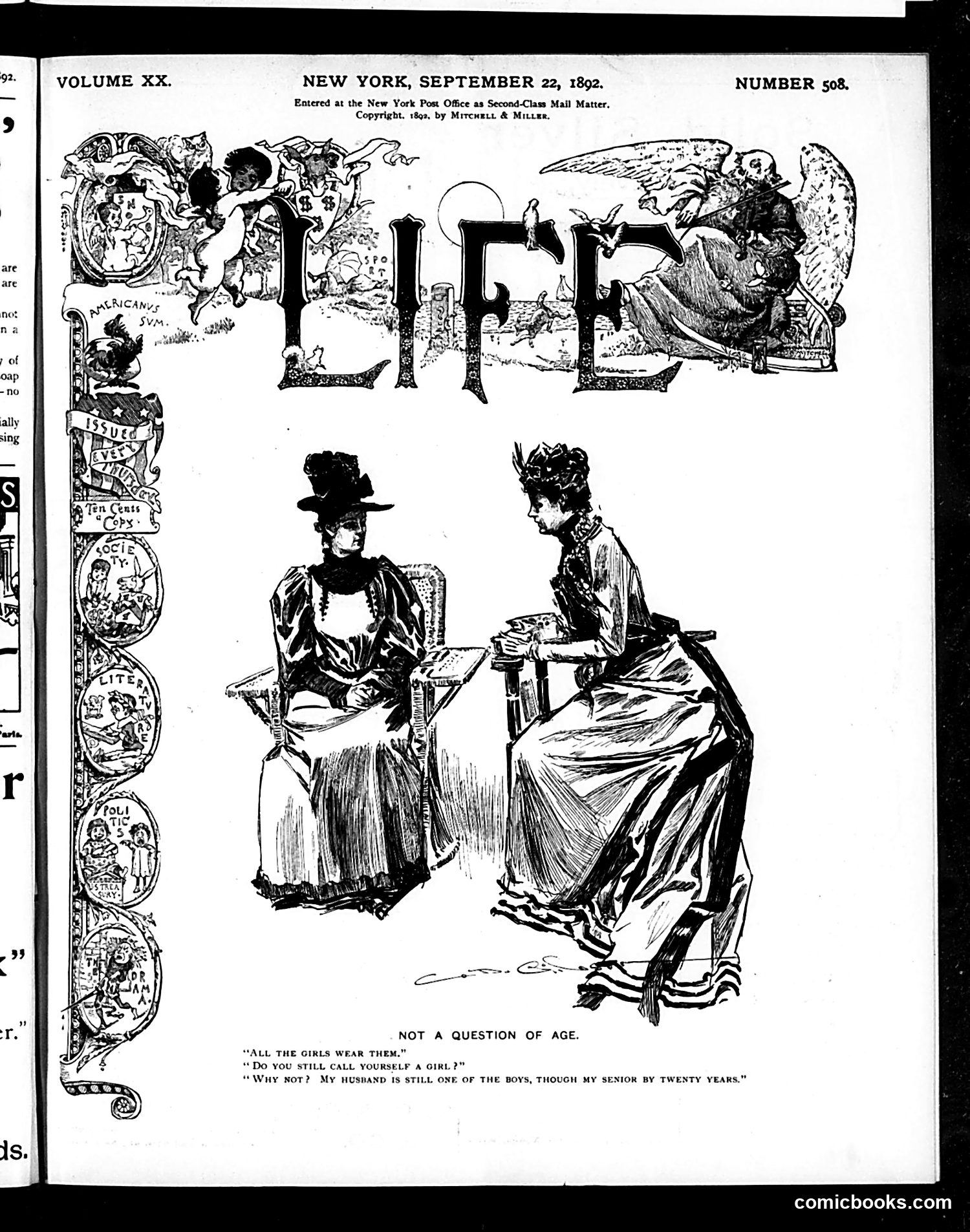
This satirical cartoon depicts two well-dressed women in conversation, illustrating a debate about marital status and social identity. The caption and dialogue address whether a married woman should still be called a "girl": - Woman 1: "All the girls wear them." - Woman 2: "Do you still call yourself a girl?" - Woman 3: "Why not? My husband is still one of the boys, though my senior by twenty years." The humor lies in the double standard: men retain the casual "boy" designation into adulthood when socializing, while women's use of "girl" after marriage was considered inappropriate by contemporary social conventions. The satire critiques this gendered inconsistency in how society labels adults based on marital status, suggesting both husbands and wives should be afforded equal linguistic flexibility.
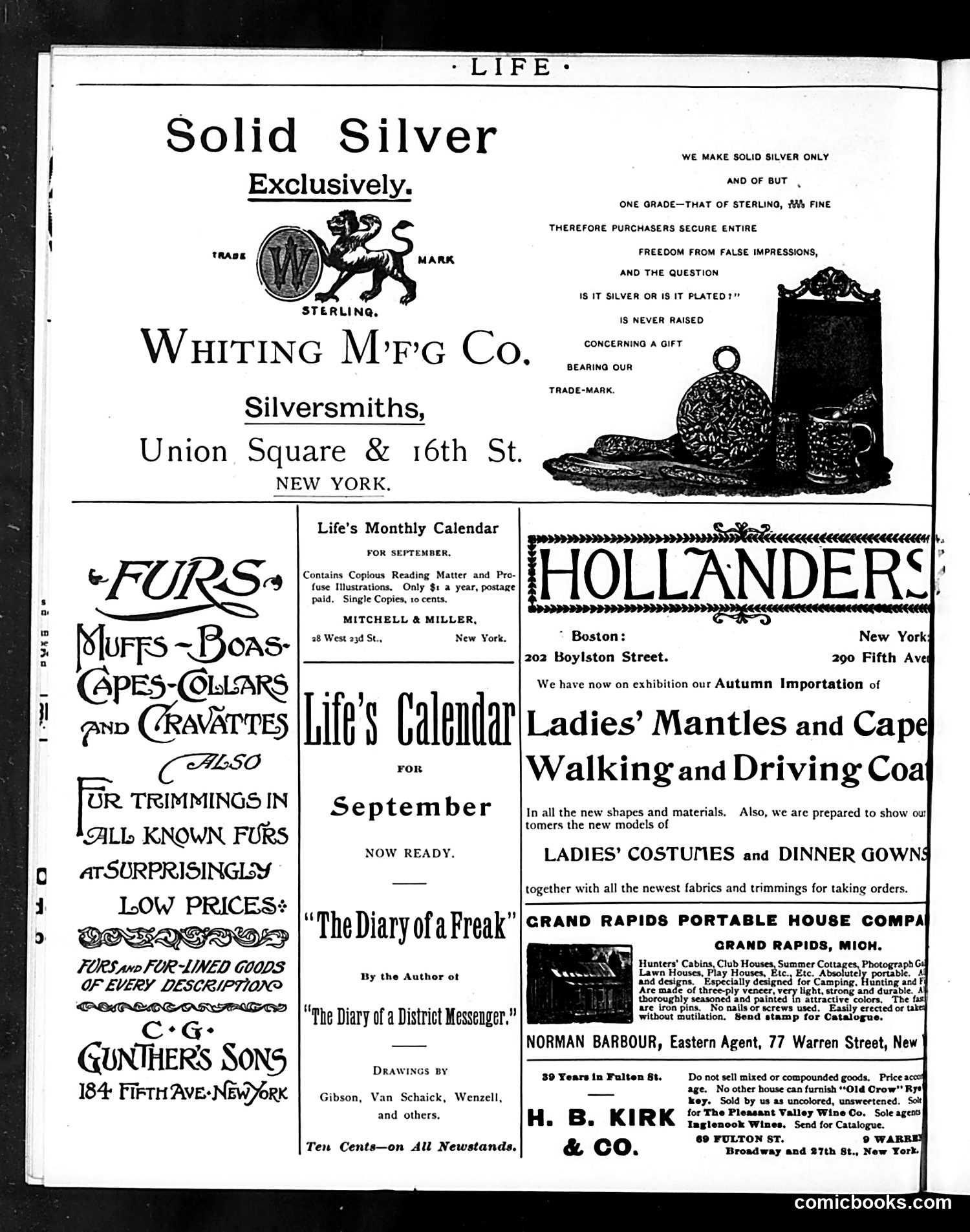
This page is **primarily advertising**, not satirical content. The main advertisement promotes Whiting Manufacturing Company's sterling silver flatware and hollowware, emphasizing it's "solid silver exclusively" to distinguish their products from cheaper plated alternatives—a significant sales concern of the era. Other advertisements include: - Hollanders (clothing, Boston and New York) - Gunthers Sons (furs) - Grand Rapids Portable House Company - H.B. Kirk & Co. (wines) The only editorial content is promotion for "Life's Calendar for September" and an upcoming book, "The Diary of a Freak." There are no political cartoons or satirical commentary on this particular page—it's a standard turn-of-century magazine advertisement layout.
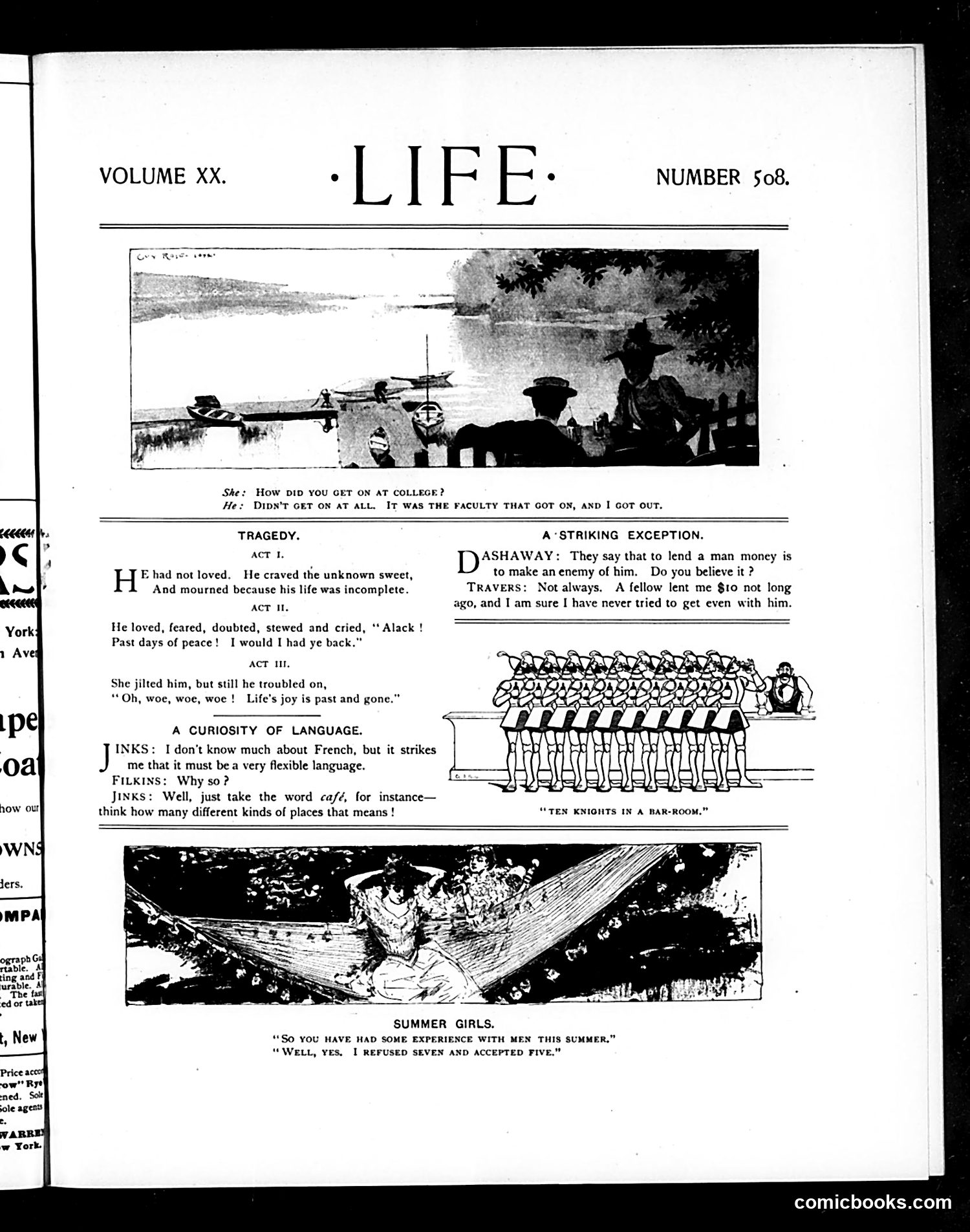
This page contains several humor pieces rather than political cartoons: 1. **"Tragedy"** - A three-act romantic sketch satirizing melodramatic love stories popular in theater and literature of the era. 2. **"A Striking Exception"** - A dialogue joke about making enemies, with the punchline that lending money to someone is guaranteed not to create enmity (because they'll avoid you). 3. **"A Curiosity of Language"** - A conversation between characters "Jinks" and "Filferns" joking about the French word "café" having multiple meanings in different contexts. 4. **"Ten Knights in a Bar-Room"** - A visual gag illustration. 5. **"Summer Girls"** - A joke about a woman's dating experiences, with the punchline involving accepting five proposals after refusing seven. These are light social humor pieces typical of Life magazine's satirical approach to contemporary manners and relationships.
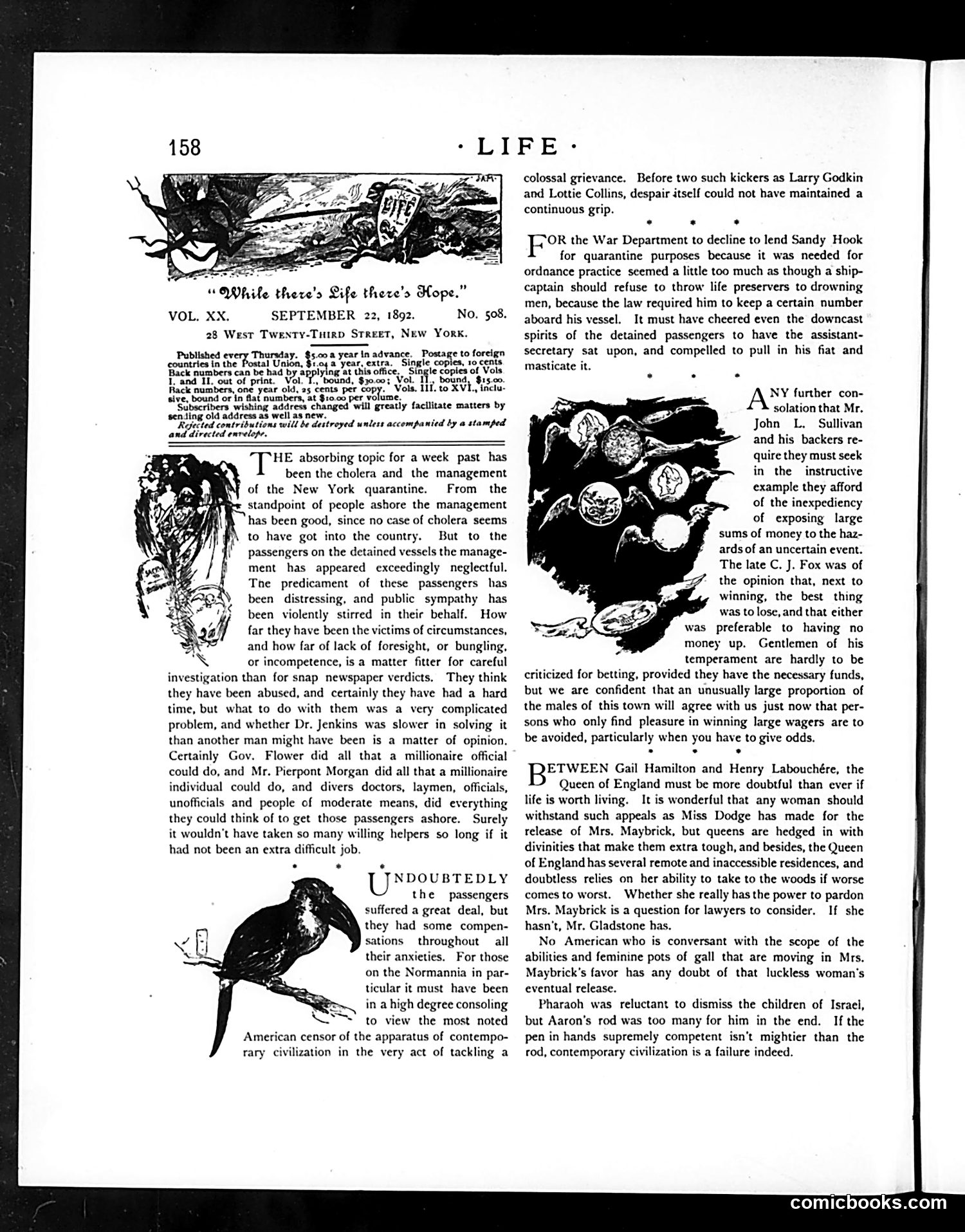
This page contains editorial commentary on contemporary crises rather than political cartoons. The main illustrated elements are decorative vignettes (a ship, vegetables, a bird) accompanying text about the 1892 cholera outbreak affecting New York quarantine management and detained ship passengers. The editorials discuss several issues: mismanagement of quarantine procedures, criticism of wealthy individuals like John L. Sullivan for gambling large sums, and commentary on British politics involving figures named Gail Hamilton, Henry Labouchère, and Mrs. Maybrick (likely the controversial poisoning case). The final paragraph references biblical allusions (Pharaoh and Aaron's rod). The satire targets governmental incompetence and the wealthy's frivolous behavior during public health crises.
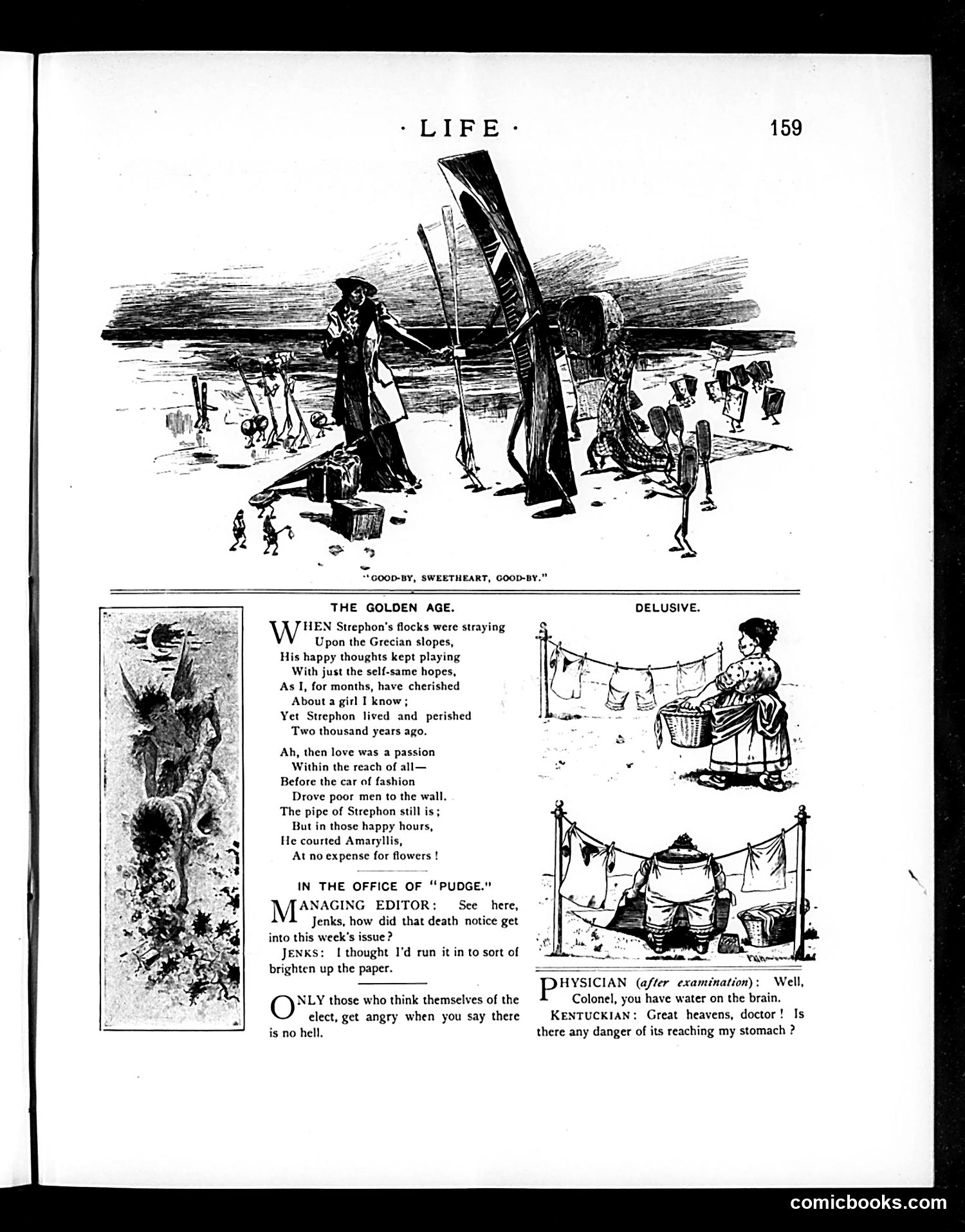
This page contains several unrelated satirical pieces: **Top cartoon** ("Good-by, Sweetheart, Good-by"): Depicts figures on a beach with a wrecked ship, likely satirizing romantic farewells or wartime departures—a common Life theme during WWI era. **"The Golden Age"**: A poem romanticizing ancient Greece while contrasting it with modern poverty ("poor men to the wall"), suggesting satirical commentary on capitalism versus classical ideals. **"In the Office of 'Pudge'"**: Office humor mocking a managing editor's decision to publish a death notice, poking fun at editorial judgment and newspaper sensationalism. **"Delusive"** and **"Physician" sketches**: Domestic/medical humor—the laundry scene and doctor's joke about "water on the brain" are gentle domestic satire typical of the era. Overall, this represents Life's mix of political-social commentary and lighthearted domestic humor.
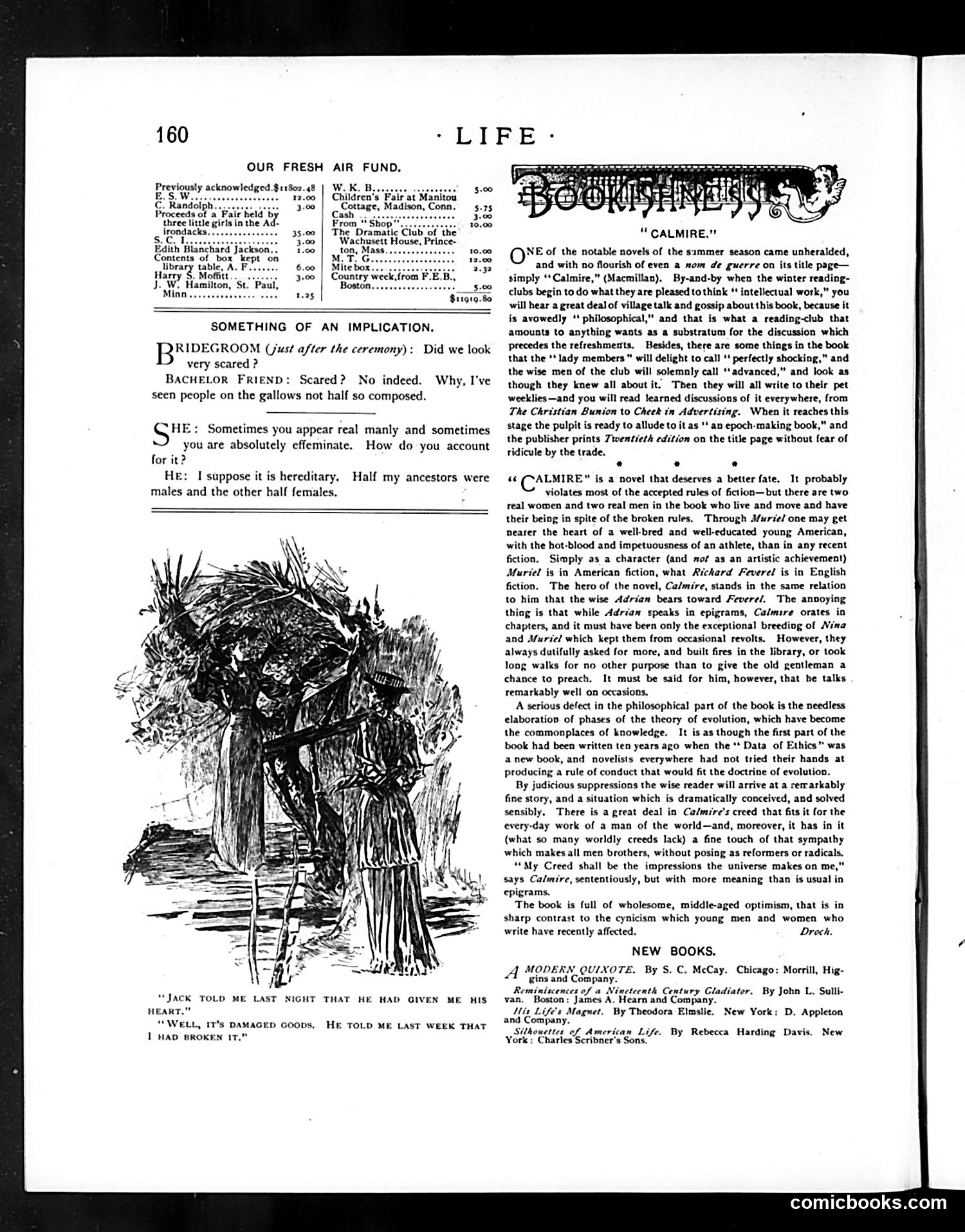
This page contains a brief comedic dialogue between a bridegroom and bachelor friend, followed by a book review section. **The Cartoon/Dialog:** The small illustrated exchange humorously addresses masculinity and emotional restraint. A bridegroom is asked if he appeared "scared" at his wedding ceremony. He denies fear, attributing his composed demeanor to heredity—joking that half his ancestors were male and half female. The humor relies on the era's expectation that men maintain emotional stoicism during significant life events, with the punchline being a somewhat crude biological observation about his mixed ancestry. **The Content:** The page primarily features a book review of "Calmire" and a "New Books" section listing recent publications. This appears to be a typical early-20th-century *Life* magazine page mixing light humor with literary criticism and advertising.
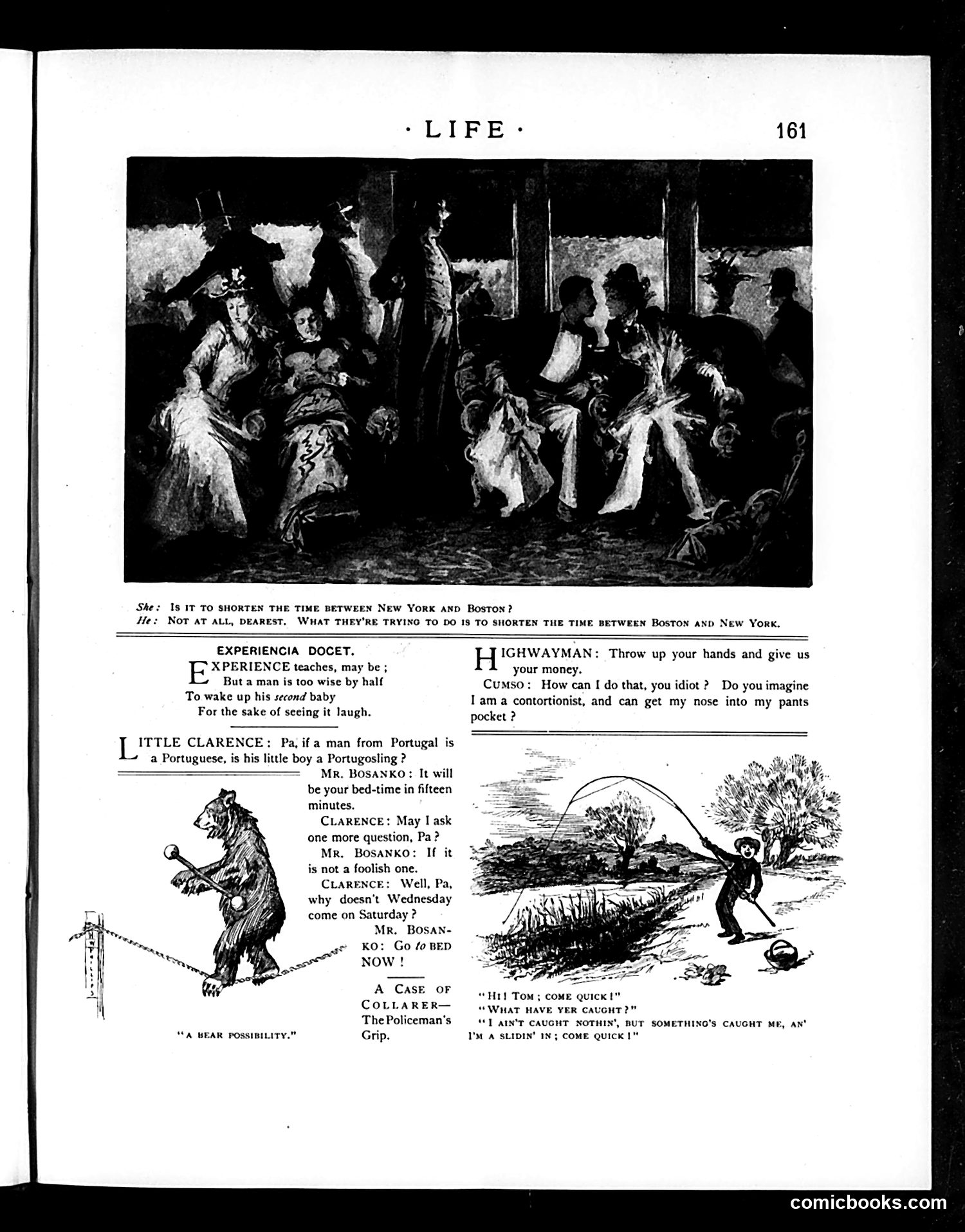
**Top Panel:** A social scene showing well-dressed men and women in conversation. The caption jokes about shortening travel time between New York and Boston—the humor turns on the male character suggesting they're trying to shorten the distance between the cities, while the female character reveals they're actually trying to shorten the Boston-to-New York route instead. This is likely a play on romantic/geographic confusion. **Middle Section:** "Little Clarence" contains a pun about a Portuguese man and his "Portoguesling" (child). The humor relies on wordplay. **Bottom Right:** A simple comic showing a man fishing who's apparently caught something alive. The dialogue suggests slapstick humor about his catch escaping. These appear to be light, punning humor pieces typical of early 20th-century satirical magazine content—relatively apolitical domestic humor and wordplay.
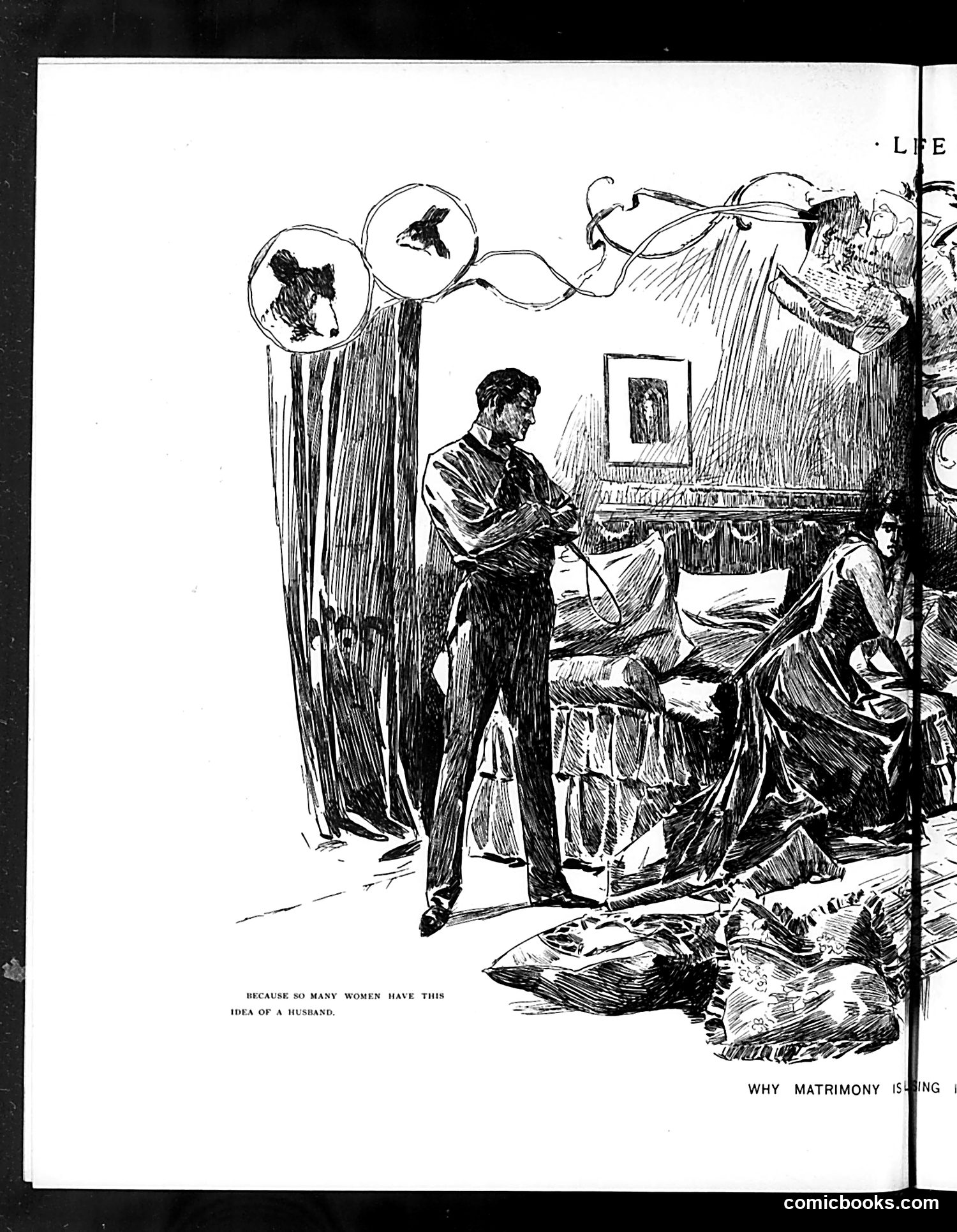
This satirical illustration critiques the idealized romantic fantasy many women held about husbands. The caption reads: "Because so many women have this idea of a husband" and "Why matrimony is—ing" (the final word appears cut off). The cartoon shows contrasting scenes: two circular insets at top depict women's romanticized visions of male suitors, while the main scene reveals harsh reality—a man standing amid household chaos, surrounded by a woman in distress on a bed, scattered belongings, and general domestic disorder. The satire mocks the gap between women's romantic expectations of marriage and husbands versus the messy, unglamorous reality of married life. This reflects early 20th-century commentary on marriage expectations and the disillusionment that could follow.
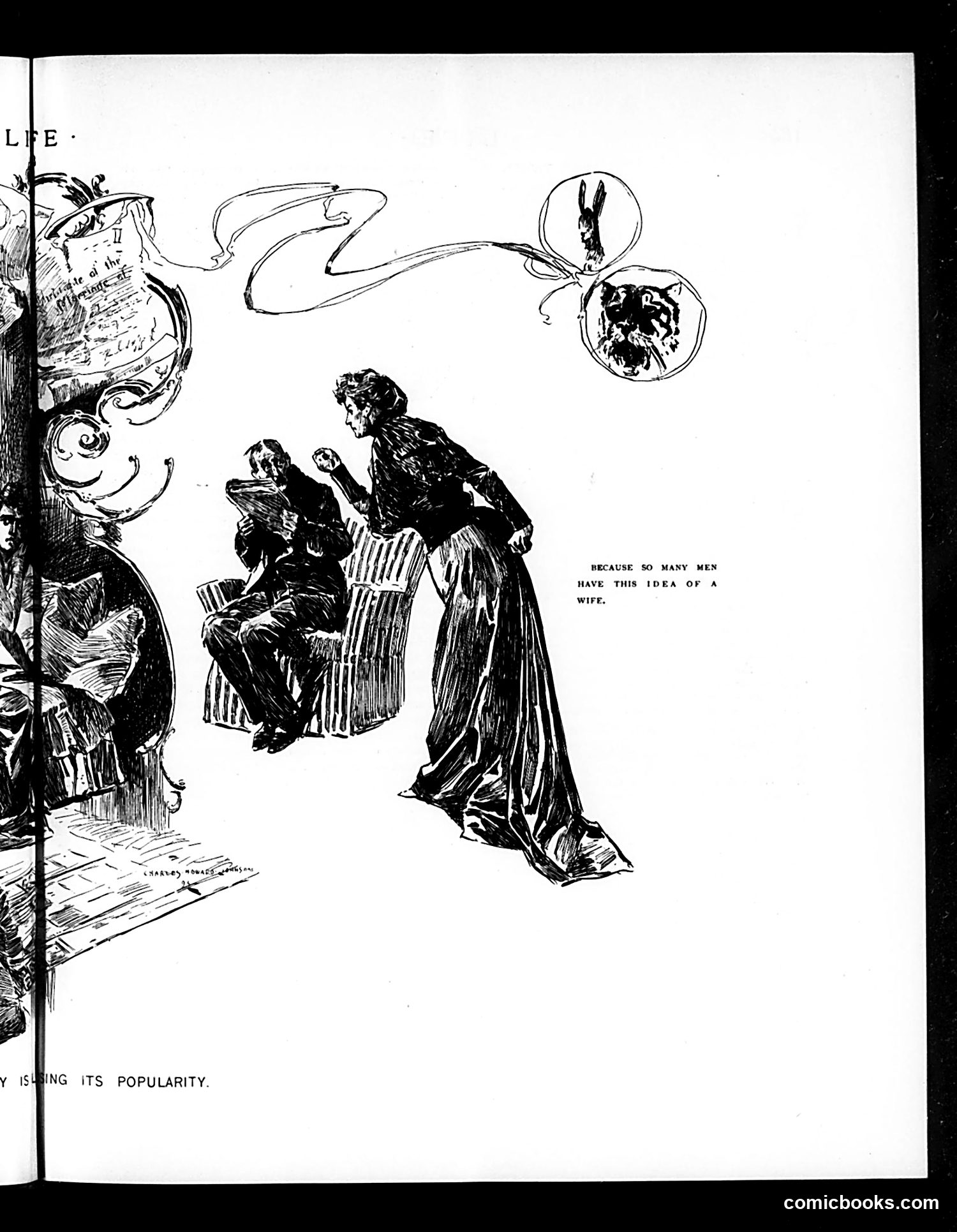
This appears to be a satirical cartoon from *Life* magazine about marriage. The central image shows a woman in an elaborate dress confronting two men in formal attire, with surreal floating head imagery above suggesting dreams or fantasies. The caption reads: "BECAUSE SO MANY MEN HAVE THIS IDEA OF A WIFE." The satire targets men's unrealistic or idealized expectations of wives. The floating heads in circles appear to represent men's fantasies or imagination—ethereal, detached from reality. The woman's dramatic gesture and flowing costume suggest she's presenting the gap between fantasy and the actual person men marry. The bottom text fragment references "popularity," though the complete context is unclear. This mocks the disconnect between romantic idealization and matrimonial reality.
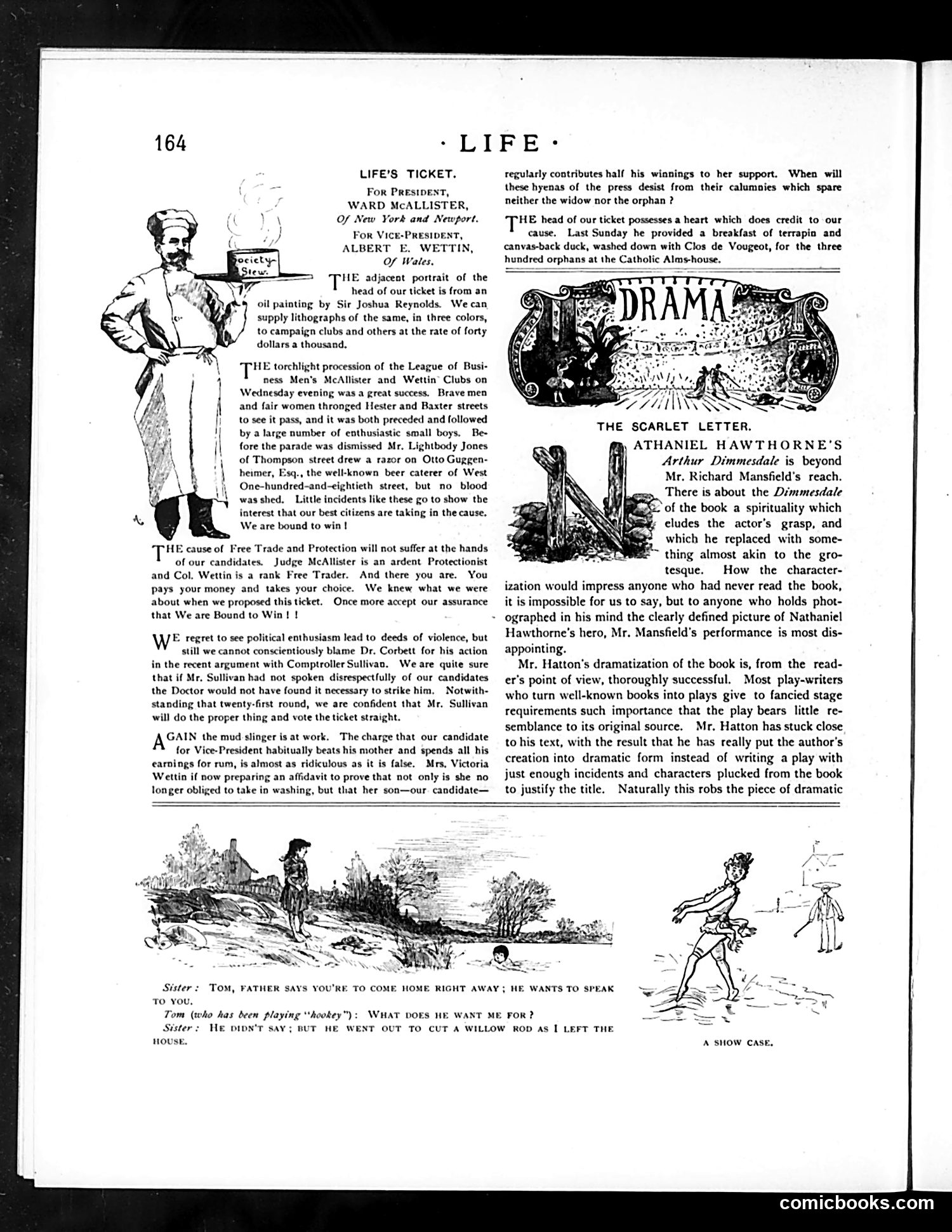
This page contains political campaign satire from an election cycle. The left column discusses candidates for Ward McAllister and Vice-President Albert E. Wettin, critiquing their campaign practices and character. The satire targets political hypocrisy: it mocks candidates who espouse principles like "Free Trade and Protection" while accepting bribes, and ridicules a candidate (apparently Mrs. Victoria Wettin) who must work to support orphans—suggesting her claims of wealth are false. The right side reviews *The Scarlet Letter* dramatization, unrelated to politics. The bottom cartoon shows a domestic scene where Tom is called home by his father, with a humorous misunderstanding about cutting a willow rod—likely satirizing generational conflict or miscommunication rather than political content.
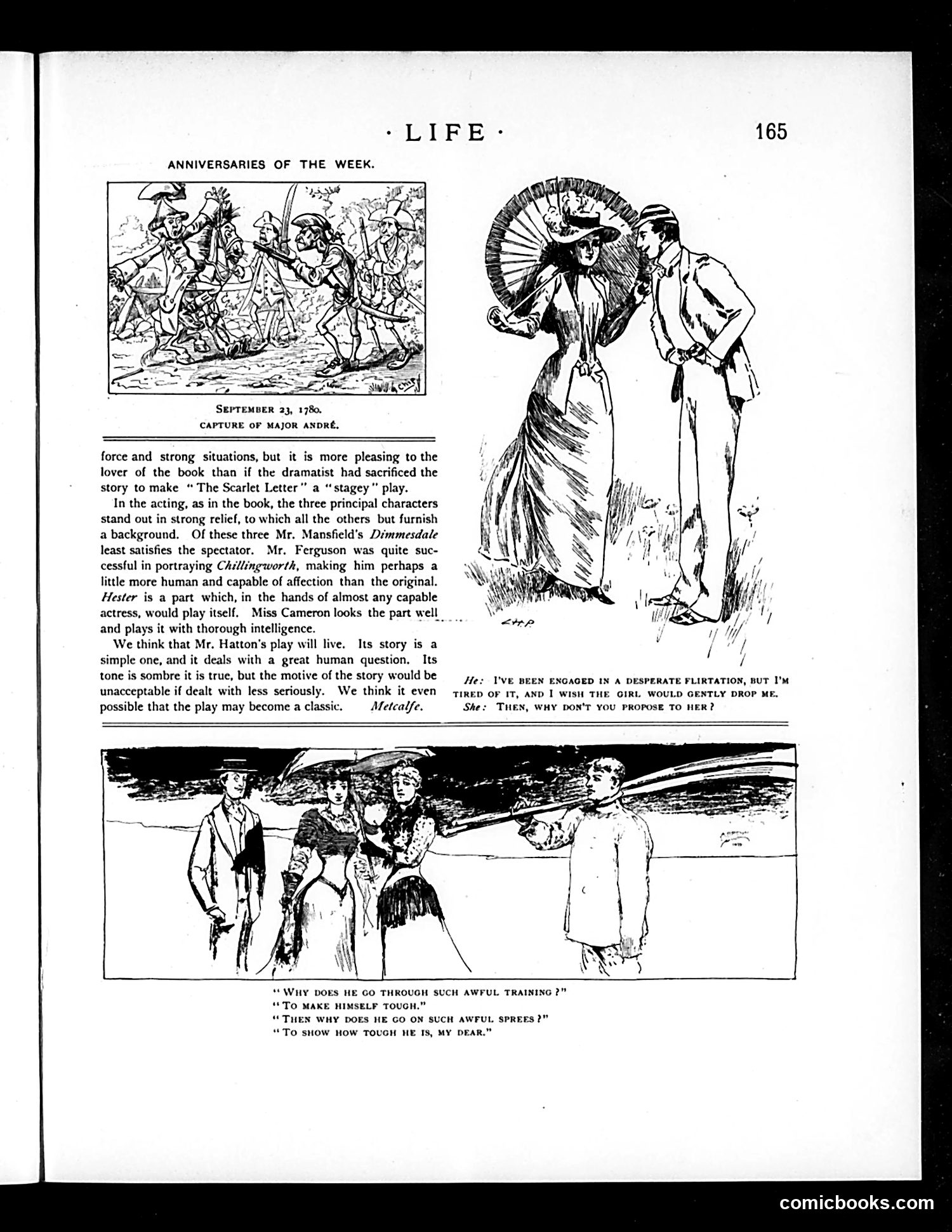
This page discusses theatrical adaptations of literary classics. The text reviews stage versions of works including "The Scarlet Letter" and another play by Mr. Hatton, praising their dramatic potential while noting the challenges of adaptation. The illustrations show period costume scenes—one depicts a couple in conversation with a parasol-carrying woman, another shows what appears to be a training or military scene. The dialogue discusses someone undergoing "awful training" to demonstrate toughness. The top historical engraving labeled "September 23, 1780 / Capture of Major André" references the American Revolutionary War spy John André's capture. The page primarily focuses on theater criticism and literary adaptations rather than political satire. Without clearer context, the specific dramatic works being reviewed and their relevance to contemporary 1920s-era issues remain somewhat unclear from this excerpt alone.
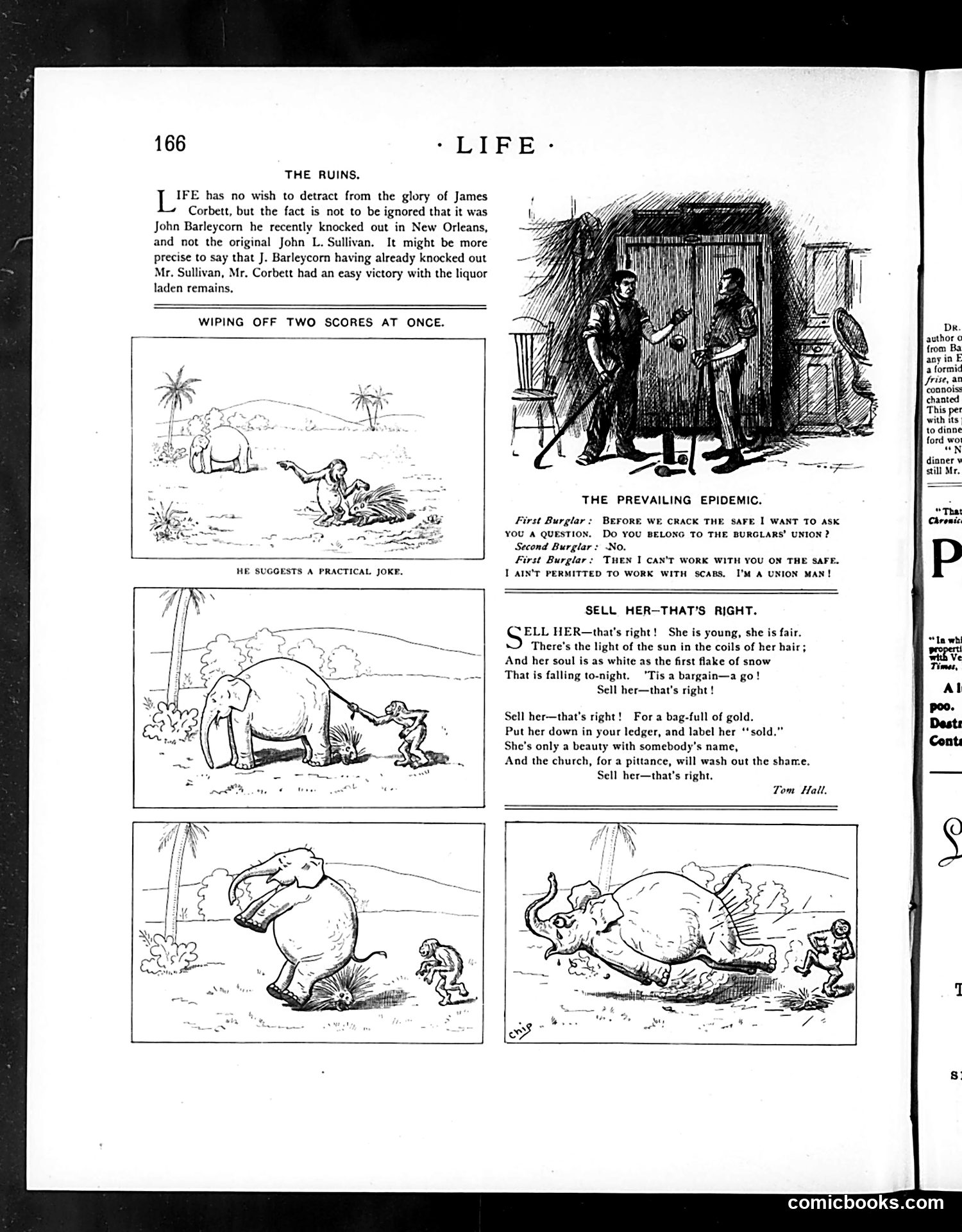
This page contains three separate satirical pieces: **"The Ruins"** mocks boxer James Corbett's recent victory over John L. Sullivan in New Orleans, suggesting Corbett merely defeated an already-weakened Sullivan damaged by alcoholism ("John Barleycorn"). The cartoon sequence shows a fat man (representing alcohol's effects) being knocked down repeatedly, satirizing that Corbett's real opponent was liquor, not a worthy fighter. **"The Prevailing Epidemic"** jokes about labor union exclusivity: two burglars cannot work together because one isn't union-certified, applying labor union rules absurdly to criminal activity—mocking rigid union protocols. **"Sell Her—That's Right"** is darker satire by Tom Hall condemning human trafficking and sexual exploitation. It describes selling a young woman into prostitution as a commercial transaction, with the church providing absolution "for a pittance." The text bitterly critiques the commodification of women and institutional complicity in their degradation.
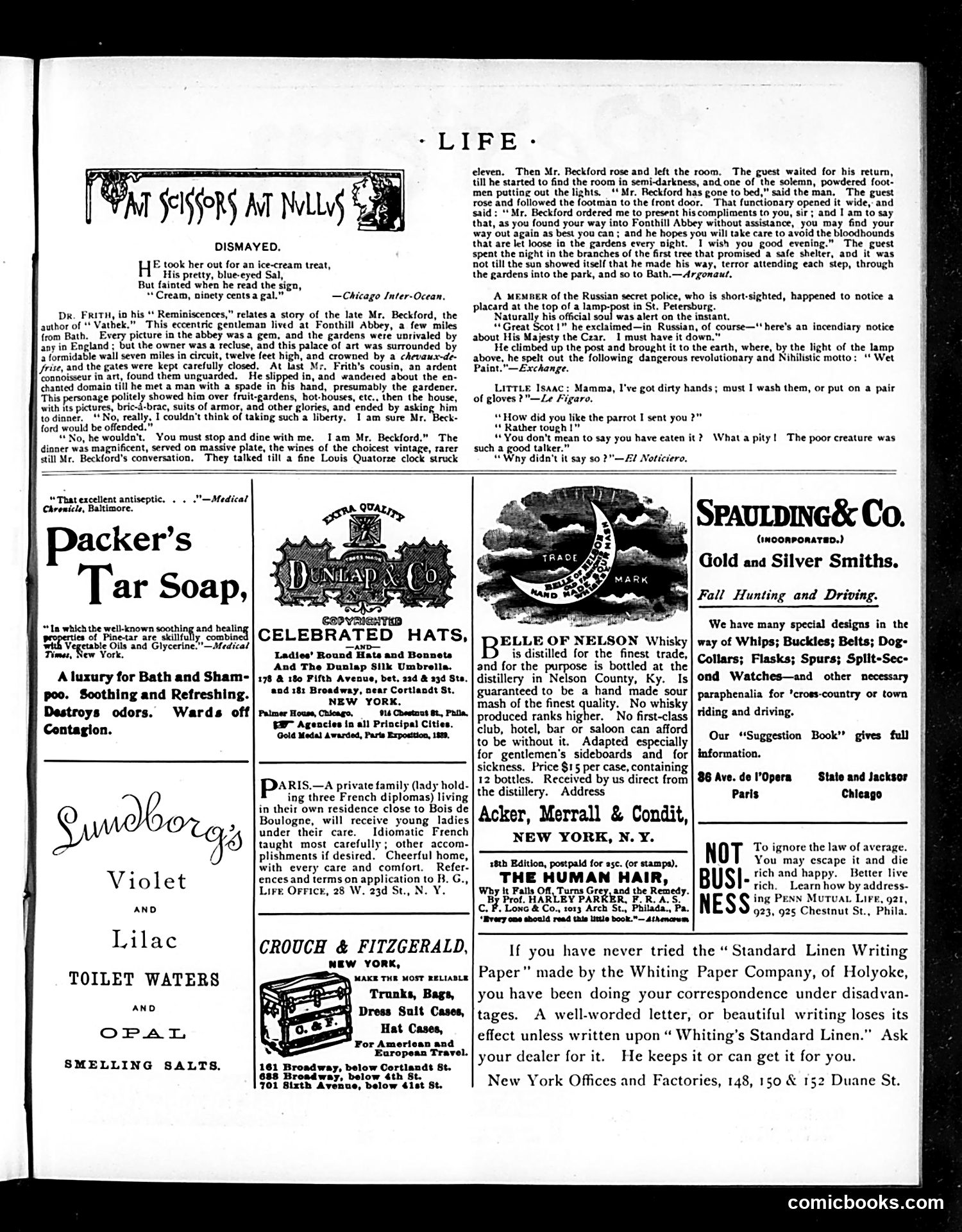
This page contains three separate humorous anecdotes rather than a political cartoon. The top piece, titled "Dismayed," jokes about inflation: a young man takes his girlfriend out for ice cream but faints upon reading the price sign—ninety cents per gallon. The humor targets the shock of rising costs. The second story recounts an anecdote from Dr. Frith's *Reminiscences* about the eccentric English collector William Beckford. An uninvited visitor sneaks into Beckford's exclusive Fonthill Abbey estate and is treated to dinner by the owner himself. Upon departure, Beckford coldly dismisses him through a servant, forcing the guest to escape the darkened gardens at night while dodging loose bloodhounds—a satirical commentary on aristocratic rudeness and the stark contrast between initial hospitality and sudden cruelty. The final anecdote mocks Russian secret police: an officer, short-sighted and overzealous, climbs a lamp post to remove what he suspects is "incendiary" revolutionary propaganda, only to discover it simply reads "Wet Paint." All three target human folly through situational comedy—greed, social pretension, and bureaucratic absurdity.
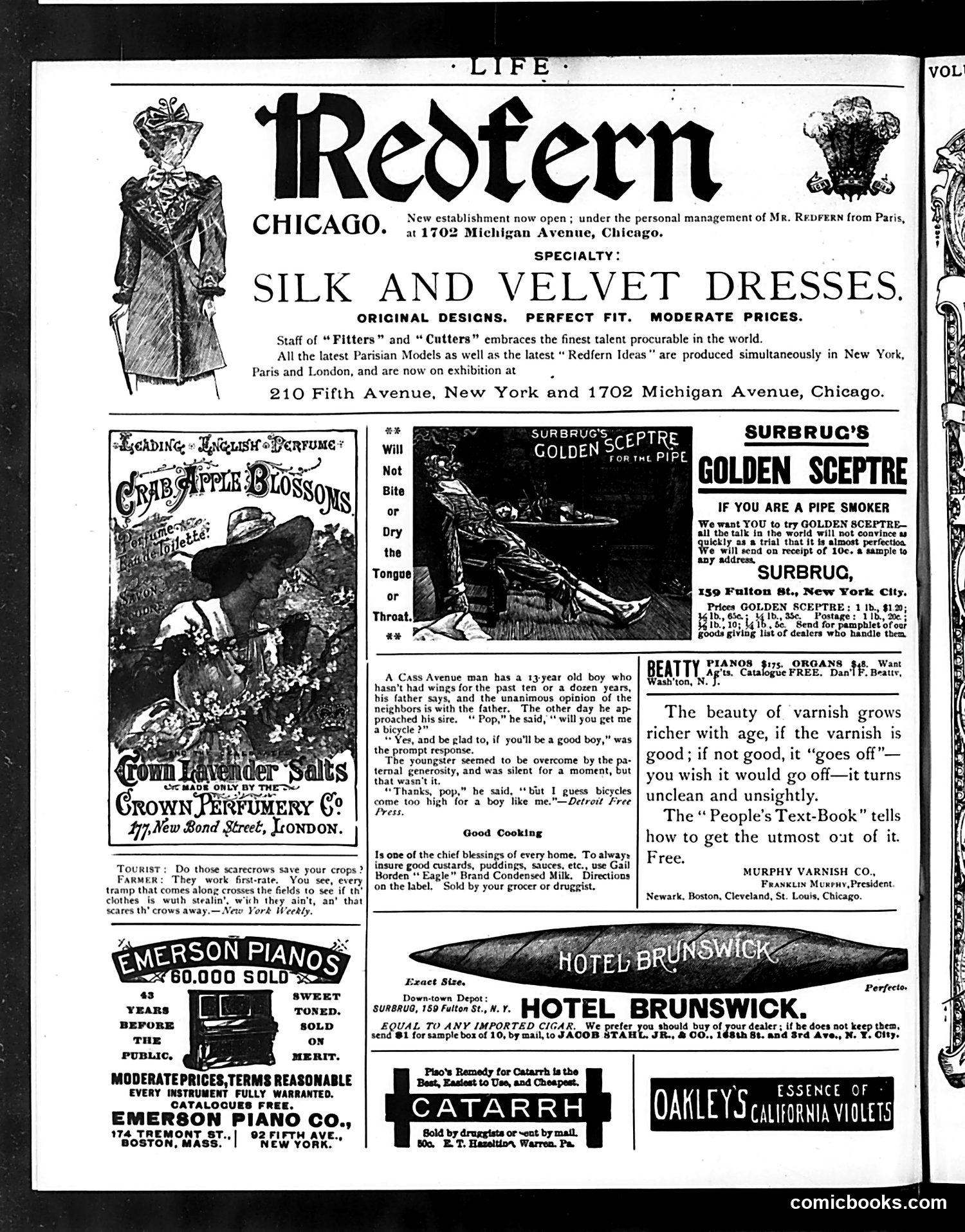
This is primarily an **advertising page** from Life magazine, circa 1890s-1900s, containing no political cartoons but rather commercial notices and a single joke. The one **cartoon/joke** depicts a tourist asking a farmer about scarecrows. The farmer's response—that tramps cross his fields to check if the scarecrow's clothes are worth stealing, and finding them worthless, the tramps scare away the crows—is a gentle working-class humor joke about poverty and the worthlessness of ragged clothing. The **advertisements** promote luxury goods typical of the era: Redfern's Paris fashions, Emerson pianos, Surbrug's cigars and pipe tobacco, condensed milk, patent medicines (Piso's catarrh remedy), varnish, and the Hotel Brunswick. The page reflects Gilded Age consumer culture and the magazine's role in reaching affluent urban readers through both satirical content and high-end advertising.