
Life, 1892-09-22 · page 6 of 14
Life — September 22, 1892 — page 6: what you’re looking at
What you’re looking at
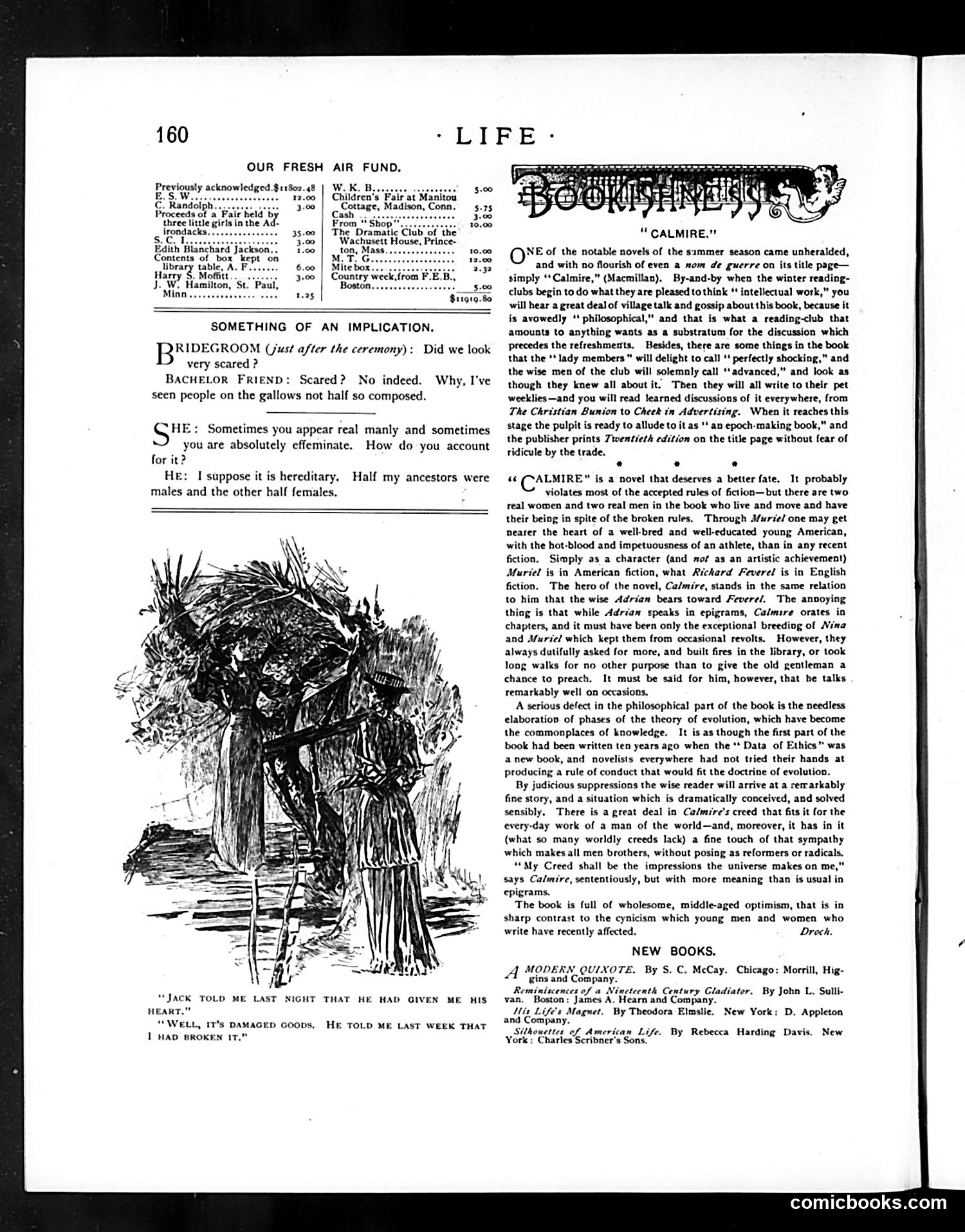
This page contains a brief comedic dialogue between a bridegroom and bachelor friend, followed by a book review section. **The Cartoon/Dialog:** The small illustrated exchange humorously addresses masculinity and emotional restraint. A bridegroom is asked if he appeared "scared" at his wedding ceremony. He denies fear, attributing his composed demeanor to heredity—joking that half his ancestors were male and half female. The humor relies on the era's expectation that men maintain emotional stoicism during significant life events, with the punchline being a somewhat crude biological observation about his mixed ancestry. **The Content:** The page primarily features a book review of "Calmire" and a "New Books" section listing recent publications. This appears to be a typical early-20th-century *Life* magazine page mixing light humor with literary criticism and advertising.
📄 Transcribed text from this page (OCR, searchable)
Machine-transcribed from the original scan — historical spelling and the odd misread are preserved.
160 OUR FRESH AIR FUND. W.K. B. Childre: Cottage, Madison, Conn. } Cash ot... From * Shop" es The Dramatic Ciub of the S.C. Leese wong Wachusett House, Prince- Edith Bianctard Jackson.) 11 ton, Mass.eseeeersere Contents of box kept on M.T:G. library table, A. F...... .co | Mitebox 211°. Harry S. Moffitt... k, J. W. Hamilton, St. Minn. Previously acknowledged.$11802.48 ES Wreccece eerie C. Randolph’ Proceeds of a Fair held vA three little girls in the Ad- Wondacks. va 12.00 SOMETHING OF AN IMPLICATION. BRIDEGROOM (just after the ceremony): Did we look very scared ? BACHELOR FRIEN Scared? No indeed. seen people on the gallows not half so composed. Why, I've ~ HE: Sometimes you appear real manly and sometimes you are absolutely effeminate. How do you account for it? HE: I suppose it is hereditary. Half my ancestors were males and the other half females. a ae AY) P “JACK TOLD ME LAST NIGHT THAT HE HAD GIVEN ME HIS HEART.” “WELL, IT's DAMAGED GoopDs, 1 HAD BROKEN 17.” HE TOLD ME LAST WEEK THAT “ CALMIRE.”” NE of the notable novels of the sammer season came unheralded, and with no flourish of even a nom de guerre on its title page— simply ‘Calmire,” (Macmillan), By-and-by when the winter reading- clubs begin to do what they are pleased to think “intellectual work,” you will hear a great dealof village talk and gossip about this book, because it is avowedly ‘‘ philosophical,” and that is what a reading-club that amounts to anything wants as a substratum for the discussion which precedes the refreshments, Besides, there are some things in the book that the ‘* lady members” will delight to call '' perfectly shocking,” and the wise men of the club will solemnly call ‘‘advanced,” and look as though they knew all about it. Then they will all write to their pet weeklies—and you will read learned discussions of it everywhere, from The Christian Bunion to Cheek in Advertising. When it reaches this stage the pulpit is ready to allude to it as “an epoch-making book,” and the publisher prints 7wentieth edition on the title page without fear of ridicule by the trade. . * . «¢ CALMIRE” is a novel that deserves a better fate. It probably violates most of the accepted rules of fiction— but there are two real women and two real men in the book who live and move and have their being in spite of the broken rules. Through Mfurie/ one may get nearer the heart of a well-bred and well-educated young American, with the hot-blood and impetuousness of an athlete, than in any recent fiction. Simply as a character (and mof as an artistic achievement) Muriel is in American fiction, what Richard Feverel is in English fiction, The hero of the novel, Ca/mire, stands in the same relation to him that the wise Adrian bears toward Fevere/. The annoying thing is that while Adrian speaks in epigrams, Ca/msre orates in chapters, and it must have been only the exceptional breeding of Nina and Muriel which kept them from occasional revolts, However, they always dutifully asked for more, and built fires in the library, or took long walks for no other purpose than to give the old gentleman a chance to preach. It must be said for him, however, that he talks remarkably well on occasions, A serious defect in the philosophical part of the book is the needless elaboration of phases of the theory of evolution, which have become the commonplaces of knowledge. It is as though the first part of the book had been written ten years ago when the ** Data of Ethics” was a new book, and novelists everywhere had not tried their hands at producing a rule of conduct that would fit the doctrine of evolution. By judicious suppressions the wise reader will arrive at a rerrarkably fine story, and a situation which is dramatically conceived, and solved sensibly, There is a great deal in Ca/mire’s creed that fits it for the every-day work of a man of the world—and, moreover, it has in it (what so many worldly creeds lack) a fine touch of that sympathy which makes all men brothers, without posing as reformers or radicals. “My Creed shall be the impressions the universe makes on me,” says Calmire, sententiously, but with more meaning than is usual in epigrams. ‘The book is full of wholesome, middle-aged optimism, that is in sharp contrast to the cynicism which young men and women who write have recently affected. Droch. NEW BOOKS. A MODERN QUIXOTE. By S.C, McCay. Chicago: Morrill, Hig- gins and Company. Reminiscences of a Nineteenth Century Gladiator, By John L. Sulli- van. Boston: James A. Hearn and Company. His Life's Magnet, By Theodora Elmslie, and Company. Sithouettes of American Life. By Rebecca Harding Davis. New Yoric: Charles Scribner's Sons. New York: D. Appleton comicbooks.com