
A complete issue · 14 pages · 1892
Life — July 14, 1892
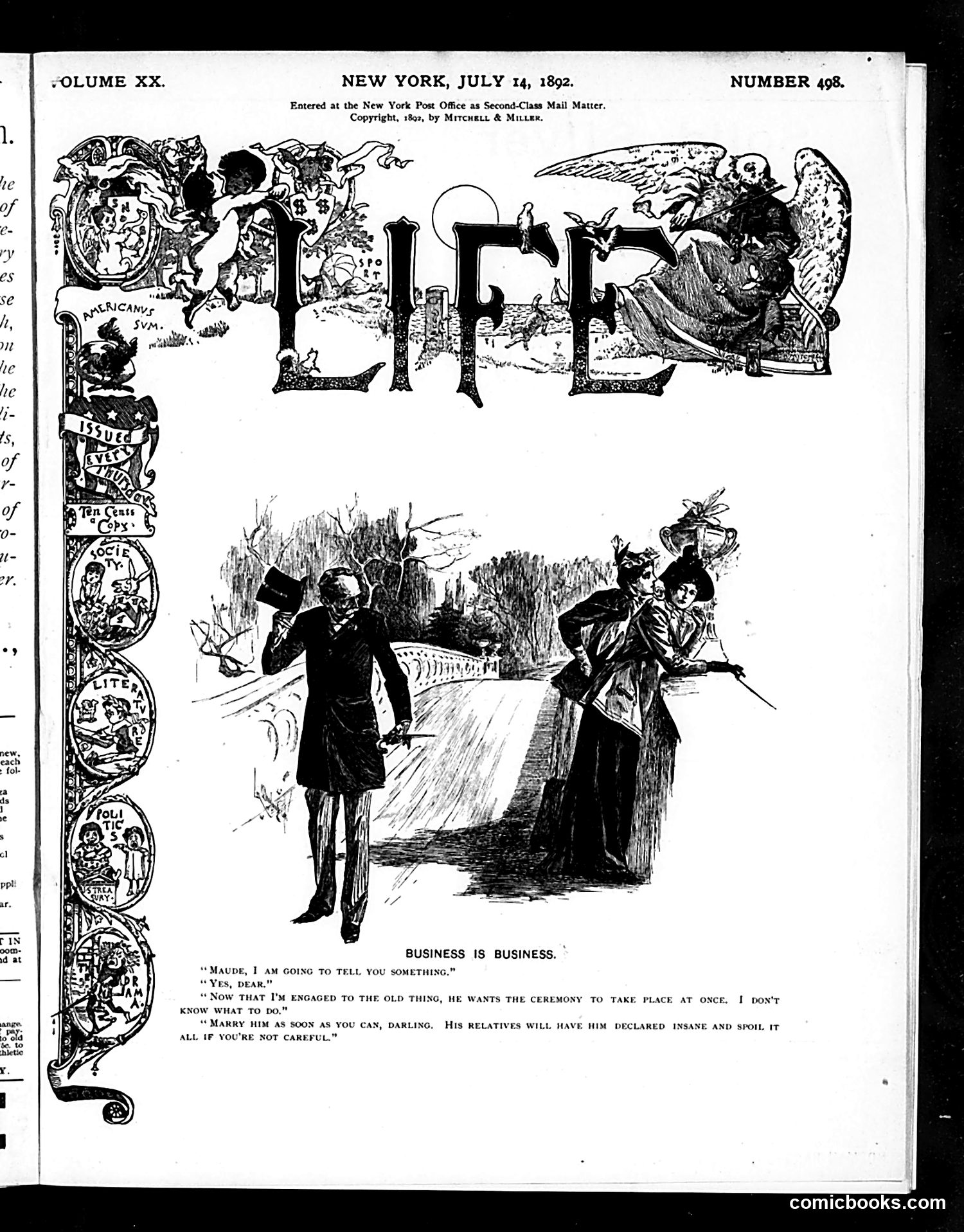
This satirical cartoon depicts a man on a bicycle encountering a well-dressed couple on a country road. The title and dialogue suggest commentary on hasty marriages driven by financial necessity rather than sentiment. The man warns the couple that the groom-to-be wants an immediate wedding ceremony because his relatives will declare him insane and squander his inheritance if he delays. The satire mocks the mercenary nature of upper-class marriages in the Gilded Age, where wealth and legal status took precedence over romance or proper courtship. The bicycle—then a fashionable novelty—may indicate the rushed, modern pace of such transactions. The rural setting contrasts with the urban, commercial values being criticized. The cartoon ridicules how business logic corrupts personal relationships among the wealthy.
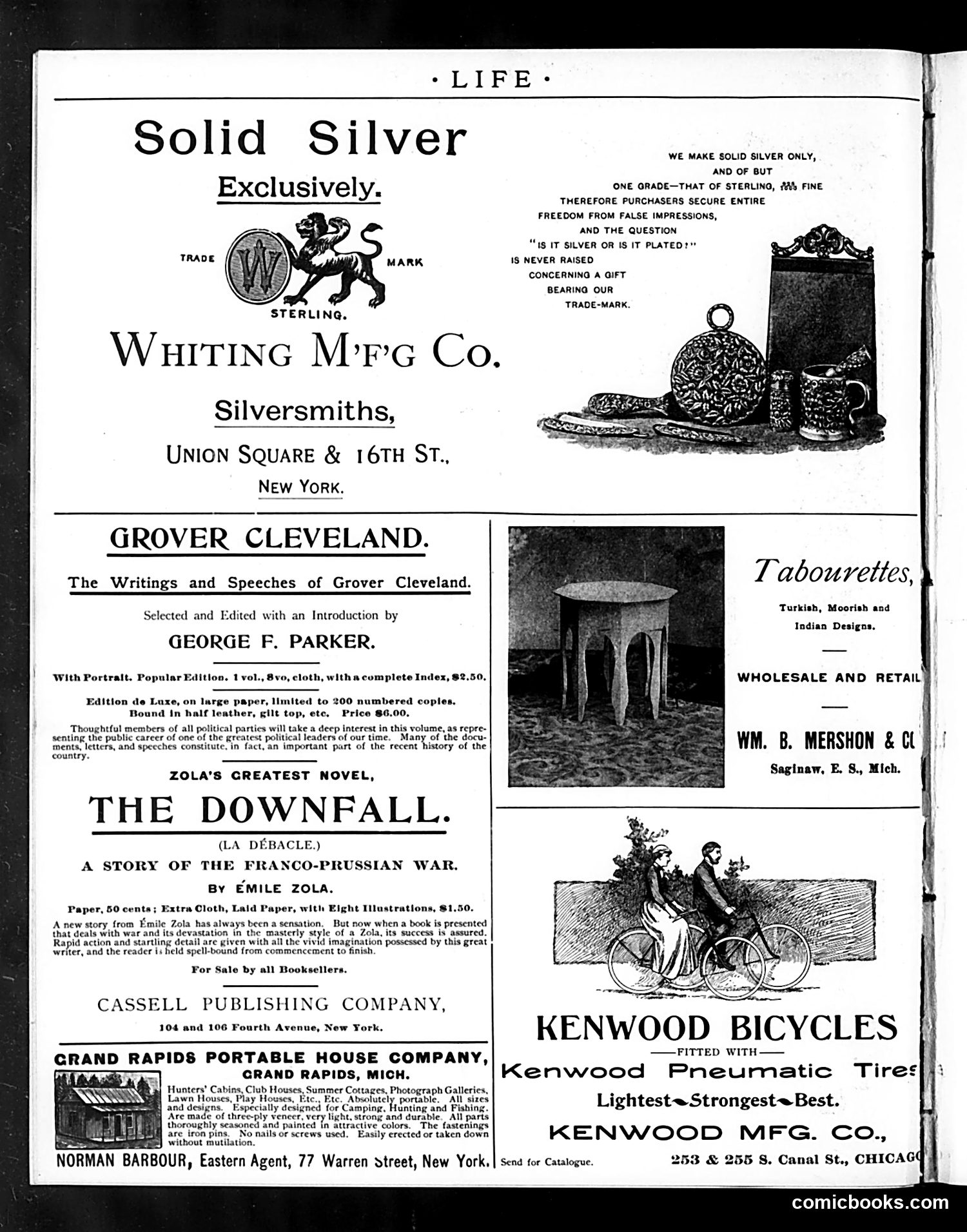
This page is primarily **advertising**, not political satire. It contains commercial notices for: - **Whiting Mfg Co.** (solid silver goods, New York silversmiths) - **Grover Cleveland** writings and speeches (a book publication) - **Zola's *The Downfall*** (novel about Franco-Prussian War) - **Grand Rapids Portable House Company** (prefabricated structures) - **Kenwood Bicycles** (with pneumatic tires, marketed as "Lightest-Strongest-Best") - **Tabourettes** (decorative tables, Turkish/Indian designs) The only potential political reference is the Cleveland book, as he was a former U.S. President. The bicycle and portable house ads reflect late-19th/early-20th century consumer interests in modern technology and practical goods. No significant satire or political commentary appears evident on this page.
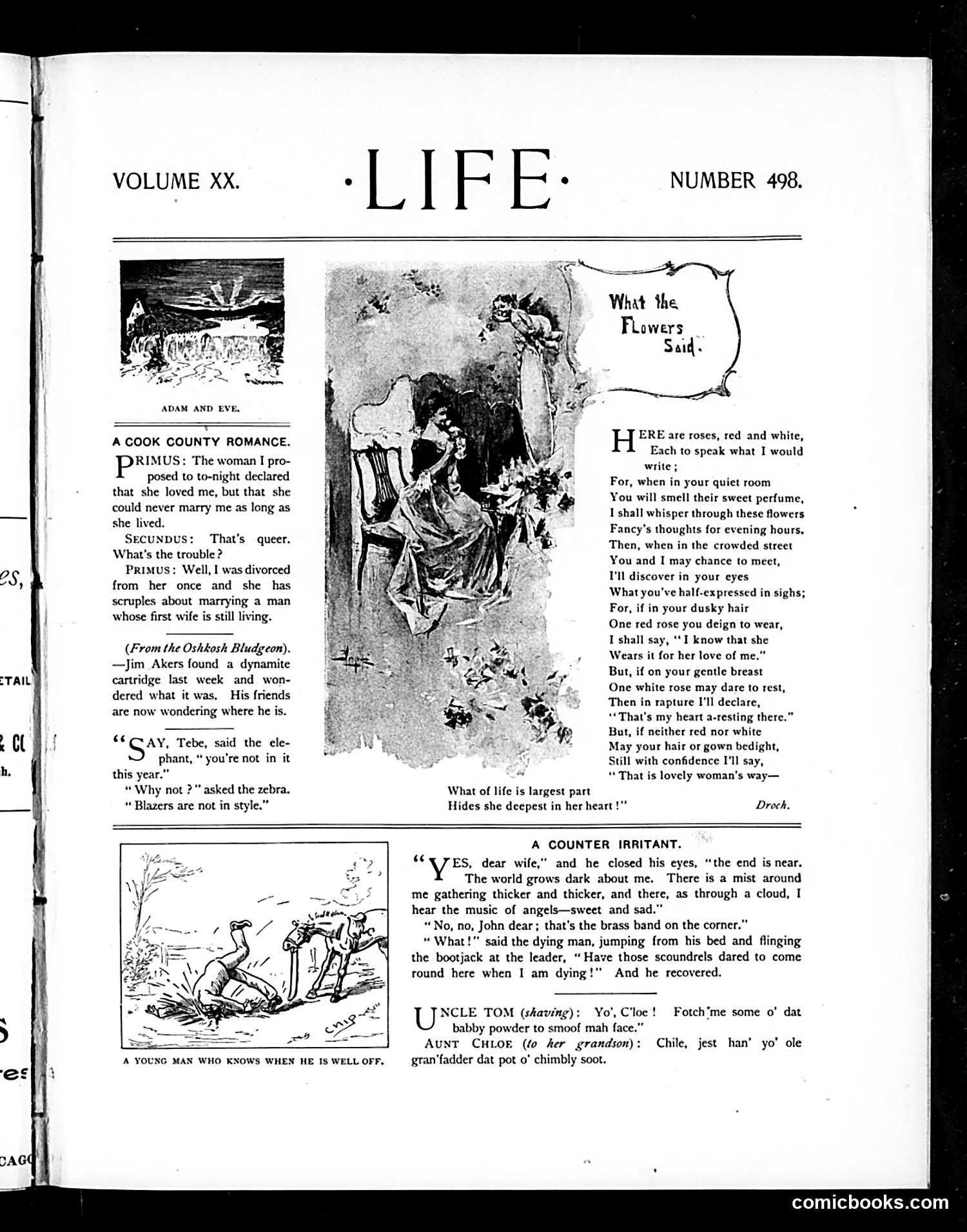
This page contains three humorous pieces typical of early 20th-century Life magazine: 1. **"A Cook County Romance"**: A brief dialogue joke about a divorced woman who remarried, with a man warning his friend about her previous marriage situation. 2. **"What the Flowers Said"**: A sentimental poem about roses as romantic messengers, reflecting Victorian-era romantic conventions—common subject matter for the period. 3. **"A Counter Irritant"**: A comic sketch about a dying man hearing a brass band playing outside, making light of his mortality through humor. 4. **"A Young Man Who Knows When He Is Well Off"**: A small cartoon (bottom left) showing a man apparently knocked down or in distress. The page represents Life's mix of gentle social satire, sentimental poetry, and physical comedy typical of American humor magazines from this era.
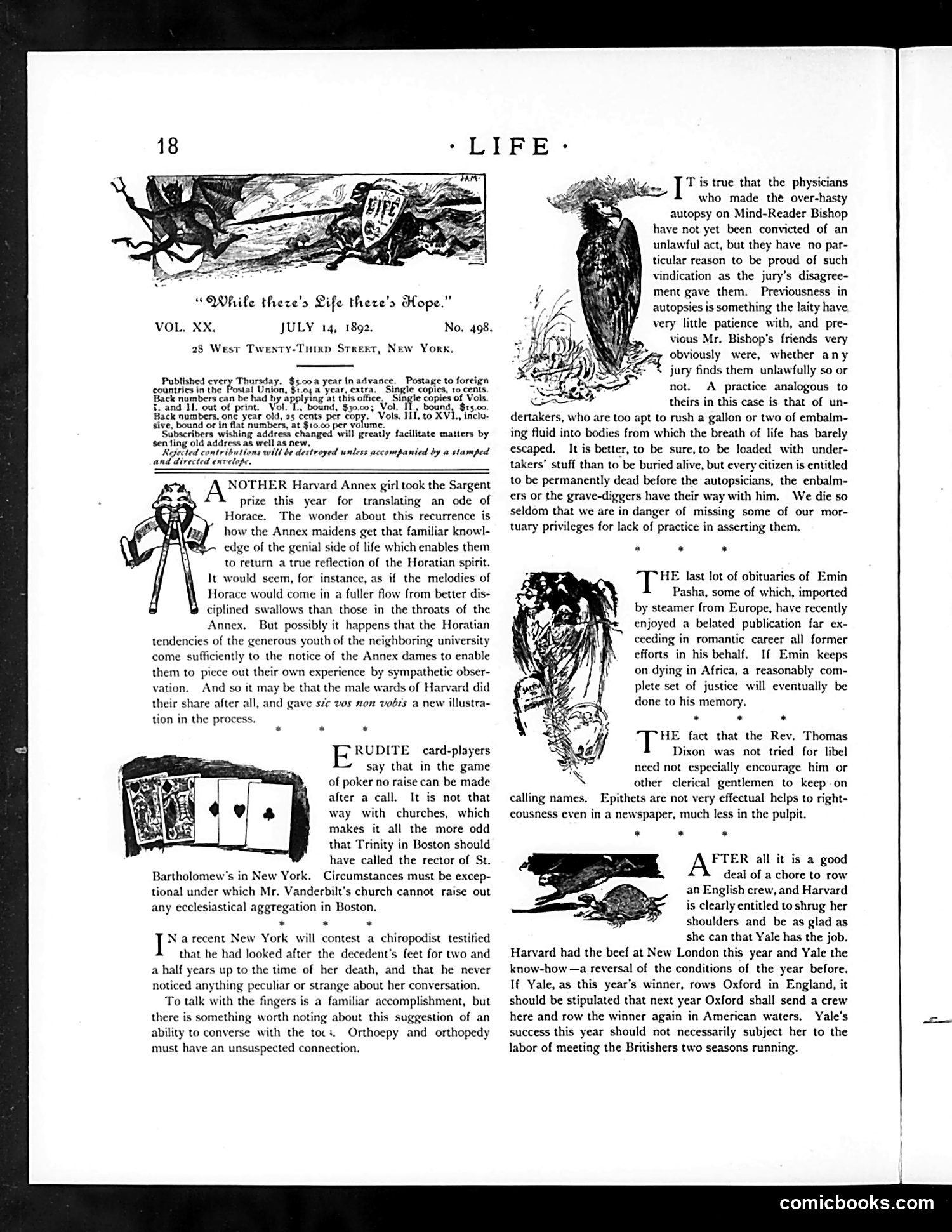
The top cartoon depicts a figure labeled "Life" riding in a chariot pulled by skeletal horses, with the caption "While there's Life there's Hope." This appears to be a standard allegorical representation common to the era—personifying "Life" itself as a force that endures despite hardship. The remaining text consists of brief satirical commentary on contemporary issues: Harvard Annex girls winning academic prizes, questionable medical autopsies, obituaries of notable figures, ecclesiastical controversies in Boston churches, poker and card-playing ethics, and a chiropodist's peculiar testimony in a legal case. The page reflects typical late-Victorian satirical humor—mocking academic pretension, medical ethics, religious hypocrisy, and social oddities through brief, acerbic observations rather than extended narratives.
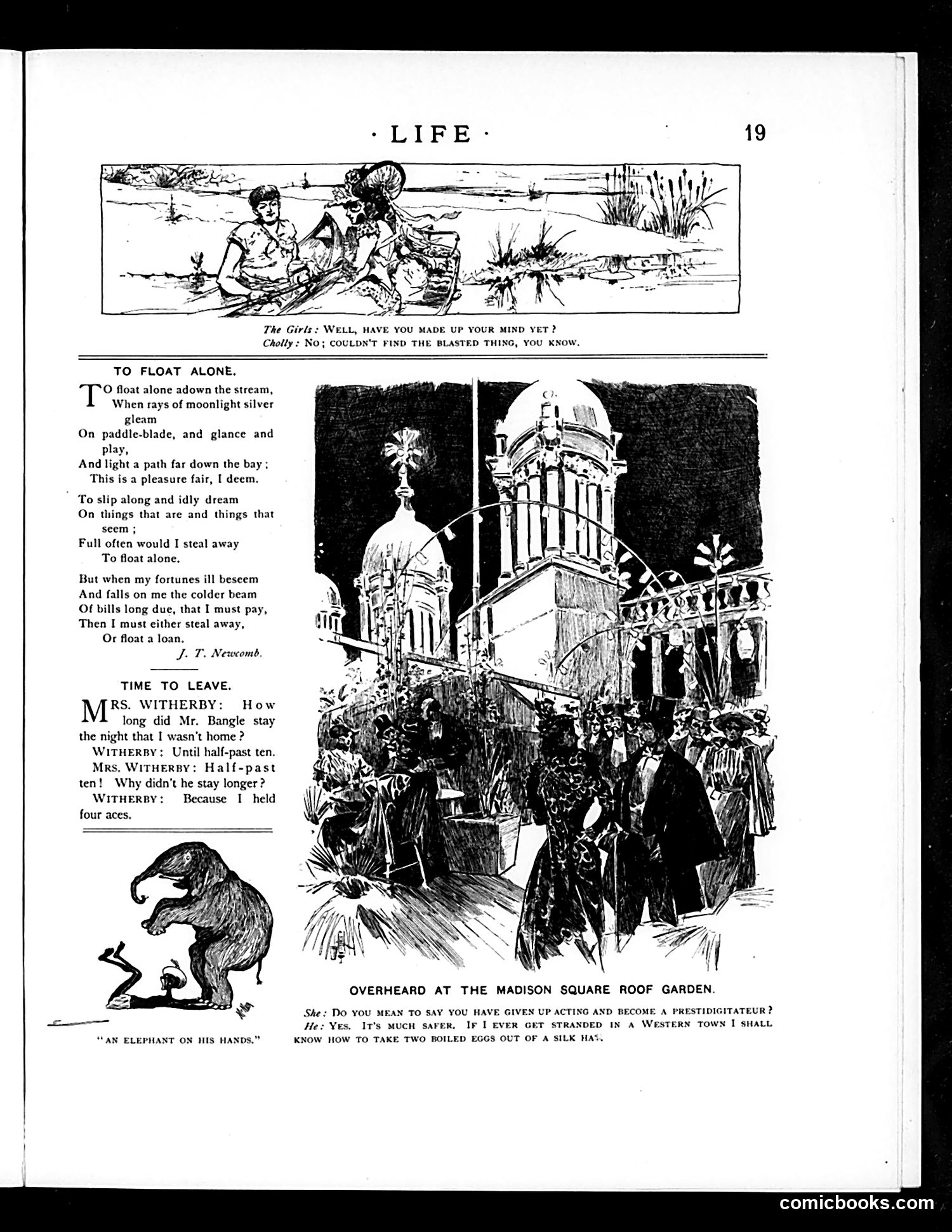
This page contains several humor pieces typical of early 20th-century Life magazine: **"To Float Alone"** is a sentimental poem by J. T. Newcomb about solitary boating, contrasting peaceful solitude with life's hardships. **"Time to Leave"** is a brief joke about Mr. Bangle overstaying his visit—Mrs. Witherby remarks he stayed because he "held four aces" (a poker reference), implying he was winning at cards. **"An Elephant on His Hands"** is a visual pun showing a small figure struggling with an elephant, illustrating the phrase about being burdened with an impossible problem. **The main illustration** depicts a crowded rooftop garden scene at Madison Square, with dialogue suggesting someone has abandoned acting for a safer profession, humorously contrasting theatrical life with mundane practicality.
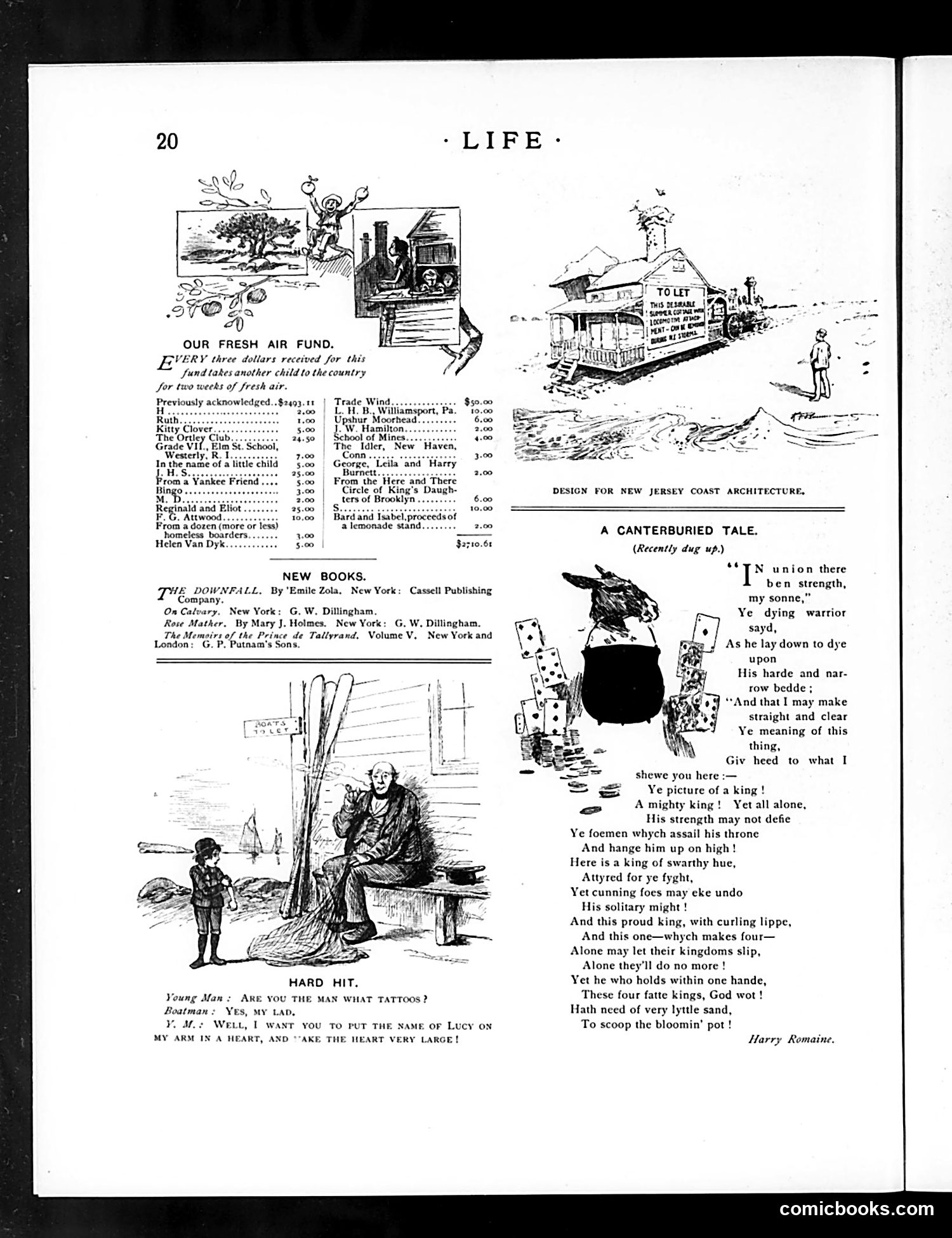
This page contains three distinct elements: **"Our Fresh Air Fund"** (top left): A charity appeal listing donations received to send urban children to the countryside for health benefits—a progressive-era social welfare initiative addressing poor children's living conditions. **"Hard Hit" cartoon** (bottom left): A boatsman and young man discuss getting tattoos. The joke plays on the phrase "hard hit"—the young man wants "Lucy" tattooed on his heart, and the boatsman warns the heart is "very large," implying either the organ's actual size or suggesting romantic complications. It's a sentimental/cautionary humor piece about impulsive romantic decisions. **"A Canterburied Tale"** (right): A poem by Harry Romaine about a dying warrior emphasizing unity and collective strength—four kings must work together, or kingdoms fail. The illustration shows playing cards, perhaps suggesting fate or chance in governance. The page mixes charitable appeals, light humor, and serious verse typical of Life's varied content.
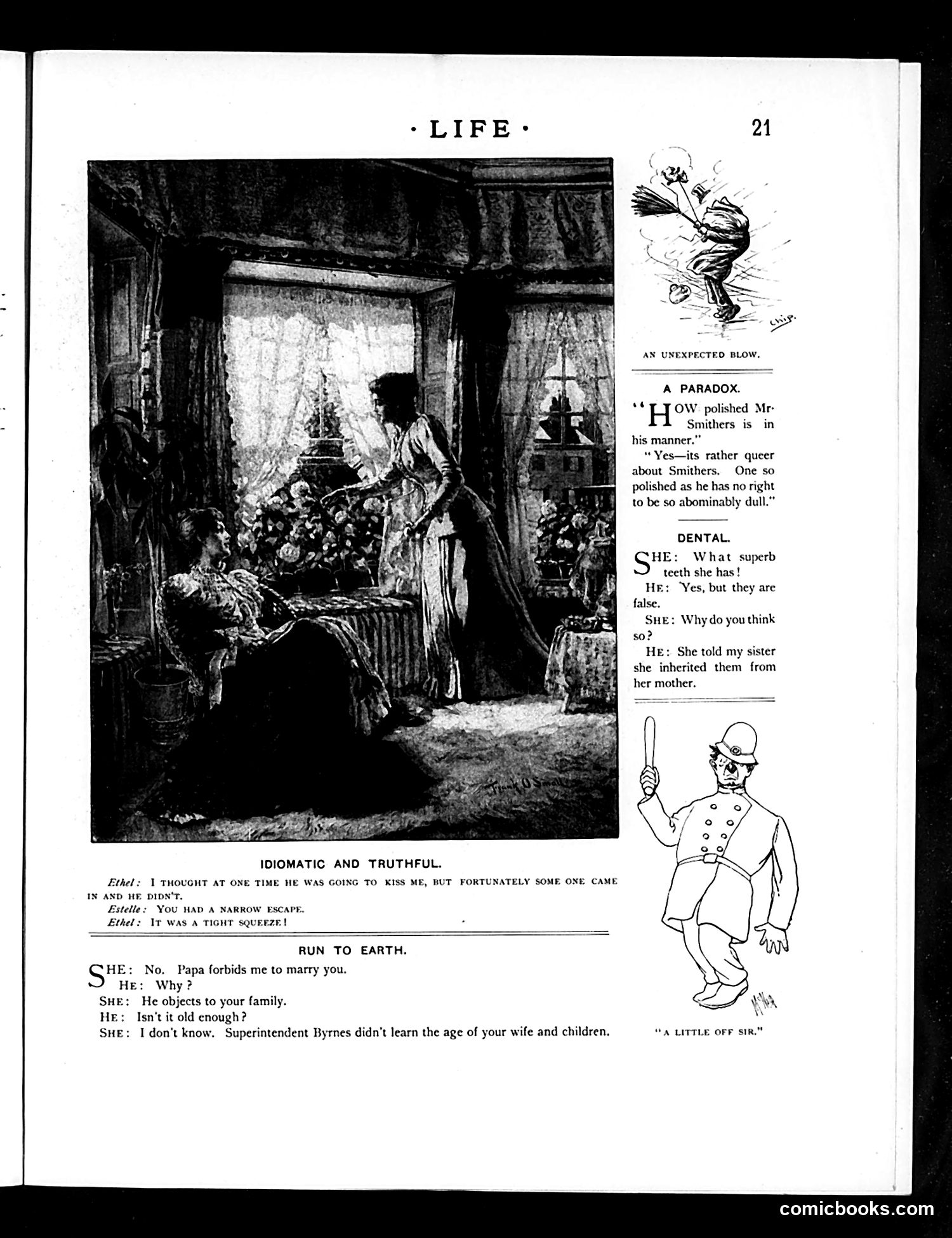
This page contains three unrelated humor pieces typical of early 20th-century Life magazine: 1. **"Idiomatic and Truthful"** (large illustration): A domestic scene where a man narrowly avoids being caught kissing a woman by another visitor's arrival—a classic adultery joke setup common to the era. 2. **"A Paradox"**: Brief dialogue mocking a man named Smithers for being simultaneously polished yet dull—social satire about superficial respectability. 3. **"Dental"** and **"Run to Earth"**: Short comic dialogues about false teeth and a father forbidding his daughter's marriage, respectively. 4. **"A Little Off Sir"**: A cartoon of a barber, likely a visual pun about over-eager haircutting. The content reflects turn-of-the-century domestic humor focusing on class anxieties, courtship restrictions, and marital infidelity as comedic topics.
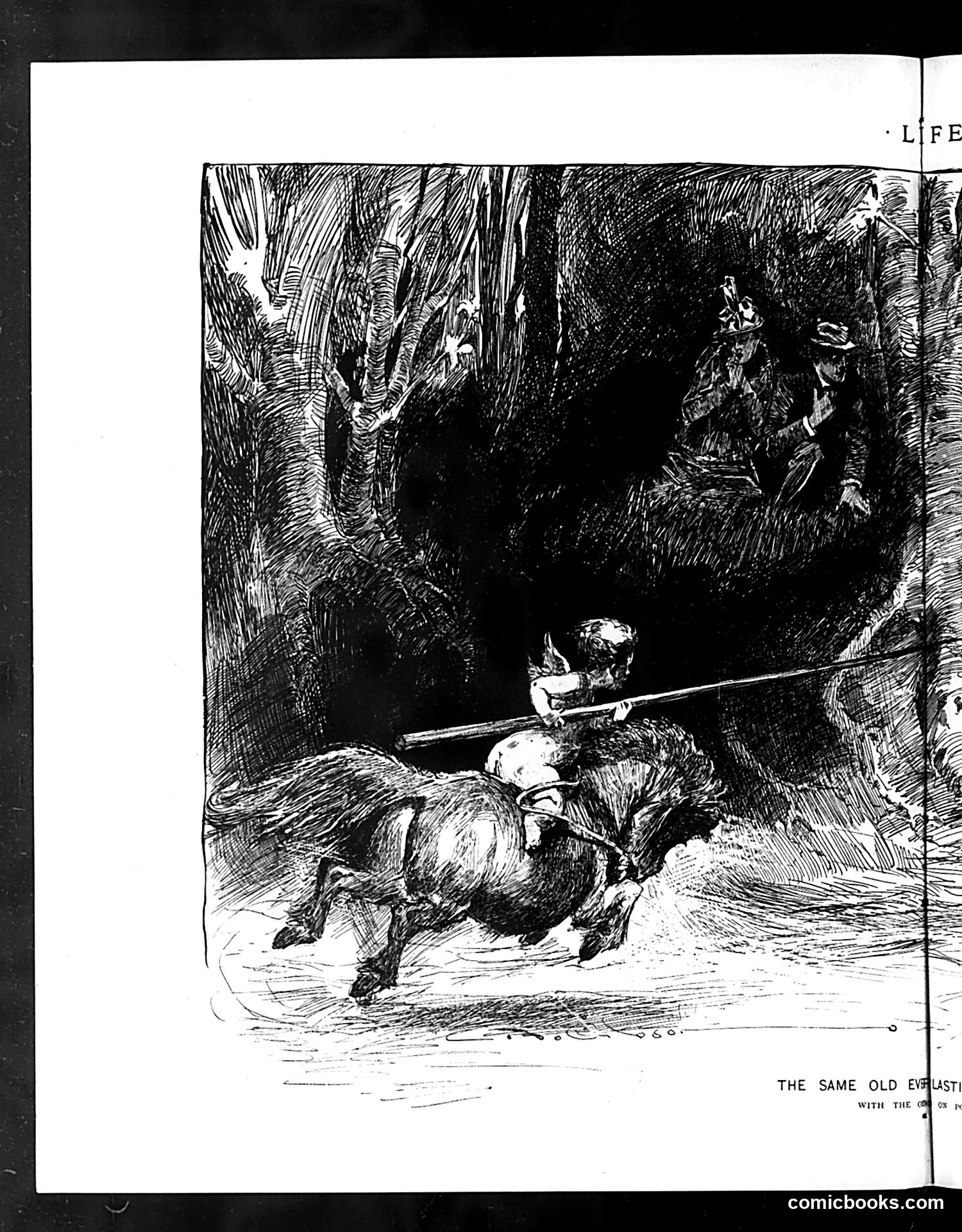
This is a political cartoon from Life magazine showing a hunter with a rifle pursuing a wild boar through a forest setting. The caption reads "THE SAME OLD EVERLASTING [STRUGGLE] WITH THE [text cut off]." The satire appears to reference the eternal nature of human conflict or struggle—the boar likely represents an enemy or adversary, and the hunter's relentless pursuit symbolizes ongoing political or social conflict that never truly ends. The "same old everlasting" language suggests this is cyclical rather than a new phenomenon. Without the complete caption or publication date visible, the specific political target remains unclear—it could reference war, class struggle, or partisan conflict—but the core message is that conflict is perpetual and inescapable.
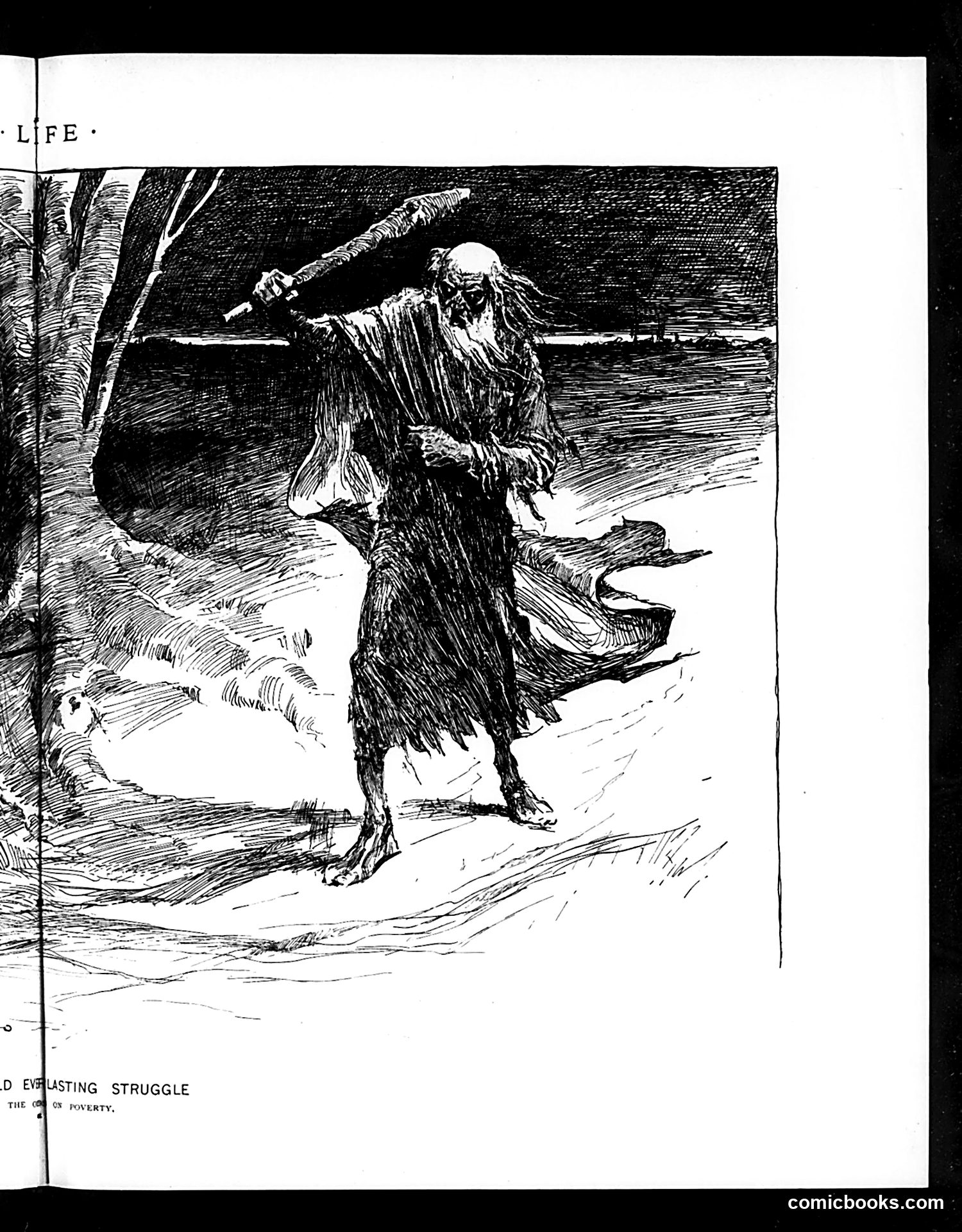
This political cartoon depicts a skeletal, impoverished figure—representing either poverty itself or a destitute person—engaged in an eternal struggle. The figure wields a tool (possibly a scythe or walking stick) defensively while standing in a snowy landscape near birch trees. The caption "THE EVERLASTING STRUGGLE" paired with the subtitle reference to "POVERTY" indicates this is social commentary about the persistent, grinding nature of poverty in American life. The skeletal appearance emphasizes dehumanization and deprivation, while the figure's defensive posture suggests poverty as an active, relentless adversary that must be constantly fought against. This reflects early 20th-century *Life* magazine's satirical engagement with progressive social issues.
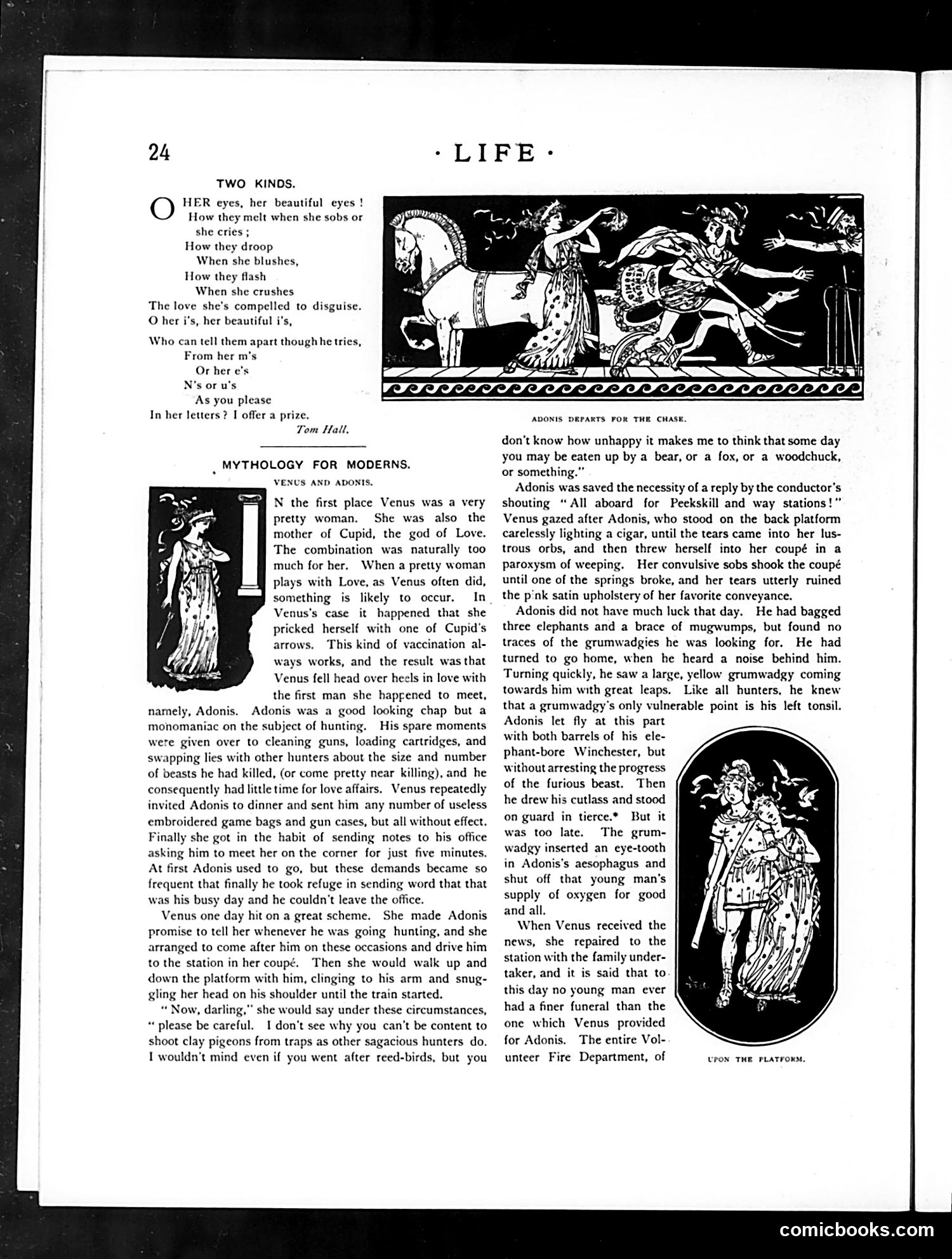
This page contains two literary pieces with classical illustrations, not political cartoons: 1. **"Two Kinds"** - A poem by Tom Hall about a woman's beautiful but tearful eyes, likely a romantic piece about concealed emotions. 2. **"Mythology for Moderns: Venus and Adonis"** - A humorous retelling of the classical myth, updated to modern times. Here, Venus is portrayed as a nagging girlfriend trying to keep her boyfriend Adonis from hunting. The satire mocks modern relationships by applying ancient mythology: Venus sends him repeated notes at work, clings to him at train stations, and ultimately her overbearing behavior leads to his death (by grummatodge). The joke targets both possessive romantic partners and the timelessness of relationship conflicts, presented through classical allusions for a literary audience.
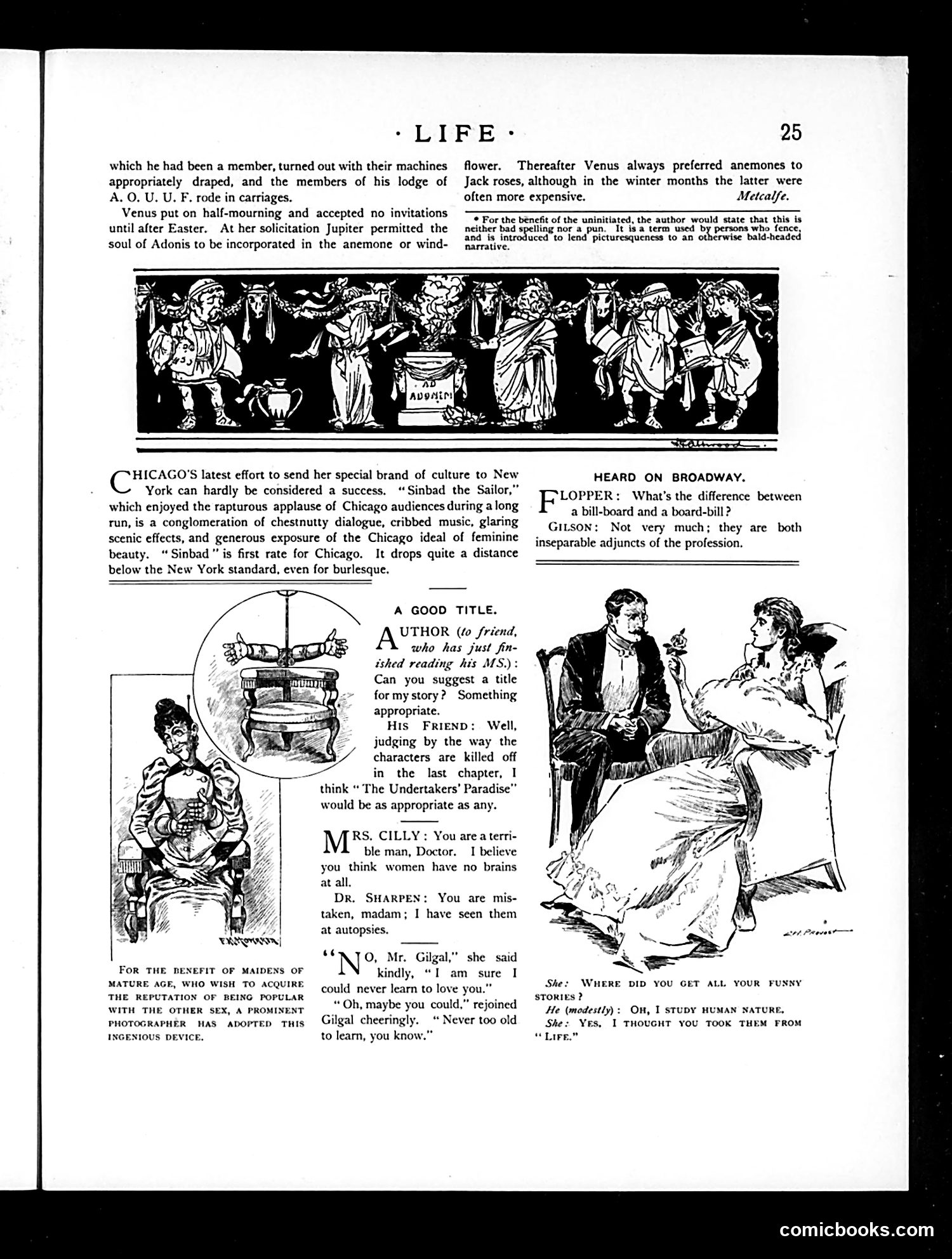
This page contains three satirical items about early 20th-century cultural and social topics: 1. **"Sinbad the Sailor"** discussion: Chicago's theatrical production is mocked for pretentious "culture" that falls short of New York standards—a jab at regional theatrical ambitions. 2. **"A Good Title"** comic: An author seeks title suggestions from a friend. When characters die in the final chapter, the friend suggests "The Undertakers' Paradise"—dark humor about death in fiction. 3. **"Heard on Broadway"** dialogue: A Gibson Girl-style woman asks a man about the difference between a billboard and a bill-doll (likely "bill-doll," meaning an attractive woman used for advertisement). The joke plays on professional women's objectification. 4. **"Mrs. Cilly" dialogue**: Satirizes debate about women's intelligence, with a doctor claiming women lack brains while citing autopsy evidence. The overall tone mocks theatrical pretension, gender politics, and urban sophistication.
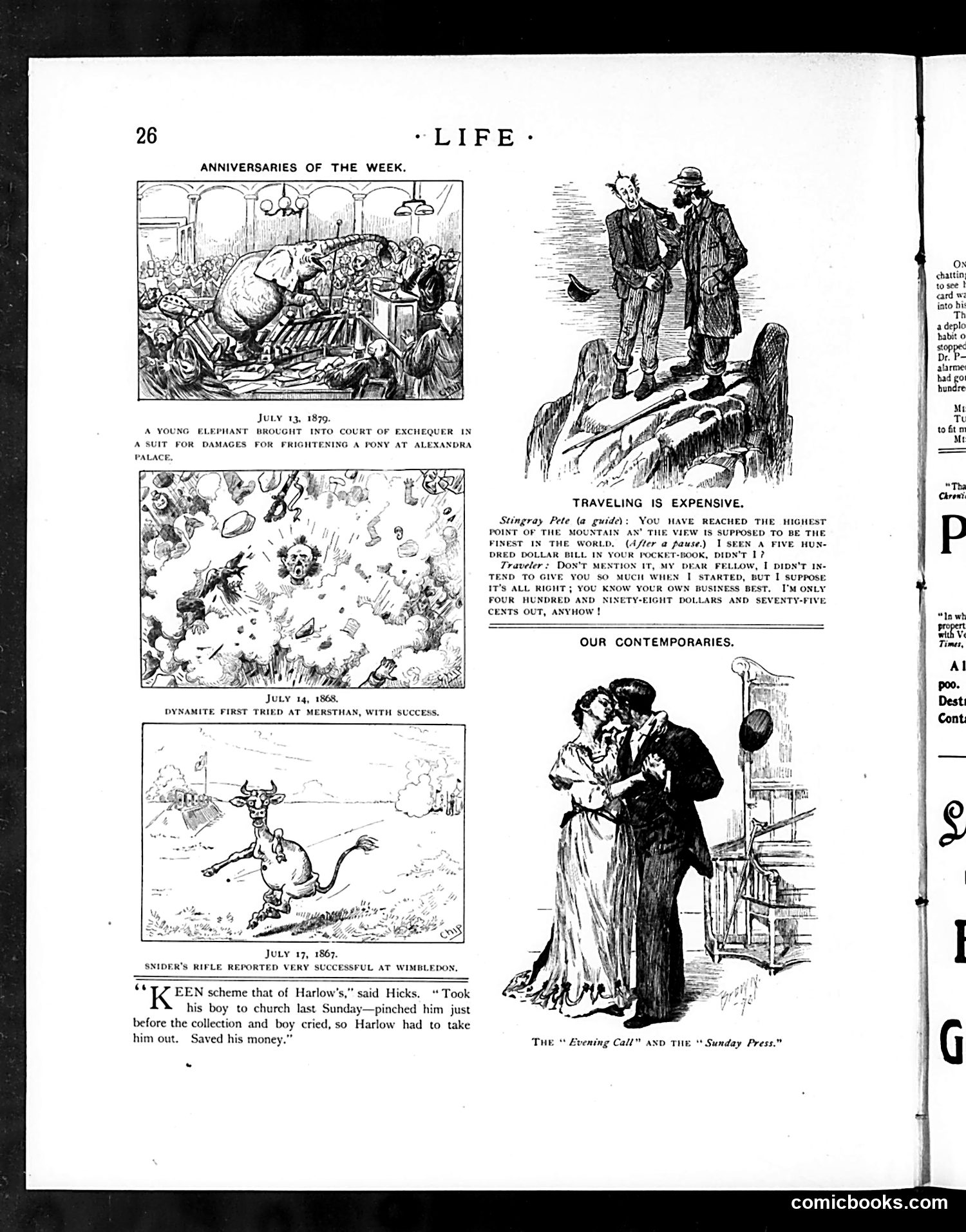
This page from Life magazine (likely 1870s-1880s) contains several satirical items: **"Anniversaries of the Week"** lists historical events with tongue-in-cheek humor—a young elephant suing for damages, dynamite testing, and rifle demonstrations—treating mundane or absurd incidents as if they were significant historical milestones. **"Traveling is Expensive"** satirizes the dynamic between guides and wealthy tourists. The con-artist guide ("Stingray Pete") manipulates his client by feigning surprise at spotting the tourist's large bankroll, guilt-tripping him into an enormous tip ($500 minus $424.75 spent = financial loss). The joke mocks both the guide's shameless manipulation and the wealthy traveler's inability to refuse. **"Our Contemporaries"** appears to reference rival publications with a romantic scene labeled "The 'Evening Call' and the 'Sunday Press,'" likely satirizing competing newspapers. The overall tone targets 19th-century social pretensions, con-artistry, and journalistic rivalry through humorous illustration.
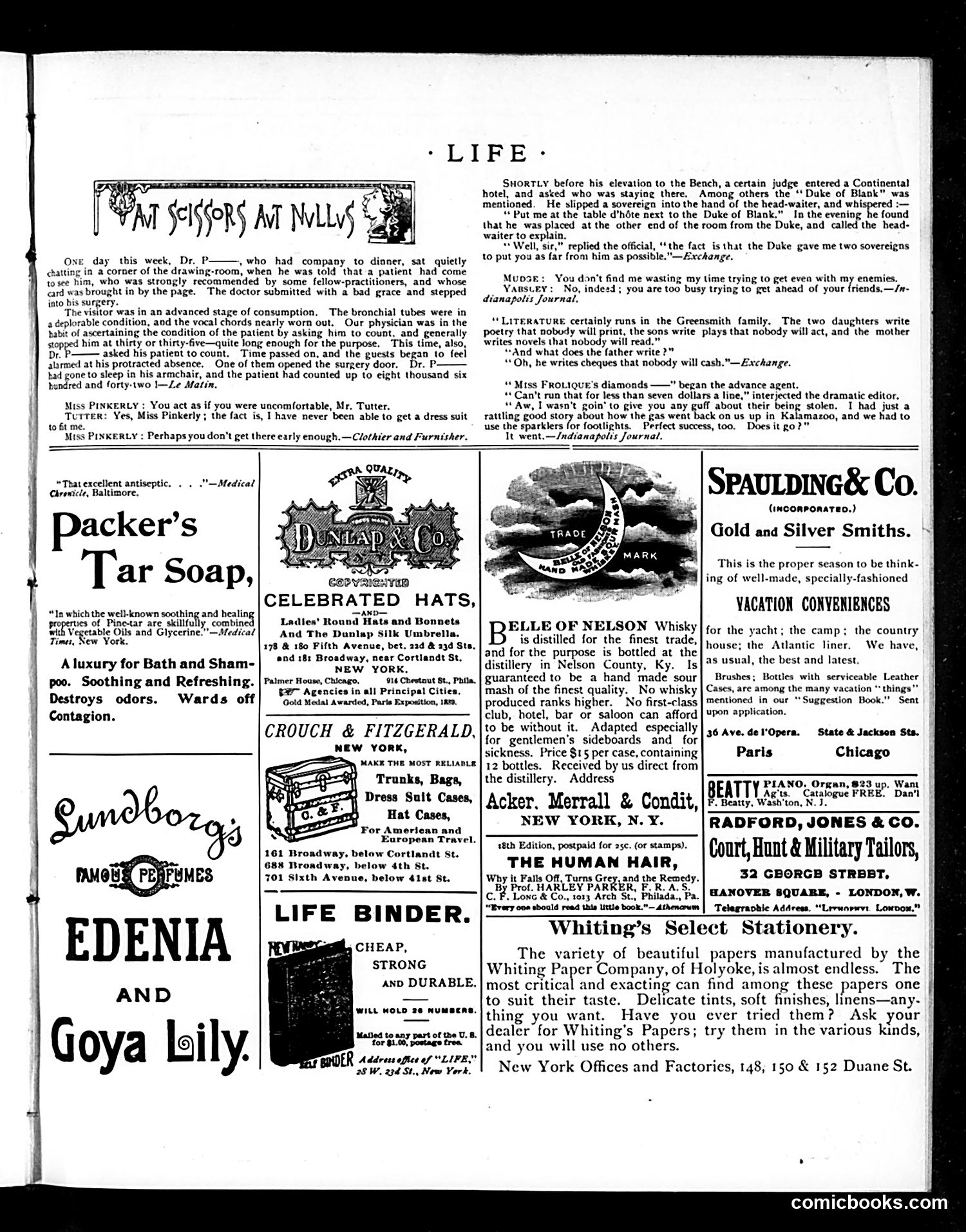
This page from *Life* magazine mixes satirical short jokes with period advertisements. The main cartoons are brief comedic vignettes: 1. **"Dr. P— Asleep"**: A doctor falls asleep while a consumption patient counts aloud—meant to mock medical negligence or the tedium of medical examinations. 2. **The "Duke of Blank" anecdote**: A social climber pays a waiter to seat him near a duke, but the duke outbids him to stay away—satirizing wealth-driven social aspiration and one-upmanship. 3. **Miss Pinkerly's dress suit problem**: A joke about ill-fitting clothes, likely mocking either tailors or overeager suitors. 4. **The Greensmith family**: Mocking pretentious literary families—daughters write unpublishable poetry, sons write unperformable plays, and father merely writes checks. 5. **Miss Frolique's diamonds**: A theatrical editor refuses a gossip story about stolen diamonds unless framed as a proper news item. The page otherwise consists of period advertisements for tar soap, hats, trunks, and stationery—typical of *Life's* revenue model.
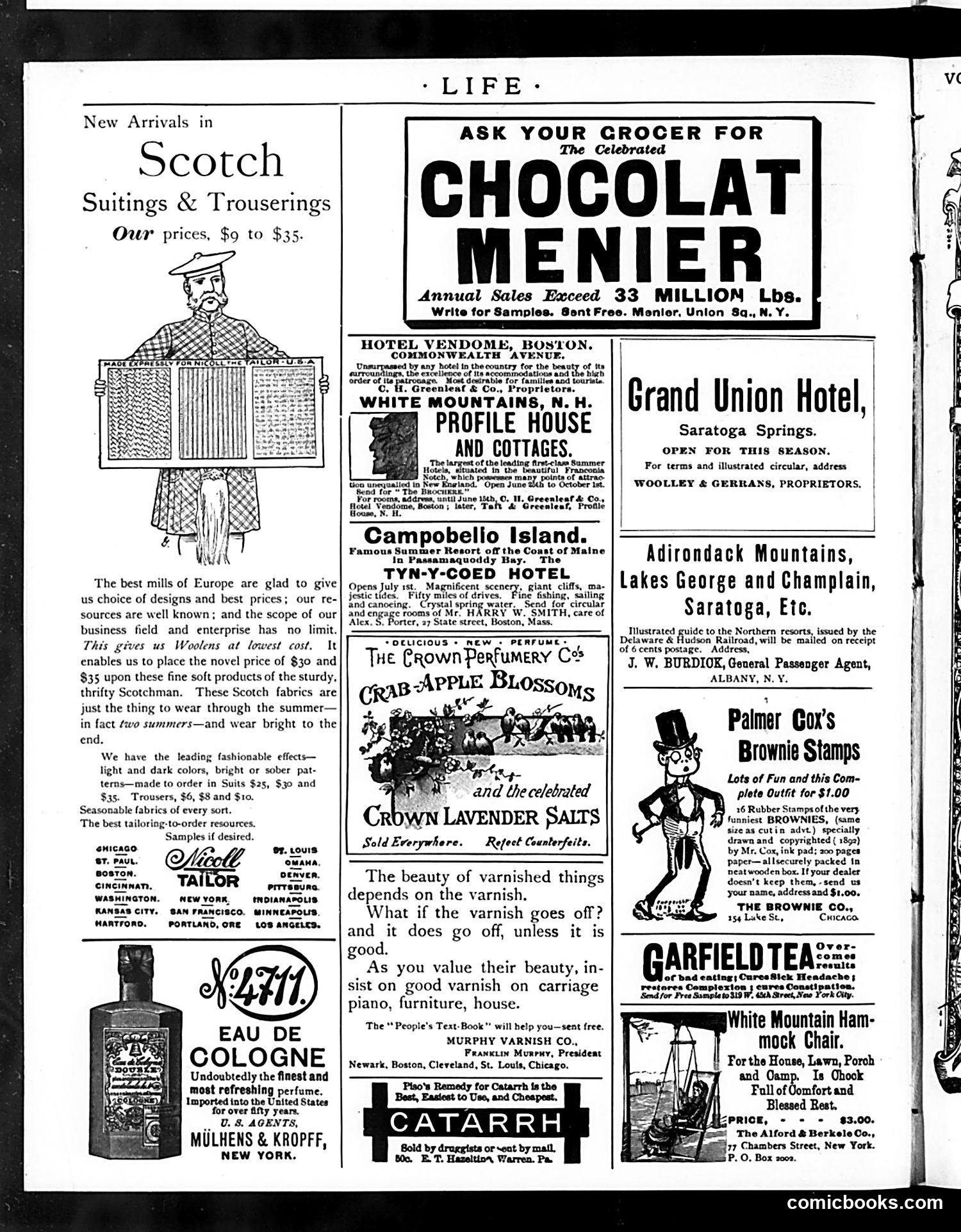
This is primarily an **advertising page** from Life magazine (late 19th century), containing no political cartoons or satire requiring historical context. The page consists entirely of product advertisements typical of the era: - **Scotch suiting advertisements** featuring a Scottish tailor displaying fabric samples - **Hotel and resort promotions** (Saratoga Springs, White Mountains, Adirondacks) - **Consumer goods ads**: Chocolat Menier chocolate, Eau de Cologne perfume, Crown Lavender Salts, varnish, catarrh remedy, tea - **Palmer Cox's Brownie Stamps** — a children's craft product based on Cox's popular "Brownie" characters The only remotely visual element is the small illustration of a Scottish gentleman in traditional dress displaying fabric swatches, which is straightforward product marketing rather than commentary or satire. This page reflects turn-of-the-century consumer culture and advertising practices but contains no political or social satire to interpret.