
Life, 1892-07-14 · page 11 of 14
Life — July 14, 1892 — page 11: what you’re looking at
What you’re looking at
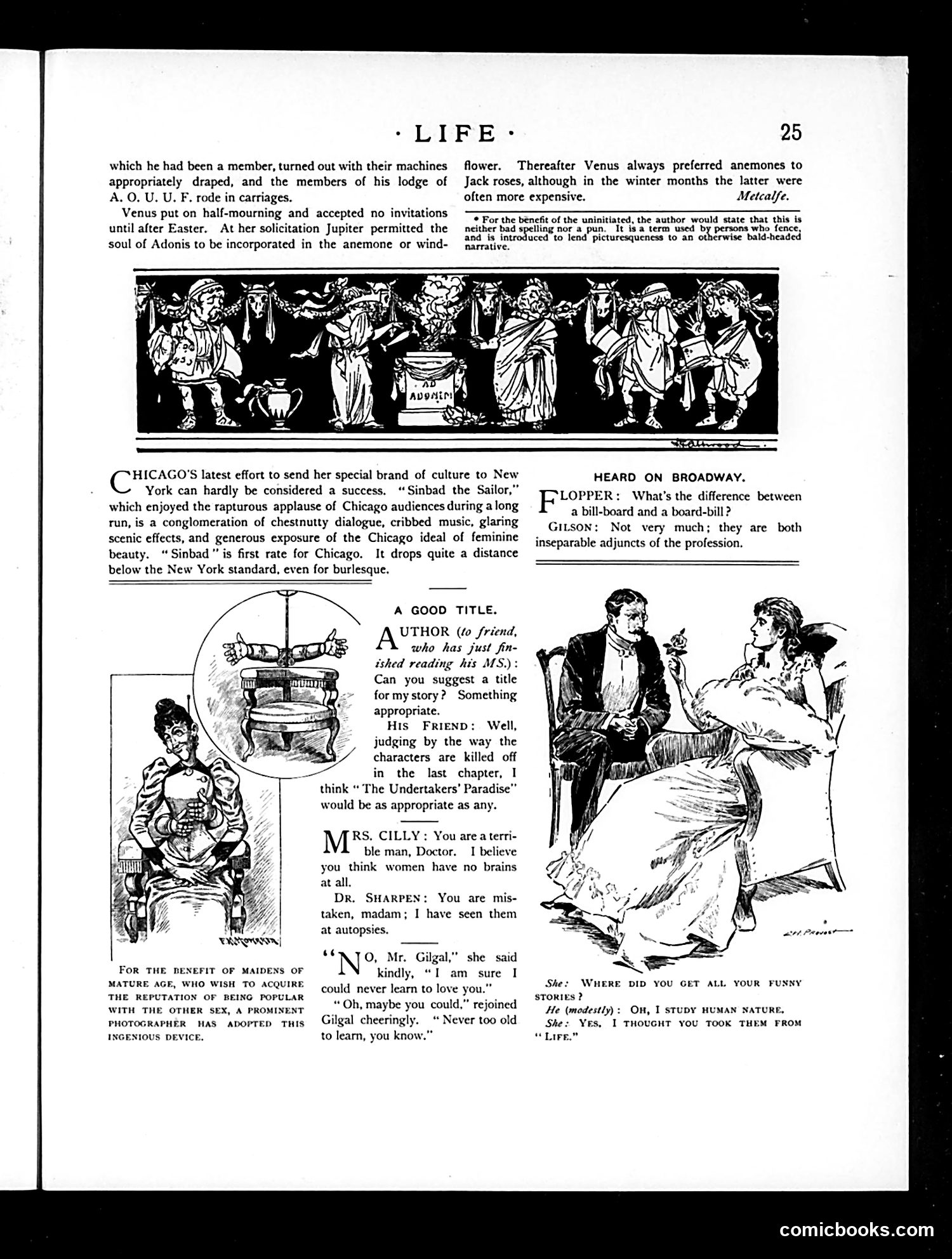
This page contains three satirical items about early 20th-century cultural and social topics: 1. **"Sinbad the Sailor"** discussion: Chicago's theatrical production is mocked for pretentious "culture" that falls short of New York standards—a jab at regional theatrical ambitions. 2. **"A Good Title"** comic: An author seeks title suggestions from a friend. When characters die in the final chapter, the friend suggests "The Undertakers' Paradise"—dark humor about death in fiction. 3. **"Heard on Broadway"** dialogue: A Gibson Girl-style woman asks a man about the difference between a billboard and a bill-doll (likely "bill-doll," meaning an attractive woman used for advertisement). The joke plays on professional women's objectification. 4. **"Mrs. Cilly" dialogue**: Satirizes debate about women's intelligence, with a doctor claiming women lack brains while citing autopsy evidence. The overall tone mocks theatrical pretension, gender politics, and urban sophistication.
📄 Transcribed text from this page (OCR, searchable)
Machine-transcribed from the original scan — historical spelling and the odd misread are preserved.
- LIFE: which he had been a member, turned out with their machines appropriately draped, and the members of his lodge of A. O. U. U. F. rode in carriages. Venus put on half-mourning and accepted no invitations 25 flower. Thereafter Venus always preferred anemones to Jack roses, although in the winter months the latter were often more expensive. Metcalfe. * For the benefit of the uninitiated, the author would state that this is until after Easter. At her solicitation Jupiter permitted the - _ ‘ and is in soul of Adonis to be incorporated in the anemone or wind- narrative. HICAGO’'S latest effort to send her special brand of culture to New York can hardly be considered a success. ‘Sinbad the Sailor,” which enjoyed the rapturous applause of Chicago audiences during a long tun, is a conglomeration of chestnutty dialogue, cribbed music, glaring scenic effects, and generous exposure of the Chicago ideal of feminine beauty. “Sinbad” is first rate for Chicago, It drops quite a distance below the New York standard, even for burlesque. A GOOD TITLE. UTHOR (¢0 friend, who has just fin- ished reading his MS.): Can you suggest a title for my story? Something appropriate. His FRIEND: Well, judging by the way the characters are killed off in the last chapter, I think “ The Undertakers’ Paradise” would be as appropriate as any. RS. CILLY: You area terri- ble man, Doctor. I believe you think women have no brains at all. Dr. SHARPEN: You are mis- taken, madam; I have seen them cy : at autopsies. TRAEWTR) “N O, Mr. Gilgal,” she said kindly, “I am sure I could never learn to love you. FOR THE BENEFIT OF MAIDENS OF MATURE AGE, WHO WISH TO ACQUIRE THE REPUTATION OF BEING POPULAR WITH THE OTHER SEX, A PROMINENT PHOTOGRAPHER HAS ADOPTED THIS INGENIOUS DEVICE. “Oh, maybe you could,” rejoined Gilgal cheeringly. “ Never too old to learn, you know.” neither bad spelling nor a pun. It juced to lend picturesqueness to an otl is a term used by persons who fence, rwise bald-headed HEARD ON BROADWAY. LOPPER: What's the difference between a bill-board and a board-bill ? GILSON: Not very much; they are both inseparable adjuncts of the profession. att/ Proves — She: WueRe DID YOU GET ALL YOUR FUNNY STORIES ? He (modestly): OW, I STUDY HUMAN NATURE, She: Yes, 1 THOUGHT YOU TOOK THEM FROM comicbooks.com