
Life, 1892-07-14 · page 4 of 14
Life — July 14, 1892 — page 4: what you’re looking at
What you’re looking at
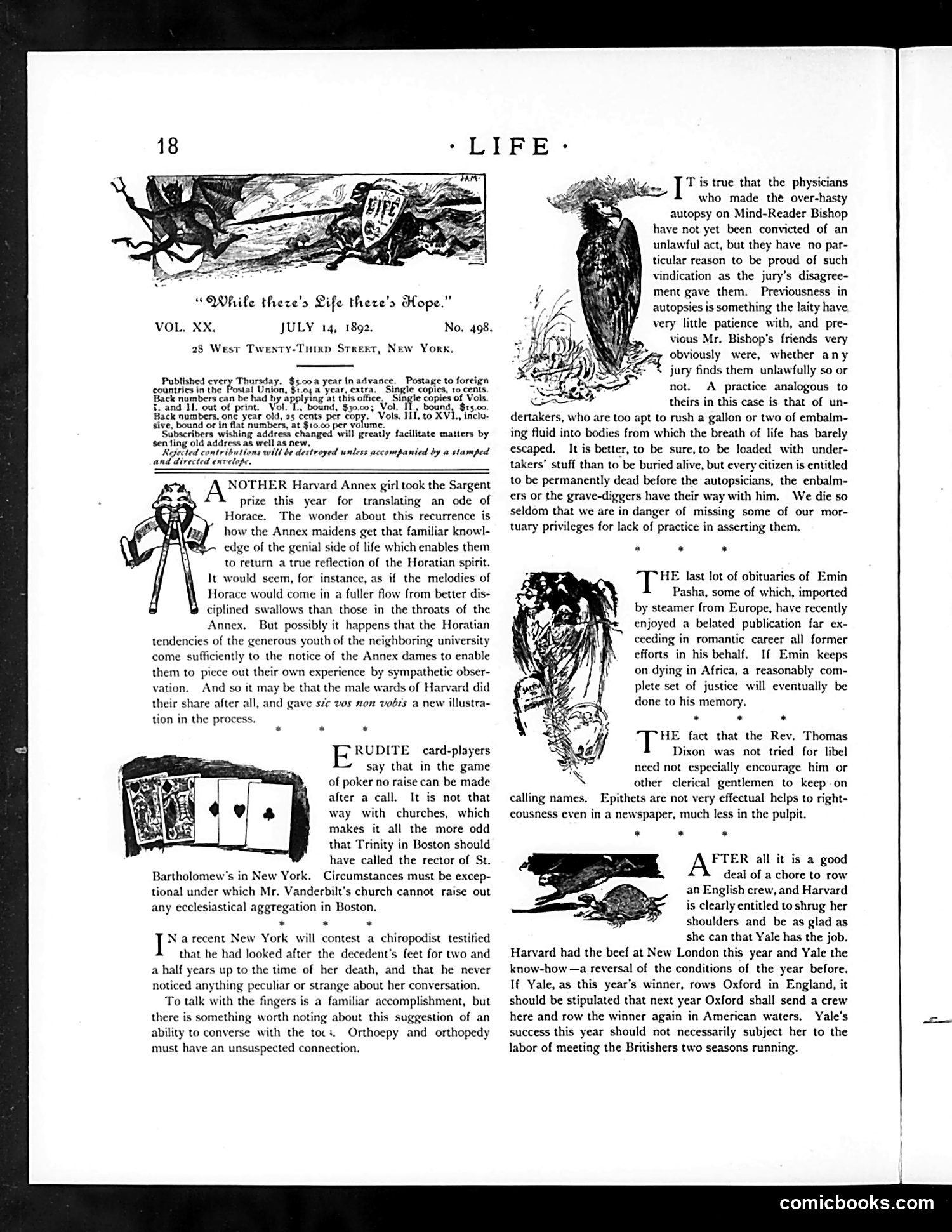
The top cartoon depicts a figure labeled "Life" riding in a chariot pulled by skeletal horses, with the caption "While there's Life there's Hope." This appears to be a standard allegorical representation common to the era—personifying "Life" itself as a force that endures despite hardship. The remaining text consists of brief satirical commentary on contemporary issues: Harvard Annex girls winning academic prizes, questionable medical autopsies, obituaries of notable figures, ecclesiastical controversies in Boston churches, poker and card-playing ethics, and a chiropodist's peculiar testimony in a legal case. The page reflects typical late-Victorian satirical humor—mocking academic pretension, medical ethics, religious hypocrisy, and social oddities through brief, acerbic observations rather than extended narratives.
📄 Transcribed text from this page (OCR, searchable)
Machine-transcribed from the original scan — historical spelling and the odd misread are preserved.
“Mile there's Life there's Hope.” VOL. XX. JULY 14, 1892. No. 498. 28 West Twenty-Tuirp Street, New York. Published every Thursday. $s.00a year in advance. Postage to foreign countries in the Postal Union, $t.oy a year, extra. Single copies, ro cents. Back numbers can be had by applying at this office,” Single copics of Vols. T. and II, out of print. Vol. T., bound, $30.00; Vol. I1., bound, $15.00. Back numbers, one year old, a5 Cents per copy.” Vols. III. to XVI, inclu: sive, bound of in flat numbers, at $10.00 per volum: Subscribers wishing address changed will greatly facilitate matters by sen ing old address as well as new. Rejected contributions will be destroyed untess accompanied by a stamped and directed envelope. e. NOTHER Harvard Annex girl took the Sargent prize this year for translating an ode of Horace. The wonder about this recurrence is how the Annex maidens get that familiar knowl- edge of the genial side of life which enables them to return a true reflection of the Horatian spirit. It would seem, for instance if the melodies of Horace would come in a fuller flow from better dis- ciplined swallows than those in the throats of the Annex. But possibly it happens that the Horatian tendencies of the generous youth of the neighboring university come sufficiently to the notice of the Annex dames to enable them to piece out their own experience by sympathetic obser- vation. And so it may be that the male wards of Harvard did their share after all, and gave sé¢ vos non vobis a new illustra- tion in the process. : ; RUDITE card-players say that in the game of poker no raise can be made after a call. It is not that way with churches, which makes it all the more odd that Trinity in Boston should have called the rector of St. Bartholomew's in New York. Circumstances must be excep- tional under which Mr. Vanderbilt's church cannot raise out any ecclesiastical aggregation in Boston. . . * io arecent New York will contest a chiropodist testified that he had looked after the decedent's feet for two and a half years up to the time of her death, and that he never noticed anything peculiar or strange about her conversation, To talk with the fingers is a familiar accomplishment, but there is something worth noting about this suggestion of an ability to converse with the toc, Orthoepy and orthopedy must have an unsuspected connection. T is true that the physicians who made the over-hasty autopsy on Mind-Reader Bishop have not yet been convicted of an unlawful act, but they have no par- ticular reason to be proud of such vindication as the jury's disagree- ment gave them. Previousness in autopsies is something the laity have very little patience with, and pre- vious Mr. Bishop's friends very obviously were, whether any £ jury finds them unlawfully so or not. A practice analogous to theirs in this case is that of un- dertakers, who are too apt to rush a gallon or two of embalm- ing fluid into bodies from which the breath of life has barely escaped. It is better, to be sure,to be loaded with under- takers’ stuff than to be buried alive, but every citizen is entitled to be permanently dead before the autopsicians, the enbalm- ers or the grave-diggers have their way with him. We die so seldom that we are in danger of missing some of our mor- tuary privileges for lack of practice in asserting them. « . . HE last lot of obituaries of Emin Pasha, some of which, imported by steamer from Europe, have recently enjoyed a belated publication far ex- ceeding in romantic career all former efforts in his behalf. If Emin keeps on dying in Africa, a reasonably com- plete set of justice will eventually be done to his memory. . . . HE fact that the Rev. Thomas Dixon was not tried for libel need not especially encourage him or other clerical gentlemen to keep on calling names. Epithets are not very effectual helps to right- cousness even in a newspaper, much less in the pulpit. . ATT all it is a good deal of a chore to row an English crew, and Harvard is clearly entitled to shrug her shoulders and be as glad as she can that Yale has the job. Harvard had the beef at New London this year and Yale the know-how —a reversal of the conditions of the year before. If Yale, as this year's winner, rows Oxford in England, it should be stipulated that next year Oxford shall send a crew here and row the winner again in American waters. Yale's success this year should not necessarily subject her to the labor of meeting the Britishers two seasons running. comicbooks.com