
A complete issue · 19 pages · 1892
Life — June 30, 1892
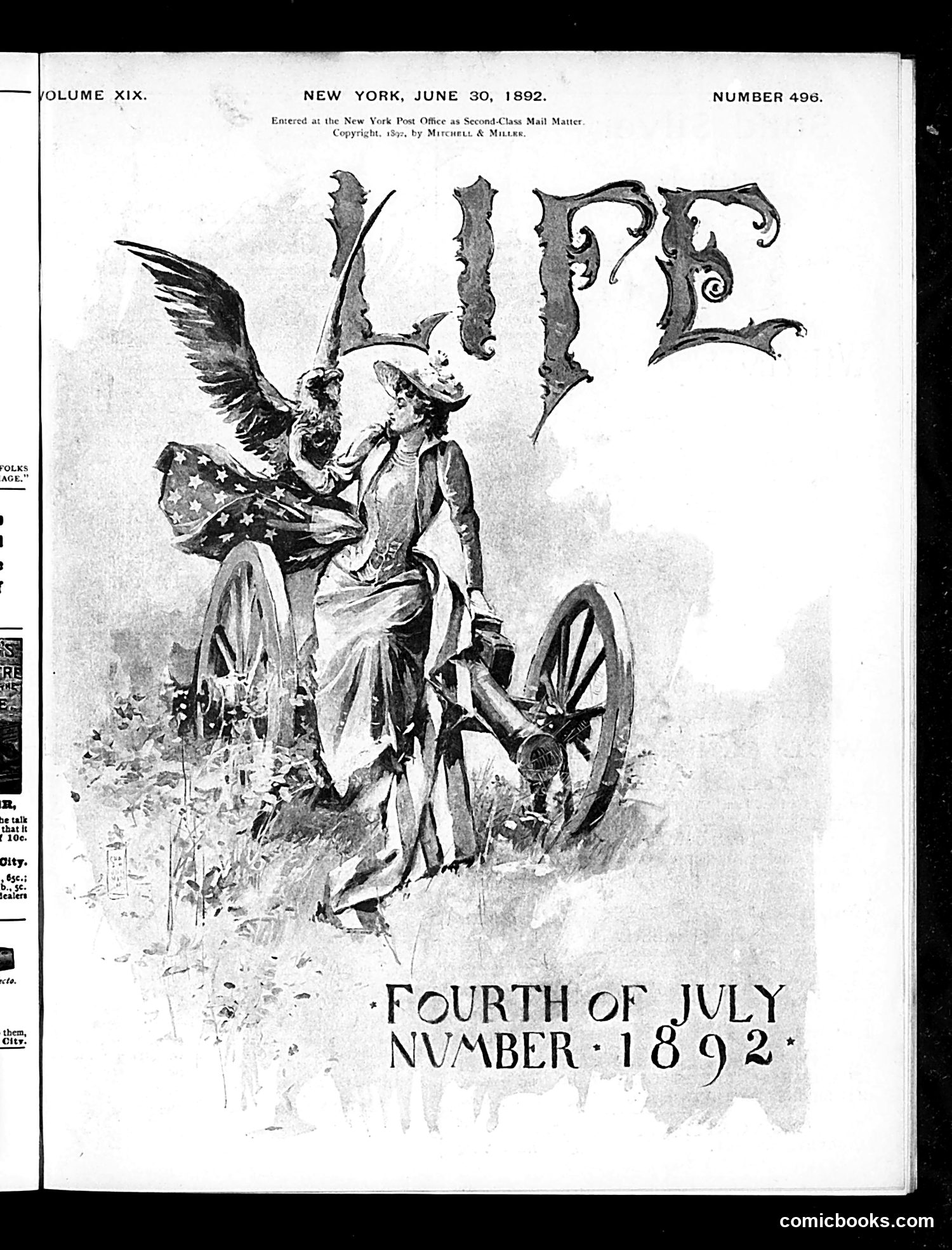
This is the cover of Life's Fourth of July 1892 issue. The illustration depicts **Lady Liberty** (identifiable by her winged headdress and American flag cape) riding in a carriage pulled by an eagle. She appears to be in motion, suggesting America's forward progress or momentum around Independence Day. The decorative lettering spells "LIFE" at the top, establishing this as the magazine's masthead. The date "1892" and "Fourth of July Number" ground this as a patriotic holiday issue. The satirical intent is unclear from the image alone—it may celebrate American strength, mock political excess, or comment on contemporary national affairs. The romantic, allegorical style was typical of 1890s patriotic imagery, though Life often used such imagery ironically.
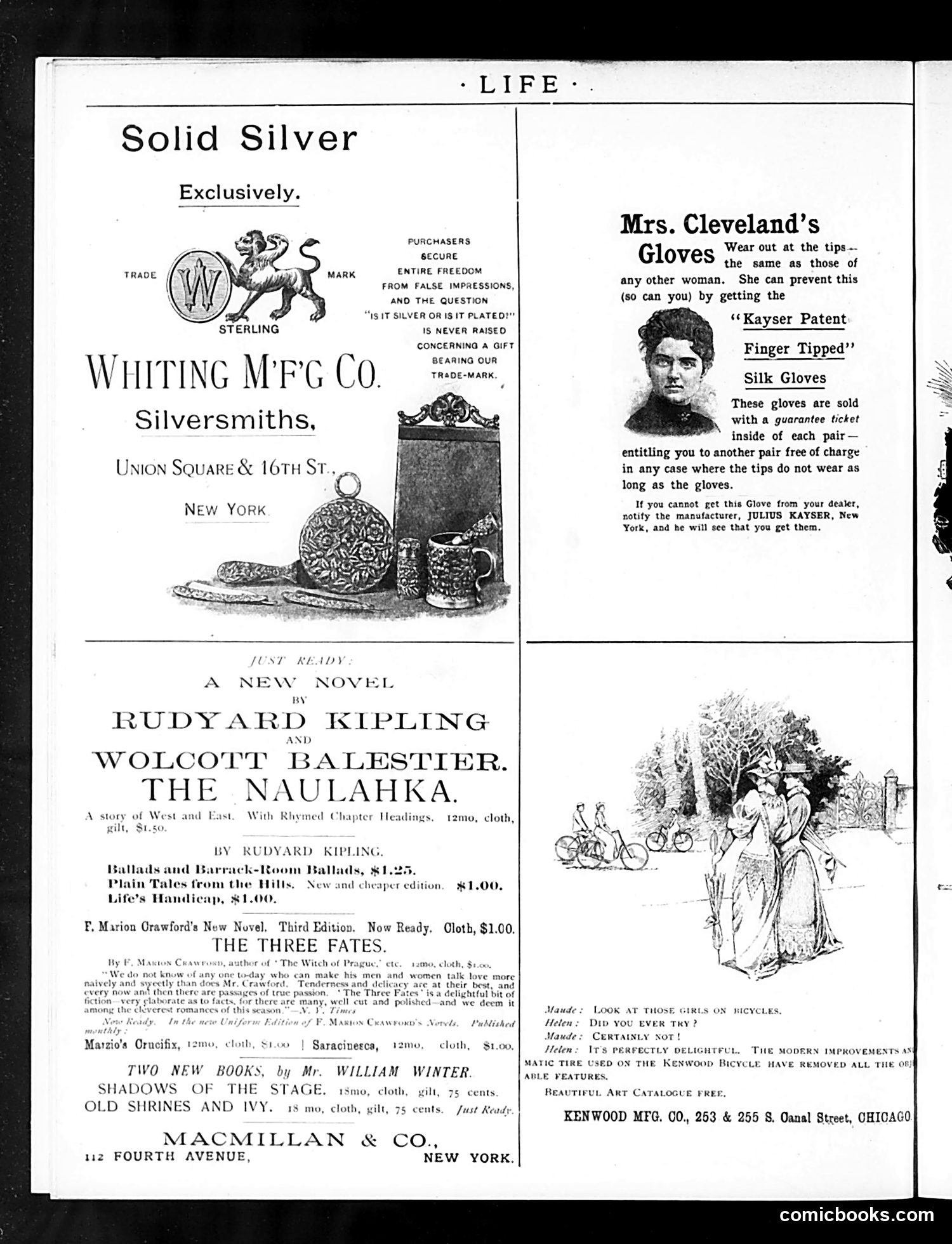
This page is primarily **advertising and book announcements** rather than political satire. The left side advertises Whiting MFG Co.'s solid silver products with their trademark lion logo. Below are announcements for new novels, including Rudyard Kipling's *The Naulahka* and works by other contemporary authors. The right side features an advertisement for "Kayser Patent Finger Tipped" silk gloves endorsed by "Mrs. Cleveland"—likely referencing a First Lady, suggesting these were premium consumer goods. Below is a Kenwood bicycle advertisement with an illustrated scene of women cyclists, promoting modern bicycle improvements. The content reflects late 19th-century consumer culture and advertising rather than political commentary or satire.
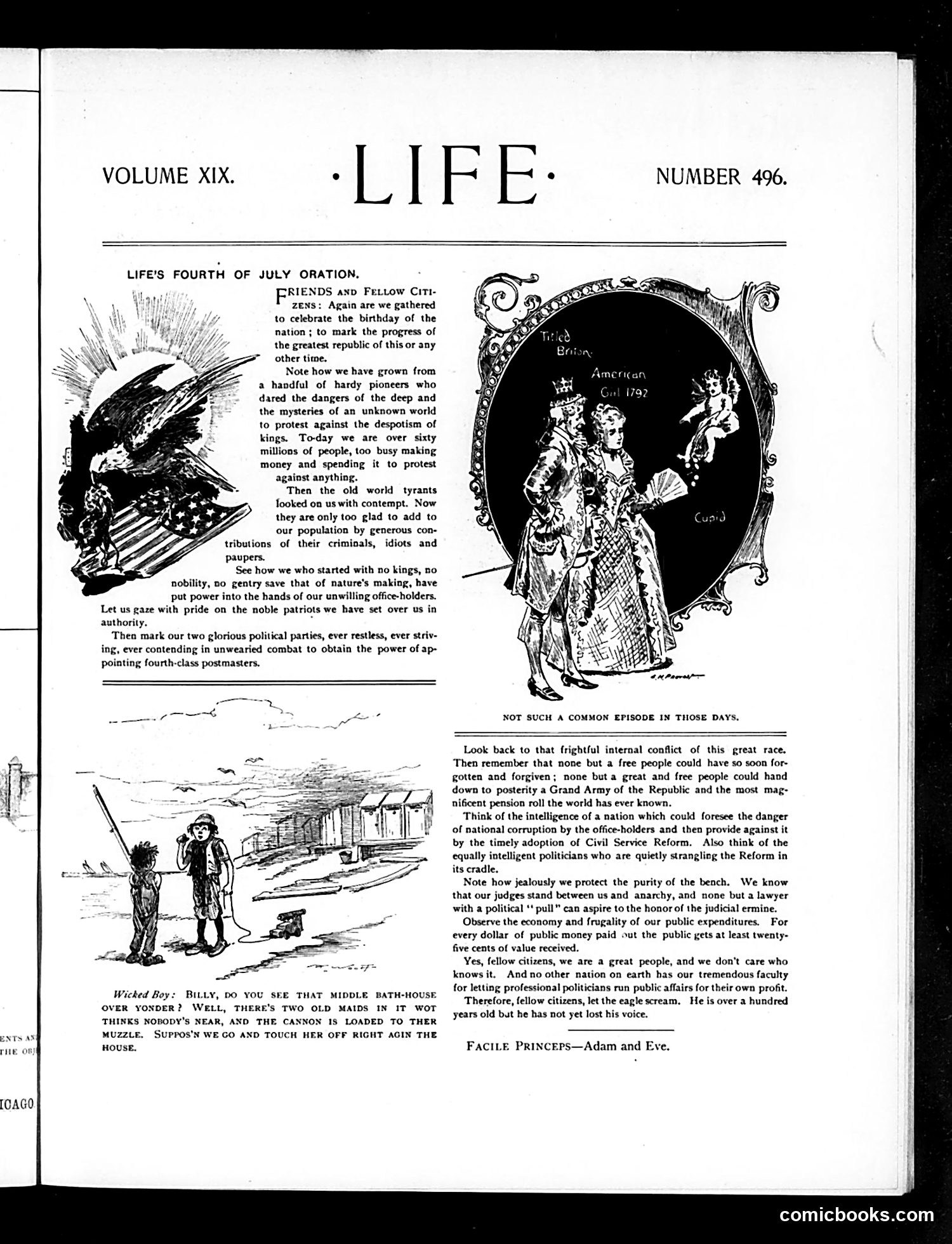
This Fourth of July oration satirizes American politics and corruption circa the 1880s-90s. The eagle-and-shield illustration celebrates American independence and republicanism. However, the text mocks the contradiction between founding ideals and current reality: the nation has grown from "hardy pioneers" rejecting tyranny to a corrupt system where "office-holders" wield power and "professional politicians run affairs" for profit rather than public good. The cartoon "Wicked Boy" depicts street children near a bathhouse, illustrating urban poverty and social neglect—a stark contrast to the patriotic rhetoric above. The piece advocates for Civil Service Reform to combat patronage corruption, arguing that even a "hundred years old" boy deserves political voice. The satire suggests American democracy has betrayed its founding principles through systematic graft.
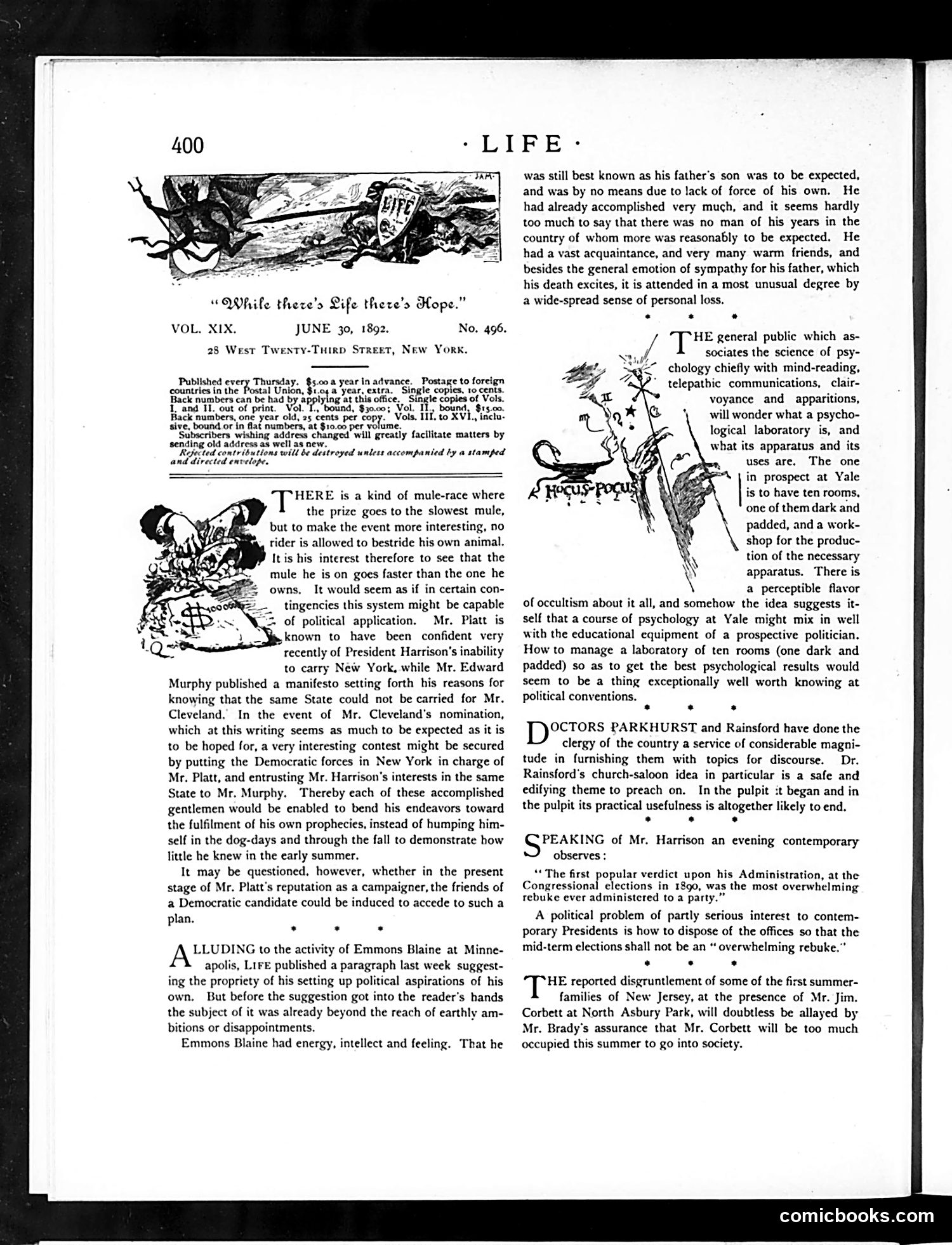
The page contains two satirical cartoons and commentary on American politics. **First cartoon** (top): Depicts a mule-race where "the prize goes to the slowest mule." The text explains this as political satire—comparing political conventions to a race where candidates benefit by being slower than their rivals. It references President Harrison's difficulty carrying New York and Edward Murphy's manifest supporting Cleveland's nomination, suggesting Democratic strategists were maneuvering to secure nomination through calculation rather than merit. **Second cartoon** ("Hocus Pocus," bottom left): Illustrates political manipulation, likely referencing similar convention scheming. The broader commentary criticizes how political parties manipulate conventions and nominations through backroom deals rather than democratic process—a common complaint about Gilded Age politics.
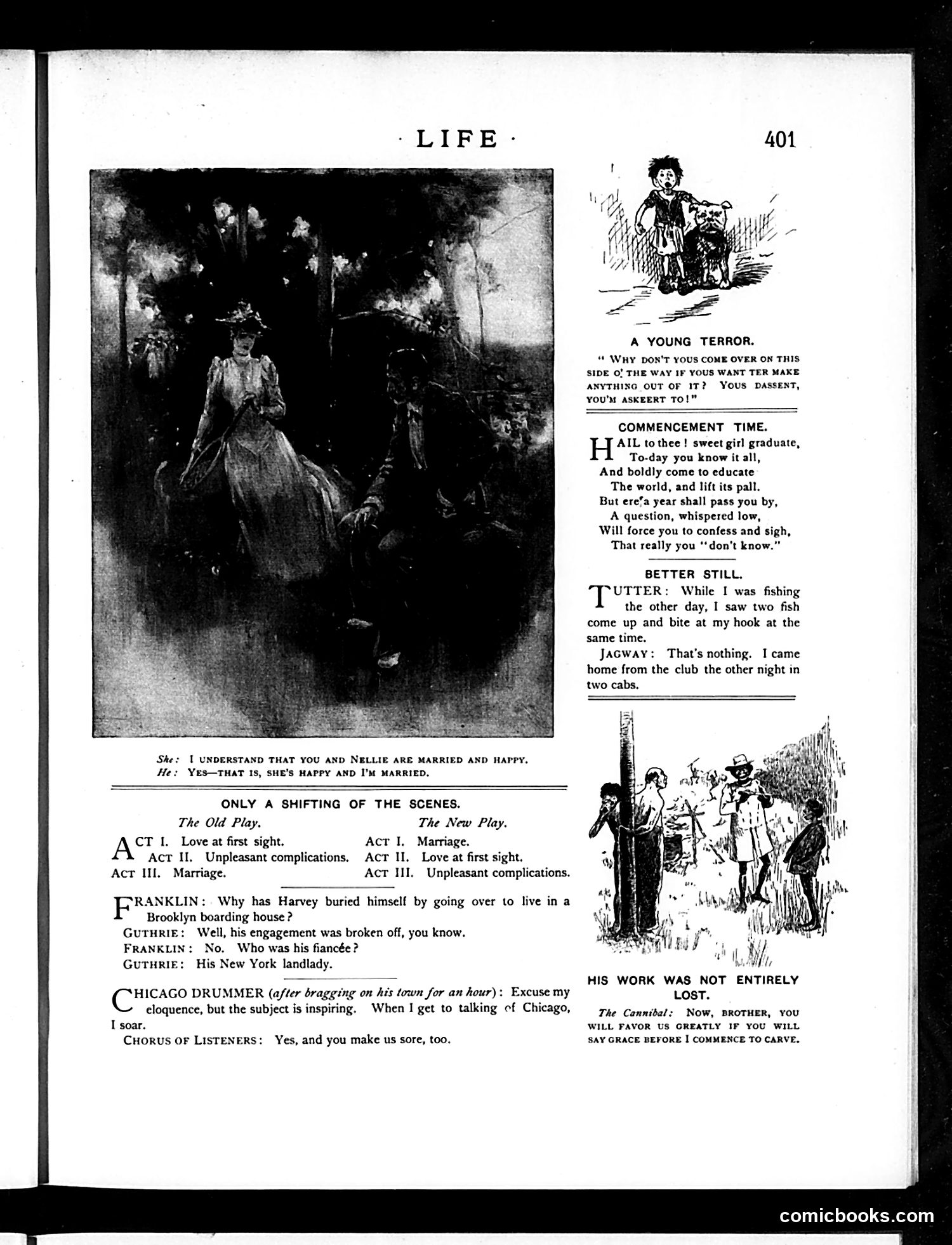
This page contains theatrical humor and social commentary typical of early 20th-century Life magazine. The main content compares "The Old Play" with "The New Play," both following identical three-act structures (love, complications, marriage), suggesting that despite claims of theatrical innovation, plots remain formulaic and predictable. The satirical dialogue mocks pretentious conversation: a Chicago drummer boasts about his hometown until heckled by listeners. The "Better Still" anecdote features Tutter and Jagway in a one-upmanship competition about unlikely encounters, a common humor format. The illustrations include domestic and social scenes. Overall, the page satirizes theatrical clichés, urban boasting, and the human tendency toward exaggeration—themes reflecting turn-of-the-century American middle-class society.
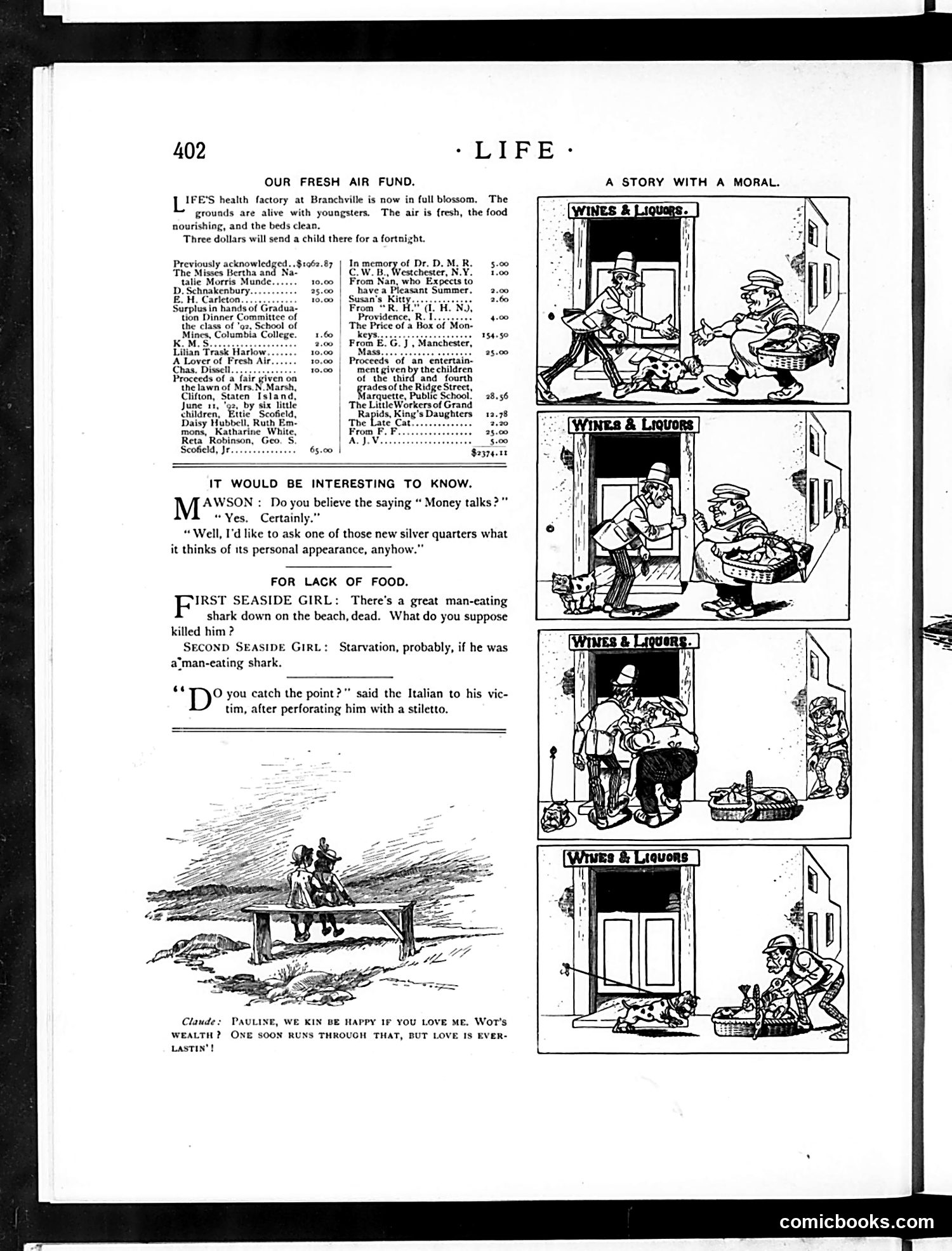
This four-panel comic appears to satirize Prohibition-era hypocrisy. The recurring "WINES & LIQUORS" storefront sign suggests the strip mocks how alcohol sales continued despite legal bans—the shop maintains a facade while conducting business out back or through side dealings. Each panel shows men conducting transactions or exchanges at the storefront, likely depicting the widespread illegal alcohol trade during Prohibition. The comic's humor derives from the open-secret nature of speakeasies and underground liquor sales: despite official prohibition, merchants and customers brazenly continued the trade with minimal pretense. The page also includes unrelated content—a charitable fundraising list ("Our Fresh Air Fund") and period jokes about money and class. The overall issue reflects Life magazine's satirical commentary on American social contradictions and the failure of Prohibition enforcement.
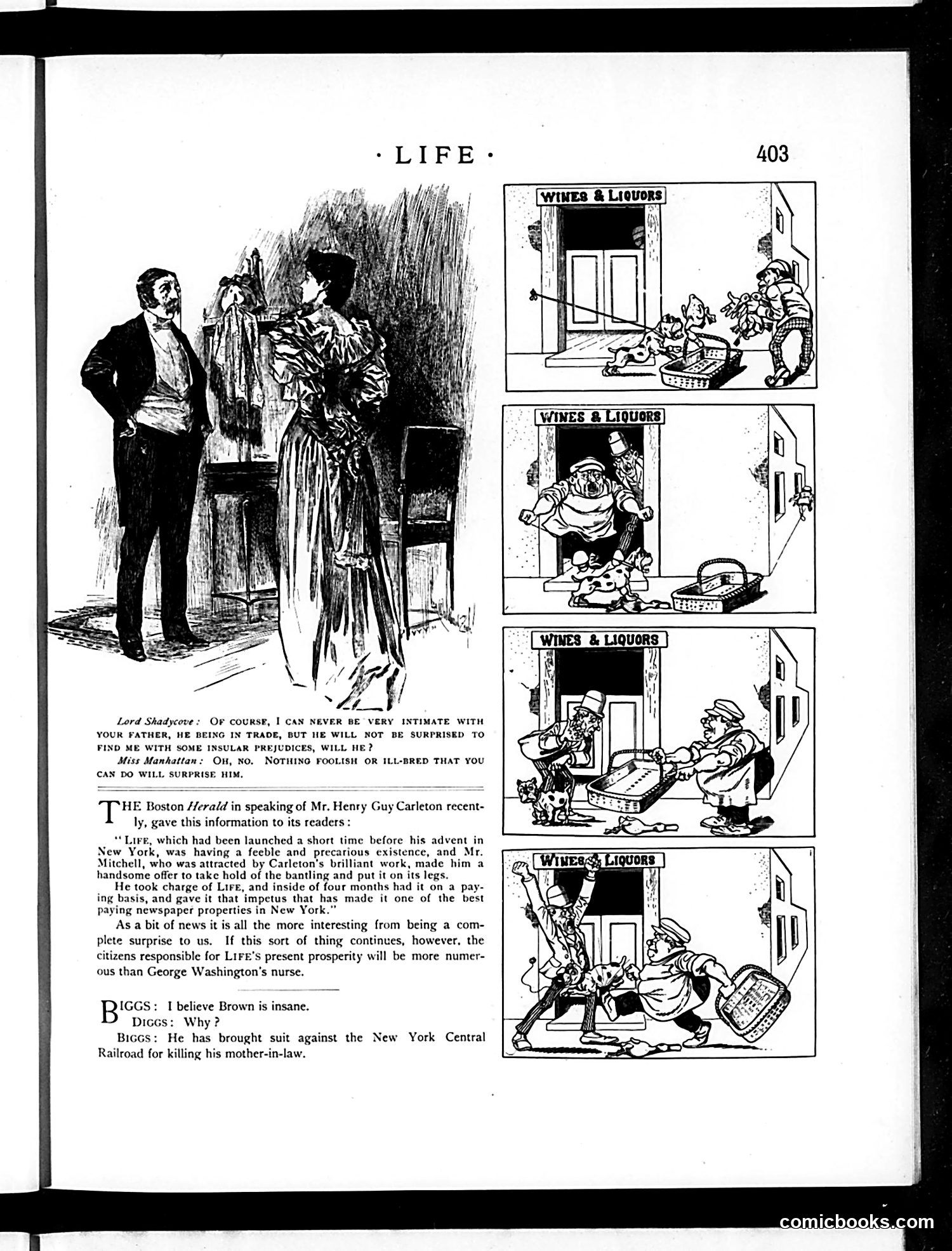
The left panel shows a dialogue about Lord Shadycrest's son, establishing a satirical scene about class and respectability. The conversation suggests the son will inherit his father's disreputable business dealings. The right panels depict a four-panel comic strip titled "Wines & Liquors" showing what appears to be Santa Claus repeatedly visiting a liquor store, with children and baskets of goods. The humor likely satirizes either excessive holiday consumption or the commercialization of Christmas through alcohol sales—both common targets of American satire in the early 20th century. The bottom dialogue between Biggs and Diggs references a lawsuit against the New York Central Railroad regarding someone's death, possibly critiquing corporate negligence or liability issues of the era.
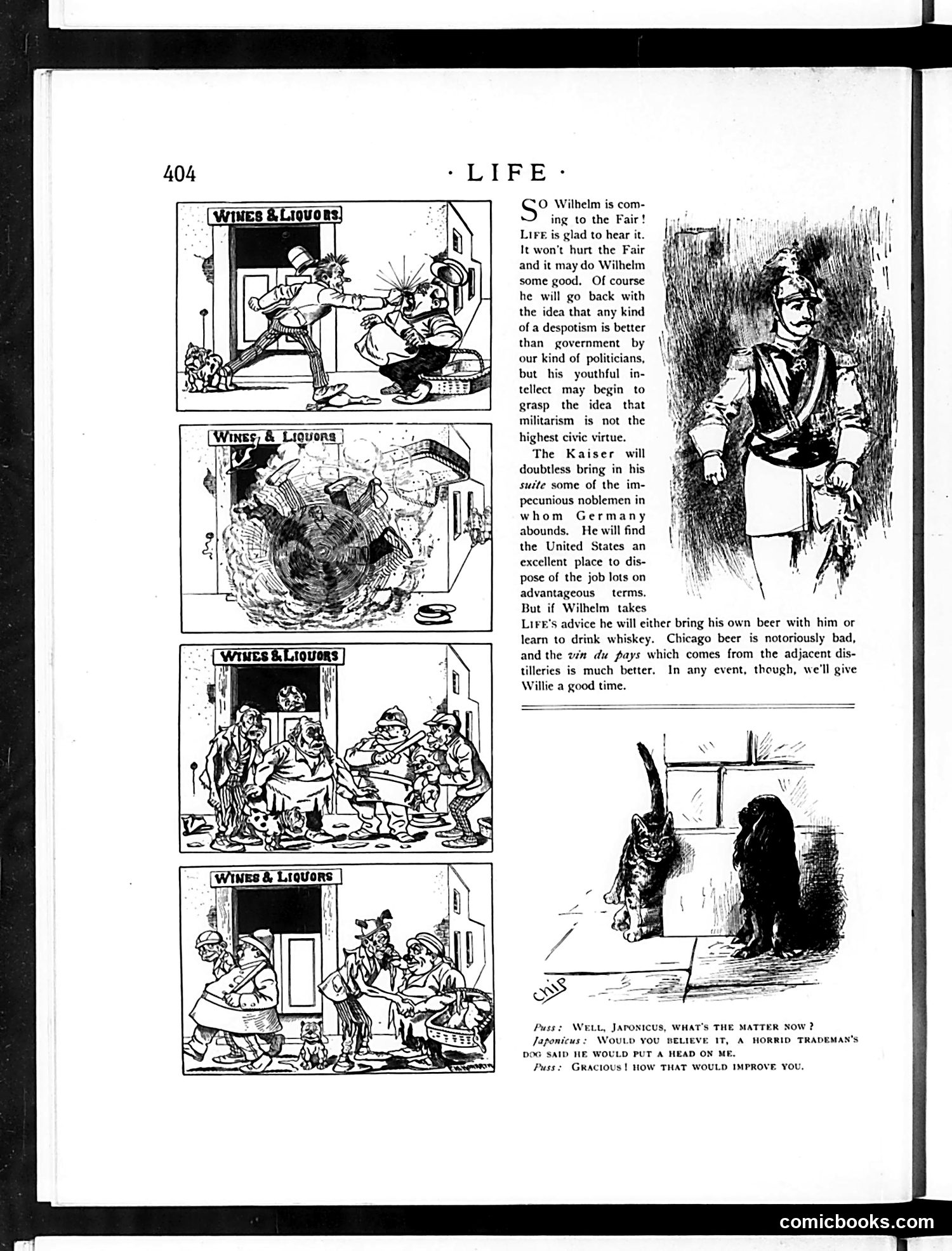
This page contains four sequential comic panels depicting a "Wines & Liquors" shop, apparently satirizing alcohol consumption and its effects. The comics show increasingly chaotic scenes at the shop's entrance, progressing from one or two figures to crowds of people. The accompanying text discusses **Wilhelm** (likely Kaiser Wilhelm II of Germany) visiting the United States Fair. Life's editors suggest Wilhelm might adopt American drinking customs—either German beer or American whiskey and "vin du pays"—rather than returning home with militaristic ideas. Below is a separate cartoon featuring two animals (appearing to be a donkey and dog) with dialogue mocking someone named **Japonicus**, making a joke about putting "a head on me." The overall tone satirizes both alcohol culture and foreign diplomatic visits, typical of early-20th-century American satirical journalism.
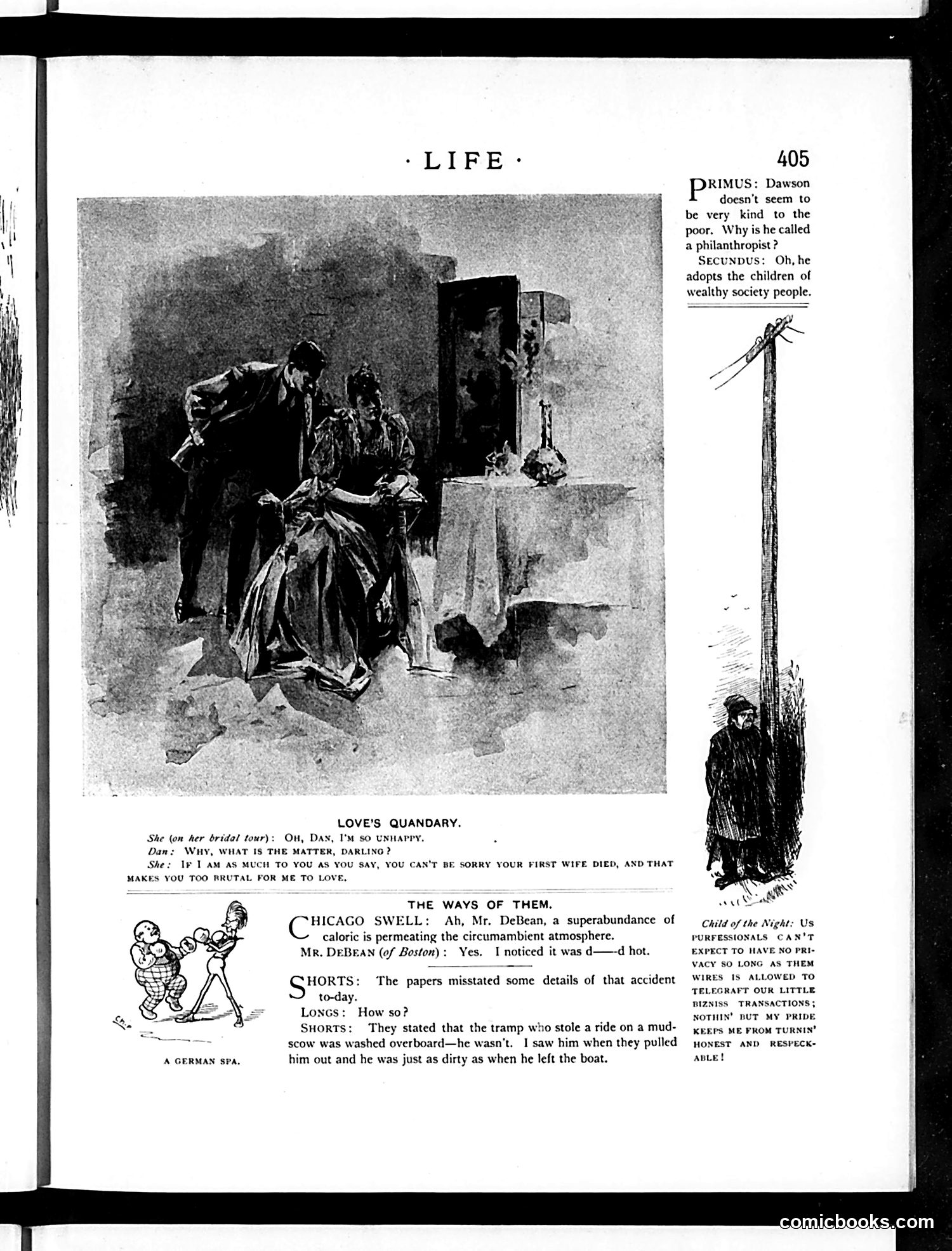
This page from *Life* magazine contains satirical dialogues and illustrations mocking social hypocrisy and manners. **"Love's Quandary"** depicts a domestic quarrel where a husband defends his infidelity by claiming he cannot apologize to his wife because she cannot apologize for her first husband's death—a darkly absurd rationalization that satirizes male excuses for bad behavior. **"The Ways of Them"** features brief comedic exchanges mocking upper-class affectations. "Chicago Swell" jokes about pretentious atmosphere; "A German Spa" (illustration shows men wrestling) satirizes European spa culture; and subsequent items mock newspaper inaccuracies and working-class dignity. The section titled **"Child of the Night"** critiques society's hypocrisy regarding class and morality. Overall, these pieces use humor to expose contradictions in contemporary social conduct and class attitudes.
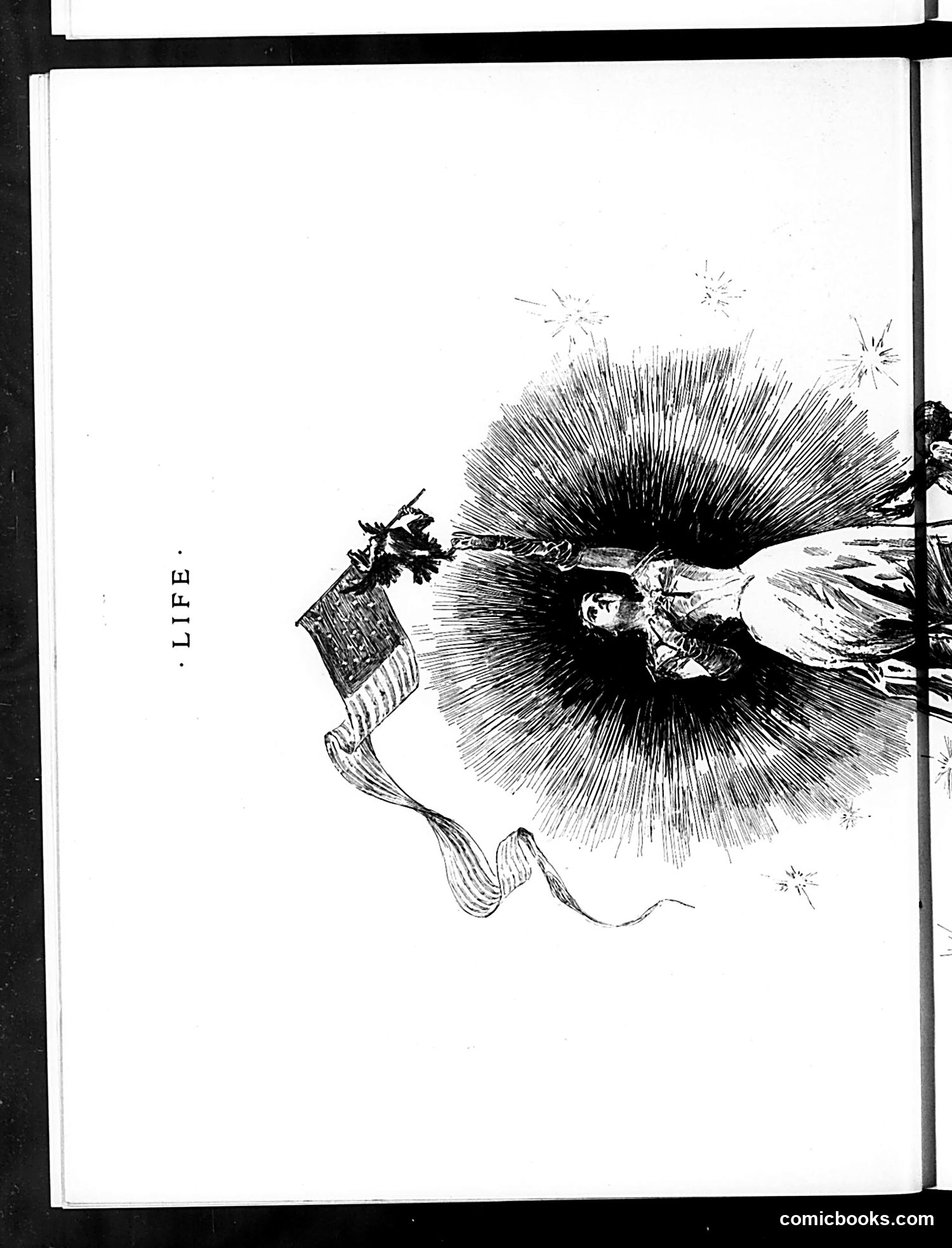
This page shows a satirical illustration titled "Life" depicting a figure riding what appears to be a comet or shooting star across a radiating sunburst background, with smaller stars scattered around. The figure holds what looks like an American flag. The cartoon appears to be patriotic satire, likely commenting on American optimism, expansionism, or national aspirations during an unspecified historical period. The comet imagery suggests rapid progress or ambition, while the flag reinforces nationalist themes. Without the publication date visible, the specific historical context remains unclear—this could reference various periods of American expansion or political fervor. The style and printing technique suggest late 19th or early 20th-century origin, but the exact event or figure being satirized cannot be definitively determined from the image alone.
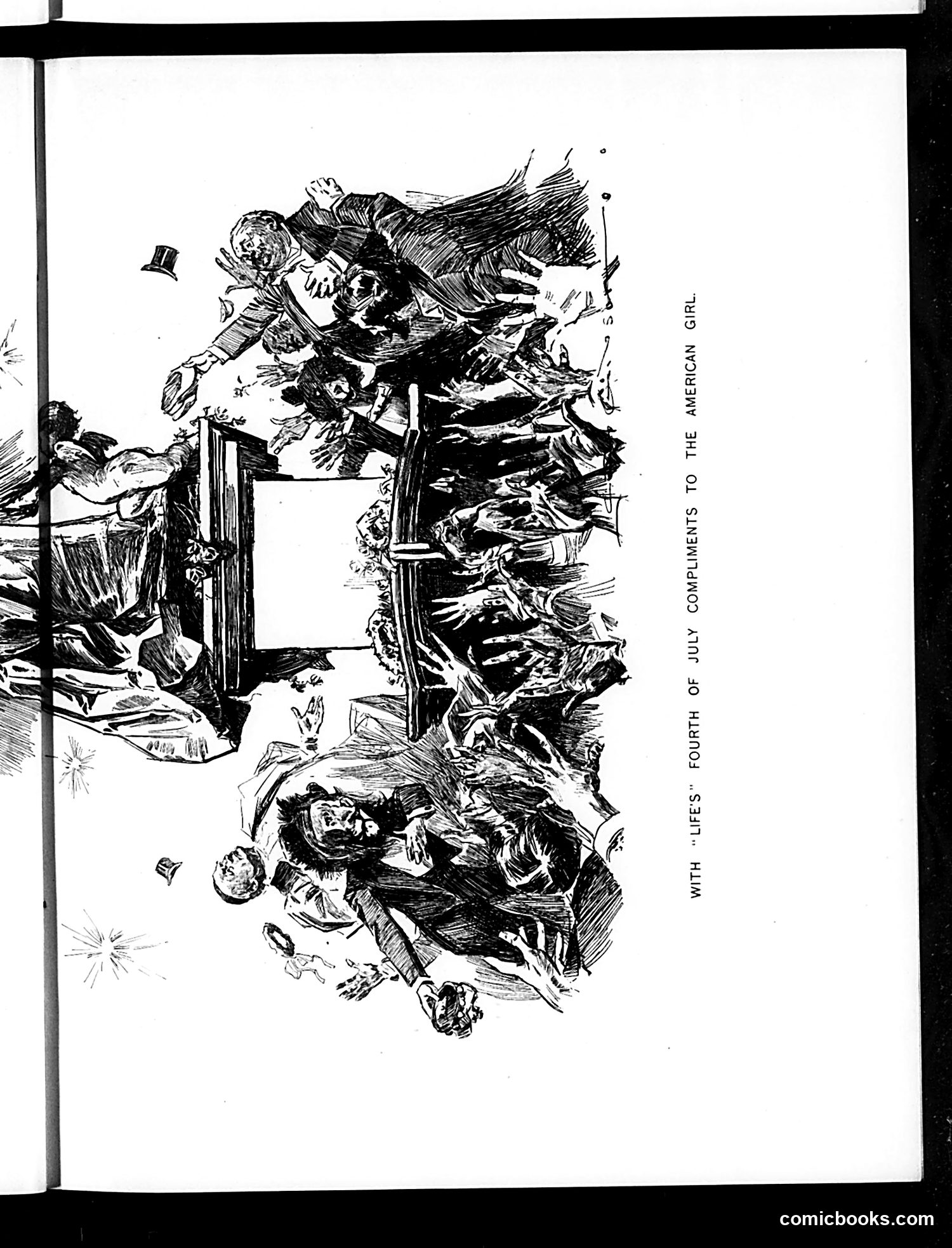
This is a satirical cartoon titled "WITH 'LIFTS' FOURTH OF JULY COMPLIMENTS TO THE AMERICAN GIRL," appearing to be a rotated or sideways illustration meant to be viewed from different angles. The image depicts multiple female figures in dynamic, chaotic poses emerging from or around what appears to be a window or frame structure. The cartoon seems to satirize contemporary American women—likely referencing the "New Woman" or modern girl of the early 20th century—through exaggerated, energetic depictions. The "lifts" reference in the title suggests elevator technology, possibly commenting on modernity, social mobility, or the increasingly public presence of women in urban spaces. The Fourth of July framing indicates patriotic satire about evolving American identity and gender roles during this era.
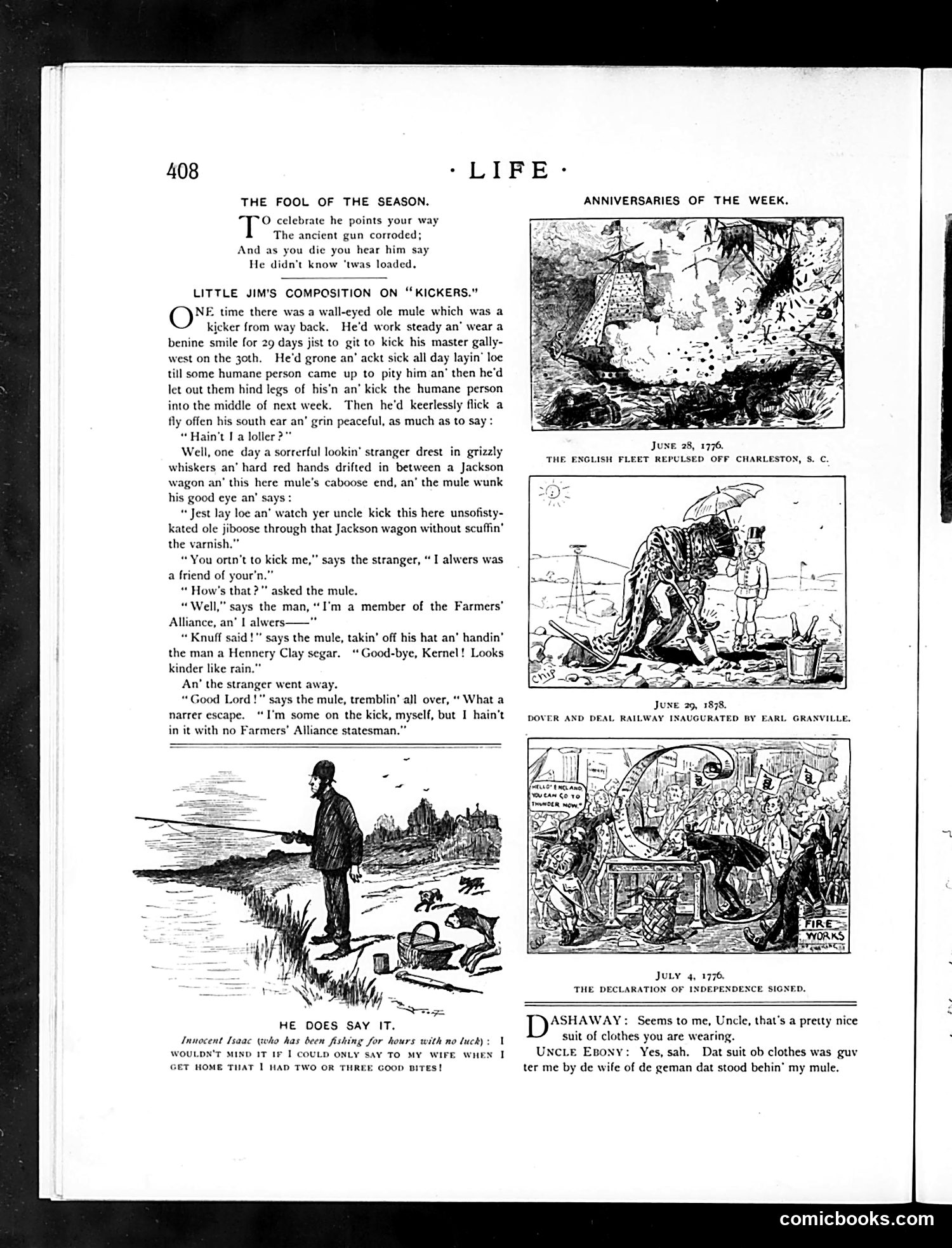
This page contains three distinct satirical pieces: 1. **"The Fool of the Season"**: A brief verse mocking someone who shoots a gun carelessly, claiming ignorance ("didn't know 'twas loaded")—satirizing negligent or reckless behavior. 2. **"Little Jim's Composition on Kickers"**: A humorous tall tale where a stubborn mule refuses to kick a stranger upon learning he's a Farmers' Alliance member. This satirizes the **Farmers' Alliance movement** (a late-1880s agrarian political organization) as so formidable that even a famously aggressive mule fears it—mocking the Alliance's growing political power and influence. 3. **"He Does Say It"**: A fishing joke about a man wishing he could tell his wife he caught fish, implying he typically returns empty-handed. The page also includes historical anniversary illustrations for June 29, 1878 (Dover-Deal Railway) and July 4, 1776 (Declaration of Independence), plus a brief dialogue featuring "Uncle Ebony" in period dialect humor. The dominant satire targets the Farmers' Alliance as a formidable political force worth fearing.
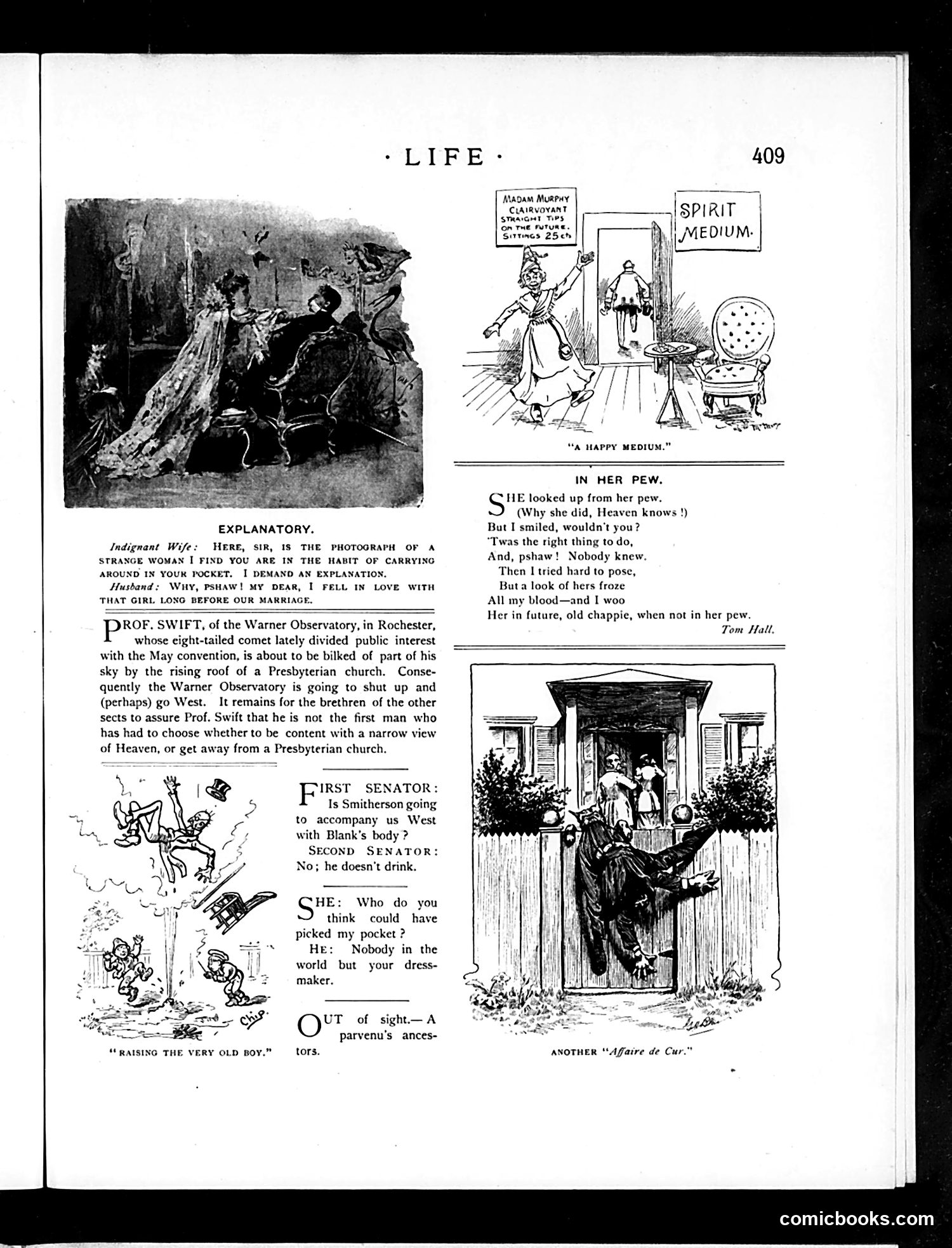
This page contains multiple unrelated satirical items typical of *Life* magazine's format: 1. **"Explanatory"**: A husband caught carrying another woman's photograph claims he fell in love with her before marriage—satirizing male infidelity excuses. 2. **Prof. Swift's Observatory**: Mocks a real astronomer whose Warner Observatory will be blocked by a Presbyterian church's expanding roof. The satire ridicules religious institutions literally obstructing scientific progress and suggests Swift must choose between faith or knowledge—a common late-19th/early-20th century tension. 3. **Senator Dialogue**: Jokes about a politician refusing to travel with a corpse because "he doesn't drink"—implying heavy drinking accompanies such grim journeys. 4. **Dressmaker Joke**: A pickpocket victim is told only her dressmaker could steal from her—satirizing dressmakers' notorious access to clients' clothing and valuables. 5. **Poem/Illustration**: Romanticizes a chance church encounter with a woman, playing on Victorian propriety and flirtation.
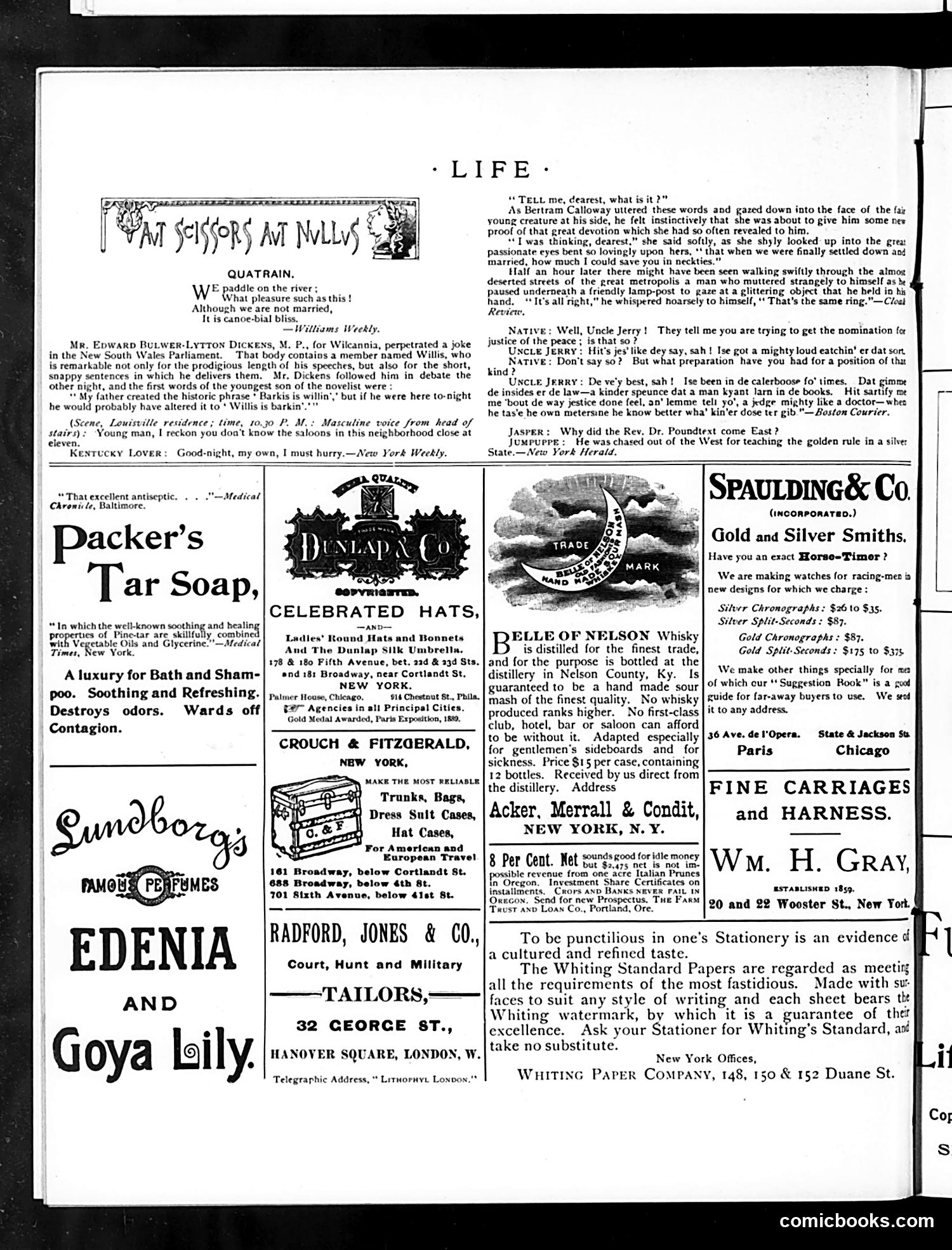
This page contains several brief humorous sketches rather than single political cartoons: **"Scissors at Nullus"** offers a pun on "canoe-bial bliss"—wordplay about unmarried couples canoeing together. **The main narratives mock romantic sentimentality**: One sketch subverts the conventional "devoted fiancée" trope by revealing the woman's true concern is saving her future husband money on neckties—a jab at materialism masquerading as devotion. **"Uncle Jerry" dialogue** appears to satirize incompetence in local politics, depicting a Black character claiming qualification for justice of the peace based solely on arrests rather than legal knowledge—likely reflecting period prejudices about political patronage and unqualified appointees. **The "Rev. Dr. Poundtext" joke** mocks hypocrisy: a minister expelled from the West for preaching Christian ethics (the "golden rule") to wealthy people ("silver State"), implying Western elites rejected moral teaching. The page is primarily **advertising** for various consumer goods (soap, hats, trunks, perfume), with satirical content interspersed.
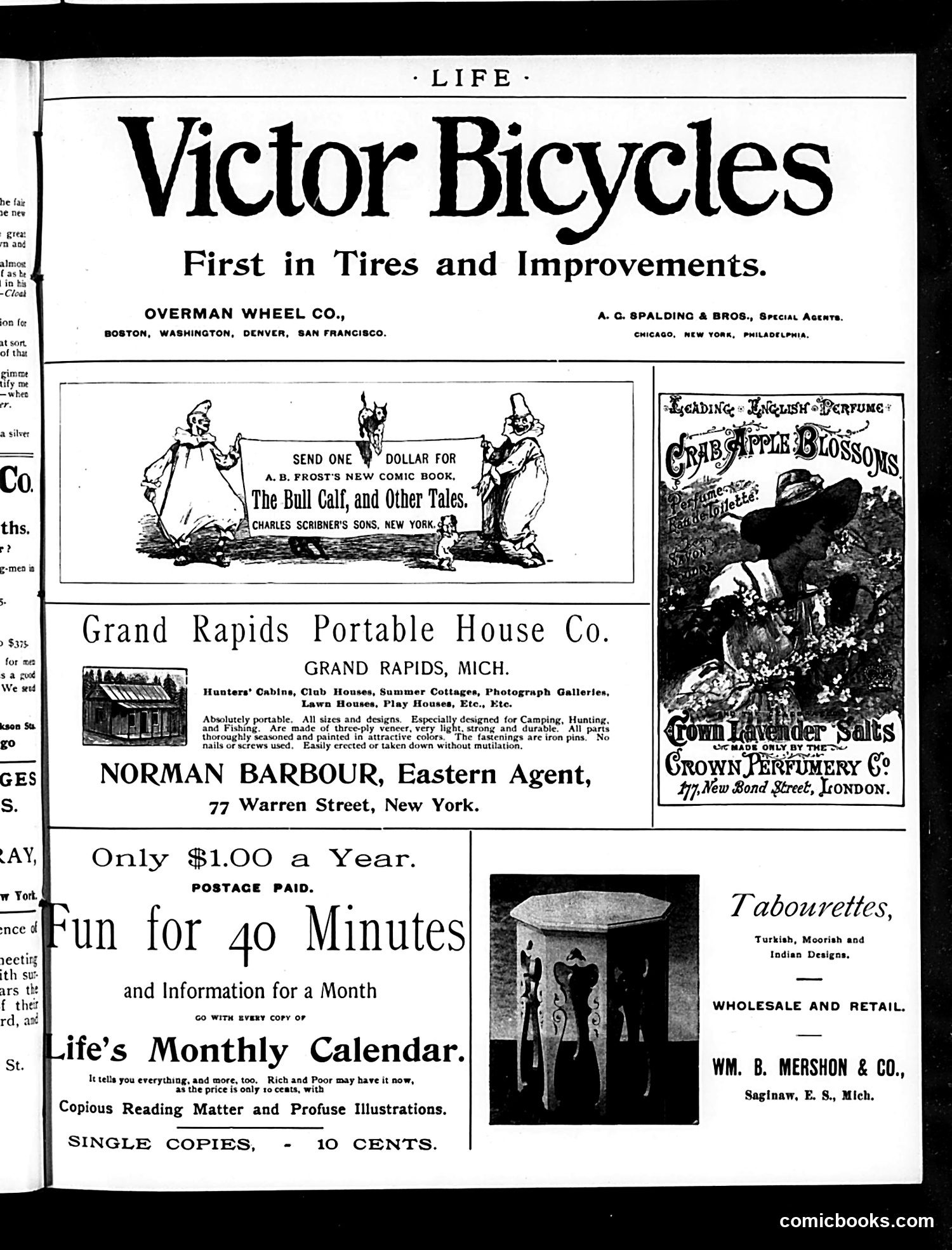
This is primarily an **advertising page** from Life magazine, not a political cartoon or satire. The page contains multiple product advertisements typical of the era. The main featured cartoon (top center) shows three clown-like figures advertising "The Bull Calf, and Other Tales," a comic book by A.B. Frost, priced at one dollar. The caricatured figures appear designed for humor appeal to attract readers to purchase the publication. Below this are advertisements for practical goods: Victor Bicycles (emphasizing tire quality), Grand Rapids Portable Houses (prefabricated structures for camping/hunting), and tabourettes (decorative stools). There's also a promotion for "Life's Monthly Calendar" at $1/year. **The satire is minimal here.** The page functions mainly as a revenue stream through advertising rather than political commentary. Any humor derives from the clown caricatures' exaggerated features rather than social critique. This reflects Life's dual role as both satirical publication and commercial advertising venue in this era.
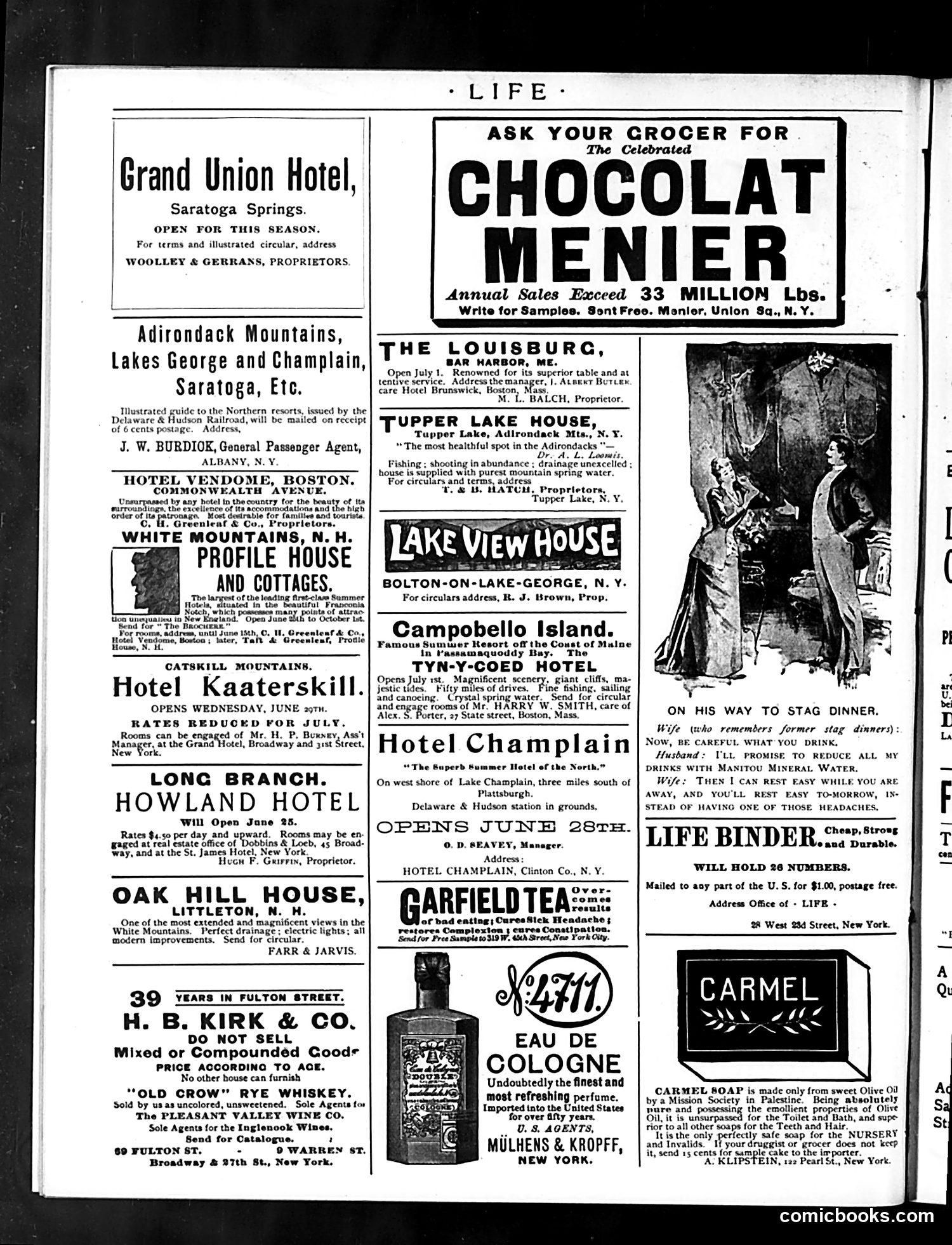
This page is primarily **advertising**, not editorial content or political satire. It consists almost entirely of hotel and product advertisements aimed at wealthy American leisure travelers in what appears to be the late 19th century. The one narrative image appears on the right side: labeled "ON HIS WAY TO STAG DINNER," it shows a man preparing for an evening event, with accompanying text about reducing "all my wife Manitou Mineral Water" consumption. This appears to be advertising mineral water as a digestion aid for wealthy gentlemen. The dominant content comprises advertisements for upscale seasonal hotels throughout the northeastern United States (Saratoga Springs, the Adirondacks, Lake George, Bar Harbor, White Mountains), luxury goods (Chocolat Menier, Eau de Cologne, Old Crow whiskey), and patent medicines (Garfield Tea). There is no discernible political satire or social commentary present.
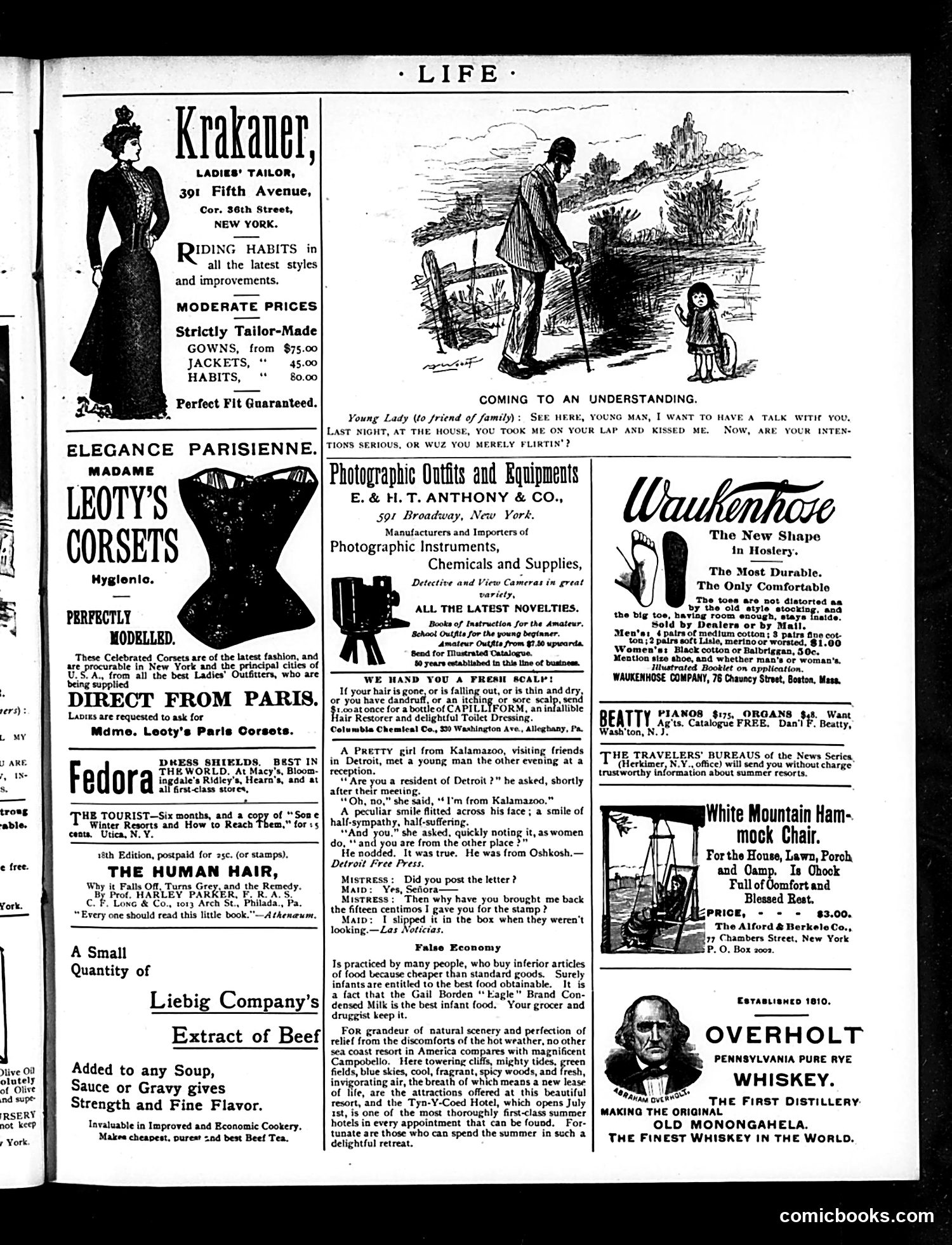
This page is primarily **advertisements** with two brief humorous anecdotes interspersed. The main cartoon, titled "Coming to an Understanding," depicts a young woman confronting a man about his intentions after he kissed her the previous night. The joke relies on the social anxiety of the Victorian era regarding courtship propriety—a young unmarried woman's reputation depended on clarifying whether a man's advances were serious (marriage-minded) or merely flirtation. The illustration shows her demanding he explain himself, reflecting anxieties about proper romantic conduct. A secondary anecdote jokes about a girl from Kalamazoo meeting a man from Oshkosh—towns that sound absurd to Eastern ears—with the punchline that he responds with "half-sympathy, half-suffering" upon learning she's not local, suggesting small-town pride or prejudice. The remaining content consists entirely of period advertisements for women's fashion (corsets, riding habits), photographic equipment, hair restoration products, and food items—typical of Life's revenue model in this era.
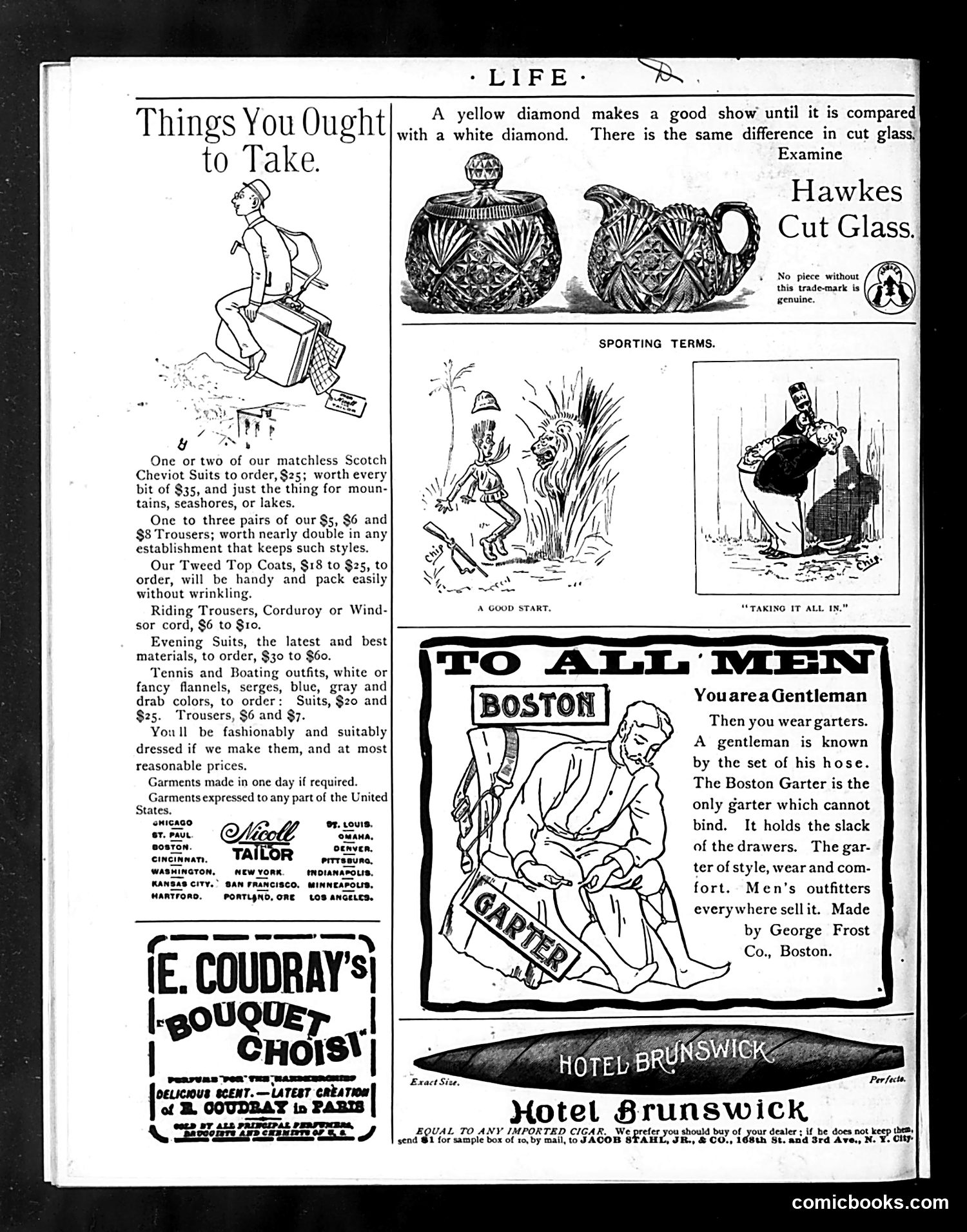
This page is **primarily advertising** with minimal editorial content. The advertisements target affluent male readers of the era. The two small cartoons labeled "Sporting Terms" depict hunting/fishing scenes with captions "A Good Start" and "Taking It All In"—likely humorous commentary on sportsmen's experiences, though the specific jokes are unclear without fuller context. The substantive satirical content appears minimal. Instead, the page showcases: - **Sartorial ads** for tailored suits and clothing, positioning quality garments as markers of gentlemanly status - **Boston Garter advertisement** explicitly stating "You are a Gentleman / Then you wear garters"—reflecting period concerns with proper masculine dress and propriety - **Product endorsements** for cut glass, cigars, and perfume, all emphasizing quality and refinement The underlying satire appears gentle: the equation of material consumption (correct garters, fine suits, imported cigars) with gentlemanly status itself. Rather than mocking this materialism directly, Life's advertisers simply assert it as social fact for their wealthy readership.
I can see this is a page from what appears to be a historical publication, but the image is almost entirely black or illegible. The only clearly visible text is the "comicbooks.com" watermark at the bottom right corner, which is a modern addition and not part of the original publication. The left margin shows partial text fragments ("ed," "ss.," "S.") and what might be a circular logo or emblem, but these are too unclear to identify with confidence. Without legible content or discernible cartoon imagery, I cannot reliably identify figures, references, or satirical points that would explain this page's meaning to modern readers. A higher-quality or properly scanned image would be needed for accurate analysis.