
Life, 1892-06-30 · page 4 of 19
Life — June 30, 1892 — page 4: what you’re looking at
What you’re looking at
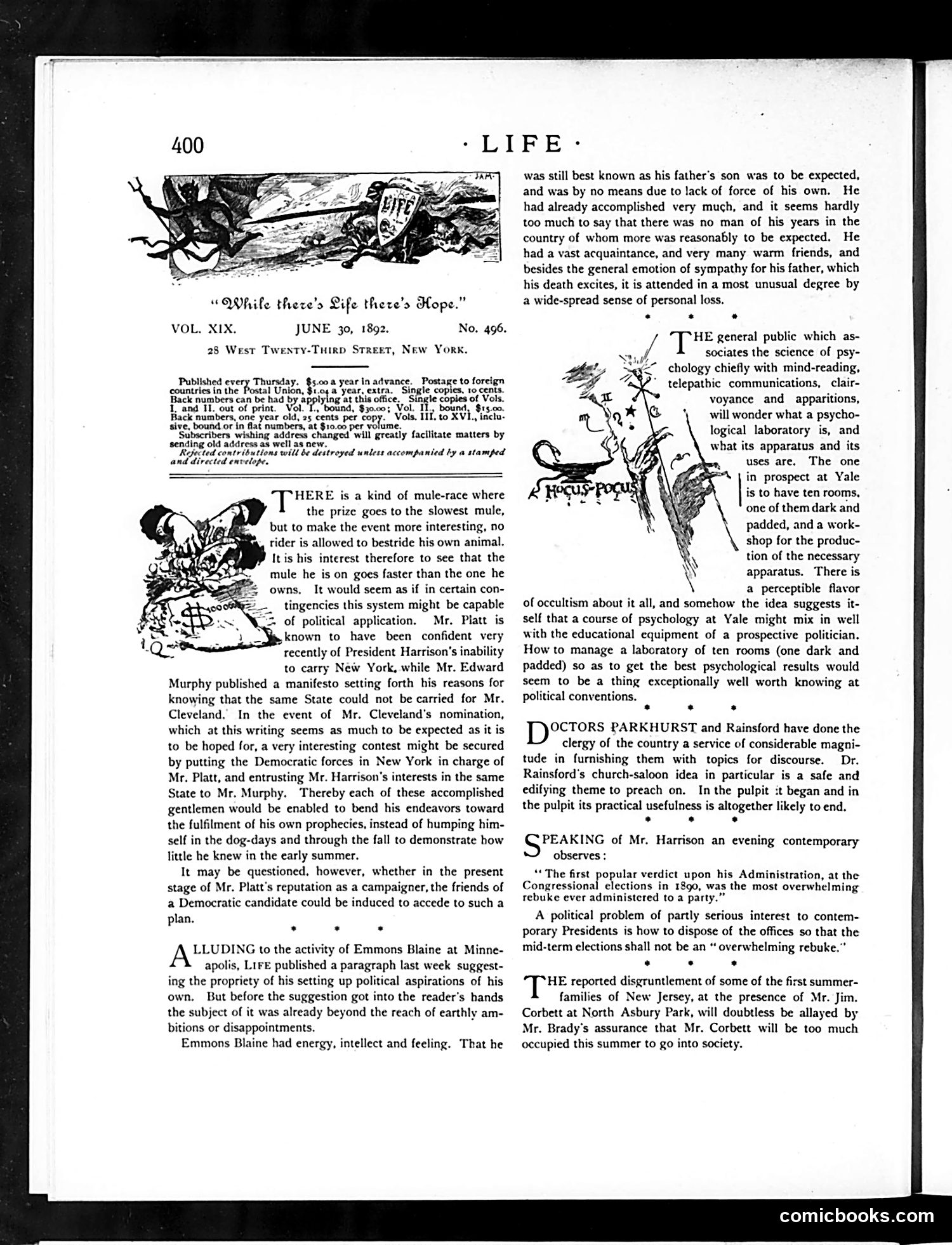
The page contains two satirical cartoons and commentary on American politics. **First cartoon** (top): Depicts a mule-race where "the prize goes to the slowest mule." The text explains this as political satire—comparing political conventions to a race where candidates benefit by being slower than their rivals. It references President Harrison's difficulty carrying New York and Edward Murphy's manifest supporting Cleveland's nomination, suggesting Democratic strategists were maneuvering to secure nomination through calculation rather than merit. **Second cartoon** ("Hocus Pocus," bottom left): Illustrates political manipulation, likely referencing similar convention scheming. The broader commentary criticizes how political parties manipulate conventions and nominations through backroom deals rather than democratic process—a common complaint about Gilded Age politics.
📄 Transcribed text from this page (OCR, searchable)
Machine-transcribed from the original scan — historical spelling and the odd misread are preserved.
*~ LIFE: “While there's Life there's Hope.” VOL. XIX. JUNE 30, 1892. No. 496. 28 West Twenty-THirpD Street, New York. Published every Thursday. §s.0o.a year in advance. Postage to foreign countries in the Postal Union, $1.04 @ year, extra. Single copies. 10 cents. Back numbers can be had by. Single copies of Vols. 1, and II. out of print. Vol. I., bound, $30.00; Vol. IT., bound, $15.00. Hack numbers, one year old, 25 cents per copy.’ Vols. Ii. to XV1., inclu- sive, bound or in flat numbers, at $10.00 per volume. Subscribers wishing address changed will greatly facilitate matters by sending old address as well as new. Rejected contributions will be destroyed untess accompanied by a stamped and directed envelope. HERE is a kind of mule-race where the prize goes to the slowest mule, but to make the event more interesting, no rider is allowed to bestride his own animal. Itis his interest therefore to see that the mule he is on goes faster than the one he owns. It would seem as if in certain con- tingencies this system might be capable ‘% of political application. Mr. Platt is known to have been confident very recently of President Harrison's inability to carry New York, while Mr. Edward Murphy published a manifesto setting forth his reasons for knowing that the same State could not be carried for Mr. Cleveland. In the event of Mr. Cleveland's nomination, which at this writing seems as much to be expected as it is to be hoped for, a very interesting contest might be secured by putting the Democratic forces in New York in charge of Mr. Platt, and entrusting Mr. Harrison's interests in the same State to Mr. Murphy. Thereby each of these accomplished gentlemen would be enabled to bend his endeavors toward the fulfilment of his own prophecies, instead of humping him- self in the dog-days and through the fall to demonstrate how little he knew in the early summer. It may be questioned, however, whether in the present stage of Mr. Platt’s reputation as a campaigner, the friends of a Democratic candidate could be induced to accede to such a plan. . . . LLUDING to the activity of Emmons Blaine at Minne- apolis, LiFe published a paragraph last week suggest- ing the propriety of his setting up political aspirations of his own. But before the suggestion got into the reader's hands the subject of it was already beyond the reach of earthly am- bitions or disappointments. Emmons Blaine had energy, intellect and feeling. That he was still best known as his father’s son was to be expected, and was by no means due to lack of force of his own. He had already accomplished very much, and it seems hardly too much to say that there was no man of his years in the country of whom more was reasonably to be expected. He had a vast acquaintance, and very many warm friends, and besides the general emotion of sympathy for his father, which his death excites, it is attended in a most unusual degree by a wide-spread sense of personal loss. . . . Te general public which as- sociates the science of psy- chology chiefly with mind-reading, telepathic communications, clair- voyance and apparitions, will wonder what a psycho- logical laboratory is, and what its apparatus and its uses are. The one in prospect at Yale is to have ten rooms, one of them dark and padded, and a work- shop for the produc- tion of the necessary apparatus. There is a perceptible flavor of occultism about it all, and somehow the idea suggests it- self that a course of psychology at Yale might mix i with the educational equipment of a prospective polit How to manage a laboratory of ten rooms (one dark and padded) so as to get the best psychological results would seem to be a thing exceptionally well worth knowing at political conventions. . . . OCTORS PARKHURST and Rainsford have done the clergy of the country a service of considerable magni- tude in furnishing them with topics for discourse. Dr. Rainsford’s church-saloon idea in particular is a safe and edifying theme to preach on. In the pulpit it began and in the pulpit its practical usefulness is altogether likely to end. . . . PEAKING of Mr. Harrison an evening contemporary observes : _‘* The first popular verdict upon his Administration, at the Congressional elections in 1890, was the most overwhelming rebuke ever administered to a party.” A political problem of partly serious interest to contem- porary Presidents is how to dispose of the offices so that the mid-term elections shall not be an “ overwhelming rebuke.” . . . HE reported disgruntlement of some of the first summer- families of New Jersey, at the presence of Mr. Jim. Corbett at North Asbury Park, will doubtless be allayed by Mr. Brady's assurance that Mr. Corbett will be too much occupied this summer to go into society. comicbooks.com