
A complete issue · 18 pages · 1892
Life — May 12, 1892
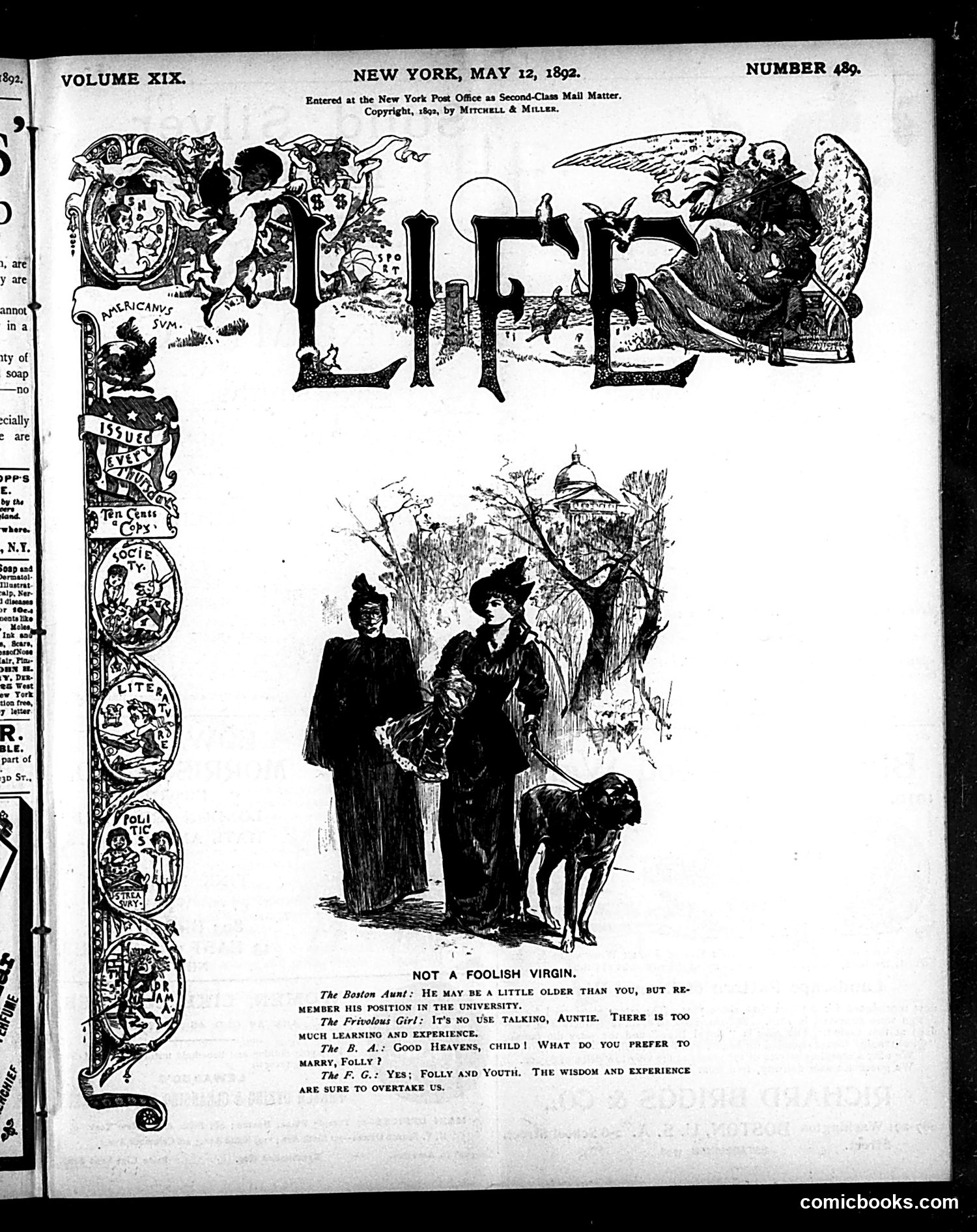
This cartoon depicts a dialogue about education and courtship. Two well-dressed women walk with a dog near the Capitol building, discussing whether youth should marry based on love or wisdom/experience. The "Boston Aunt" argues that despite being older, her university position commands respect. The "Frivolous Girl" responds that learning matters less than practical experience in marriage. The "D.A." (likely a society matron) asks which should take priority, and the "F.G." concludes that "folly and youth" must yield to "wisdom and experience." The satire targets contemporary debates about women's education, marriage eligibility, and gender roles in the 1890s—specifically mocking the tension between educated, unmarried older women and younger women pursuing matrimony over intellectual achievement.
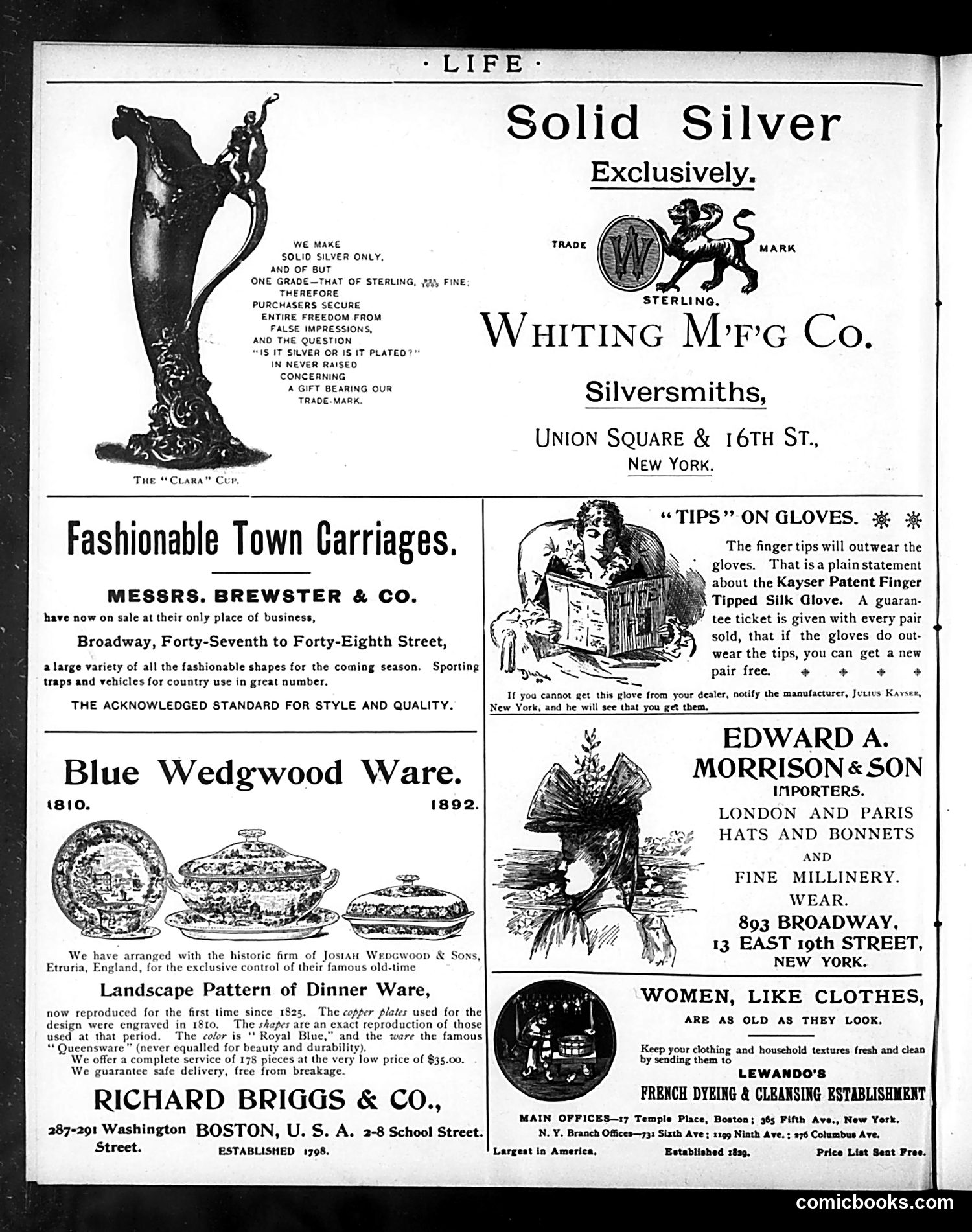
This page is **primarily advertising**, not satire or political commentary. It contains commercial advertisements for luxury goods targeting wealthy consumers of the era: - **Whiting Mfg Co.**: Sterling silver tableware, emphasizing quality and authenticity - **Brewster & Co.**: High-end carriages for the wealthy - **Blue Wedgwood Ware**: Historic English pottery (reproduced since 1525) - **Richard Briggs & Co.**: Fine dinnerware with landscape patterns - **Edward A. Morrison & Son**: Women's hats and millinery imports - **Lewando's**: French dry cleaning service The only quasi-humorous content is a small tip about glove maintenance. Overall, this reflects late 19th-century upper-class consumer culture, with no apparent political satire or social commentary present.
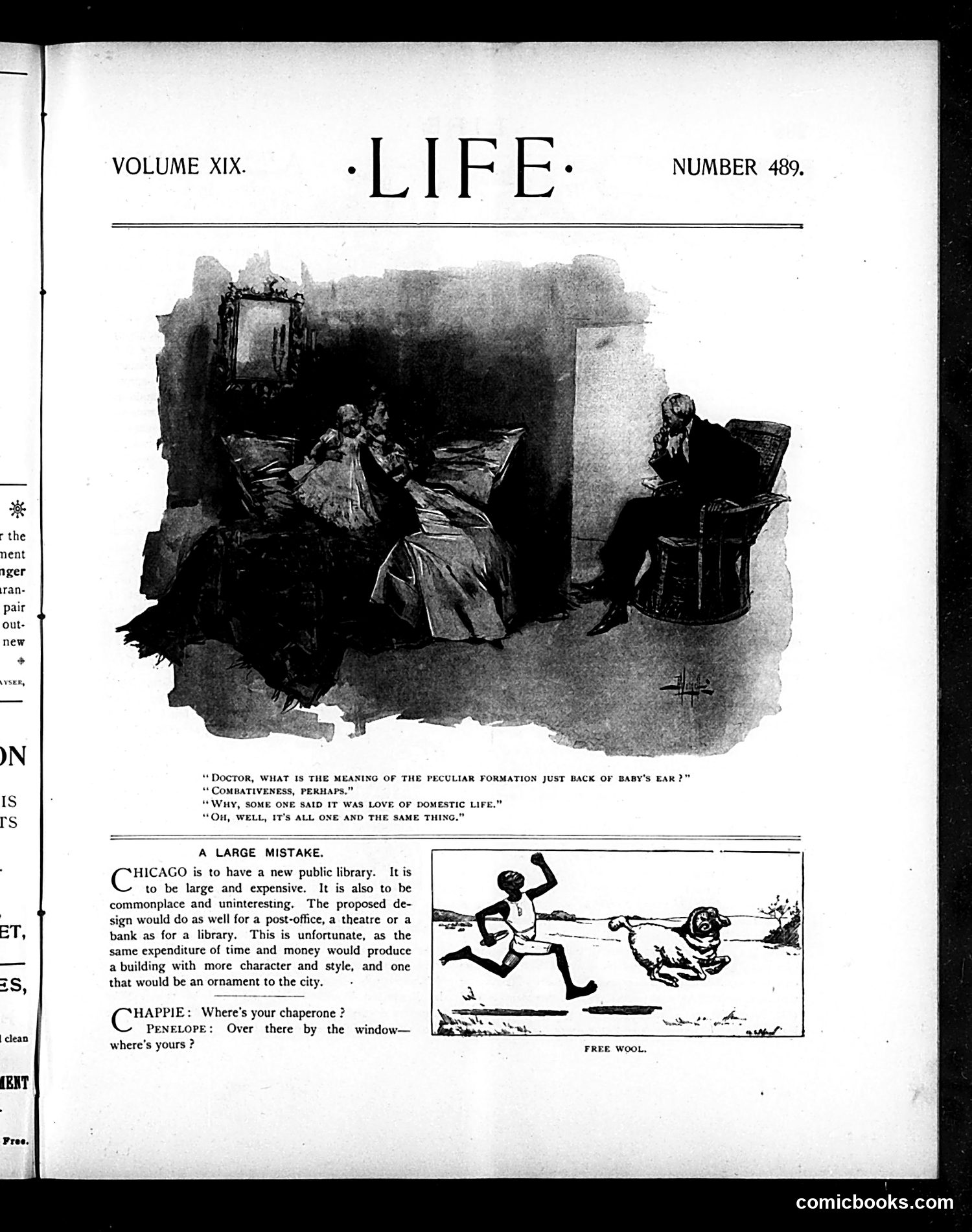
**Top Cartoon:** This depicts a medical consultation, likely mocking Victorian domestic propriety. A doctor examines a patient while another figure observes. The dialogue suggests the doctor is explaining some anatomical peculiarity in euphemistic terms ("love of domestic life"), with the punchline being that medical conditions and romantic feelings are "all one and the same thing"—satirizing how Victorian society obscured bodily functions behind sentimental language. **"A Large Mistake" Article:** Critiques Chicago's proposed new public library design as architecturally uninspired—suitable for a post-office or theater but lacking distinction for such an important civic building. **Bottom Cartoon ("Free Wool"):** Shows a figure chasing another, likely satirizing trade policy disputes over wool tariffs, a recurring political issue of the era.
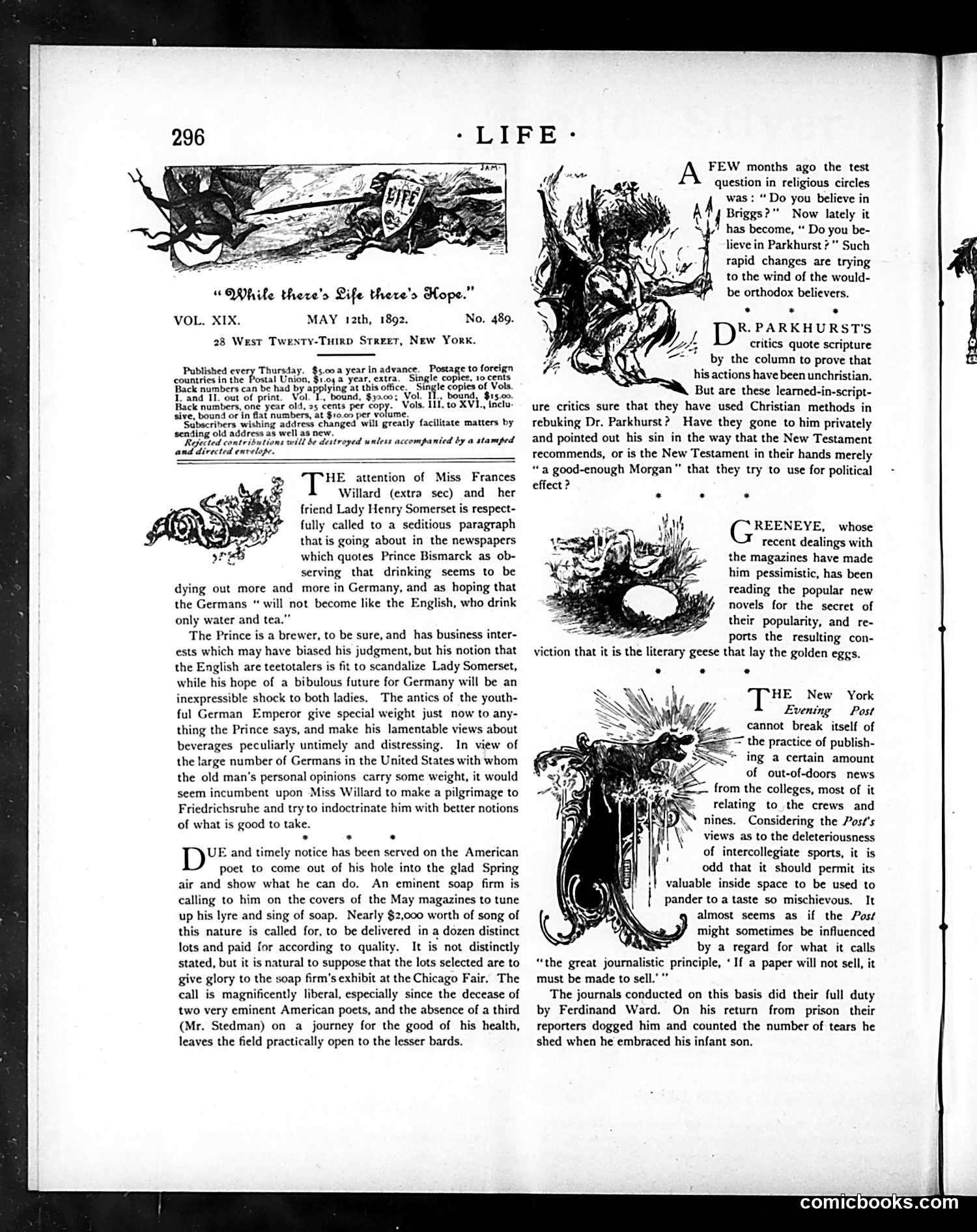
The page contains three separate satirical sections rather than a unified cartoon. **Top section** discusses Prince Bismarck's views on German drinking habits and his hope that Germans will adopt English tea-drinking instead of alcohol—a commentary on German-American relations and stereotypes about national drinking cultures. **Middle section** mocks an American poet being courted by soap companies to endorse their products at the Chicago Fair, satirizing the commercialization of literary figures and the era's aggressive advertising practices. **Bottom section** references Ferdinand Ward's return from prison and reunion with his infant son—Ward was a notorious financier involved in the 1884 collapse of Grant & Ward bank, a major scandal. The satire concerns journalists' sensationalistic coverage of his release. The overall theme critiques journalism, commercialism, and public figures of the 1890s.
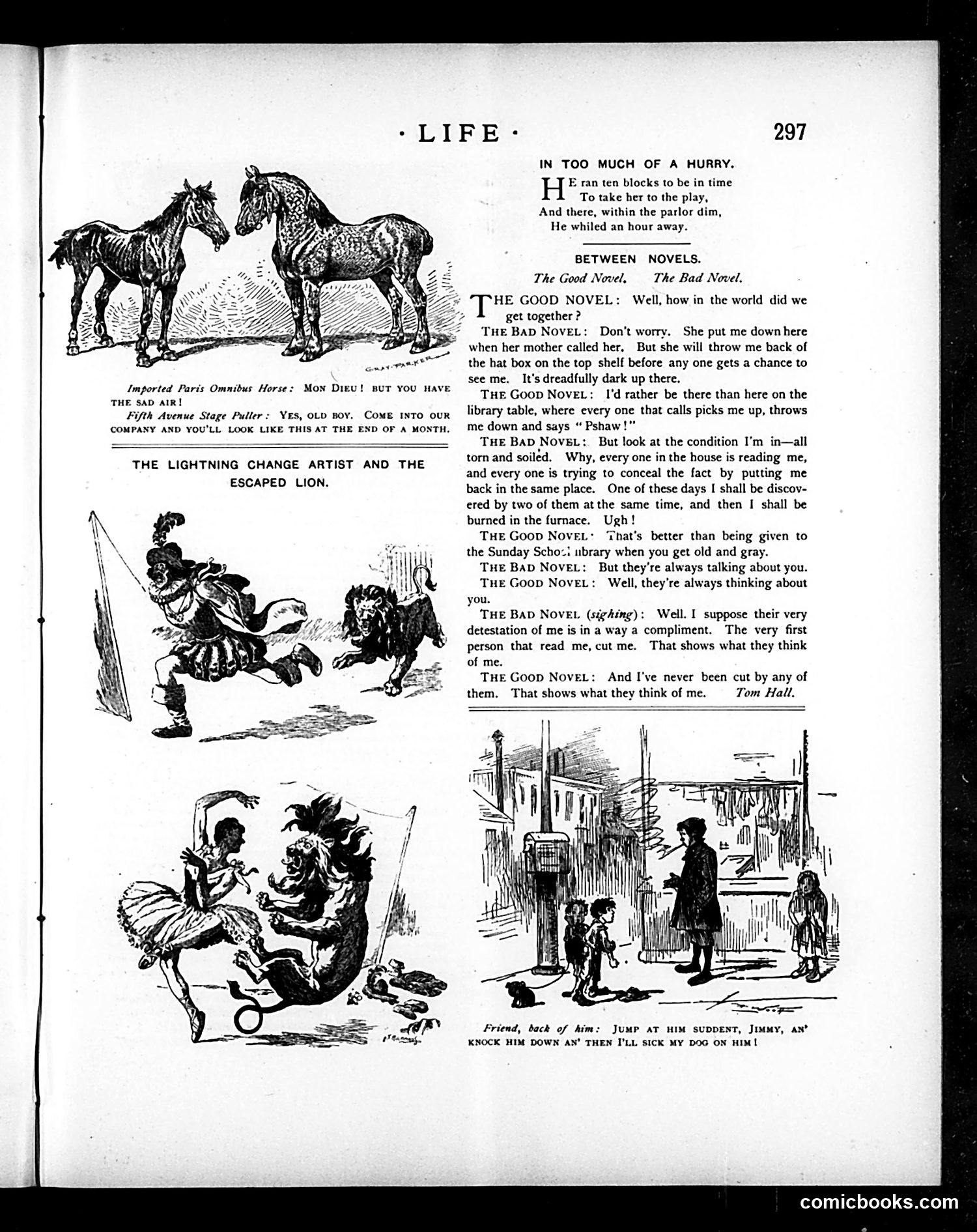
This page contains three distinct satirical elements: 1. **"In Too Much of a Hurry"** (top): A brief poem mocking someone rushing to theater, only to waste time in the lobby. 2. **"Between Novels"**: A dialogue between a Good Novel and Bad Novel personified as characters. The Bad Novel complains about mistreatment—being hidden on shelves and threatened with burning—while the Good Novel boasts of library respect. This satirizes contemporary literary snobbery and class distinctions in reading material. 3. **"The Lightning Change Artist and the Escaped Lion"**: Whimsical illustrations depicting circus/performance chaos with magical transformations and wild animals, typical of Life's humorous visual storytelling. The page reflects early-20th-century concerns about literature, entertainment, and social pretension.
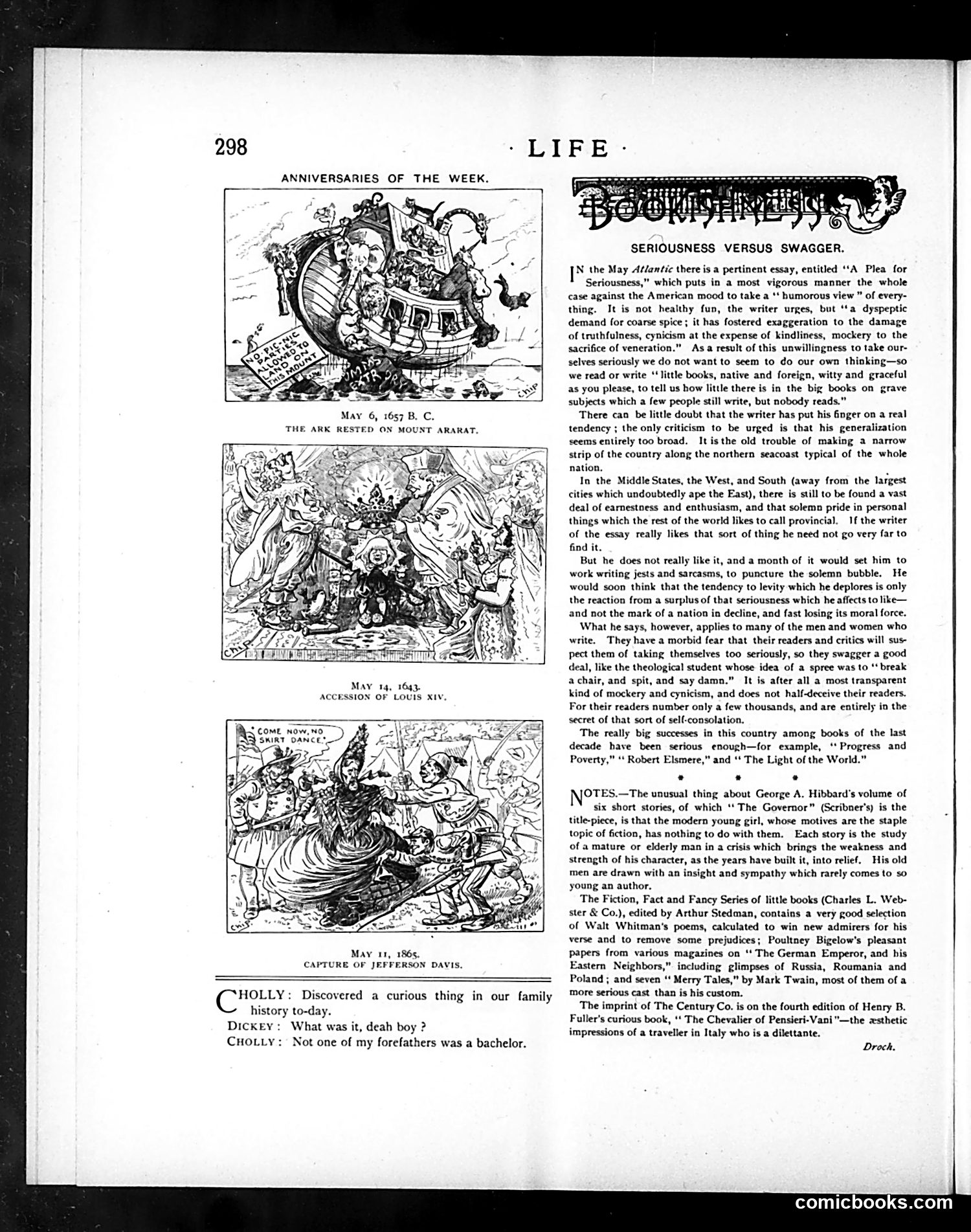
This page features three historical anniversary cartoons in the left column commemorating biblical and royal events: Noah's Ark (May 6, 1651), Louis XIV's accession (May 14, 1643), and Jefferson Davis (May 11, 1865). The main article "Seriousness Versus Swagger" critiques American literary trends, arguing against excessive "coarse spice" and cynicism in contemporary writing. The author contends that serious literature from the Midwest and South shows genuine earnestness, while East Coast writers employ mockery and sarcasm to appear sophisticated. The piece laments that successful recent American books have been serious works like "Progress and Poverty" rather than frivolous satire. A brief comedic dialogue at bottom jokes about family genealogy.
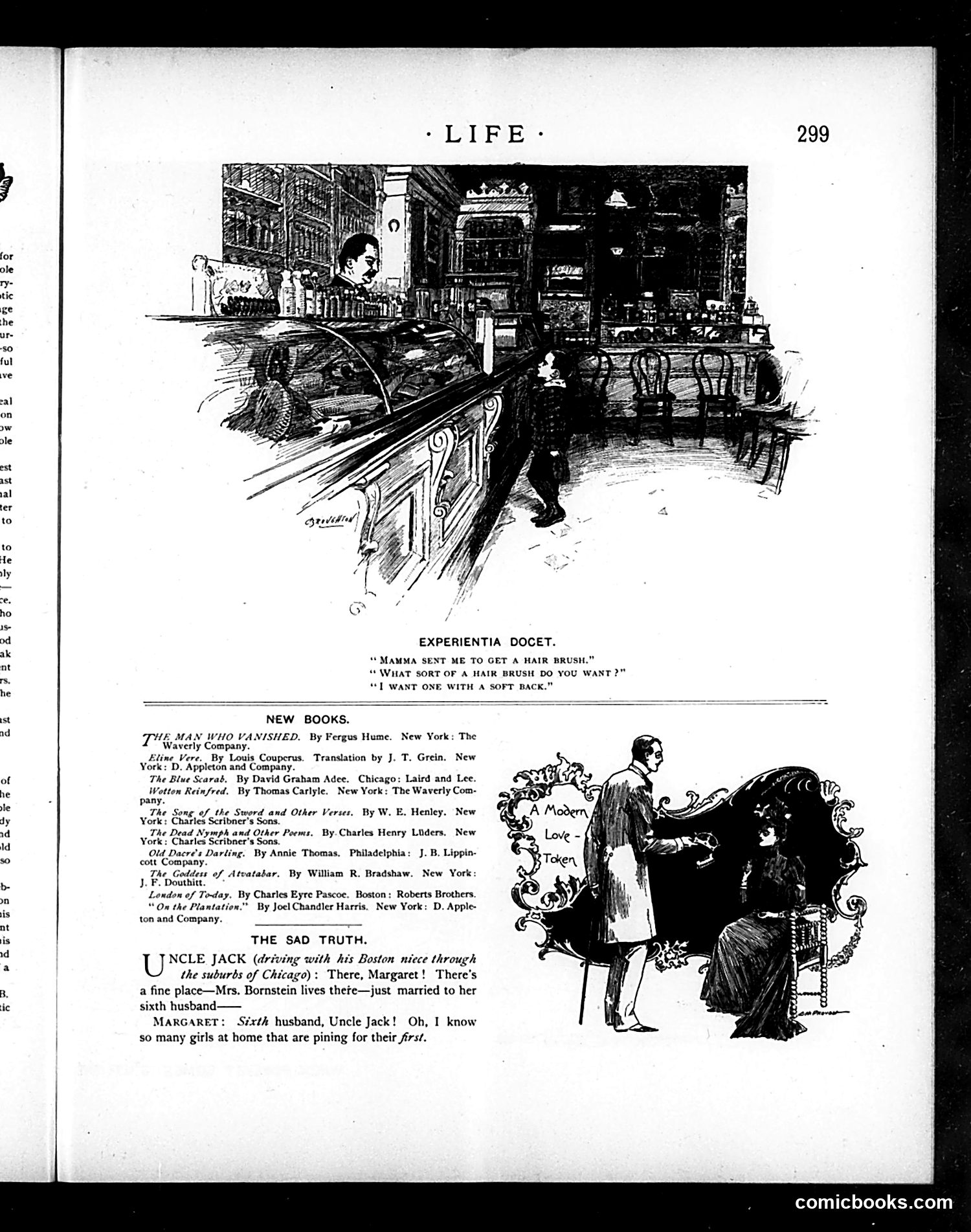
This page contains two separate satirical pieces from Life magazine: **Top cartoon ("Experientia Docet"):** Shows a shopkeeper's interaction with a customer buying a hairbrush. The humor hinges on the phrase "soft back"—the customer wants a brush with soft bristles for gentle grooming, but the shopkeeper (standing above the counter) appears to misunderstand or interpret the request differently, likely with sexual innuendo. It's mild Victorian-era wordplay satire. **Bottom section ("The Sad Truth"):** Uncle Jack drives his niece through Chicago suburbs, mentioning a wealthy widow (Mrs. Bornstein) who just married her sixth husband. Margaret's response—that many girls at home are "pining for their first"—satirizes women's desperation for marriage. The joke criticizes both female marriage-obsession and wealthy women's serial marriages as social problems worthy of mockery.
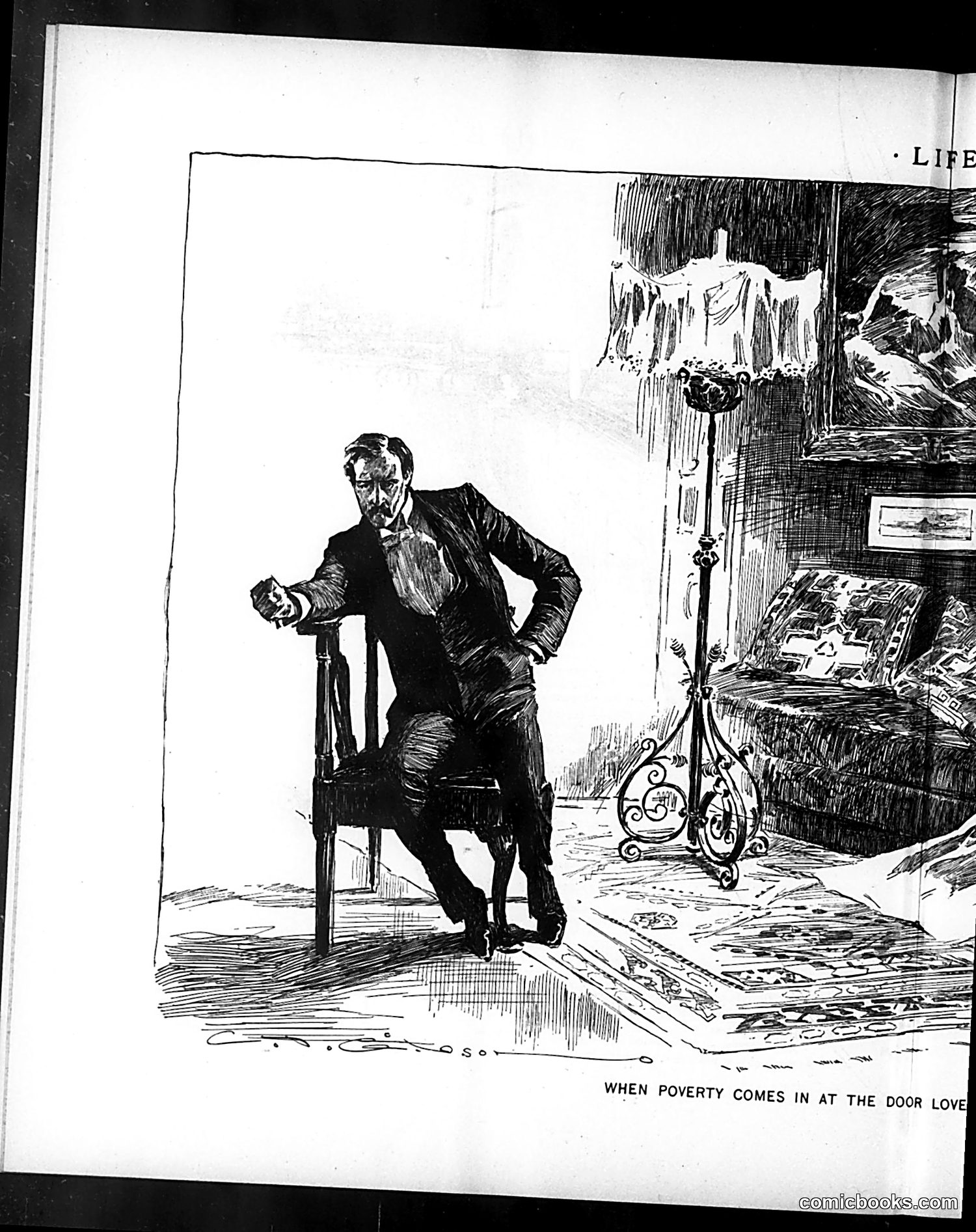
This appears to be a satirical cartoon illustrating the proverb "When poverty comes in at the door, love flies out the window." The image depicts a well-dressed gentleman in formal attire, seated and gesturing dismissively, surrounded by domestic furnishings and artwork. The cartoon satirizes the notion that romantic affection dissolves under financial hardship. The well-appointed room suggests the man once had means, now apparently diminished. The satire critiques either: (1) the materialism of relationships, suggesting love is conditional on wealth, or (2) the hypocrisy of the well-to-do who abandoned romantic ideals when facing economic difficulty. Without additional context from Life magazine's publication date, the specific economic conditions it references remain unclear, though the theme suggests commentary on class relations and relationship stability.
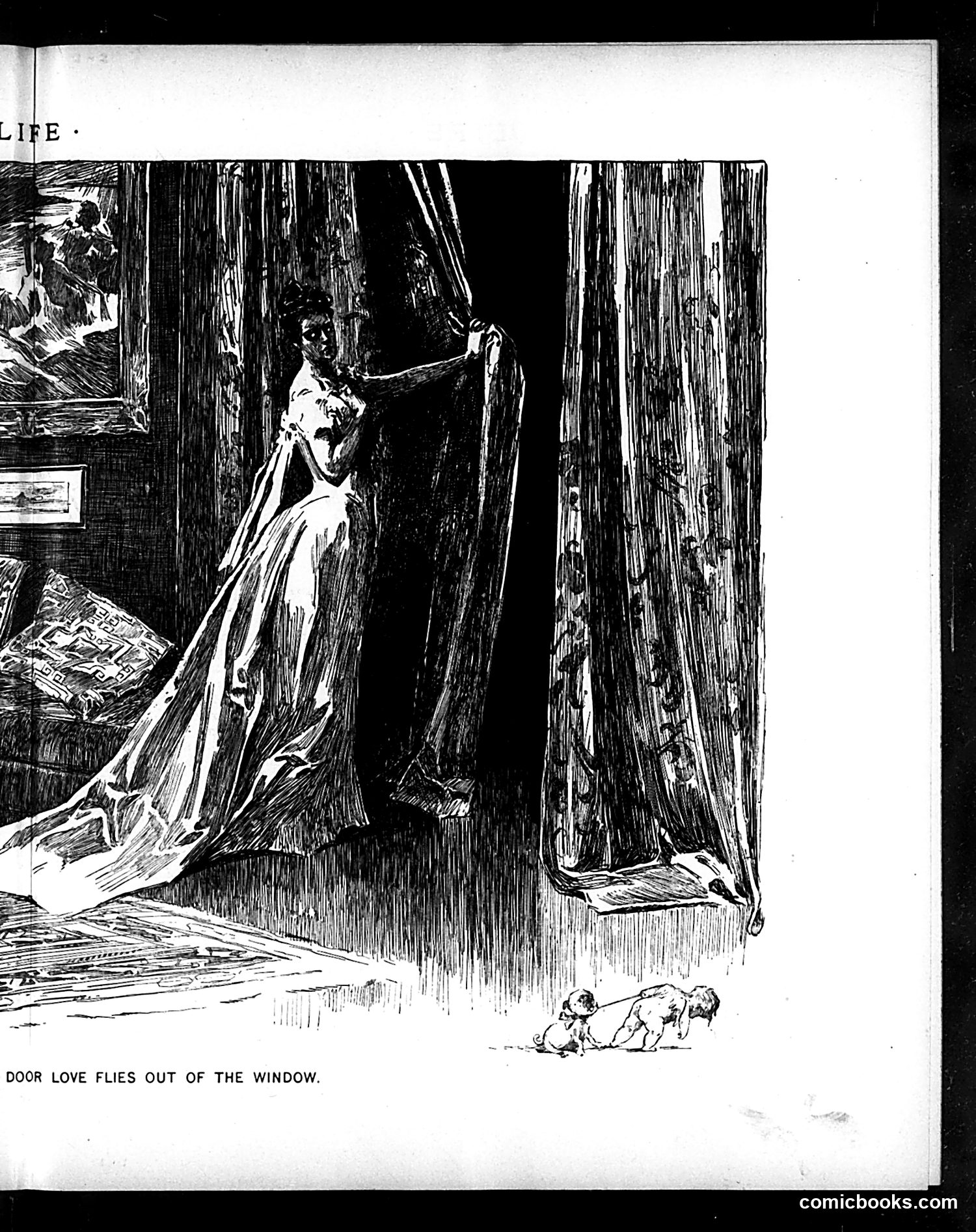
This illustration depicts a dramatic domestic scene: a woman in flowing robes stands at an open window, gesturing expressively outward, while two cherubs or putti crawl on the floor below. The caption "Door Love Flies Out of the Window" is a visual pun playing on the common phrase "when the door opens, love flies out the window"—meaning romantic affection deteriorates when practical concerns intrude. The satire appears to comment on marital disillusionment or the fragility of romantic love in domestic life. The woman's theatrical pose and the cherubs' helpless position suggest that idealized love cannot survive real-world circumstances. The work uses classical allegorical imagery (the cherubs representing love) to mock the gap between romantic ideals and matrimonial reality.
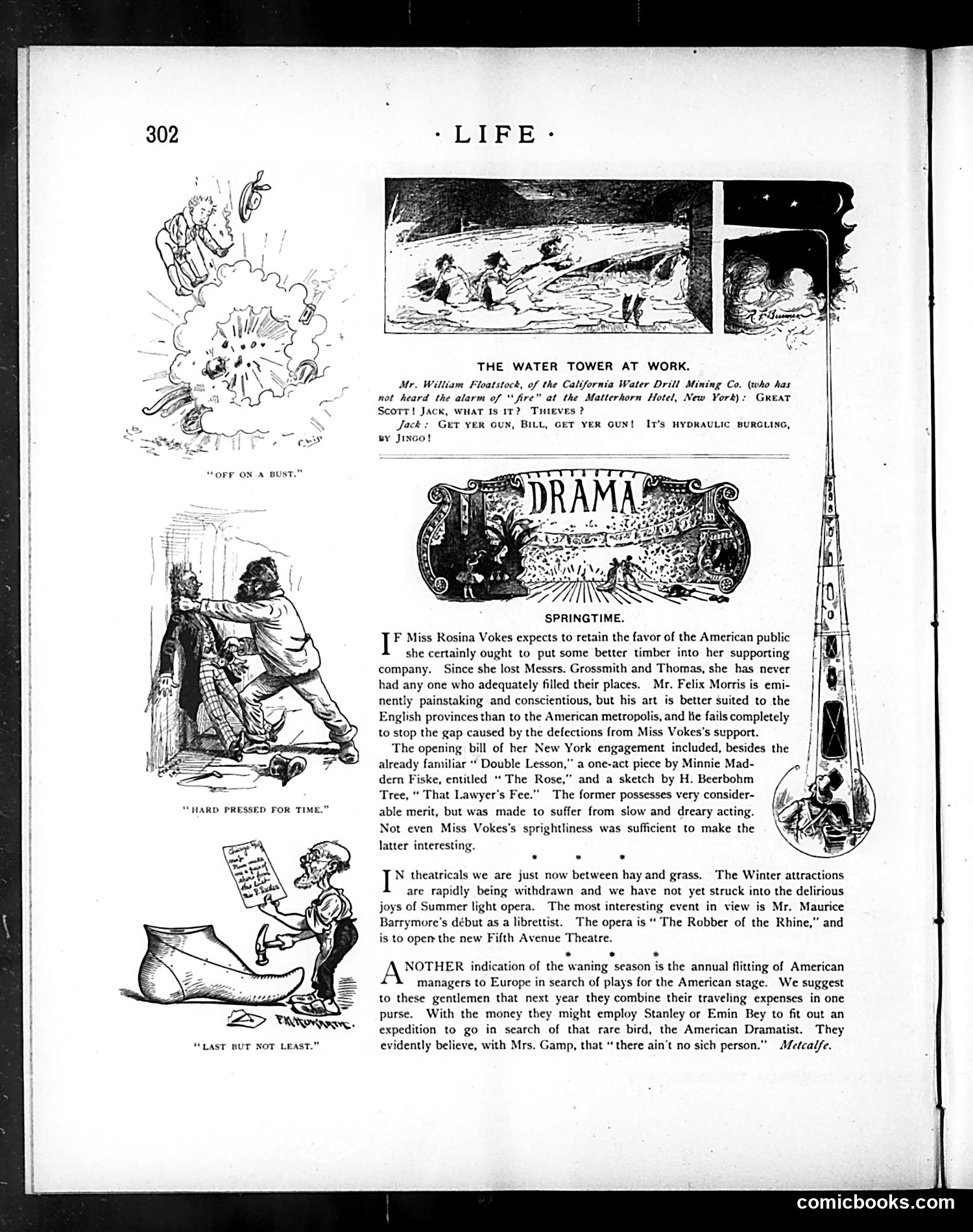
This page contains theater criticism and satirical cartoons from Life magazine's "Drama" section. The main content critiques actress Rosina Vokes's theatrical company, noting she's lost her supporting actors Grosssmith and Thomas, and praising Felix Morris's acting while questioning whether he can fill the gap. The left-side cartoons appear to be generic vaudeville/theater gags titled "Off on a Bust," "Hard Pressed for Time," and "Last but Not Least"—showing comedic situations unrelated to specific political figures. The text discusses the theatrical season's transition and mentions Maurice Barrymore's debut as a librettist in "The Robber of the Rhine" at the Fifth Avenue Theatre. The closing paragraph humorously suggests American theater managers should combine European scouting with seeking "rare birds" like Stanley or Emin Bey, referencing contemporary explorers.
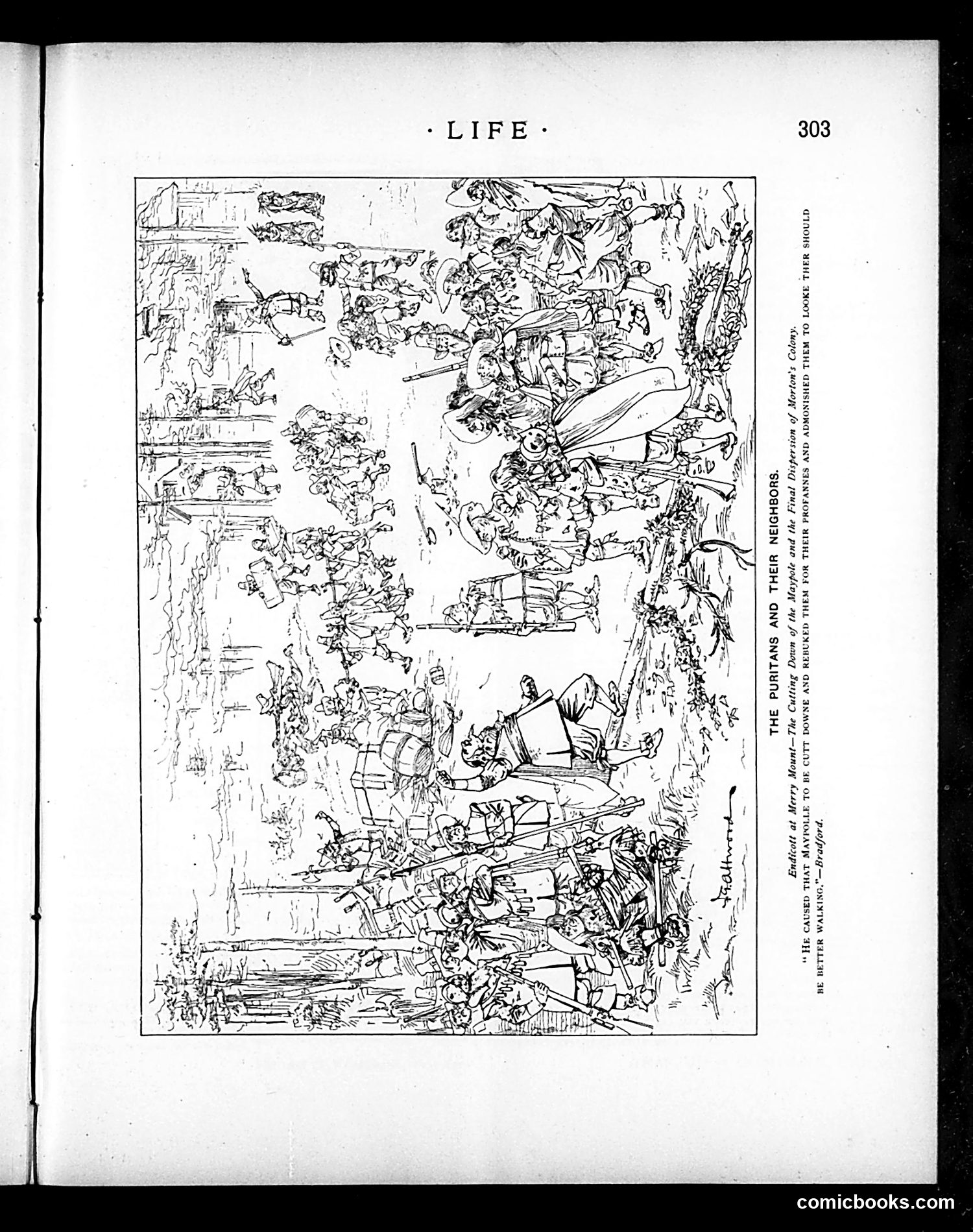
This page from *Life* magazine (page 303) features a detailed satirical illustration titled "The Courtains and Their Neighbors" by S. Eichorn. The sketch depicts a crowded domestic scene with numerous figures engaged in various activities—some appear to be socializing, others involved in household tasks or leisure pursuits. The cartoon appears to be social satire about suburban or middle-class neighborhood life, showing the interconnected dramas and interactions among residents. The densely packed composition with many characters suggests commentary on crowded living conditions or the gossipy, intertwined nature of neighborhood communities. Without clearer visibility of specific character labels or captions identifying particular figures as political/social personalities, the precise satirical targets remain unclear, though the overall theme appears critical of contemporary domestic social dynamics.
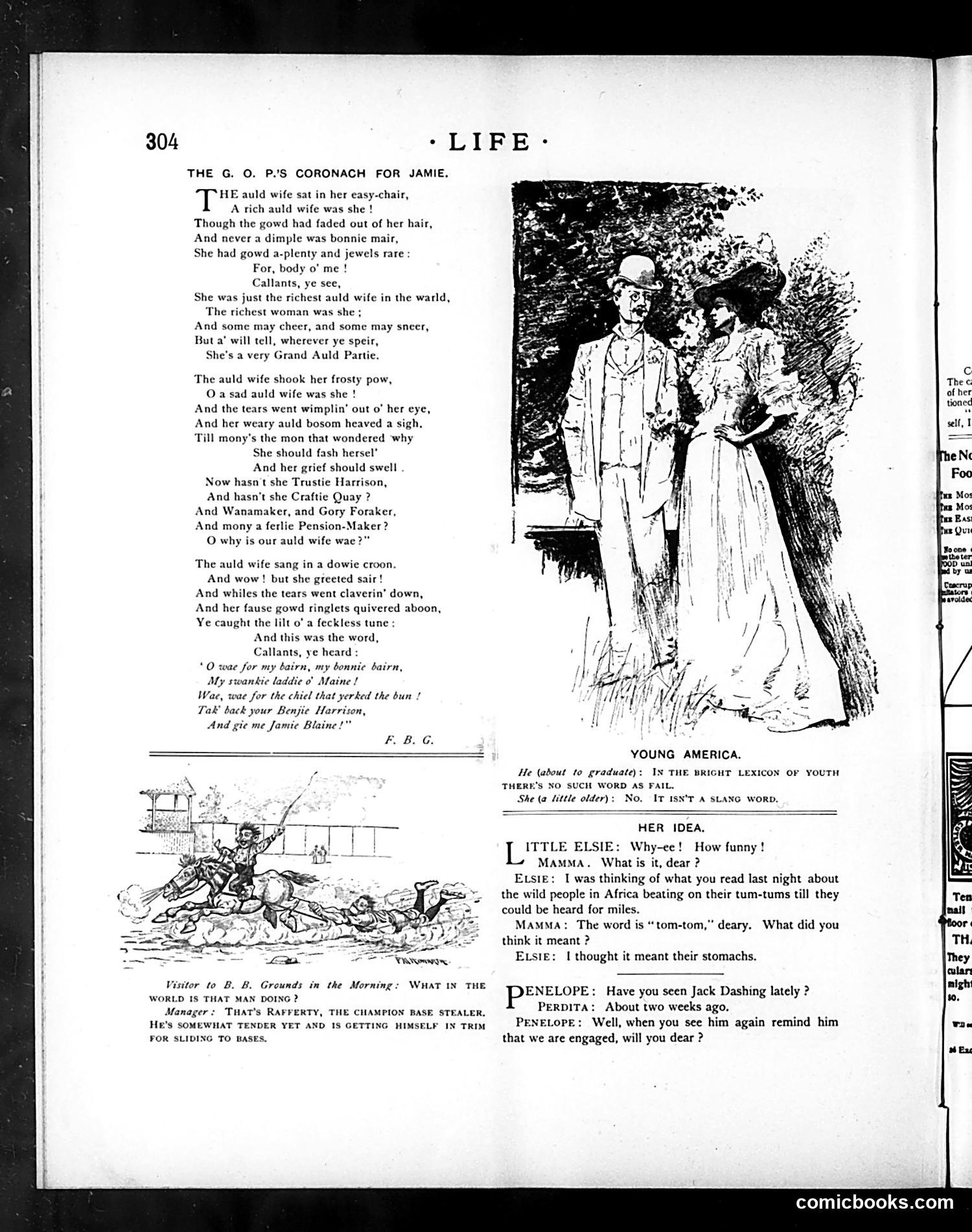
This page contains political satire disguised as Scottish folk poetry. "The G.O.P.'s Coronach for Jamie" uses the metaphor of a wealthy old woman mourning her lost son to mock the Republican Party's abandonment of James G. Blaine (the "Jamie" referenced). The poem names specific Republican figures—Harrison, Quay, Wanamaker, and Foraker—as those who failed to support Blaine's political interests. The "auld wife" represents the Republican Party itself, lamenting that despite controlling wealth and power, it has lost its favored candidate. The remaining content comprises light humorous sketches unrelated to the political satire: "Young America" jokes about youth's optimism versus reality, "Her Idea" presents a child's misunderstanding of "tom-tom" drums, and a baseball manager quip about base-stealing. The overall tone targets Republican party politics and leadership decisions of the period.
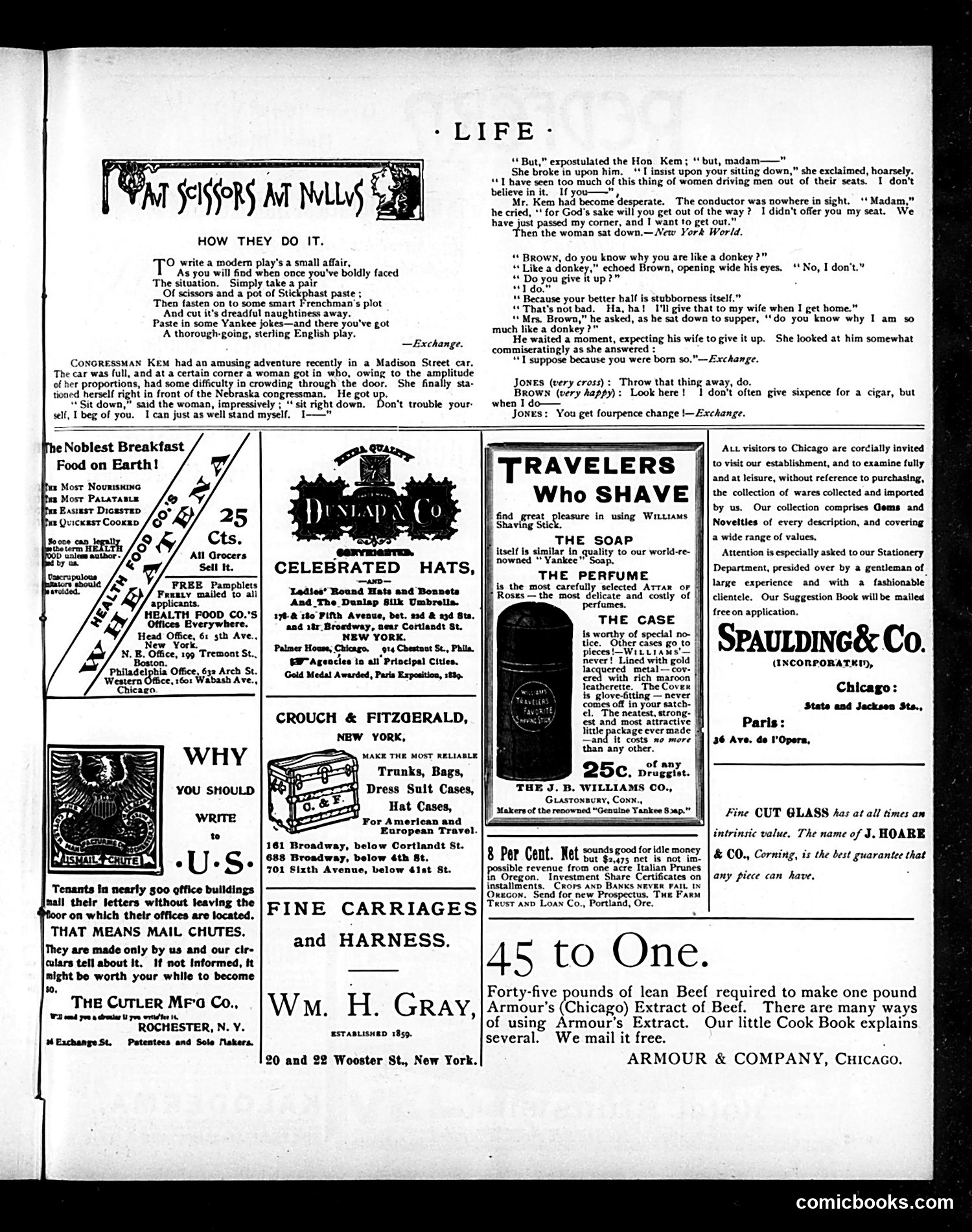
This page is primarily **advertising with interspersed humor pieces**, typical of Life magazine's format. The main satirical content consists of three brief anecdotes mocking human behavior: 1. **The streetcar incident**: A congressman is forced to stand by an aggressive woman who demands he sit, claiming women are "driven out of their seats." The joke: she only agrees to sit when he admits he wasn't offering her his seat anyway—revealing her aggressive stance was performative. 2. **The donkey joke**: A man tells his wife a joke comparing her stubbornness to a donkey. She counters by suggesting he's like a donkey *because he was born that way*—a cutting domestic put-down. 3. **The cigar exchange**: A man complains about expensive cigars; his friend reveals he only pays sixpence but receives fourpence change—implying the cigars are worthless. These are **gentle domestic and social satire** targeting marital discord, pomposity, and consumer gullibility. The remaining content is period advertising for breakfast food, hats, luggage, and beef extract—typical late-19th-century magazine fare.
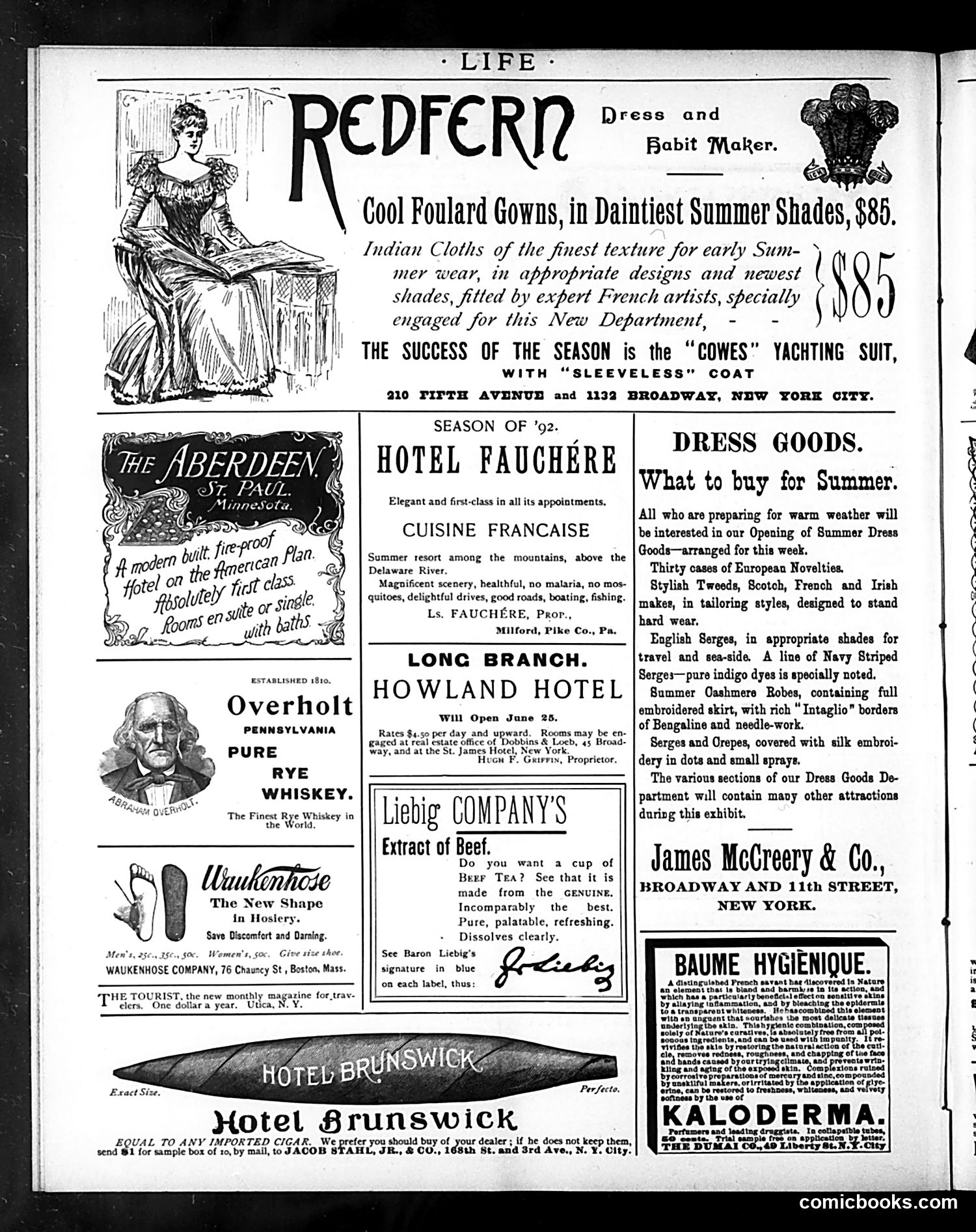
This is primarily a **commercial advertisement page** with no political cartoons or satirical content. The page showcases luxury goods and services typical of 1890s America. **Key advertisers include:** - **Redfern**: High-end dress and baby clothing maker featuring French design ($85 for summer gowns—expensive for the era) - **Hotel Fauchere & Howland Hotel**: Upscale summer resorts in Pennsylvania and Long Branch - **Overholt Rye Whiskey**: Premium liquor brand - **James McCreery & Co.**: Upscale department store advertising summer dress goods - Various patent medicines and luxury items (Liebig's Beef Extract, Baume Hygienique) **Context for modern readers:** This reflects the Gilded Age's consumer culture—wealthy Americans purchasing imported European fashions, vacationing at resort hotels, and consuming luxury products. The French branding and "expert French artists" signify prestige. The page reveals what affluent Americans valued: European sophistication, leisure travel, and refined fashion.
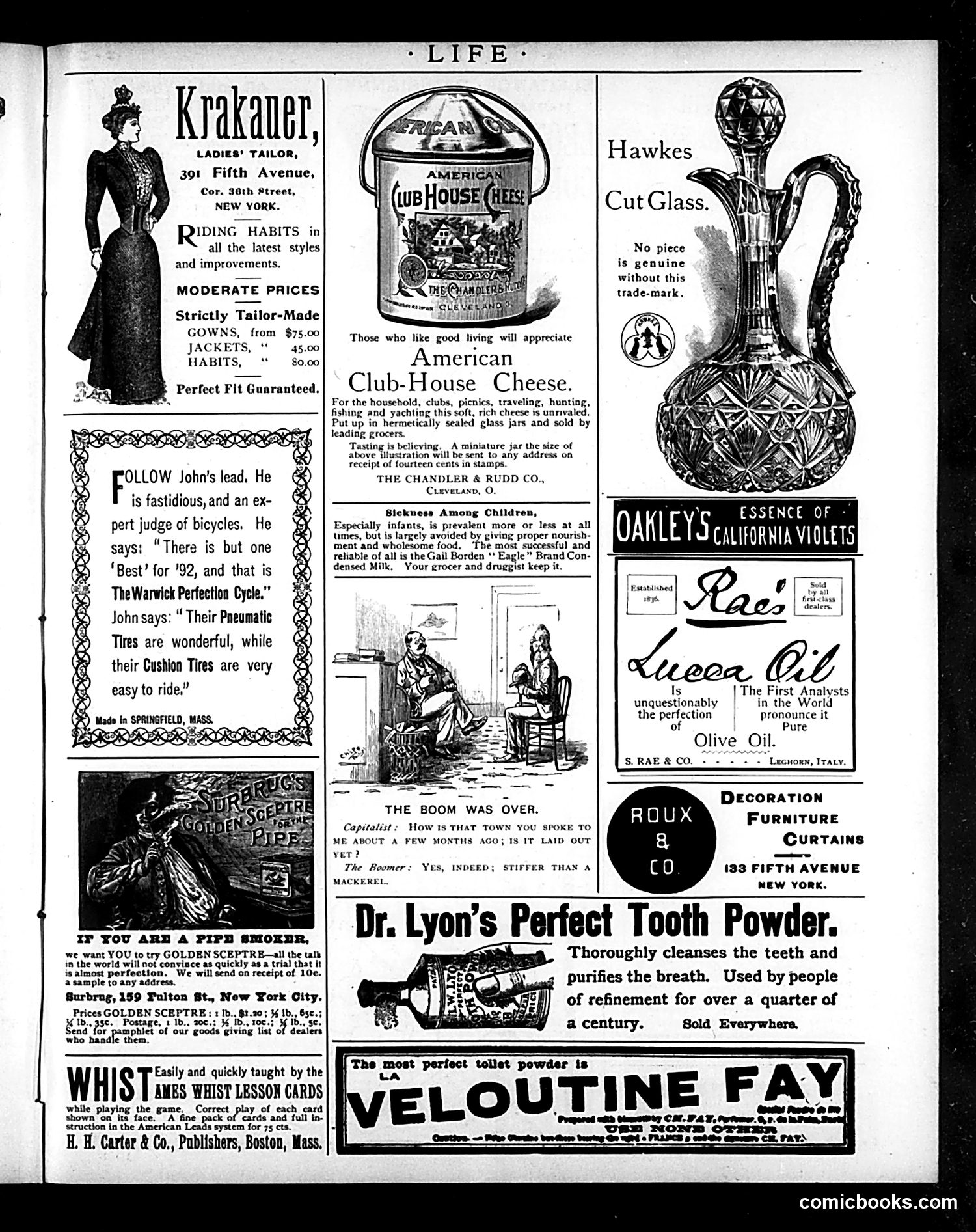
This page is primarily **advertisements** from an 1892 issue of *Life* magazine, with one cartoon. **The Cartoon:** "The Boom Was Over" depicts a dialogue between a Capitalist and a Boomer (a real-estate speculator). The Capitalist asks about a town the Boomer promoted months earlier; the Boomer admits it's now "stiffer than a mackerel"—meaning dead or defunct. This satirizes the **1880s-90s land speculation bubble** where promoters hyped undeveloped towns that often failed. The joke: the Boomer's earlier enthusiasm has collapsed into failure, comparing the town's lifelessness to a dead fish. **The Advertisements** showcase period consumer goods: ladies' tailoring, bicycles ("Warwick Perfection"), cigars, cheese, olive oil, tooth powder, and furniture—reflecting the era's commercial culture and advertising conventions in satirical magazines.
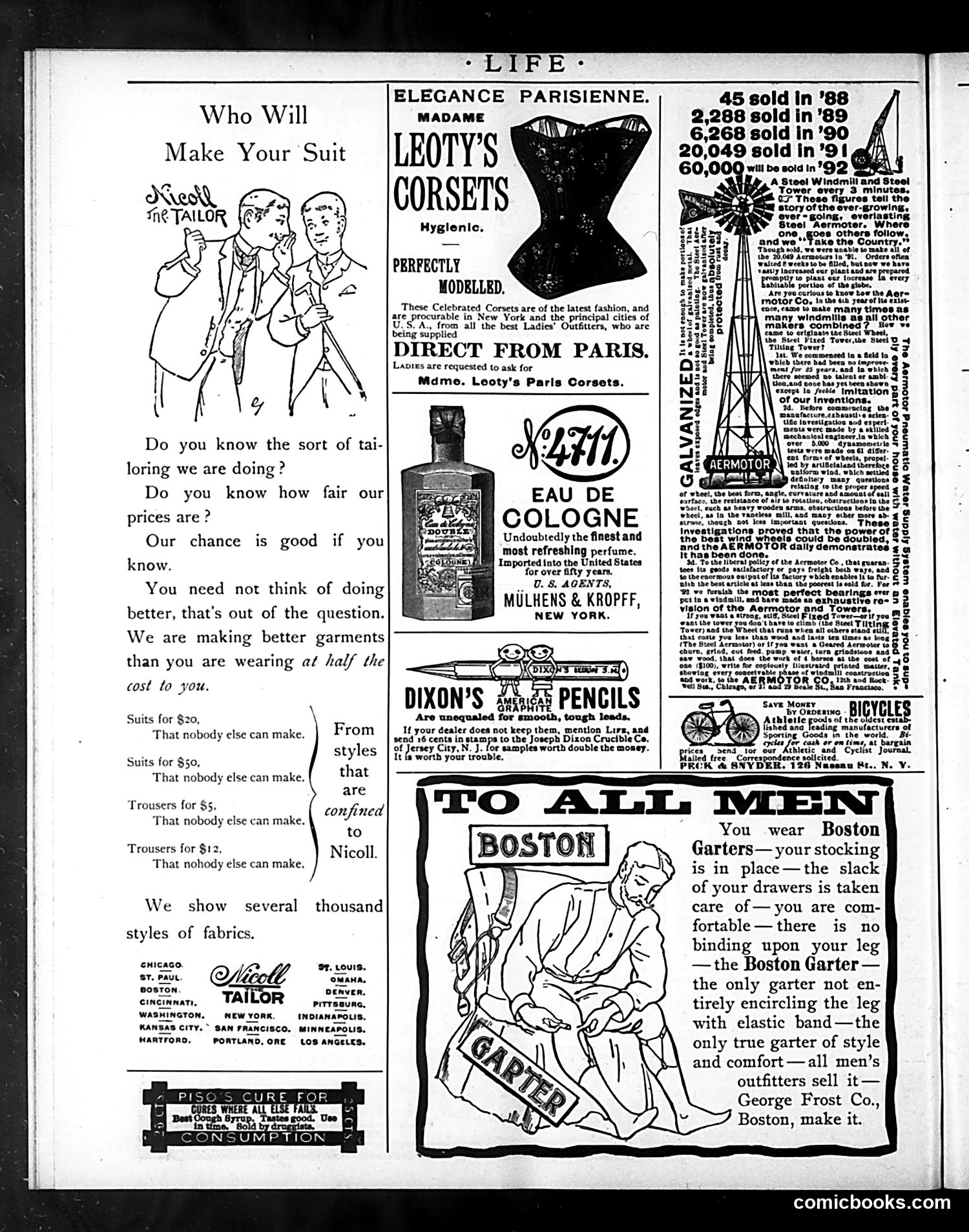
This is primarily a **advertising page** with minimal editorial content. The main satirical element appears in the left column: a cartoon titled "Who Will Make Your Suit" featuring Nicoll the Tailor. The cartoon depicts three men in suits, with the accompanying text making a sales pitch: Nicoll offers suits at $20, $50, and trousers at $5 and $12—prices he claims are "half the cost" of competitors' garments. The humor lies in the aggressive, somewhat boastful advertising approach typical of the era, essentially claiming "nobody else can make" comparable quality at these prices. The page is otherwise dominated by product advertisements (corsets, eau de cologne, pencils, bicycles, and garters), reflecting Life's mixed editorial-advertising model. The corset ad notably includes sales figures showing exponential growth ("60,000 will be sold in '92"), exemplifying the period's embrace of commercial success metrics in marketing. The "Boston Garter" ad at bottom features instructional imagery about proper fit—standard period advertising pedagogy.
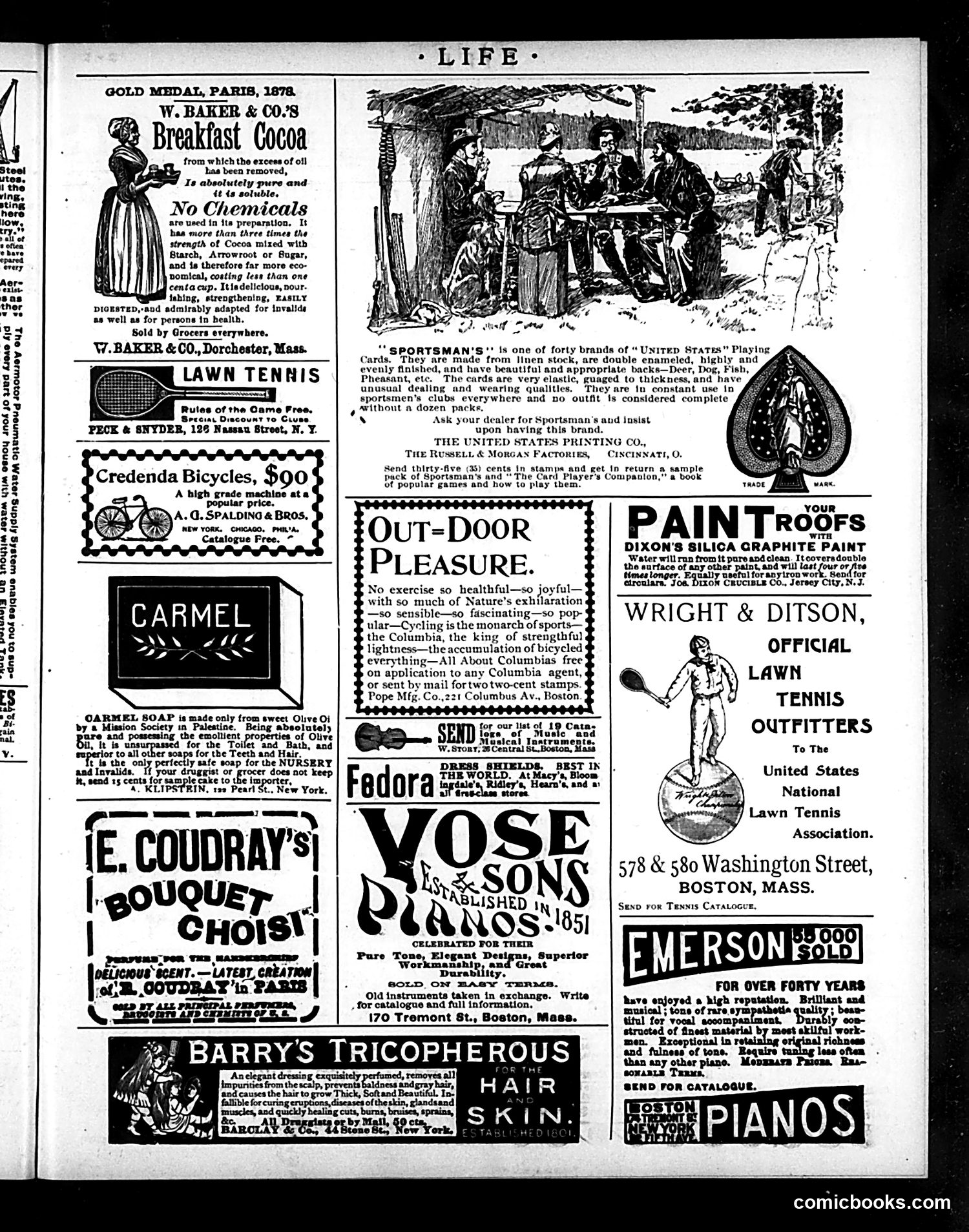
This is primarily an **advertising page** from Life magazine, not a political cartoon. It contains roughly 15 commercial advertisements for late-19th-century products and services. The ads reflect the era's consumer culture: W. Baker's cocoa (emphasizing purity and health), bicycles (Credenda and Columbia brands—cycling was a major fad), lawn tennis equipment and outfitters, playing cards, pianos, hair/skin products, and musical instruments. One small **illustrated vignette** appears at top-right showing people in Victorian dress engaged in outdoor leisure activities—consistent with the "Out-Door Pleasure" theme promoted throughout. The ads reveal social priorities of the 1870s-80s: athleticism, respectability, refined pastimes (lawn tennis, cycling), and manufactured goods marketed as scientific improvements. There's no apparent satire or political commentary—this is straightforward commercial promotion targeting middle and upper-class readers.
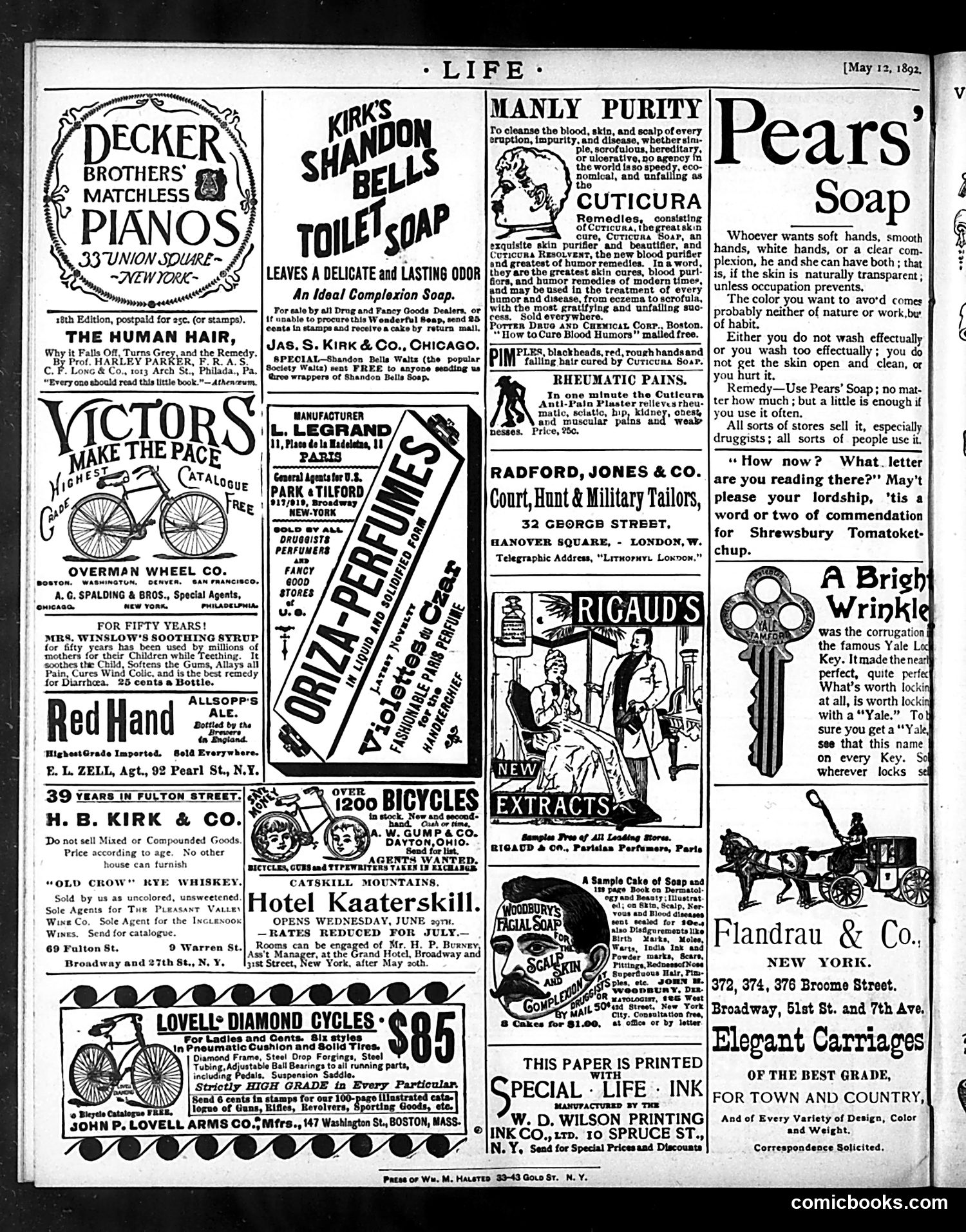
This is primarily an **advertising page** with no political cartoons or satire. It contains commercial advertisements typical of 1890s America. The ads reflect period concerns and products: hair loss remedies (addressed to men worried about baldness), complexion soaps and skin treatments (emphasizing "purity" and "manly" appearance), and consumer goods like pianos, bicycles, and whiskey. Notable is the racist imagery in at least one advertisement (the "Red Hand" ale ad), which was commonplace in late 19th-century advertising. The Cuticura ads use pseudo-medical language to promise cures for skin conditions—typical of the era's unregulated patent medicine marketing. The bicycle advertisements reflect the 1890s cycling craze. Overall, the page documents consumer culture and advertising practices of the Gilded Age, including both legitimate products and dubious health claims that would later be regulated by the FDA.