
Life, 1892-05-12 · page 6 of 18
Life — May 12, 1892 — page 6: what you’re looking at
What you’re looking at
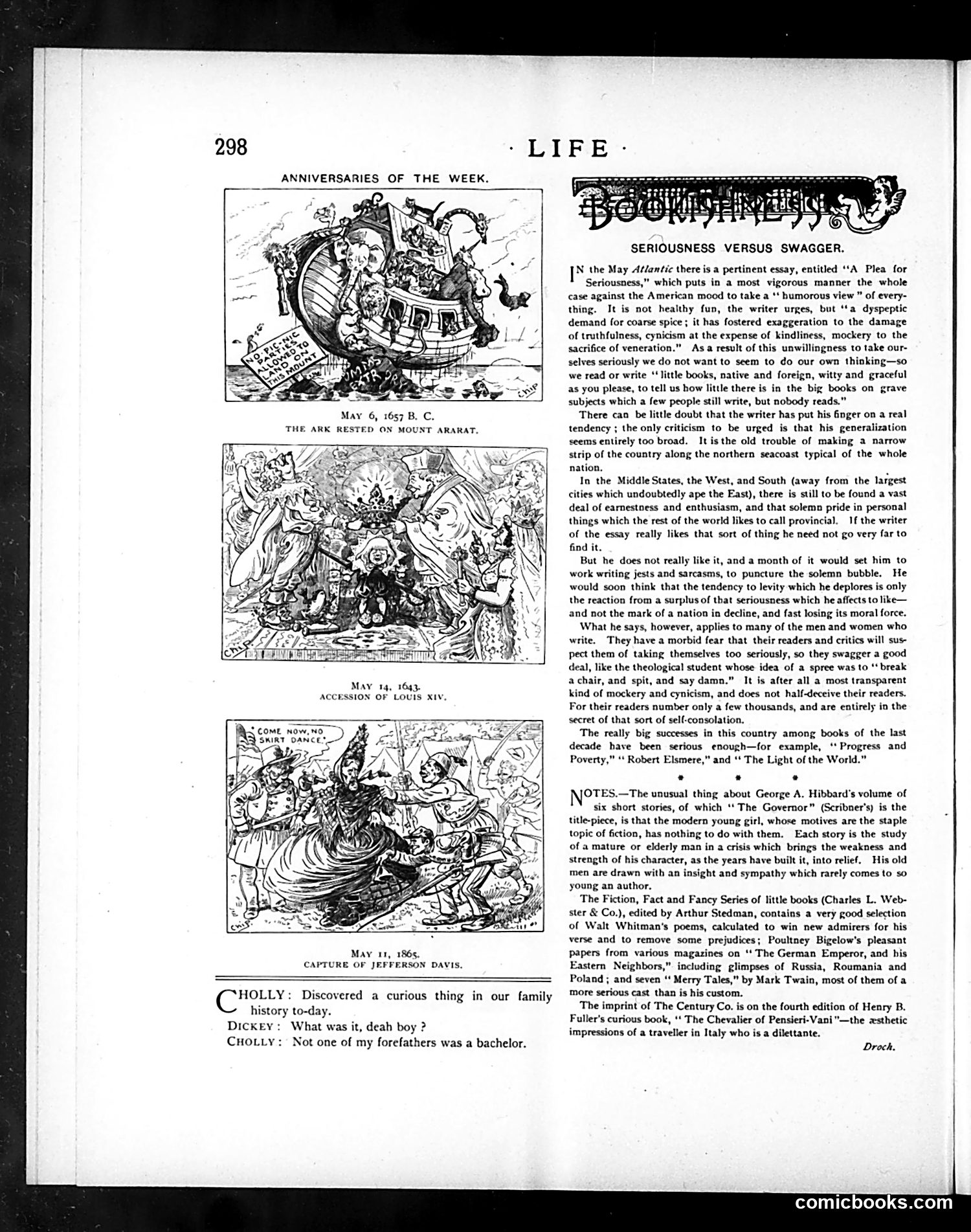
This page features three historical anniversary cartoons in the left column commemorating biblical and royal events: Noah's Ark (May 6, 1651), Louis XIV's accession (May 14, 1643), and Jefferson Davis (May 11, 1865). The main article "Seriousness Versus Swagger" critiques American literary trends, arguing against excessive "coarse spice" and cynicism in contemporary writing. The author contends that serious literature from the Midwest and South shows genuine earnestness, while East Coast writers employ mockery and sarcasm to appear sophisticated. The piece laments that successful recent American books have been serious works like "Progress and Poverty" rather than frivolous satire. A brief comedic dialogue at bottom jokes about family genealogy.
📄 Transcribed text from this page (OCR, searchable)
Machine-transcribed from the original scan — historical spelling and the odd misread are preserved.
May 6, 1657 B. C. RESTED ON MOUNT ARARAT. MAY 14, 1643. ACCESSION OF LOUIS XIV, COME NOW, NO AF} SKIRT DANCE”, See Bs May 11, 186s. CAPTURE OF JEFFERSON DAVIS, HOLLY: Discovered a curious thing in our family history to-day. Dickey: What was it, deah boy ? CHOLLY: Not one of my forefathers was a bachelor. SERIOUSNESS VERSUS SWAGGER. J) the May Addantic there is a pertinent essay, entitled “A Plea for Seriousness,” which puts in a most vigorous manner the whole case against the American mood to take a ** humorous view ” of every- thing. It is not healthy fun, the writer urges, but ‘a dyspeptic demand for coarse spice; it has fostered exaggeration to the damage of truthfulness, cynicism at the expense of kindliness, mockery to the sacrifice of veneration.” Asa result of this unwillingness to take our- selves seriously we do not want to seem to do our own thinking—so we read or write ‘little books, native and foreign, witty and graceful as you please, to tell us how little there is in the big books on grave subjects which a few people still write, but nobody reads.” There can be little doubt that the writer has put his Gnger on a real tendency ; the only criticism to be urged is that his generalization seems entirely too broad. It isthe old trouble of making a narrow strip of the country along the northern seacoast typical of the whole nation. . In the Middle States, the West, and South (away from the largest cities which undoubtedly ape the East), there is still to be found a vast deal of earnestness and enthusiasm, and that solemn pride in personal things which the rest of the world likes to call provincial. If the writer of the essay really likes that sort of thing he need not go very far to find it. But he does not really like it, and a month of it would set him to work writing jests and sarcasms, to puncture the solemn bubble. He would soon think that the tendency to levity which he deplores is only the reaction from a surplus of that seriousness which he affects to like— and not the mark of a nation in decline, and fast losing its moral force. What he says, however, applies to many of the men and women who They have a morbid fear that their readers and critics will sus- pect them of taking themselves too seriously, so they swagger a good deal, like the theological student whose idea of a spree was to break achair, and spit, and say damn.” It is after all a most transparent kind of mockery and cynicism, and does not half-deceive their readers. For their readers number only a few thousands, and are entirely in the secret of that sort of self-consolation. The really big successes in this country among books of the last decade have been serious enough—for example, ‘Progress and Poverty,” “ Robert Elsmere,” and ‘ The Light of the World.” * * . OTES.—The unusual thing about George A. Hibbard’s volume of six short stories, of which ‘‘ The Governor” (Scribner's) is the title-piece, is that the modern young girl, whose motives are the staple topic of fiction, has nothing to do with them. Each story is the study of a mature or elderly man in a crisis which brings the weakness and strength of his character, as the years have built it, into relief. His old men are drawn with an insight and sympathy which rarely comes to so young an author. The Fiction, Fact and Fancy Series of little books (Charles L. Web- ster & Co.), edited by Arthur Stedman, contains a very good selection of Walt Whitman's poems, calculated to win new admirers for his verse and to remove some prejudices; Poultney Bigelow's pleasant papers from various magazines on ‘ The German Emperor, and bis Eastern Neighbors,” including glimpses of Russia, Roumania and Poland ; and seven “ Merry Tales," by Mark Twain, most of them of a more serious cast than is his custom. The imprint of The Century Co. is on the fourth edition of Henry B. Fuller's curious book, ‘ The Chevalier of Pensieri-Vani"—the xsthetic impressions of a traveller in Italy who is a dilettante. write. Droch, comicbooks.com