
Life, 1892-05-12 · page 4 of 18
Life — May 12, 1892 — page 4: what you’re looking at
What you’re looking at
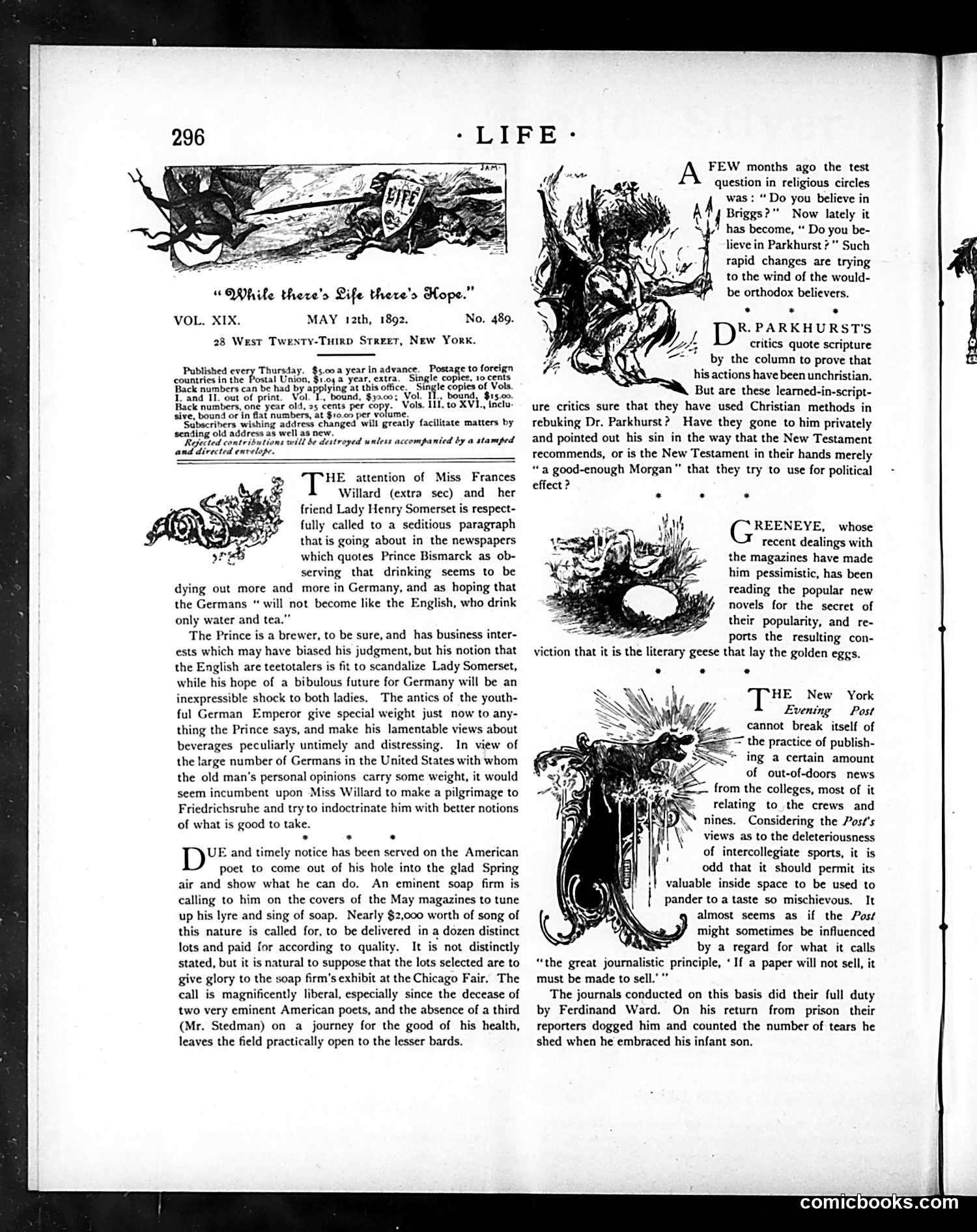
The page contains three separate satirical sections rather than a unified cartoon. **Top section** discusses Prince Bismarck's views on German drinking habits and his hope that Germans will adopt English tea-drinking instead of alcohol—a commentary on German-American relations and stereotypes about national drinking cultures. **Middle section** mocks an American poet being courted by soap companies to endorse their products at the Chicago Fair, satirizing the commercialization of literary figures and the era's aggressive advertising practices. **Bottom section** references Ferdinand Ward's return from prison and reunion with his infant son—Ward was a notorious financier involved in the 1884 collapse of Grant & Ward bank, a major scandal. The satire concerns journalists' sensationalistic coverage of his release. The overall theme critiques journalism, commercialism, and public figures of the 1890s.
📄 Transcribed text from this page (OCR, searchable)
Machine-transcribed from the original scan — historical spelling and the odd misread are preserved.
“Mhile there's Life there's Hope.” XIX. MAY tath, 1892. 28 West Twenty-THirp Street, New York. VOL. No. 489. Published every Thursday. $5.00. year in advance. Postage to foreign countries in the Postal Union, $roy a year, extra, Single copies, ro cents Back numbers can be had by applying at this office,” Single coples of Vols I. and If. out of print. Vol. I., bound, $39.00; Vol. I1., bound, $15.00. Back numbers, one year old, 25 cents per copy. Vols. IIT. to XVI, inclu- sive, bound or in flat numbers, at $10.00 per volume. Subscribers wishing address changed will greatly facilitate matters by sending old address as well as new. : Rejected contributions will be destroyed untess accompanied by a stamped and directed envelope. HE attention of Miss Frances Willard (extra sec) and her friend Lady Henry Somerset is respect- fully called to a seditious paragraph that is going about in the newspapers which quotes Prince Bismarck as ob- serving that drinking seems to be dying out more and more in Germany, and as hoping that the Germans “ will not become like the English, who drink only water and tea.” The Prince is a brewer, to be sure, and has business inter- ests which may have biased his judgment, but his notion that the English are teetotalers is fit to scandalize Lady Somerset, while his hope of a bibulous future for Germany will be an inexpressible shock to both ladies. The antics of the youth- ful German Emperor give special weight just now to any- thing the Prince says, and make his lamentable views about beverages peculiarly untimely and distressing. In view of the large number of Germans in the United States with whom the old man’s personal opinions carry some weight, it would seem incumbent upon Miss Willard to make a pilgrimage to Friedrichsruhe and try to indoctrinate him with better notions of what is good to take. . . . UE and timely notice has been served on the American poet to come out of his hole into the glad Spring air and show what he can do. An eminent soap firm is calling to him on the covers of the May magazines to tune up his lyre and sing of soap. Nearly $2,000 worth of song of this nature is called for, to be delivered in a dozen distinct lots and paid for according to quality. It is not distinctly stated, but it is natural to suppose that the lots selected are to give glory to the soap firm's exhibit at the Chicago Fair. The call is magnificently liberal, especially since the decease of two very eminent American poets, and the absence of a third (Mr. Stedman) on a journey for the good of his health, leaves the field practically open to the lesser bards. FEW months ago the test question in religious circles A was : “ Do you believe in A Briss?” Now lately it “y' has become, “ Do you be- f lieve in Parkhurst? Such rapid changes are trying to the wind of the would- be orthodox believers. . . . R. PARKHURST'S critics quote scripture by the column to prove that his actions have been unchristian. But are these learned-in-script- ure critics sure that they have used Christian methods in rebuking Dr. Parkhurst? Have they gone to him privately and pointed out his sin in the way that the New Testament recommends, or is the New Testament in their hands merely “‘a good-enough Morgan” that they try to use for political y a . REENEYE, whose recent dealings with the magazines have made him pessimistic, has been reading the popular new novels for the secret of their popularity, and re- = me ports the resulting con- viction that it is the literary geese that lay the golden eggs. / HE New York ti y Evening Post Fogg. cannot break itself of = the practice of publish- SS ing a certain amount of out-of-doors news - from the colleges, most of it relating to the crews and nines. Considering the Post's views as to the deleteriousness of intercollegiate sports, it is odd that it should permit its valuable inside space to be used to pander to a taste so mischievous. It almost seems as if the Post might sometimes be influenced S by a regard for what it calls “the great journalistic principle, ‘If a paper will not sell, it must be made to sell.” The journals conducted on this basis did their full duty by Ferdinand Ward. On his return from prison their reporters dogged him and counted the number of tears he shed when he embraced his infant son. comicbooks.com