A complete issue · 14 pages · 1892
Life — April 28, 1892
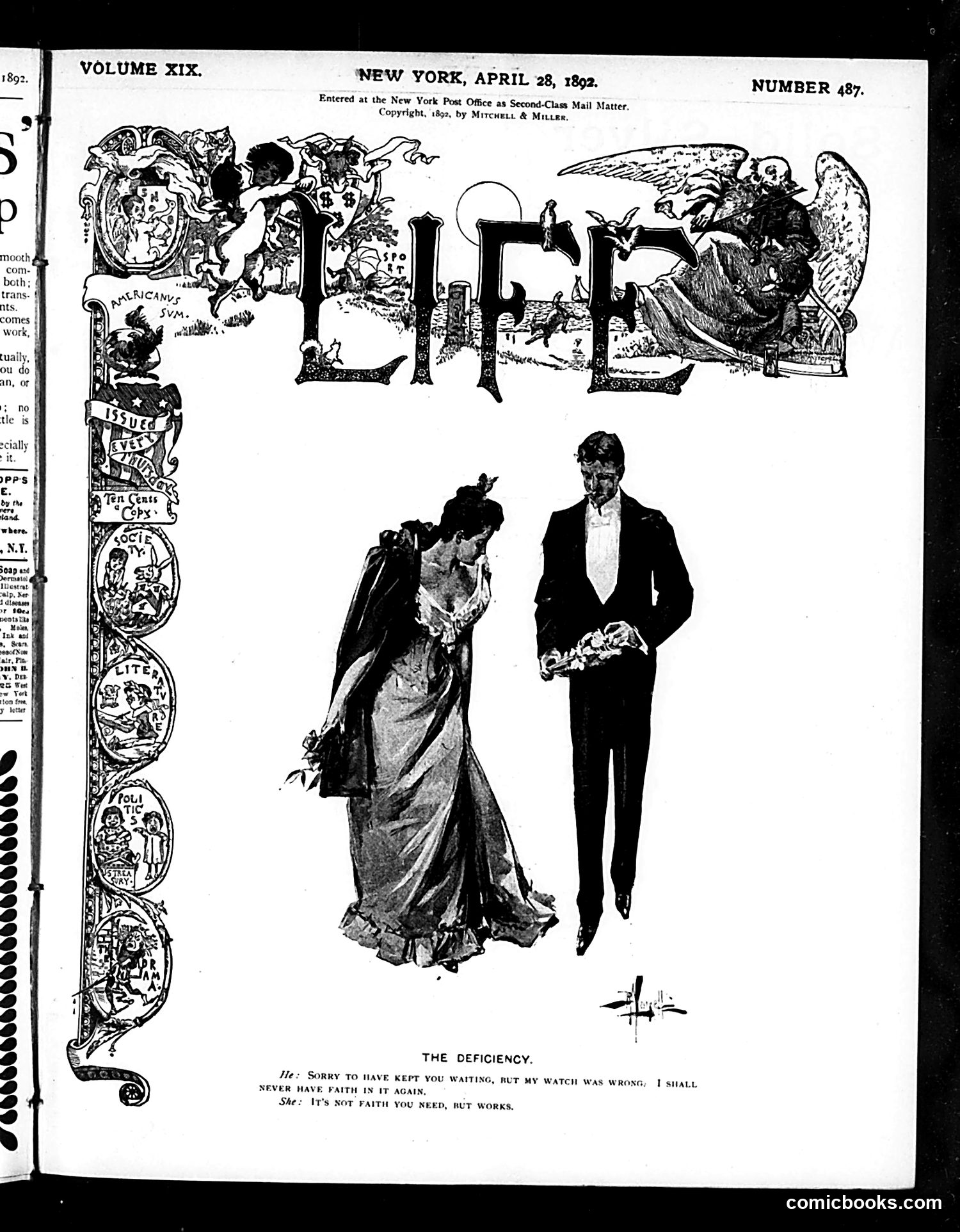
This cartoon satirizes a couple's marital discord. A well-dressed man and an elegantly-gowned woman stand apart, their body language suggesting distance or tension. The caption reads: **He:** "Sorry to have kept you waiting, but my watch was wrong. I shall never have faith in it again." **She:** "It's not faith you need, but works." The humor turns on a pun: "works" simultaneously means the mechanical components of a watch and implies the man needs to demonstrate his devotion through *actions* rather than excuses. The wife suggests her husband's unreliability in keeping appointments—a common domestic complaint—requires more than apologies; he needs behavioral change. The cartoon mocks both male excuses and female exasperation with inattentive husbands.
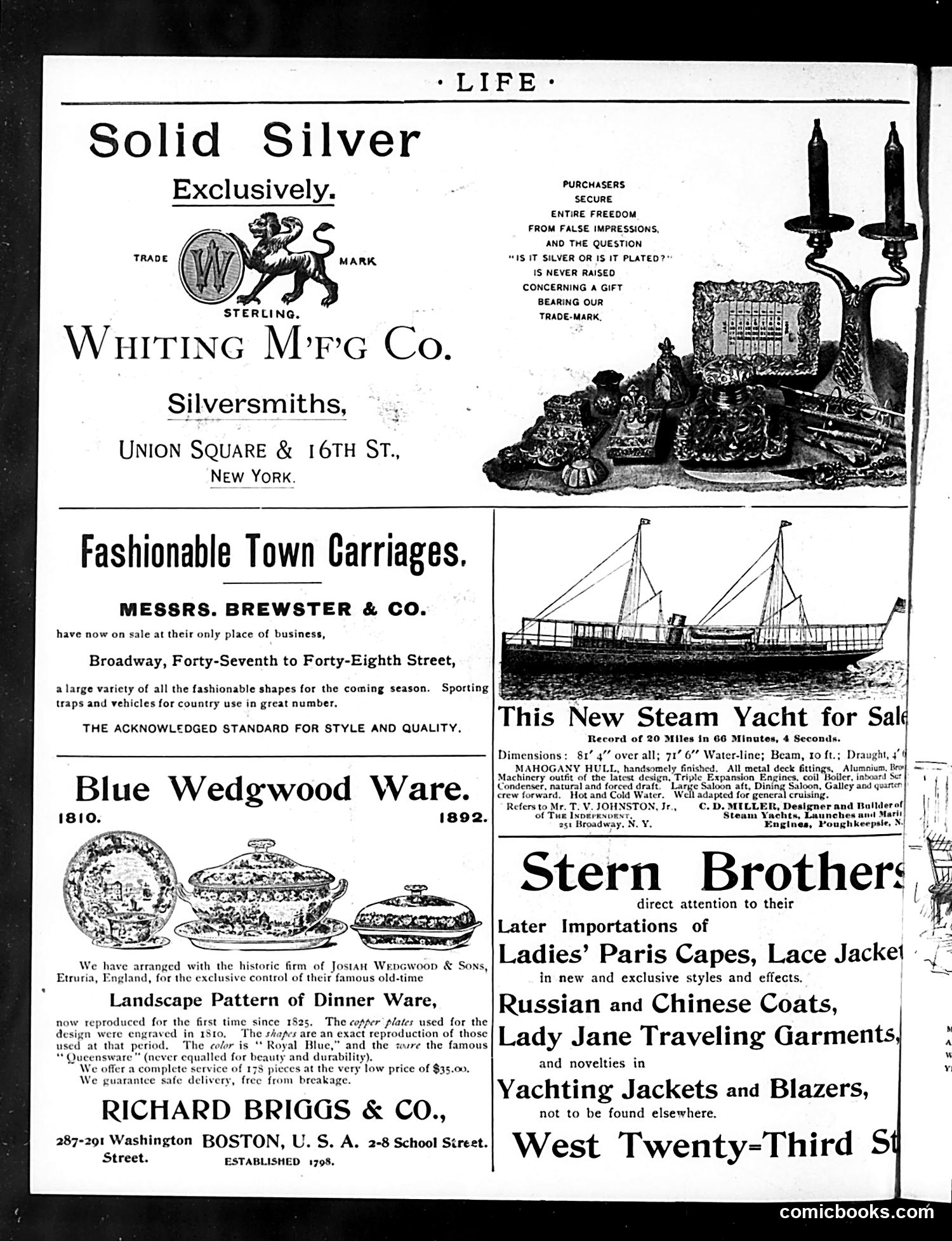
This page is **primarily advertising**, not political cartoons or satire. It contains five separate commercial advertisements from the 1890s era: 1. **Whiting Manufacturing Co.** (silversmiths, NYC) - promoting solid sterling silver goods 2. **Messrs. Brewster & Co.** - fashionable town carriages on Broadway 3. **Blue Wedgewood Ware** (1810-1892) - reproduction dinnerware from Boston firm Richard Briggs & Co. 4. **Steam Yacht Advertisement** - featuring a new vessel with speed record 5. **Stern Brothers** - a department store advertising ladies' clothing (capes, coats, traveling garments, yachting jackets) The page reflects late-19th-century consumer culture and luxury goods targeting wealthy New York City residents. There are no political cartoons or satirical commentary present—this is a straightforward advertising section of the *Life* magazine.
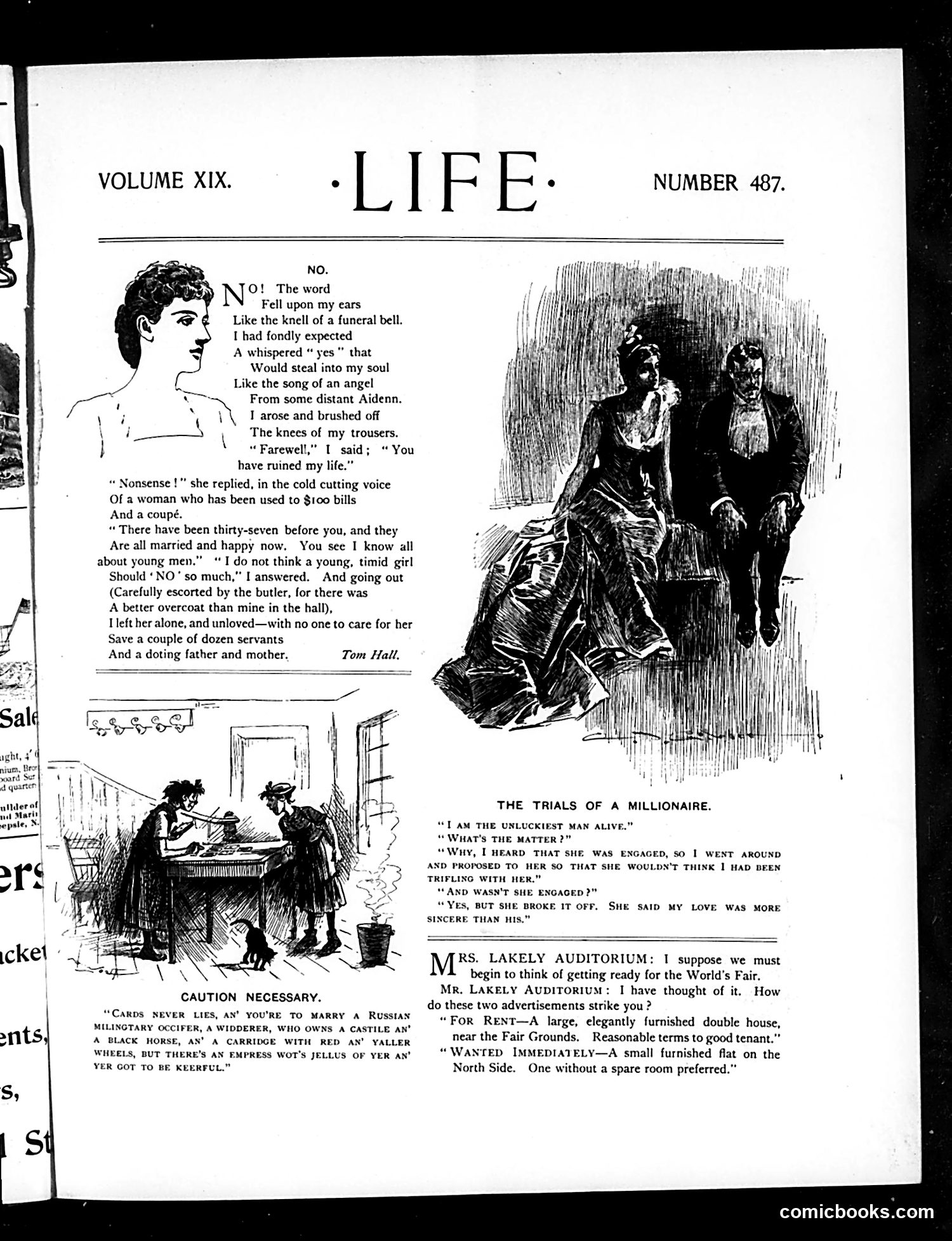
This page contains literary and social commentary rather than political cartoons. The main feature is a poem titled "No." by Tom Hall, depicting a young woman's rejection of a marriage proposal. The poem is satirical, with the woman defiantly refusing her suitor despite societal pressure to accept. The illustration "The Trials of a Millionaire" shows a wealthy man's romantic misadventure—he attempted to court an engaged woman, resulting in rejection. The caption mocks his failure despite his wealth and status. The "Caution Necessary" cartoon (lower left) is a humorous social commentary on marriage prospects, listing absurd conditions for a potential husband. The "Mrs. Likely Auditorium" section contains apartment rental advertisements, mixing editorial content with commercial notices typical of the era's Life magazine format.
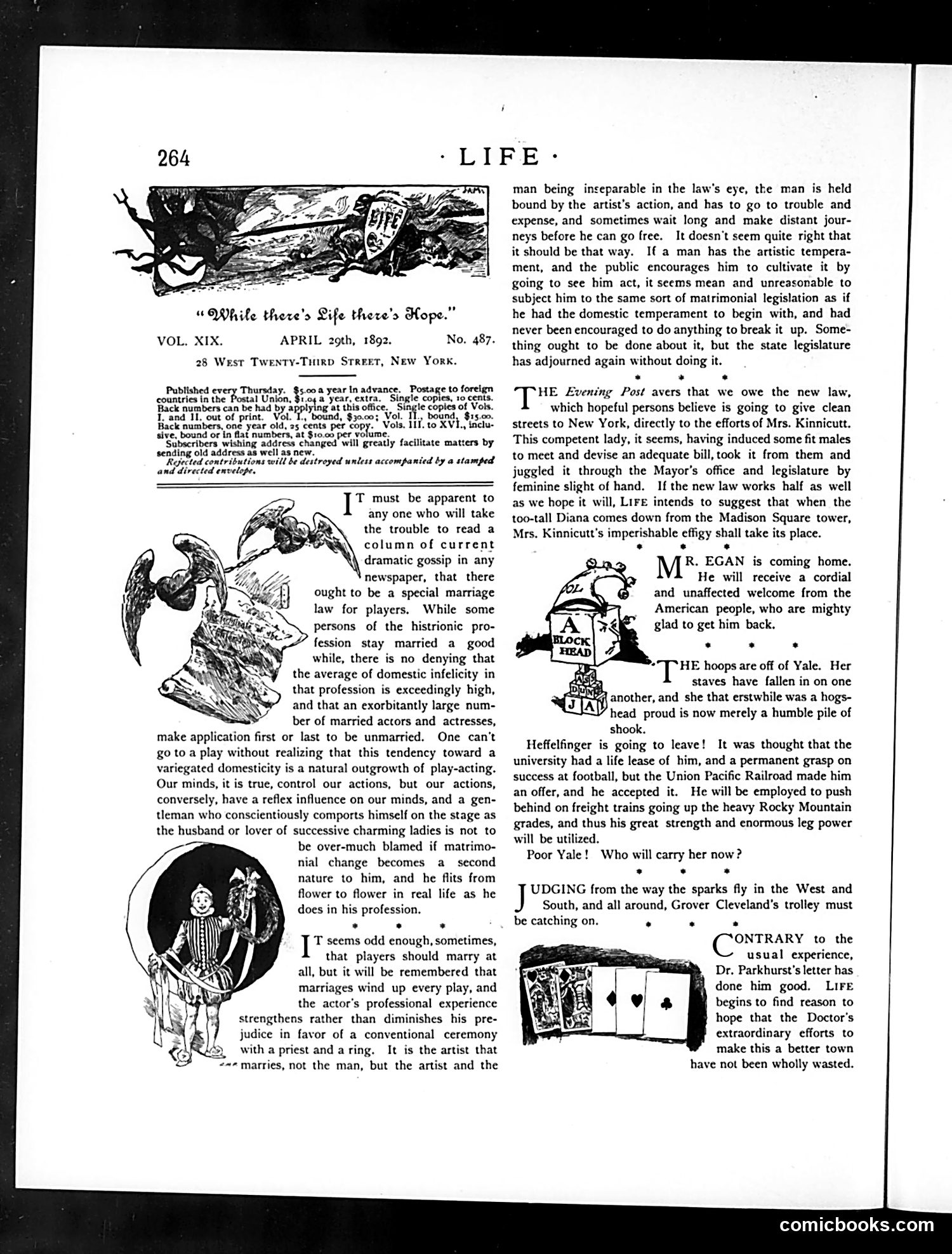
This page contains editorial commentary on several contemporary issues. The main text discusses a proposed marriage law for actors, arguing that players shouldn't be forced to marry on stage just because their characters do—such performances shouldn't carry legal weight. The illustrations appear to be decorative vignettes rather than political cartoons. One shows theatrical figures; another depicts playing cards. Additional brief items address: Mr. Egan's homecoming and American welcome; Yale's loss in athletic competition; Heifelfinger's departure for the Union Pacific Railroad; and Dr. Parkhurst's efforts to improve the town (likely referencing his anti-corruption crusade in New York City). The tone is typical of *Life*'s satirical commentary on contemporary social, legal, and cultural matters.
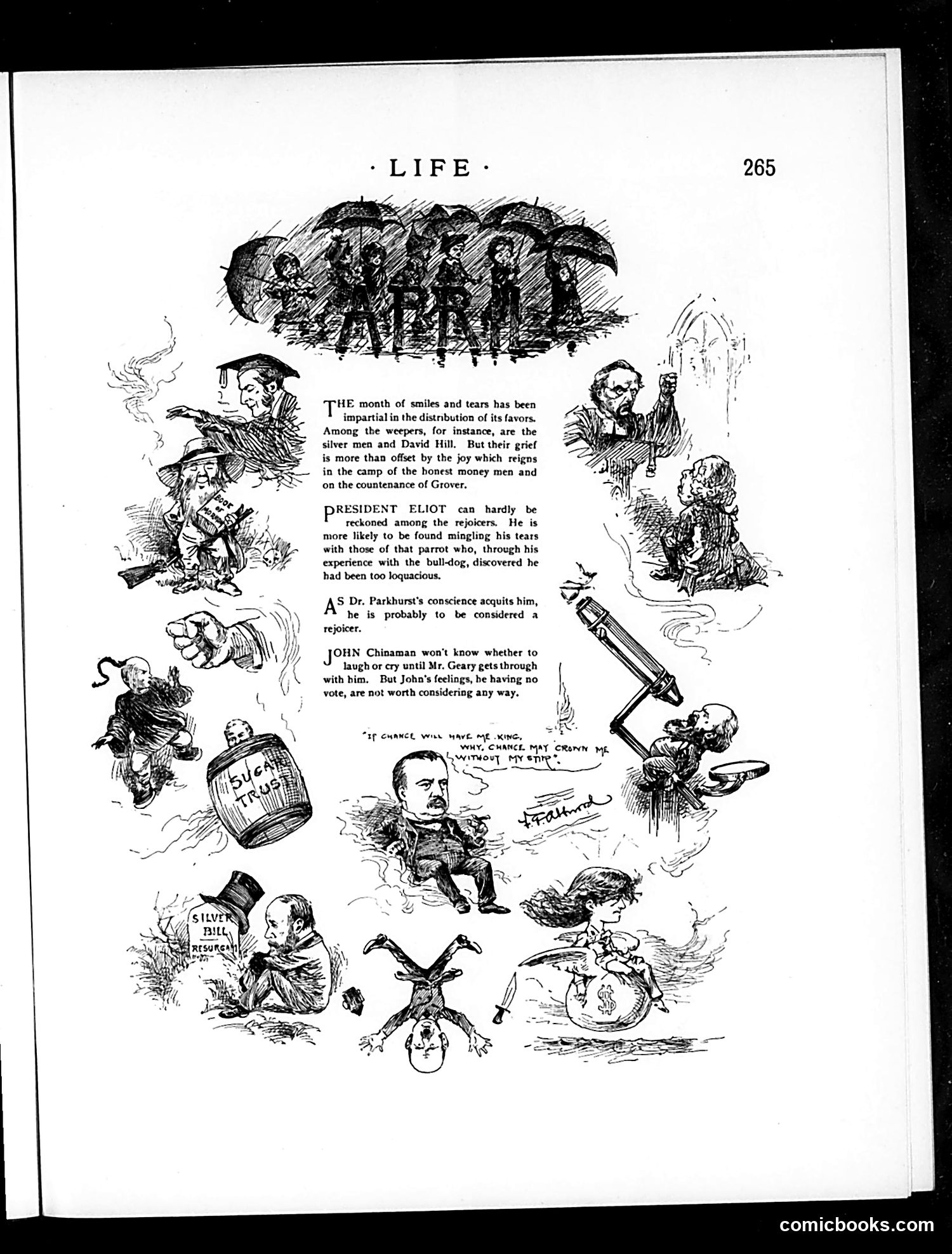
This satirical page comments on the 1884 U.S. presidential election aftermath, likely November 1884. The central caricatured figure appears to be James G. Blaine (based on the distinctive mustache and "If Chance will have me King" quote), the defeated Republican candidate. The scattered vignettes mock various Republican figures weeping over their electoral loss. References include "Silver Bill" (likely Congressman William Allison), President Eliot (Harvard's Charles Eliot), and "John Chinaman" (a derogatory reference to Chinese exclusion politics). The barrel labeled "Slush Fund" references campaign corruption allegations against Blaine. The overall satire celebrates the Republicans' defeat by Democrat Grover Cleveland, depicting the opposition party in comic distress over lost power and patronage opportunities.
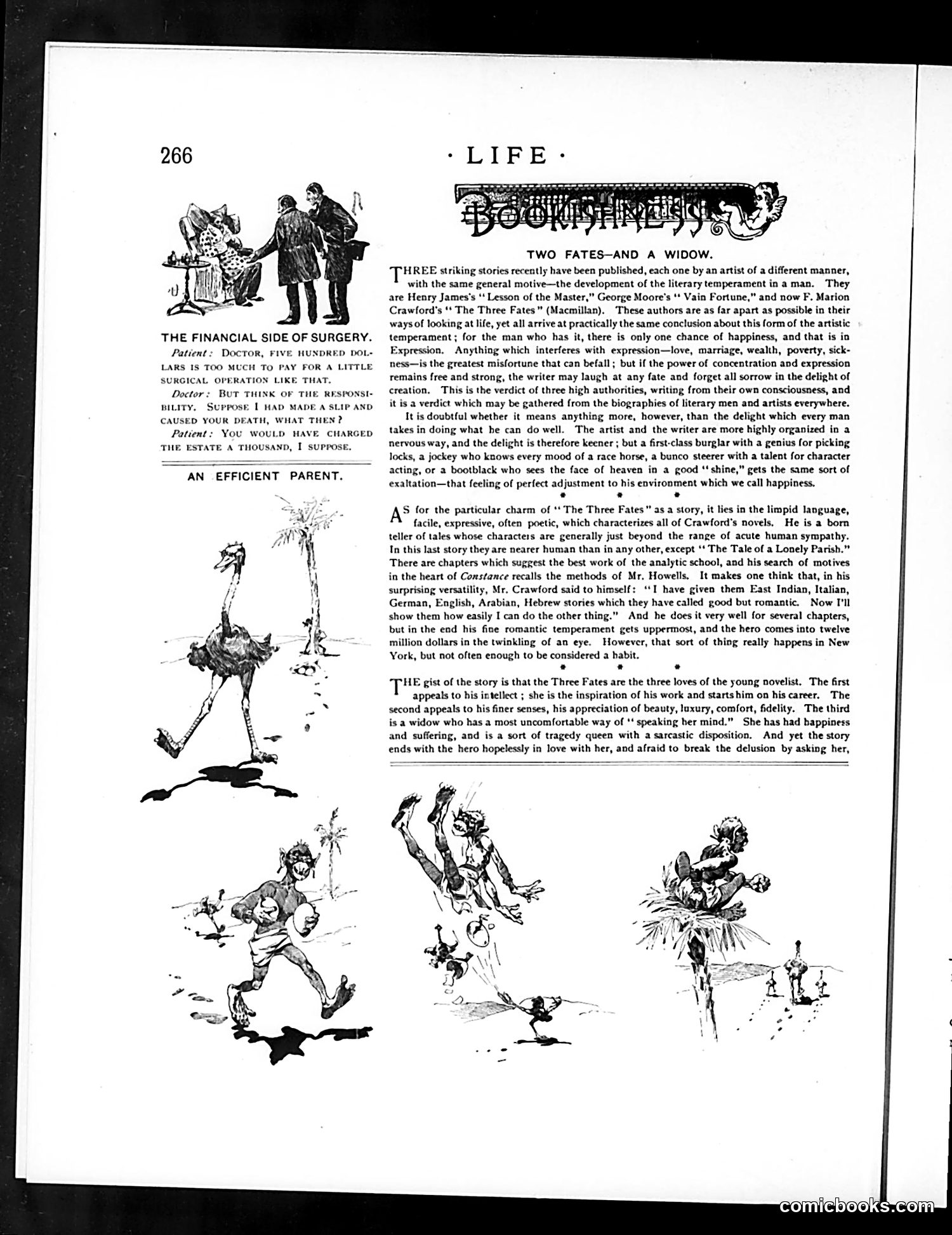
This page contains book reviews rather than political cartoons. The main content discusses F. Marion Crawford's novel "The Three Fates" (Macmillan), comparing it with works by Henry James and George Moore. The illustrated vignettes (small cartoon sketches) appearing throughout appear to be decorative accompaniments to the literary discussion, depicting scenes of social interaction and human drama rather than making specific political commentary. The review emphasizes Crawford's ability to write about artistic temperament and human psychology, noting his talent for depicting characters "just beyond the range of usual human sympathy." The text suggests the novel concerns three women who influence a young novelist's life and career choices. No clear political satire or topical references are evident on this page—it functions primarily as cultural criticism for an educated readership.
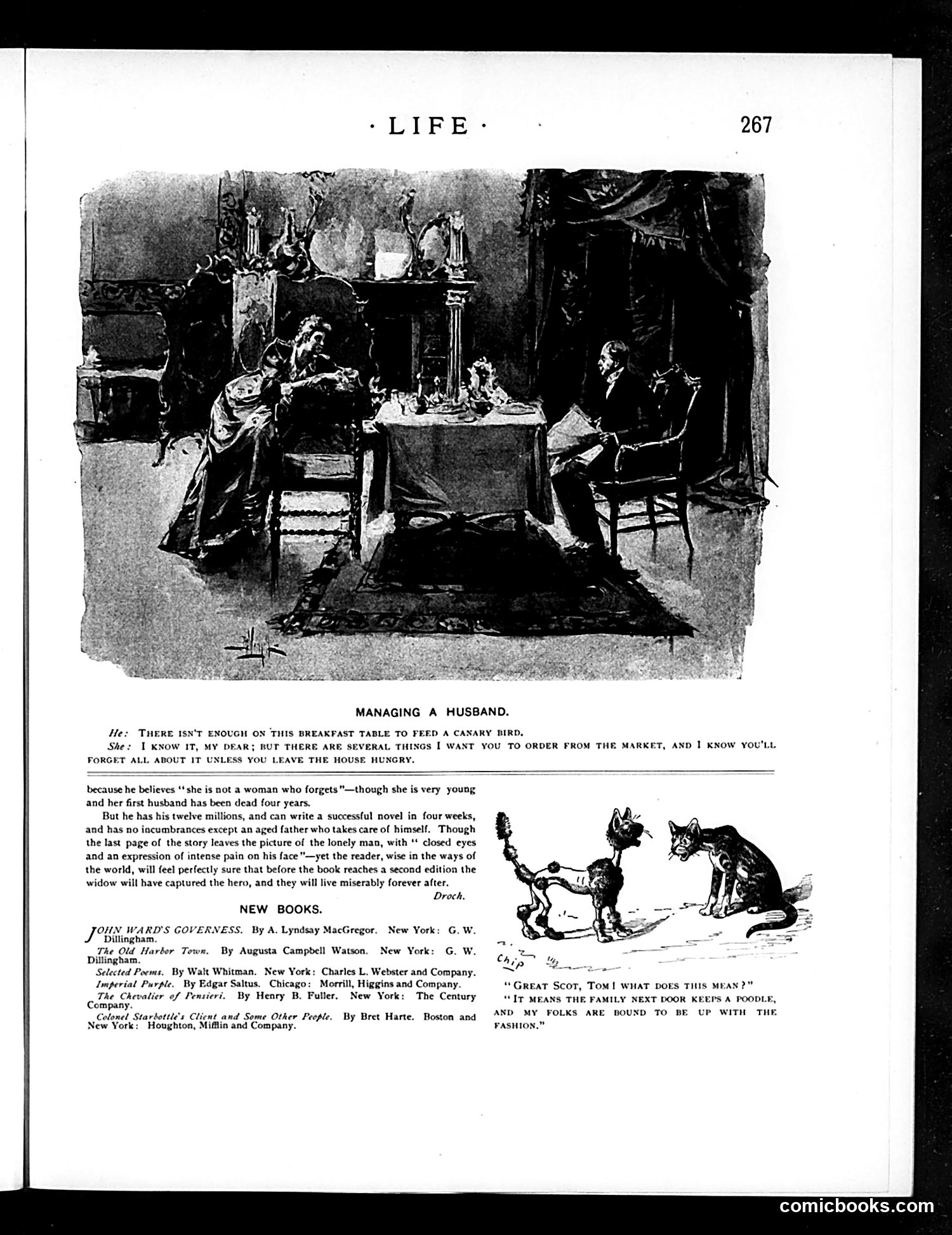
This page satirizes early 20th-century domestic gender dynamics. The cartoon titled "Managing a Husband" depicts a wife directing her husband at the breakfast table, instructing him to order specific items from the market and threatening that he'll "forget all about it unless you leave the house hungry." The satire mocks both spouses: the wife as a controlling domestic manager, the husband as incompetent and forgetful without her direction. The accompanying text discusses a widow who remarries a successful novelist, suggesting she manages him similarly—implying wives "manage" husbands through manipulation rather than partnership. The lower illustration shows dogs, likely a humorous aside unrelated to the main satire. The "New Books" section lists contemporary publications, typical of Life's content.
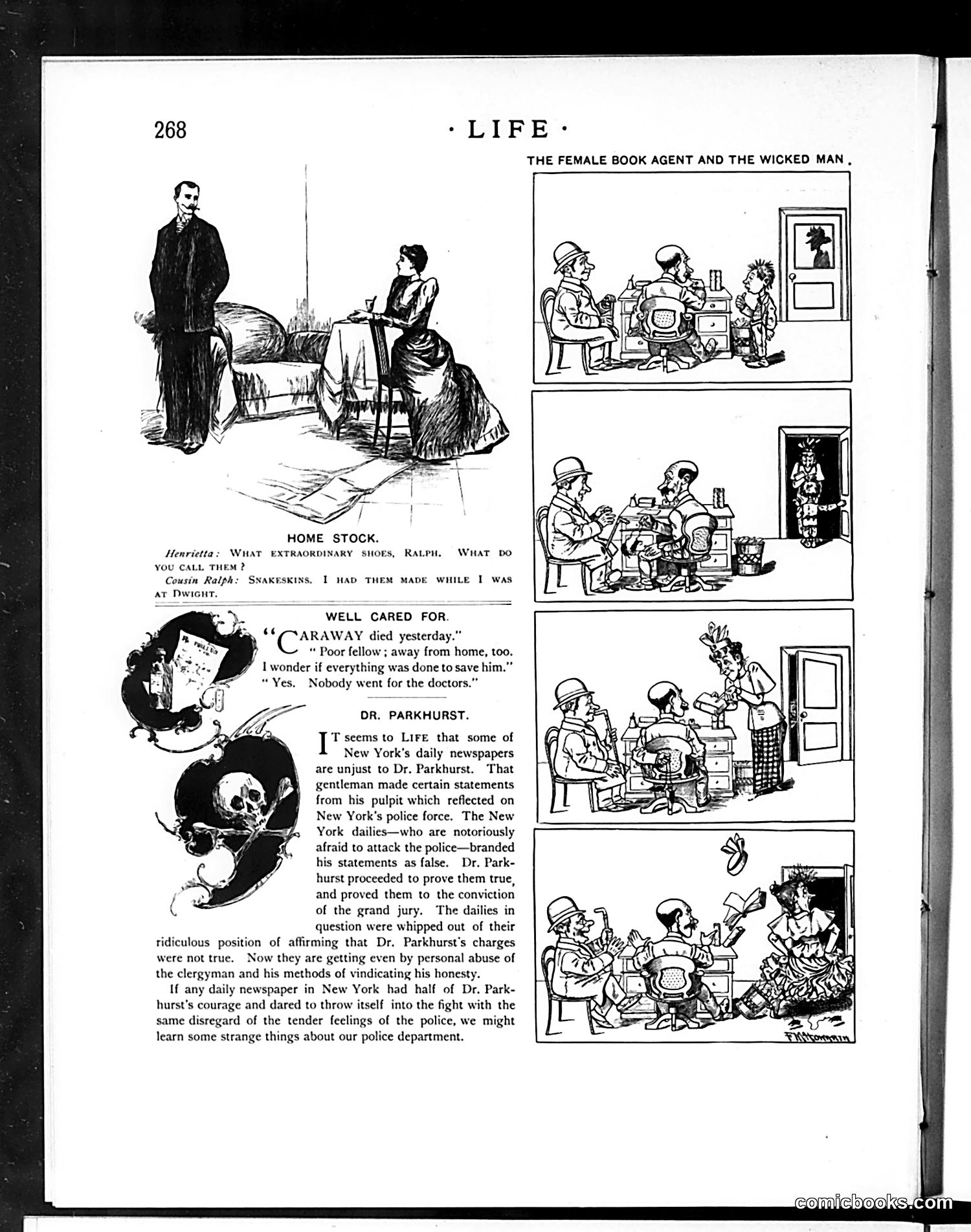
**Top Section ("Home Stock"):** A man and woman at a desk discuss extraordinary shoes called "Snakeskins," made while he was away. The joke satirizes improbable domestic excuses. **"Well Cared For":** A brief dialogue about someone named Caraway who died away from home without medical attention. **"Dr. Parkhurst" (Main Editorial):** This is the page's substantive content. The text criticizes Dr. Parkhurst, apparently a public figure who made claims about New York's police force that newspapers disputed. The article praises Parkhurst's courage in challenging police misconduct while condemning newspapers for attacking him rather than supporting reform. The right-side comic strip shows what appears to be children's interactions, possibly illustrating domestic or moral themes. The page combines light humor with serious social commentary about police accountability and journalistic integrity in early 20th-century New York.
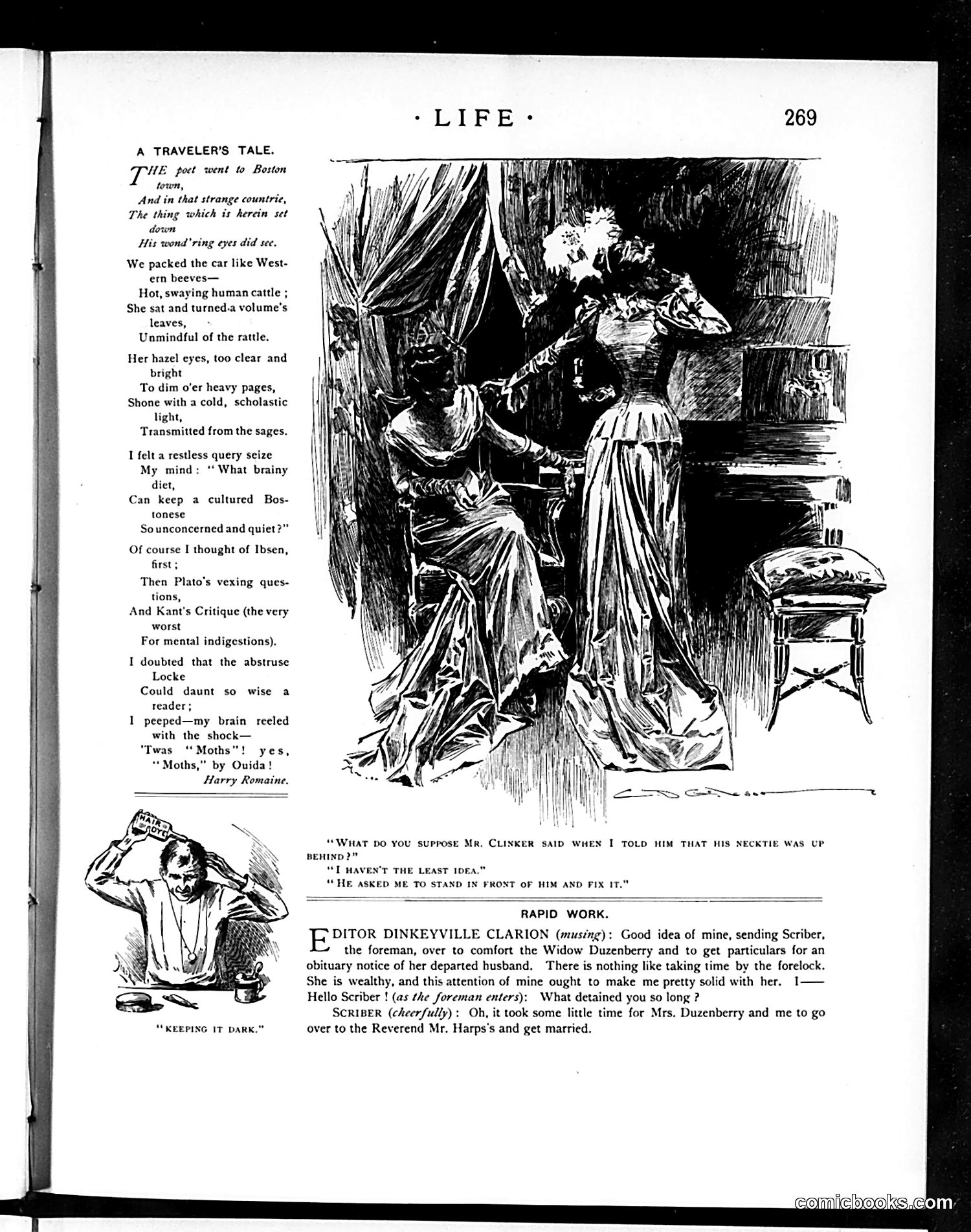
This page contains two distinct elements: **Upper section:** A poem titled "A Traveler's Tale" by Harry Romaine, describing packing a car for travel with a woman who reads heavily. The accompanying illustration shows two figures in what appears to be a bedroom or private space, with period clothing suggesting early 20th century. **Lower section:** A comedic dialogue titled "Rapid Work" involving Editor Dinkeyville Clarion, a Scriber (foreman), and discussion of comforting a "Widow Duzenberry" regarding her deceased husband. The small cartoon labeled "Keeping It Dark" shows a figure in casual dress. The humor appears to center on romantic misunderstandings and the speed of courtship/remarriage. Without additional context about specific individuals referenced, the satire seems to target small-town social conventions and gossip rather than particular political figures.
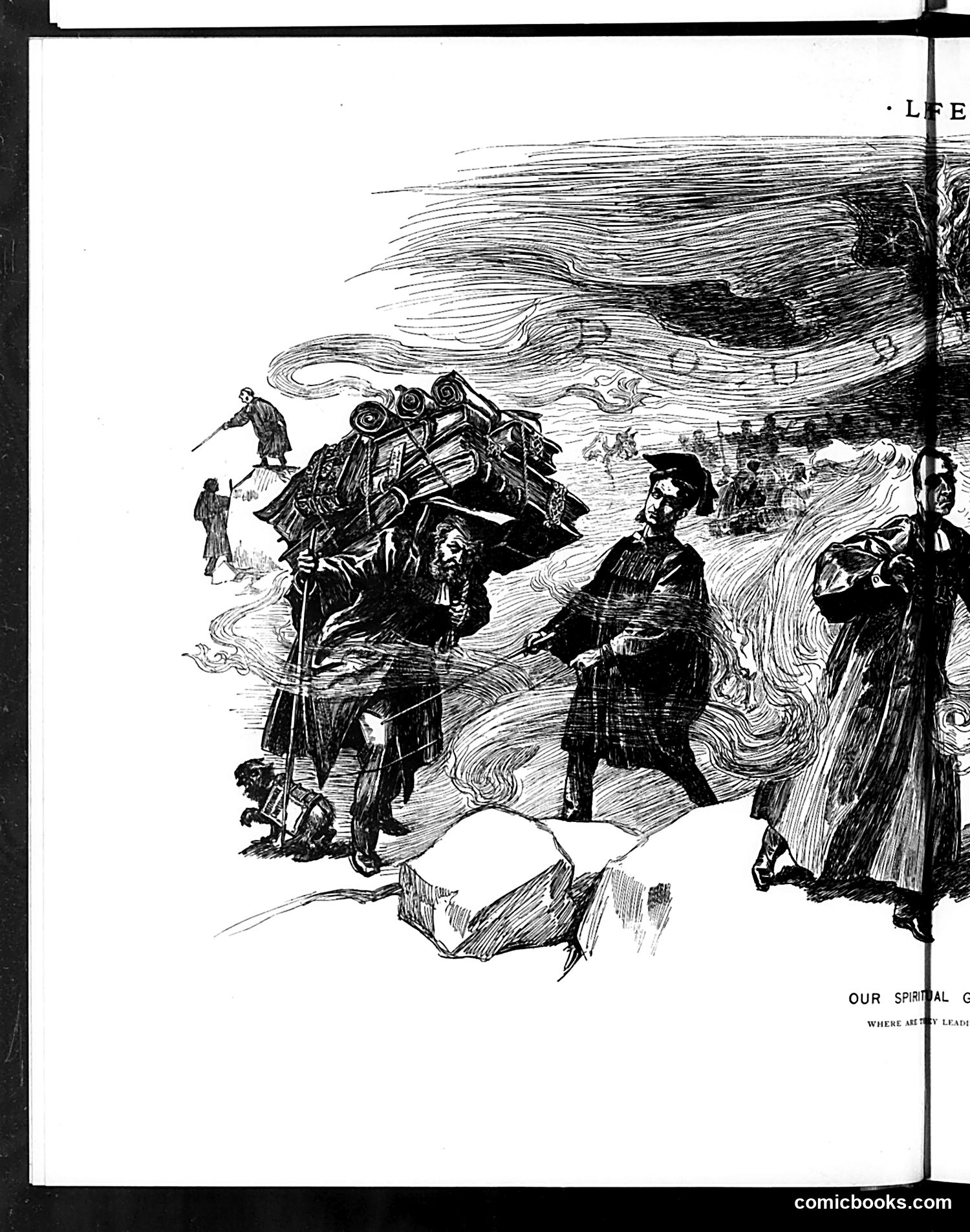
This appears to be a satirical illustration from *Life* magazine depicting a military or spiritual scene. The image shows several uniformed figures in what appears to be a dramatic moment, with elaborate linework suggesting wind or spiritual energy in the background. The partial text visible reads "OUR SPIRITUAL G[UIDE]" and "WHERE ARE THEY LEAD[ING]," suggesting political satire about military or religious leadership. The figures wear ornate military dress with decorative elements. Without complete caption text and given the magazine's satirical nature, this likely critiques the direction or wisdom of contemporary leaders—possibly military commanders or spiritual authorities—questioning where they're guiding the nation. The exact historical context and specific figures referenced remain unclear without fuller text.
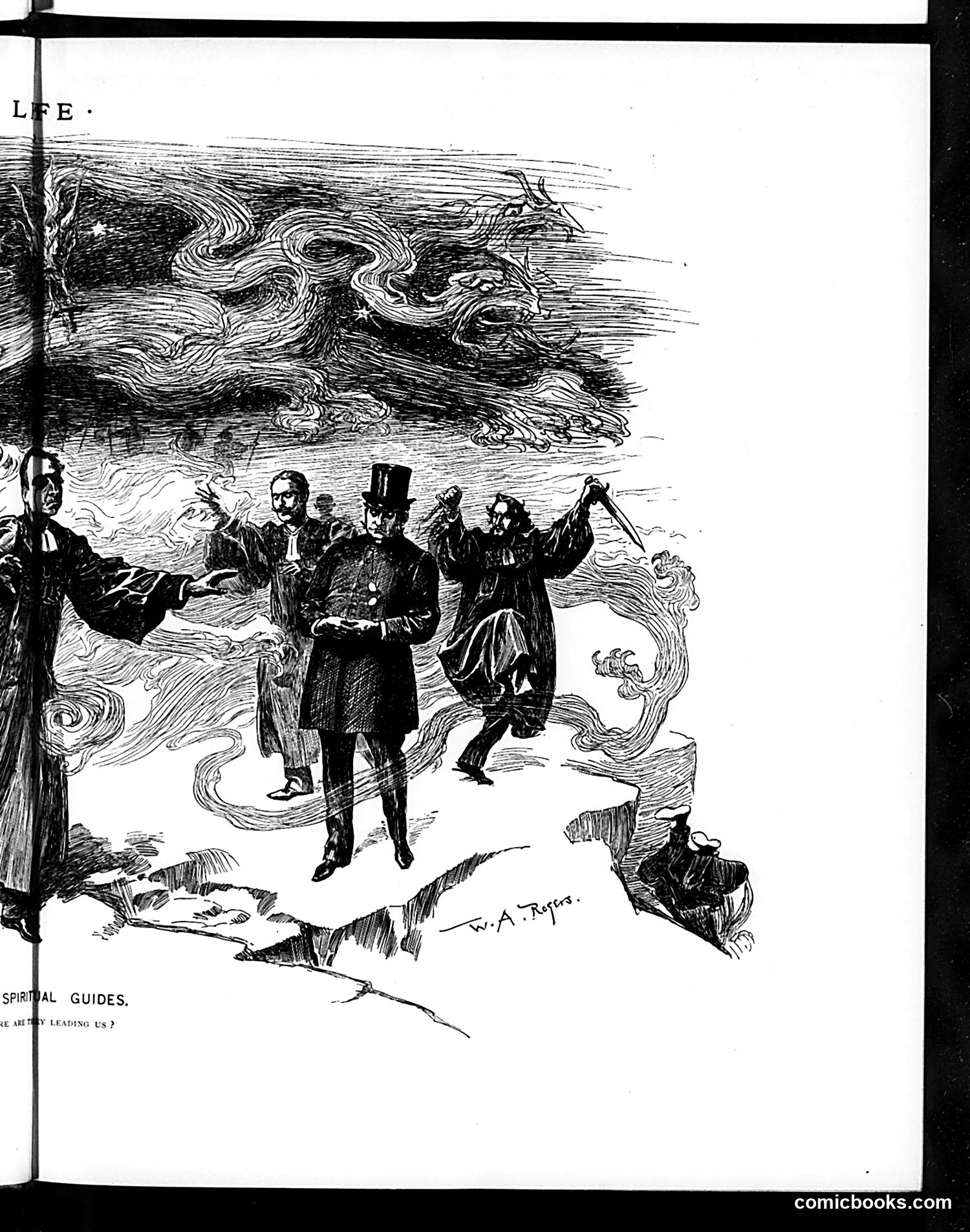
This satirical cartoon depicts five men in 19th-century formal dress (top hats and coats) gesturing animatedly in a supernatural setting. Above them looms a demonic or ghostly figure with swirling, aggressive features. The caption "SPIRITUAL GUIDES" and subtitle "THE ARTISTRY LEADING US?" suggests the cartoon mocks contemporary spiritualism—a popular movement claiming communication with the dead. The five figures appear to represent spiritualist practitioners or mediums claiming to channel supernatural guidance. The menacing apparition above implies satire: rather than connecting with benign spirits, these "guides" may actually be channeling darker, more sinister forces. The cartoon ridicules both the spiritualist movement's claims and the charlatans who profited from public fascination with the occult, suggesting their "guidance" was fraudulent or dangerously deceptive.
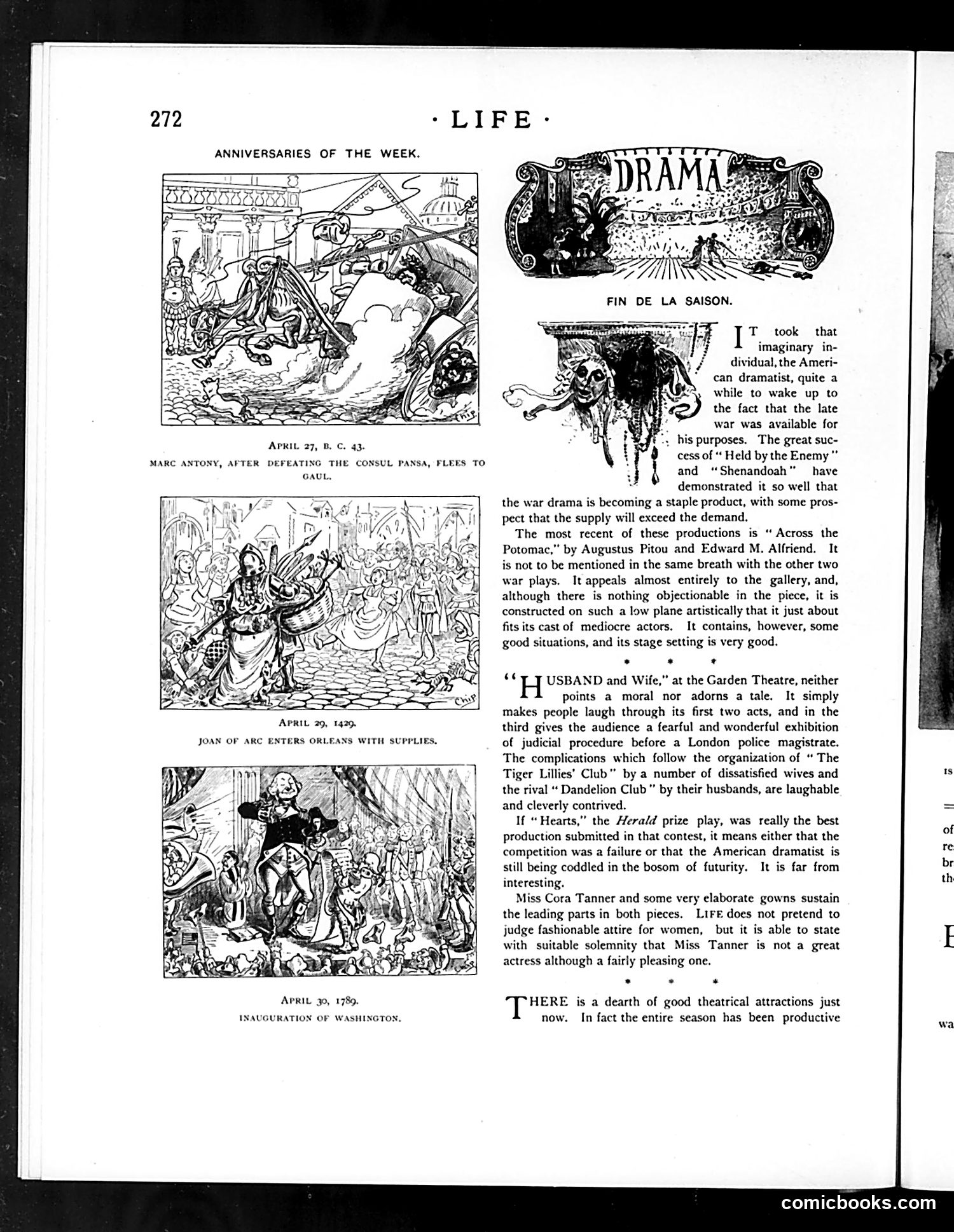
This page reviews recent theatrical productions, primarily Civil War dramas. The text criticizes "Across the Potomac" as artistically inferior pandering to audiences, while praising earlier successes like "Held by the Enemy" and "Shenandoah" that demonstrated war's theatrical potential. The left illustrations show historical anniversaries—Marc Antony's flight (April 27, 43 B.C.), Joan of Arc entering Orleans (April 29, 1429), and Washington's Inauguration (April 30, 1789)—appearing to be unrelated decorative historical engravings typical of Life's layout. The drama critique notes contemporary comedies like "Husband and Wife" entertain through plot complications about rival wives' clubs. The review dismisses the Herald prize-winning play "Hearts" as uninteresting, suggesting American dramatists receive unwarranted coddling. It concludes by criticizing actress Cora Tanner's limited talent despite her elaborate costumes, and notes the season overall lacks quality theatrical attractions.
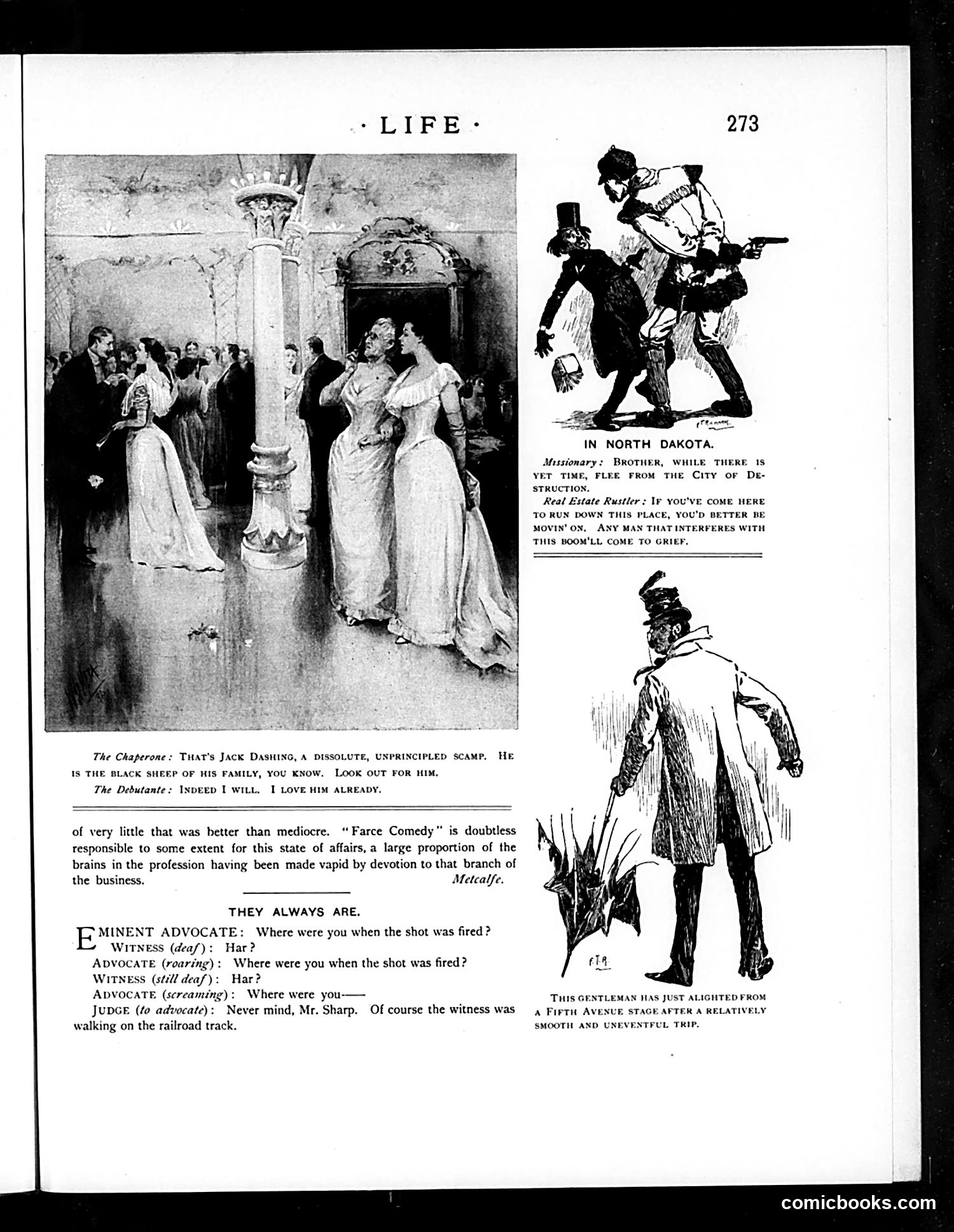
This page contains three satirical cartoons mocking different social situations: 1. **The Chaperone/Debutante cartoon** (left): A chaperone warns a young debutante about "Jack Dashing," a disreputable man, yet the debutante immediately declares her love for him—satirizing how young women ignore warnings about unsuitable suitors. 2. **The Courtroom scene** (center): An advocate repeatedly shouts questions at a deaf witness, with a judge finally accepting the absurd excuse that the witness was "walking on the railroad track"—mocking the incompetence or absurdity of legal proceedings. 3. **The North Dakota cartoon** (right): A missionary urges a man to flee a city of "destruction," but a "Real Estate Rustler" threatens him if he discourages development—satirizing how frontier boosters suppress criticism to promote town growth over moral concerns. The page critiques social pretense, legal fumbling, and commercial exploitation masquerading as progress.