
Life, 1892-04-28 · page 4 of 14
Life — April 28, 1892 — page 4: what you’re looking at
What you’re looking at
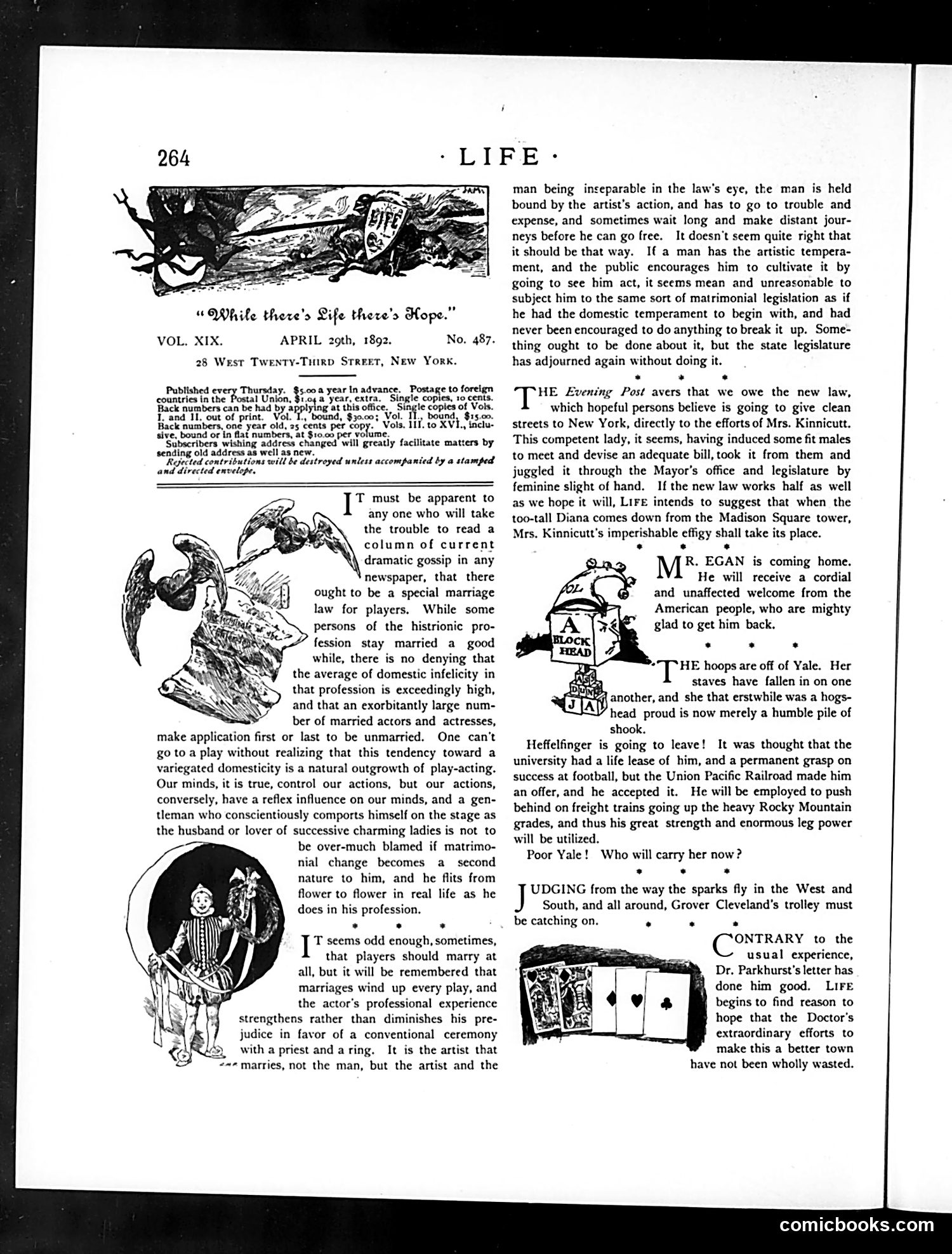
This page contains editorial commentary on several contemporary issues. The main text discusses a proposed marriage law for actors, arguing that players shouldn't be forced to marry on stage just because their characters do—such performances shouldn't carry legal weight. The illustrations appear to be decorative vignettes rather than political cartoons. One shows theatrical figures; another depicts playing cards. Additional brief items address: Mr. Egan's homecoming and American welcome; Yale's loss in athletic competition; Heifelfinger's departure for the Union Pacific Railroad; and Dr. Parkhurst's efforts to improve the town (likely referencing his anti-corruption crusade in New York City). The tone is typical of *Life*'s satirical commentary on contemporary social, legal, and cultural matters.
📄 Transcribed text from this page (OCR, searchable)
Machine-transcribed from the original scan — historical spelling and the odd misread are preserved.
“Phile there's Life there's Hope.” VOL. XIX. APRIL 29th, 1892. No. 487. 28 West Twenty-Tuirp Street, New York. Back numbers, one year eldves bens pe per sive, bound or in flat numbers, at $10.00 per v Satecribers wishing address changed will greatly facilitate matters by sending old address as well as new. Rejected contributions will be destroyed unless accompanied by a stamped and directed envelope, Published every Thurstay. $s.00a year in advance. Postage to forelgn countries in the Postal Union, $rog a year, extra. Single copies, 10 cents, Back numbers can be had by 3 piping a as tis office, Si te copies of Vols. I, and II, out of print. bound, $15.00. oy Y * Vols. Hd, to XVI. sisela: T must be apparent to any one who will take the trouble to read a column of current \\ dramatic gossip in any newspaper, that there ought to be a special marriage law for players. While some persons of the histrionic pro- fession stay married a good while, there is no denying that the average of domestic infelicity in that profession is exceedingly high, and that an exorbitantly large num- ber of married actors and actresses, make application first or last to be unmarried. One can't go to a play without realizing that this tendency toward a variegated domesticity is a natural outgrowth of play-acting. Our minds, it is true, control our actions, but our actions, conversely, have a reflex influence on our minds, and a gen- tleman who conscientiously comports himself on the stage as the husband or lover of successive charming ladies is not to be over-much blamed if matrimo- nial change becomes a_ second nature to him, and he flits from flower to flower in real life as he does in his profession, . . T seems odd enough, sometimes, that players should marry at all, but it will be remembered that marriages wind up every play, and the actor's professional experience strengthens rather than diminishes his pre- judice in favor of a conventional ceremony with a priest and a ring. It is the artist that * LIFE man being inseparable in the law's eye, the man is held bound by the artist’s action, and has to go to trouble and expense, and sometimes wait long and make distant jour- neys before he can go free. It doesn't seem quite right that it should be that way. If a man has the artistic tempera- ment, and the public encourages him to cultivate it by going to see him act, it seems mean and unreasonable to subject him to the same sort of matrimonial legislation as if he had the domestic temperament to begin with, and had never been encouraged to do anything to break it up. Some- thing ought to be done about it, but the state legislature has adjourned again without doing it. . . . HE Evening Post avers that we owe the new law, which hopeful persons believe is going to give clean streets to New York, directly to the efforts of Mrs. Kinnicutt. This competent lady, it seems, having induced some fit males to meet and devise an adequate bill, took it from them and juggled it through the Mayor's office and legislature by feminine slight of hand. If the new law works half as well as we hope it will, LiFe intends to suggest that when the too-tall Diana comes down from the Madison Square tower, Mrs. Kinnicutt’s imperishable effigy shall take its place. * . *. R. EGAN is coming home. He will receive a cordial and unaffected welcome from the American people, who are mighty glad to ” him back. * “qe i are off of Yale. Her staves have fallen in on one > another, and she that erstwhile was a hogs- head proud is now merely a humble pile of shook. Heffelfinger is going to leave! It was thought that the university had a life lease of him, and a permanent grasp on success at football, but the Union Pacific Railroad made him an offer, and he accepted it. He will be employed to push behind on freight trains going up the heavy Rocky Mountain grades, and thus his great strength and enormous leg power will be utilized, Poor Yale! Who will carry her now? . . . UDGING from the way the sparks fly in the West and South, and all around, Grover Cleveland’s trolley must be catching on. . ONTRARY to the usual experience, Dr. Parkhurst’s letter has done him good. LIFE begins to find reason to hope that the Doctor's extraordinary efforts to make this a better town have not been wholly wasted. comicbooks.com