
Life, 1892-04-28 · page 8 of 14
Life — April 28, 1892 — page 8: what you’re looking at
What you’re looking at
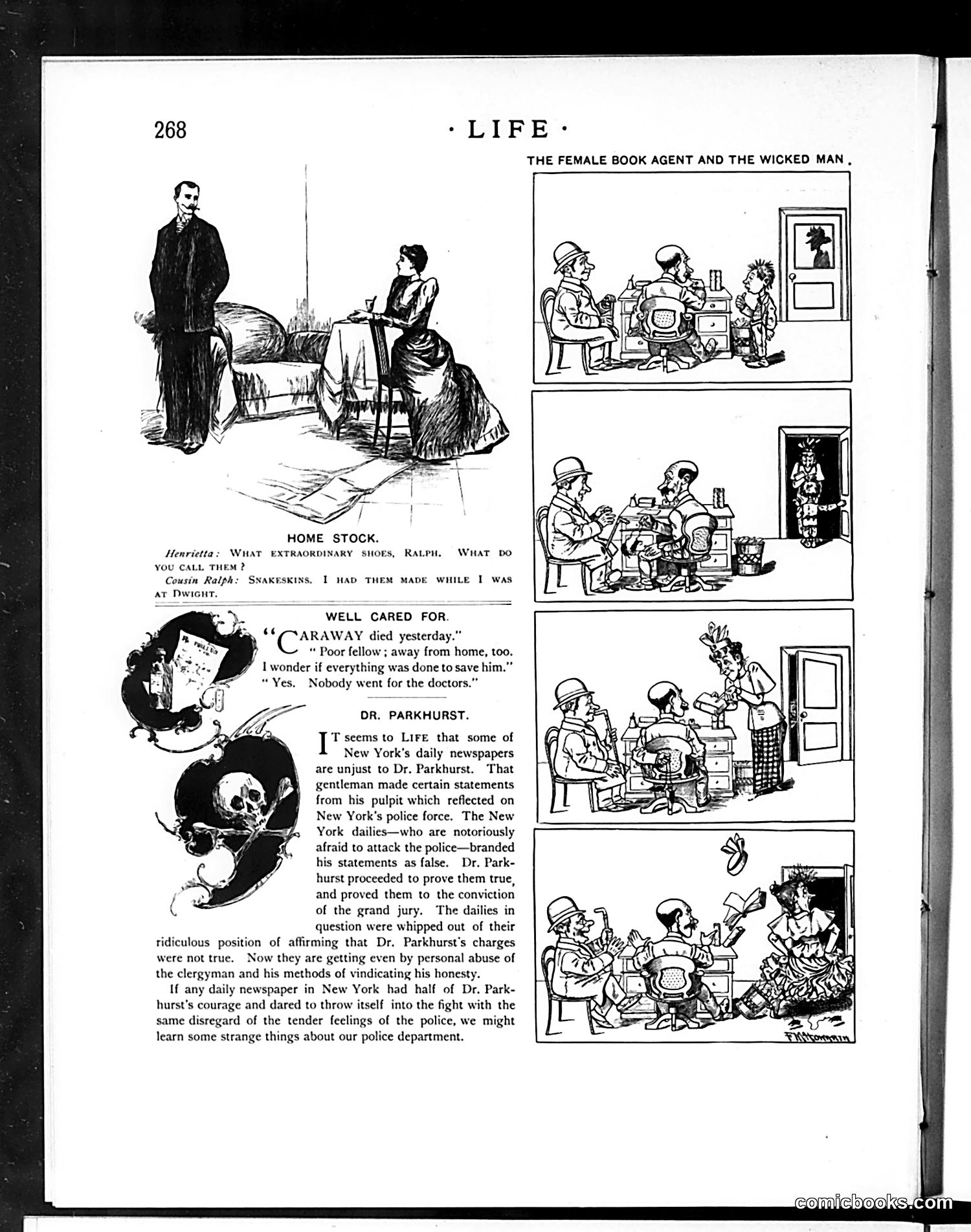
**Top Section ("Home Stock"):** A man and woman at a desk discuss extraordinary shoes called "Snakeskins," made while he was away. The joke satirizes improbable domestic excuses. **"Well Cared For":** A brief dialogue about someone named Caraway who died away from home without medical attention. **"Dr. Parkhurst" (Main Editorial):** This is the page's substantive content. The text criticizes Dr. Parkhurst, apparently a public figure who made claims about New York's police force that newspapers disputed. The article praises Parkhurst's courage in challenging police misconduct while condemning newspapers for attacking him rather than supporting reform. The right-side comic strip shows what appears to be children's interactions, possibly illustrating domestic or moral themes. The page combines light humor with serious social commentary about police accountability and journalistic integrity in early 20th-century New York.
📄 Transcribed text from this page (OCR, searchable)
Machine-transcribed from the original scan — historical spelling and the odd misread are preserved.
* LIFE: THE FEMALE BOOK AGENT AND THE WICKED MAN , HOME STOCK. Henrietta: WWAT EXTRAORDINARY SHOES, RALPH, WHAT DO YOU CALL THEM ? Cousin Ralph: SNAKESKINS. I HAD THEM MADE WHILE I was ar Dwicht. WELL CARED FOR. . » CARAWAY died yesterday.” “ Poor fellow ; away from home, too. I wonder if everything was done to save him.” “Yes, Nobody went for the doctors.”” OR. PARKHURST. T seems to Lire that some of New York's daily newspapers are unjust to Dr. Parkhurst. That gentleman made certain statements from his pulpit which reflected on New York's police force. The New York dailies—who are notoriously afraid to attack the police—branded his statements as false. Dr. Park- hurst proceeded to prove them true, and proved them to the conviction of the grand jury, The dailies in question were whipped out of their ridiculous position of affirming that Dr. Parkhurst’s charges were not true. Now they are getting even by personal abuse of the clergyman and his methods of vindicating his honesty. If any daily newspaper in New York had half of Dr. Park- hurst's courage and dared to throw itself into the fight with the same disregard of the tender feelings of the police, we might learn some strange things about our police department.