
Life, 1892-04-28 · page 6 of 14
Life — April 28, 1892 — page 6: what you’re looking at
What you’re looking at
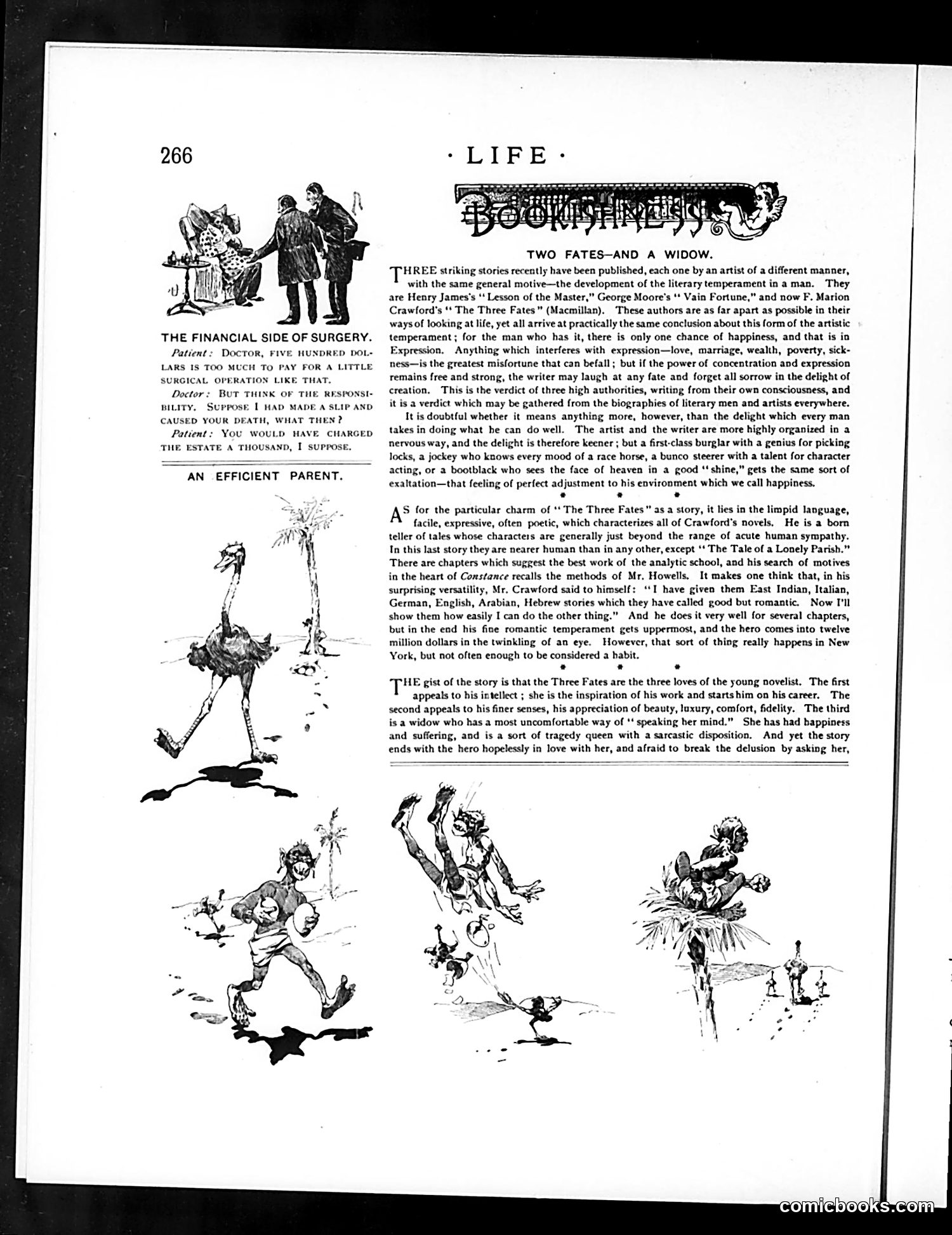
This page contains book reviews rather than political cartoons. The main content discusses F. Marion Crawford's novel "The Three Fates" (Macmillan), comparing it with works by Henry James and George Moore. The illustrated vignettes (small cartoon sketches) appearing throughout appear to be decorative accompaniments to the literary discussion, depicting scenes of social interaction and human drama rather than making specific political commentary. The review emphasizes Crawford's ability to write about artistic temperament and human psychology, noting his talent for depicting characters "just beyond the range of usual human sympathy." The text suggests the novel concerns three women who influence a young novelist's life and career choices. No clear political satire or topical references are evident on this page—it functions primarily as cultural criticism for an educated readership.
📄 Transcribed text from this page (OCR, searchable)
Machine-transcribed from the original scan — historical spelling and the odd misread are preserved.
THE FINANCIAL SIDE OF SURGERY. Patient; Doctor, FIVE HUNDRED DOL+ LARS IS TOO MUCH TO PAY FOR A LITTLE SURGICAL OPERATION LIKE THAT, Doctor BUT THINK OF THE RESPONSI- BILITY, SUPPOSE I HAD MADE A SLIP AND CAUSED YOUR DEATH, WHAT THEN? Patient: YOU WOULD HAVE CHARGED THE ESTATE A THOUSAND, I SUPPOSE, AN EFFICIENT PARENT. TWO FATES—AND A WIDOW. tis REE striking stories recently have been published, each one by an artist of a different manner, with the same general motive—the development of the literary temperament ina man. They are Henry James's ‘ Lesson of the Master,” George Moore's ** Vain Fortune,” and now F. Marion Crawford's ‘* The Three Fates” (Macmillan), ‘These authors are as far apart as possible in their ways of looking at life, yet all arrive at practically the same conclusion about this form of the artistic temperament; for the man who has it, there is only one chance of happiness, and that is io Expression, Anything which interferes with expression—love, marriage, wealth, poverty, sick- ness—is the greatest misfortune that can befall; but if the power of concentration and expression remains free and strong, the writer may laugh at any fate and forget all sorrow in the delight of creation, This is the verdict of three high authorities, writing from their own consciousness, and it is a verdict which may be gathered from the biographies of literary men and artists everywhere. It is doubtful whether it means anything more, however, than the delight which every man takes in doing what he can do well. The artist and the writer are more highly organized in a nervous way, and the delight is therefore keener ; but a first-class burglar with a genius for picking locks, a jockey who knows every mood of a race horse, a bunco steerer with a talent for character acting, or a bootblack who sees the face of heaven in a good ‘‘shine,” gets the same sort of exaltation—that feeling of perfect adjustment to his environment which we call happiness, « * . AS for the particular charm of ** The Three Fates" as a story, it lies in the limpid language, facile, expressive, often poetic, which characterizes all of Crawford's novels, He is a born teller of tales whose characters are generally just beyond the range of acute human sympathy. In this last story they are nearer human than in any other, except ‘¢ The Tale of a Lonely Parish.” There are chapters which suggest the best work of the analytic school, and his search of motives in the heart of Constance recalls the methods of Mr. Howells, It makes one think that, in his surprising versatility, Mr. Crawford said to himself: “I have given them East Indian, Italian, German, English, Arabian, Hebrew stories which they have called good but romantic. Now I'll show them how easily I can do the other thing.” And he does it very well for several chapters, but in the end his fine romantic temperament gets uppermost, and the hero comes into twelve million dollars in the twinkling of an eye. However, that sort of thing really happens in New York, but not often enough to be considered a habit. * * . THE sist of the story is that the Three Fates are the three loves of the young novelist. The first appeals to his intellect ; she is the inspiration of his work and starts him on his career. The second appeals to his finer senses, his appreciation of beauty, luxury, comfort, fidelity. The third is a widow who has a most uncomfortable way of ** speaking her mind.” She has had bappiness and suffering, and is a sort of tragedy queen with a sarcastic disposition. And yet the story ends with the hero hopelessly in love with her, and afraid to break the delusion by asking her,