
A complete issue · 18 pages · 1892
Life — March 31, 1892
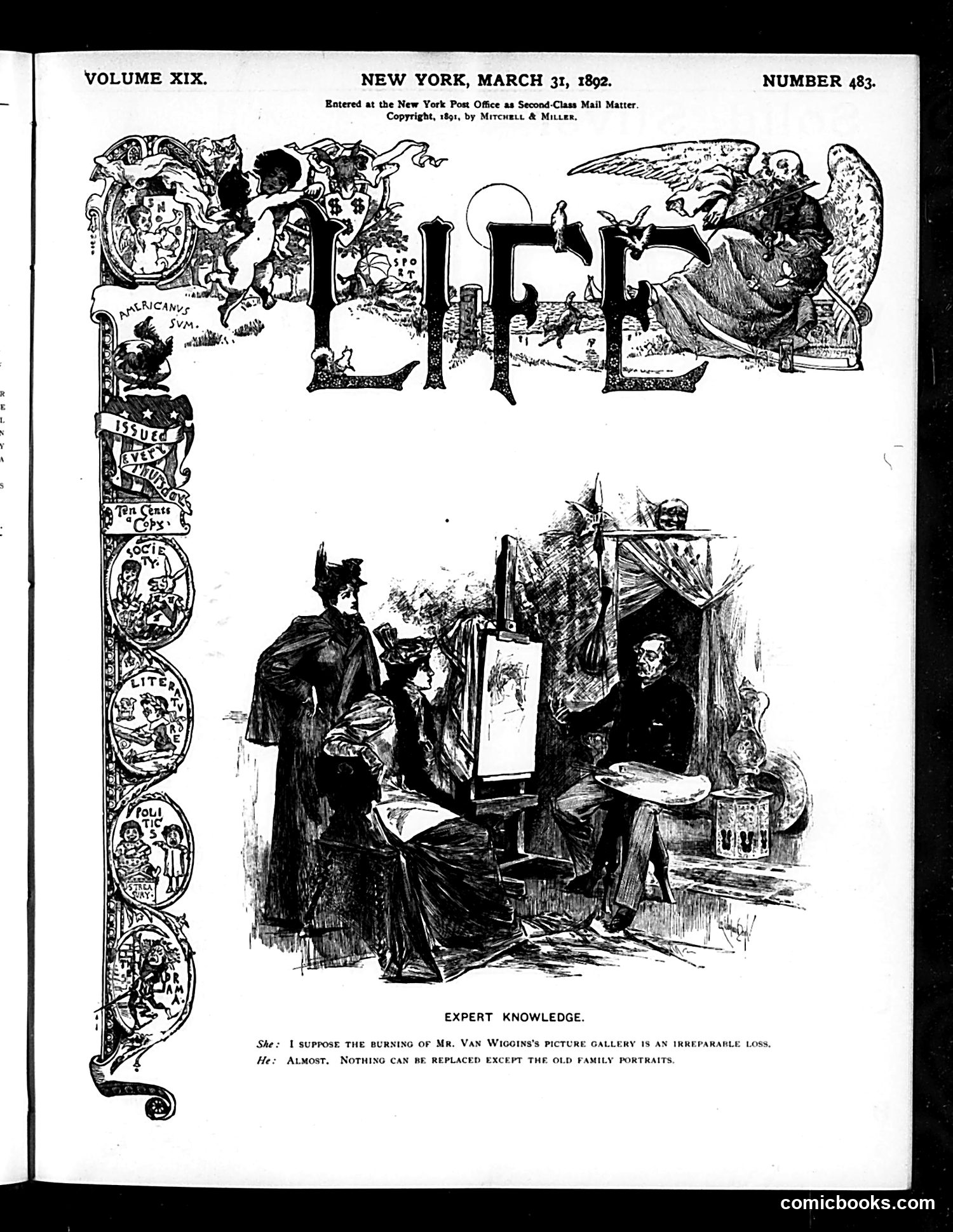
This page contains a single cartoon titled "Expert Knowledge." It depicts two figures examining an artwork in what appears to be a gallery or studio setting. The dialogue suggests they're discussing the loss of a valuable painting collection: **She**: "I suppose the burning of Mr. Van Wiggins's picture gallery is an irreparable loss." **He**: "Almost. Nothing can be replaced except the old family portraits." The satire targets wealthy collectors and insurance fraud. The joke implies that Van Wiggins's old family portraits are worthless, so they're easily replaceable—suggesting the valuable paintings were destroyed intentionally for insurance money. The cartoon mocks both the pretension of wealthy art collectors and the suspicion of deliberate arson for financial gain, a concern that would have resonated with Gilded Age readers aware of such scandals.
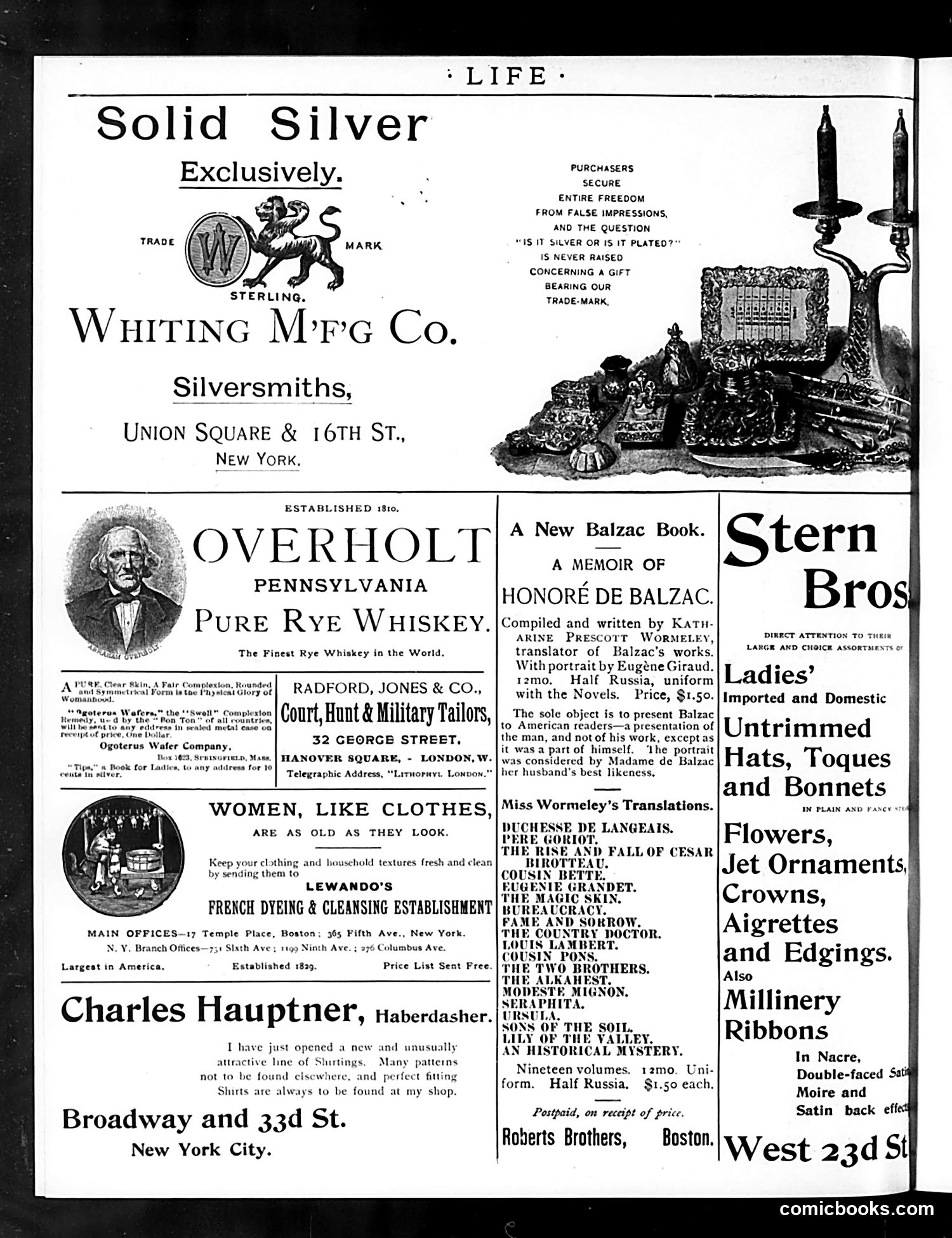
This page is **primarily advertising**, not political satire or editorial content. It consists of period commercial advertisements for: - **Whiting Mfg Co.** (sterling silver goods, NYC) - **Overholt Pennsylvania Pure Rye Whiskey** - **Radford, Jones & Co.** (tailors, London) - **Lewando's French Dyeing & Cleansing** (Boston/NYC) - **Charles Hauptner** (shirting/haberdashery, NYC) - **Stern Bros** (millinery and ribbons, NYC) - **Roberts Brothers** (publishers, Boston, advertising a Balzac memoir) The only visual elements are product illustrations and small decorative vignettes typical of late 19th/early 20th-century magazine advertising. There are no political cartoons, caricatures of public figures, or satirical commentary visible on this page.
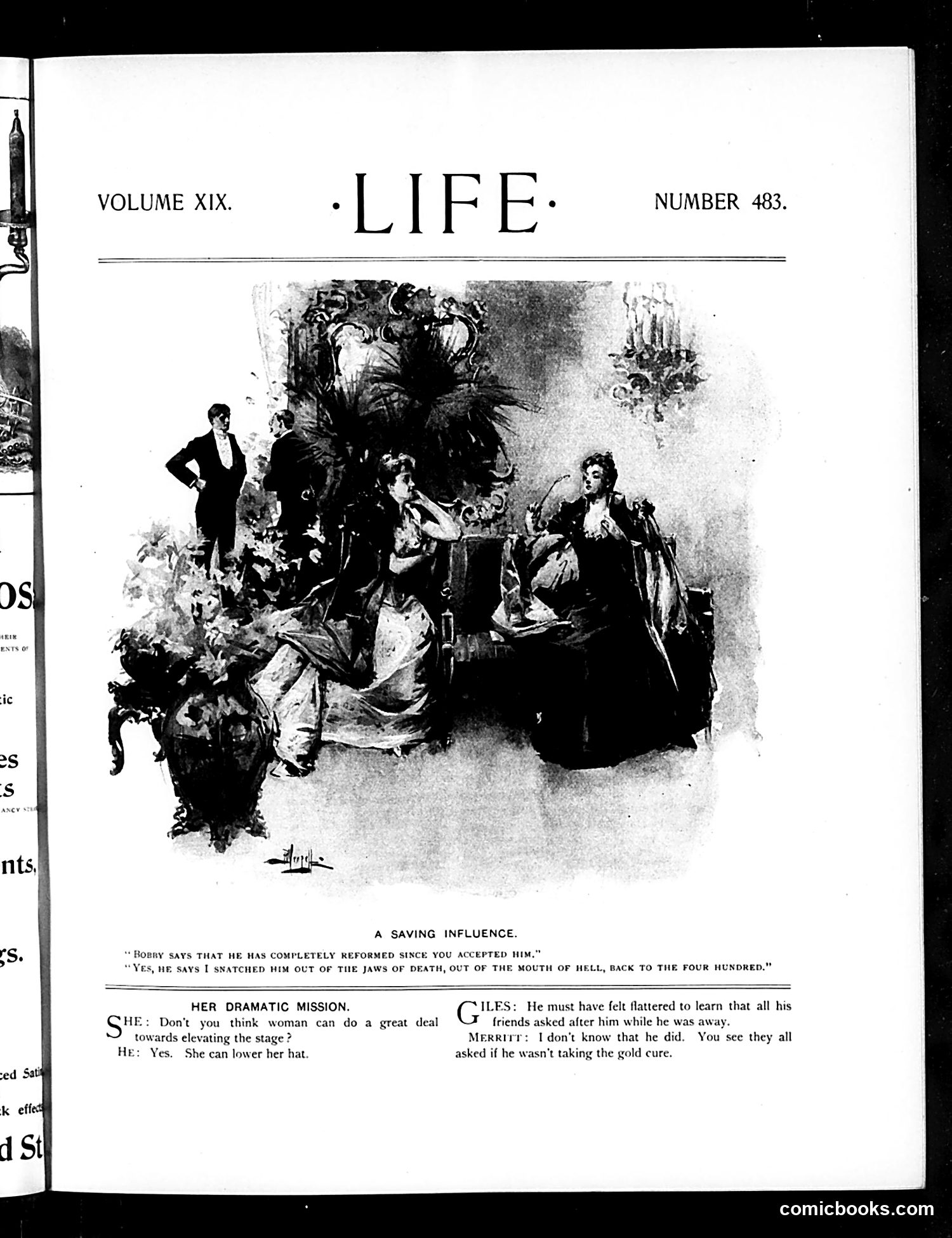
This page features a satirical illustration titled "A Saving Influence" with accompanying dialogue. The cartoon depicts an elegant social scene with well-dressed figures in what appears to be a drawing room, with ornate decorative elements. The dialogue concerns a woman's reformative impact on a man. One speaker notes the man "completely reformed since you accepted him," while another references saving him "out of the jaws of death, out of the mouth of hell, back to the four hundred"—suggesting rescue from disreputable circumstances into high society. The secondary dialogue, "Her Dramatic Mission," jokes that a woman can elevate the stage by "lowering her hat," a period-typical reference to women's elaborate headwear that obstructed theater audiences' views. The satire targets both social climbing and gender dynamics of the era.
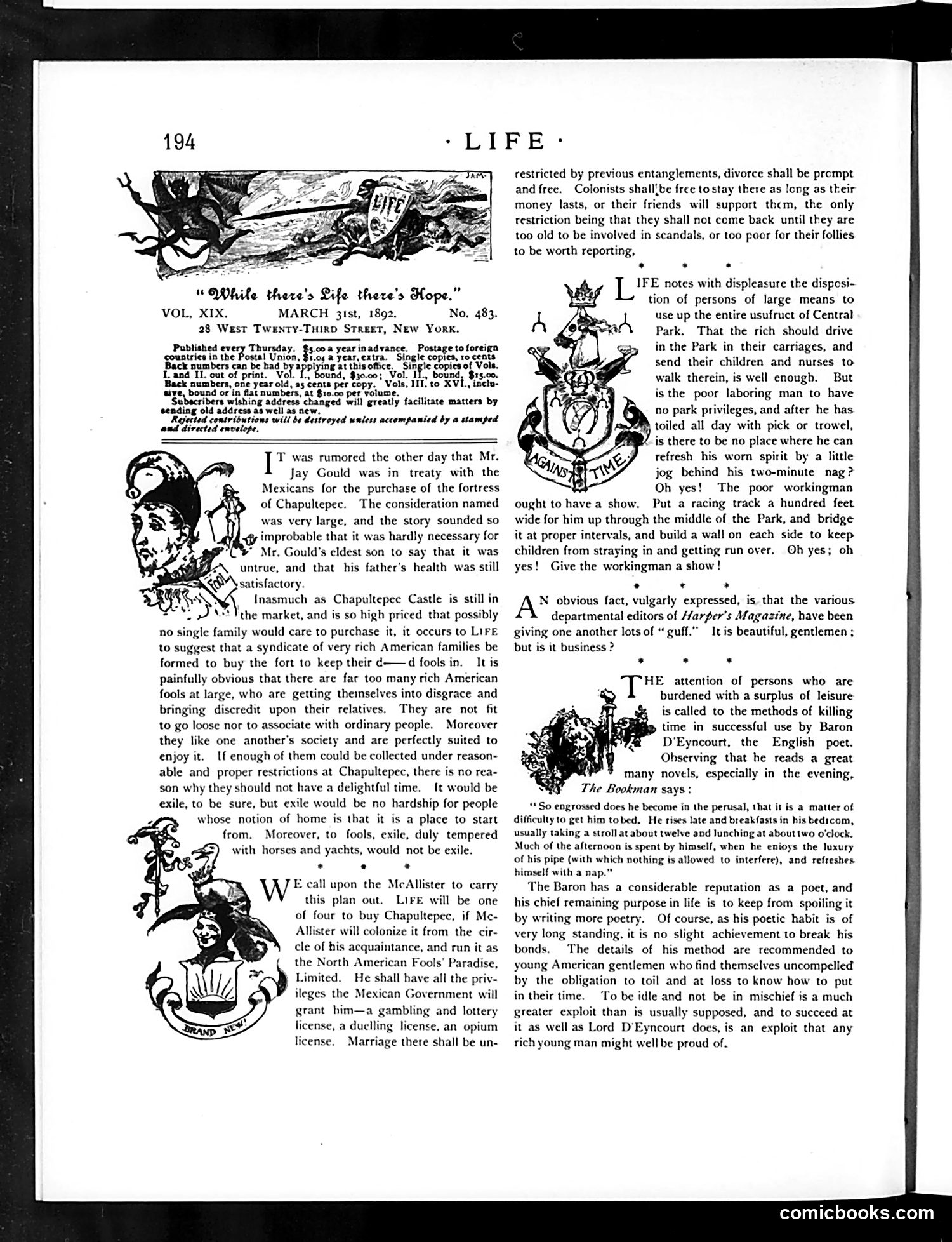
This page contains satirical editorial pieces rather than political cartoons. The main topics include: 1. **Chapultepec Castle purchase**: The text mocks a rumored plan for wealthy Americans to buy Mexico's famous fortress as a private residence, calling it foolish and critiquing the growing financial dominance of American wealth. 2. **Central Park access**: LIFE satirizes wealthy New Yorkers monopolizing Central Park with carriages and private use while working-class laborers have no recreational space after exhausting labor. 3. **Baron D'Eyncourt**: A brief piece praising the English poet's method of combating idleness through productive reading and writing habits. The magazine uses sharp social criticism to highlight class inequalities and mock wealthy American pretensions of the Gilded Age.
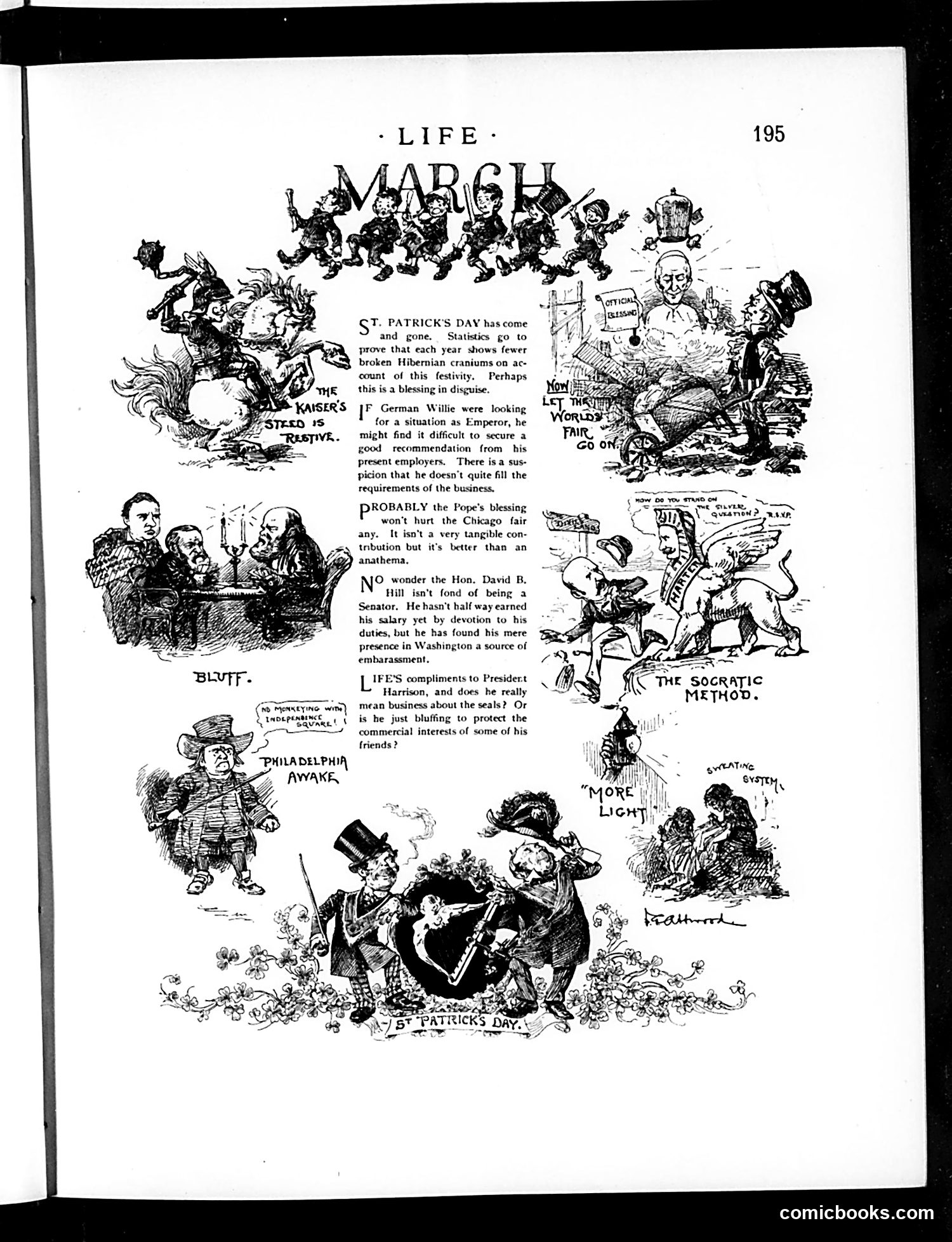
This page satirizes March 1891 American politics and society through multiple cartoons: **"The Kaiser's Stixed is Delivel"** mocks German Emperor Wilhelm II seeking an honest job recommendation—suggesting he lacks qualifications despite his status. **"Bluff"** appears to depict a political confrontation or negotiation scene. **"Philadelphia Awake"** shows a figure in Western attire, likely commenting on Philadelphia politics or business. **"The Socratic Method"** and **"More Light"** cartoons reference philosophical approaches to problems, possibly mocking political discourse. The central **St. Patrick's Day** illustration satirizes the holiday's celebration while the surrounding text critiques various political figures—including Senator David B. Hill and President Harrison—for their questionable motivations and self-serving behavior in politics and business.
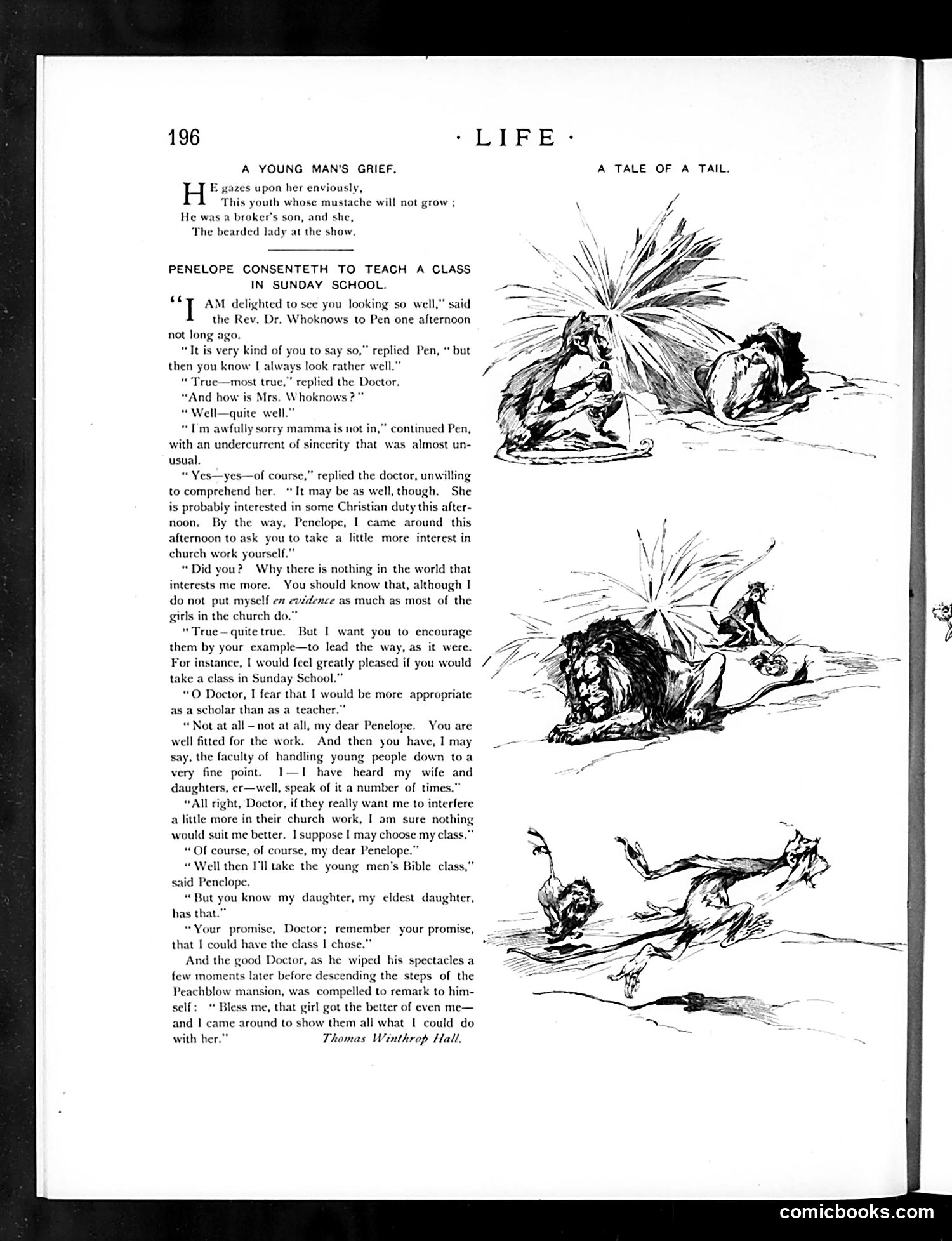
The page contains two sections: **Left side**: A prose piece titled "Penelope Consenteth to Teach a Class in Sunday School" depicts a dialogue between Rev. Dr. Whoknowns and Pen (Penelope), wherein the Doctor persuades her to lead a young men's Bible class. The humor relies on Penelope's reluctance being overcome through the Doctor's flattery about her abilities with "young people." **Right side**: "A Tale of a Tail" consists of three sequential ink sketches depicting what appears to be an animal (possibly a dog or fox) interacting with its tail in comedic poses—jumping, twisting, and playing with it. The humor is visual slapstick rather than political satire. Neither section contains identifiable caricatures of specific public figures or contemporary political references. This appears to be general-interest humor typical of early 20th-century Life magazine.
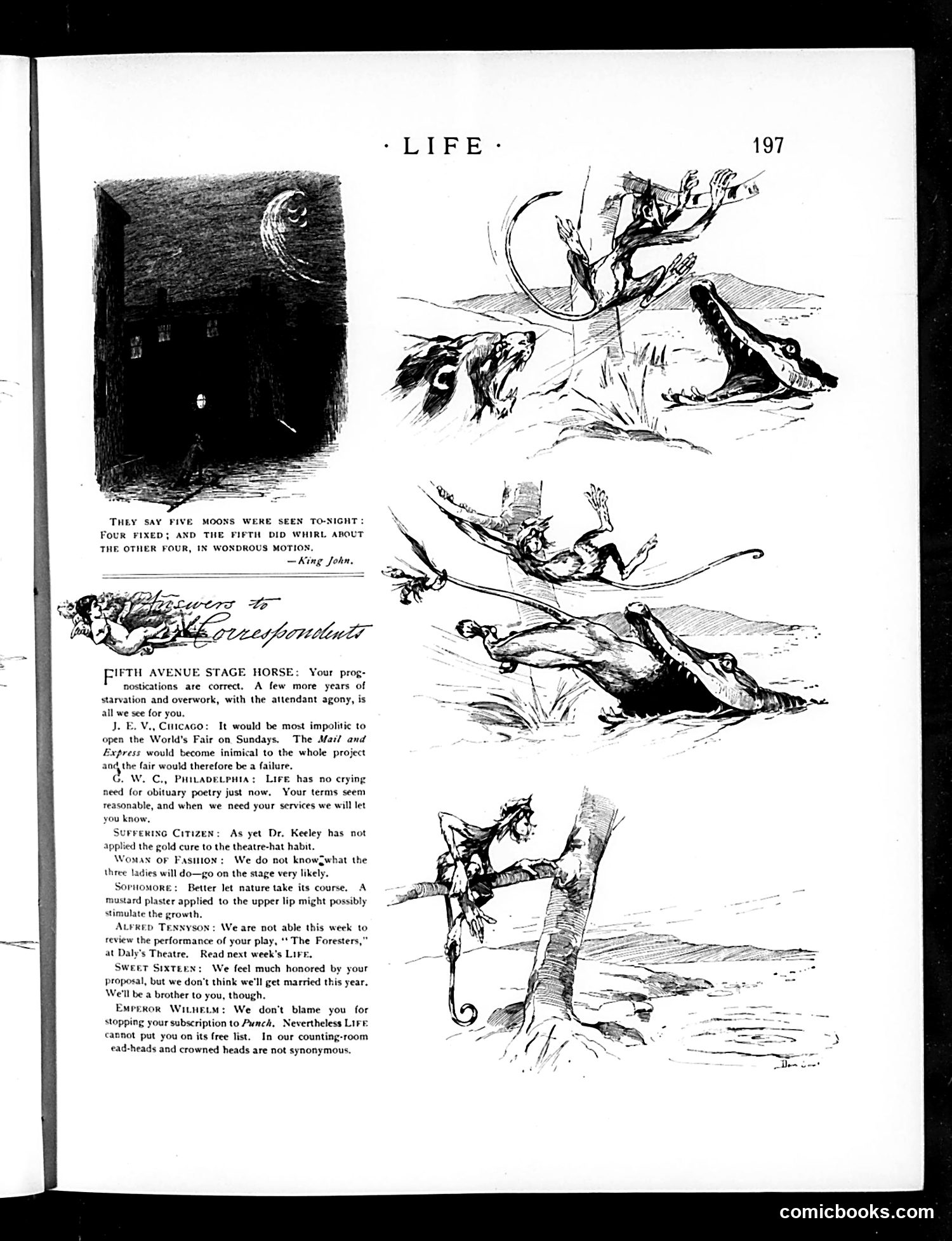
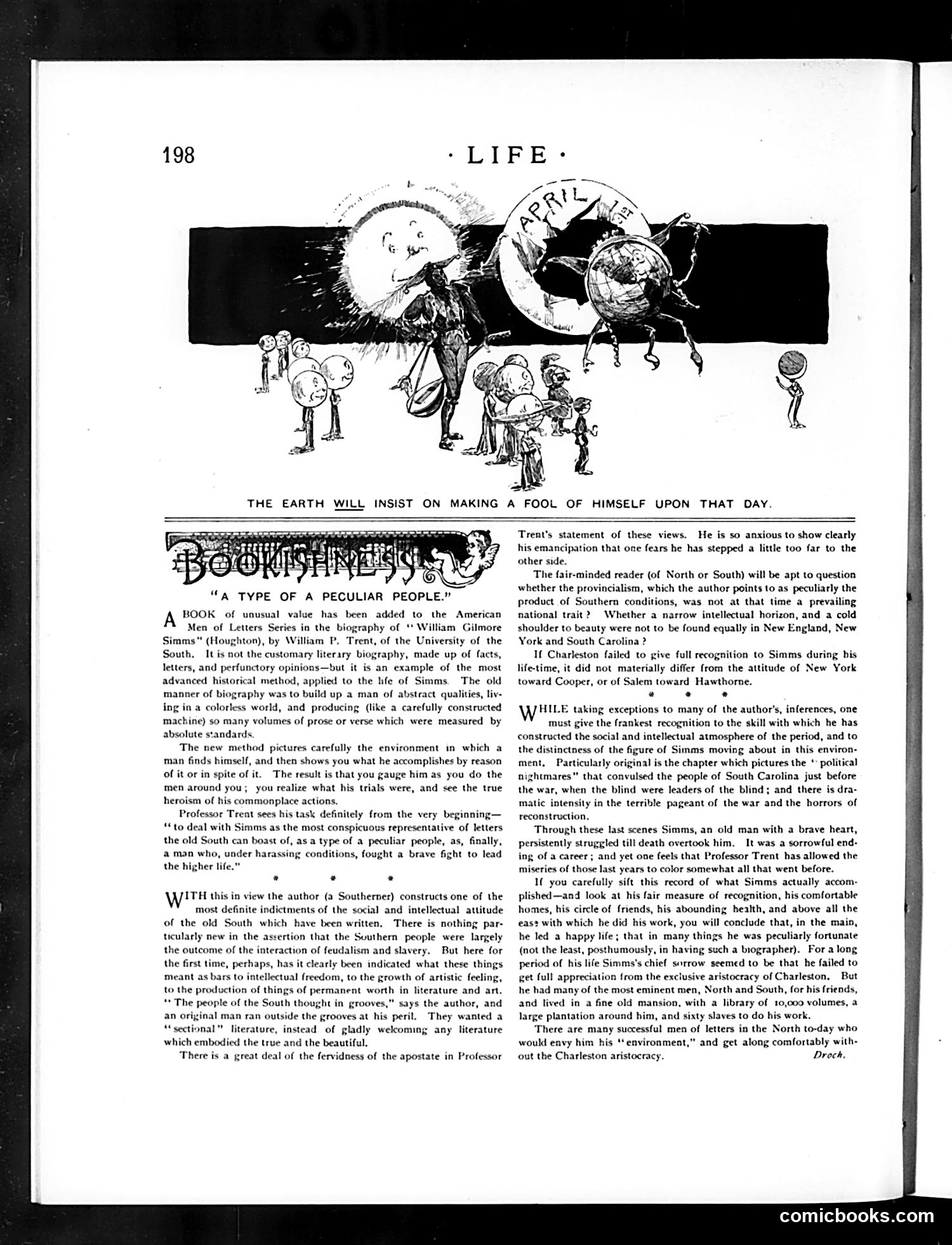
The top illustration depicts April Fools' Day, showing the Earth as a fool making itself ridiculous before small human figures. The caption states "THE EARTH WILL INSIST ON MAKING A FOOL OF HIMSELF UPON THAT DAY." Below is a book review of William Gilmore Simms's biography by William P. Trent. The text discusses Simms as a Southern literary figure, noting the author's efforts to portray the South's intellectual contributions despite regional provincialism and the legacy of slavery. The review examines Simms's life within the context of antebellum Southern society, his struggles for literary recognition, and his eventual comfortable life on a plantation. The reviewer praises the work's fair assessment of a significant but underappreciated American author.
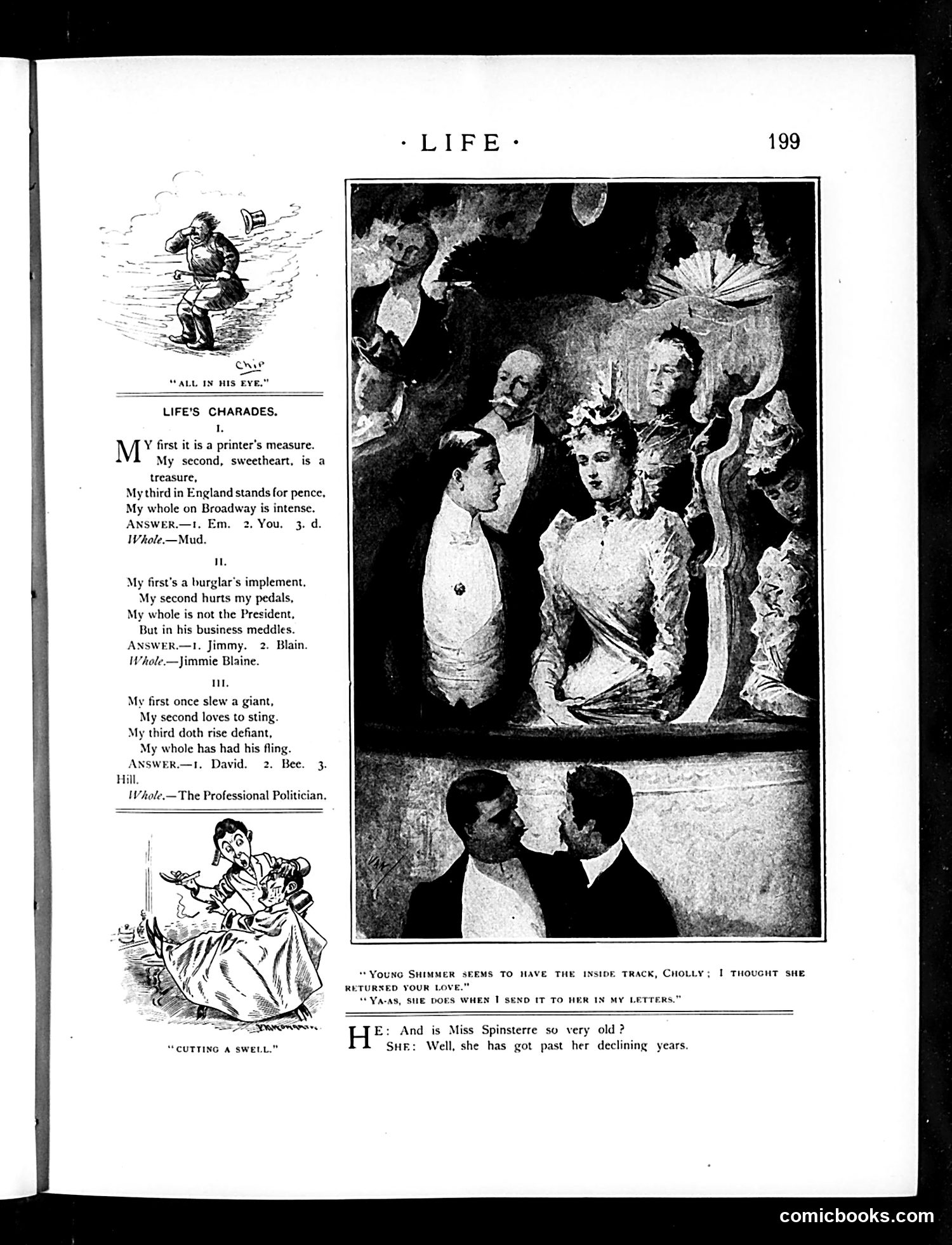
This page contains **"Life's Charades"**—riddle-style wordplay puzzles common to the era. The three charades use fragmented clues to describe things: 1. A printer's measure, sweetheart, and fence = "INTENSE" 2. A butcher's tool, something that hurts pedals, and relates to the President = "JIMMY" (likely President Jimmy Carter-era reference) 3. References to slaying a giant, stinging, and defiance = "DAVID" The accompanying sketches and photographs (including one labeled "Cutting a Swell") illustrate theatrical or social scenes typical of Life's satirical humor. The final dialogue joke mocks aging: when asked if Miss Spinsterre is old, the response is she's "got past her declining years"—dark humor about female aging and unmarriageability. These represent common early 20th-century magazine entertainments mixing wordplay with social satire.
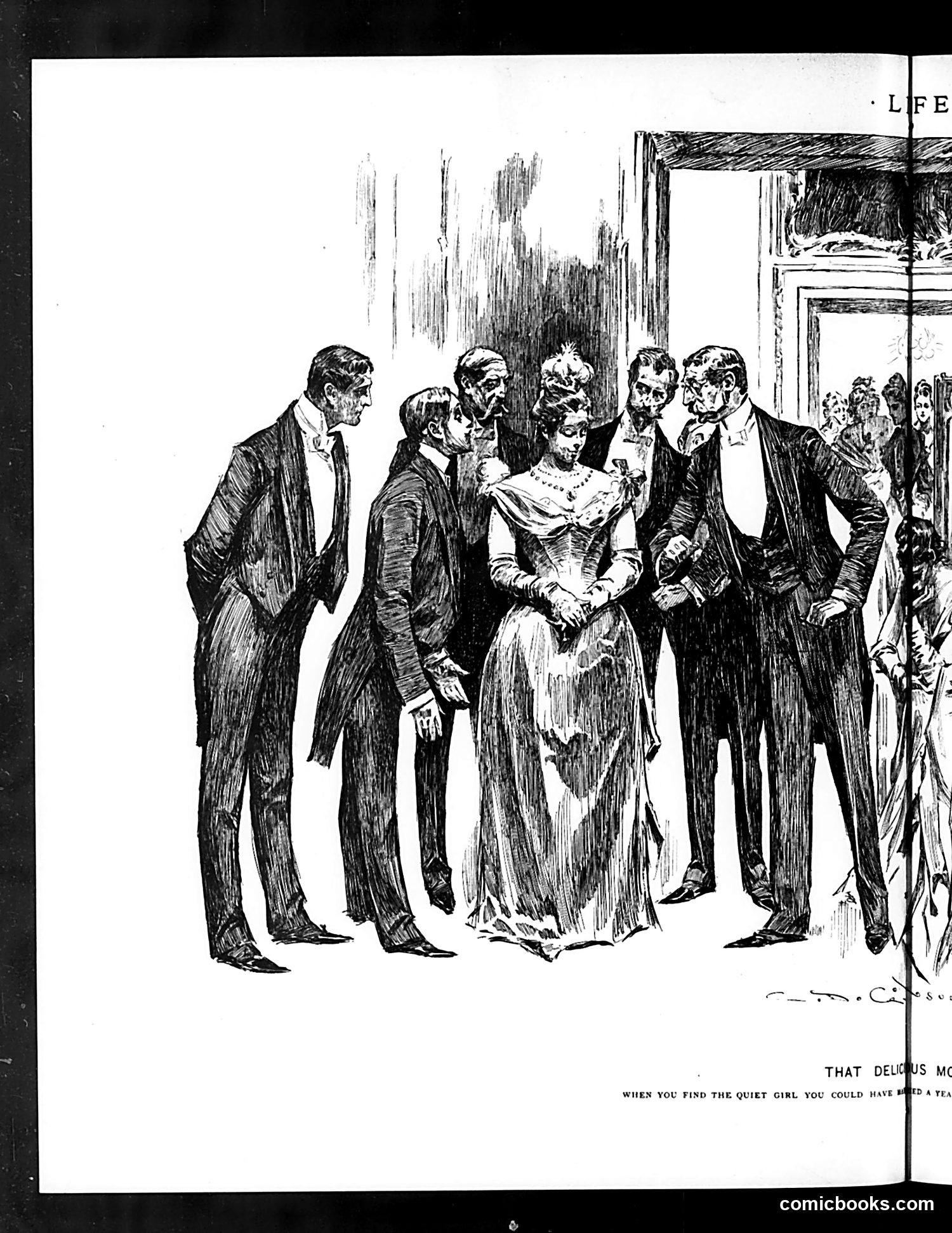
This is a satirical illustration from *Life* magazine showing a social gathering with five men in formal evening wear surrounding a single woman in an elaborate gown. The visible caption reads: "WHEN YOU FIND THE QUIET GIRL YOU COULD HAVE FOUND A YEA[R]..." The cartoon satirizes the social dynamics of courtship and marriage in what appears to be the Gilded Age or early 20th century. The joke suggests that men overlook quiet, modest women until they're no longer available—implying regret or missed opportunity. The woman is positioned as the focal point of male attention, highlighting how women's value in society was measured by romantic desirability. The formal setting and dress indicate upper-class social conventions being mocked for their superficiality regarding female character.
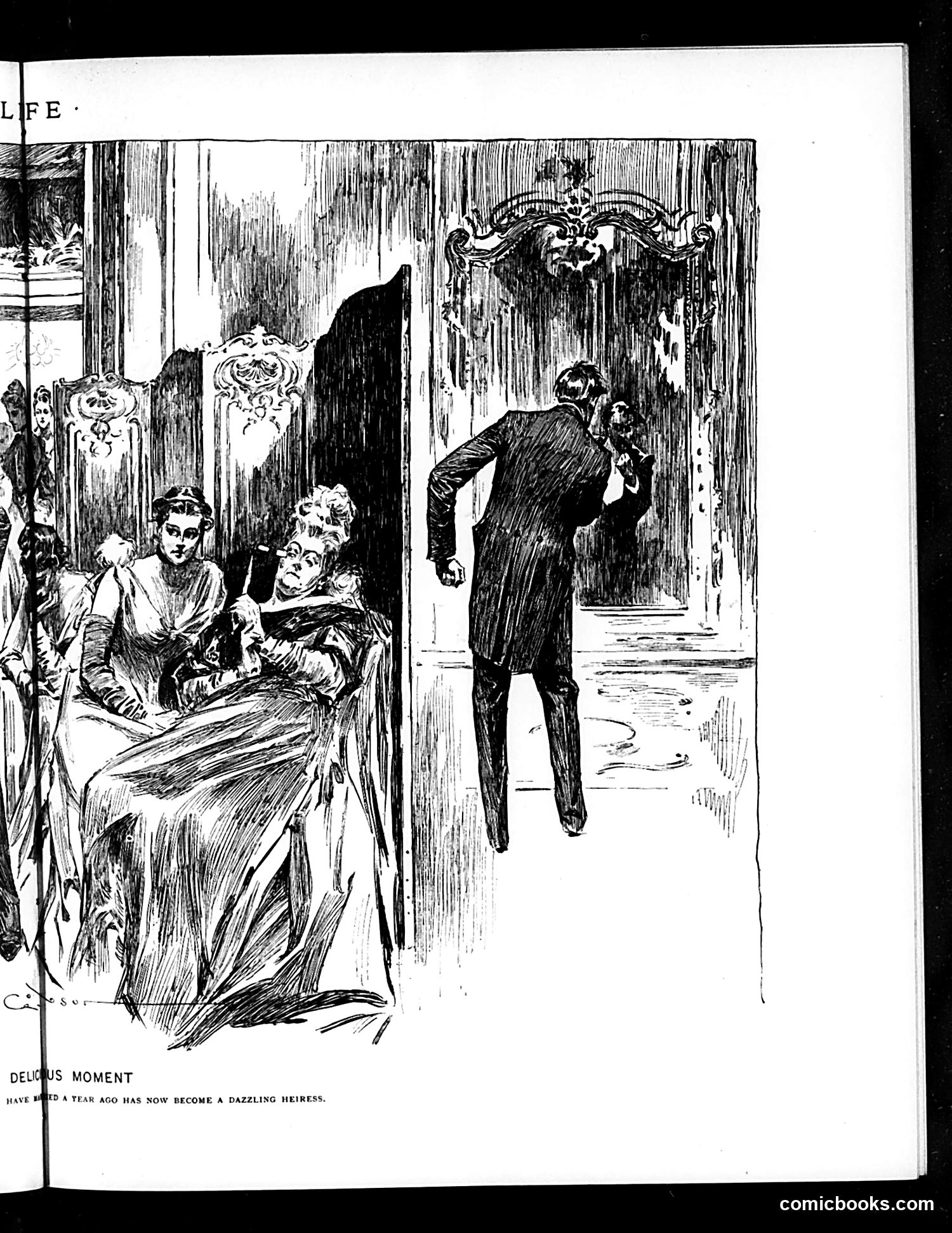
This cartoon depicts a comedic scene of social anxiety about wealth and status. On the left, a woman in an ornate interior—likely newly wealthy—sits nervously with companions. On the right, a man in formal dress rushes away, appearing flustered or embarrassed. The caption reads: "Have lived a year ago has now become a dazzling heiress." The satire targets the social awkwardness of sudden wealth. The "delicious moment" refers to the ironic humor of watching someone of humble origins (from "a year ago") now elevated to heiress status, and the awkward social dynamics this creates. The rushing figure suggests discomfort—perhaps from a former acquaintance now confronted with this dramatic social reversal. The joke mocks both new money's pretensions and society's snobbish reactions to social climbing.
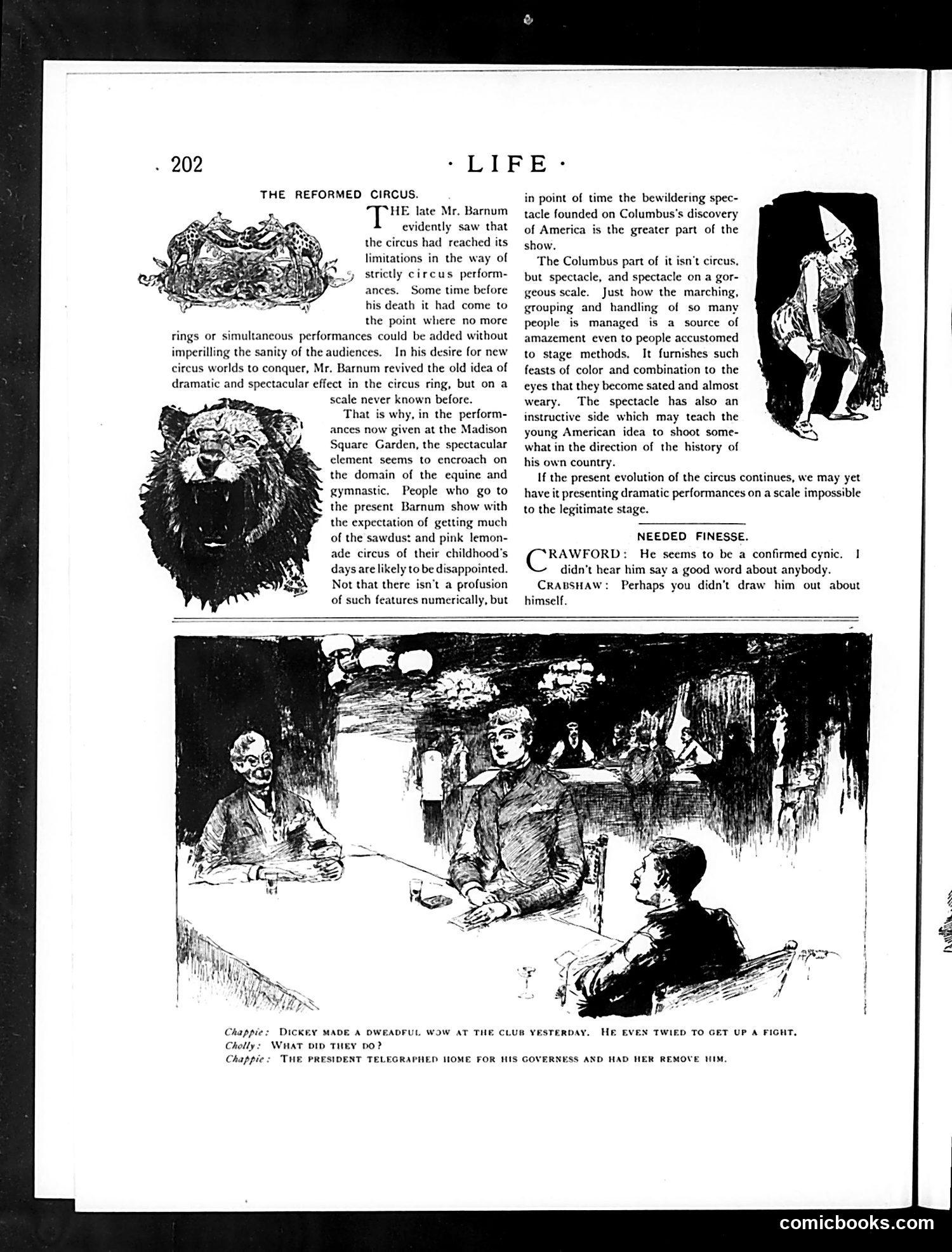
This article praises P.T. Barnum's modern circus innovations at Madison Square Garden, particularly his elaborate Columbus discovery spectacle. The piece argues that traditional circus acts (rings, acrobatics, horses) had reached saturation—audiences couldn't absorb more simultaneous performances without losing sanity. Barnum's solution: theatrical spectacle on an unprecedented scale. The Columbus pageant transcends circus into pure drama, employing masses of performers with "feasts of color and combination" that overwhelm viewers. The author notes this educates young Americans about their own history while questioning whether such scale could ever work on a legitimate theater stage. The brief comic below, "Needed Finesse," shows a cynic who won't praise anyone, illustrating that some people lack social polish—a light satirical jab at personality types.
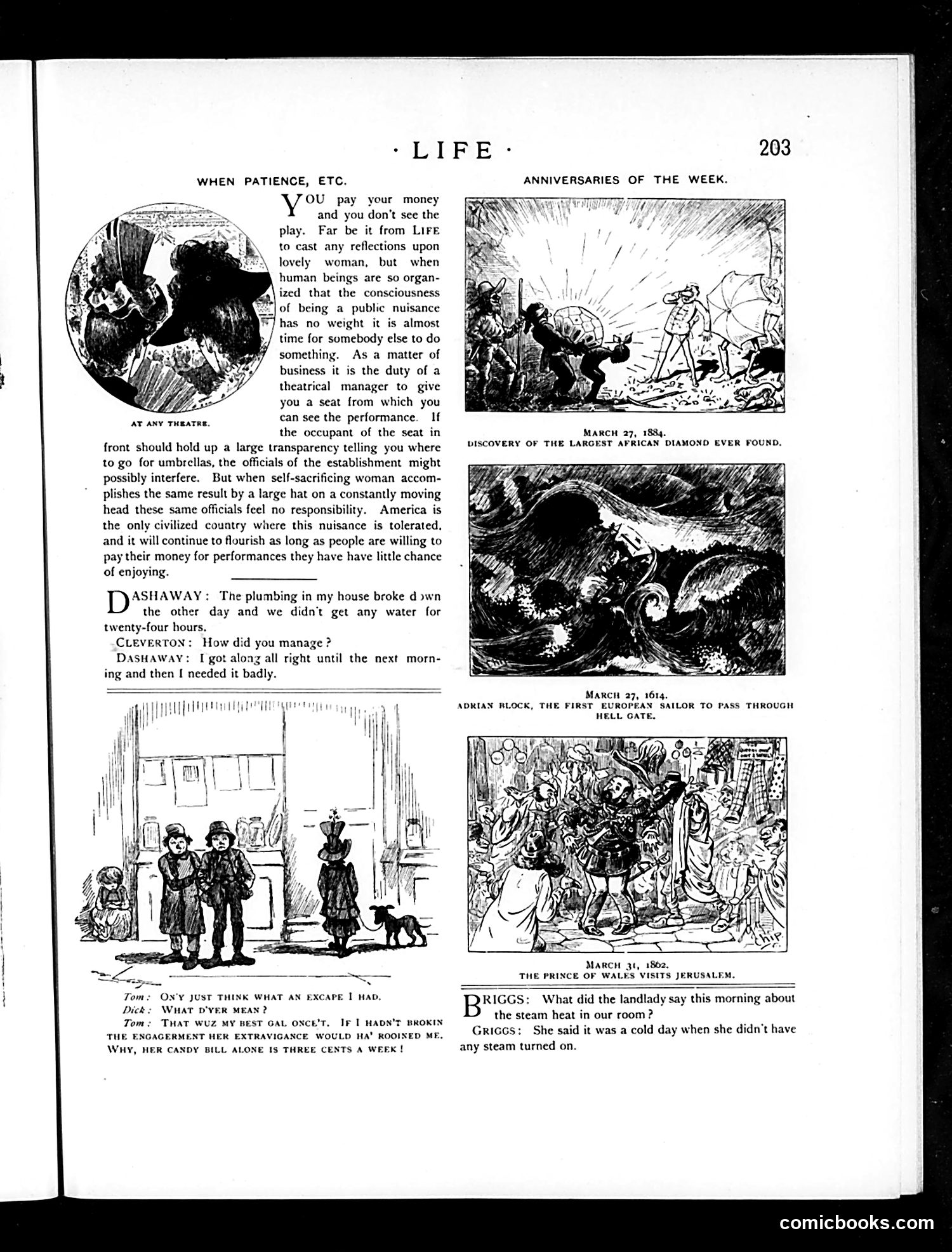
This *Life* magazine page (page 203) combines several satirical elements: **Main Editorial Piece ("When Patience, ETC")**: Criticizes women's large hats worn in theaters, which obstruct other patrons' views. The writer argues that while theater managers would stop men from holding up signs blocking the stage, they tolerate women blocking sightlines with constantly-moving elaborate hats. The satire targets both the inconsistent enforcement of theater etiquette and American tolerance for this "nuisance" compared to other "civilized countries." **"Anniversaries of the Week"**: Historical illustrations marking events on March 27 and 31, appearing to be a regular feature. **Comic Vignettes**: Short humorous dialogues—one about plumbing problems, another about a man relieved to have avoided marrying an extravagant woman, and a final exchange about a landlady's steam heat complaints—all standard light humor for the era. The page reflects early-20th-century social anxieties about women's fashion and public behavior in mixed spaces.
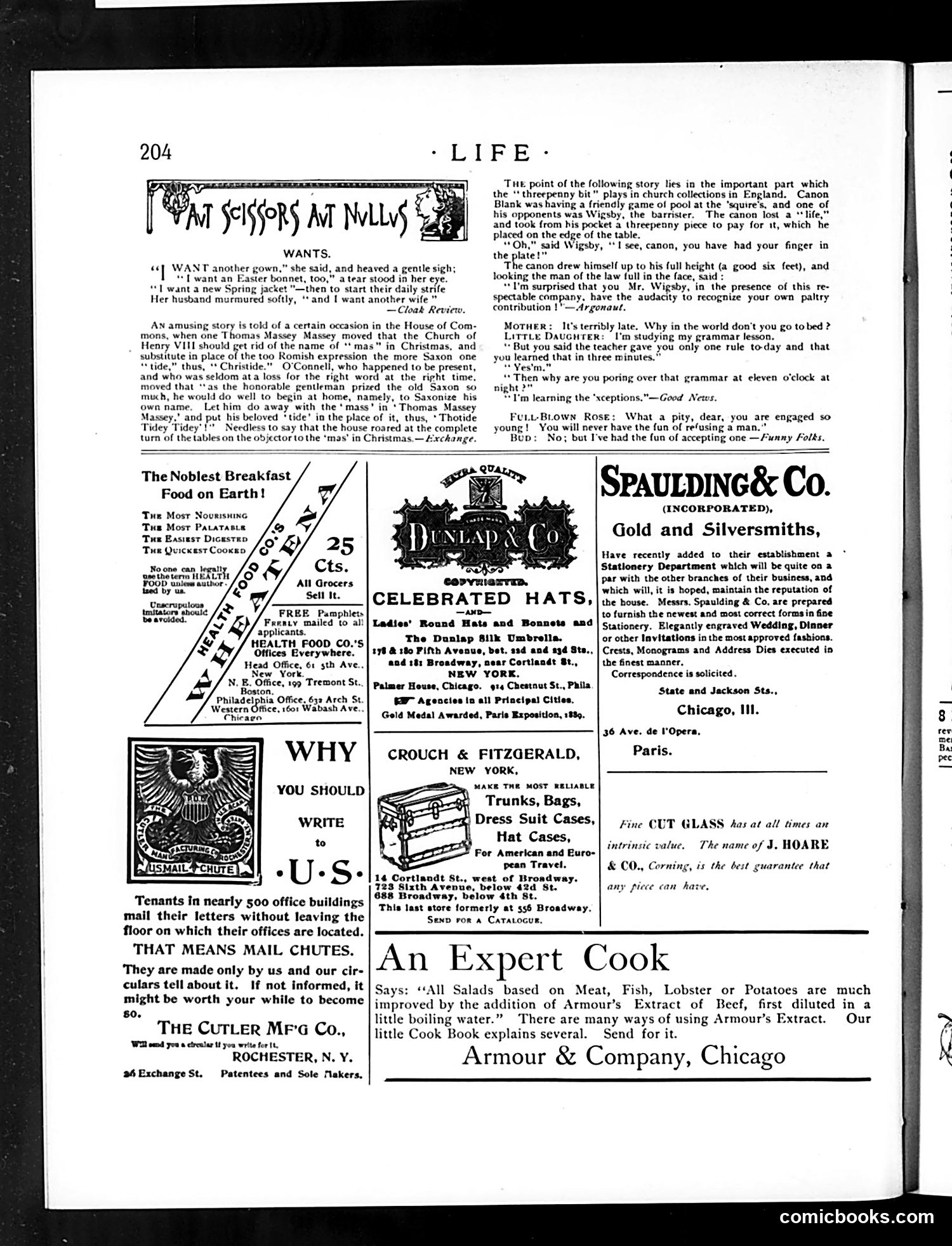
This page from *Life* magazine contains several short satirical anecdotes and advertisements typical of late 19th-century humor. **The Main Cartoons/Stories:** 1. **"Wants"** - A domestic humor piece where a wife lists material desires (gown, bonnet, jacket), and the husband responds he wants "another wife." Standard Victorian-era commentary on marital discord and female consumption. 2. **The Christmas/Thomas Massey anecdote** - References a British Parliament debate (likely 1840s-50s) where a legislator proposed removing the Latin "mass" from "Christmas" to use Saxon "tide" instead. O'Connell's witty retort—suggesting the man Saxonize his own name "Massey"—satirizes linguistic pedantry and anti-Catholic sentiment. 3. **The Canon and threepenny bit** - A clergyman is caught using church collection money to pay a gambling debt, humorously caught out by a barrister. 4. **Grammar exceptions** - A child stays up late claiming to study grammar exceptions—obviously making excuses. The remainder is period advertising for breakfast cereal, mail chutes, hats, and luggage—no satirical content.
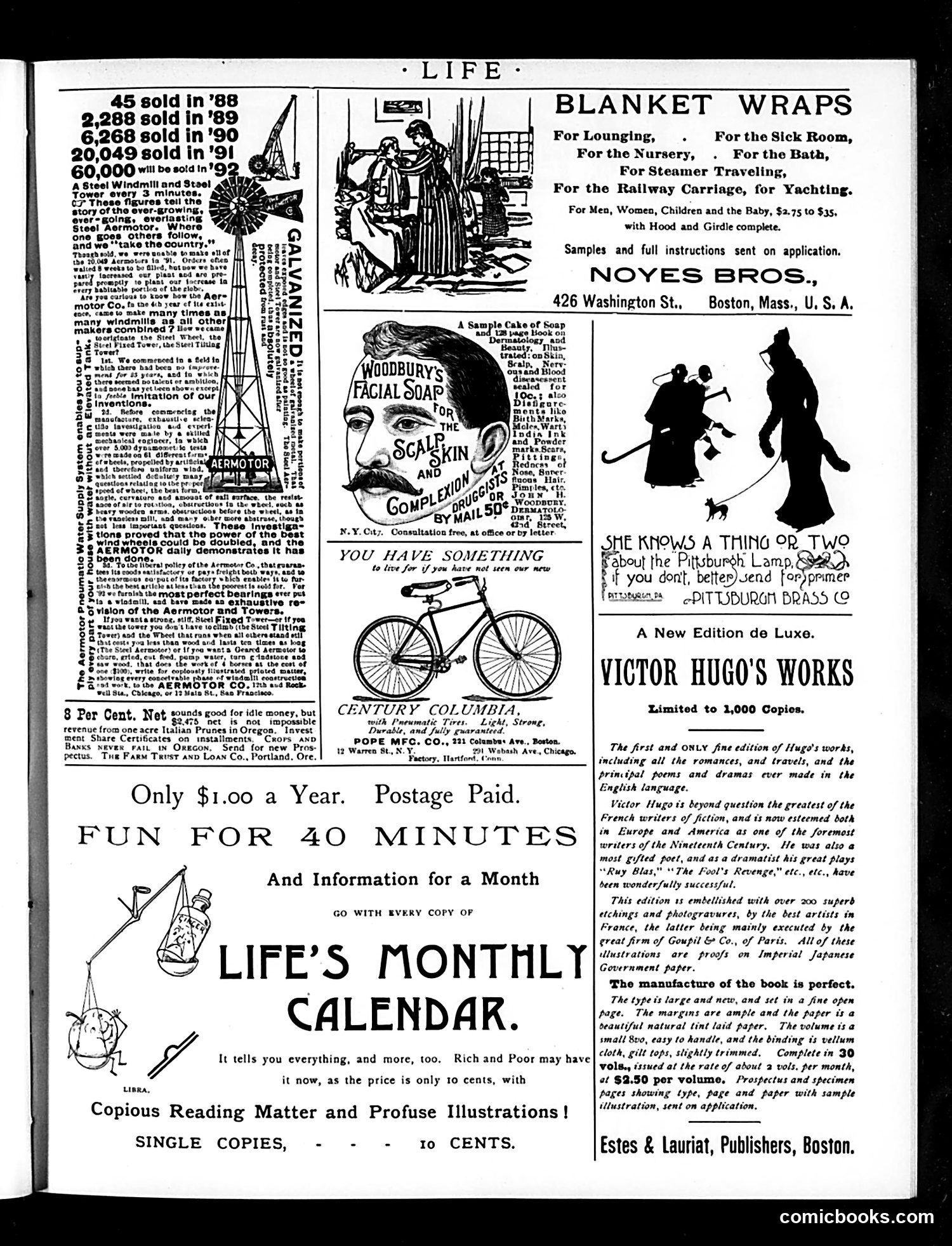
This page is primarily **advertising**, not political satire. It displays various late-19th-century product advertisements typical of a commercial magazine: **Main advertisements include:** - Blanket wraps for travel and home use - Steel windmills and towers (Aermotor) - Woodbury's Facial Soap (with a male face illustration) - Century Columbia bicycles with pneumatic tires - Pittsburgh Brass lamps - Italian prune investment shares - Life's Monthly Calendar (10 cents) **The only satirical content** appears to be the small silhouette illustration labeled "She Knows a Thing or Two," which humorously depicts a woman with the Pittsburgh lamp—a common advertising trope suggesting the product is indispensable. The page's dominant purpose is **commercial**: promoting subscriptions to Life Magazine itself ("Fun for 40 Minutes...Only $1.00 a Year") and a limited-edition Victor Hugo Works collection. This reflects Life's era as a magazine supported primarily by advertising revenue rather than editorial satire.
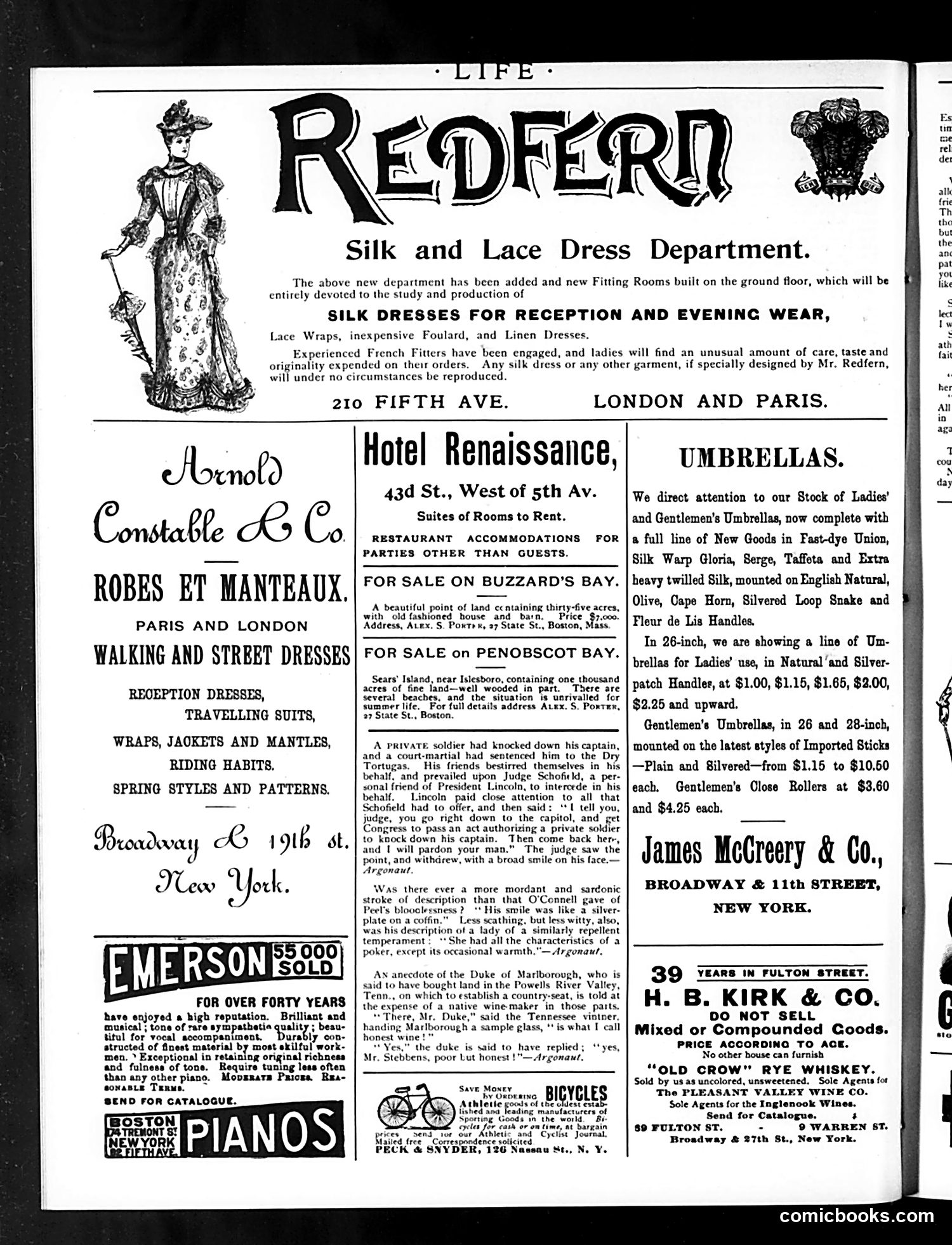
This page is primarily **advertisements** with three brief humorous anecdotes interspersed. There are no political cartoons. The ads showcase luxury goods (Redfern silk dresses, pianos, umbrellas, real estate) targeting wealthy clientele in the Gilded Age. The notable content consists of three satirical stories: 1. **Lincoln anecdote**: A soldier court-martialed for striking his captain seeks a pardon. Lincoln humorously refuses to intervene unless Congress first passes a law *authorizing* soldiers to strike captains—absurd logic that exposes the unreasonableness of the request. 2. **Peel character sketch**: A withering comparison of British politician Robert Peel's cold demeanor to a "silver plate"—sharp social satire. 3. **Duke of Marlborough**: A Tennessee vintner offers wine, calling it "honest." When the Duke questions its quality, the vintner replies it's "poor but honest"—a joke mocking rustic pride and poverty. These represent *Life* magazine's satirical humor: political wit, social commentary, and class-conscious jokes aimed at educated readers.
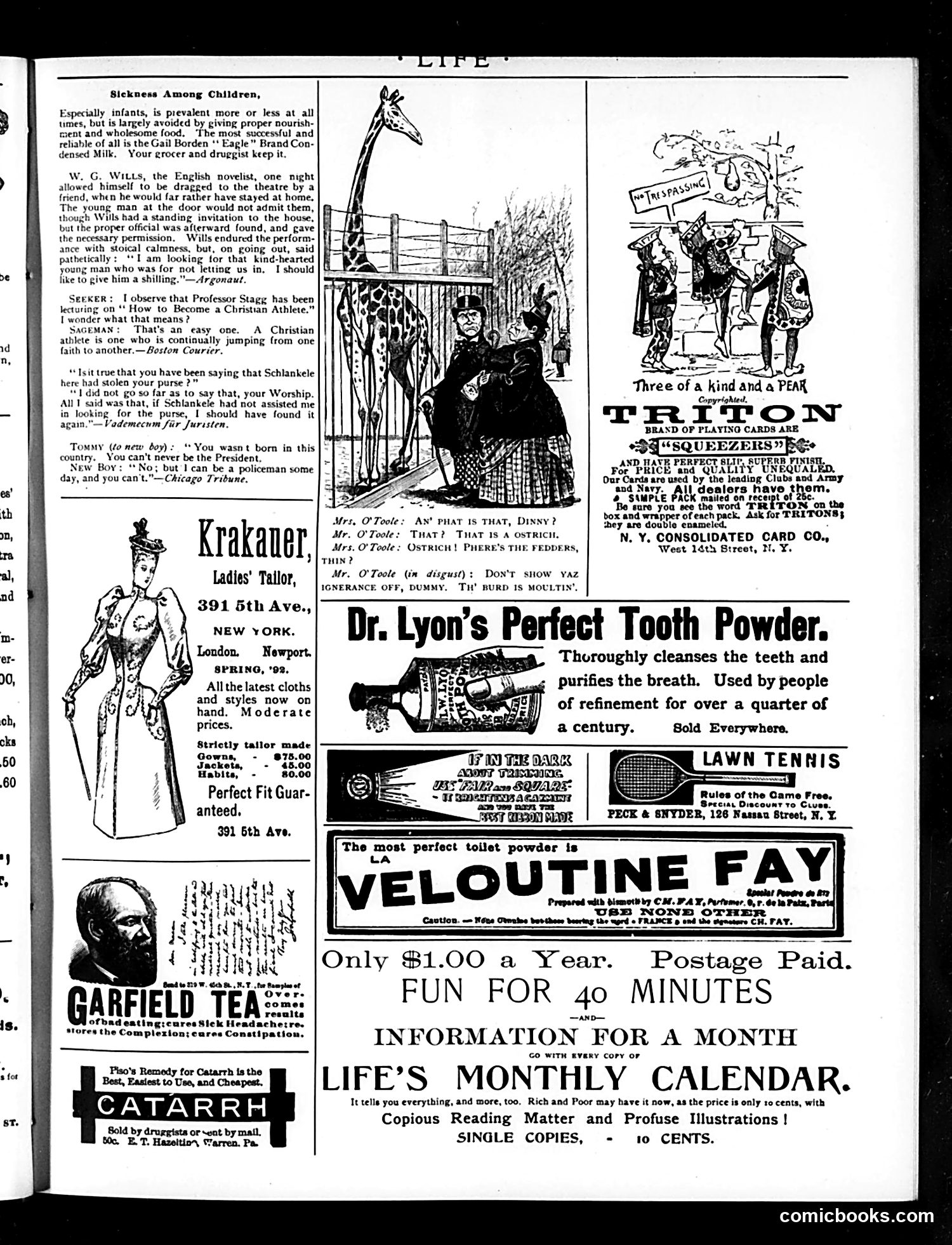
This page is primarily **advertising and humor** rather than political satire. The main content includes: **The cartoon dialogue** (center-left) depicts an Irish immigrant family (O'Tooles) discussing a bird at the zoo. The humor relies on ethnic stereotyping—a common trope of the era—where working-class Irish characters use malapropisms and poor grammar. Mrs. O'Toole mistakes an ostrich for a chicken, and Mr. O'Toole rudely corrects her, attributing her ignorance to her not seeing the "feathers" (molting). **The social commentary** is gentle: brief anecdotes about theater etiquette, Christian athletes, and social hierarchy (the "new boy" can't become President but might become a policeman). **The rest is commercial**: ads for condensed milk, ladies' tailoring, playing cards, tooth powder, and other products typical of 1890s Life magazine. The page reflects turn-of-century consumer culture and casual ethnic humor that was socially acceptable then but would be considered offensive today.
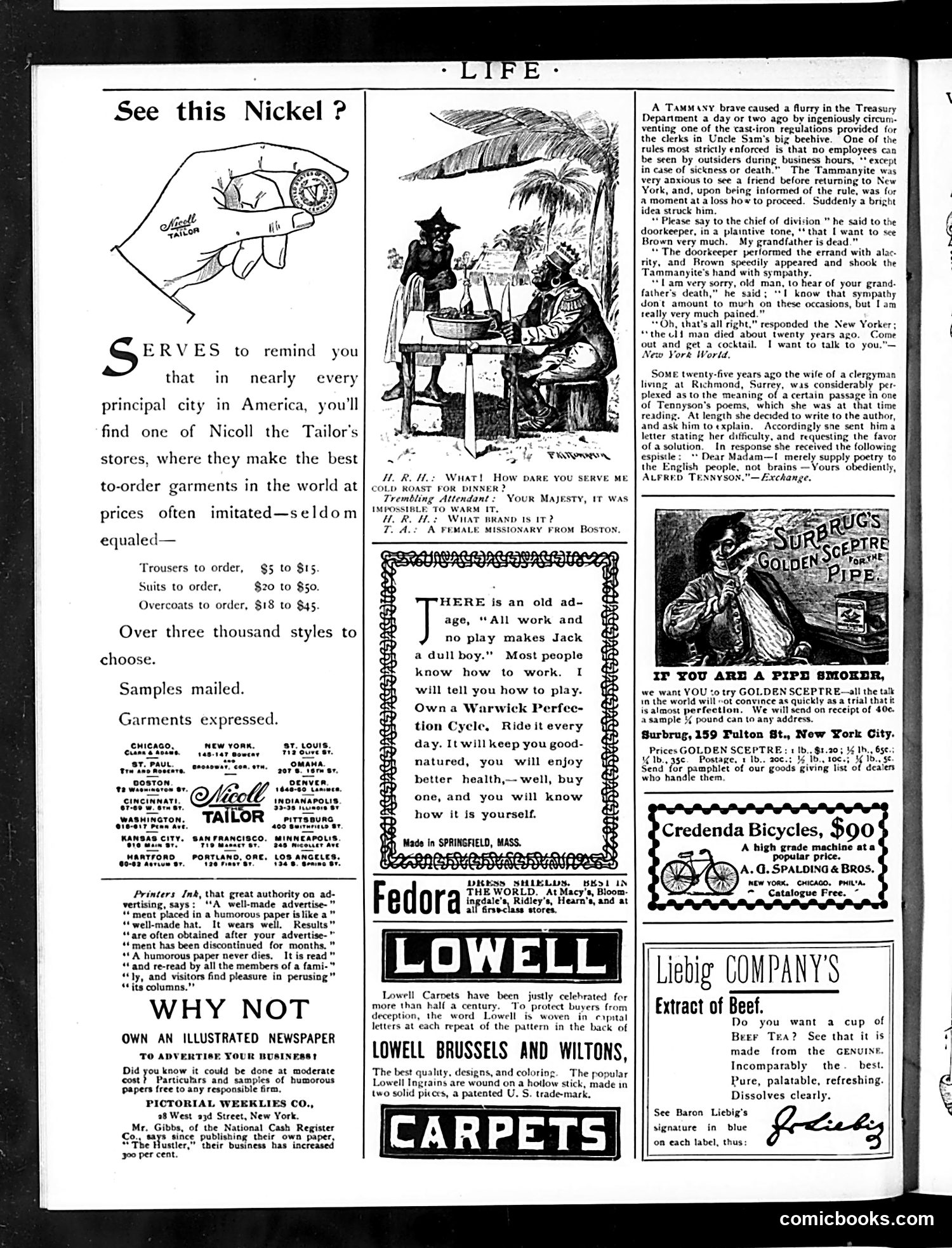
This page is primarily **advertising**, though it includes two brief humorous pieces typical of Life magazine's satirical content. The main cartoon depicts a confrontation between a snobbish H.R.H. (His Royal Highness, a prince or nobleman) and a "trembling attendant" over cold roast being served for dinner. The joke satirizes British aristocratic pretension: when the H.R.H. demands to know why the food wasn't warmed, the attendant explains that warming it was "impossible"—and reveals the cause is "a female missionary from Boston." The satire mocks American female missionaries as intrusive busybodies, and jokes that their mere presence somehow interferes with basic domestic functions. Below the cartoon, a short anecdote mocks a "Tammanyite" (corrupt New York politician affiliated with Tammany Hall) who exploits a Treasury Department rule prohibiting visitors during work hours. He falsely claims his grandfather died to gain access to his friend, then admits the grandfather "died about twenty years ago" and invites the friend for a cocktail. The satire targets political corruption and hypocrisy.