
Life, 1892-03-31 · page 4 of 18
Life — March 31, 1892 — page 4: what you’re looking at
What you’re looking at
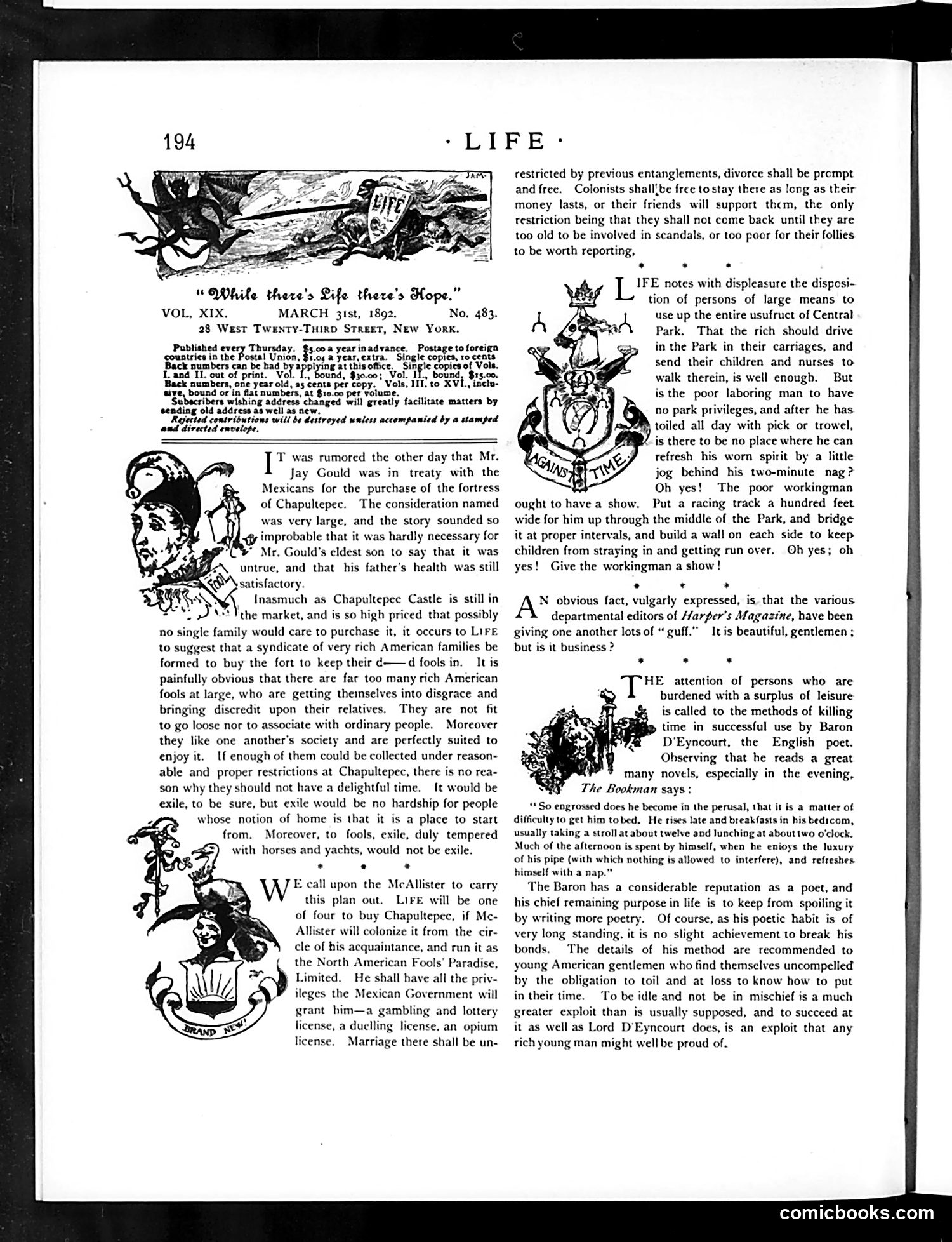
This page contains satirical editorial pieces rather than political cartoons. The main topics include: 1. **Chapultepec Castle purchase**: The text mocks a rumored plan for wealthy Americans to buy Mexico's famous fortress as a private residence, calling it foolish and critiquing the growing financial dominance of American wealth. 2. **Central Park access**: LIFE satirizes wealthy New Yorkers monopolizing Central Park with carriages and private use while working-class laborers have no recreational space after exhausting labor. 3. **Baron D'Eyncourt**: A brief piece praising the English poet's method of combating idleness through productive reading and writing habits. The magazine uses sharp social criticism to highlight class inequalities and mock wealthy American pretensions of the Gilded Age.
📄 Transcribed text from this page (OCR, searchable)
Machine-transcribed from the original scan — historical spelling and the odd misread are preserved.
LIFE “Mile there's Life there's Hope.” VOL, XIX. MARCH 31st, 1892. No. 483. 28 West T' Published ev geaairics | in the TY-THirD STREET, New York. Thursday. oo.a year inadvance. Postage to foreign ostal Union, of a year, extra. Single copies, ro.cents ioe sth Ibis ofce,” Single copiesof Vole Bane "TI. out of print. . Vol. I., bound, $15.00. Back numbers, one year old, a5 cents per tor, ote 0 XVi., inclu- tive, bound ‘or in flat numbers, at $10.00 per volume. Subscribers wishing address changed will greatly facilitate matters by sending old address as well as new. Rejected contributions will be destroyed unless accompanied by a stamped and directed envelope. T was rumored the other day that Mr. Jay Gould was in treaty with the Mexicans for the purchase of the fortress of Chapultepec. The consideration named was very large, and the story sounded so gy improbable that it was hardly necessary for Mr. Gould's eldest son to say that it was a. Unatee and that his father’s health was still laaamiieh as Chapultepec Castle is still in the market, and is so high priced that possibly no single family would care to purchase it, it occurs to LIFE to suggest that a syndicate of very rich American families be formed to buy the fort to keep their d——d fools in. It is painfully obvious that there are far too many rich American fools at large, who are getting theinselves into disgrace and bringing discredit upon their relatives. They are not fit to go loose nor to associate with ordinary people. Moreover they like one another's society and are perfectly suited to enjoy it. If enough of them could be collected under reason- able and proper restrictions at Chapultepec, there is no rea- son why they should not have a delightful time. It would be exile, to be sure, but exile would be no hardship for people whose notion of home is that it is a place to start from. Moreover, to fools, exile, duly tempered with horses and yachts, would not be exile. . . . E call upon the McAllister to carry this plan out. LiFe will be one of four to buy Chapultepec, if M Allister will colonize it from the ci cle of his acquaintance, and run it as the North American Fools’ Paradise, Limited. He shall have all the priv- ileges the Mexican Government will grant him—a gambling and lottery license, a duelling license, an opium license. Marriage there shall be un- restricted by previous entanglements, divorce shall be prompt and free. Colonists shall{be free to stay there as long as their money lasts, or their friends will support them, the only restriction being that they shall not come back until they are too old to be involved in scandals, or too poor for their follies to be worth reporting, . . . IFE notes with displeasure the disposi- tion of persons of large means to use up the entire usufruct of Central Park. That the rich should drive in the Park in their carriages, and send their children and nurses to walk therein, is well enough. But isthe poor laboring man to have no park privileges, and after he has toiled all day with pick or trowel, is there to be no place where he can refresh his worn spirit by a little jog behind his two-minute nag? Oh yes! The poor workingman ought to have a show. Put a racing track a hundred feet wide for him up through the middle of the Park, and bridge it at proper intervals, and build a wall on each side to keep children from straying in and getting run over. Oh yes; oh yes! Give the workingman a show! . e > AS obvious fact, vulgarly expressed, is. that the various. departmental editors of Harper's Magazine, have been giving one another lots of “guff."” It is beautiful, gentlemen ; but is it business ? . . . HE attention of persons who are burdened with a surplus of leisure is called to the methods of killing time in successful use by Baron D'Eyncourt, the English poet. Observing that he reads a great many novels, especially in the evening, The Bookman says: “*So engrossed does he become in the perusal, that it is a matter of difficulty to get him tobed. He rises late and breakfasts in his bedrcom, usually taking a stroll at about twelve and lunching at about two o'clock. Much of the afternoon is spent by himself, when he enioys the luxury of his pipe (with which nothing is allowed to interfere), and refreshes himself with a nap.” The Baron has a considerable reputation as a poet, and his chief remaining purpose in life is to keep from spoiling it by writing more poetry. Of course, as his poetic habit is of very long standing, it is no slight achievement to break his bonds. The details of his method are recommended to young American gentlemen who find themselves uncompelled by the obligation to toil and at loss to know how to put in their time. ‘To be idle and not be in mischief is a much greater exploit than is usually supposed, and to succeed at it as well as Lord D'Eyncourt does, is an exploit that any rich young man might well be proud of. comicbooks.com