
Life, 1892-03-31 · page 8 of 18
Life — March 31, 1892 — page 8: what you’re looking at
What you’re looking at
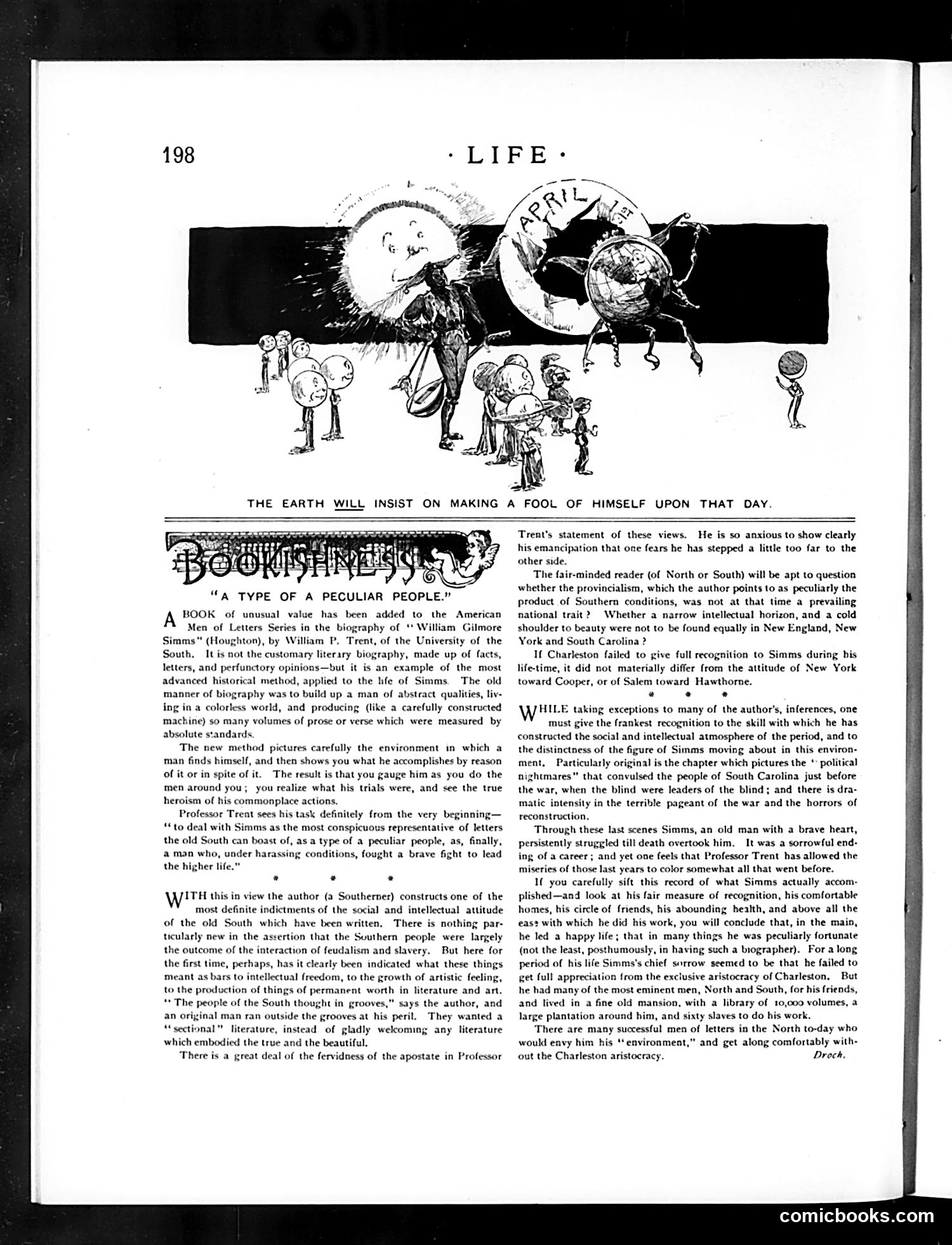
The top illustration depicts April Fools' Day, showing the Earth as a fool making itself ridiculous before small human figures. The caption states "THE EARTH WILL INSIST ON MAKING A FOOL OF HIMSELF UPON THAT DAY." Below is a book review of William Gilmore Simms's biography by William P. Trent. The text discusses Simms as a Southern literary figure, noting the author's efforts to portray the South's intellectual contributions despite regional provincialism and the legacy of slavery. The review examines Simms's life within the context of antebellum Southern society, his struggles for literary recognition, and his eventual comfortable life on a plantation. The reviewer praises the work's fair assessment of a significant but underappreciated American author.
📄 Transcribed text from this page (OCR, searchable)
Machine-transcribed from the original scan — historical spelling and the odd misread are preserved.
\\ THE EARTH WILL INSIST ON MAKING A FOOL OF HIMSELF UPON THAT DAY. “A TYPE OF A PECULIAR PEOPLE.” BOOK of unusual value has been added to the American Men of Letters Series in the biography of * William Gilmore Simms" (Houghton), by William P. Trent, of the University of the South. It is not the customary literary biography, made up of facts, letters, and perfunctory opinions—but it is an example of the most advanced historical method, applied to the fe of Simms. The old manner of biography was to build up a man of abstract qualities, liv- ing in a colorless world, and producing (like a carefully constructed machine) so many volumes of prose or verse which were measured by absolute standards, The new method pictures carefully the environment in which a man finds himself, and then shows you what he accomplishes by reason of it or in spite of it. The result is that you gauge him as you do the men around you; you realize what his trials were, and see the true heroism of his commonplace actions. Professor Trent sees his task definitely from the very beginning— * to deal with Simms as the most conspicuous representative of letters the old South can boast of, asa type of a peculiar people, as, finally, a man who, under harassing conditions, fought a brave fight to lead the higher life.” * * * WITH this in view the author (a Southerner) constructs one of the most definite indictments of the social and intellectual attitude of the old South which have been written, There is nothing par- ticularly new in the assertion that the Southern people were largely the outcome of the interaction of feudalism and slavery. But here for the first time, perhaps, has it clearly been indicated what these things meant as bars to intellectual freedom, to the growth of artistic feeling, to the production of things of permanent worth in literature and art. “* The people of the South thought in grooves,” says the author, and an original man ran outside the grooves at his peril. They wanted a “sectional” literature, instead of gladly welcoming any literature which embodied the true and the beautiful. There is a great deal of the fervidness of the apostate in Professor Trent's statement of these views. He is so anxious to show clearly his emancipation that one fears he has stepped a little too far to the other side. The fair-minded reader (of North or South) will be apt to question whether the provincialism, which the author points to as peculiarly the product of Southern conditions, was not at that time a prevailing national trait? Whether a narrow intellectual horizon, and a cold shoulder to beauty were not to be found equally in New England, New York and South Carolina ? If Charleston failed to give full recognition to Simms during bis life-time, it did not materially differ from the attitude of New York toward Cooper, or of Salem toward Hawthorne. * . * HILE taking exceptions to many of the author's, inferences, one must give the frankest recognition to the skill with which he has constructed the social and intellectual atmosphere of the period, and to the distinctness of the figure of Simms moving about in this environ- ment, Particularly original is the chapter which pictures the ‘ political nightmares” that convulsed the people of South Carolina just before the war, when the blind were leaders of the blind; and there is dra- matic intensity in the terrible pageant of the war and the horrors of reconstruction, Through these last scenes Simms, an old man with a brave heart, persistently struggled till death overtook him, It was a sorrowful end- ing of a career; and yet one feels that Professor Trent has allowed the miseries of those last years to color somewhat all that went before. If you carefully sift this record of what Simms actually accom- plished—and look at his fair measure of recognition, his comfortable homes, his circle of friends, his abounding health, and above all the eas? with which he did his work, you will conclude that, in the main, he led a happy life; that in many things he was peculiarly fortunate (not the least, posthumously, in having such a biographer). For a long period of his life Simms’s chief sorrow seemed to be that he failed to get {ull appreciation from the exclusive aristocracy of Charleston, But he had many of the most eminent men, North and South, for his friends, and lived in a fine old mansion, with a library of 10,009 volumes, a large plantation around him, and sixty slaves to do his work. ‘There are many successful men of letters in the North to-day who would envy him his “environment,” and get along comfortably with- out the Charleston aristocracy. Droch. comicbooks.com