
A complete issue · 16 pages · 1892
Life — March 24, 1892
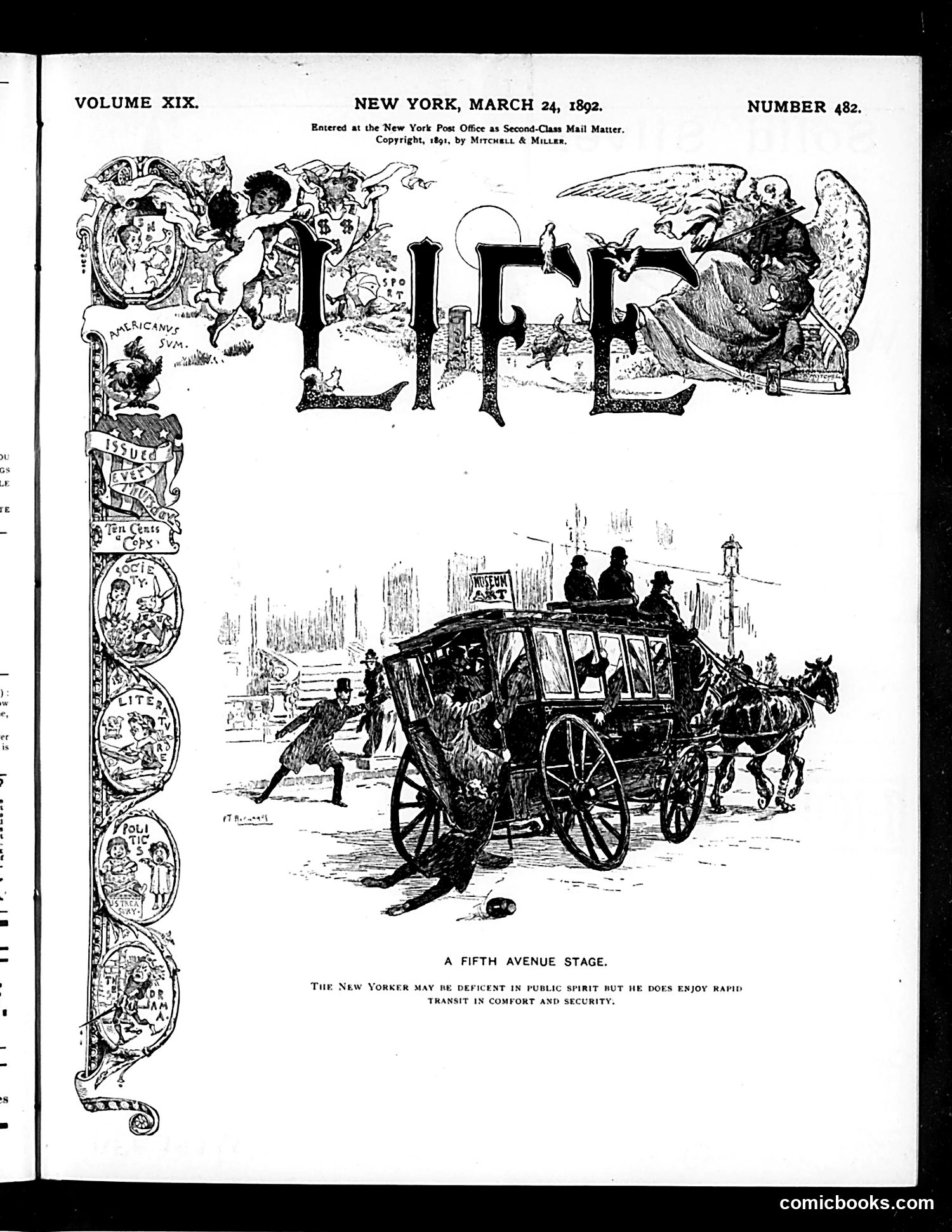
This satirical cartoon depicts a horse-drawn carriage on Fifth Avenue, New York's most prestigious address. The caption states: "The New Yorker may be deficient in public spirit but he does enjoy rapid transit in comfort and security." The satire targets wealthy New Yorkers' priorities, suggesting they care more about personal comfort and speedy transportation than civic duty or public welfare. The elaborate carriage and well-dressed passengers represent the affluent class, while the figure being left behind (possibly representing the common good or public interest) is abandoned. The ornamental left border, typical of Life magazine's design, contains various symbolic medallions relating to American themes and cultural references from the period.
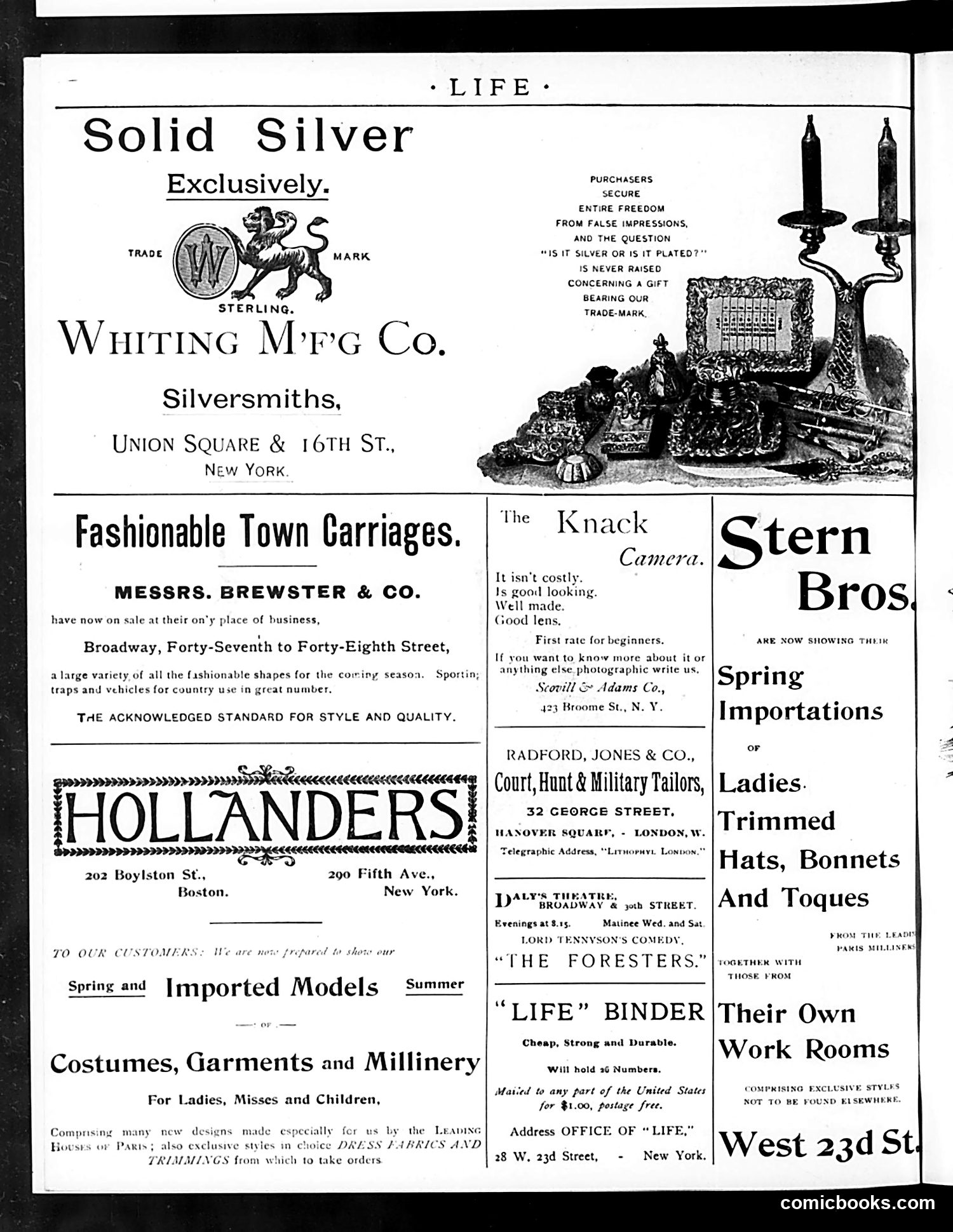
This page is **primarily advertising**, not satirical content. It contains multiple commercial advertisements from what appears to be the late 19th or early 20th century, including: - Whiting Mfg Co. (sterling silver goods) - Brewster & Co. (carriages) - Hollanders (clothing/millinery in Boston and New York) - Stern Bros. (ladies' hats and bonnets) - Various other retailers The only potentially satirical element is a small illustration accompanying the Whiting Mfg Co. ad, which shows an ornate tabletop display with candlesticks. The text emphasizes that purchasers can be "secure" their gifts are solid silver, mocking common consumer anxiety about whether items were genuinely silver or merely plated—a legitimate concern in the era. The page reflects *Life* magazine's business model: mixing entertainment with paid advertisements.
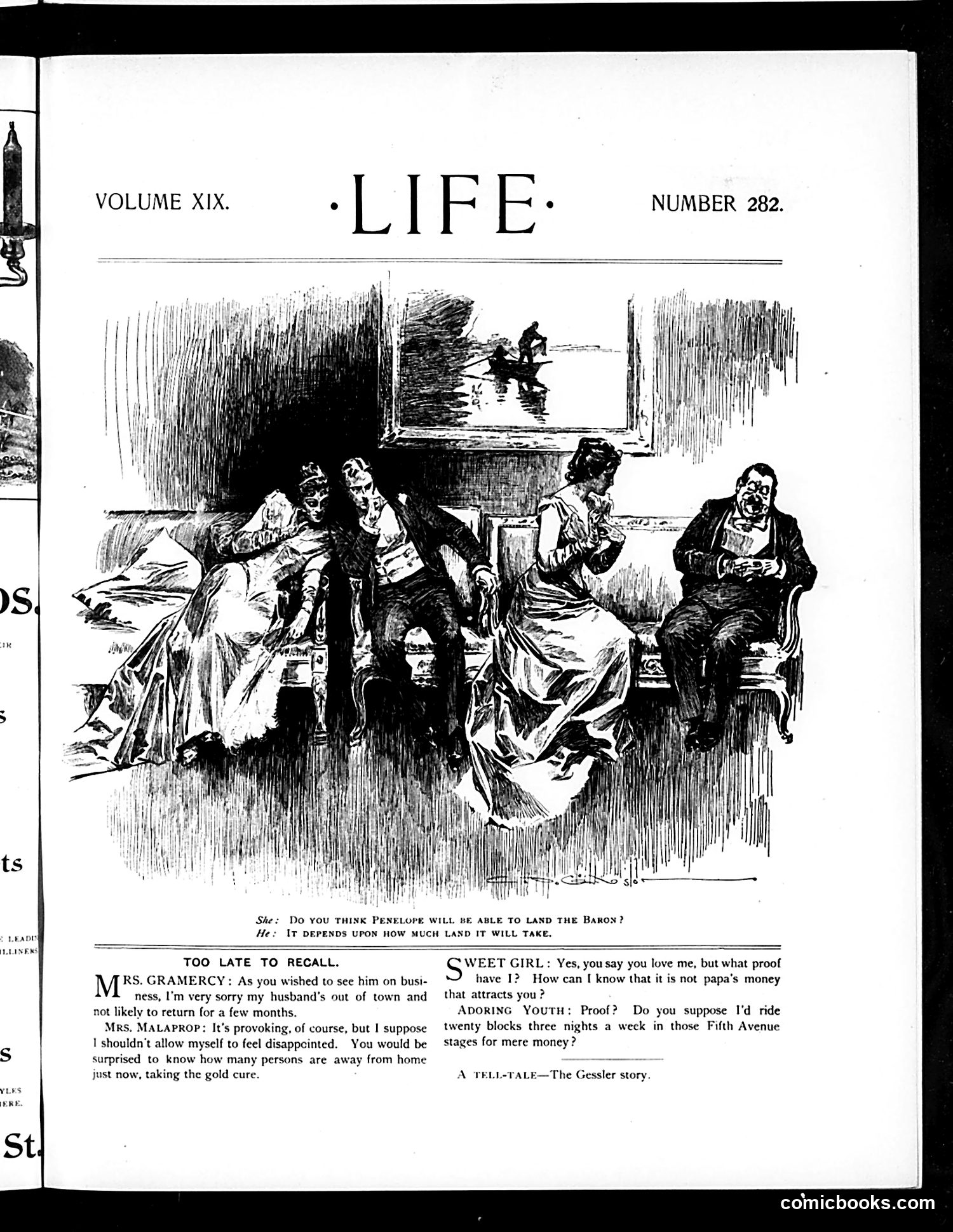
This page from *Life* magazine (Volume XIX, Number 282) features a satirical cartoon and dialogue pieces mocking upper-class social pretense. The main cartoon shows wealthy society figures in a drawing room, with one man asking another if a woman named Penelope will be "able to land the Baron"—implying marriage for wealth or status. The response "It depends upon how much land it will take" satirizes the transactional nature of aristocratic marriages among the wealthy. Below, two brief comedic dialogues mock romantic relationships: one depicts a wife suspicious her husband's business trip is actually an affair, and another shows a young woman questioning her suitor's love—he claims to ride "twenty blocks three nights a week" through Fifth Avenue (then the wealthy district) for money, not romance. The humor targets materialism and cynicism in upper-class courtship.
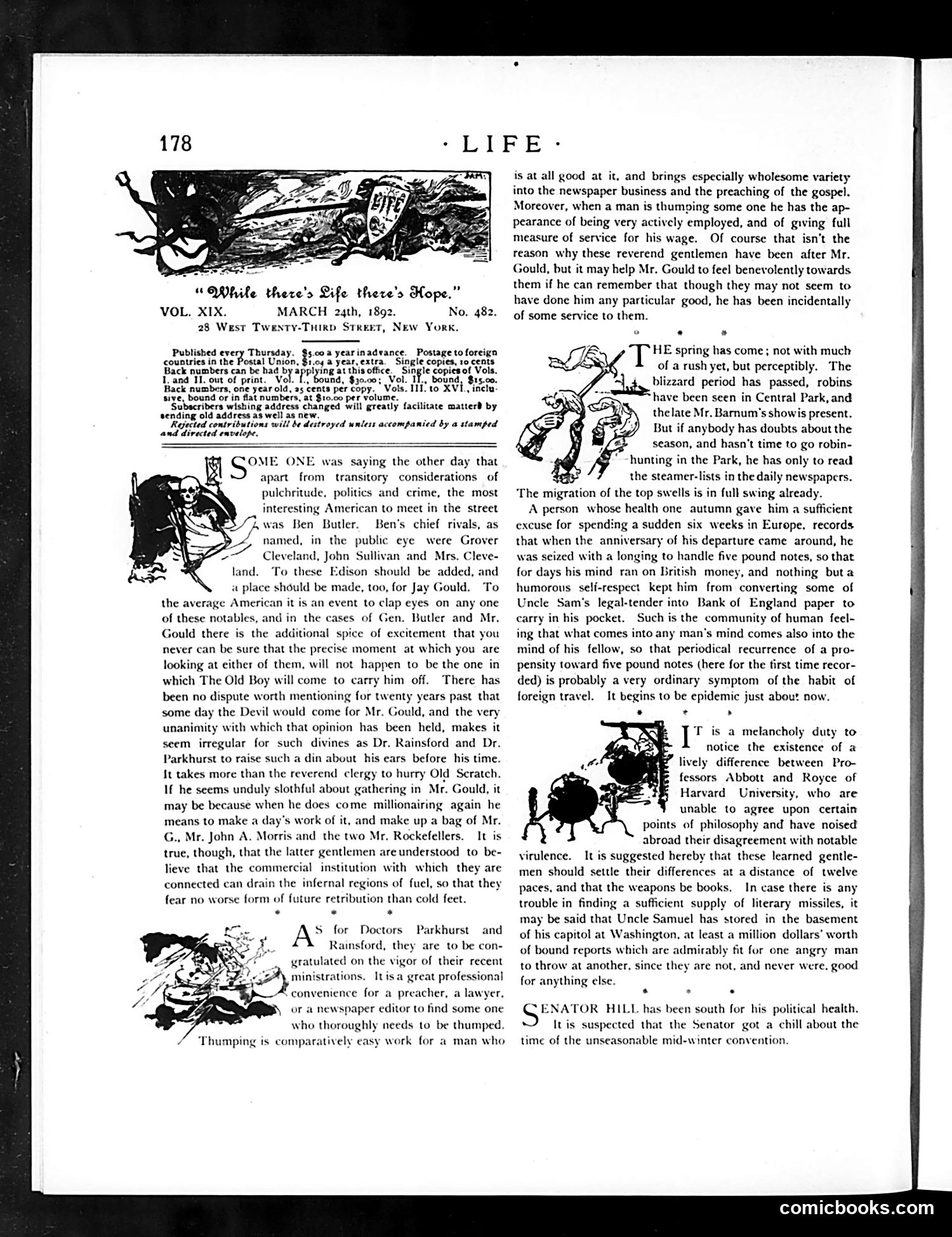
This page contains editorial commentary rather than political cartoons. The text discusses several contemporary figures: **Ben Butler, Grover Cleveland, John Sullivan, and Jay Gould** are mentioned as notable Americans whose potential involvement in scandals would be noteworthy. **Dr. Parkhurst and Dr. Rainsford** are congratulated on recent "ministrations"—likely referring to their public advocacy or reform work. **Professors Abbott and Royce** of Harvard are depicted as having a philosophical disagreement, with satirical suggestions they settle their dispute at distance. **Senator Hill** is mentioned regarding his political health and a "mid-winter convention." The overall tone mocks prominent public figures while commenting on contemporary reform movements, clerical activism, and academic disputes. The specific events referenced are unclear without additional historical context.
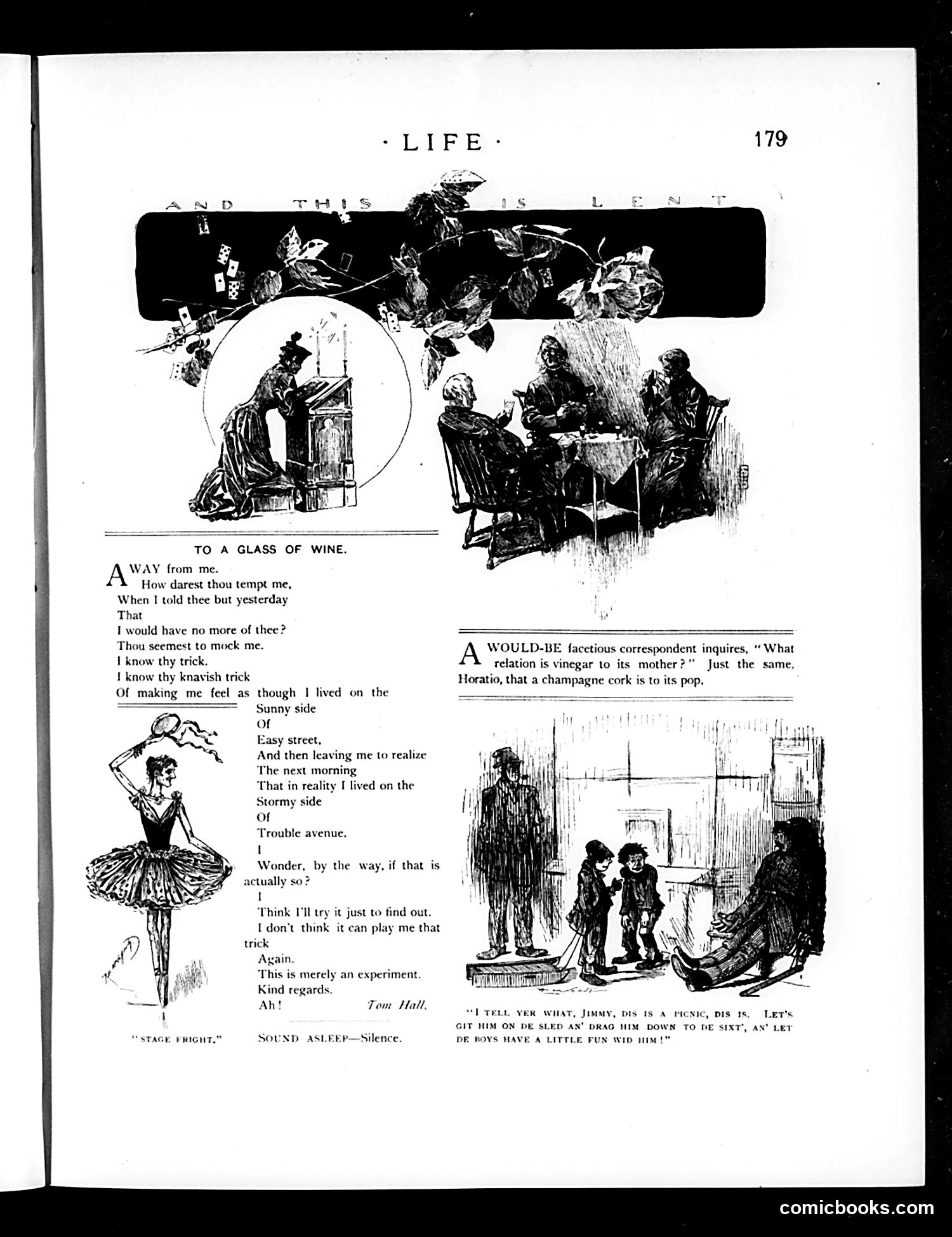
This page contains two distinct pieces of humor: **"To a Glass of Wine"** (left) is a poem mocking someone who claimed to have quit drinking, only to reveal they still indulge regularly. The speaker ironically catalogs their various drinking locations and rationalizations ("making my feet as though I lived on the Sunny side / Of Easy street"). The accompanying illustration shows a dancer, likely representing the speaker's bohemian lifestyle. **The right panel** presents a satirical exchange about the relationship between vinegar and champagne—likely a class-commentary joke suggesting pretension or social climbing, given the reference to "champagne cork" and "pop." The bottom illustration depicts what appears to be street urchins or working-class children being offered dubious "fun" by an adult figure—a commentary on exploitation or questionable entertainments. The overall tone reflects early 20th-century satirical humor targeting drinking culture and class distinctions.
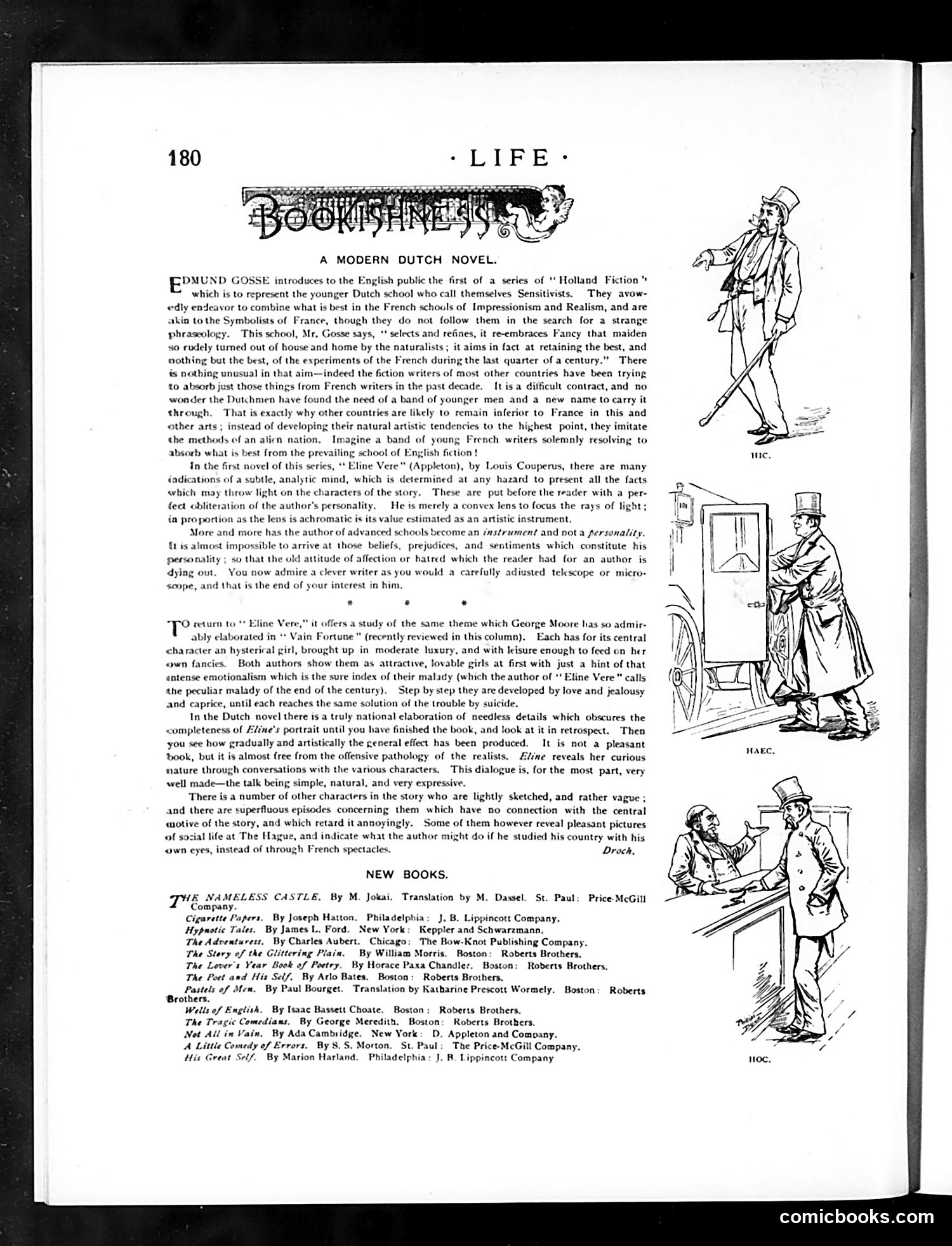
This page primarily contains a literary review of "Boomshrine," a modern Dutch novel by Edmund Gosse, discussing how Dutch writers are developing new artistic tendencies distinct from French influences. The three small sketches on the right (labeled HIC, HAEC, HOC) appear to be Latin grammar jokes—these are the nominative forms of the Latin demonstrative pronoun "this" in masculine, feminine, and neuter cases. The cartoons humorously illustrate the grammatical genders through character sketches: a man, a woman, and what appears to be an androgynous or ambiguous figure, visually parodying the Latin declension lesson. The bottom section lists "NEW BOOKS," announcing recent literary publications from various American publishers.
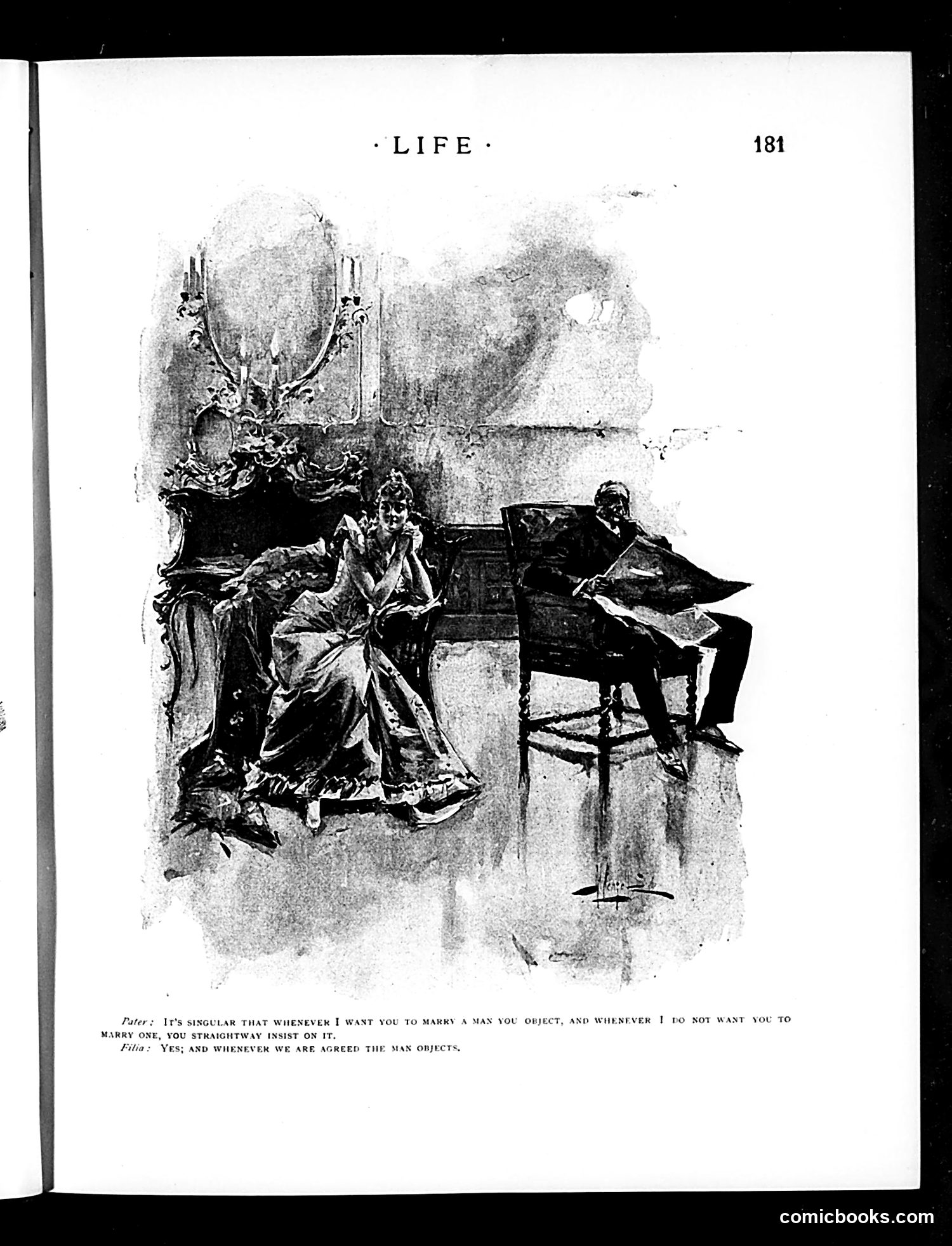
This page features a domestic humor cartoon illustrating gender dynamics in marriage. The scene shows a well-dressed couple in an ornate interior—a woman seated on an elaborate chair and a man sitting across from her. The caption presents dialogue between "Peter" and "Filia" (Latin for "daughter"), with Peter stating he insists she marry a man she objects to, while Filia responds they should "agree the man objects" instead. The satire targets the contradiction in patriarchal marriage customs: men claimed authority over women's marital choices, yet the cartoon suggests women possessed equal veto power through the prospective groom's own objections. It's a witty commentary on the absurdity of forced marriages and highlights women's limited agency in Victorian-era matrimonial arrangements.
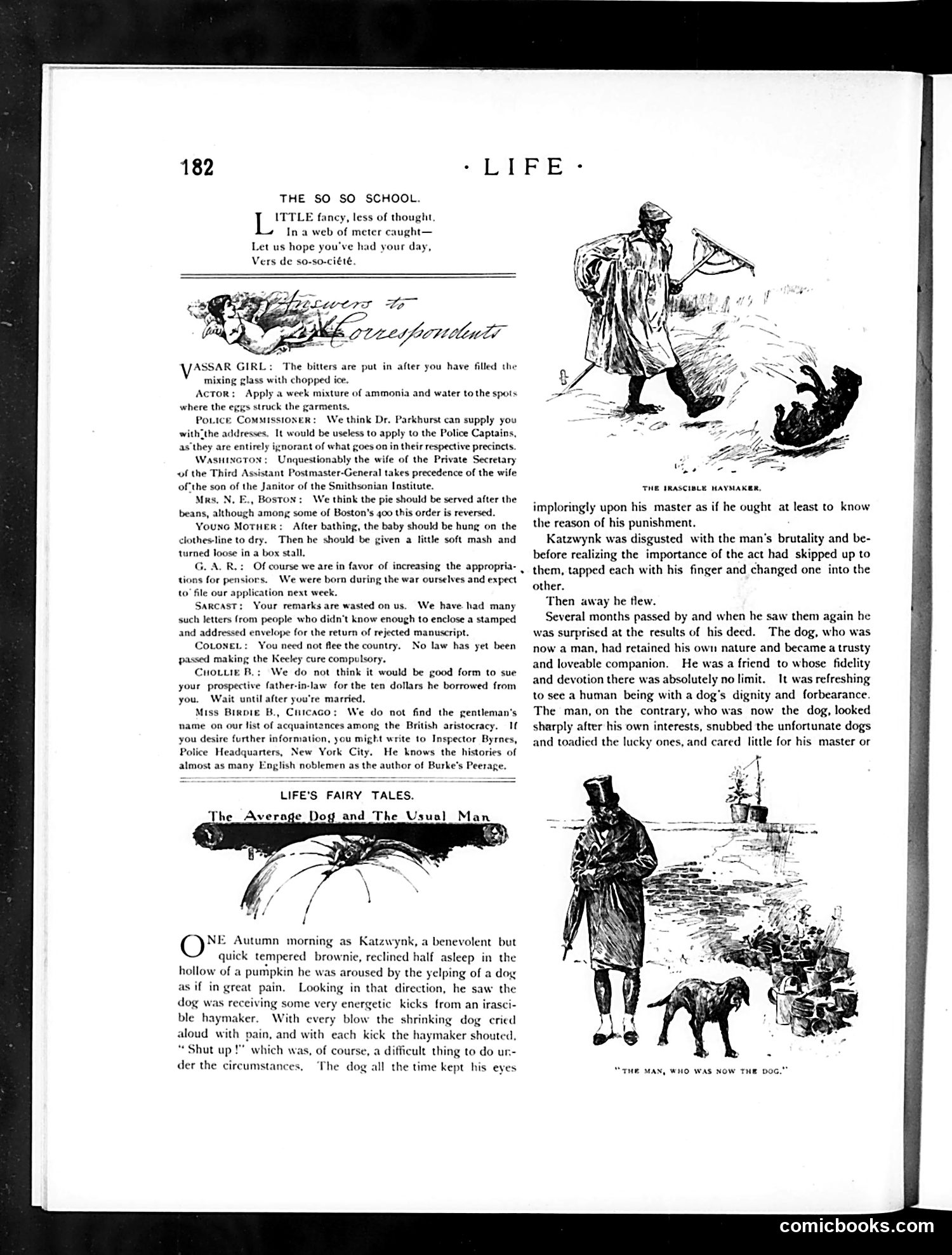
This page contains two satirical pieces. "The So So School" is a humorous advice column mocking pretentious social etiquette through faux-correspondent responses about stain removal, dinner order, and borrowed teacups—poking fun at overly-formal upper-class conventions. The main feature, "Life's Fairy Tales: The Average Dog and The Usual Man," presents a moral inversion: a man brutally kicks a stray dog, then years later encounters it again—now transformed into a dignified, well-fed companion to a gentleman, while the man remains unchanged. The satire suggests dogs possess more capacity for growth and forgiveness than humans, inverting traditional hierarchy. The illustrations show the dog's journey from abuse to respectability, contrasting the man's moral stagnation.
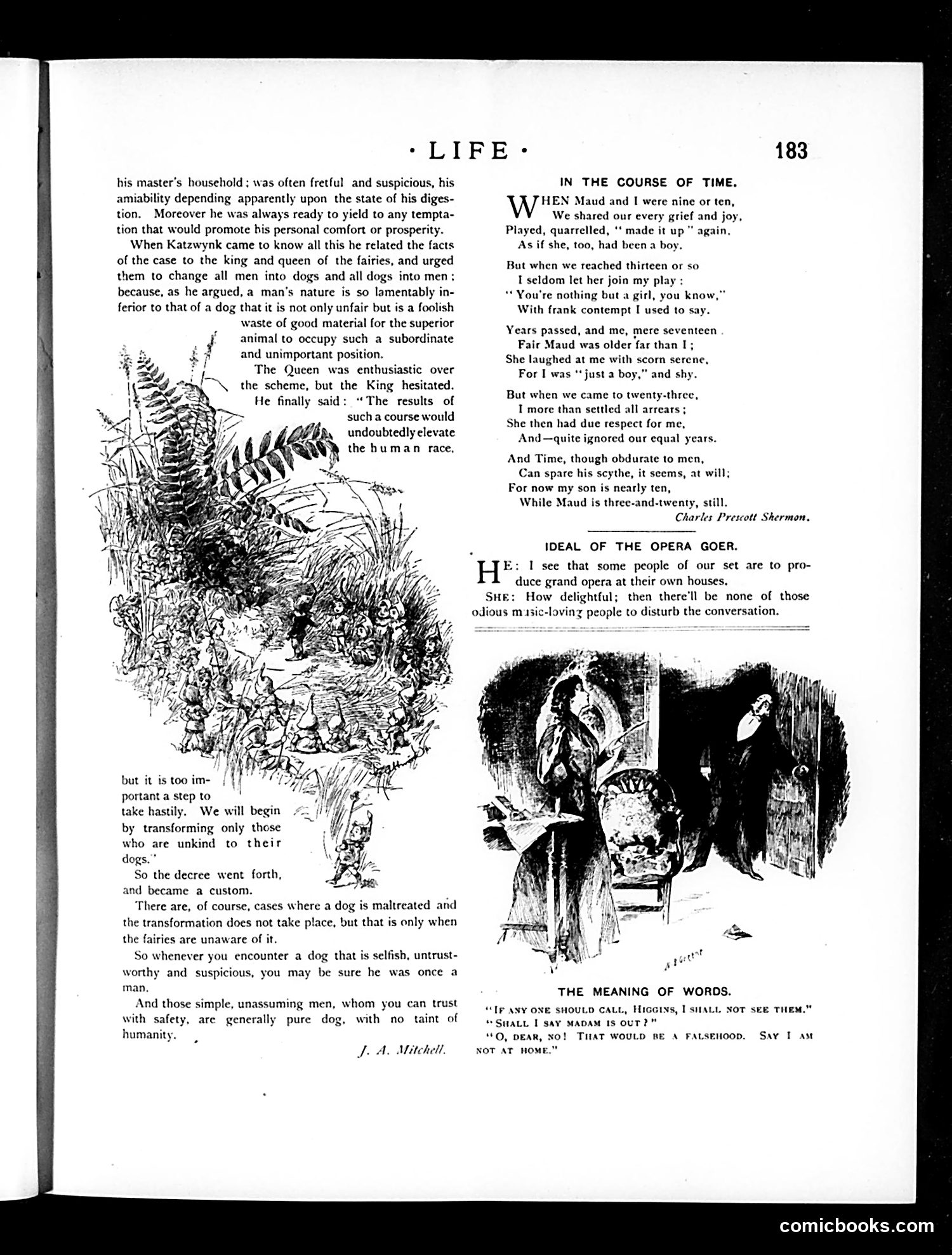
This page contains three distinct pieces: 1. **Left illustration**: A detailed fairy-tale scene depicting what appears to be a transformation narrative, accompanying text about dogs and human nature (attributed to J.A. Mitchell). 2. **"In the Course of Time"** (center): A poem by Charles Prescott Sherman about aging and a relationship with "Maud," tracing their bond from childhood through adulthood as both mature. 3. **"Ideal of the Opera Goer"** (right): A satirical dialogue mocking opera attendees who disrupt performances with conversation, featuring a dark illustration of people at an opera house. The page primarily targets social pretension and behavioral rudeness among the upper classes attending cultural events, while the poem reflects on time's passage and changing relationships—typical themes for Life's satirical commentary on American society.
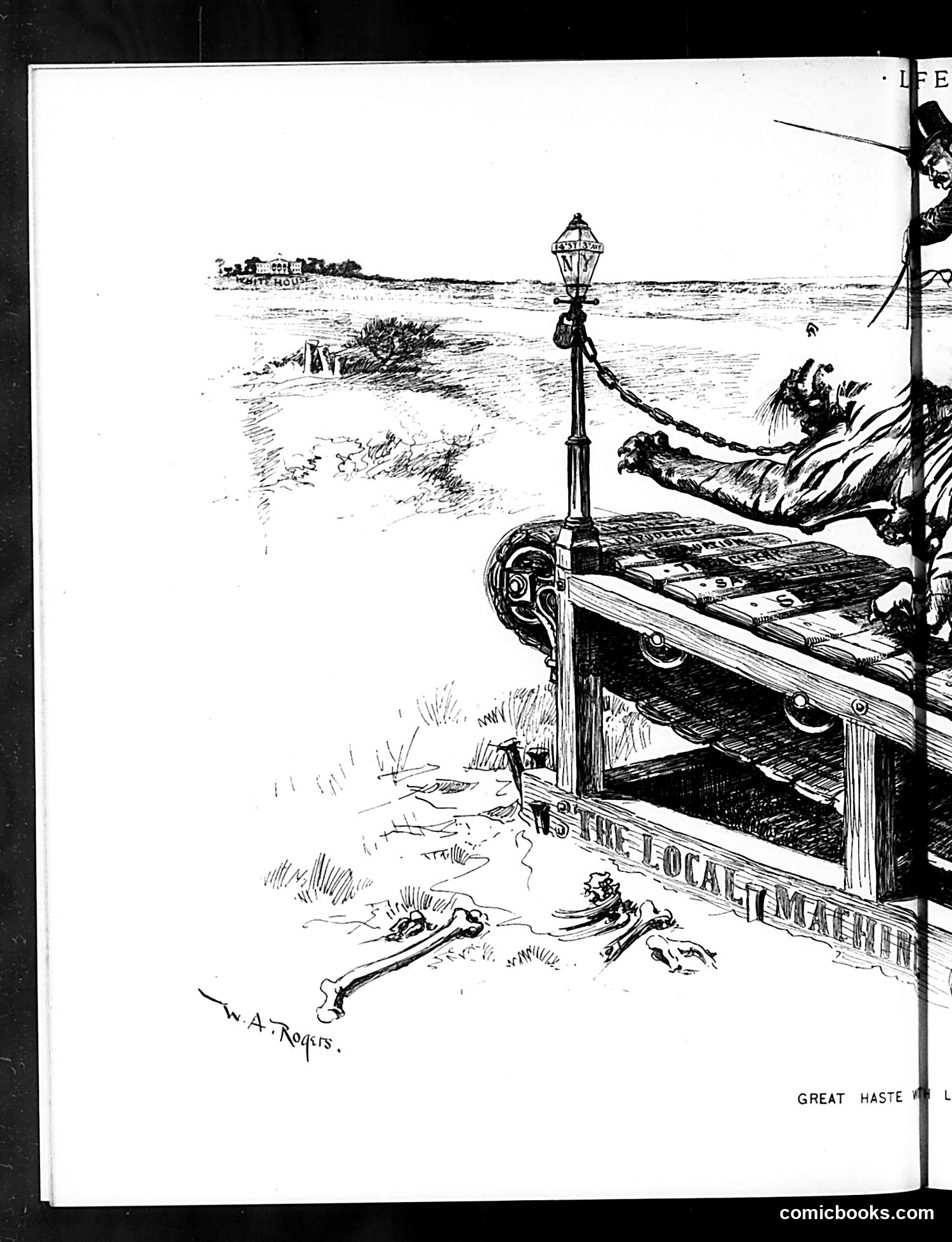
This is a single-panel cartoon by W.A. Rogers titled "Great Haste" (visible at bottom right). It depicts a wooden dock or pier structure labeled "THE FOCAL POINT" with a street lamp and mooring chain. In the foreground, two human skeletons lie on the ground in apparent haste or panic. In the background across the water, a building labeled "WHITE HOUSE" is visible on the horizon. The satire appears to comment on death or destruction occurring at a significant location ("the focal point"), with the White House present as a distant observer. The skeletons suggest mortality or casualties, while "great haste" implies rushed, chaotic action. Without additional historical context about when this appeared, the specific political event referenced remains unclear, though it likely critiques governmental negligence or crisis mismanagement.
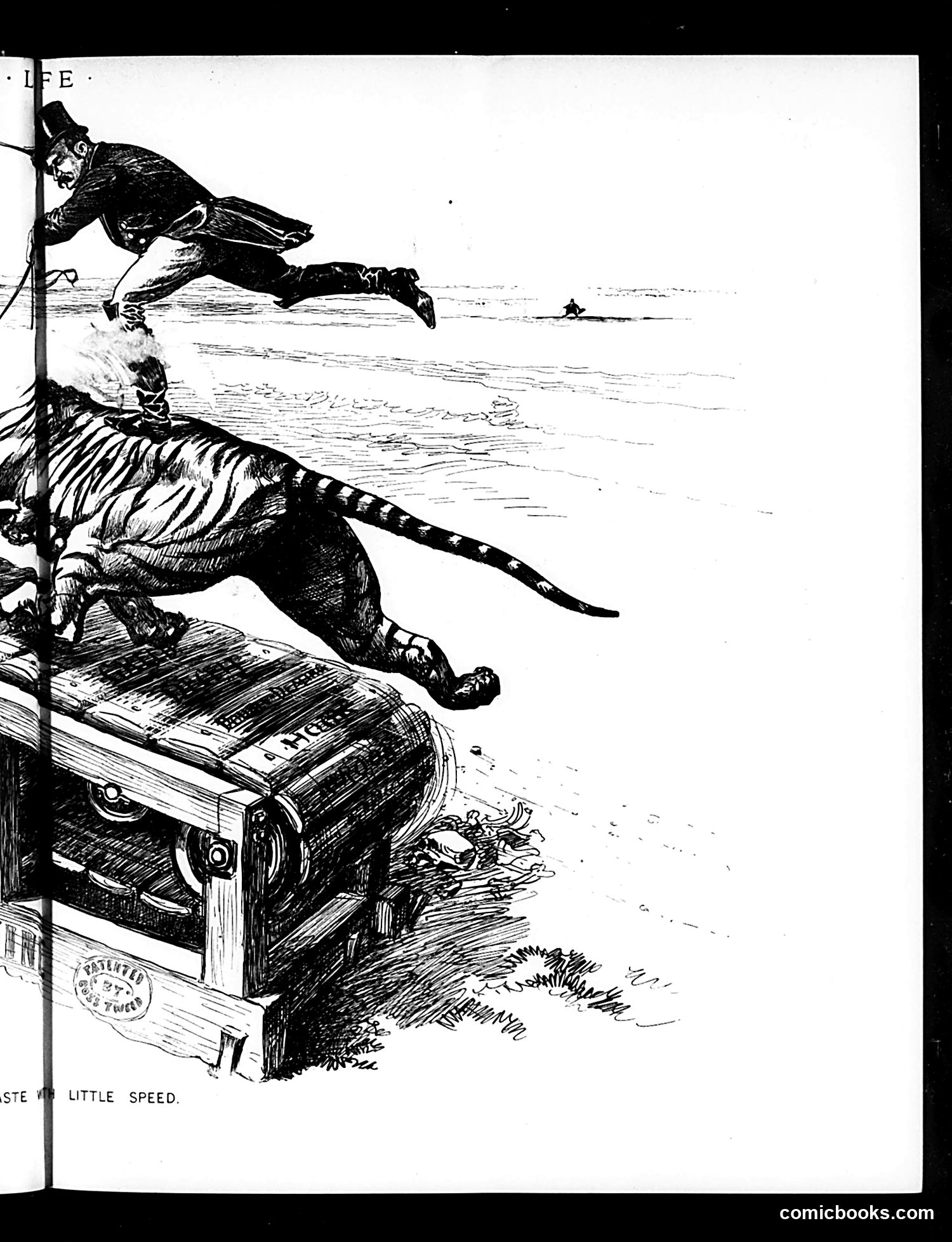
This political cartoon depicts a man in formal attire leaping desperately from a dock while a tiger (with a striped tail) sits calmly nearby. A trunk and luggage rest on the dock. The title "Little Speed" suggests the man's hurried escape. The cartoon likely satirizes a political or social figure attempting to flee a dangerous situation—the tiger representing either a threat, scandal, or opponent catching up. The formal dress and luggage suggest he's abandoning a position or responsibility. Without the publication date visible, the specific political reference is unclear, but the cartoon critiques someone's hasty retreat or loss of control in a precarious situation.
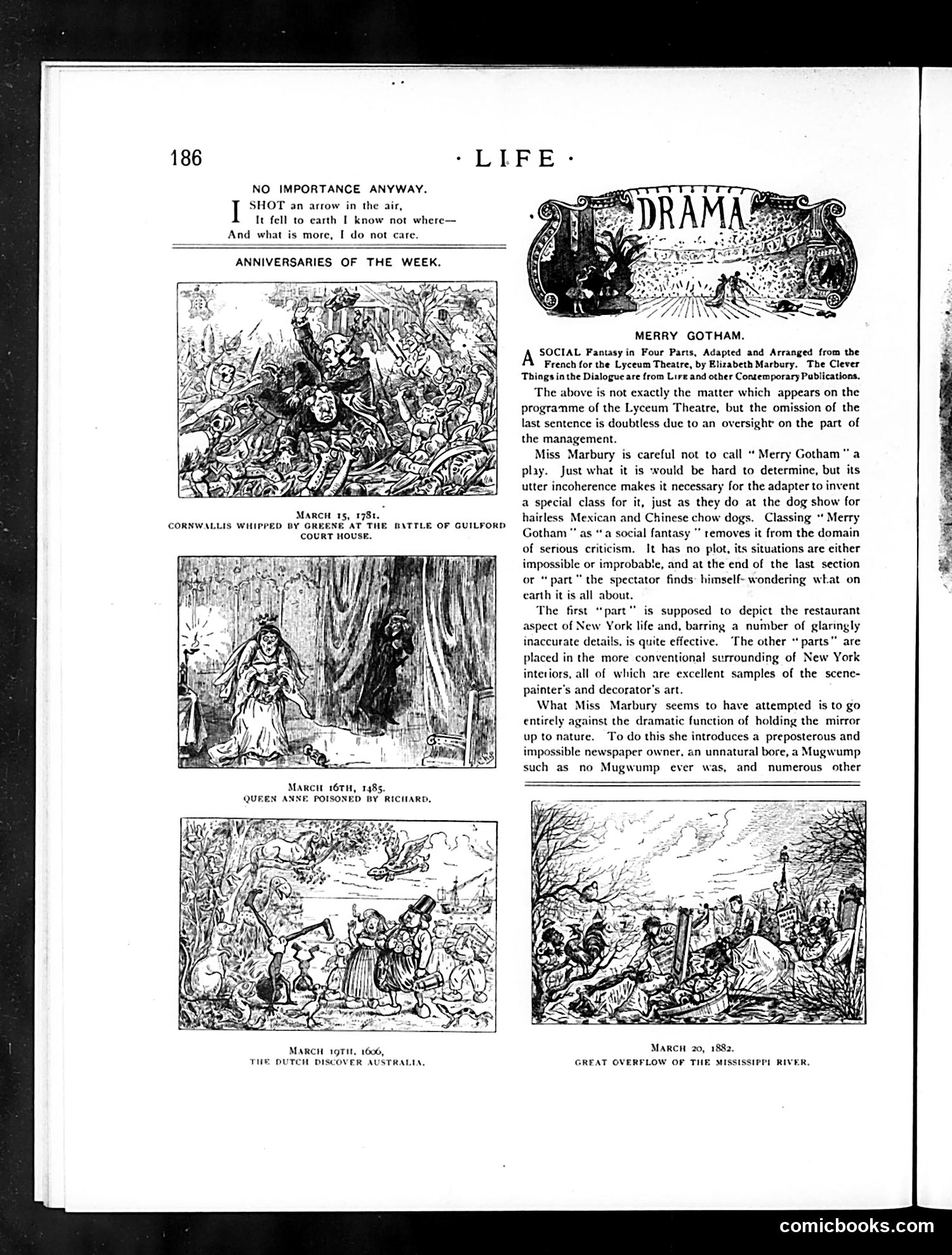
This page contains a theater review of "Merry Gotham," a play adapted by Elizabeth Marbury from French sources for the Lyceum Theatre. The critic's satire targets the play's incoherence: it lacks a coherent plot and relies on impossible situations, leading the adapter to invent the category "social fantasy" rather than call it a traditional play. The review mocks both the production's New York setting details (some deliberately inaccurate) and its invented characters—a preposterous newspaper owner, an "unnatural bore," and a "Mugwump" (a political independent from the Gilded Age, typically portrayed as ineffectual). The critic suggests the play intentionally avoids holding "a mirror up to nature," the classical dramatic function. The opening poem and historical "anniversaries" are standard Life magazine filler content unrelated to the review.
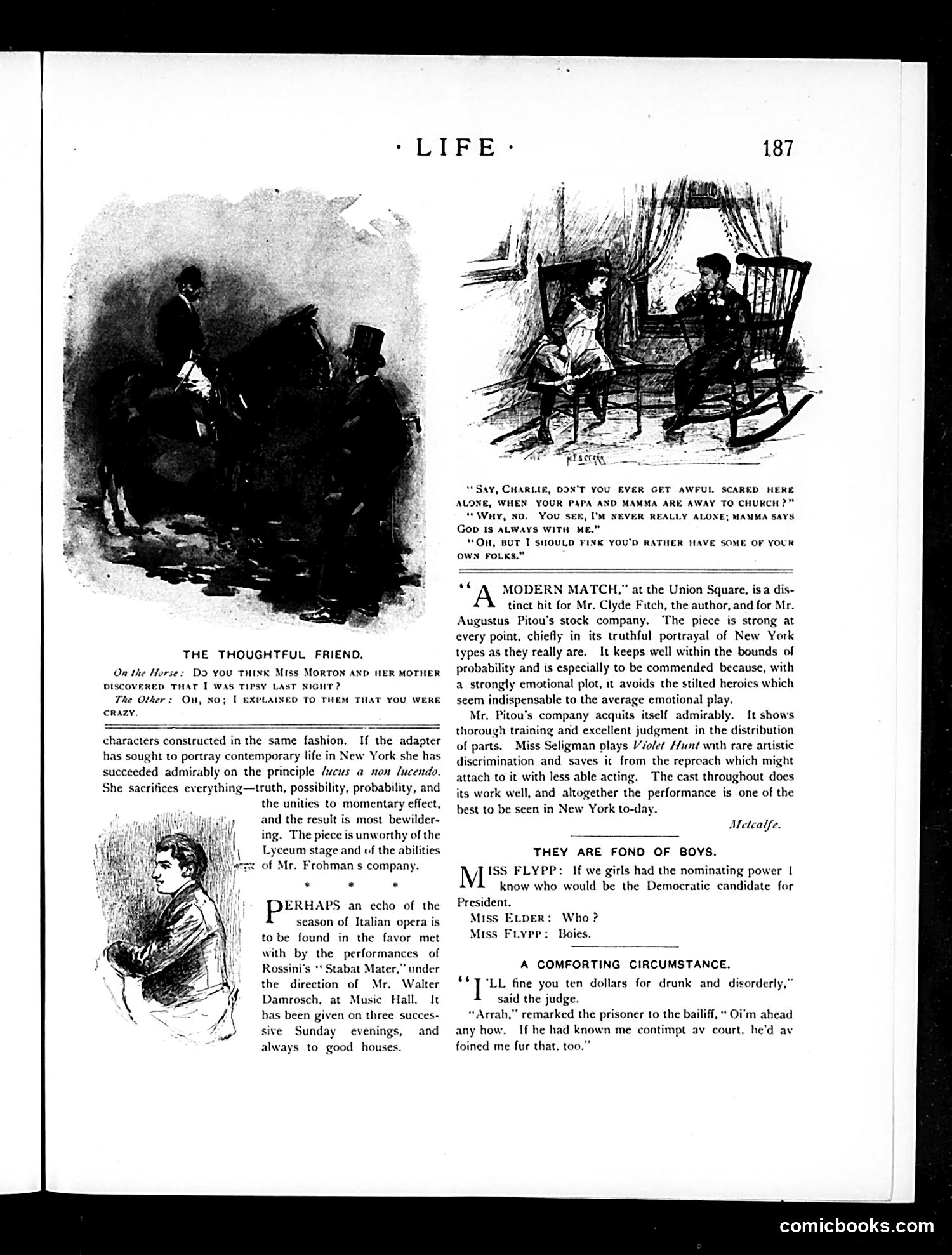
This page contains multiple cartoons and theater reviews typical of Life's satirical content. **"The Thoughtful Friend"** (top left) depicts two men on horseback. One asks if companions discovered his drunkenness the previous night; the other reassures him by claiming he explained the behavior as mere craziness instead—a joke about preferring the social stigma of insanity over intoxication. **The children's dialogue** (top right) contrasts innocent religious faith with worldly concerns. A child insists he's never alone because "God is always with me," while his friend suggests he'd prefer actual people present. **"A Modern Match"** is a theater review praising Clyde Fitch's play for accurately portraying New York types without melodramatic excess. The page also includes brief satirical exchanges: one joke plays on "Boies" (likely William Jennings Bryan's running mate Adlai Stevenson I or a political figure) as an attractive Democratic candidate to female voters; another presents an Irish immigrant making light of legal penalties. The content reflects turn-of-century urban American society and theater culture.
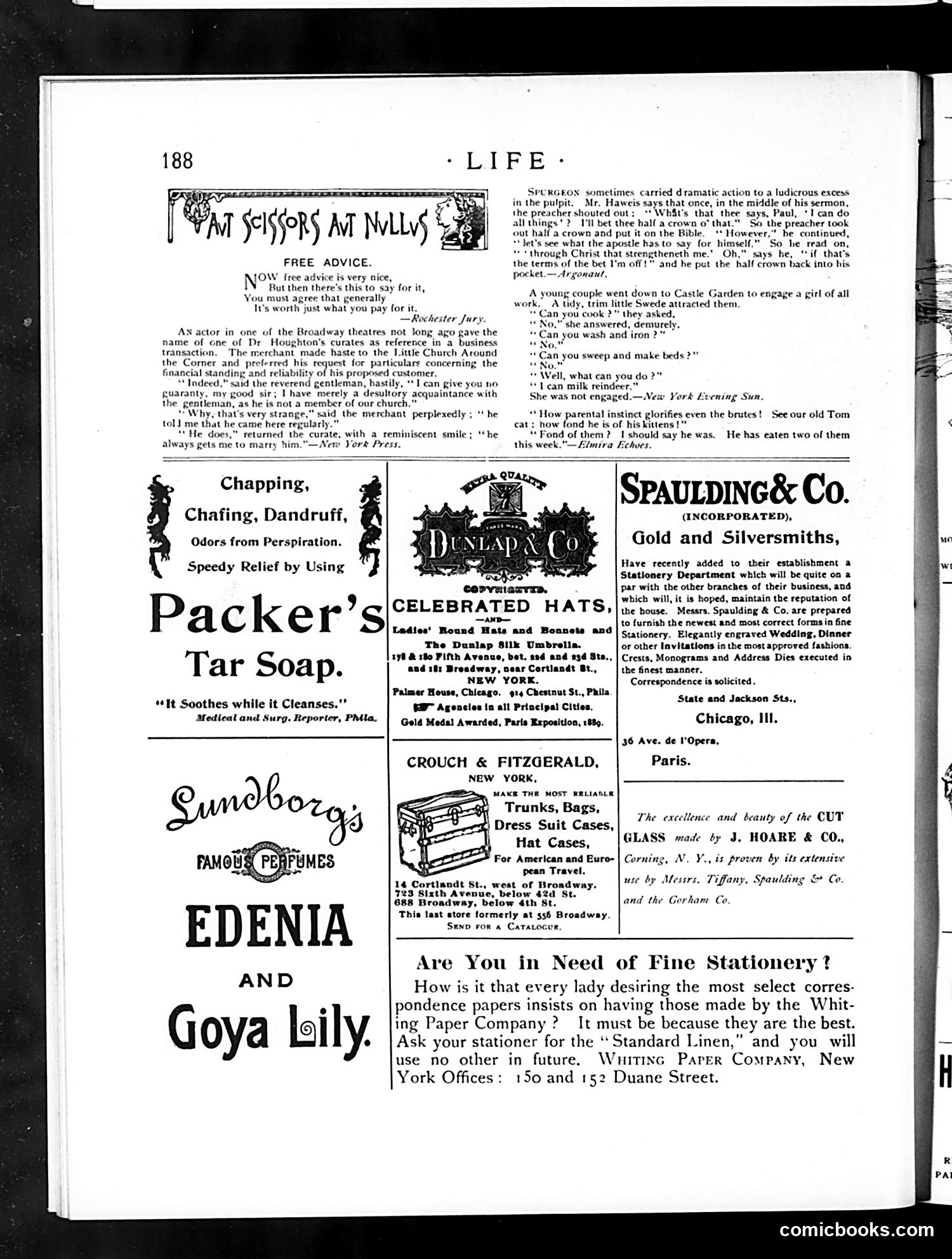
This page is primarily **advertisements** with brief satirical anecdotes at the top. The main content includes: **Satirical Anecdotes:** - A story about an actor using a clergyman's name as a business reference, only to have the clergyman deny knowing him well—a joke about the disconnect between church attendance and actual membership - A humorous snippet about Spurgeon (a famous preacher) making a theatrical bet during a sermon, satirizing overly dramatic preaching - A brief comedy piece about immigrants' job qualifications: a young Swedish woman applying as a maid can only "milk reindeer," making her unemployable **Advertisements:** The page features typical late 19th-century product ads: Packer's Tar Soap, Dunlap Hats, Crouch & Fitzgerald luggage, Spaulding & Co. stationery and silverware, and high-end glass makers. These reflect the magazine's affluent readership. The humor is gentle, domestic, and class-conscious rather than politically pointed.
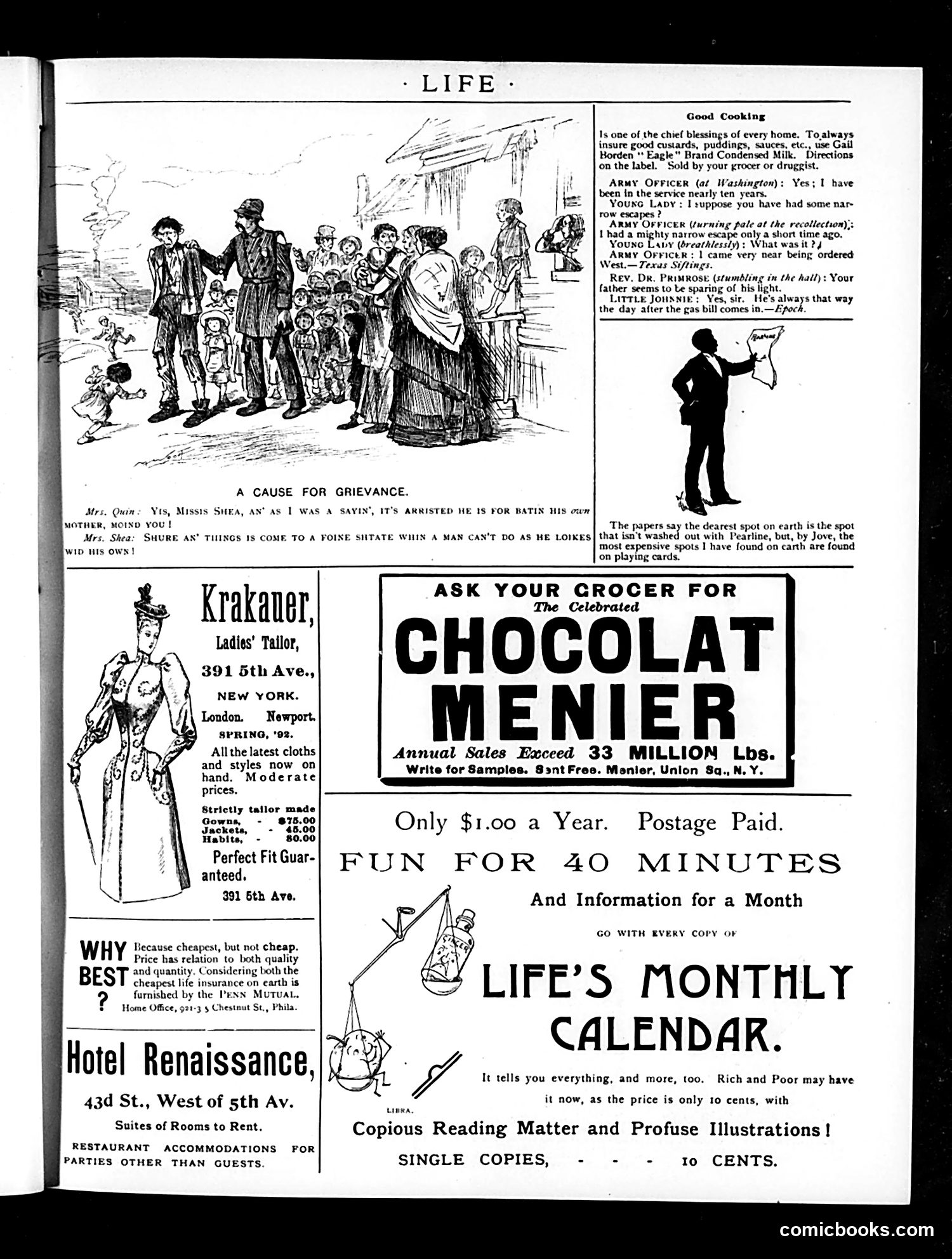
The main cartoon depicts two Irish working-class women (Mrs. Quin and Mrs. Shea, indicated by their dialect) discussing a domestic abuse case. Mrs. Quin mentions a man arrested "for batin' his own mother," and Mrs. Shea responds that things have reached a "fine state" when a man can't do as he likes with his own family. The satire targets two things: (1) the casual acceptance of domestic violence in working-class Irish communities, presented through heavy ethnic dialect for comic effect, and (2) the absurdity of the legal system's intervention in "private" family matters. By modern standards, this reveals the era's deeply uncomfortable attitudes toward spousal and parental abuse—what was once considered a man's prerogative is now recognized as criminal. The "humor" relies entirely on ethnic caricature and the shocking (to 1890s readers) notion that law enforcement would interfere in family violence.
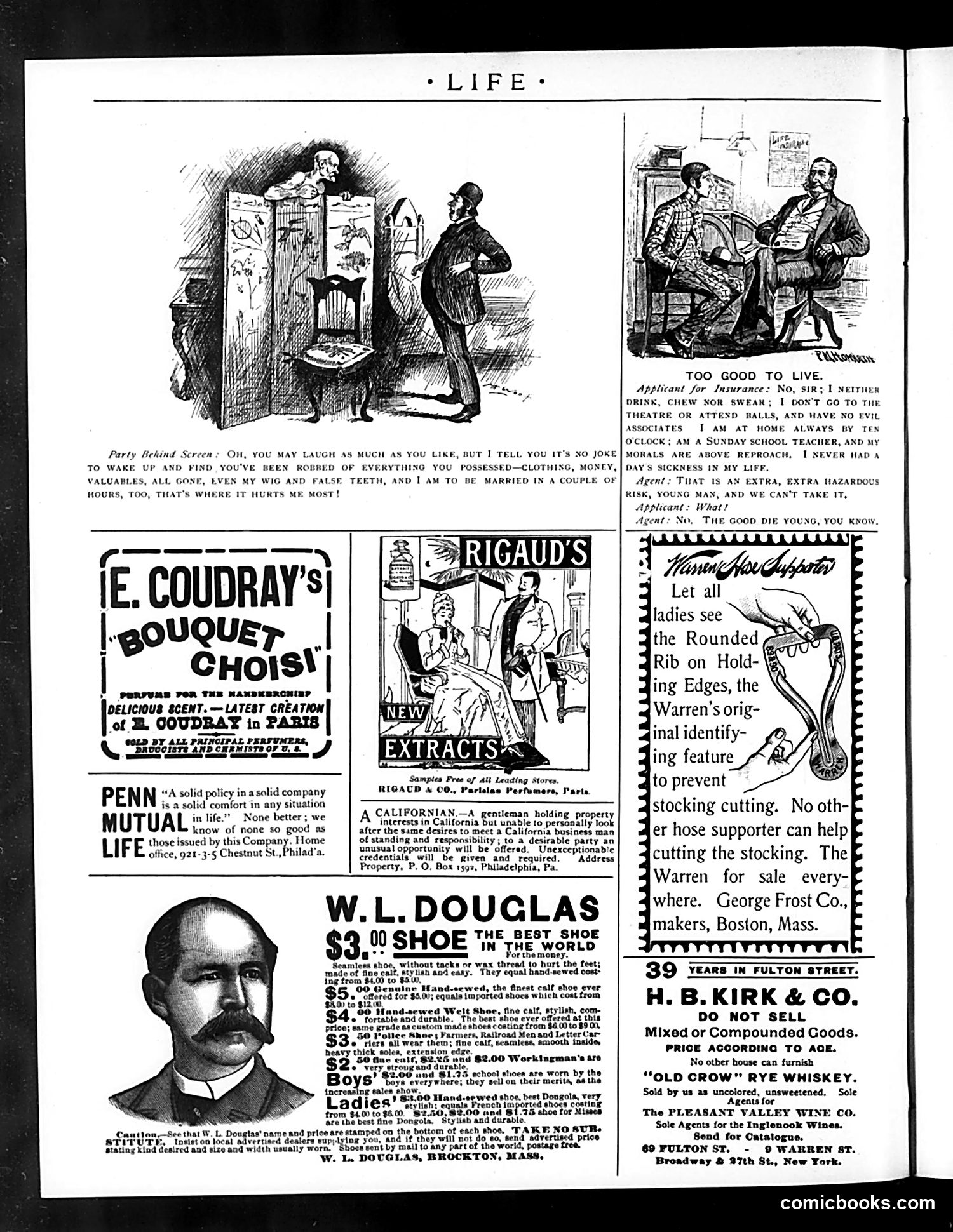
This cartoon mocks life insurance underwriting practices of the era. An applicant for insurance lists impeccable credentials: he neither drinks, swears, gambles, nor frequents theaters; he's always home by ten, teaches Sunday school, and has never been sick. The insurance agent rejects him anyway, declaring him an "extra, extra hazardous risk" because "the good die young." The joke satirizes the absurdity of insurance logic—that virtuous living paradoxically makes one uninsurable. It's darkly humorous commentary on how insurance companies find reasons to deny coverage, inverting normal expectations: being *too* moral becomes grounds for rejection rather than acceptance. The accompanying dialogue about being robbed and married reinforces the theme that life's unpredictability makes everyone risky to insure, regardless of character. The page is primarily advertisements for period products (perfume, shoes, whiskey) with this single satirical cartoon.