
Life, 1892-03-24 · page 9 of 16
Life — March 24, 1892 — page 9: what you’re looking at
What you’re looking at
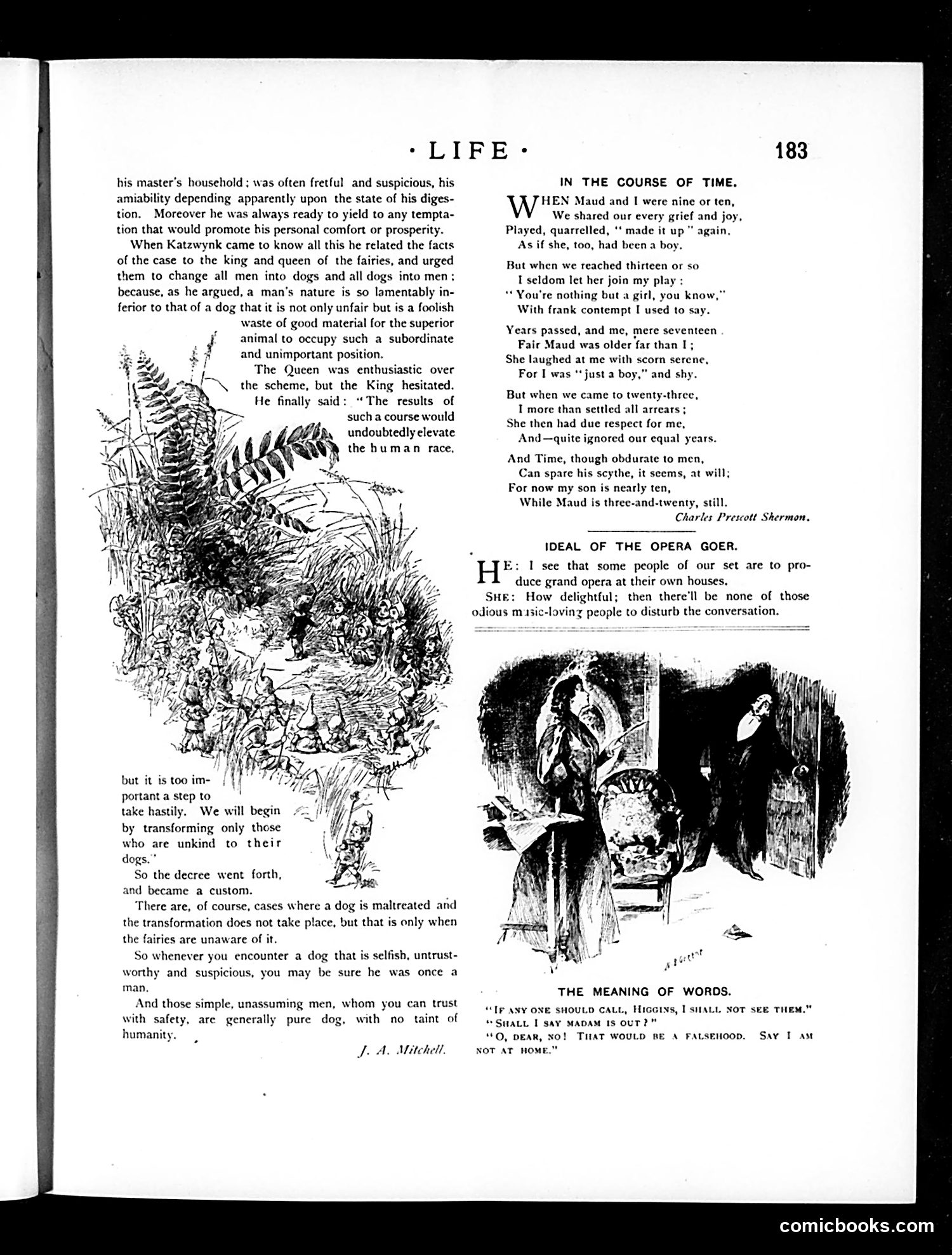
This page contains three distinct pieces: 1. **Left illustration**: A detailed fairy-tale scene depicting what appears to be a transformation narrative, accompanying text about dogs and human nature (attributed to J.A. Mitchell). 2. **"In the Course of Time"** (center): A poem by Charles Prescott Sherman about aging and a relationship with "Maud," tracing their bond from childhood through adulthood as both mature. 3. **"Ideal of the Opera Goer"** (right): A satirical dialogue mocking opera attendees who disrupt performances with conversation, featuring a dark illustration of people at an opera house. The page primarily targets social pretension and behavioral rudeness among the upper classes attending cultural events, while the poem reflects on time's passage and changing relationships—typical themes for Life's satirical commentary on American society.
📄 Transcribed text from this page (OCR, searchable)
Machine-transcribed from the original scan — historical spelling and the odd misread are preserved.
> LIFE: his master’s household ; was often fretful and suspicious, his amiability depending apparently upon the state of his diges- tion. Moreover he was always ready to yield to any tempta- tion that would promote his personal comfort or prosperity. When Katzwynk came to know all this he related the facts of the case to the king and queen of the fairies, and urged them to change all men into dogs and all dogs into men; because, as he argued, a man’s nature is so lamentably in- ferior to that of a dog that it is not only unfair but is a foolish waste of good material for the superior animal to occupy such a subordinate and unimportant position. The Queen was enthusiastic over the scheme, but the King hesitated. He finally said: “The results of such a course would undoubtedly elevate the human race, but it is too im- portant a step to take hastily. We will begin by transforming only those who are unkind to their dogs.” So the decree went forth, and became a custom. There are, of course, cases where a dog is maltreated and the transformation does not take place, but that is only when the fairies are unaware of it. So whenever you encounter a dog that is selfish, untrust- worthy and suspicious, you may be sure he was once a man. And those simple, unassuming men, whom you can trust with safety, are generally pure dog, with no taint of humanity. J. AL Mitchell. IN THE COURSE OF TIME. HEN Maud and I were nine or ten, We shared our every grief and joy. Played, quarrelled, ‘* made it up” again, Asif she, too, had been a boy. But when we reached thirteen or so I seldom let her join my play : “You're nothing but a girl, you know,” With frank contempt I used to say. Years passed, and me, mere seventeen Fair Maud was older far than 1; She laughed at me with scorn serene, For I was “just a boy,” and shy. But when we came to twenty-three, I more than settled all arrears ; She then had due respect for me, And—quite ignored our equal years. And Time, though obdurate to men, Can spare his scythe, it seems, at will; For now my son is nearly ten, While Maud is three-and-twenty, still. Charles Prescott Shermon, IDEAL OF THE OPERA GOER. I see that some people of our set are to pro- duce grand opera at their own houses, H SHE: How delightful; then there'll be none of those odious music-lovinz people to disturb the conversation. THE MEANING OF WORDS. “TF ANY ONE SHOULD CALL, Hicotns, I siALL NoT see THEM.” “SHALL I SAY MADAM IS OUT?" “*O, DEAR, NO! THAT WOULD BE NOT AT HOME. A FALSEHOOD, Say IT ast comicbooks.com