
Life, 1892-03-24 · page 6 of 16
Life — March 24, 1892 — page 6: what you’re looking at
What you’re looking at
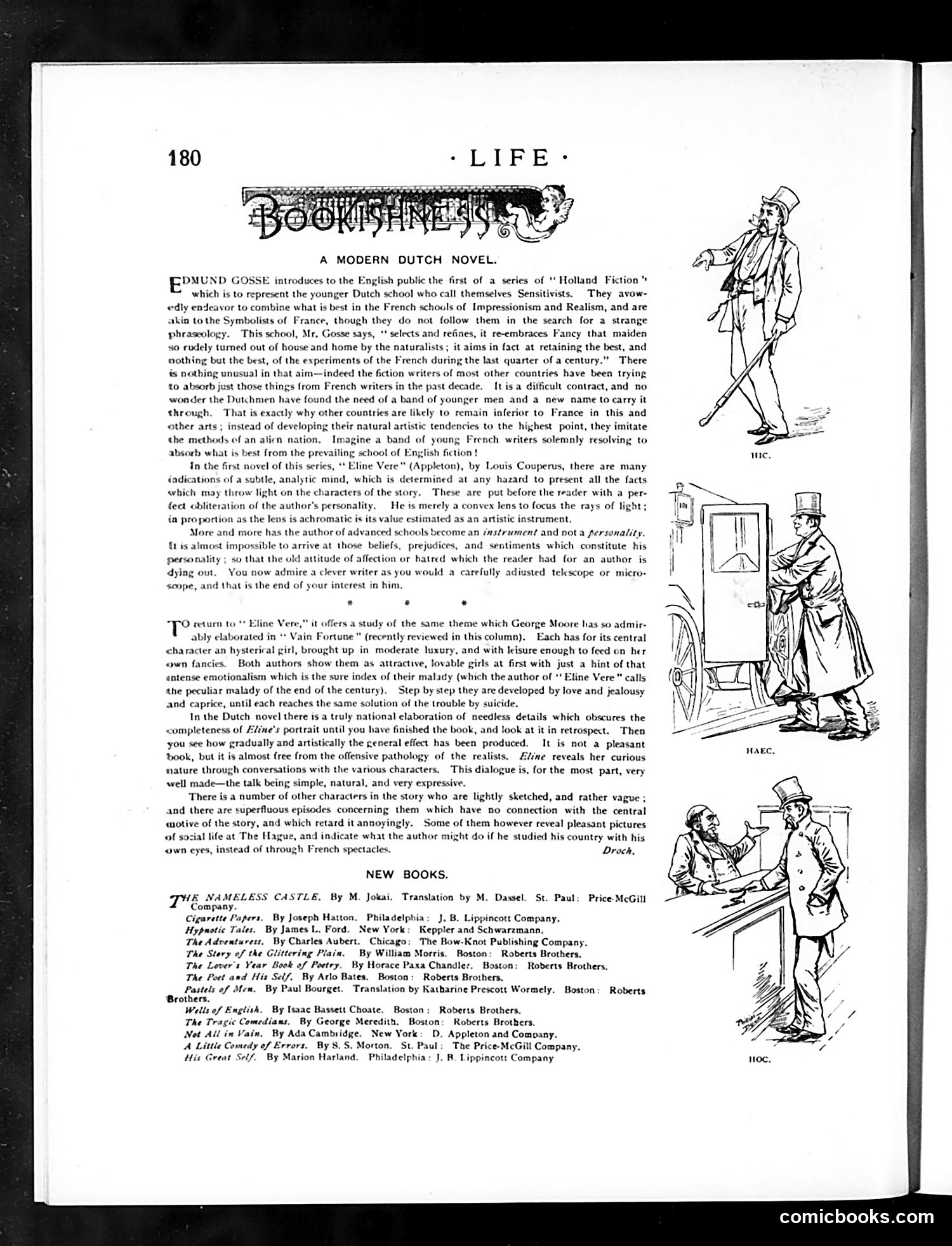
This page primarily contains a literary review of "Boomshrine," a modern Dutch novel by Edmund Gosse, discussing how Dutch writers are developing new artistic tendencies distinct from French influences. The three small sketches on the right (labeled HIC, HAEC, HOC) appear to be Latin grammar jokes—these are the nominative forms of the Latin demonstrative pronoun "this" in masculine, feminine, and neuter cases. The cartoons humorously illustrate the grammatical genders through character sketches: a man, a woman, and what appears to be an androgynous or ambiguous figure, visually parodying the Latin declension lesson. The bottom section lists "NEW BOOKS," announcing recent literary publications from various American publishers.
📄 Transcribed text from this page (OCR, searchable)
Machine-transcribed from the original scan — historical spelling and the odd misread are preserved.
A MODERN DUTCH NOVEL. DMUND GOSSE introduces to the English public the first of a series of “Holland Fiction "+ which is to represent the younger Dutch school who call themselves Sensitivists. They avow- edly endeavor to combine what is best in the French schools of Impressionism and Realism, and are kin to the Symbolists of France, though they do not follow them in the search for a strange phraseology. This school, Mr. Gosse says, ‘* selects and refines, it re-embraces Fancy that maiden so rudely turned out of house and home by the naturalists; it aims in fact at retaining the best, and nothing but the best, of the experiments of the French during the last quarter of a century.” There és nothing unusual in that aim—indeed the fiction writers of most other countries have been trying to absorb just those things from French writers in the past decade, It is a difficult contract, and no wonder the Dutchmen have found the need of a band of younger men and a new name to carry it through. That is exactly why other countries are likely to remain inferior to France in this and other arts; instead of developing their natural artistic tendencies to the highest point, they imitate the methods of an alien nation, Imagine a band of young French writers solemnly resolving to absorb what is best from the prevailing school of English fiction ! In the first novel of this series, ‘* Eline Vere” (Appleton), by Louis Couperus, there are many éadications of a subtle, analytic mind, which is determined at any hazard to present all the facts which may throw light on the characters of the story, These are put before the reader with a per- fect obliteration of the author's personality, He is merely a convex lens to focus the rays of light; ia proportion as the lens is achromatic is its value estimated as an artistic instrument. More and more has the author of advanced schools become an instrument and nota personality. {1 is almost impossible to arrive at those beliefs, prejudices, and sentiments which constitute his personality ; so that the old attitude of affection or hatred which the reader had for an author is dying out. You now admire a clever writer as you would a carefully adiusted telescope or micro- soope, and that is the end of your interest in him. ‘O return to * Eline Vere,” it offers a study of the same theme which George Moore has so admir- ably elaborated in * Vain Fortune " (recently reviewed in this column). Each has for its central character an hysterical girl, brought up in moderate luxury, and with leisure enough to feed on her ‘own fancies. Both authors show them as attractive, lovable girls at first with just a hint of that éntense emotionalism which is the sure index of their malady (which the author of *' Eline Vere" calls ‘the peculiar malady of the end of the century). Step by step they are developed by love and jealousy and caprice, until each reaches the same solution of the trouble by suicide, In the Dutch novel there is a truly national elaboration of needless details which obscures the completeness of Edine’s portrait until you have finished the book, and look at it in retrospect. Then you see how gradually and artistically the general effect has been produced. It is not a pleasant Dook, but it is almost free from the offensive pathology of the realists. Eline reveals her curious nature through conversations with the various characters, This dialogue is, for the most part, very well made—the talk being simple, natural, and very expressive. There is a number of other characters in the story who are lightly sketched, and rather vague ; and there are superfluous episodes concerning them which have no connection with the central motive of the story, and which retard it annoyingly. Some of them however reveal pleasant pictures of social life at The Hague, and indicate what the author might do if he studied his country with his own eyes, instead of through French spectacles. Drock. NEW BOOKS. ‘SS CASTLE. By M. Jokai. Translation by M. Dassel. St. Paul: Price-McGill Cigarette Papers. By Joseph Hatton. Philadelphia: J. B. Lippincott Company. Hypnotic Tales. By James L.. Ford. New York: Keppler and Schwarzmann, The Adventuress, By Charles Aubert. Chicago: The Bow-Knot Publishing Company. The Story of the Glittering Plain. By William Morris. Boston: Roberts Brothers, The Lover's Year Book of Poetry. By Horace Paxa Chandler, Boston: Roberts Brothers. The Poet and His Self, By Arlo Bates, Boston: Roberts Brothers. Pastels of Men, By Paul Bourget. Translation by Katharine Prescott Wormely. Boston: Roberts Brothers. Wells of English. By Isaac Bassett Choate. Boston; Roberts Brothers, The Tragic Comedians, By George Meredith, Boston: Roberts Brothers. ¢ Al! in Vain, By Ada Cambridge, New York: D. Appleton and Company. le Comedy of Errors. By 8.5. Morton. St.Paul: The Price McGill Company. ion Harland, Philadelphia: J. R. Lippincott Company comicbooks.com