
A complete issue · 18 pages · 1892
Life — March 17, 1892
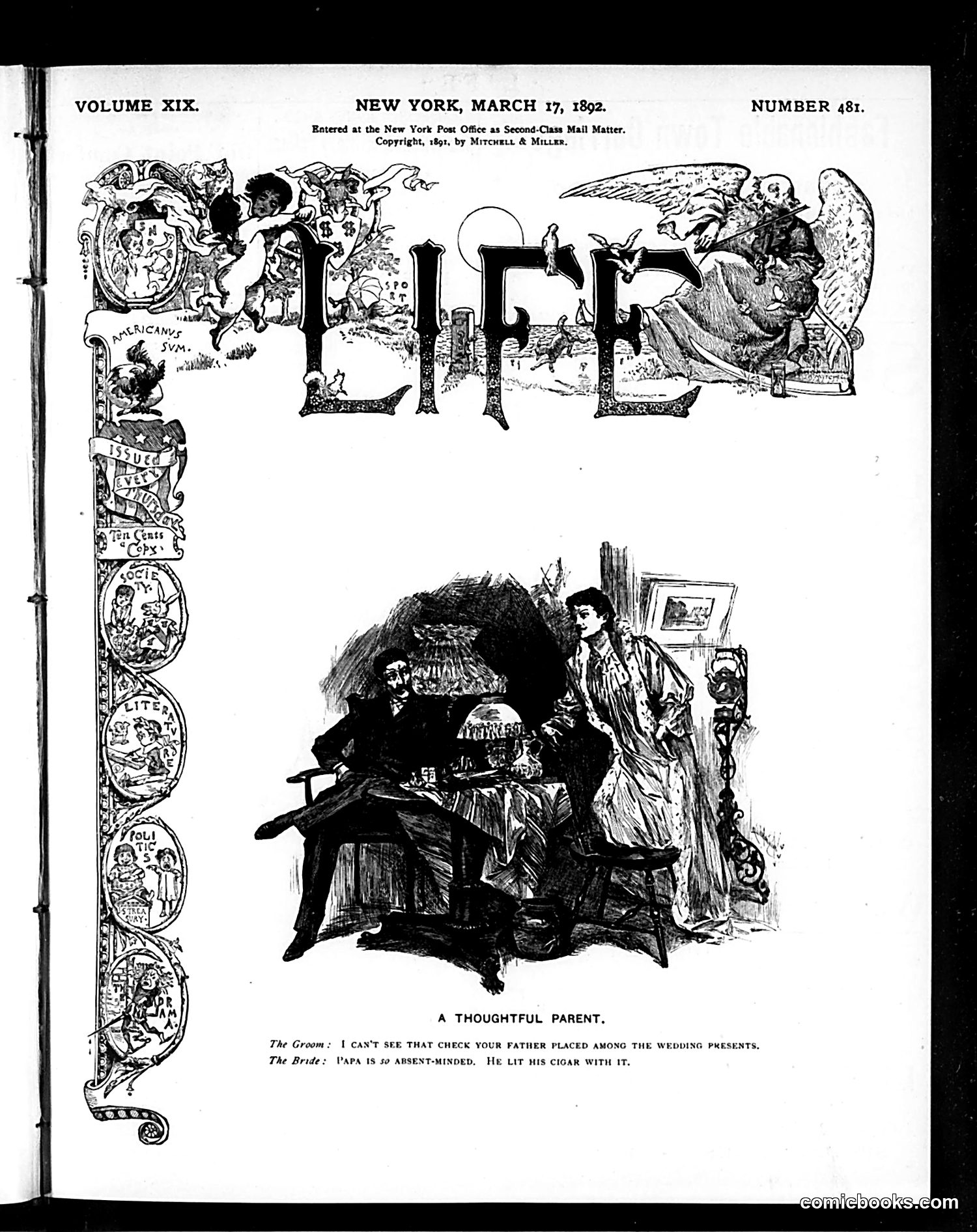
This single-panel cartoon satirizes a groom's absent-minded father at a wedding reception. The joke is straightforward domestic humor: the groom's father has absentmindedly placed a cigar (part of the wedding presents) in his mouth and lit it, rather than setting it aside with the other gifts. The bride comments to the groom that she cannot find the check his father placed among the wedding presents—because Papa has unconsciously smoked it along with the cigar. It's a pun on the double meaning of "check" (financial instrument vs. a checkered cigar band pattern). The satire mocks absent-minded older men and their preoccupation with cigars—a common leisure activity for wealthy gentlemen of the era. It's mild, family-appropriate humor typical of Life's editorial cartooning.
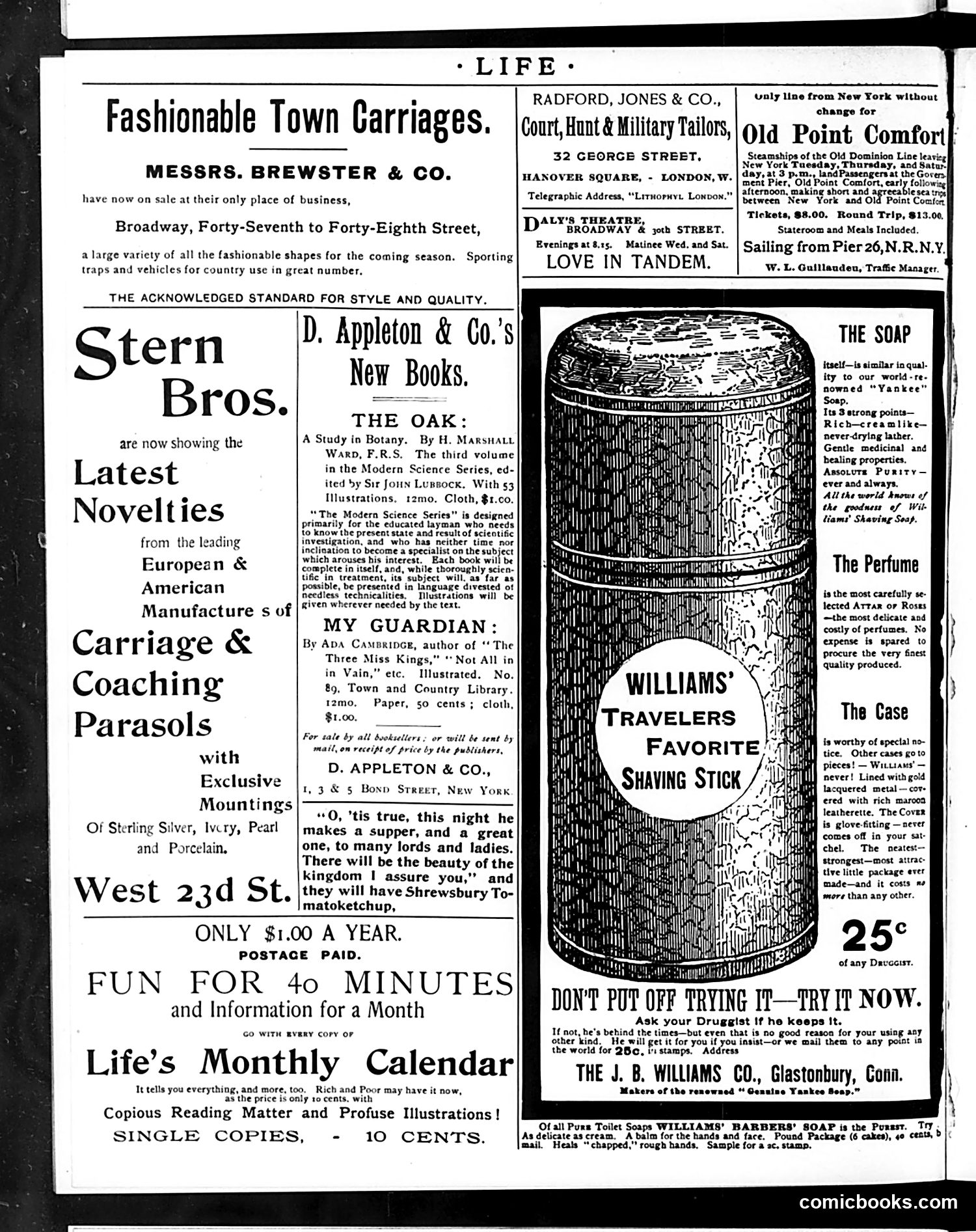
This page is **primarily advertising**, not satirical content. It contains six distinct advertisements for period products (circa 1880s-1890s): 1. **Messrs. Brewster & Co.** — fashionable carriages on Broadway 2. **Stern Bros.** — carriage parasols in sterling silver and porcelain 3. **D. Appleton & Co.** — new books including "The Oak" and "My Guardian" 4. **Radford, Jones & Co.** — tailors on Hanover Square, London 5. **Old Point Comfort** — steamship line from New York 6. **Williams' Travelers Favorite Shaving Stick** — the largest ad, featuring a product container The page also promotes **Life's Monthly Calendar** (10 cents) as entertainment reading. **No political cartoons or satire appear here.** This is a straightforward commercial advertising page from Life magazine's monetization.
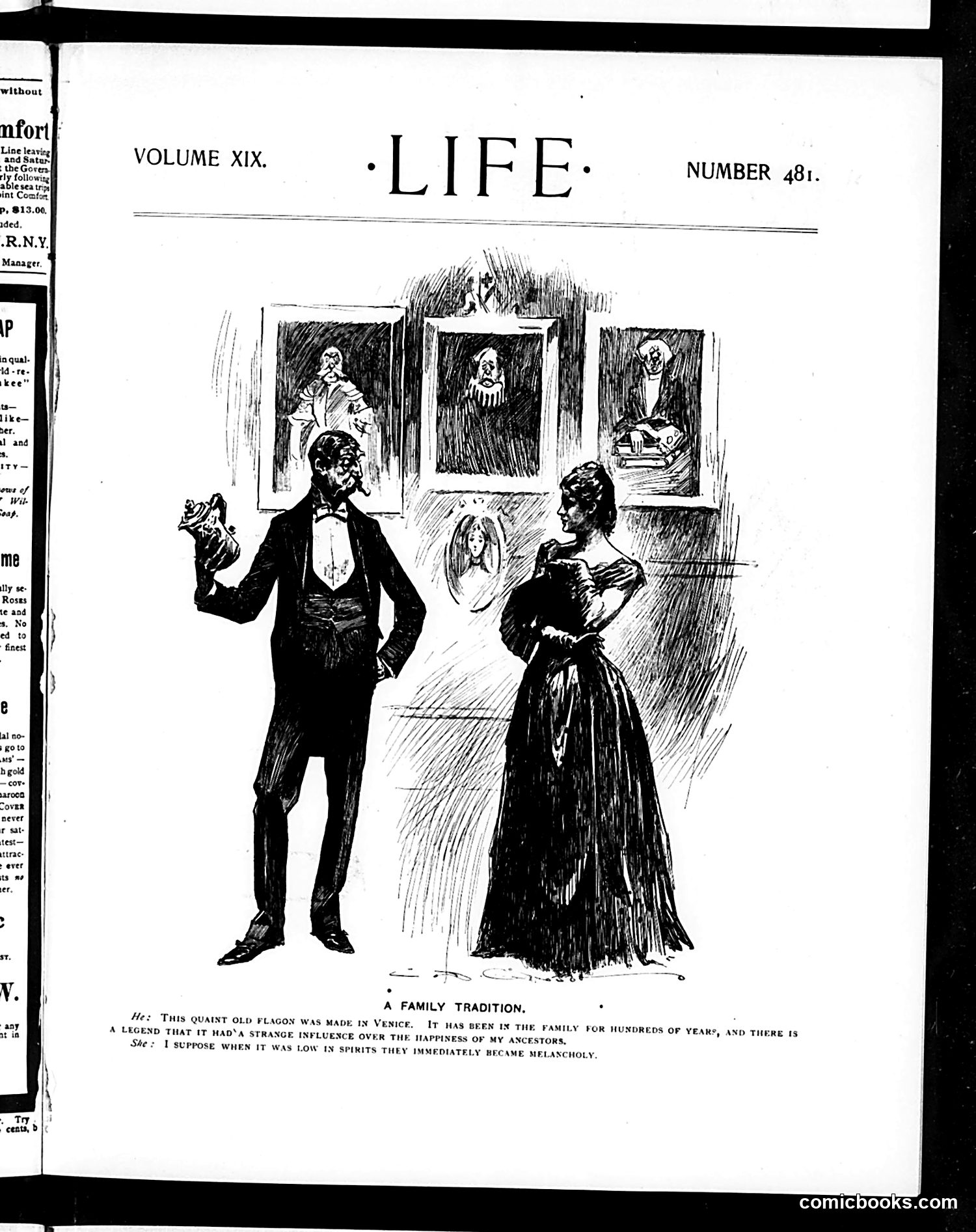
This cartoon depicts a man in formal evening wear showing a woman a portrait gallery. The caption indicates the framed images on the wall are ancestral portraits, establishing a "family tradition" of a "quaint old flagon" (bottle) made in Venice that has influenced family happiness for centuries. The satire plays on aristocratic pretension: the man is proudly displaying what appears to be a haunted or cursed family heirloom, treating it as a cherished tradition. The woman's skeptical expression suggests she questions this dubious "legacy." The joke mocks how wealthy families romanticize and perpetuate superstitions or questionable inheritances as noble family customs, rather than recognizing them as nonsensical or problematic behaviors passed through generations.
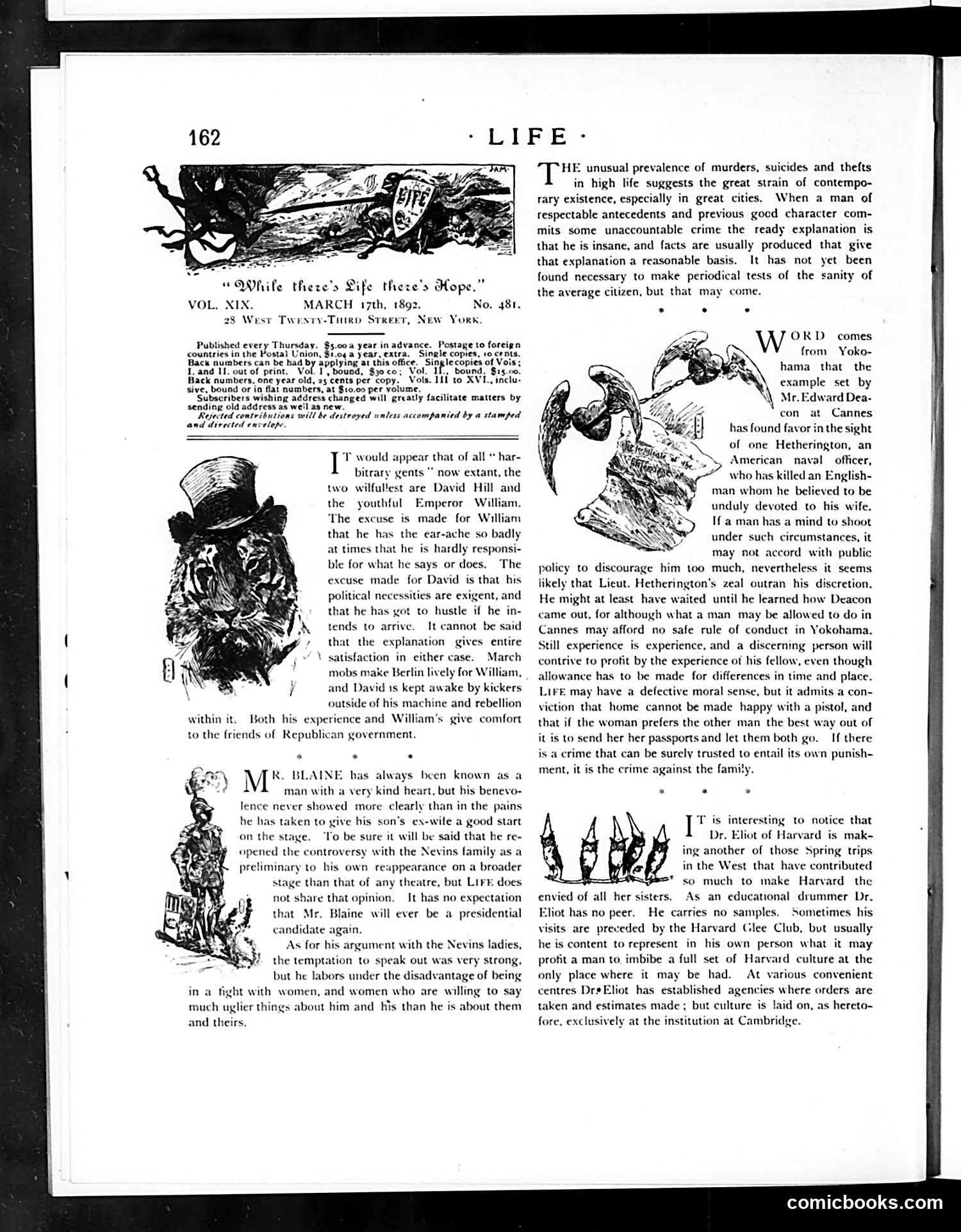
The page contains three political caricatures with accompanying satirical commentary. The first cartoon (top left) depicts what appears to be **David Hill and Emperor William** in conflict, referencing their political rivalry. The text suggests Hill faces criticism for his political necessities and conduct. The second cartoon features **Mr. Blaine**, described as a man "with a very kind heart" whose benevolence is questioned regarding help given to his son's ex-wife. The satire critiques his opening of controversies with the Nevins family as preparation for a broader political reappearance. The third illustration shows figures related to **Dr. Eliot of Harvard**, satirizing his educational initiatives and western expansion of Harvard's cultural influence. The page's overall thrust mocks prominent political and social figures of the 1892 era through exaggerated caricature and ironic commentary.
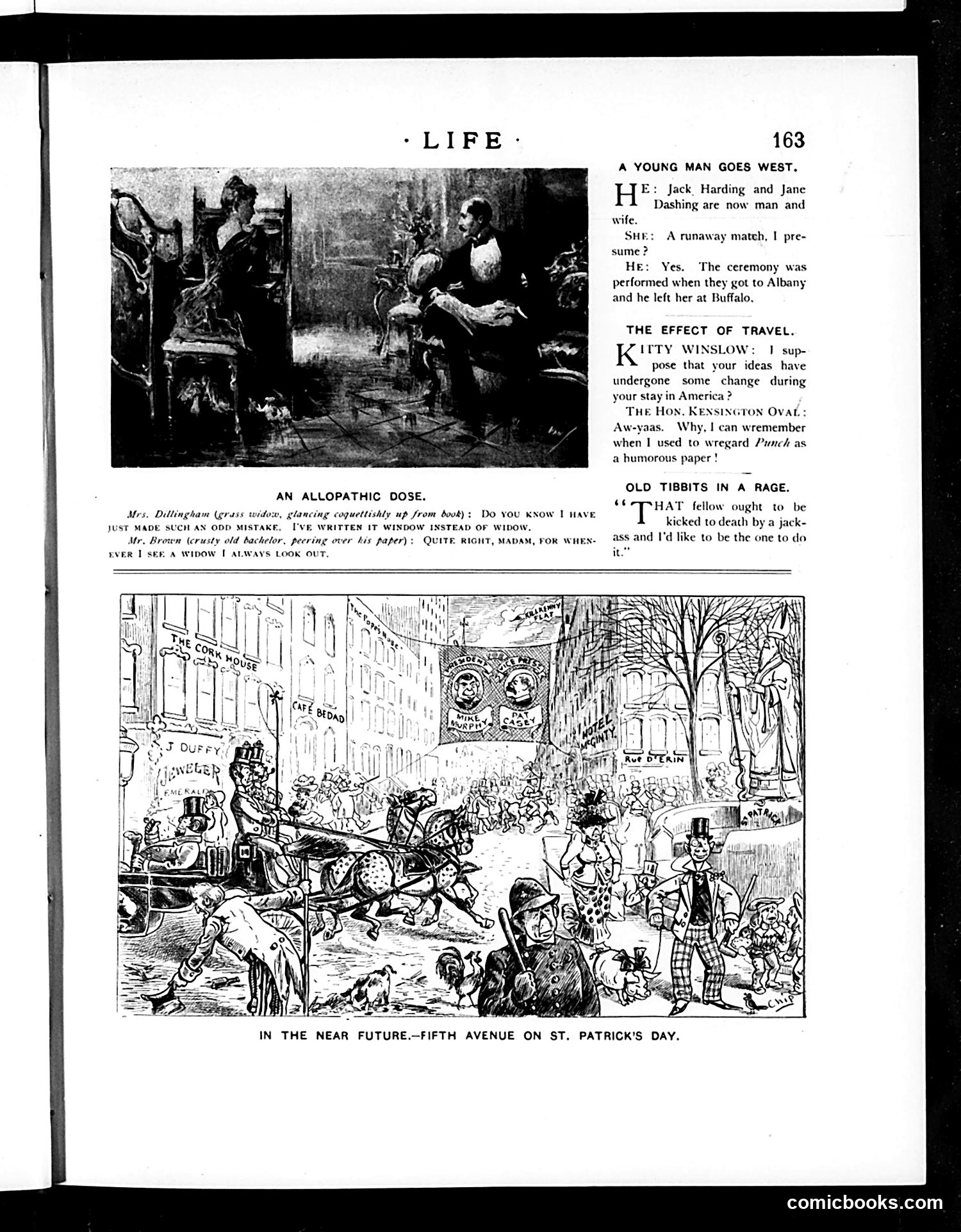
This page contains three separate satirical pieces: 1. **"An Allopathic Dose"** (top): A domestic scene mocking Mrs. Dillingham for writing to newspapers complaining about widows, while Mr. Brown (her husband) sarcastically suggests windows need "looking out" — a visual pun on her complaints about the view. 2. **"A Young Man Goes West"** (right column): Brief dialogue about Jack Harding and Jane Dashing's hasty marriage in Albany/Buffalo, with Kitty Winslow noting how travel changes people's ideas. 3. **"In the Near Future—Fifth Avenue on St. Patrick's Day"** (bottom): A satirical prediction showing a chaotic St. Patrick's Day parade with horse-drawn carriages, crowds, and general mayhem on New York's Fifth Avenue, poking fun at the holiday's anticipated disorder. The humor relies on domestic comedy and social observation typical of early 20th-century Life magazine.
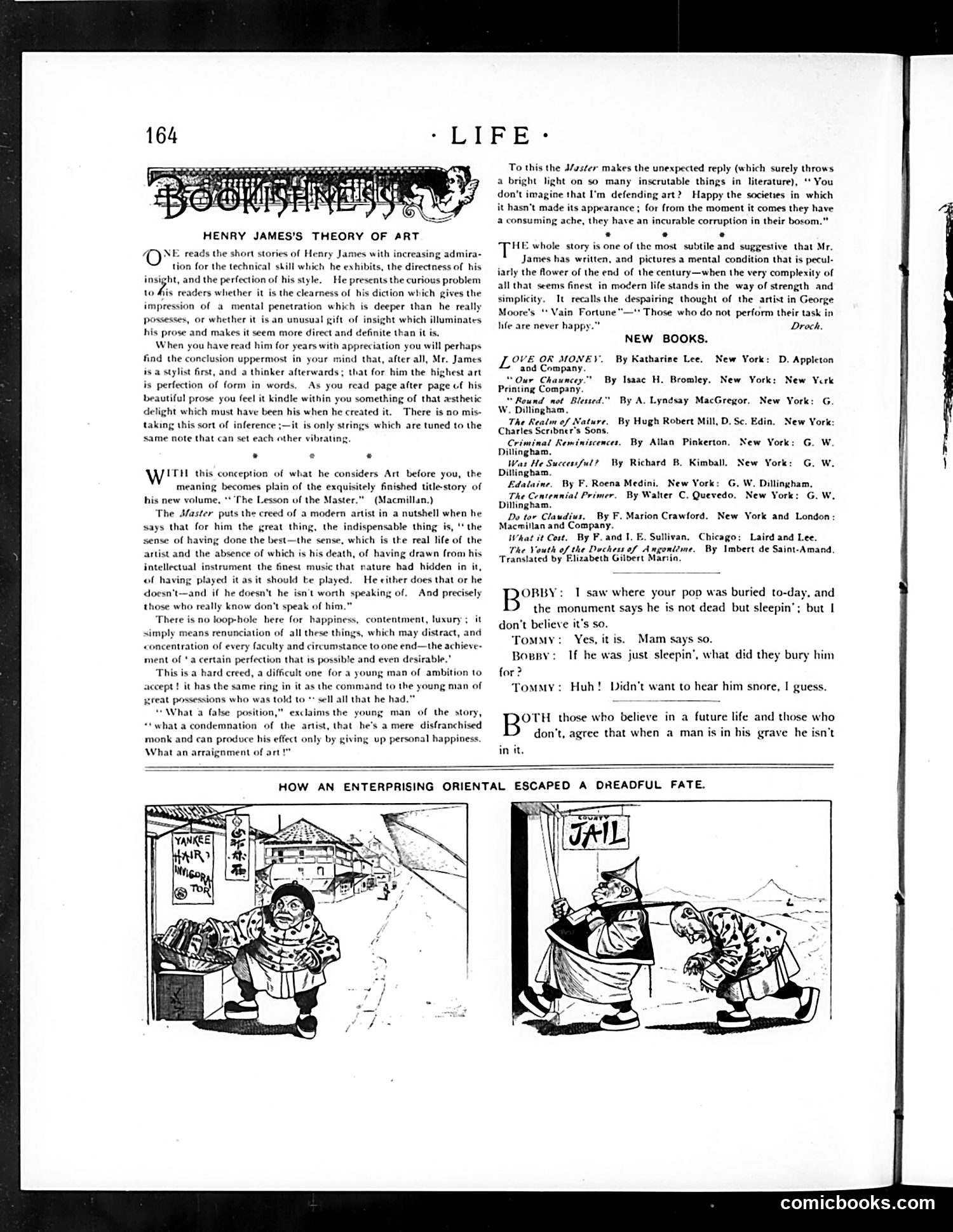
This two-panel cartoon depicts a figure in Asian dress (caricatured with exaggerated features typical of the era's racist imagery) escaping from jail. In the first panel, he stands outside a Japanese jail. In the second, he's shown breaking free from the structure. The satire appears to mock either Asian criminality or, conversely, to celebrate cunning escape from an unjust imprisonment. The phrase "enterprising Oriental" uses contemporary racial terminology. Without additional context about the specific historical event referenced, the exact political point remains unclear—whether it's commentary on Asian immigration, criminal justice, or international relations. The cartoon relies heavily on offensive stereotypes standard to early 20th-century American satire.
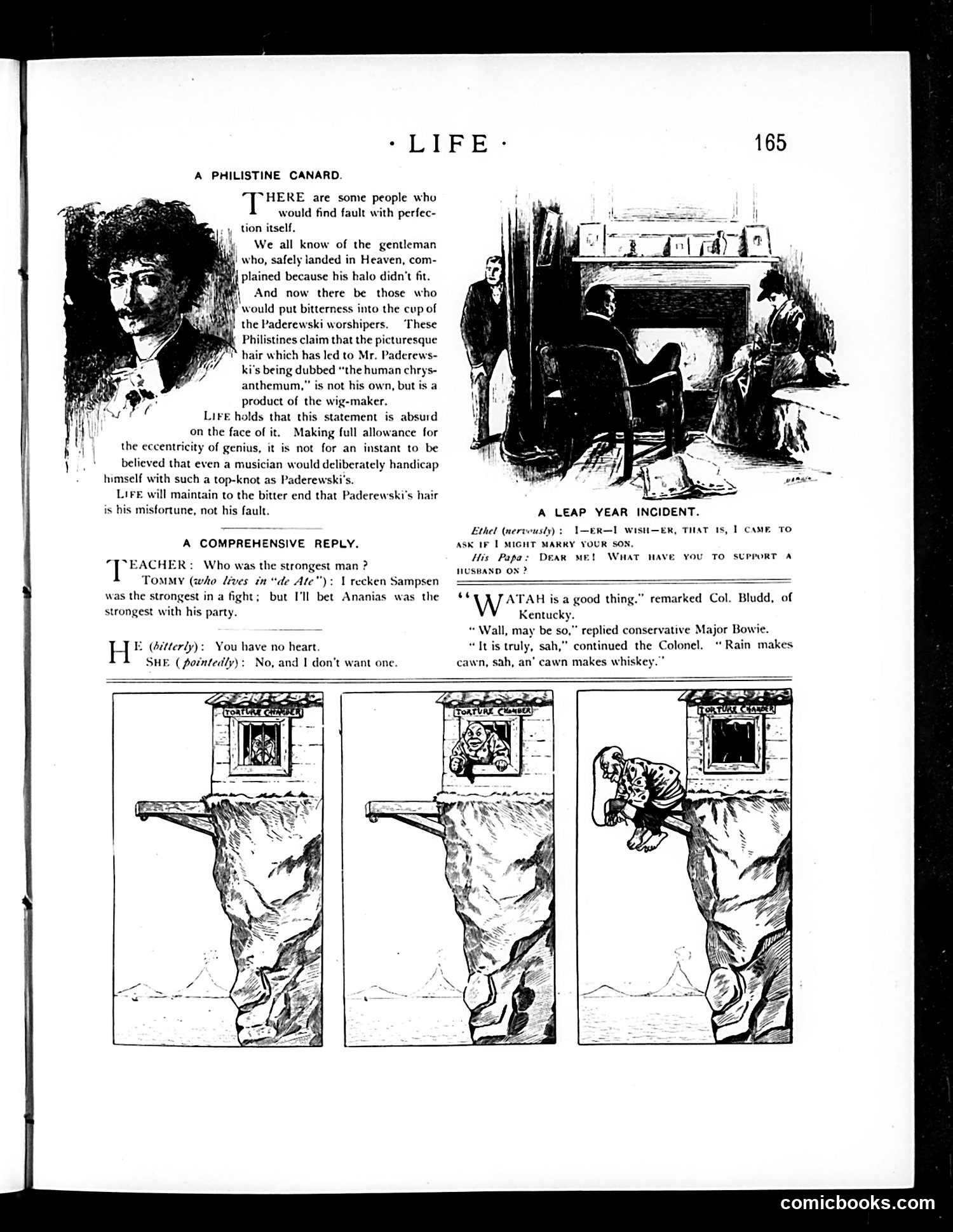
**"A Philistine Canard"** critiques those who fault perfection itself, referencing Paderewski (likely the famous pianist/statesman) and his distinctive "human chrysanthemum" hairstyle. The satire defends eccentric genius against philistine criticism. **"A Comprehensive Reply"** shows a humorous teacher-student exchange about strength, with the student claiming Tommy (likely a boxer) was strongest, then asserting Ananias was stronger. The joke plays on Ananias as a biblical figure associated with lies. **"A Leap Year Incident"** depicts a domestic conversation where a wife proposes marriage to her husband. The exchange about watah (water) and whiskey appears to satirize Southern dialect and domestic attitudes. The three-panel cartoon below remains unclear without additional context about the tortoise cottage setting.
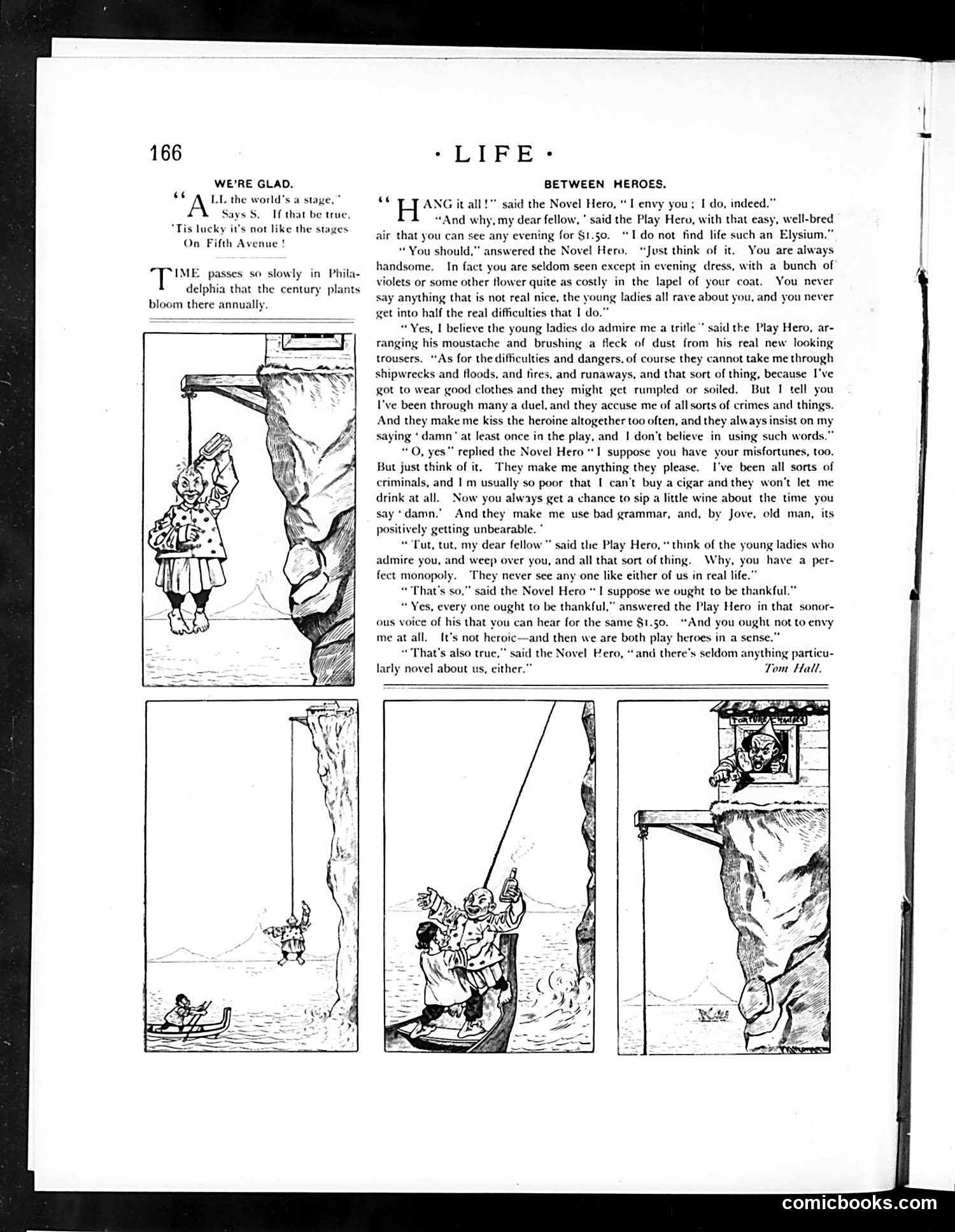
This page contains two distinct pieces: **"We're Glad"** (left): A brief satirical comment on Philadelphia's slow passage of time, illustrated with a sketch of a small child dwarfed by an enormous adult figure—likely mocking the city's sluggish pace and outdated character. **"Between Heroes"** (right): A dialogue between a "Novel Hero" and "Play Hero" debating the relative hardships of their professions. The Novel Hero complains about poverty, bad grammar, and constant accusations of criminality, while the Play Hero brags about wealthy admirers and $1.50 theater tickets. The satire targets the pretension of stage actors versus literary characters, mocking theatrical self-importance and the gap between stage glamour and literary realism. The accompanying comic strip illustrates their respective worlds. Both pieces satirize contemporary American cultural hierarchies and pretensions.
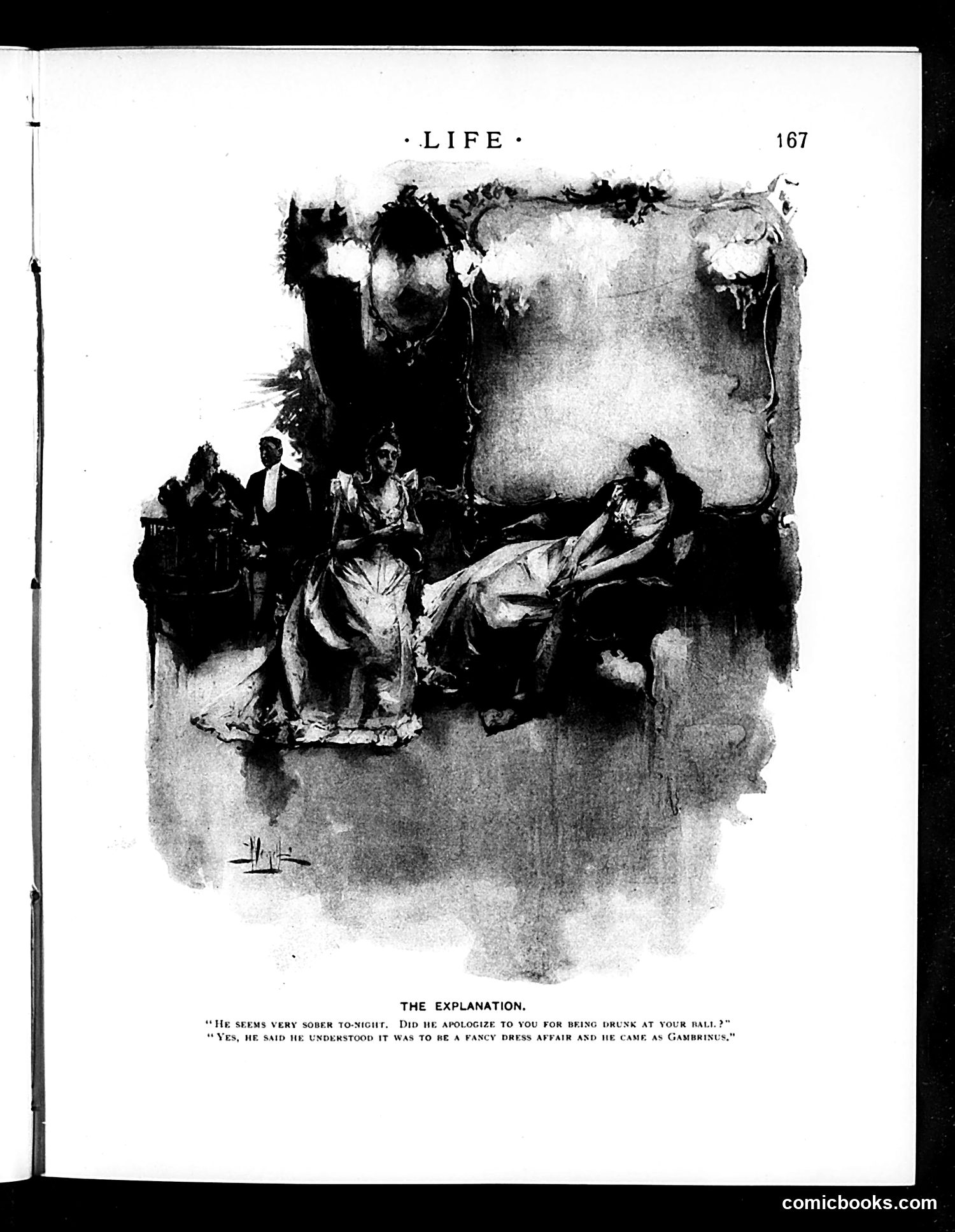
This cartoon satirizes a social embarrassment at a formal ball. The caption reveals the joke: a man appeared drunk at an elegant event, and when confronted, he claimed he misunderstood—he thought it was a "fancy dress affair" and came dressed as "Gambrinus" (the legendary Flemish king associated with beer and brewing). The humor works on multiple levels: the man's excuse is obviously absurd (implying his drunkenness was intentional costume performance rather than loss of control), and "Gambrinus" is a transparent, ridiculous alias for someone behaving like a drunkard. The sketch depicts well-dressed society figures reacting to this social transgression, mocking both the offender's transparent lie and the pretensions of formal social gatherings.
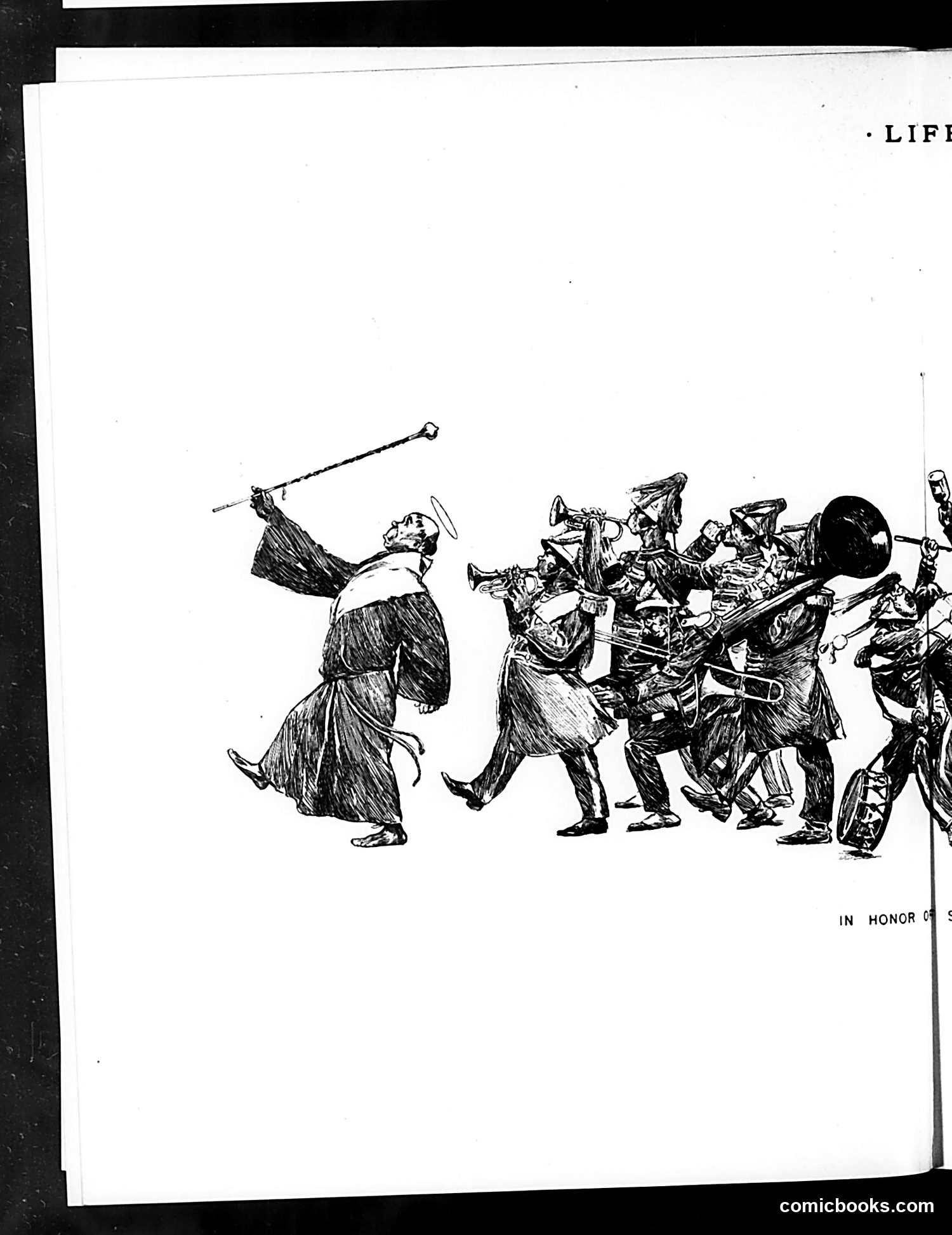
This ink drawing depicts a satirical scene of a conductor leading an orchestra. On the left, a figure wielding a baton appears to be conducting with dramatic flair. The orchestra members on the right are playing various brass and wind instruments in an energetic, somewhat chaotic manner. The partial text visible reads "IN HONOR O[F]" at the bottom right, suggesting this cartoon commemorates or mocks a specific person or event, though the complete context is cut off in this image. Without the full caption or date, the specific political/social reference remains unclear. However, the exaggerated conducting style and orchestra composition suggest satire about musical performance, possibly critiquing leadership, coordination, or a particular public figure's management style. The style is consistent with early-to-mid 20th century American political cartooning.
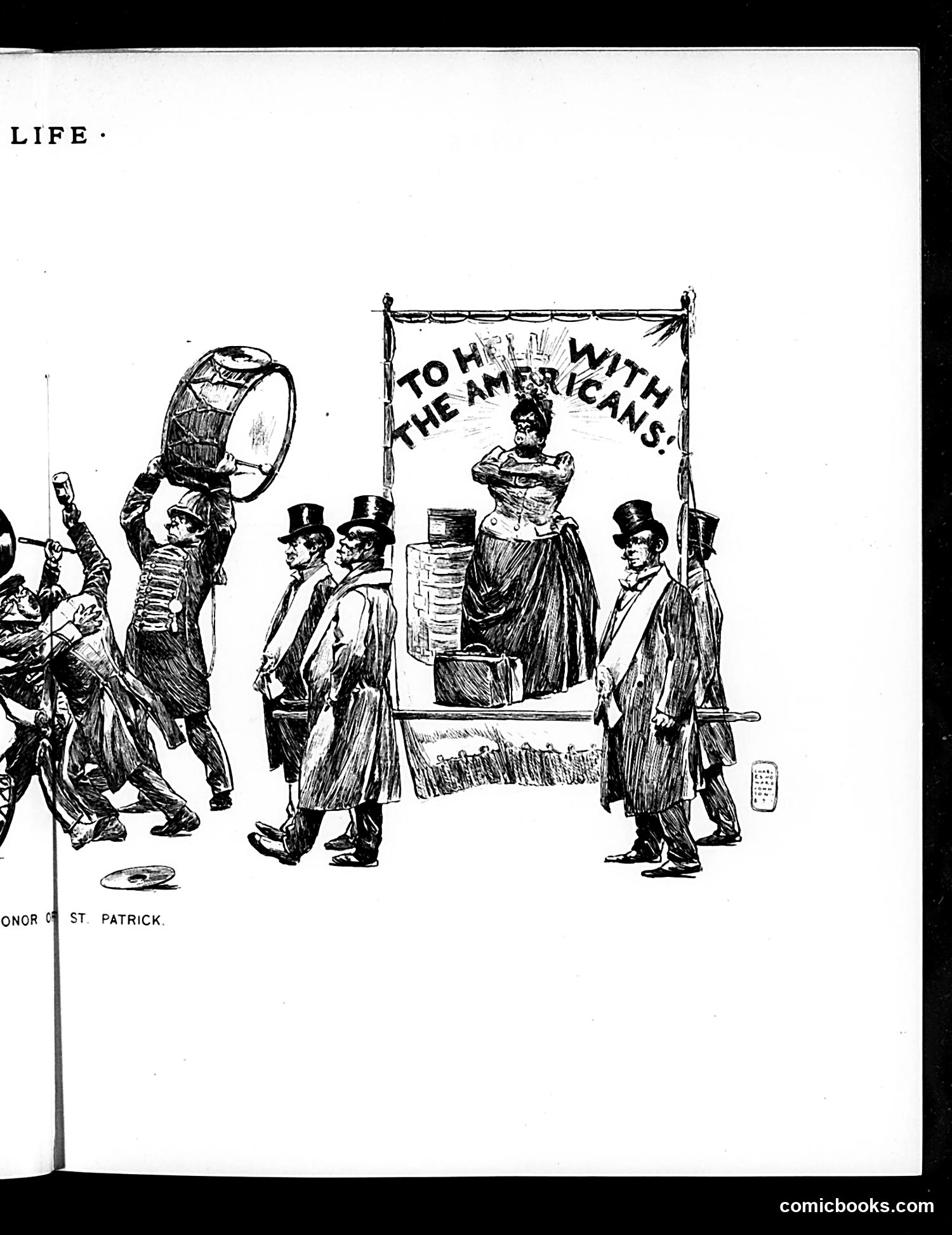
This is a satirical cartoon from *Life* magazine depicting a St. Patrick's Day parade scene. A woman figure stands elevated on a platform holding a banner reading "TO HELL WITH THE AMERICANS!" while men in formal dress and top hats parade below, appearing to celebrate or participate. The satire likely critiques Irish-American political sentiment, possibly referencing anti-American or separatist Irish sentiment popular among some Irish-American communities during a specific historical period. The elevated, theatrical presentation of the woman and the formal procession suggest mockery of the pageantry surrounding these political expressions. The cartoon's exact historical context—whether referencing Irish independence movements, immigration politics, or domestic American divisions—requires knowledge of the specific publication date to determine precisely.
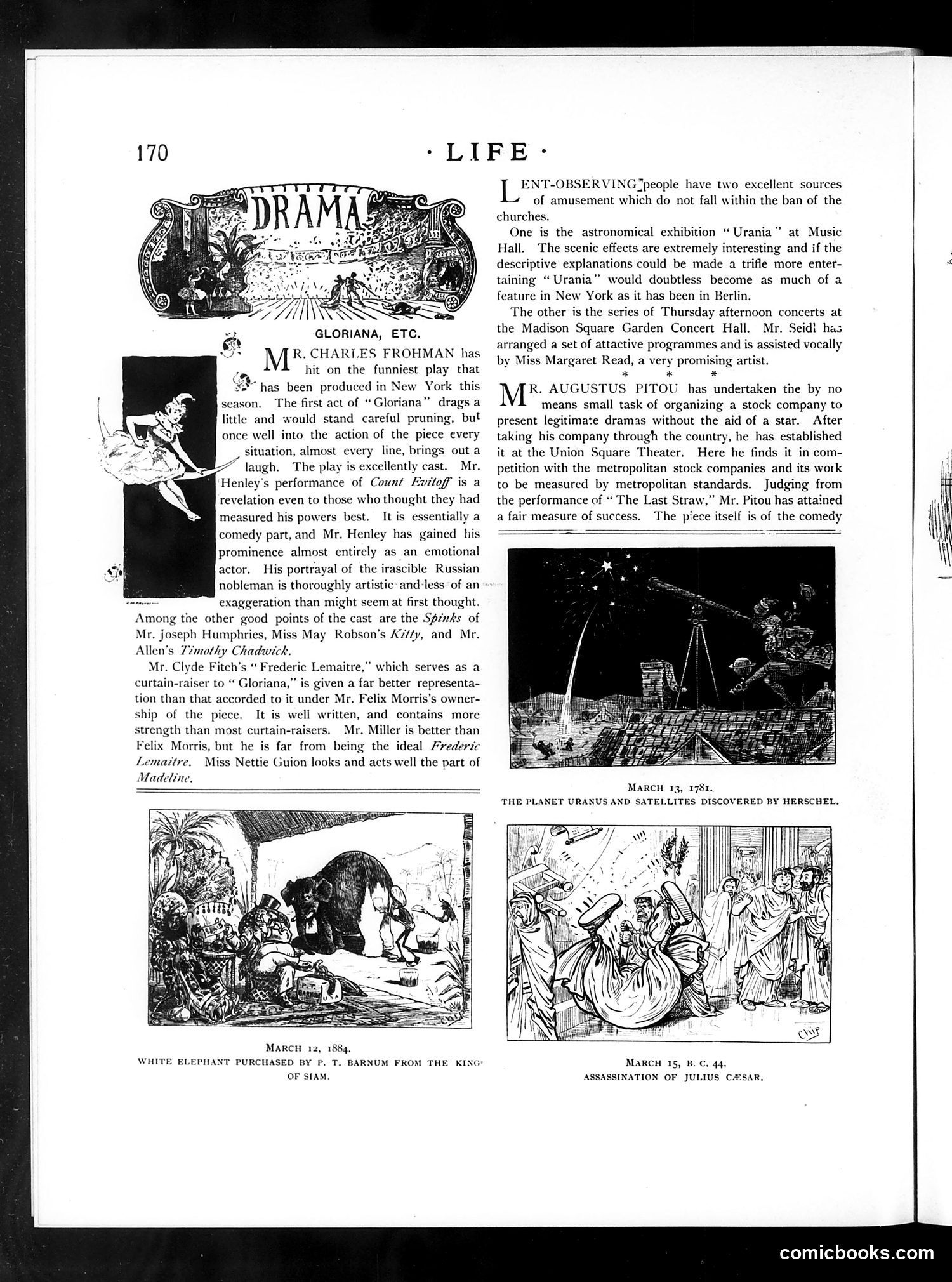
This page reviews New York theatrical productions. The main text praises Charles Frohman's play "Gloriana," highlighting actor Mr. Henley's comedic performance as Count Evitoff, a Russian nobleman—calling it a surprising success for an actor known for emotional dramatic roles. The review also discusses companion productions and other theatrical ventures. The illustrations are thematic historical references unrelated to the drama reviews: they commemorate significant dates—Herschel's 1781 discovery of Uranus and Caesar's assassination in 44 B.C.—likely chosen to fill space or provide humorous contrast to contemporary theater gossip. The page also mentions other amusements including the "Urania" astronomical exhibition and concert series, suggesting what respectable entertainment options existed for New York society in the 1880s.
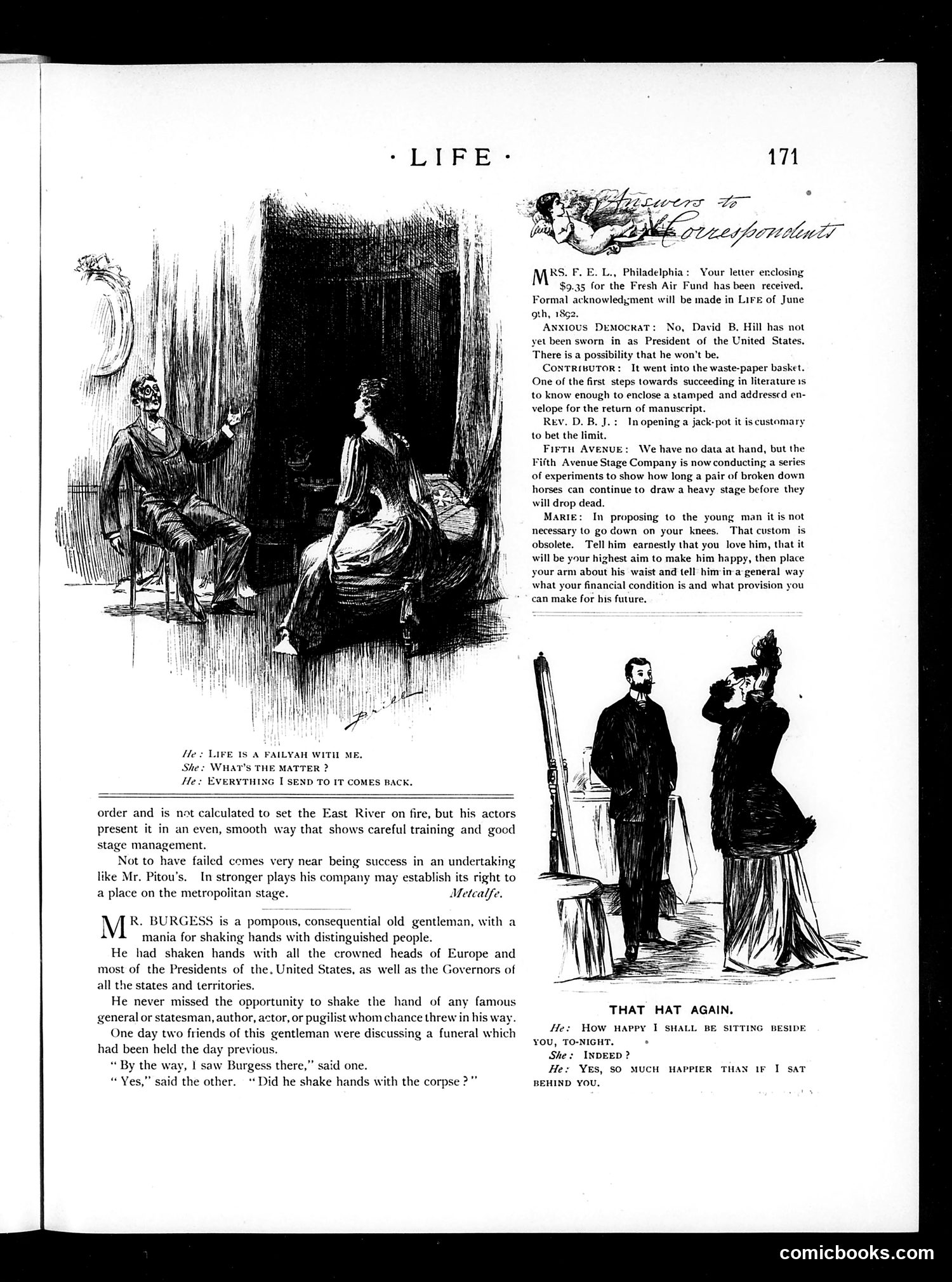
This page combines **advice column responses** with **satirical commentary** and cartoon illustrations. The advice section mocks various reader inquiries with tongue-in-cheek answers—a staple of Life's humor. Notable responses include: - A jab at David B. Hill (a prominent 1890s Democratic politician), sarcastically suggesting he won't become President - Mockery of rejected manuscript submissions - Cynical commentary on the Fifth Avenue Stage Company's treatment of old horses The main narrative describes **Mr. Burgess**, a pompous social climber obsessed with shaking hands with famous and powerful people—a recognizable type of Gilded Age social-climber. The humor culminates in the joke that he shook hands with a corpse at a funeral, satirizing his indiscriminate hand-shaking compulsion. The bottom cartoons illustrate courtship scenes with double-entendre dialogue about seating arrangements and happiness. Overall, the page reflects Life's satirical focus on **social pretension, political figures, and romantic comedy** of the 1890s era.
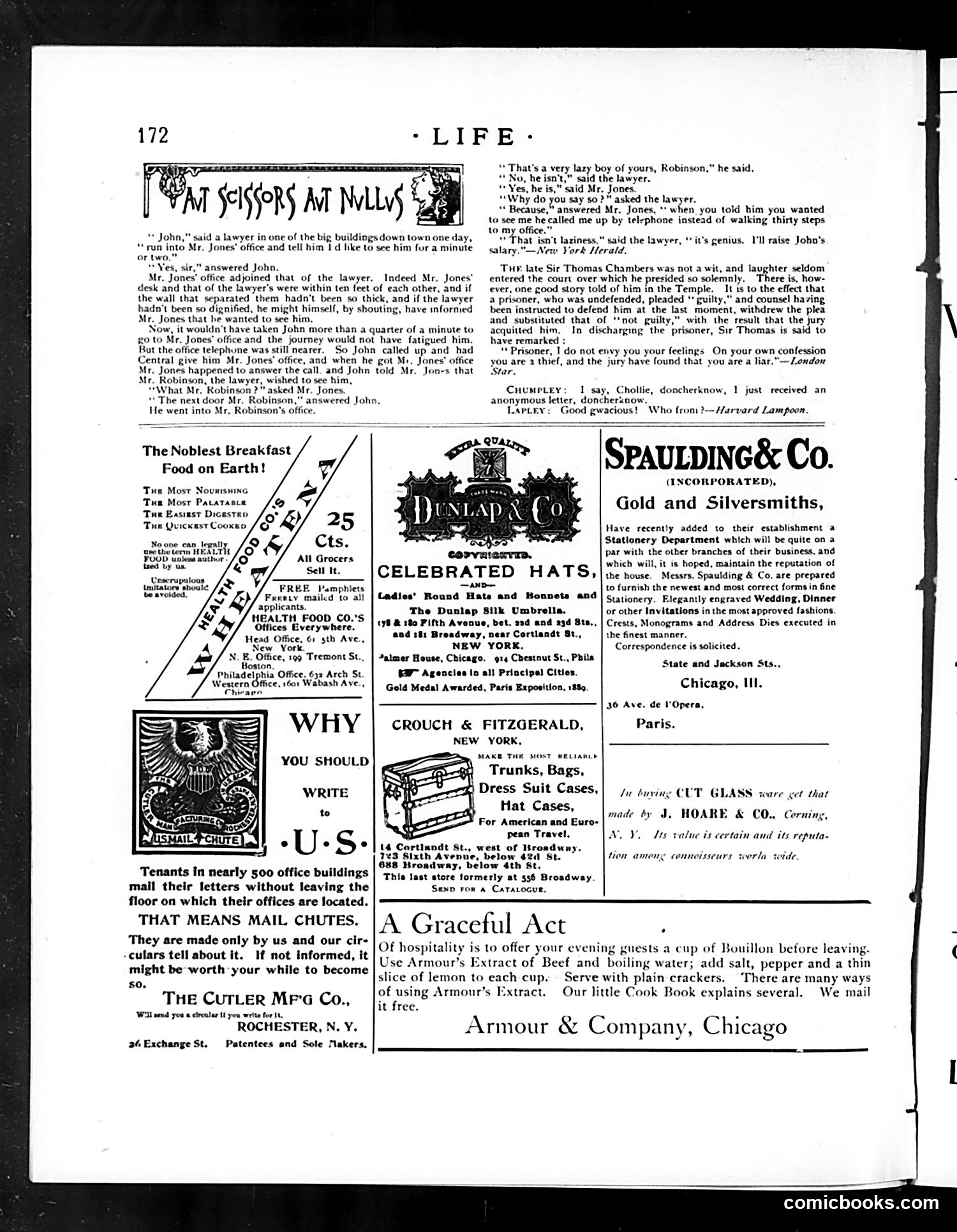
This page primarily contains **three humorous anecdotes** rather than political cartoons: 1. **The "Lazy" Boy**: A lawyer's messenger boy uses the telephone to contact an adjacent office instead of walking thirty feet. The lawyer celebrates this as "genius" rather than laziness—a joke about technological efficiency replacing physical effort. 2. **Sir Thomas Chambers**: A Victorian-era court anecdote where a judge discharges an acquitted prisoner by remarking he's both a thief (by his own admission) and a liar (by the jury's verdict). The humor lies in the judge's rare, cutting wit. 3. **The Anonymous Letter**: A brief Harvard Lampoon joke where "Chollie" receives an anonymous letter, with the punchline's humor unclear from the visible text. The remaining content is **period advertising** for breakfast cereal, mail chutes, hats, luggage, and beef extract—typical of early 20th-century Life magazine. The page satirizes emerging modern conveniences (the telephone) and captures genteel Victorian courtroom humor.
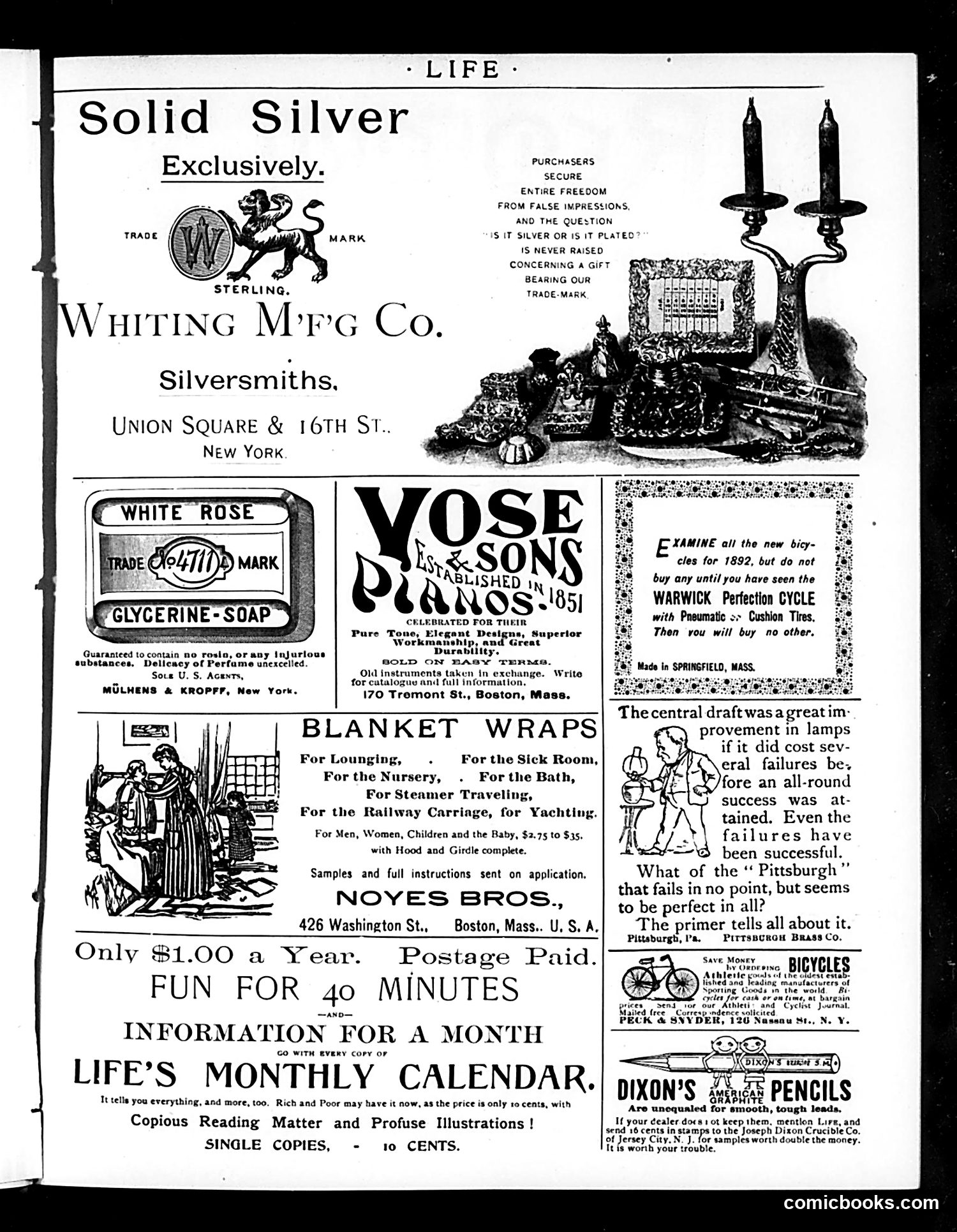
This is primarily an **advertising page**, not a political cartoon. It showcases late 19th-century consumer products (circa 1892, based on bicycle dating). Key advertisements include: - **Whiting Mfg Co.**: Solid silver goods, emphasizing authenticity to counter consumer anxiety about silver-plating fraud - **Vose & Sons Pianos**: Established 1851, marketed as superior and durable - **Warwick Perfection Cycle**: A bicycle with pneumatic (air-filled) cushion tires, positioned as the latest 1892 innovation - **Blanket Wraps**: Multipurpose garments for various activities - **Life's Monthly Calendar**: The magazine itself, promoted as affordable at 10 cents The page reflects **1890s consumer culture**: advertisements stress product authenticity, technological advancement (pneumatic tires were novel), and aspirational middle-class purchases. There is no political satire visible—this is straightforward commercial content typical of the era's magazine culture.
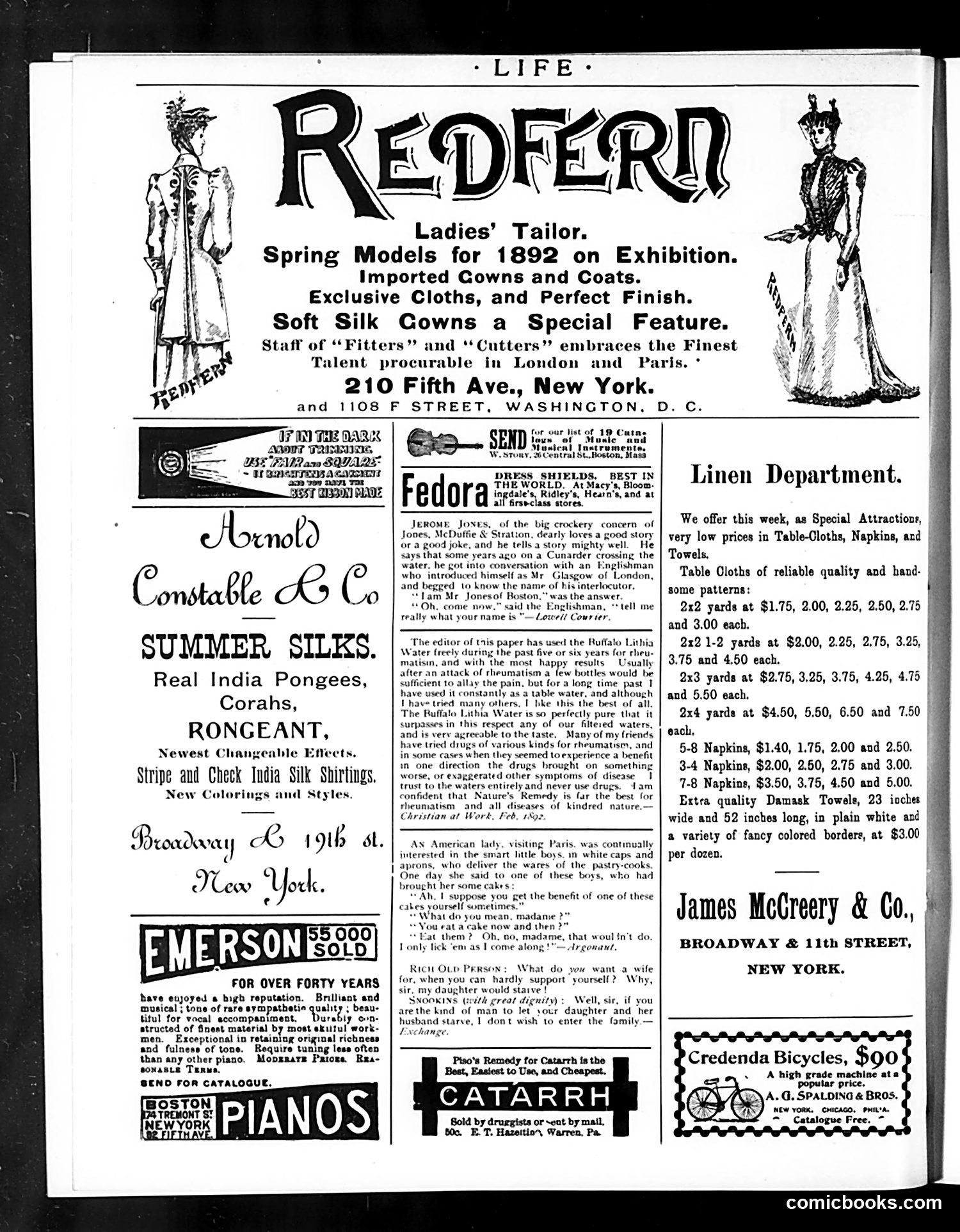
This is primarily a **commercial advertising page** with minimal satirical content. The page features dress shops, pianos, and various patent medicines typical of 1890s periodicals. The only identifiable **humorous anecdotes** are short jokes: 1. **Jerome Jones story**: A traveling businessman meets an Englishman on a ship who claims his name is "Mr. Glasgow of London." Jones skeptically asks if that's "really" his name—a mild joke about implausible introductions. 2. **Paris pastry-boy dialogue**: An American woman in Paris naively asks a delivery boy if he eats the pastries he delivers. His response that he merely "licks" them as he walks is comedic—suggesting both the boy's poverty and the woman's obliviousness to class differences. 3. **"Rich Old Person" exchange**: A terse dialogue about whether a suitor wants a wife for her money, ending with the woman's dignified refusal to marry into a family that would let dependents starve. These are gentle, anecdotal humor rather than pointed political satire—reflecting Life's shift toward lighter magazine content by 1892.
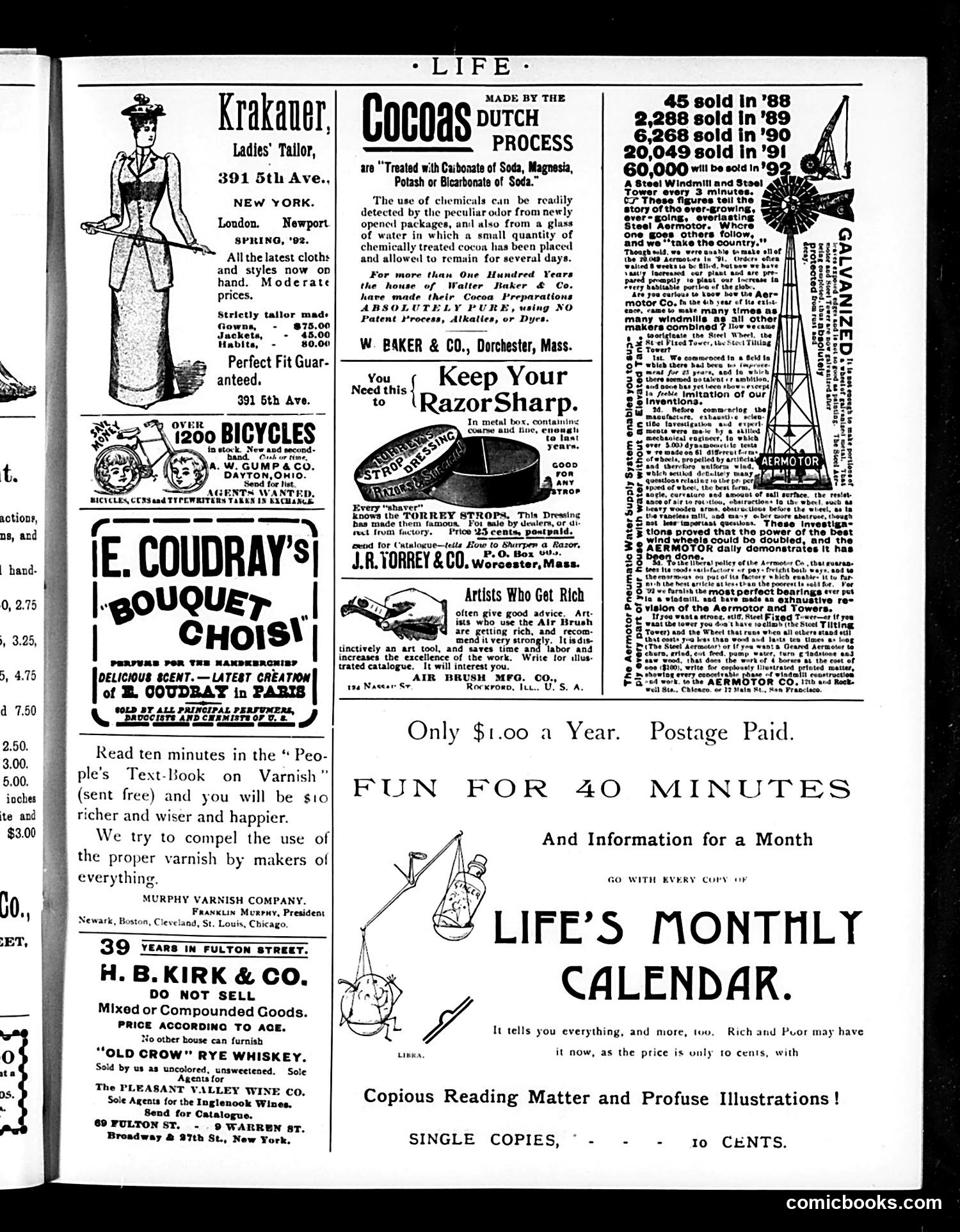
This page is **primarily advertising**, typical of late-19th-century magazines. The content includes: **Notable Ads:** - **Krakauer Ladies' Tailor** (391 5th Ave, NYC): Fashion services with moderate pricing - **W. Baker & Co. Cocoas**: A response to competitors using chemical additives; Baker emphasizes their cocoa has been "absolutely pure" for over 100 years with no patent processes or alkalies - **Torrey Razor Strops**: Grooming tools - **Life Magazine subscription**: $1/year, promoting "Life's Monthly Calendar" **The only apparent editorial content** is a diagram (lower right) showing a Steel Windmill's sales growth from 1888-1892, demonstrating increased consumer adoption of this agricultural technology. **Context for modern readers:** This reflects the *patent medicine and adulteration era*—companies competed by claiming purity against competitors using cheaper chemical additives. The windmill chart illustrates industrial-era marketing of farm innovations. Overall, this is a straightforward advertising page with minimal satire or political content.
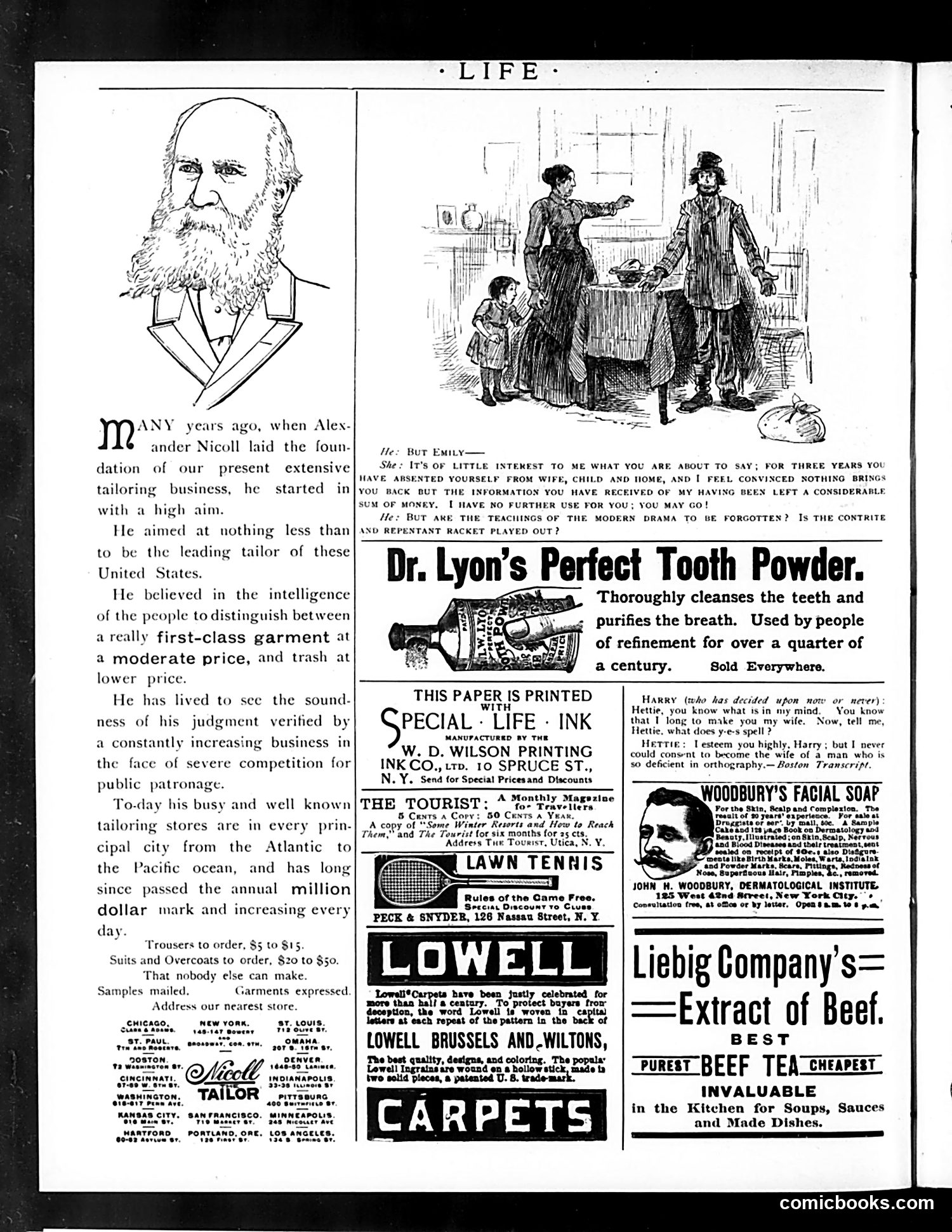
This page combines a biographical advertisement with social satire. The left side profiles Alexander Nicoll, founder of an extensive tailoring business claiming nationwide presence and success—a straightforward commercial puff piece advertising made-to-order clothing. The right side contains two distinct cartoons mocking contemporary social pretensions. The top sketch depicts a domestic confrontation where a husband, having inherited money, dismisses his wife of three years with callous indifference, lecturing her about "modern drama" teachings regarding penitence—satirizing how newly wealthy men abandoned their wives for supposedly more refined companions. Below, a brief joke ridicules a woman rejecting a suitor for poor spelling ("y-e-s" instead of "yes"), mocking both pedantic femininity and shallow courtship standards. The page is otherwise filled with period advertisements: Dr. Lyon's tooth powder, Lowell carpets, Liebig beef extract, and other consumer goods—typical of Life's mixed editorial-advertising format. The satire targets nouveau riche hypocrisy and feminine affectation common to Gilded Age social climbing.