
Life, 1892-03-17 · page 8 of 18
Life — March 17, 1892 — page 8: what you’re looking at
What you’re looking at
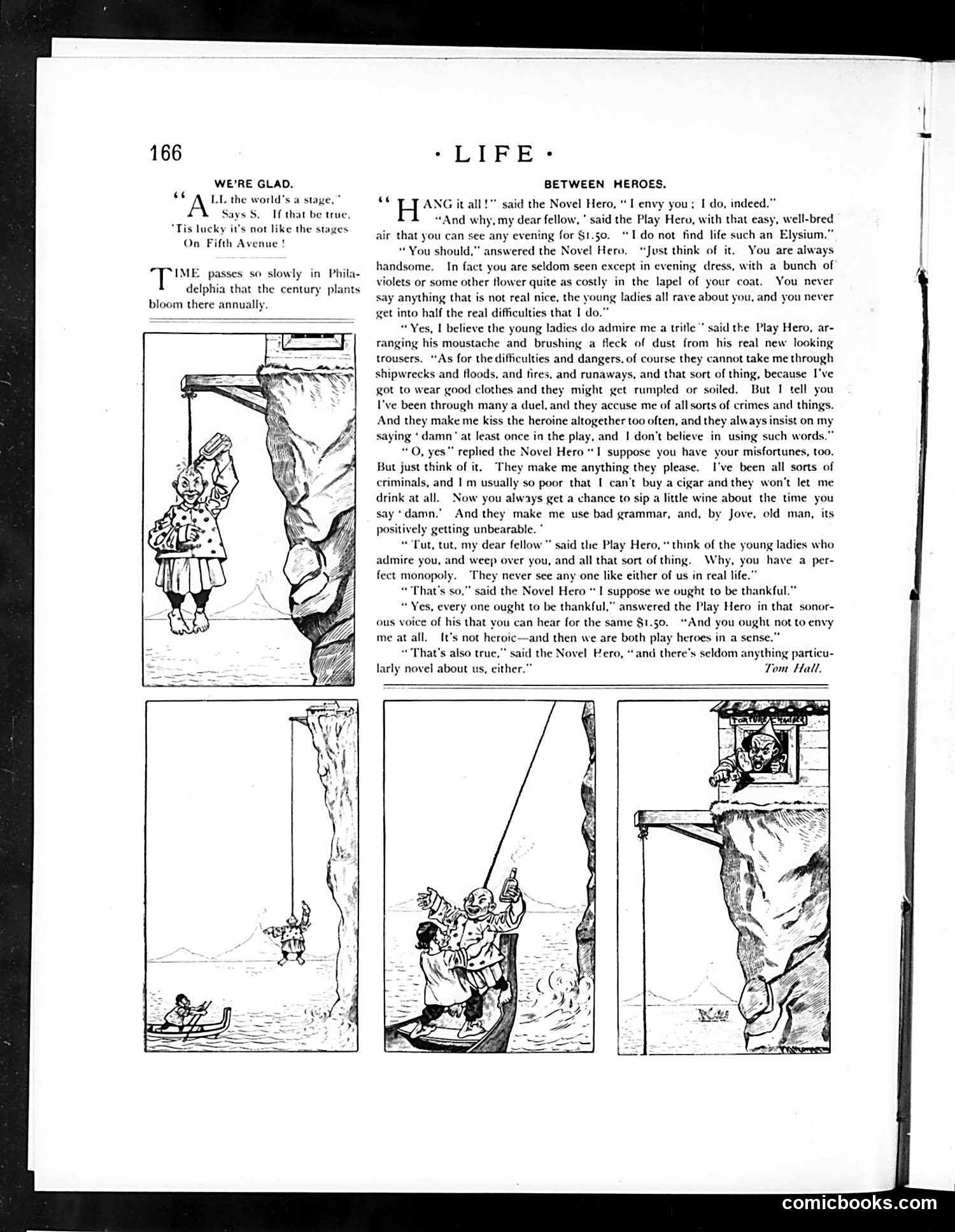
This page contains two distinct pieces: **"We're Glad"** (left): A brief satirical comment on Philadelphia's slow passage of time, illustrated with a sketch of a small child dwarfed by an enormous adult figure—likely mocking the city's sluggish pace and outdated character. **"Between Heroes"** (right): A dialogue between a "Novel Hero" and "Play Hero" debating the relative hardships of their professions. The Novel Hero complains about poverty, bad grammar, and constant accusations of criminality, while the Play Hero brags about wealthy admirers and $1.50 theater tickets. The satire targets the pretension of stage actors versus literary characters, mocking theatrical self-importance and the gap between stage glamour and literary realism. The accompanying comic strip illustrates their respective worlds. Both pieces satirize contemporary American cultural hierarchies and pretensions.
📄 Transcribed text from this page (OCR, searchable)
Machine-transcribed from the original scan — historical spelling and the odd misread are preserved.
166 WE'RE GLAD. BETWEEN HEROES. LL. the world’s a stage.” “ LIANG it allt” said the Novel Hero, “I envy you: I do, indeed.” Says S. If that be true “And why, my dear fellow, ' said the Play Hero, with that easy, well-bred ‘Tis lucky it’s not like the stages , Kr egi @ And life such an Elysium.” On Fifth Avenue ! air that you can see any evening for $1.50. “Ido not find life such an Elysium. “You should,” answered the Novel Hero. “Just think of it. You are always handsome. In fact you are seldom seen except in evening dress, with a bunch of violets or some other flower quite as costly in the lapel of your coat. You never say anything that is not real nice, the young ladies all rave about you, and you never get into half the real difficulties that I do.” “Yes, I believe the young ladies do admire me a trifle” said the Play Hero, ar- ranging his moustache and brushing a fleck of dust from his real new looking trouset ‘As for the difficulties and dangers, of course they cannot take me through shipwrecks and floods, and fires, and runaways, and that sort of thing, because I've got to wear good clothes and they might get rumpled or soiled. But I tell you I've been through many a duel, and they accuse me of all sorts of crimes and things. And they make me kiss the heroine altogether too often, and they always insist on my saying ‘ damn‘ at least once in the play, and I don’t believe in using such words.” “O, yes” replied the Novel Hero “I suppose you have your misfortunes, too. But just think of it. They make me anything they please. I've been all sorts of criminals, and I m usually so poor that [ can’t buy a cigar and they won't let_ me drink at all. Now you always get a chance to sip a little wine about the time you say ‘damn.’ And they make me use bad grammar, and, by Jove, old man, its positively getting unbearable. * “ Tut, tut, my dear fellow” said the Play Hero,“ think of the young ladies who admire you, and weep over you, and all that sort of thing. Why, you have a per- fect monopoly. ‘They never see any one like either of us in real life.” “That's so," said the Novel Hero “I suppose we ought to be thankful.” * Yes, every one ought to be thankful,” answered the Play Hero in that sonor- ous voice of his that you can hear for the same $1.50. “And you ought not to envy me at all, [t's not heroic—and then we are both play heroes in a sense.” ~ That's also true,” said the Novel Hero, “and there's seldom anything particu- larly novel about us, either.” Tom Hall. IME. passes so slowly in Phila- delphia that the century plants bloom there annually, Tow TP = A= « comicbooks.com