
Life, 1892-03-17 · page 6 of 18
Life — March 17, 1892 — page 6: what you’re looking at
What you’re looking at
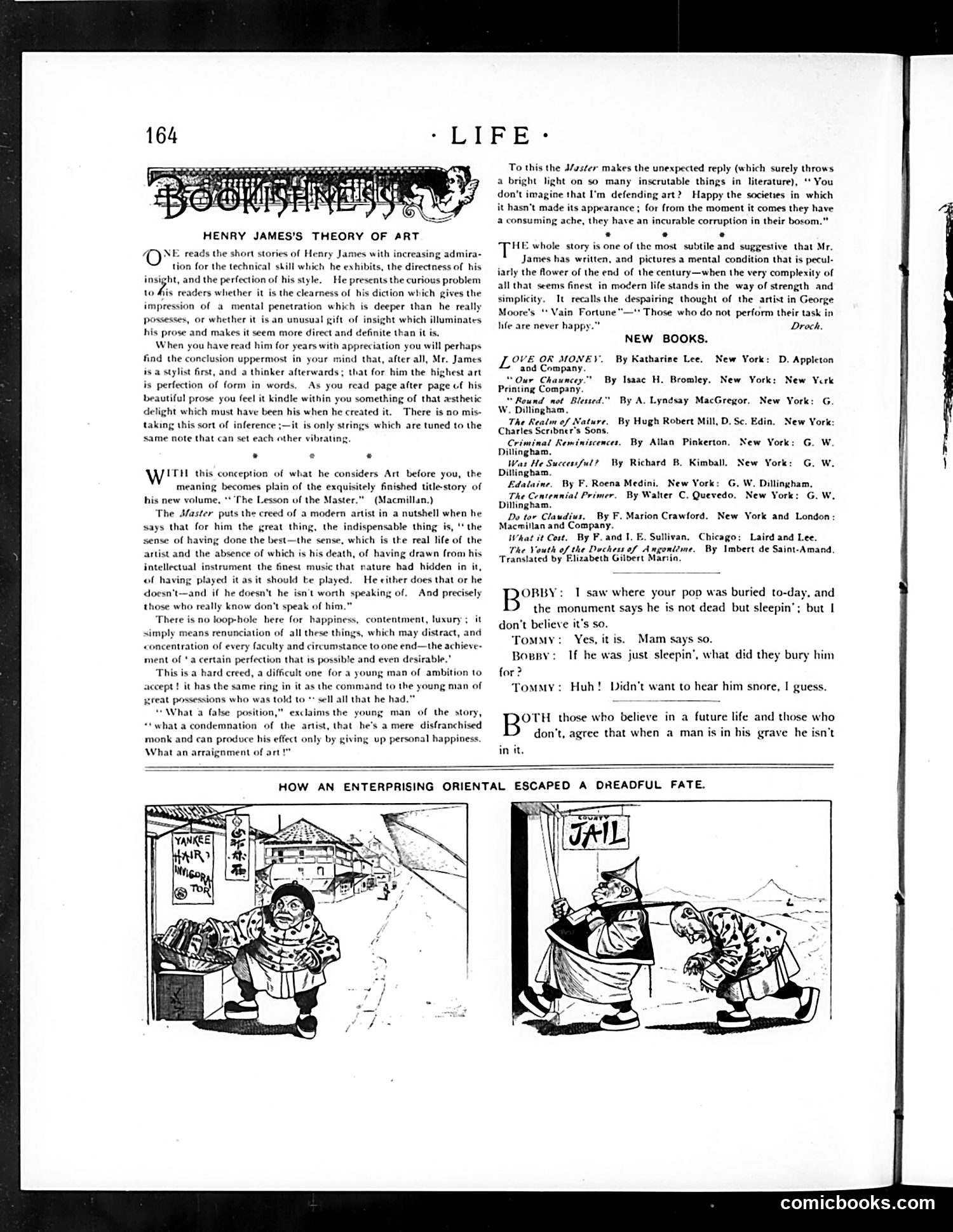
This two-panel cartoon depicts a figure in Asian dress (caricatured with exaggerated features typical of the era's racist imagery) escaping from jail. In the first panel, he stands outside a Japanese jail. In the second, he's shown breaking free from the structure. The satire appears to mock either Asian criminality or, conversely, to celebrate cunning escape from an unjust imprisonment. The phrase "enterprising Oriental" uses contemporary racial terminology. Without additional context about the specific historical event referenced, the exact political point remains unclear—whether it's commentary on Asian immigration, criminal justice, or international relations. The cartoon relies heavily on offensive stereotypes standard to early 20th-century American satire.
📄 Transcribed text from this page (OCR, searchable)
Machine-transcribed from the original scan — historical spelling and the odd misread are preserved.
* LIFE: HENRY JAMES'S THEORY OF ART (CYNE reads the short stories of Henry James with increasing admira- tion for the technical skill which he exhibits, the directness of his insight and the perfection of his style. He presents the curious problem to Ais readers whether it is the clearness of his diction which gives the impression of a mental penetration which is deeper than he really possesses, or whether it is an unusual gift of insight which illuminates his prose and makes it seem more direct and definite than it is. When you have read him for years with appreciation you will perhaps find the conclusion uppermost in your mind that, after all, Mr. James is a stylist first, and a thinker afterwards; that for him the highest art is perfection of form in words. As you read page after page uf his beautiful prose you feel it kindle within you something of that zsthetic delight which must have been his when he created it. There is no mis- taking this sort of inference ;—it is only strings which are tuned to the same note that can set each other vibrating. . ° . WITH this conception of what he considers Art before you, the meaning becomes plain of the exquisitely finished titlestory of his new volume, ** The Lesson of the Master." (Macmillan.) The AMaster puts the creed of a modern artist in a nutshell when he says that for him the great thing, the indispensable thing is, ‘the sense of having done the best—the sense, which is the real life of the artist and the absence of which is his death, of having drawn from his intellectual instrument the finest music that nature had hidden in it, of having played it as it should te played. He either does that or he doesn't—and if he doesn't he isn't worth speaking of. And precisely those who really know don't speak of him.” There is no loop-hole here for happiness, contentment, luxury; it simply means renunciation of all these things, which may distract, and concentration of every faculty and circumstance to one end—the achieve- ment of ‘a certain perfection that is possible and even desirable,’ This is a hard creed, a difficult one for a young man of ambition to accept! it has the same ring in it as the command to the young man of sell all that he had.” “What a false position," exclaims the young man of the story, + what a condemnation of the artist, that he's a mere disfranchised monk and can produce his effect only by giving up personal happiness, What an arraignment of art! xreat possessions who was told to * To this the Jfaster makes the unexpected reply (which surely throws a bright light on so many inscrutable things in literature), You don't imagine that I'm defending art? Happy the societies in which it hasn't made its appearance ; for from the moment it comes they have a consuming ache, they have an incurable corruption in their bosom.” * ° ° 6 ess whole story is one of the most subtile and suggestive that Mr. James has written, and pictures a mental condition that is pecul- iarly the Nower of the end of the century—when the very complexity of all that seems finest in modern life stands in the way of strength and simplicity, It recalls the despairing thought of the artist in George Moore's * Vain Fortune"—"* Those who do not perform their task in life are never happy.” Droch. NEW BOOKS. LOVE, OR MONEY. By Katharine Lee, and Compan Our Chauncey. Printing Company Round not Blessed.” W. Dillingham, The Realm of Nature, Charles Scribner's Sons. Criminal Reminiscences. Dillingham, Was He Successful? Dillingham. Edalaine. The Centennial Primer. Dillingham. Do tor Claudius, By F. Marion Crawford. New York and London : Macmillan and Company. What it Cost, By F. and I, E. Sullivan, Chicago: Laird and Lee. The Vouth of the Duchess of Angontime. By Imbert de Saint-Amand Translated by Elizabeth Gilbert Maria. New York: D. Appleton By Isaac H. Bromley, New York: New Verk By A. Lyndsay MacGregor. New York: G. By Hugh Robert Mill, D. Sc. New York: By Allan Pinkerton, New York: G. W. By Richard B. Kimball, New York: G. W. By F. Roena Medini. New York: G. W. Dillingham, By Walter C. Quevedo. New York: G. W. if OBBY: 1 saw where your pop was buried to-day, and the monument says he is not dead but sleepin’; but | don’t believe it’s so. Tommy: Yes, itis. Mam says so. Boppy: If he was just sleepin’, what did they bury him for? Tommy: Huh! Didn't want to hear him snore, | gues: OTH those who believe in a future life and those who don’t, agree that when a man is in his grave he isn’t in it. HOW AN ENTERPRISING ORIENTAL ESCAPED A OREADFUL FATE. comicbooks.com