
A complete issue · 18 pages · 1892
Life — January 14, 1892
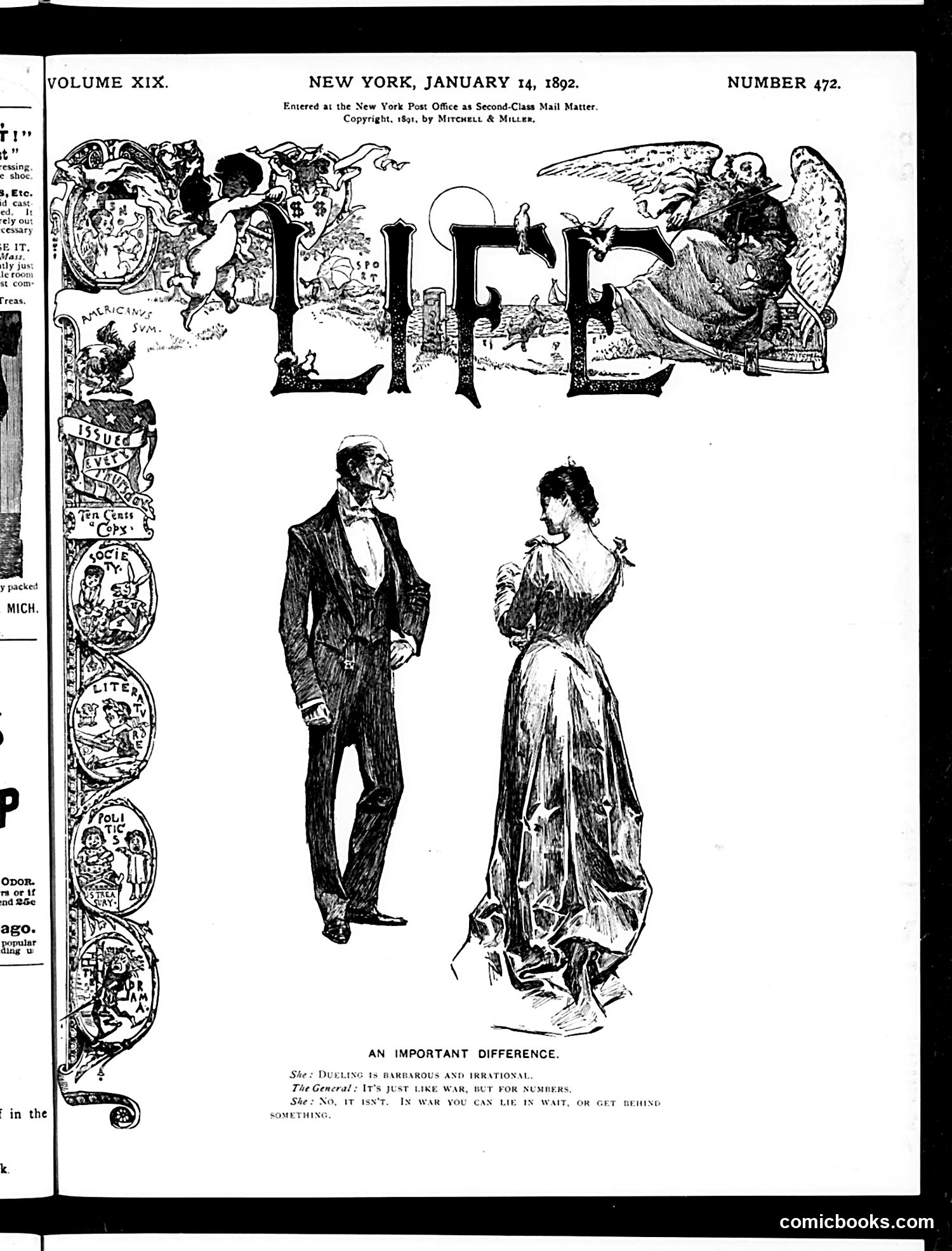
This satirical cartoon contrasts two figures in formal dress. The caption presents a dialogue between "She" and "The General": **She**: Dueling is barbarous and irrational. **The General**: It's just like war, but for numbers. **She**: No, it isn't. In war you can lie in wait, or get behind something. The satire mocks military justifications for dueling by exposing the logical inconsistency: if dueling is acceptable because it mirrors warfare, then the General's argument collapses when confronted with war's actual tactics (ambush, cover). The cartoon ridicules both the practice of dueling—still occurring among gentlemen in 1892—and military men who defend it through flawed reasoning. "She" represents common sense, while "The General" embodies outdated aristocratic honor codes.
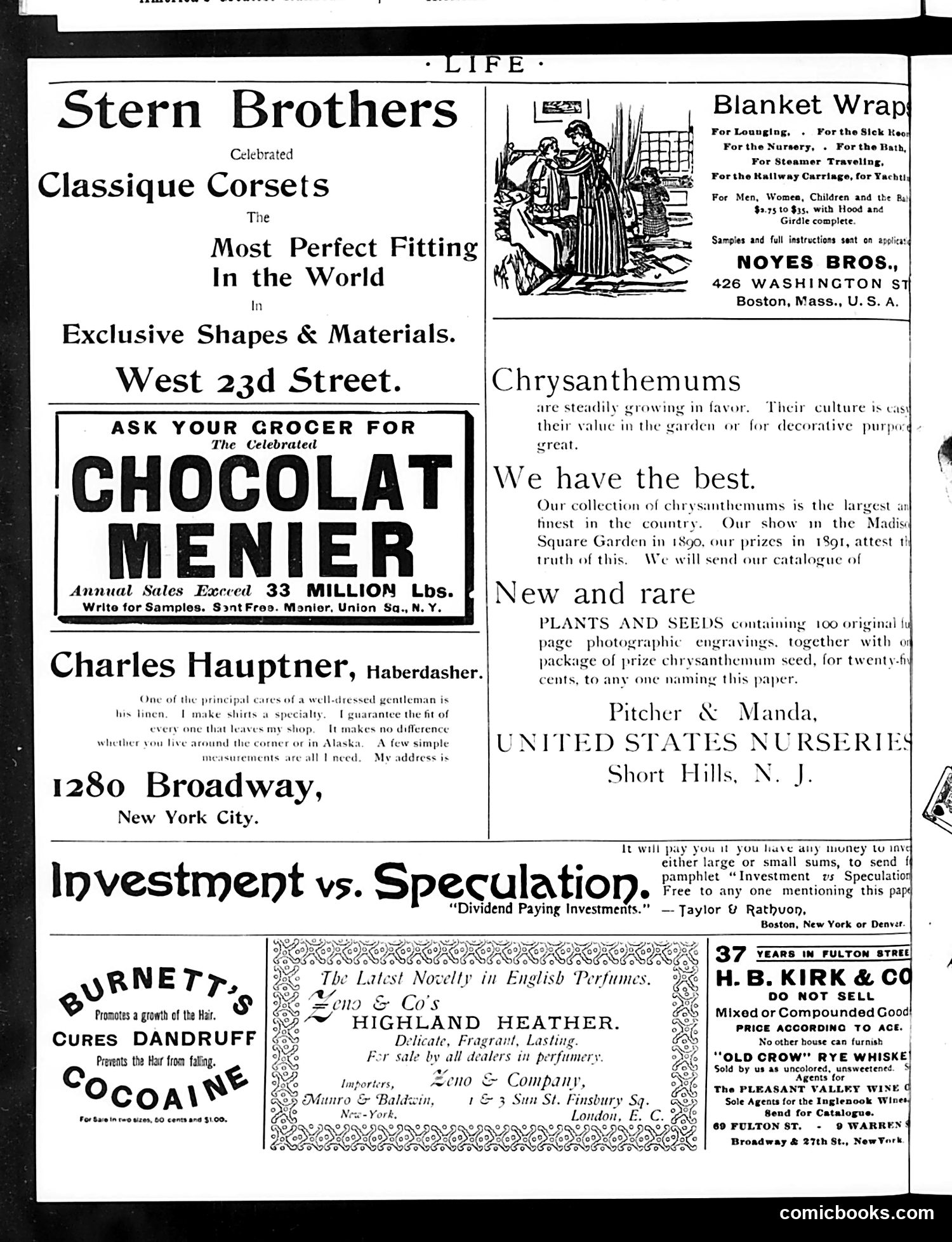
This page is primarily **advertising content** rather than satirical cartoons. The ads showcase products typical of the early 20th century: - **Stern Brothers corsets** ("Most Perfect Fitting in the World") - **Chocolat Menier** chocolate (claiming 33 million pounds annual sales) - **Charles Hauptner's haberdashing** services on Broadway - **H.B. Kirk & Co.'s "Old Crow" whiskey** (notably advertising cocaine-laced products, which was legal then) - **Burnett's Cocaine** for dandruff treatment The only image shows a domestic scene with a blanket wrap product from Noyes Bros. The notable historical element is the **casual advertisement of cocaine**, reflecting pre-1906 American pharmaceutical practices before pure food and drug regulations. This reveals how normalized dangerous substances were before modern consumer safety laws.
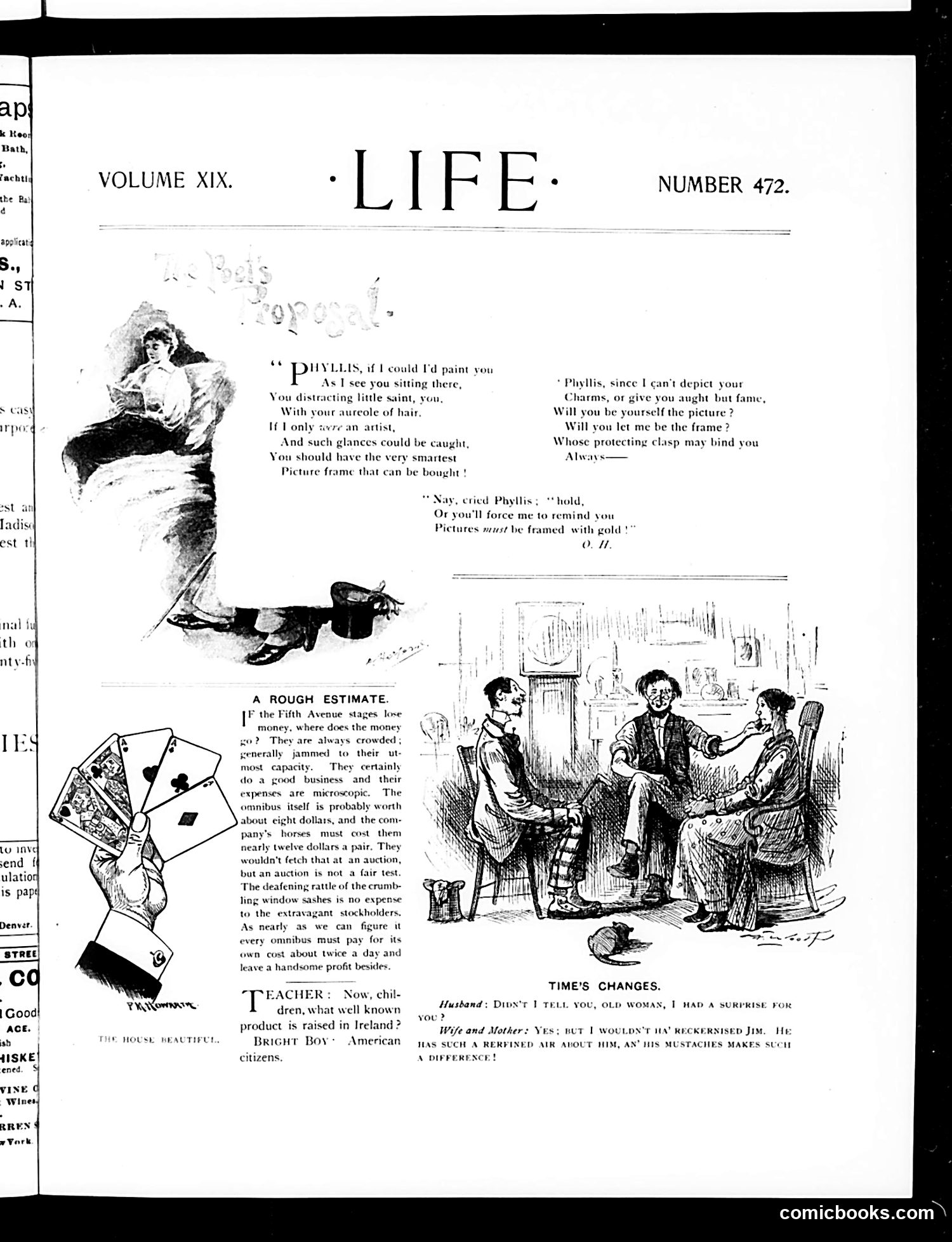
This page contains three distinct satirical pieces: 1. **"Phyllis" poem**: A romantic verse about painting a woman's portrait, playing on artistic idealization versus reality. 2. **"A Rough Estimate"**: A cartoon with playing cards and commentary about auction house expenses. It satirizes how auction houses' overhead costs—estimated at eight dollars per item—nearly double what sellers actually receive, making auctions financially unfair despite their reputation. 3. **"Time's Changes"**: A dialogue between a teacher and student about Irish-raised products. The joke concerns a man ("Jim") who has apparently become so refined (refined air, refined mustaches) that his own family wouldn't recognize him—satirizing pretentious social climbing and affectation. The page combines romantic, financial, and social satire typical of early 20th-century American humor magazines.
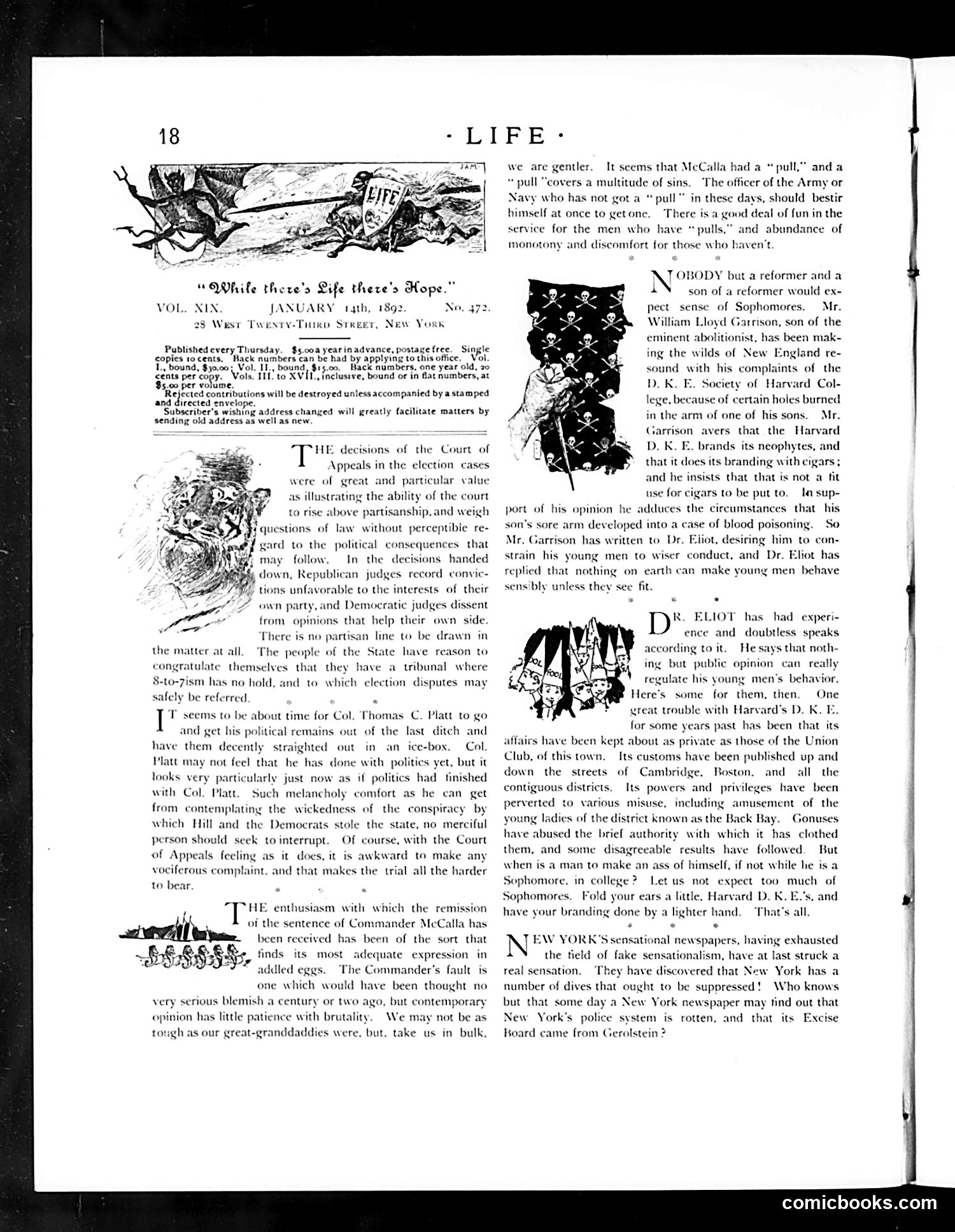
This page contains political commentary rather than cartoons. The text discusses several contemporary issues: 1. **Court of Appeals decisions** on election cases, praising the court for rising above partisanship. 2. **Col. Thomas C. Platt** — a prominent New York Republican politician who is urged to remove himself from politics, suggesting he's become a liability to the party. 3. **Commander McCalla's sentence** — apparently a military matter receiving public attention, with the author defending the verdict against contemporary criticism. 4. **Harvard D.K.E. Society scandal** — the text references complaints from abolitionist William Lloyd Garrison's son about holes burned in his son's arm, allegedly by fraternity members, sparking debate about whether public opinion can regulate young men's behavior. The page emphasizes political neutrality and moral questions about youth conduct.
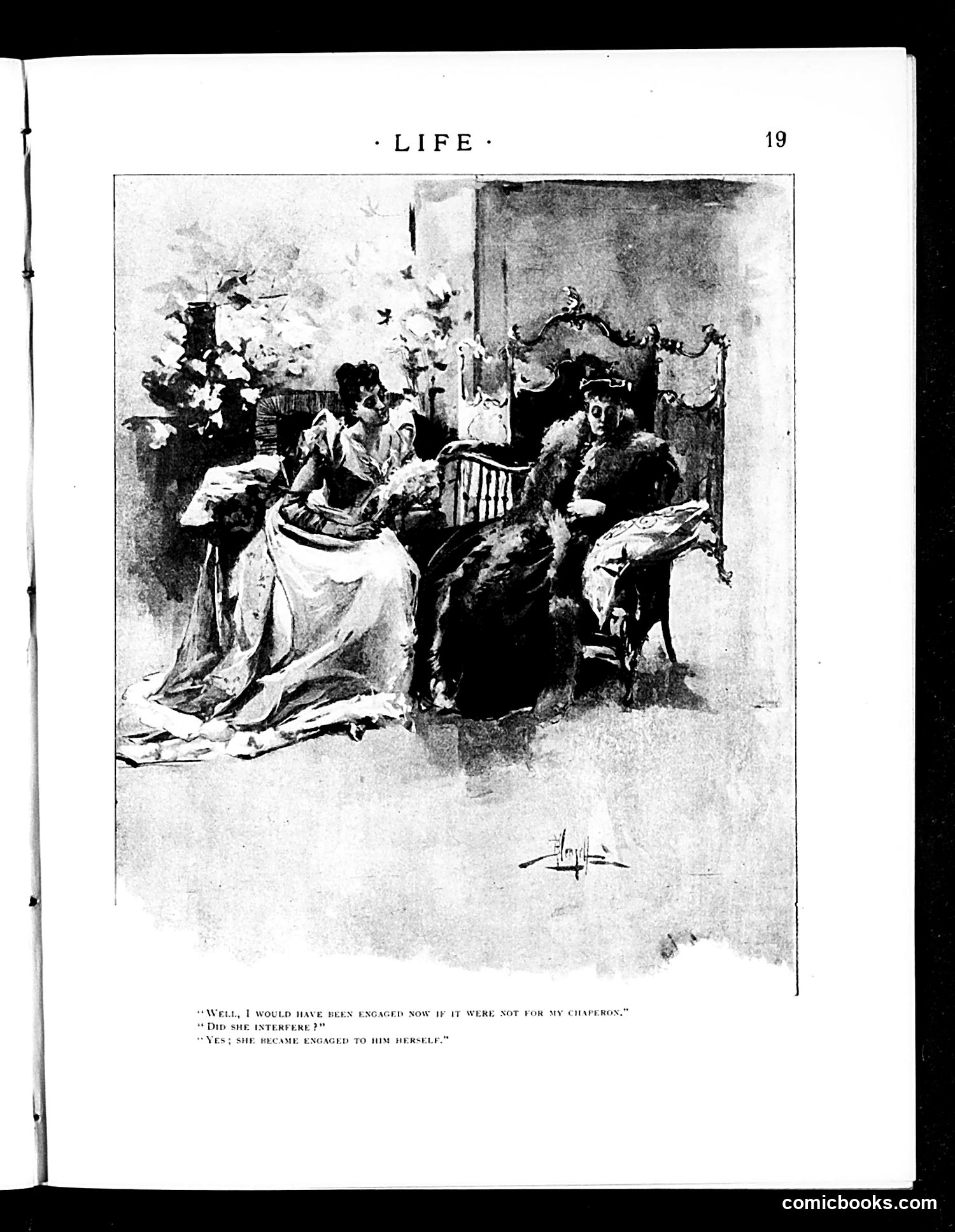
This page from *Life* magazine depicts a domestic scene with social commentary on engagement and marriage customs. The illustration shows what appears to be a Victorian-era parlor with multiple figures gathered around a woman in a white dress (suggesting a newly engaged woman). The caption dialogue reads: "Well, I would have been engaged now if it were not for my chaperon. Did she interfere?" "Yes; she became engaged to him herself." The satire targets the role of chaperons in courtship during this period. The joke hinges on the ironic twist that the chaperon, meant to protect a young woman's virtue and facilitate proper courtship, instead secures the engagement for herself—undermining her duty and the young woman's prospects. This mocks both the absurdity of strict chaperonage rules and older women's marriage prospects.
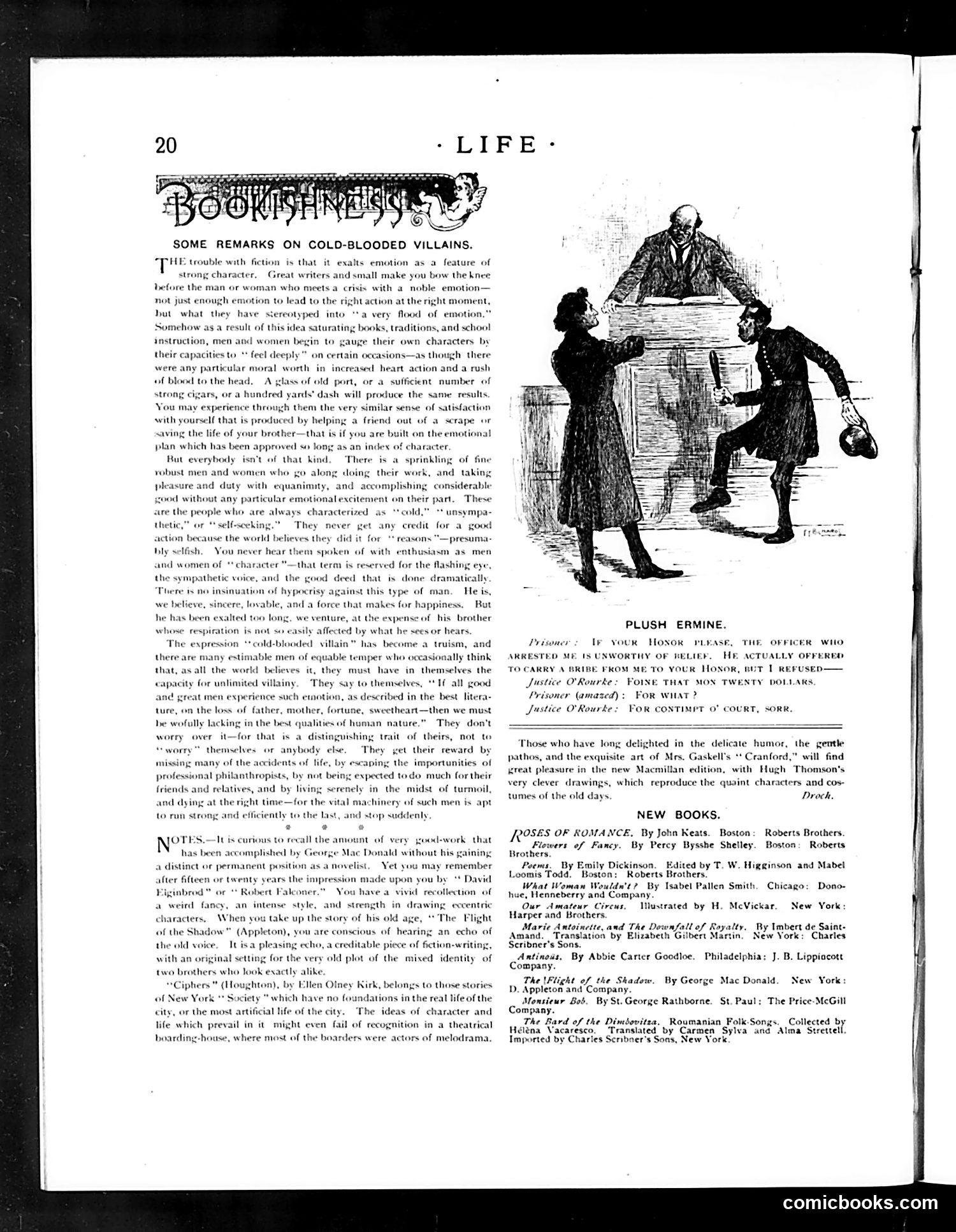
This page contains an article titled "Some Remarks on Cold-Blooded Villains" discussing fictional characterization, paired with an illustration labeled "Plush Ermine." The illustration shows three men in what appears to be a legal or official setting. The caption references "Justice O'Rourke" and mentions a prisoner accused of bribery and grand larceny. The dialogue includes "Justice O'Rourke: Foine that mon twenty dollars" and "For what?" and "For contempt o' court, sor." This appears to be satirizing corruption in the judicial system—specifically Irish-American judges accepting bribes or demonstrating bias. The heavy Irish dialect in the speech patterns and the character names suggest the satire targets Irish-American political/judicial figures of the era, likely early 20th century. The "cold-blooded villain" theme connects to the accompanying article's discussion of character types in fiction.
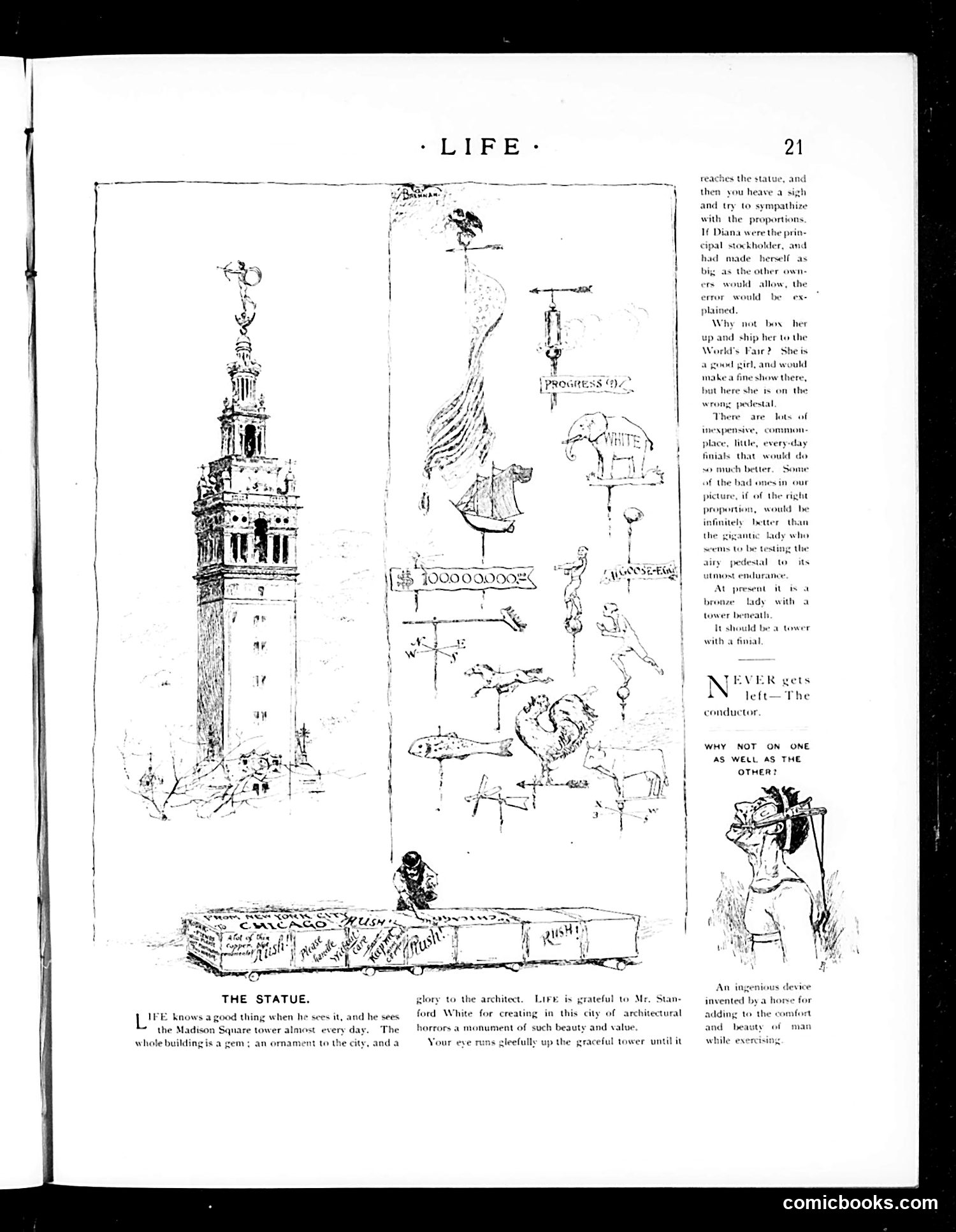
This page satirizes a proposed Diana statue for Madison Square. The main cartoon critiques the statue's enormous scale—the artist sketches show Diana as disproportionately tall compared to the Madison Square tower beside it. The accompanying text argues that if Diana were the principal stockholder, her gigantic size would be understandable, but such an oversized monument is impractical and aesthetically wrong. The secondary cartoon titled "Why Not on One as Well as the Other?" depicts a man using an "ingenious device" to add comfort while exercising—likely mocking unnecessary Victorian-era contraptions. The satire targets both architectural hubris and the era's tendency toward excess and pretentious monuments in urban design.
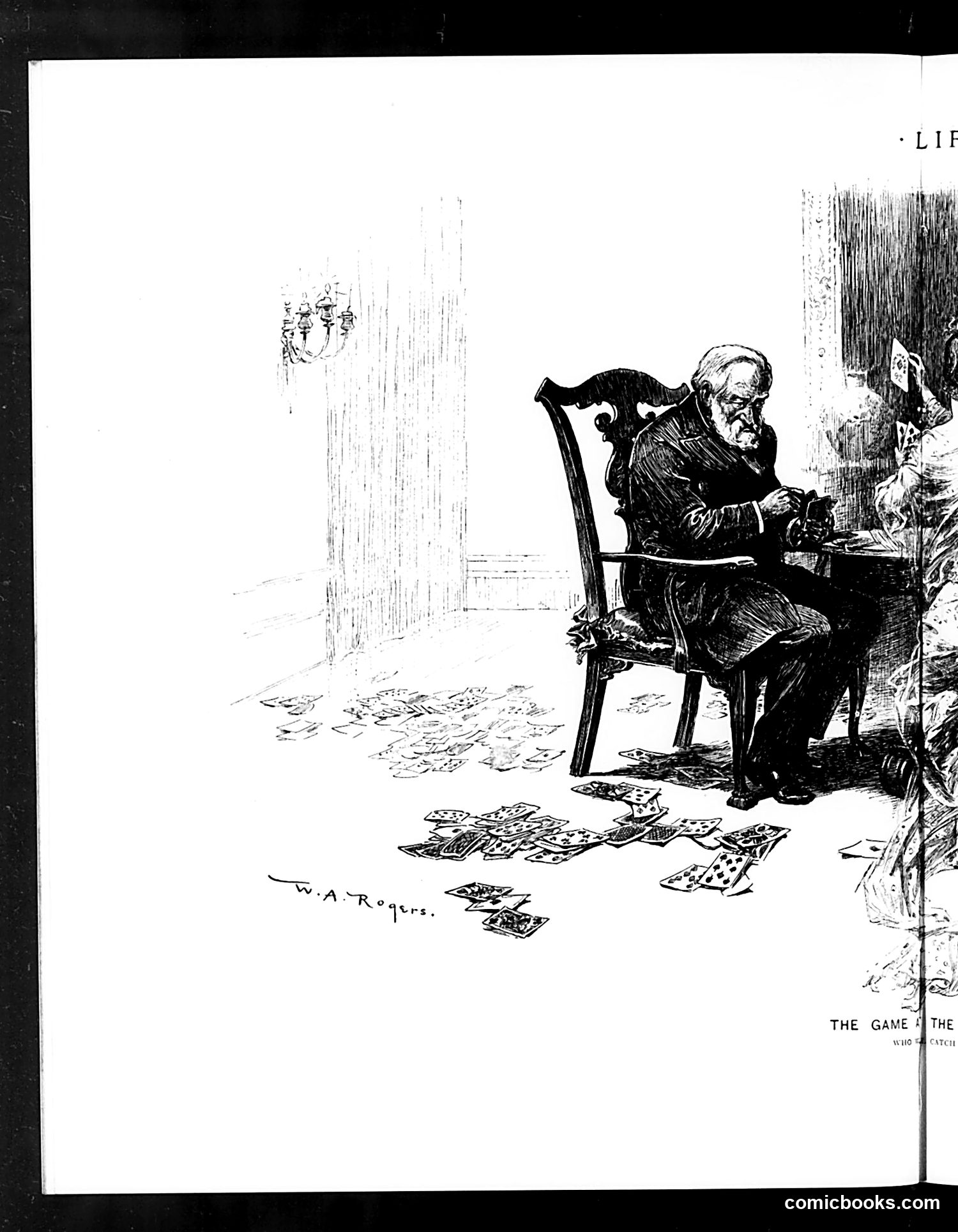
This political cartoon depicts an elderly man seated in a chair, surrounded by scattered playing cards on the floor. The figure appears to be a caricature of a wealthy or powerful individual engaged in gambling or financial speculation. The satire likely comments on risk-taking behavior—either literal gambling or metaphorical financial manipulation by the wealthy. The proliferation of cards suggests compulsive or reckless wagering. The man's absorbed posture and the mess of cards surrounding him imply he's lost control of the situation or squandered resources. Without additional context from the magazine's date, the specific identity of the figure remains unclear, though the cartoon critiques the dangers or foolishness of unchecked gambling/speculation among the powerful.
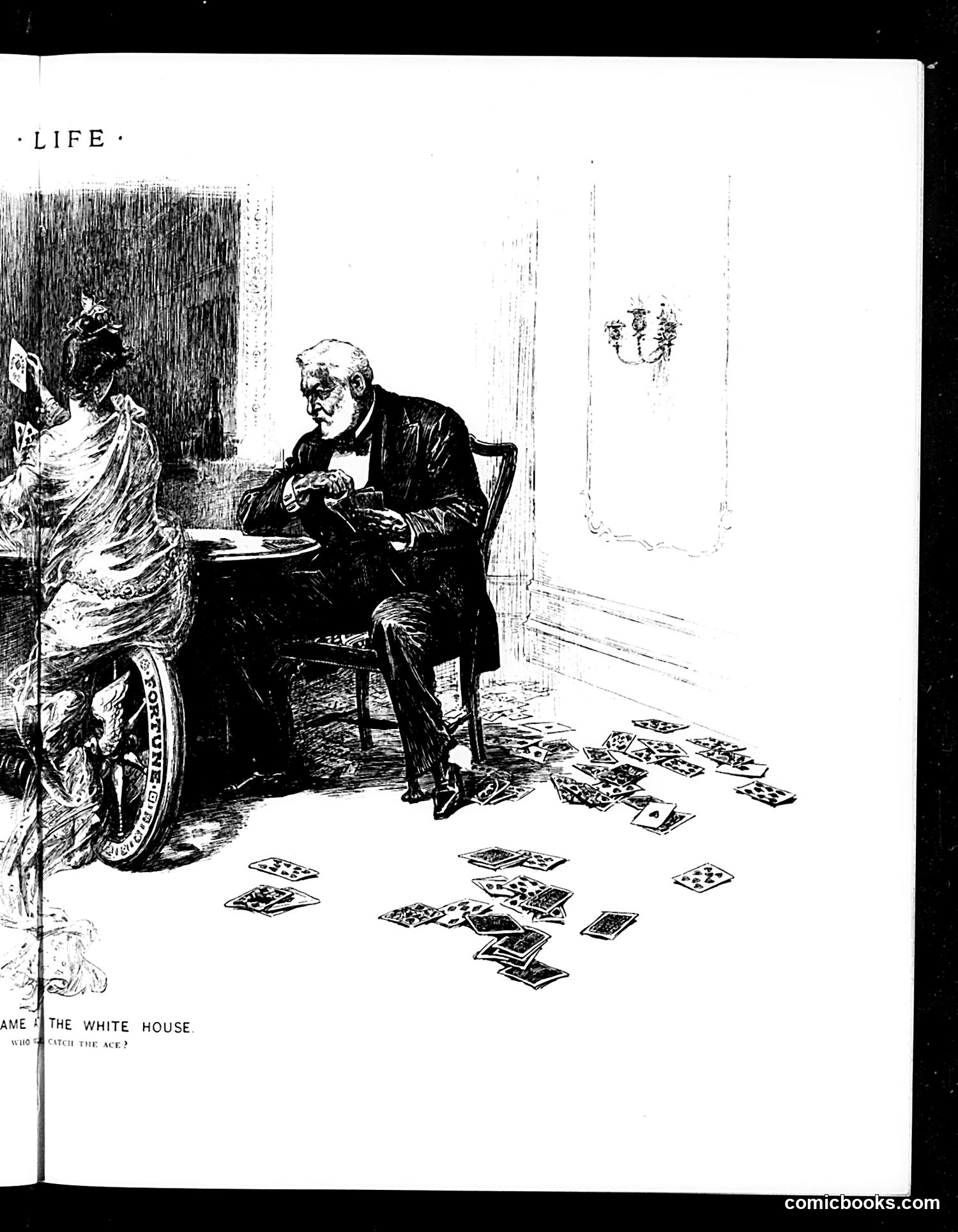
This *Life* magazine illustration titled "The White House" depicts an elderly gentleman in formal attire sitting alone at a table, surrounded by playing cards scattered on the floor. The image appears to be political satire, likely critiquing a president's decision-making or judgment during his administration. The scattered playing cards suggest the subject is "gambling" with important matters of state—treating serious governmental decisions like a card game rather than with proper deliberation. The solitary figure conveys isolation or poor counsel. Without the publication date visible, I cannot definitively identify which president this targets, though the formal 19th-century artistic style suggests it's from an earlier era of American politics. The satire's core message: frivolous or reckless leadership.
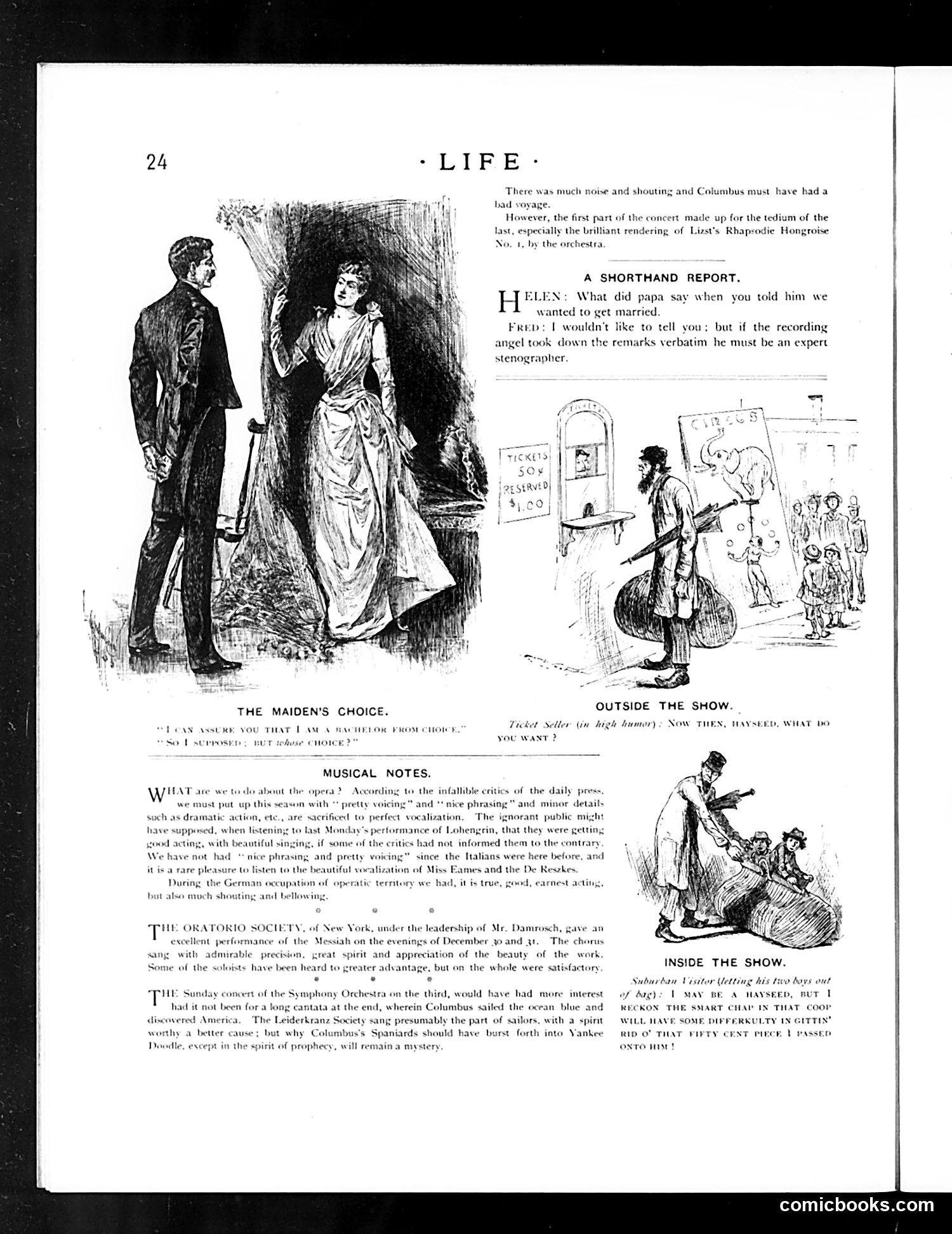
This page contains three distinct illustrated sections satirizing late 19th-century social and cultural life: **"The Maiden's Choice"** depicts a woman rejecting a suitor, playing on Victorian courtship conventions and women's marriage negotiations. **"Outside the Show"** and **"Inside the Show"** contrast poor versus wealthy spectators at a theatrical performance, satirizing class divisions in access to entertainment. The **"Musical Notes"** section critiques opera performances and audiences, mentioning specific New York organizations (the Oratorio Society and Symphony Orchestra). It humorously notes that ignorant audiences mistook poor singing for genuine artistry, while critics and informed listeners recognized deficiencies. The satire targets both pretentious audiences and mediocre performances of classical music during this period.
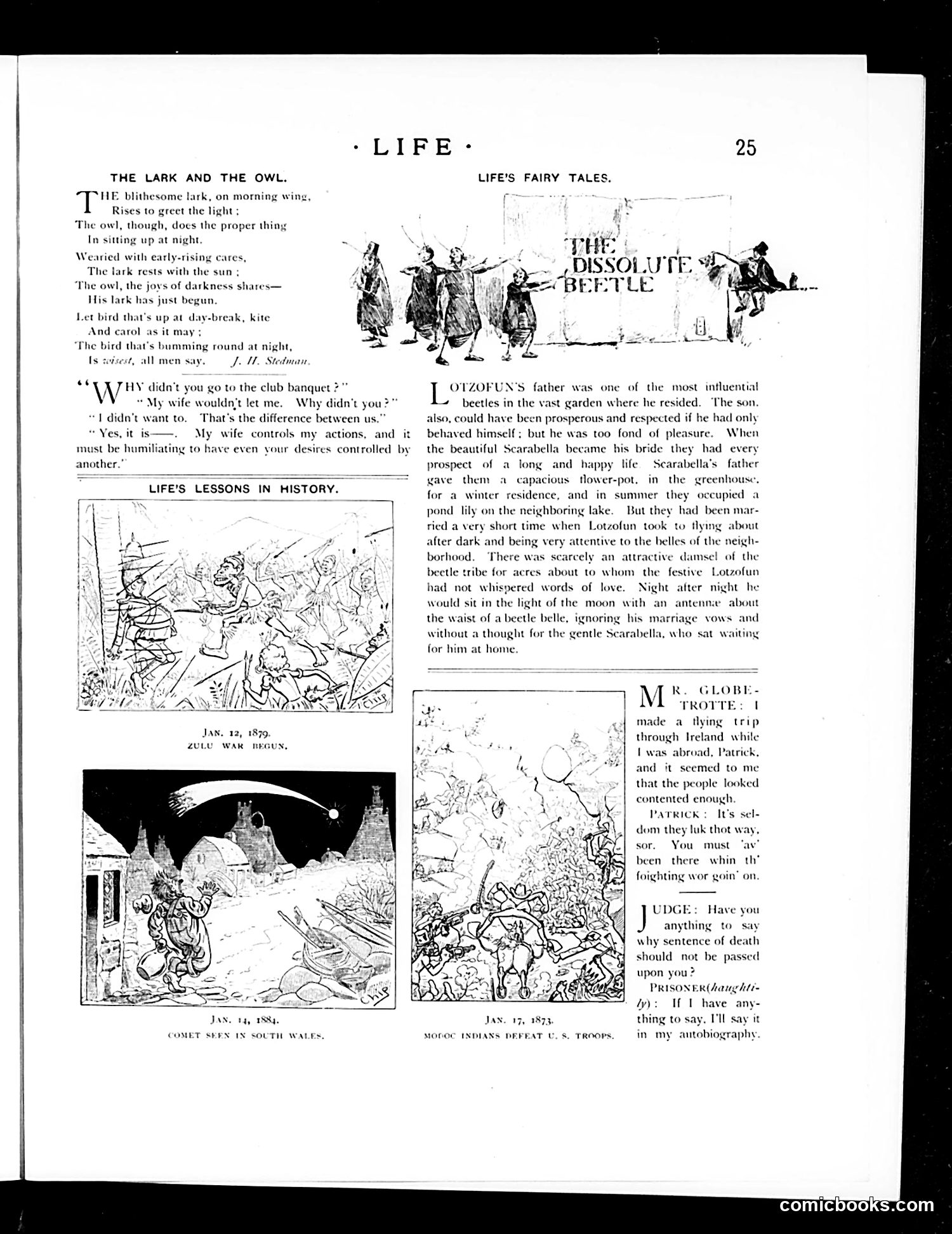
This page contains literary and satirical content rather than political cartoons. The top features "The Lark and the Owl," a poem contrasting early-rising virtue with nocturnal behavior. Below that, "Life's Lessons in History" presents historical illustrations dated Jan. 12, 1899 ("Zulu War Begins"), Jan. 14, 1884 ("Comet Seen in South Wales"), and Jan. 17, 1875 ("Moros Indians Defeat U.S. Troops"). The main narrative, "The Dissolute Beetle," is a satirical fairy tale about Lotzofun, a beetle son who abandons his family's respectable life to court a belle named Scarabella. The story mocks romantic distraction from duty—a common turn-of-the-century morality theme satirizing irresponsible behavior and social climbing.
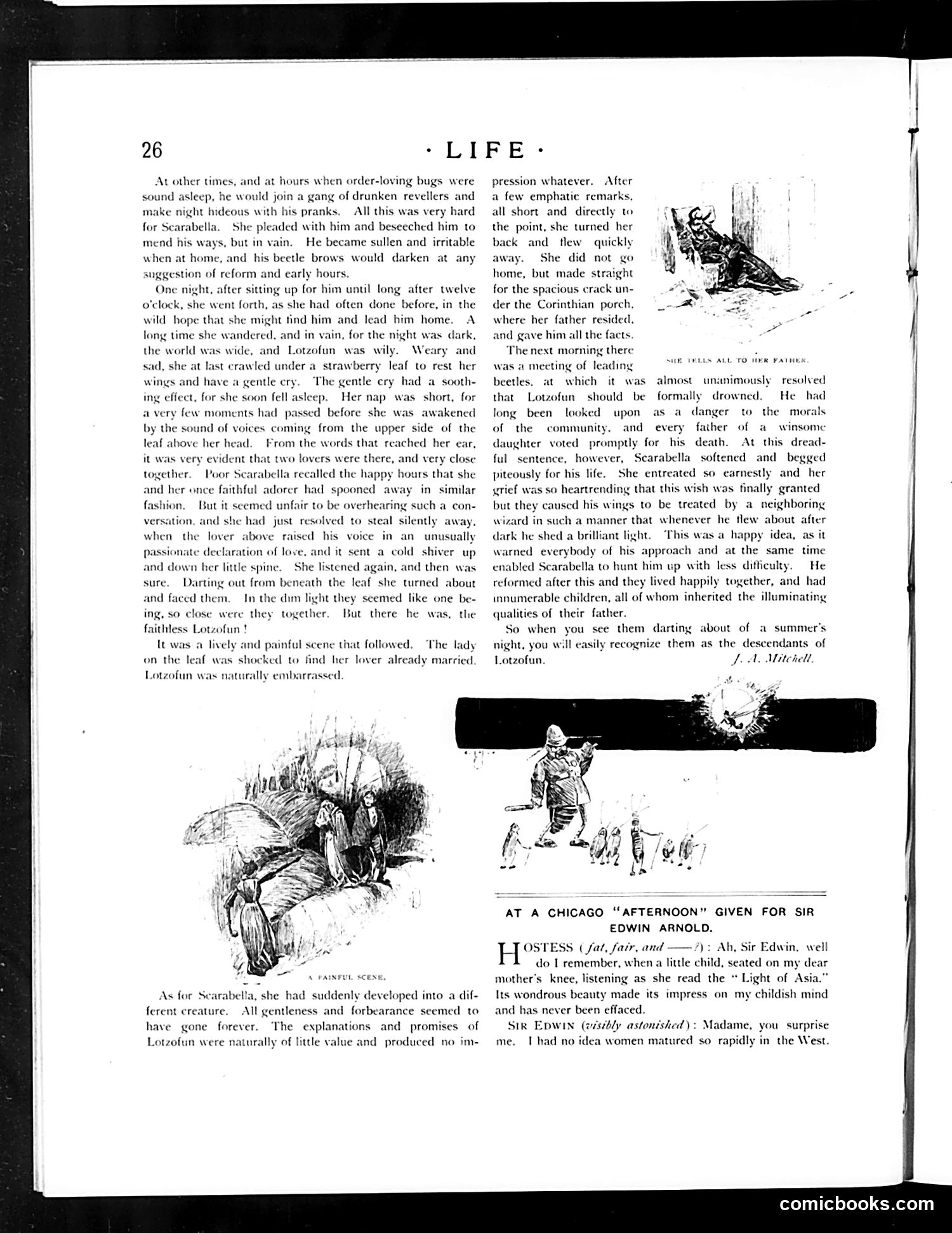
This page contains two distinct pieces: **1. "Lotzofun" Beetle Story (main narrative with illustrations):** A satirical moral fable about an unfaithful beetle named Lotzofun who abandons his devoted wife Scarabella for other pleasures. When discovered with another mate, he faces community judgment and near-drowning. Scarabella's mercy saves him, but as punishment, wizards enchant his wings to glow—forcing him into visibility and allowing her surveillance. The story mocks infidelity, gender relations, and Victorian morality through insect characters. **2. "At a Chicago 'Afternoon'" (bottom section):** A social satire featuring Sir Edwin Arnold (an actual 19th-century English poet/journalist). A hostess begins addressing him, apparently making a joke about women's "maturation" in the American West. The incomplete sentence ("fat, fair, and ——?") suggests she's making a crude or inappropriate remark. **Overall context:** This represents Life's typical satirical blend of fable-based social commentary and contemporary witty social observation targeting the era's attitudes toward marriage, infidelity, and gender dynamics.
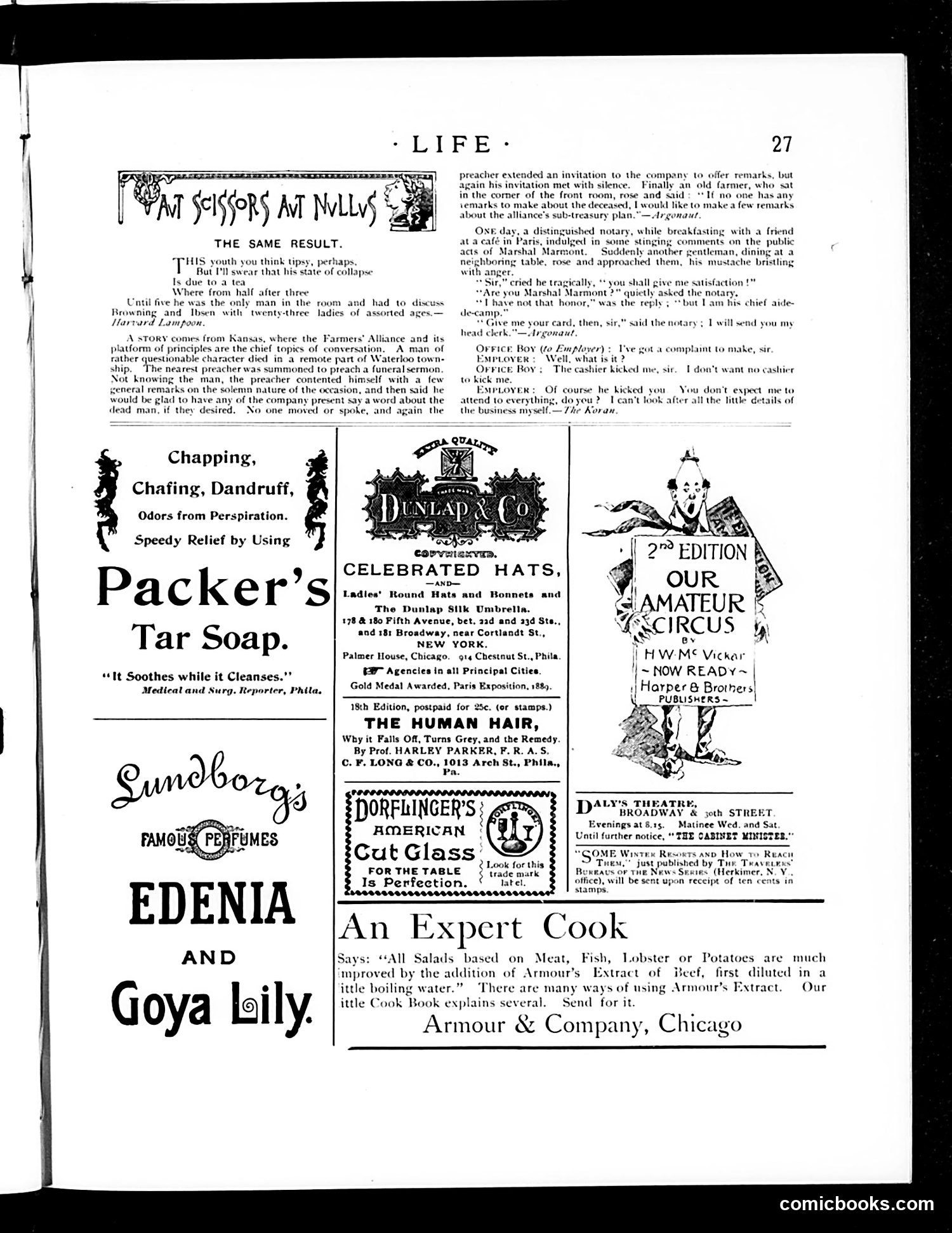
This page is primarily **advertisements** with two embedded satirical anecdotes in the text sections. The first story mocks the **Farmers' Alliance**, a late-19th-century agrarian political movement. A man dies, and when the preacher invites mourners to speak, only an old farmer responds—but instead of eulogizing the deceased, he uses the moment to promote the Alliance's "sub-treasury plan" (their political platform). The joke: the Alliance members were so obsessed with their cause that even a funeral becomes a political opportunity. The second anecdote involves **Marshal Marmont**, a Napoleonic-era French general. A notary insults him publicly; Marmont's aide demands satisfaction (a duel). The irony: the notary must apologize to preserve his honor, despite having legitimate complaints. This satirizes the absurdity of aristocratic honor codes. The remaining content consists of period advertisements for Packer's Tar Soap, Dunlap hats, Dorflinger glassware, Armour's beef extract, and other products—typical of Life magazine's revenue model.
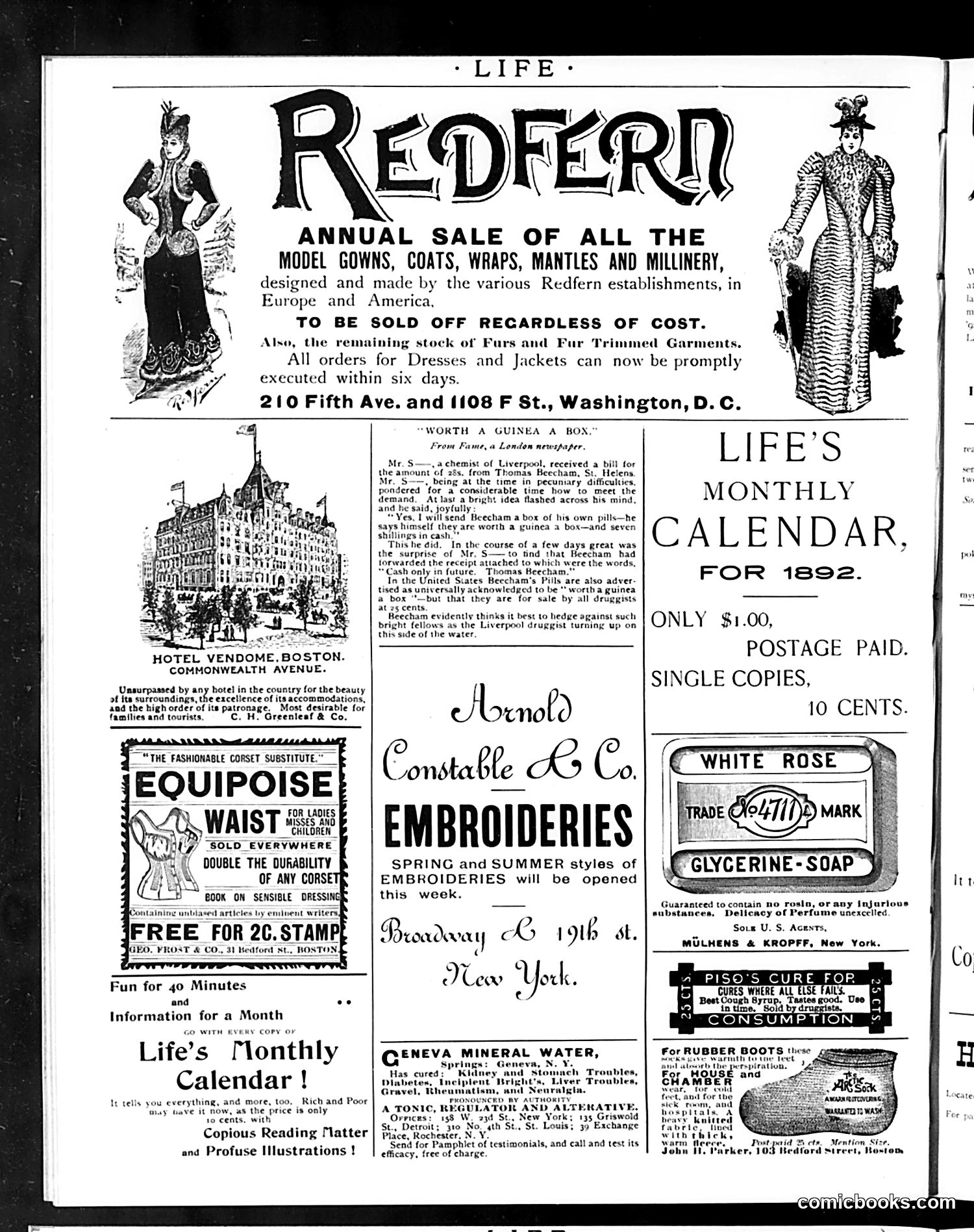
This is primarily a **advertising page** from Life's 1892 issue, not a political cartoon. The page showcases various commercial advertisements typical of the era: **Main content includes:** - A Redfern fashion house sale announcement (high-end women's clothing) - Life's Monthly Calendar for 1892 (10 cents) - A brief anecdote about Beecham's Pills, mocking a Liverpool druggist who tried to pay a debt with the pills themselves, claiming they're "worth a guinea a box"—satirizing patent medicine marketing claims - Various product ads: Equipoise corsets, Arnold Constable embroideries, White Rose soap, Piso's Consumption Cure, Geneva Mineral Water, rubber boots **The satirical element** is minimal—only the Beecham's Pills story gently mocks exaggerated advertising claims common to patent medicines of the period, which promised miraculous cures with dubious evidence. The page primarily reflects **consumer culture and advertising practices** of 1890s America rather than political satire.
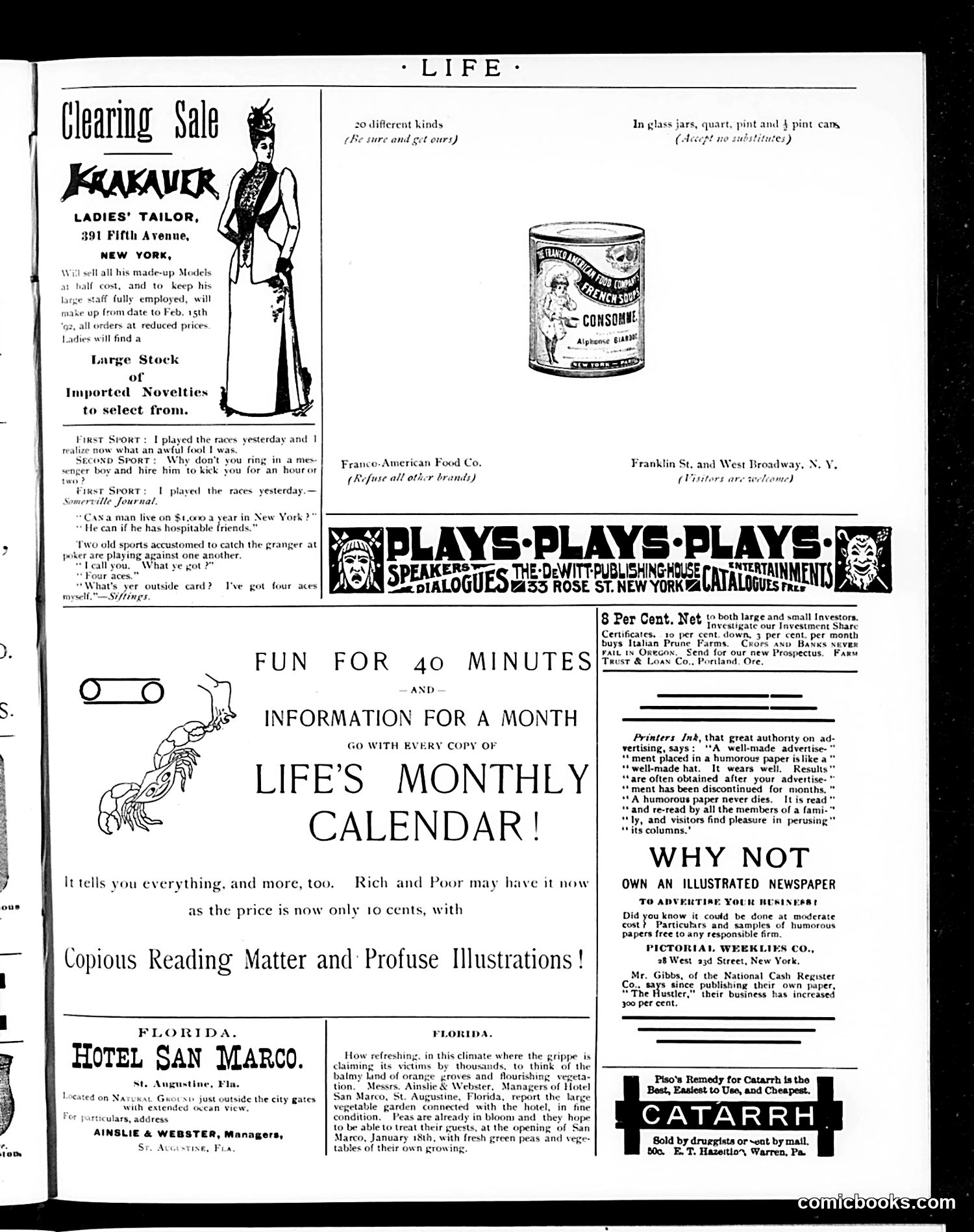
This is primarily an **advertising page** from Life magazine, circa early 1900s. The content is dominated by commercial advertisements rather than editorial satire. The notable comedic element is a brief dialogue labeled "First Sport" (reprinted twice), which appears to be a newspaper joke about a man who gambled at horse races and lost money. The humor is simple: when asked what he "got," he replies "four aces," but clarifies he's describing his foolish decision-making, not a winning hand. The accompanying text puns on the phrase "Can a man live on $1,000 a year in New York?"—the joke being that he can if he has "hospitable friends" to mooch from. The rest of the page advertises products (Kakauer's tailoring, Franco-American food), hotels (Hotel San Marco in Florida), investment schemes, and Life's own monthly calendar. A footer promotes Life as an effective advertising medium, claiming humorous papers get repeatedly read by entire families. The page reflects early-1900s consumer culture and advertising strategy rather than political satire.
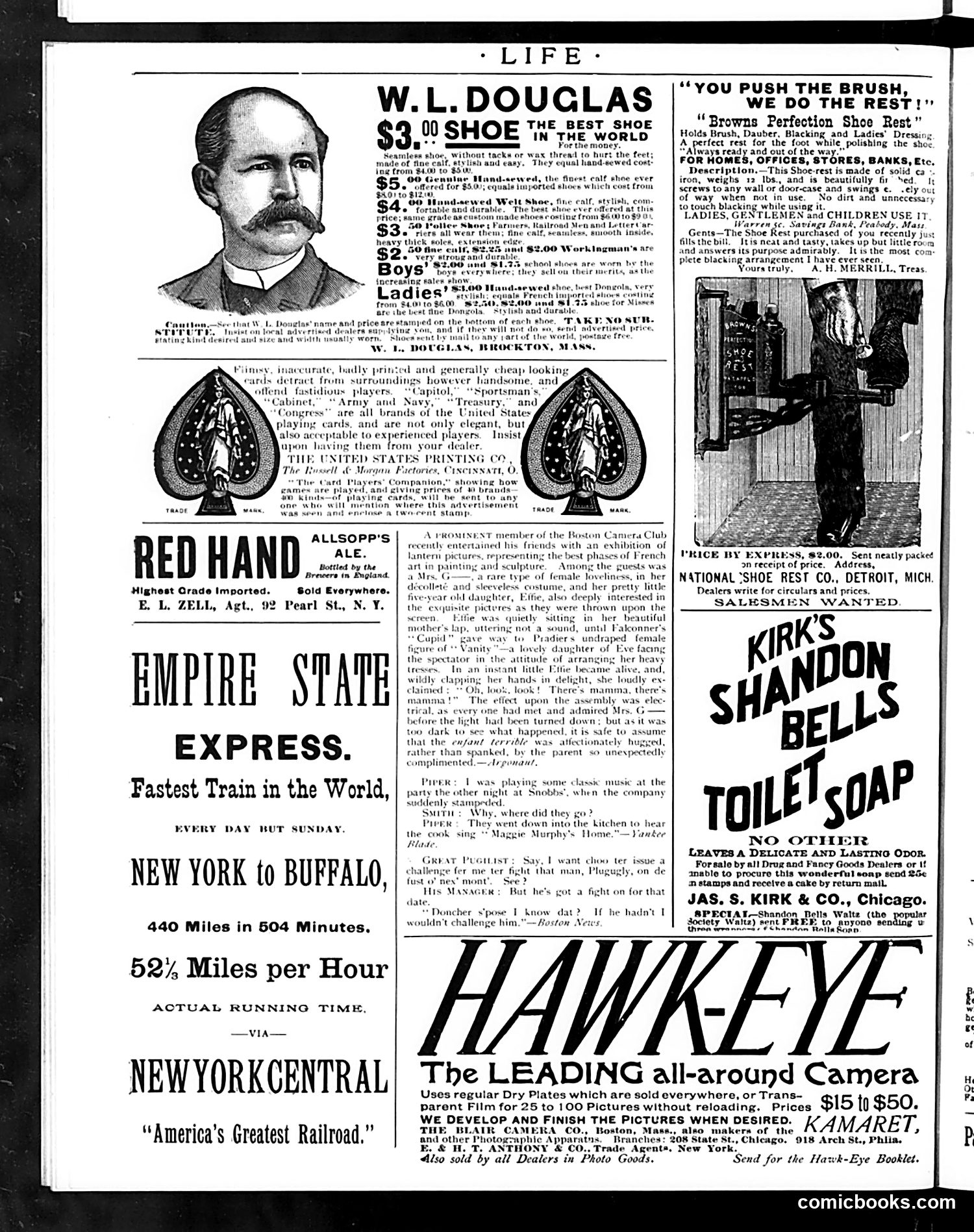
This page is primarily **advertising**, typical of Life magazine's format during this era. The major advertisements include: - **W.L. Douglas shoes** ($3-$5 range) — promoting affordability and quality construction - **Empire State Express** — the New York Central Railroad's flagship train, boasting record speed (52½ mph for 440 miles) - **Playing cards**, **Red Hand beer**, **Hawkeye cameras**, and various other consumer products The page includes **brief humorous anecdotes** rather than political cartoons. One joke describes a child at an art exhibition asking her mother, "Mamma, there's a lady without any clothes on" — the humor deriving from childish innocence encountering classical nude artwork. **Context for modern readers:** This reflects the late 19th/early 20th-century American consumer boom, technological pride (the railroad's speed), and the social anxieties around propriety and art appreciation. The ads emphasize value and modernity rather than luxury.
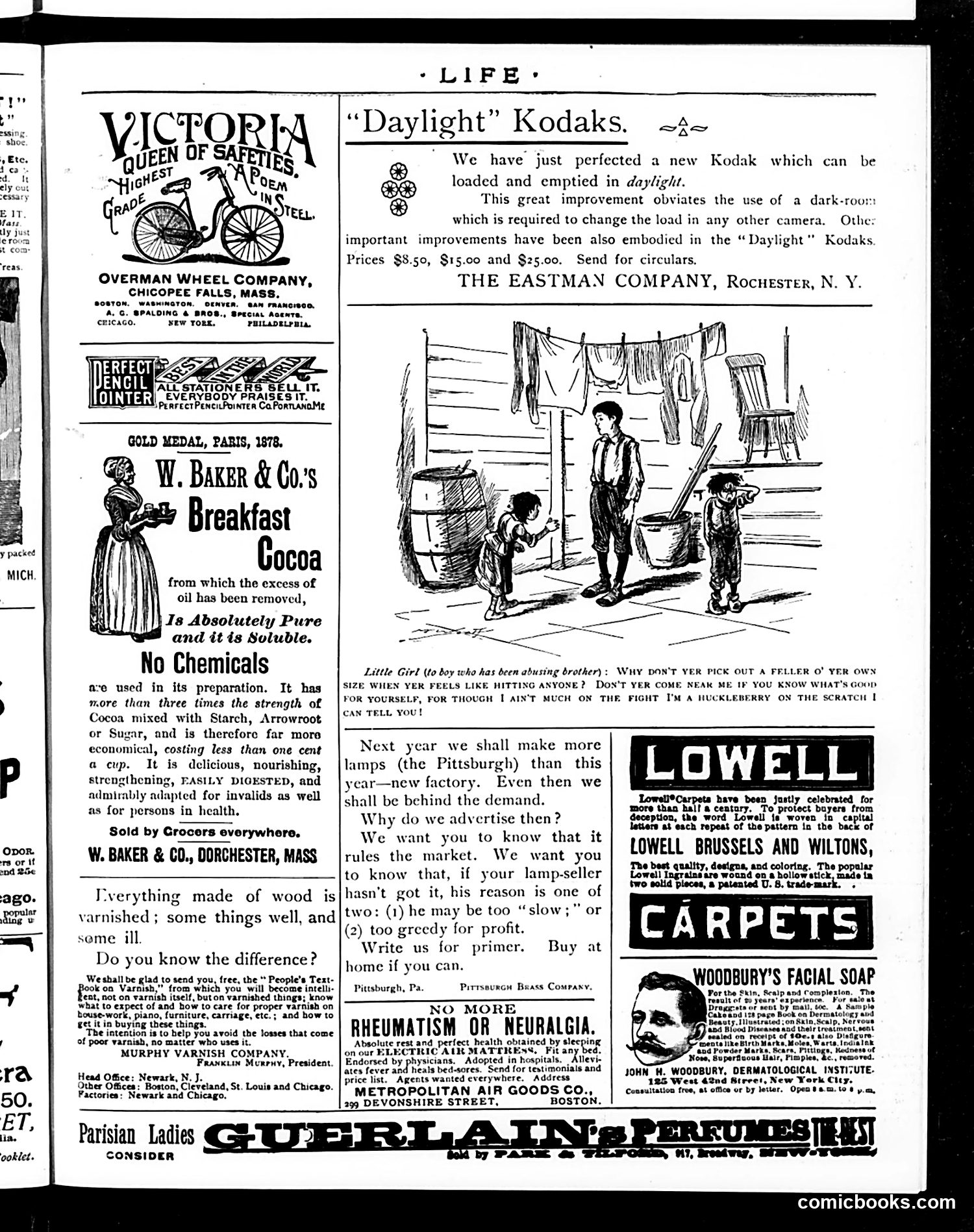
This page is primarily **advertising**, typical of late-19th-century American magazines. The notable content is a small cartoon captioned "Little Girl (to boy who has been abusing brother)," depicting a street scene where a young girl confronts a boy, saying he should pick on someone his own size instead of her brother—"for though I ain't much on the fight I'm a huckleberry on the scratch!" The joke relies on period slang: "huckleberry" (a small, insignificant thing) and "scratch" (fighting ability). The satire is gentle domestic humor about childhood justice and standing up to bullies. The page otherwise features product advertisements for bicycles, cocoa, pencils, cameras, carpets, soap, and medical devices. These ads reflect 1880s consumer goods and the technological novelty of items like Kodak cameras and electric mattresses, illustrating what middle-class Americans were buying.
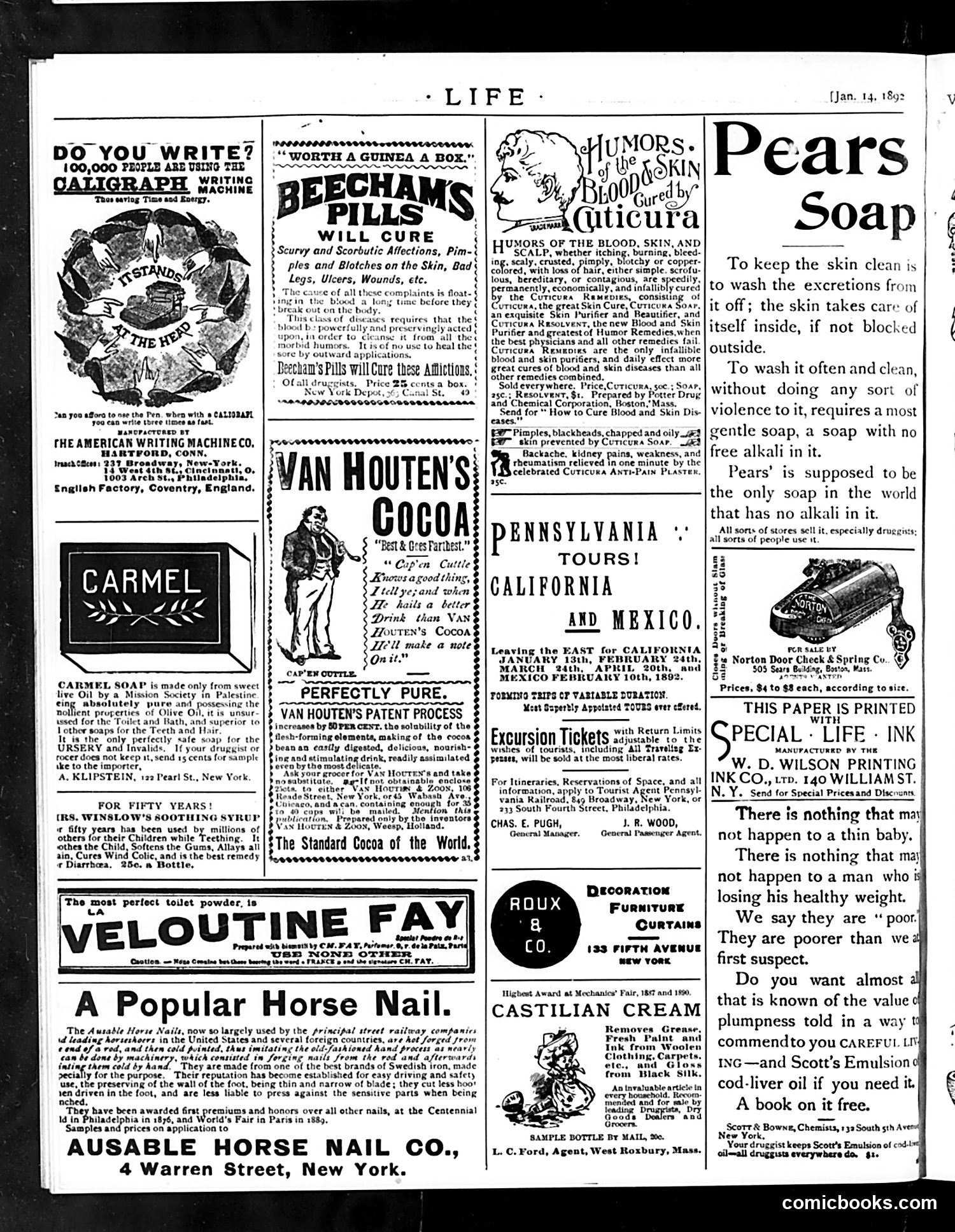
This page is **primarily advertisements**, not political cartoons. It showcases late 19th-century patent medicines and consumer goods typical of the era. Notable ads include: - **Beecham's Pills**: Claims to cure blood and skin diseases—representative of the fraudulent medical advertising common before FDA regulation - **Van Houten's Cocoa**: Emphasizes a "patent process" increasing digestibility, appealing to health-conscious consumers - **Mrs. Winslow's Soothing Syrup**: A well-known (and likely laudanum-containing) baby remedy - **Pears Soap**: Advertises as the only soap with "no alkali," targeting germ-anxious Victorians - **Ausable Horse Nail**: Technical product claiming superiority through Swedish iron construction The page reflects 1890s anxieties about health, hygiene, and modernity while showcasing unregulated marketing practices. The "satire" of *Life* appears minimal here—this is straightforward commercial content targeting middle-class readers concerned with respectability and progress.