
Life, 1892-01-14 · page 6 of 18
Life — January 14, 1892 — page 6: what you’re looking at
What you’re looking at
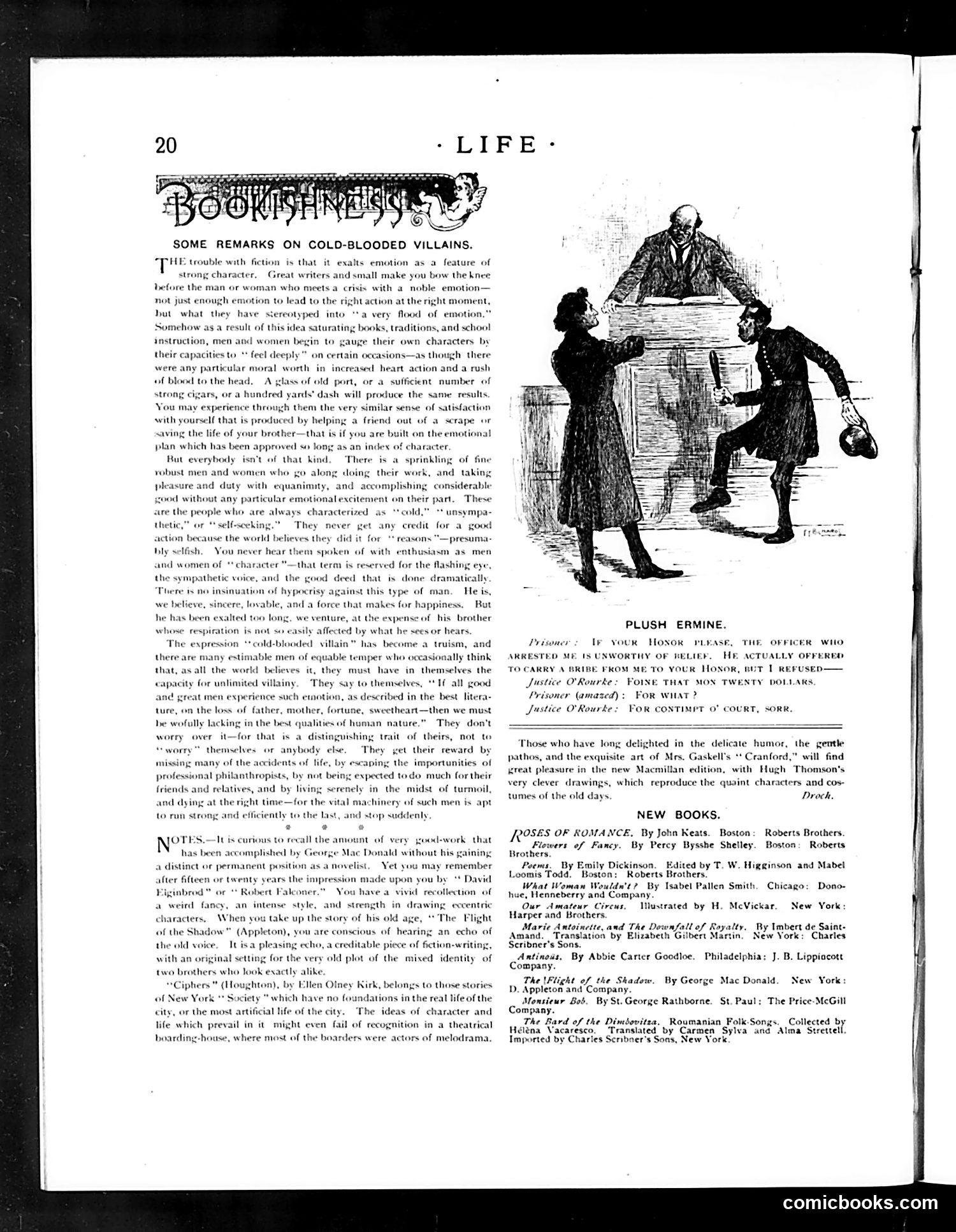
This page contains an article titled "Some Remarks on Cold-Blooded Villains" discussing fictional characterization, paired with an illustration labeled "Plush Ermine." The illustration shows three men in what appears to be a legal or official setting. The caption references "Justice O'Rourke" and mentions a prisoner accused of bribery and grand larceny. The dialogue includes "Justice O'Rourke: Foine that mon twenty dollars" and "For what?" and "For contempt o' court, sor." This appears to be satirizing corruption in the judicial system—specifically Irish-American judges accepting bribes or demonstrating bias. The heavy Irish dialect in the speech patterns and the character names suggest the satire targets Irish-American political/judicial figures of the era, likely early 20th century. The "cold-blooded villain" theme connects to the accompanying article's discussion of character types in fiction.
📄 Transcribed text from this page (OCR, searchable)
Machine-transcribed from the original scan — historical spelling and the odd misread are preserved.
vuble with fictios it exalts emot feature of {writers and small make you bow the knee pasa scharacter, ( before the not just enough an or woman who meets a crisis with a noble emotion— ation to lead to the rightaction at the right moment, Hut what they have stereotyped into ‘+a very flood of emotion.” Somehow as a result of this idea saturating books, traditions, and schoo! own characters by feel deeply” on certain occasions—as though there were any particular eart action and a rush of blood to the head. a sufficient strong cigars, or a hundred yards’ dash will produce the same results. instruction, men and women b to gauge th their capacities to asedl ral worth in in A glass of old port, number of You may experience through them the very similar sense of satisfaction with yourself that is produced by helping a friend out of a scrape or saving the life of your brother—that is if you are built on the emotional plan which has been approved so long as an index of ch But everybody isn't of that kind. There is a spi robust men and women who go along doing their work, and taking pleasure and duty with equanimty, and accomplishing considerable n their part, These + unsympa- vod without any particular emotional excites sire the people who are always characterized. 3 They action because the world believes they did it for or self-seek never y eredit for a good * reasons “—presuma- bly selfish, You never hear them: spoken of with enthusiasm as men «i women of * character "—that teray is reserved for the flashing eye, pathetic voice, and the good deed that is done dramatically He is, © 1s no insinuation of hypocrisy against this type of man we belie dia for he hast lovable, 3 that makes for happiness. But 10 long, we venture, at the expense of his brother ion is not so easily affected by what he sees or hears. The expression ** cold. J villain” has become a truism, and there are many estimable men of equable temper who occasionally think all the world believes it, they must have in themselves the elves, “Tf all good as described in the best litera- ity for unlimited villainy, ‘They say to them \ce such emotic e, sweetheart—then we must They don't for that is a distinguishing trait of theirs, not to he wofully lack the best qualities of human nature worry over it “worry” themselves or anybody eke. They f ih professional philanthropists, by ne get their reward by missing many of the accide by escaping the importunities of xpected todo much for their the midst of turmoil, such men is apt being friends and relatives, and by living serenely in and dying at ther jor the vital machi d efficiently to the last, * ° to run strong, It is curious to recall the amount of very Mae De novelist JOTES. ood-work that has been accomplished by Ge Ld without his gaining Yet y ession made upon y mber “David You have a vivid recollection of a distinct of permanent position as u may 1 after fifteen or twenty years the in ‘ou by Kiginbrod * or * Robert Falcons fancy, an intense sty When you take up the story of his old age, “Th ‘of the Shadow" (Appleton), you are conscious of a weird . and strength in drawing eccentric Flight aring an echo of characters, the old ve It isa pleasing echo, a creditable piece of fiction-writing, with an ori for the very old plot of the mixed identity of two brothers who look exactly alike. “Ciphers " (Houghton), by Ellen Olney Kirk, belongs to those stories of New York " Society "which have no foundations in the real life of the or the most artificial life of the city. The ideas of character and life which prevail in it might even fail of recognition in a theatrical boarding-house, where most of the boarders were actors of melodrama. PLUSH ERMINE. Prisoner > AP YOUR HONOR PLEASE, THE OFFICER WHO ARRESTED ME 1S UNWORTHY OF HELIER. HE ACTUALLY OFFERED TO CARRY A BRIBE FROM ME TO YOUR Hoxor, nuT 1 REFUsED— Justice O'Rourke > FONE THAT MON TWENTY Prisoner (amazed): FOR WUAT ? Justice O'Rourke: FOR CONTIMPT O° COURT, SORR. DOLLARS, Those who have long delighted in the delicate humor, the gentle skell’s ** Cranford,” will find millan edition, with very clever drawings, which reproduce the quaint characters and cos- tumes of the old days. Droch, pathos, and the exquisite art of Mrs. great pleasure in the new M Hugh Thomson's NEW BOOKS. OSES OF ROMANCE, By John Keats. Boston Flowers of Fancy. By Percy Bysshe Shelley. Brothers. Poems. By Emily Dickinson. Edited by T. W. Higginson and Mabel Loomis Todd, Boston: Roberts Brothers. What Woman Wouldn't? By Isabel Pallen Smith hue, Henneberry and Company Mlustrated by H. MeViekar, Roberts Brothers. Boston: Roberts Chicago: Dono- Our Amateur Circus. Harper and Brothers. Marie Antoinctte, and The Downfall of Royalty. Amand. | Translation by Elizabeth Gilbert Martin Scribner's Sons. Antinous, By Abvie Carter Goodloe. Company. The \Flight of the Shad D. Appleton and Company. Monsieur Bod. By St.George Rathborne. St. Paul: Company. The Bard of the Dimbovitea. Roumanian Folk-Songs. Collected by Heltna Vacaresco. ‘Translated’ by Carmen Sylva and Alma Strettell. Imported by Charles Scribner's Sons, New York New Yor! By Imbert de Saint- New York: Charles Philadelphia: J. B. Lippiacott New Vork: By George Mac Donald he Price-McGill comicbooks.com