
Life, 1892-01-14 · page 4 of 18
Life — January 14, 1892 — page 4: what you’re looking at
What you’re looking at
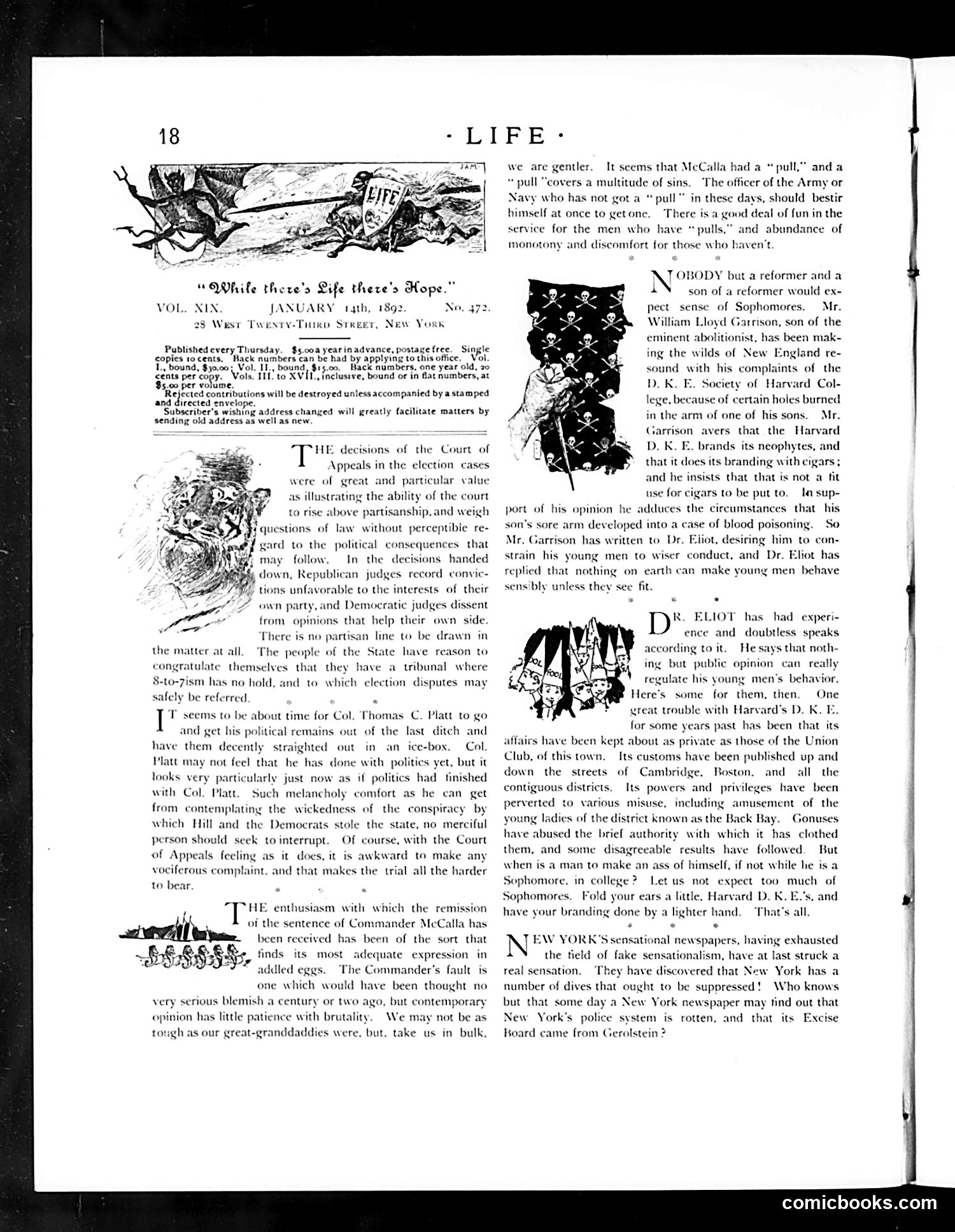
This page contains political commentary rather than cartoons. The text discusses several contemporary issues: 1. **Court of Appeals decisions** on election cases, praising the court for rising above partisanship. 2. **Col. Thomas C. Platt** — a prominent New York Republican politician who is urged to remove himself from politics, suggesting he's become a liability to the party. 3. **Commander McCalla's sentence** — apparently a military matter receiving public attention, with the author defending the verdict against contemporary criticism. 4. **Harvard D.K.E. Society scandal** — the text references complaints from abolitionist William Lloyd Garrison's son about holes burned in his son's arm, allegedly by fraternity members, sparking debate about whether public opinion can regulate young men's behavior. The page emphasizes political neutrality and moral questions about youth conduct.
📄 Transcribed text from this page (OCR, searchable)
Machine-transcribed from the original scan — historical spelling and the odd misread are preserved.
“While there's Life there's Hope.” VOL. XIX JANUARY tath, 189. 23 West Twenty-Tiuko Srreer, New York No, 472 Published every Thursday. $s.00a yearinadvance, postage free. Single copies 1ocents, Back numbers can be had by applying tothisoffice. Vol. 1., bound, $30.00; Vol. I1., bound, $15.00. Back numbers. one year old, 20 sents per copy. Vols. II! to XVIL., inclusive, bound of in flat numbers, at $5.00 per volume. Rejected contribu and directed envelope, Subscriber's wishing address changed will greatly facilitate matters by sending old address as well as new. ns will be destroyed unless accompanied by a stamped THe decisions of the Court of . \ppeals in the election cases were of great and particular value €F as illustrating the ability of the court ¥ — torrise above partisanship. and weigh ‘questions of law without perceptibie re- ard to the political consequences that may follow. Inthe decisions handed down, Republican judges record convic- tions unfavorable to the interests of their own party, and Democratic judges dissent 4 from opinions that help their own side. There is no partisan line to be drawn in the matter at all, The people of the State have reason to v tribuna congratulate themselves that they have where 8-to-7ism has no hold, and to which clection disputes may safely be referred. I seems to be about time for Col. Thomas C. Platt to go and get his political remains out of the last ditch and have them decently straighted out in an ice-box. Col. Platt may not feel that he has done with polities yet, but it looks very particularly just now as if politics had finished with Col, Platt. Such melancholy comfort as he can get from contemplating the wickedness of the conspiracy by which Hill and the Democrats stole the state, no merciful person should seek to interrupt. Of course, with the Court of Appeals feeling as it does, it is awkward to make any vociferous complaint. and that makes the trial all the harder to bear. HE enthusiasm with which the remission la has Th of the sentence of Commander Me been received has been of the sort that n&§, A finds its most adequate expression in SAVY F addled eggs. The Commander's fault is one which would have been thought no very serious blemish a century or two ago, but contemporary opinion has little patience with brutality. We may not be as tough as our great-granddaddies were. but, take us in bulk, -LIFE: we are gentler. It seems that MeCalla had a “ pull," and a * pull “covers a multitude of sins. ‘The officer of the Army or Navy who has not got a “pull” in these days, should bestir himself at once to getone. There is a good deal of fun in the service for the men who have “pulls,” and abundance of monotony and discomfort for those who haven't. N OBODY but a reformer and a son of a reformer would ex- pect sense of Sophomores. Mr. William Lloyd Garrison, son of the eminent abolitionist, has been mak- ing the wilds of New England re- sound with his complaints of the D. K, E. Society of Harvard Col- lege, because of certain holes burned in the arm of one of his sons. Mr. Garrison avers that the Harvard D. K. E. brands its neophytes, and that it does its branding with cigars ; and he insists that that is not a fit use for cigars to be put to. Ia sup- port of his opinion he adduces the circumstances that his. son’s sore arm developed into a case of blood poisoning. So Mr. Garrison has written to Dr. Eliot, desiring him to con- strain his young men to wiser conduct, and Dr. Eliot has replied that nothing on earth can make young men behave sensibly unless they see fit. D* ELIOT has had experi- ence and doubtless speaks according to it. He says that noth- ing but public opinion can really regulate his young men’s behavior. Here's some for them, then. One great trouble with Harvard’s D. K. EF. for some years past has been that its affairs have been kept about as private as those of the Union Club, of this town. Its customs have been published up and down the streets of Cambridge. Boston, and all the contiguous districts. Its powers and privileges have been perverted to various misuse, including amusement of the young ladies of the district known as the Back Bay. Gonuses have abused the brief authority with which it has clothed them, and some disagreeable results have followed. But when is a man to make an ass of himself, if not while he is a > Sophomore. in colleg: Let us not expect too much of Sophomores. Fold your ears a little, Harvard D. K. E.'s, and have your branding done by a lighter hand. ‘That's all. N' YORK'S sensational newspapers, having exhausted the tield of fake sensationalism, have at last struck a They have discovered that New York ha! number of dives that ought to be suppressed! Who knows but that some a New York newspaper may tind out that New York's police system is rotten, and that its Excise board came from Gerolstein ? real sensation, | comicbooks.com