
A complete issue · 16 pages · 1891
Life — December 24, 1891
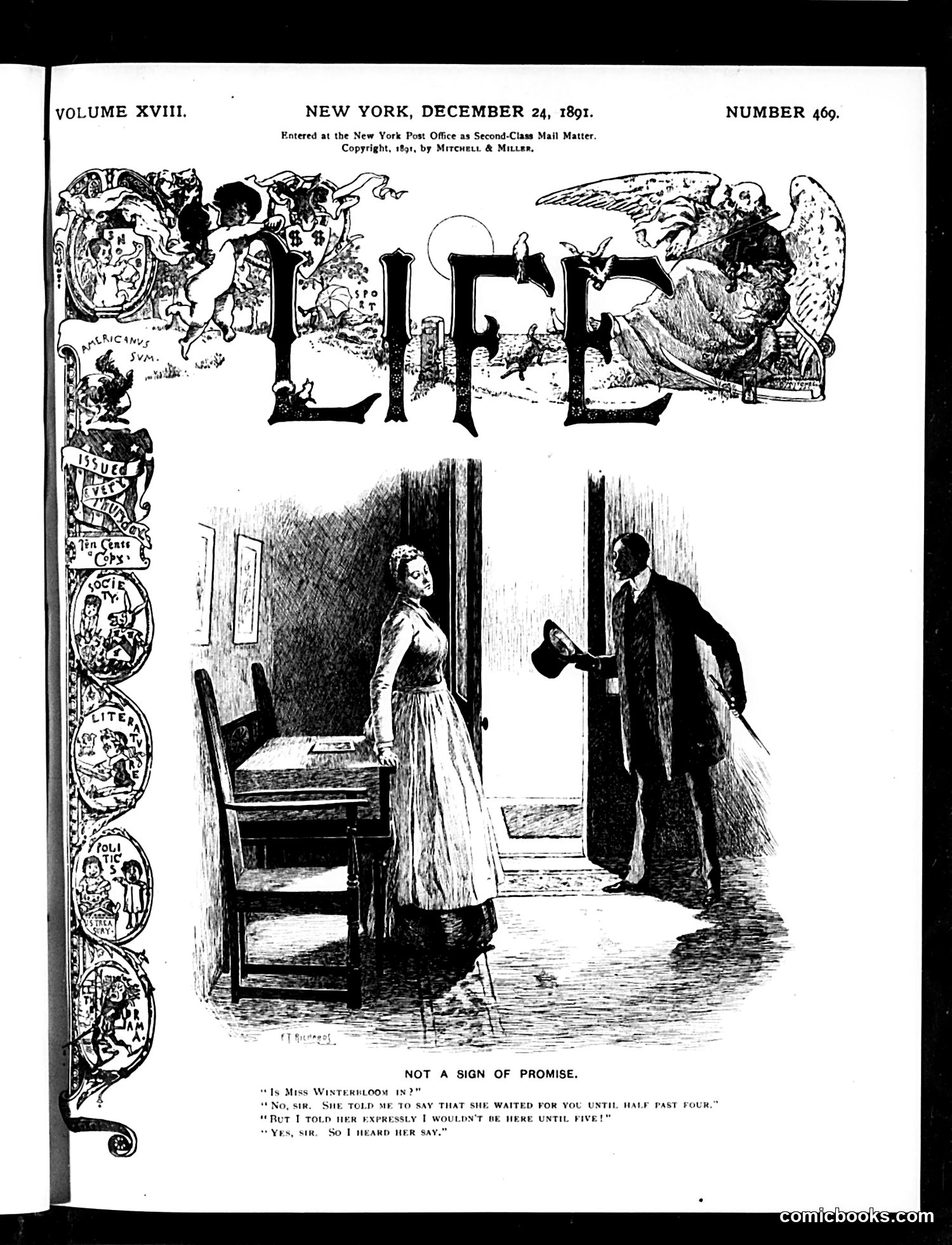
This satirical cartoon depicts a domestic scene showing a woman (Miss Winterblooms, per the dialogue) waiting in a hallway while a man departs. The caption reveals their exchange: she told him she'd wait until half past four; he responded he wouldn't return until five. Her silent presence now suggests she's been stood up or deliberately ignored. The joke operates on gender and courtship dynamics of the 1890s: the woman has positioned herself to appear patient and devoted, but the man's deliberate lateness—and his apparent indifference upon leaving—undermines any romantic promise. The title sardonically comments that his behavior offers no hopeful sign for their relationship. It's a commentary on male inconsiderateness in romantic relationships.
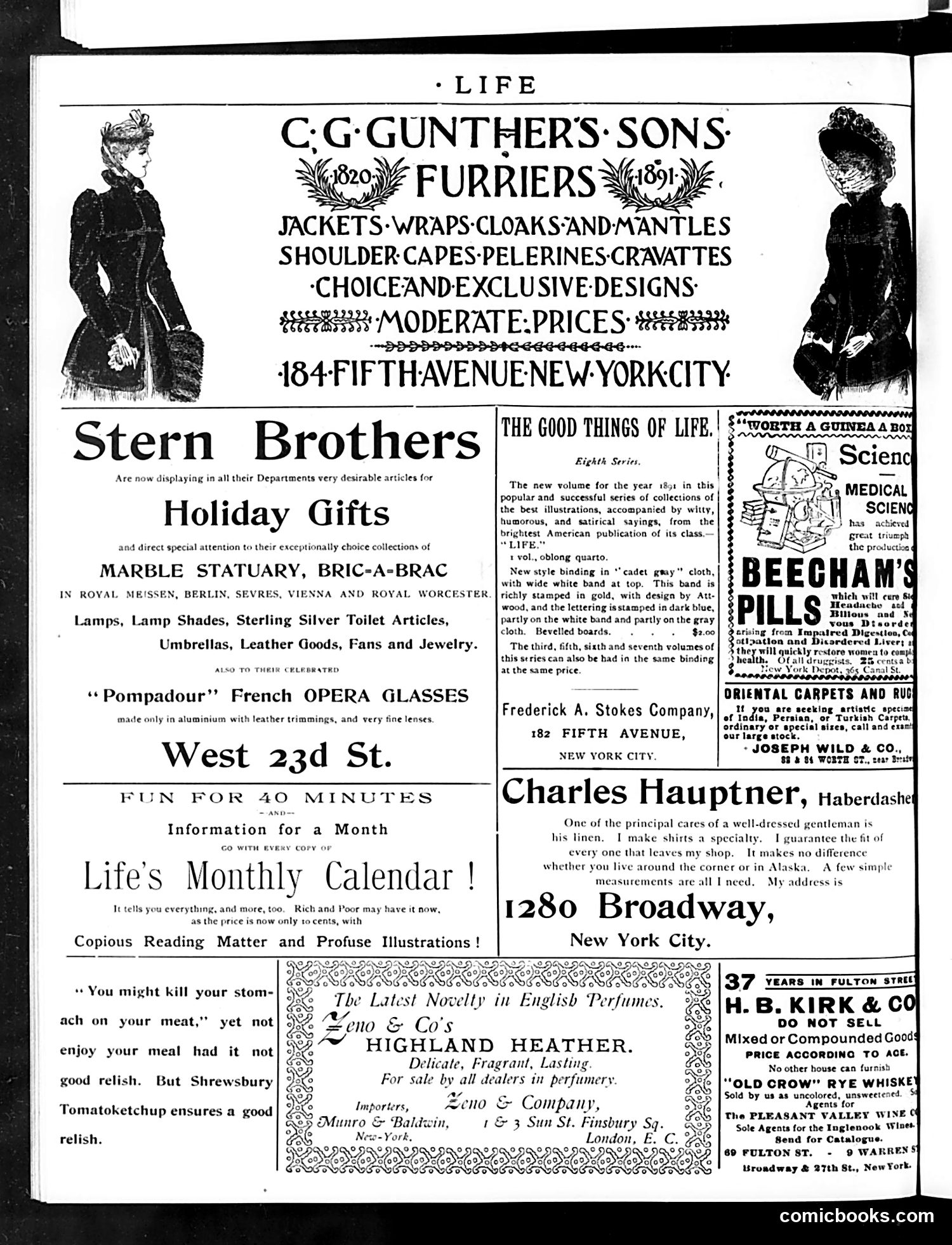
This page is **primarily advertisements** with no discernible political cartoon or satirical content visible. The ads include: - C.G. Gunther's Sons (furriers, 1820-1891) - Stern Brothers (holiday gifts, marble statuary, lamps) - Frederick A. Stokes Company (books) - Charles Hauptner (haberdasher/shirts) - H.B. Kirk & Co (mixed/compounded goods) - Zeno & Co's perfume - Shrewsbury Tomatoketchup - Life's Monthly Calendar promotion The page also promotes "The Good Things of Life" (a book series) and Beecham's Pills (a patent medicine). There are two illustrated female figures in fashionable 1890s dress accompanying the furrier advertisement, but these appear decorative rather than satirical. No political messaging or social commentary is evident on this page.
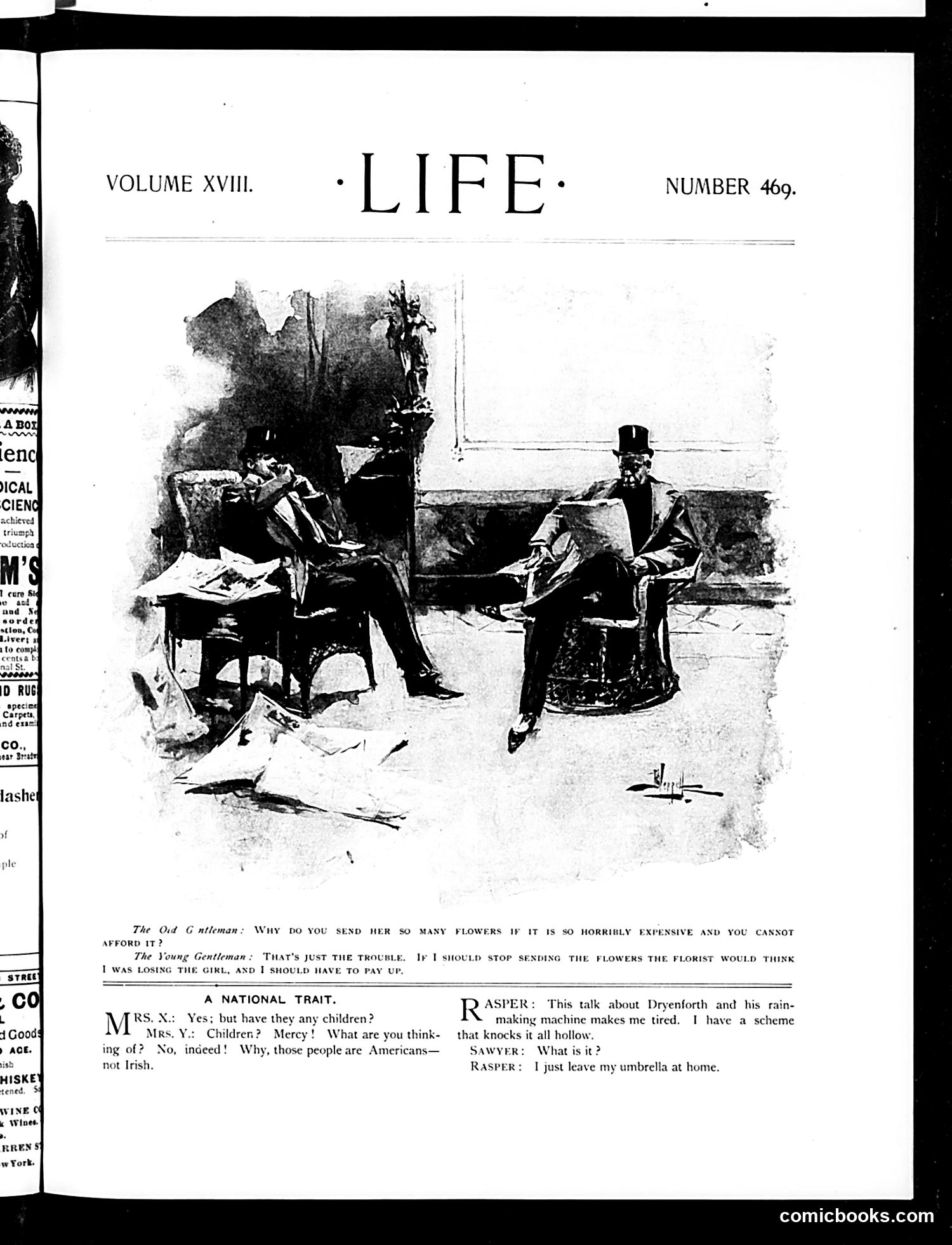
The main illustration depicts a social scene titled "A National Trait," showing well-dressed men in top hats discussing flowers and romantic gestures. The dialogue satirizes American courting customs: an older man questions why a young man sends expensive flowers to a woman, calling it wasteful. The young man responds that if he stopped, the florist would lose business—implying American men feel obligated to maintain frivolous spending habits to support commerce. The cartoon critiques both masculine romantic behavior and consumerism, suggesting American men are trapped in expensive courtship rituals they recognize as wasteful but continue anyway for economic reasons. It's social satire about class performance and commercial obligation in early 20th-century America.
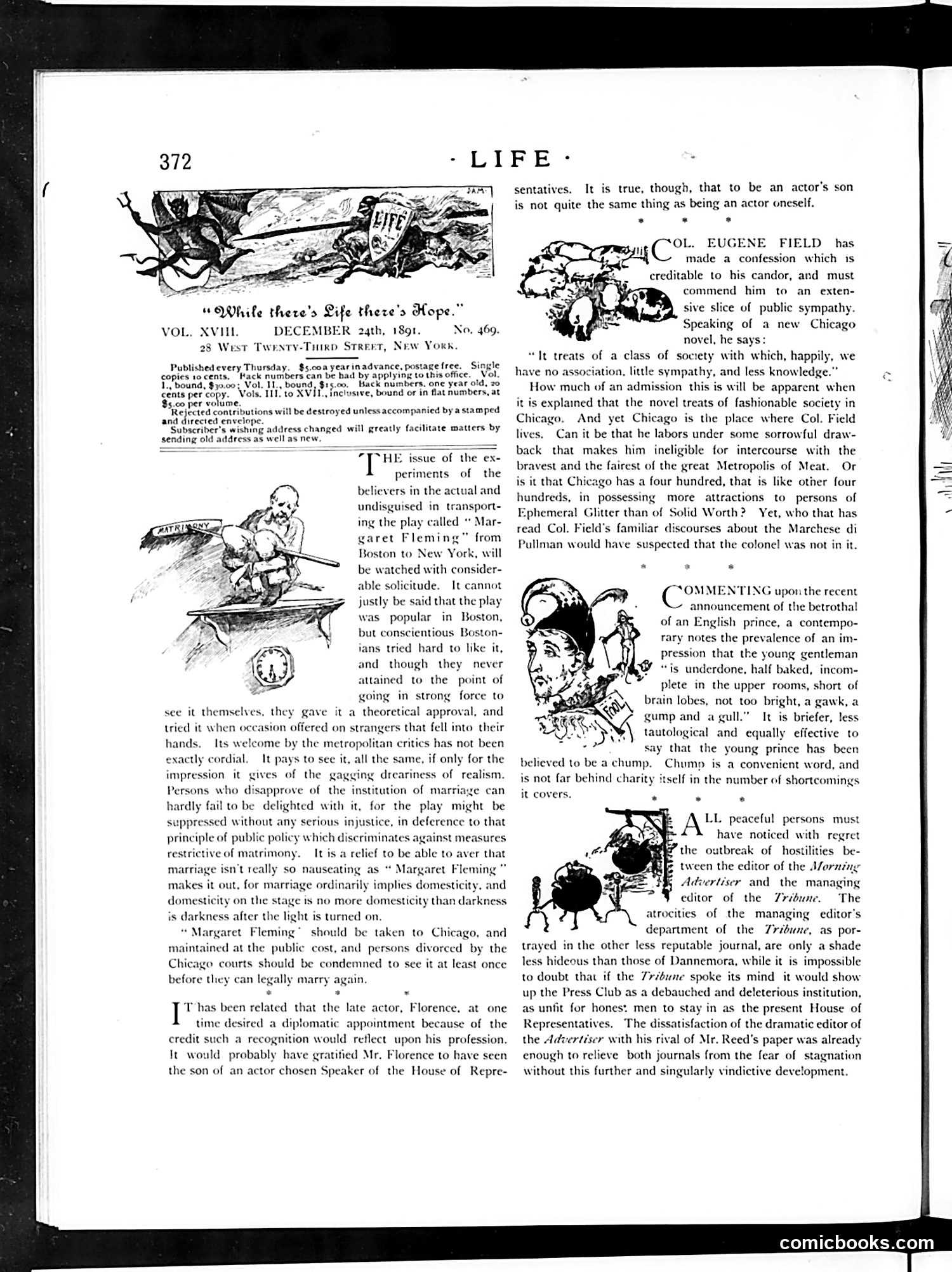
This page contains three satirical illustrations with accompanying commentary on theatrical and social matters from the 1880s. The top cartoon depicts a theatrical scene, likely referencing the play "Margaret Fleming," which the text discusses as controversial for its realistic portrayal of marriage and domestic issues—unusual for Boston theater audiences at the time. The middle illustration appears to show a dramatic figure in an exaggerated pose, commenting on theatrical performance styles. The bottom cartoon caricatures what appears to be a young aristocratic figure, accompanying text mocking recent British press descriptions of an English prince as "undersized, half-baked" and generally unsuitable—a satirical jab at both the prince and sensationalist journalism. The overall page satirizes theatrical tastes, dramatic realism, and contemporary press excess in the Gilded Age.
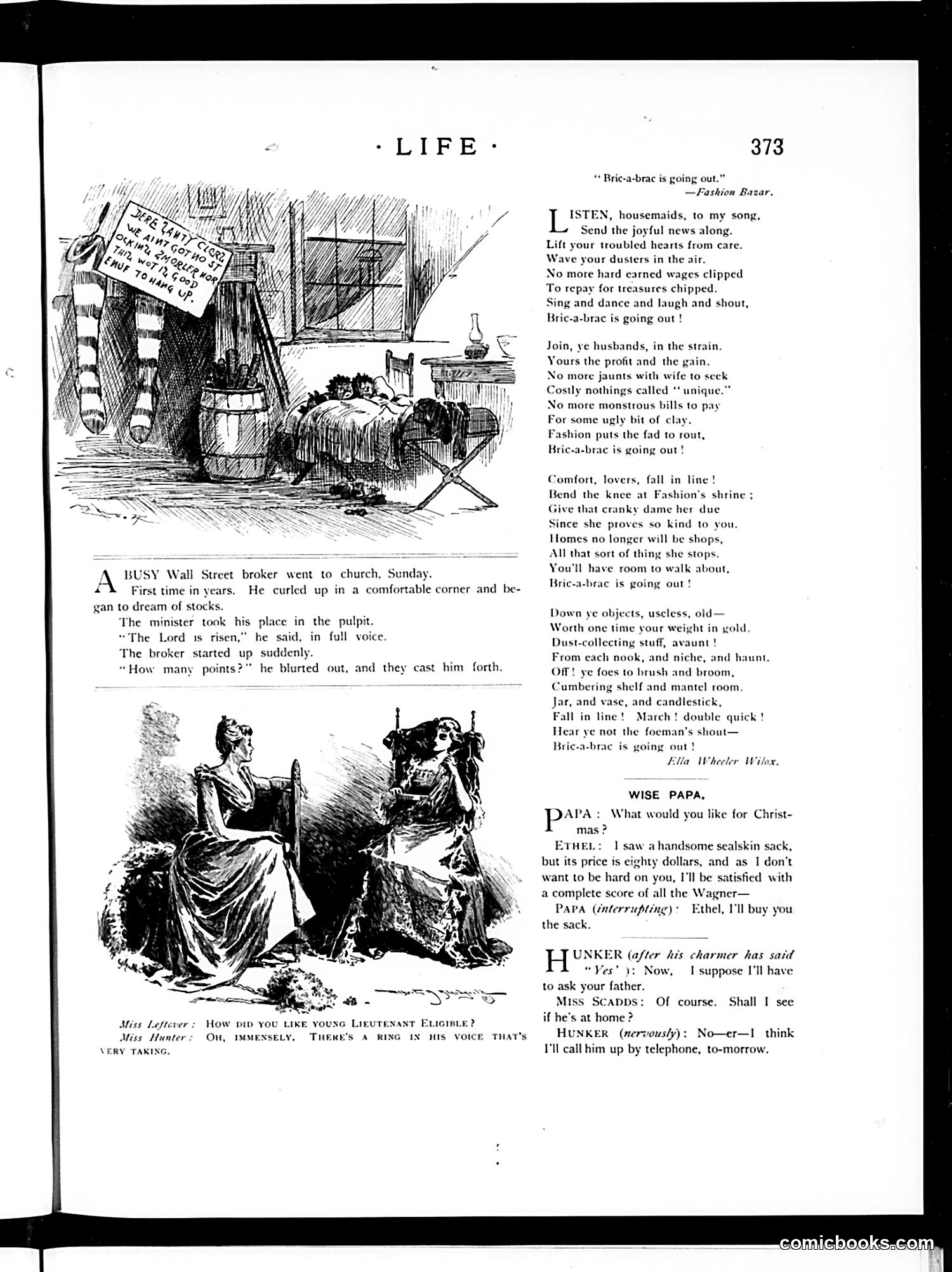
This page contains several satirical pieces targeting early 20th-century social conventions: **"Bric-a-brac is going out!"** - A poem by Ella Wheeler Wilcox celebrating the elimination of cluttered Victorian domestic décor, mocking the elaborate knick-knacks and "costly nothings" that cluttered homes. It's a progressive jab at outmoded decorating tastes. **Wall Street Broker story** - Ridicules a stockbroker's sudden religious conversion, with the punchline "How many points?" suggesting his mind remains on profit rather than spirituality. **"Wise Papa"** - A humorous domestic exchange where a daughter asks her father for an expensive sealskin coat for Christmas, negotiating down from eighty dollars by offering a Wagner score instead. The page reflects satirizing materialism, vanity, and the gap between professed values and actual behavior.
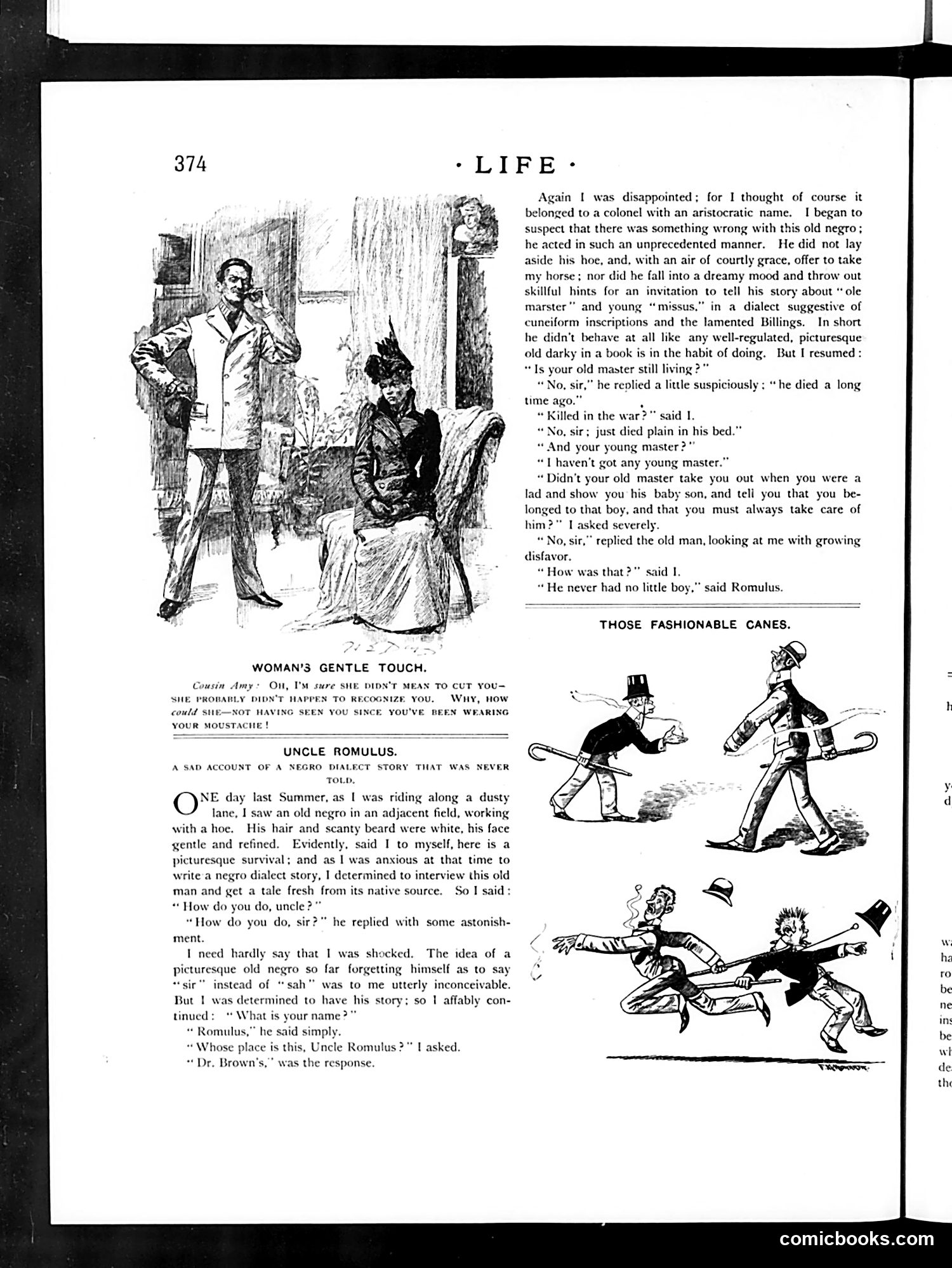
This page contains two distinct sections: **"Woman's Gentle Touch"** (top left): A sketch showing a woman confronting a man about his mustache, with dialogue suggesting she doesn't recognize him without it. This is light domestic satire about changing appearance. **"Uncle Romulus"** (main text): A longer narrative story about the author interviewing an elderly Black man working in a field. The text describes the author's shock at the man's refined speech and manner, expecting dialect stereotypes instead. The story appears to critique (or perhaps reinforce) racial assumptions of the era. **"Those Fashionable Canes"** (right): A satirical illustration sequence mocking exaggerated cane-wielding fashions, showing men in absurd poses with oversized walking sticks—social satire about male fashion affectation. The page reflects early 20th-century Life magazine's mix of domestic humor, racial attitudes, and fashion mockery.
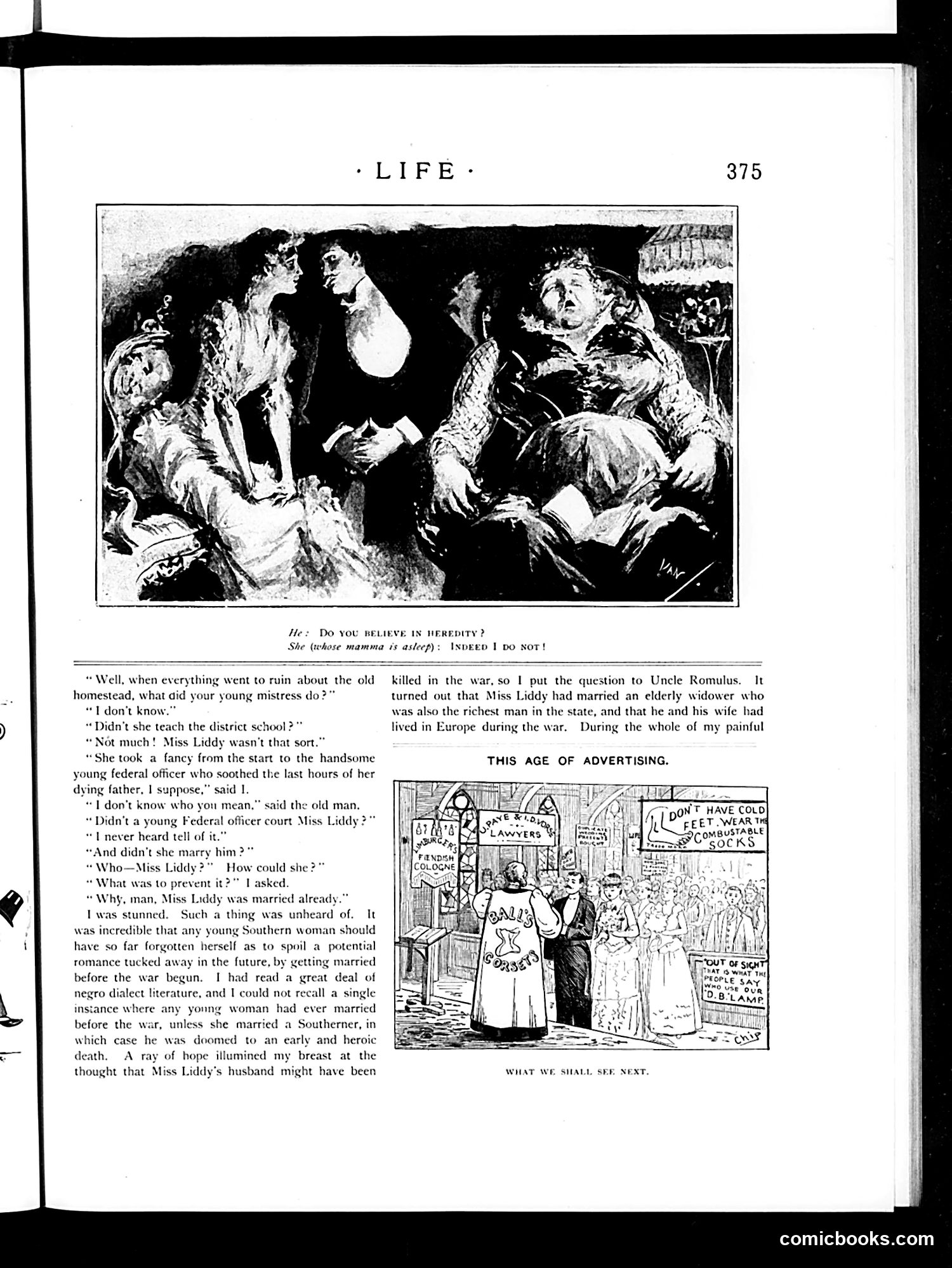
The page contains two distinct elements: **Upper illustration**: A dramatic scene depicting several figures in conversation, likely illustrating the story text below about inheritance and Southern social customs during wartime. **Lower cartoon titled "THIS AGE OF ADVERTISING"**: A satirical street scene showing storefronts with exaggerated advertising signs and banners. The joke appears to mock the proliferation of commercial advertisements cluttering urban spaces—a common complaint during the early 20th century about aggressive marketing taking over public spaces. Signs reference various products and services competing for attention in what appears to be a crowded commercial district. The accompanying story text discusses Miss Liddy's marriage before the war and inheritance matters, but the cartoon's satire focuses on commercialism rather than the narrative content above it.
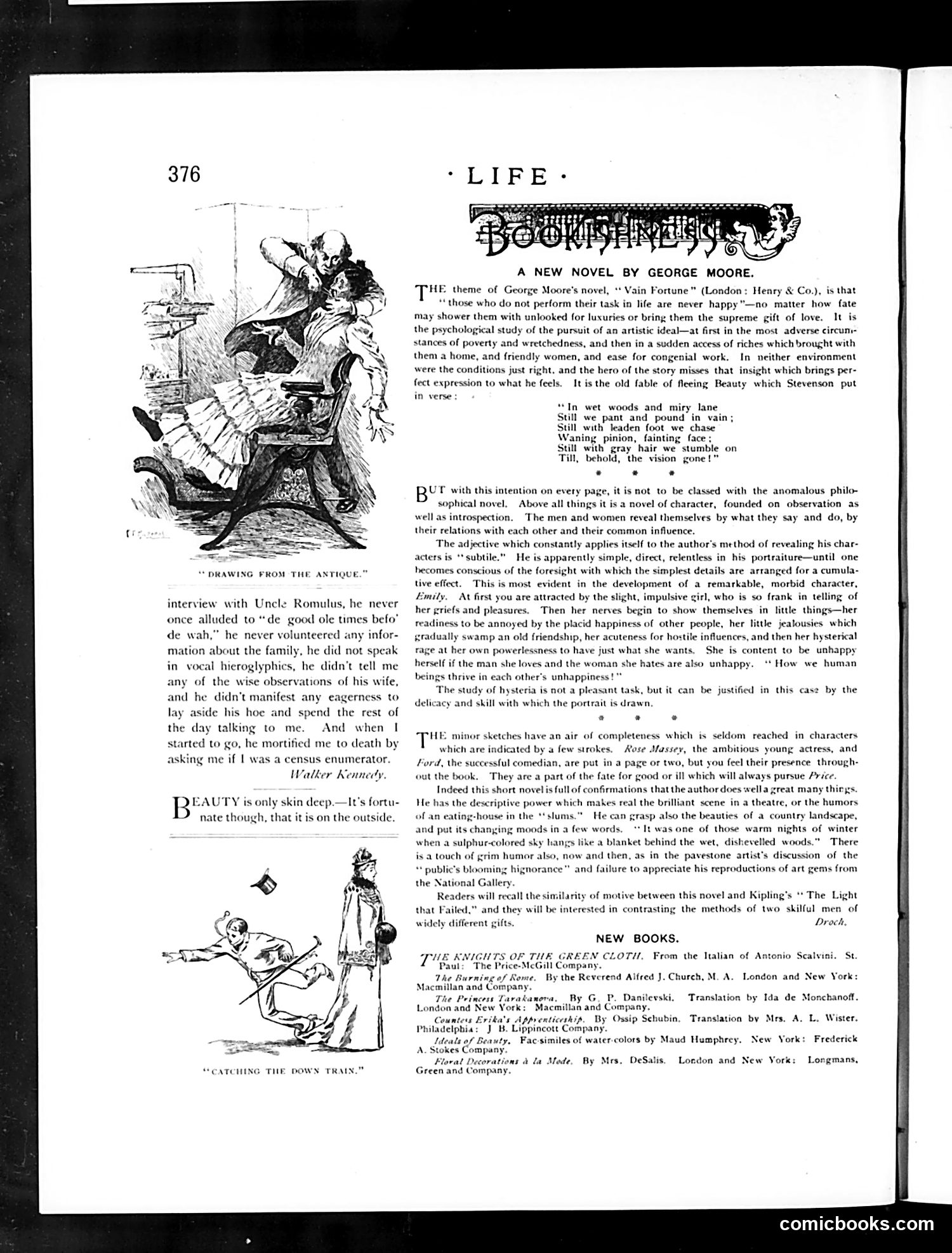
This page is primarily a **book review** for George Moore's novel "Vain Fortune," not a political cartoon. The review discusses Moore's psychological character study of an artist's pursuit of success despite poverty. The two illustrations are **literary sketches** accompanying the review: - "Drawing from the Antique" (top left) shows an artist at work - "Catching the Down Train" (bottom left) depicts a scene of ordinary life These are decorative rather than satirical. The page concludes with a "NEW BOOKS" section listing recent publications. There is **no political satire or caricature** on this page. It's a straightforward literary critique with accompanying artwork typical of *Life* magazine's book review sections from this era.
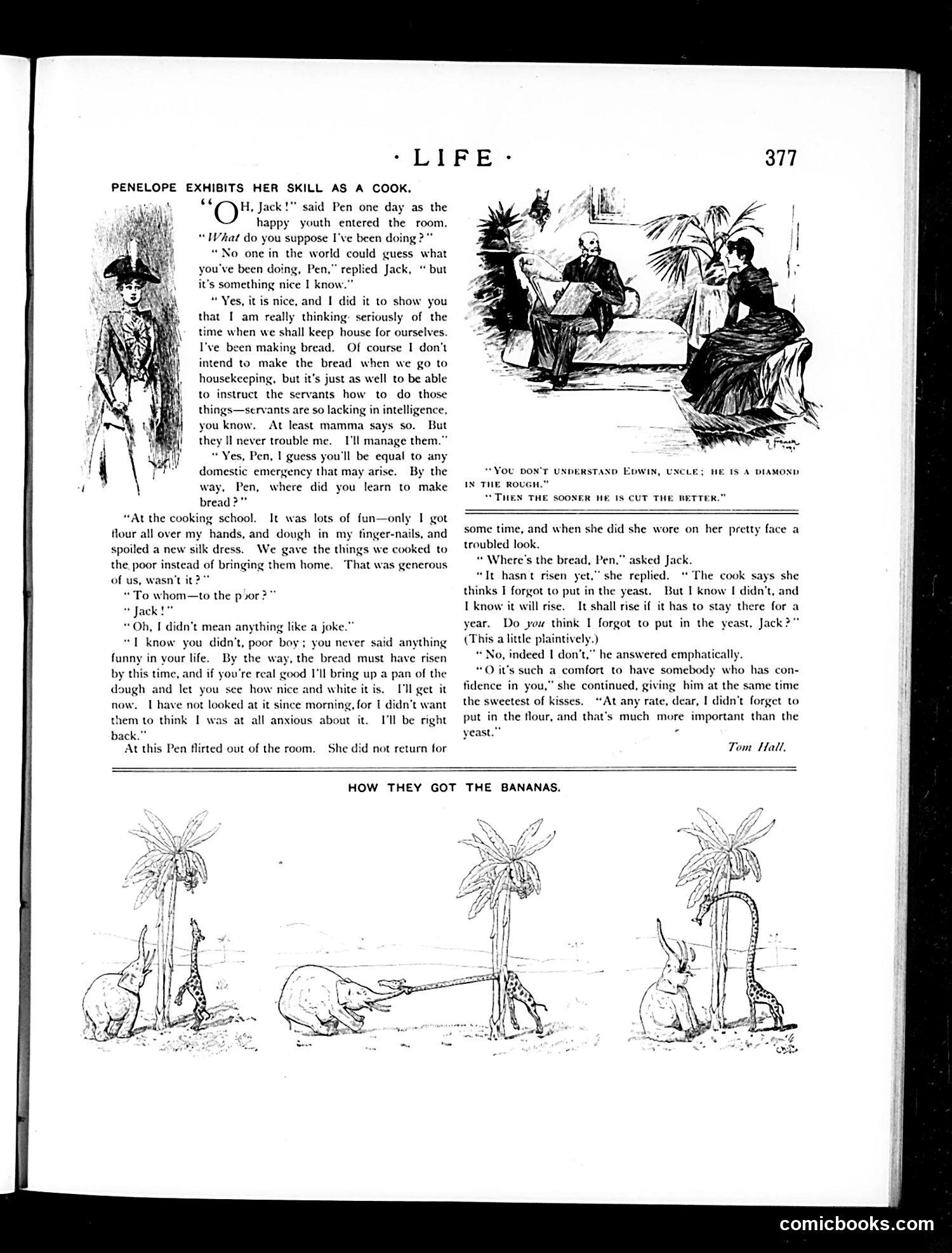
**Top Section: "Penelope Exhibits Her Skill as a Cook"** This is a domestic comedy about a young woman named Penelope who has learned bread-making. Jack teases her about forgetting to add yeast, causing the bread to fail to rise. Penelope defends herself by saying she forgot the yeast but "didn't forget to put in the flour, and that's much more important than the yeast"—a humorous non-sequitur. The joke satirizes both her cooking incompetence and her illogical reasoning. The accompanying illustration shows her as fashionably dressed but domestically challenged. **Bottom Section: "How They Got the Bananas"** Three sequential comic panels show an elephant and giraffe attempting to retrieve bananas from a banana tree. The visual gag depicts their physical comedy as they struggle with the height difference and their respective body shapes to reach the fruit. Both sections represent *Life*'s typical early 20th-century humor format: domestic comedy and animal antics.
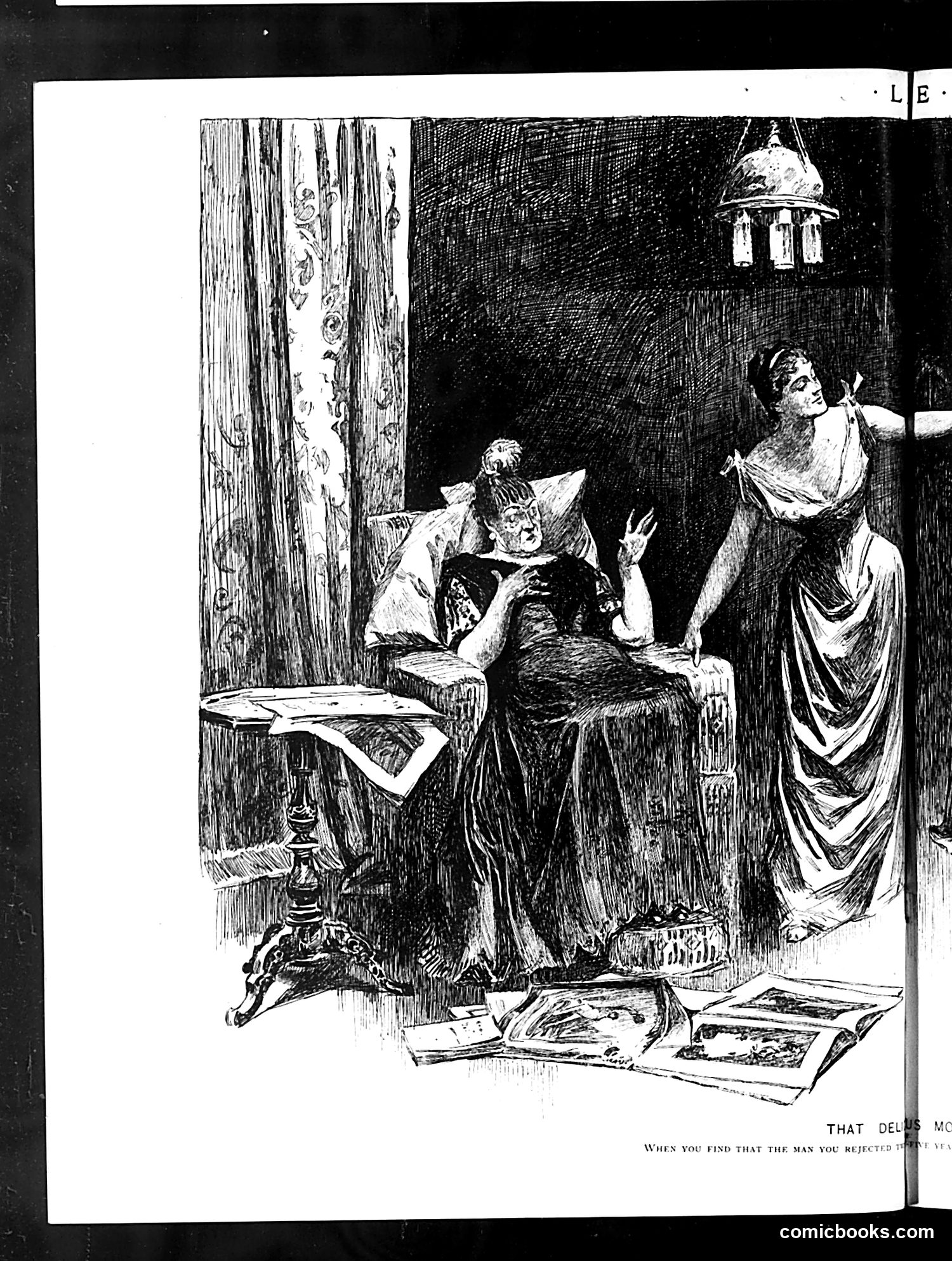
This appears to be an illustration from Life magazine showing a domestic scene. A seated woman in dark clothing holds papers while gesturing expressively to a standing woman in classical drapery on the right. The seated figure appears agitated or distressed. Papers are scattered on the floor. The partial caption reads: "WHEN YOU FIND THAT THE MAN YOU REJECTED..." (text cuts off). The joke appears to concern romantic rejection and its consequences. The classical styling of the standing figure and the theatrical poses suggest this is likely satirizing romantic drama or social expectations around courtship. The scattered papers might represent love letters or marriage proposals. Without the complete caption, the specific satirical target remains unclear, though it likely mocks contemporary attitudes toward romance, marriage prospects, or women's romantic choices during the early 20th century.
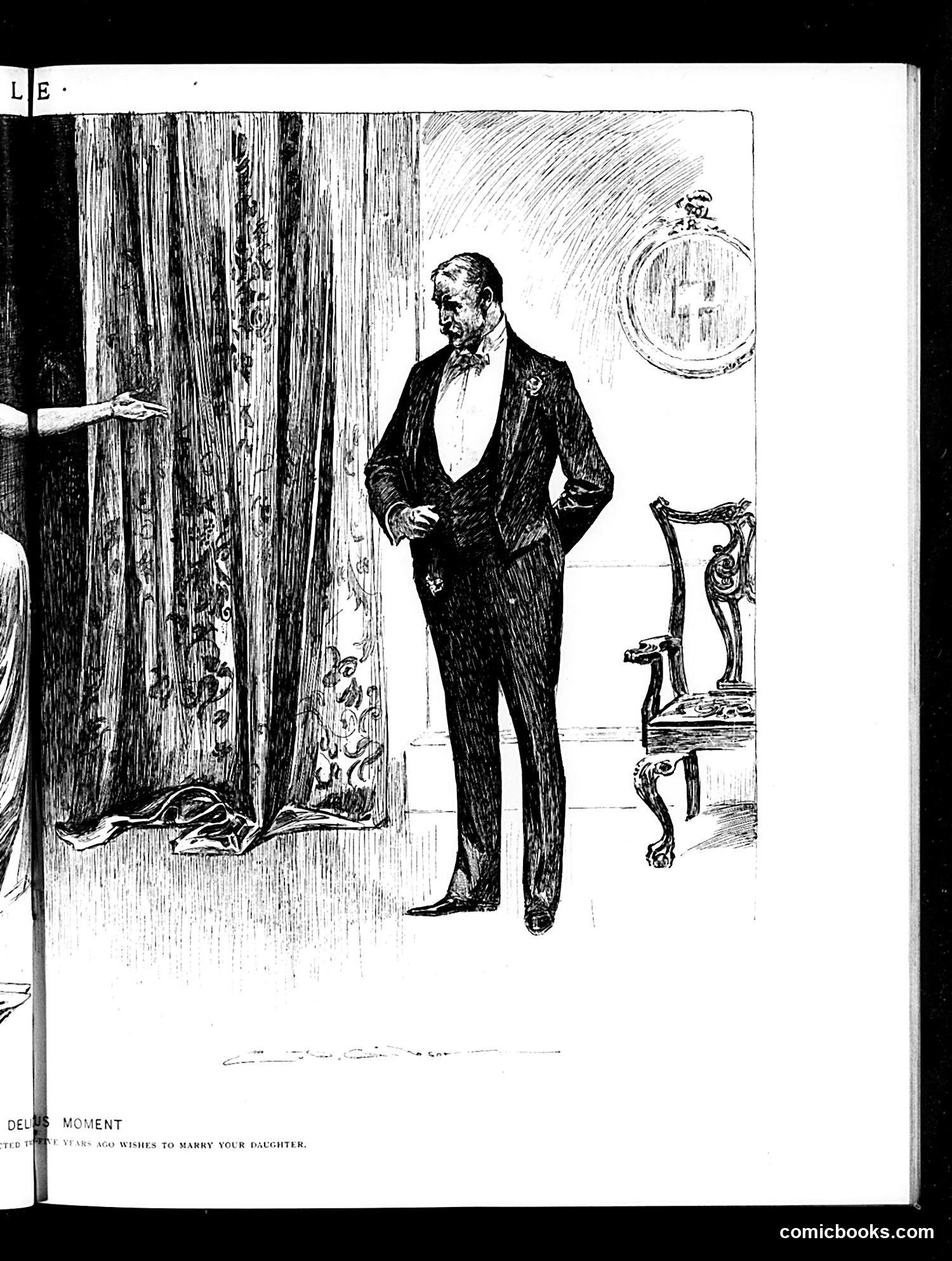
This appears to be a cartoon titled "A Delicious Moment" with the caption "Twenty Years Ago Wishes to Marry Your Daughter." The image shows a well-dressed gentleman in formal attire (tuxedo and bow tie) standing in an elegant interior, appearing somewhat awkward or anxious. The humor relies on a time-based romantic scenario: a suitor from twenty years prior is returning to propose marriage to the man's daughter—now presumably an adult. The satire likely comments on outdated courtship customs or the passage of time's effects on romantic intentions. The man's visible discomfort suggests the absurdity of reviving a decades-old romantic proposal. The elegant furnishings and formal dress emphasize the social pretension involved in such a scenario, typical of *Life* magazine's satirical commentary on upper-class manners and relationships.
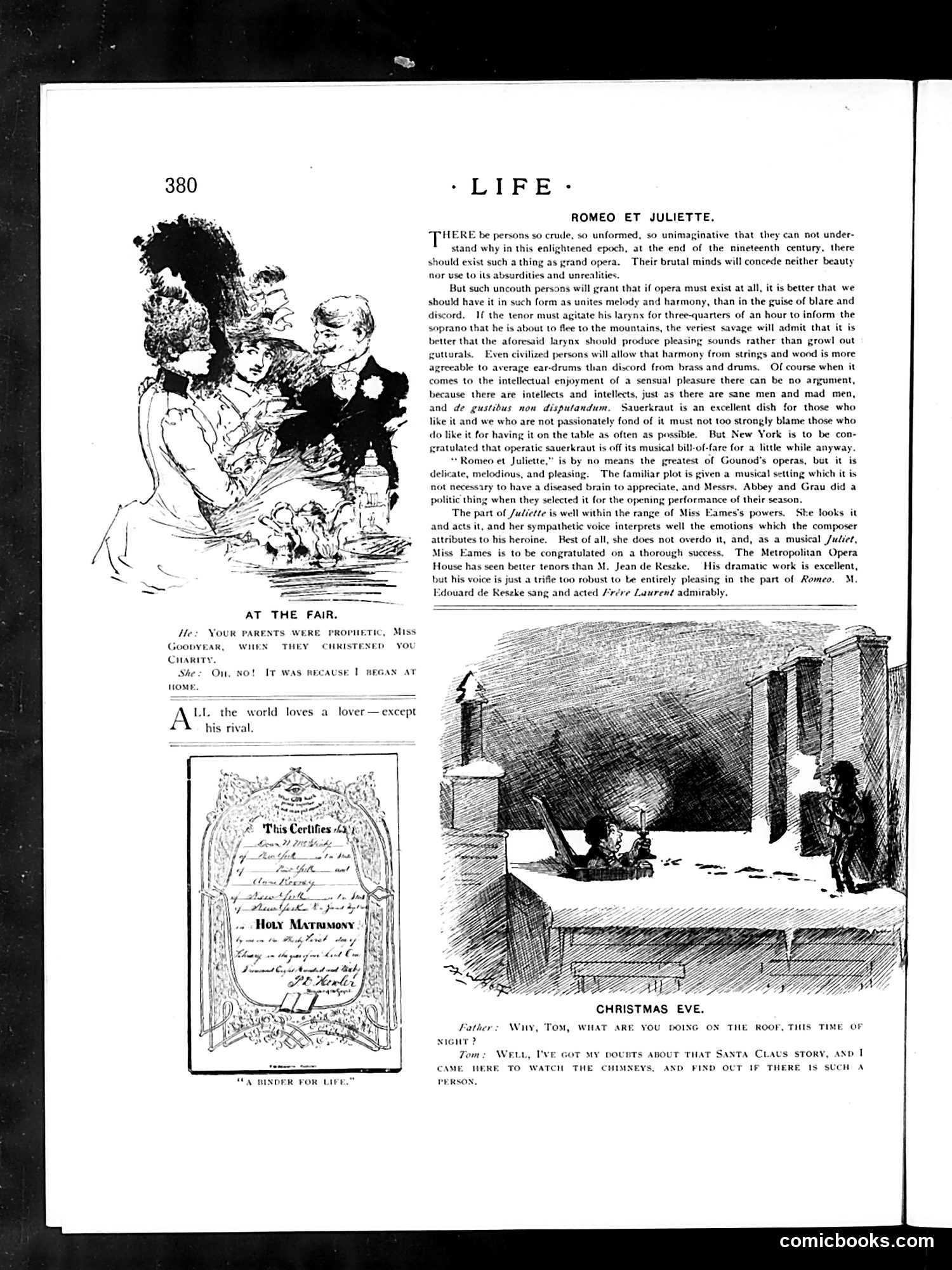
This page from *Life* magazine contains theater criticism and humorous social commentary typical of the late 19th century. The main article reviews Gounod's opera *Romeo et Juliette*, praising its melodious qualities and the performances of singers Miss Eames (as Juliet) and Jean de Reszke (as Romeo). The critic sarcastically defends opera's existence to "crude" people who don't appreciate it, using food metaphors ("operatic sauerkraut"). Below are three unrelated humor cartoons: 1. **"At the Fair"** plays on a woman's name (Miss Goodyear) being prophetic of her charitable character. 2. **"A Binder for Life"** shows a marriage certificate, illustrating the phrase's double meaning. 3. **"Christmas Eve"** depicts a skeptical boy on a roof testing the Santa Claus story by watching the chimney—gentle humor about childhood disillusionment. The page reflects genteel, urbane humor aimed at educated readers interested in fine arts and domestic life.
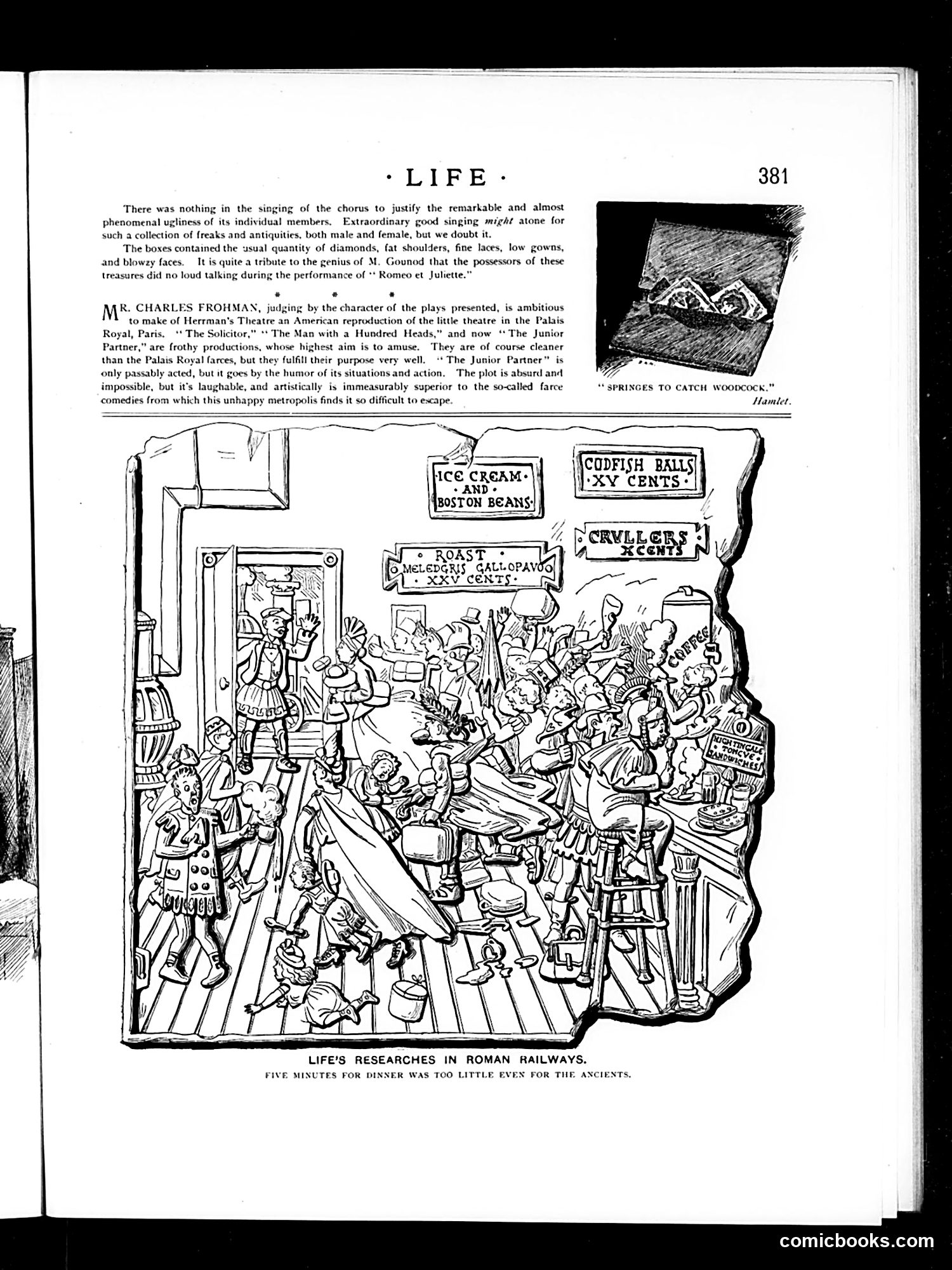
This satirical cartoon depicts an impossibly crowded Roman railway dining car, humorously suggesting the ancients faced the same time pressures modern commuters do. The labeled food stands (ice cream, roast, codfish balls, crudités) parody contemporary American dining options, transplanted absurdly into ancient Rome. The joke critiques modern rushing and commercialized dining culture by proposing that even Romans—supposedly leisurely and sophisticated—couldn't enjoy a proper meal in five minutes. It's social satire dressed as whimsical historical fantasy, mocking the frantic pace of contemporary American life and the degradation of dining into hasty, commodified transactions. The accompanying theater review above discusses Charles Frohman's efforts to establish serious theatrical standards, contrasting with this cartoon's mockery of mass-market, convenience-driven culture.
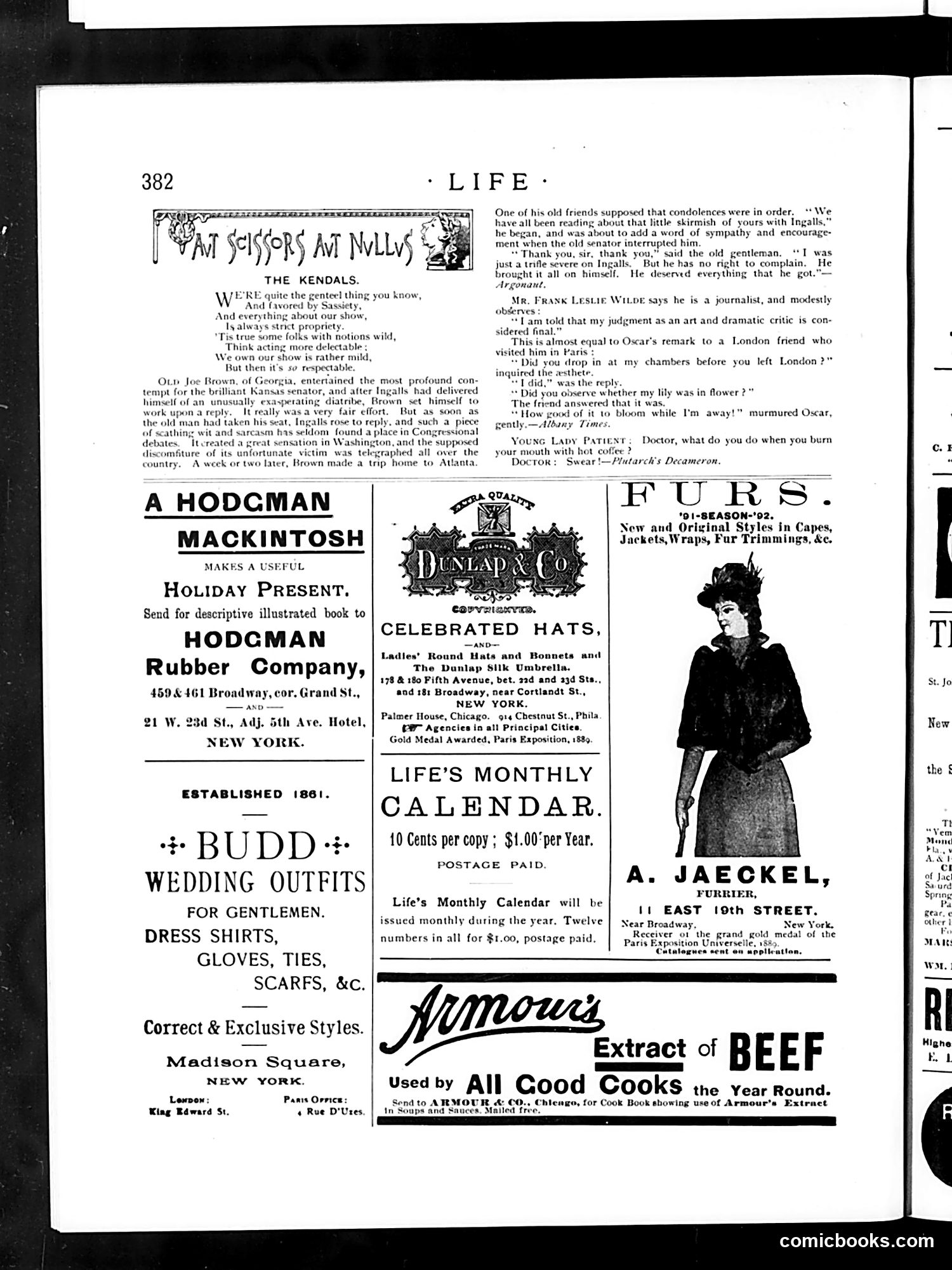
This page is primarily **advertising** with brief humorous anecdotes interspersed. The notable content includes: **"The Kendals" section:** A satirical poem mocking theatrical respectability—the Kendals were a famous Victorian acting couple known for "genteel" productions. The satire suggests their work is bland but socially acceptable, contrasting with more daring theater. **Anecdotes about public figures:** References to Senator Ingalls and Oscar Wilde appear in short quips about vanity and wit. One story mocks Wilde's self-importance regarding his judgment as a critic; another shows him concerned about a lily blooming in his absence—poking fun at his aestheticism and perceived narcissism. **Advertisements:** The page is dominated by ads for Hodgman Mackintosh raincoats, Dunlap hats, Budd wedding outfits, A. Jaeckel furs, and Armour's beef extract—typical luxury goods for affluent readers. The humor is light, society-focused satire reflecting Life's genteel audience, with no serious political content.
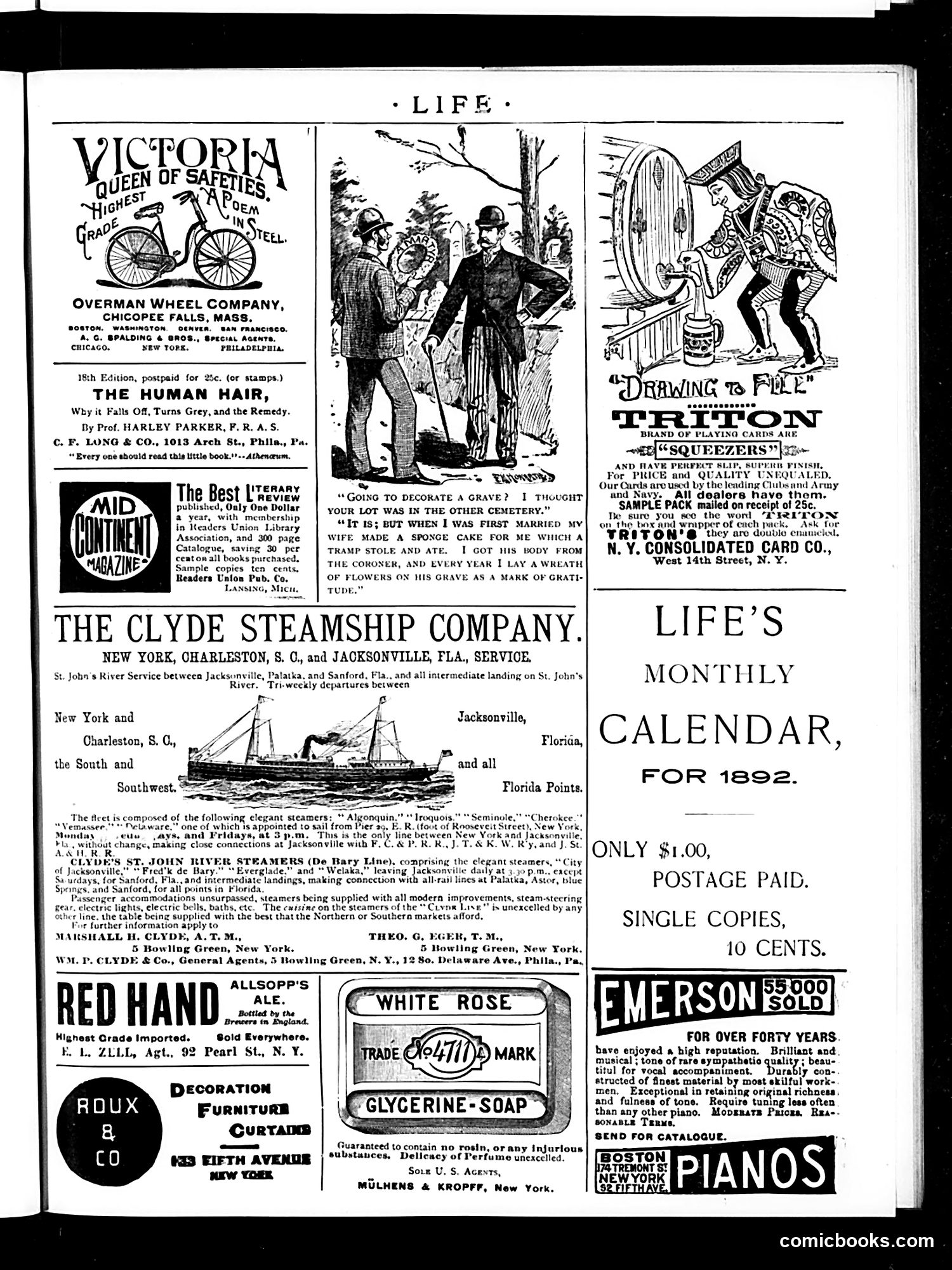
This page is primarily **advertisements with one cartoon joke**. The main cartoon ("Going to Decorate a Grave?") depicts a dark humor exchange between two men about graveyards. **The Joke**: A man mentions decorating his lot in one cemetery, and another sarcastically replies the lot "was in the other cemetery"—implying the first man should be dead. The punchline reveals the speaker lays flowers yearly to honor his wife's disastrous sponge cake, which allegedly poisoned someone so badly the coroner had to intervene. He treats the grave like a memorial to the cake's victim. **Context for Modern Readers**: This represents Victorian-era "graveyard humor"—morbid jokes about death were popular entertainment. The joke also mocks wives' cooking abilities, a common satirical trope of the period. The cartoon appears in *Life*, an American humor magazine founded in 1883, known for satirical social commentary and jokes about contemporary life. The surrounding ads (bicycles, steamships, pianos, soap) reflect 1890s consumer culture and leisure activities.
This is primarily an **advertising page** from Life magazine (circa 1891, based on copyright notice), not a satirical cartoon page. The content consists almost entirely of commercial advertisements with one small editorial illustration. The single non-ad image shows a California landscape scene labeled "Scene in San Bernardino," promoting the Atchison, Topeka & Santa Fe Railroad's winter resort routes—part of the era's aggressive marketing of California as a tourist destination. The advertisements themselves reflect 1890s consumer culture: Kirk's Shandon Bells toilet soap, Veloutine Fay powder, piano sales, Mrs. Winslow's Soothing Syrup (a patent medicine for teething children), horse nails, cuff buttons, diamonds/watches, and china. These ads reveal period concerns (infant teething remedies), luxury goods availability, and the emergence of branded consumer products. There is **no political satire or social commentary** visible on this page—it's a straightforward commercial section typical of magazines subsidizing content through advertising revenue.