
Life, 1891-12-24 · page 8 of 16
Life — December 24, 1891 — page 8: what you’re looking at
What you’re looking at
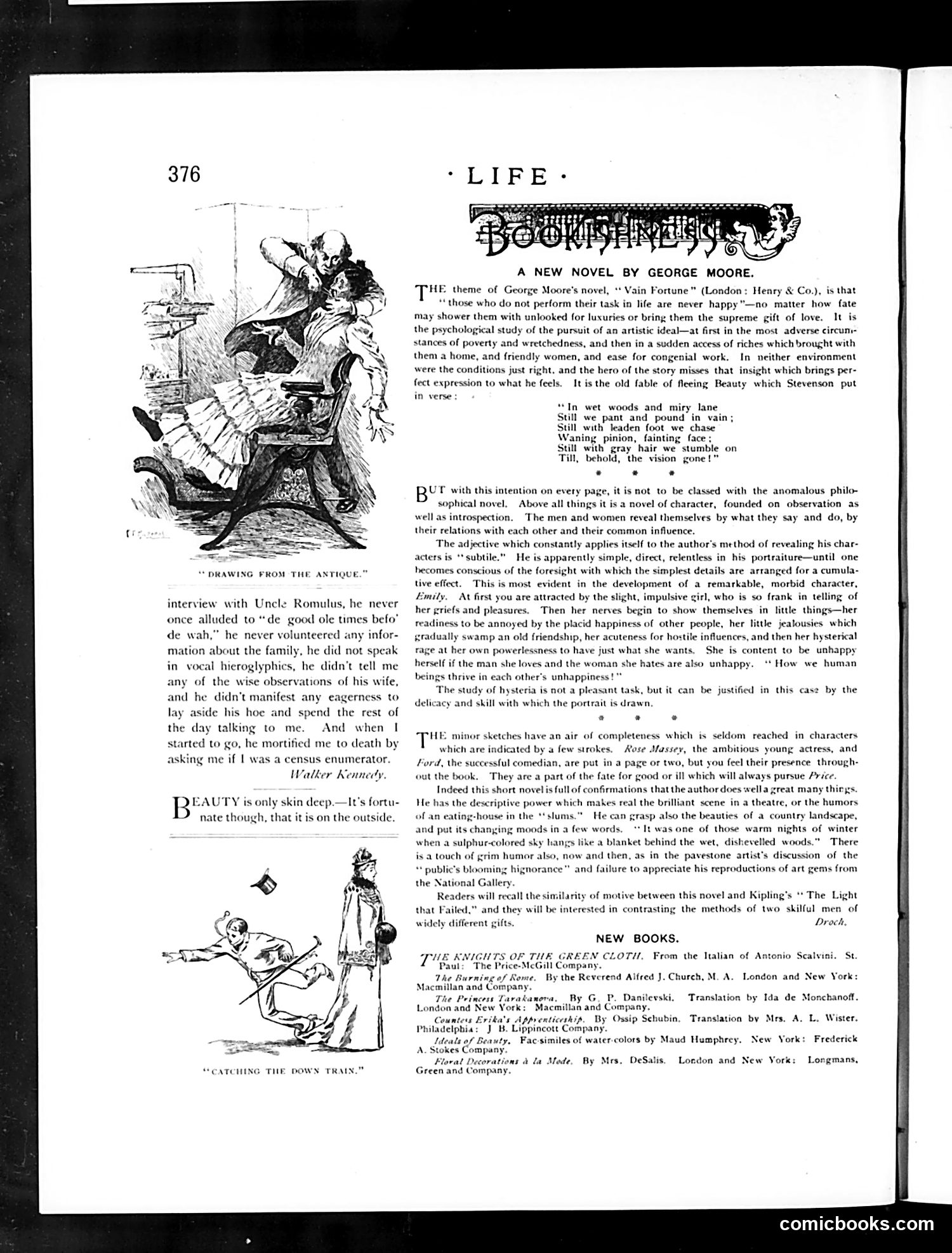
This page is primarily a **book review** for George Moore's novel "Vain Fortune," not a political cartoon. The review discusses Moore's psychological character study of an artist's pursuit of success despite poverty. The two illustrations are **literary sketches** accompanying the review: - "Drawing from the Antique" (top left) shows an artist at work - "Catching the Down Train" (bottom left) depicts a scene of ordinary life These are decorative rather than satirical. The page concludes with a "NEW BOOKS" section listing recent publications. There is **no political satire or caricature** on this page. It's a straightforward literary critique with accompanying artwork typical of *Life* magazine's book review sections from this era.
📄 Transcribed text from this page (OCR, searchable)
Machine-transcribed from the original scan — historical spelling and the odd misread are preserved.
A NEW NOVEL BY GEORGE MOORE. THE theme of George Moore's novel, * Vain Fortune" (London: Henry & . is that “those who do not perform their task in life are never happy"—no matter how fate may shower them with unlooked for luxuries or bring them the supreme gift of love. It is the psychological study of the pursuit of an artistic ideal—at first in the most adverse circum stances of poverty and wretchedness, and then in a sudden access of riches which brought with them a home, and friendly women, and ease for congenial work. In neither environment were the conditions just right. and the hero of the story misses that insight which brings per- fect expression to what he feels. It is the old fable of fleeing Beauty which Stevenson put in verse: “In wet woods and miry lane Still we pant and pound’ in’ vain ; Still with leaden foot we chase Waning pinion, fainting face ; Still with gray "hair we stumble on Till, behold, the vision gone!" BUT with this intention on every page, it is not to be classed with the anomalous philo- sophical novel, Above all things it is a novel of character, founded on observation as well as introspection, ‘The men and women reveal themselves by what they say and do, by their relations with each other and their common infiuence. The adjective which constantly applies itself to the author's method of revealing his char- acters is **subtile.” He is apparently simple, direct, relentless in his portraiture—until one ORRAWING FeO TRANROUE hecomes conscious of the foresight with which the simplest details are arranged for a cumula- : tive effect. This is most evident in the development of a remarkable, morbid character, Emily, At first you are attracted by the slight, impulsive girl, who is so frank in telling of (her griefs and pleasures. Then her nerves begin to show themselves in little things—her once alluded to “de good ole times befo" readiness to be annoyed by the placid happiness of other people, her little jealousies which de wah,” he never volunteered any infor- gradually swamp an old friendship, her acuteness for hostile influences, and then her hysterical mation about the family, he did not speak rage at her own powerlessness to have just what she wants, She is content to be unhappy in vocal hieroglyphics, he didn’t tell me herself if the man she loves and the woman she hates are also unhappy.“ How we human interview with Uncle Romulus, he never any of the wise observations of his wife, P&S thrive in each other's unhappiness , ait He dian" HAnlfesk anvenmetness 46 The study of hysteria is not a pleasant task, but it can be justified in this cast by the ang fe aN janilest -any-eagemes delicacy and skill with which the portrait is drawn. lay aside his hoe and spend the rest of the day talking to me. And when I started to go, he mortified me to death by HE. minor sketches have an air of completeness which is seldom reached in characters : which are indicated by a few strokes. Nose Massey, the ambitious young actress, and asking me if | was a census enumerator. rg, the successful comedian, are put in a page or two, but you feel their presence through- Walker Kennedy. out the book, They are a part of the fate for good or ill which will always pursue Price. Indeed this short novel is ull of confirmations that the author does wella great many things. B EAUTY is only skin deep.—lIt’s fortu- He has the descriptive power which makes real the brilliant scene in a theatre, or the humors nate though, that itis on the outside, of an eating-house in the **slums." He can grasp also the beauties of a country landscape, and put its changing moods in a few words. ‘It was one of those warm nights of winter when a sulphur-colored sky hangs like a blanket behind the wet, disheveled woods.” There isa touch of grim humor also, now and then, as in the pavestone artist's discussion of the * public's blooming hignorance” and failure to appreciate his reproductions of art gems from the National Gallery Readers will recall the similarity of motive between this novel and Kipling’s * The Light that Failed,” and they will be interested in contrasting the methods of two skilful men of widely different gifts. Droch, NEW BOOKS. Tue KNIGHTS OF THE GREEN CLOTH, From the Italian of Antonio Scalvini. St. Paul: The Price-MeGill Company. The Burning of Rome. By the Reverend Alfred J. Chureh, M.A. London and New York: Macmillan and Company Princess Tarakanora, By G. P. Danilewski, Translation by Ida de Monchanoff. London and New York: Macmillan and Company, Counters Erika's Apprenticeship. By Ossip Schubin, Translation by Mrs. A. L, Wister. Philadelphia: JB. Lippincott Company. Meals of Beauty, Fac-similes of watercolors by Maud Humphrey. New Vork: Frederick A. Stokes Company. Florat Decorations & la Mede, By Mrs, DeSalis, London and New York: Longmans, “CATCHING TILE DOWN TRAIN.” Green and C comicbooks.com