
Life, 1891-12-24 · page 6 of 16
Life — December 24, 1891 — page 6: what you’re looking at
What you’re looking at
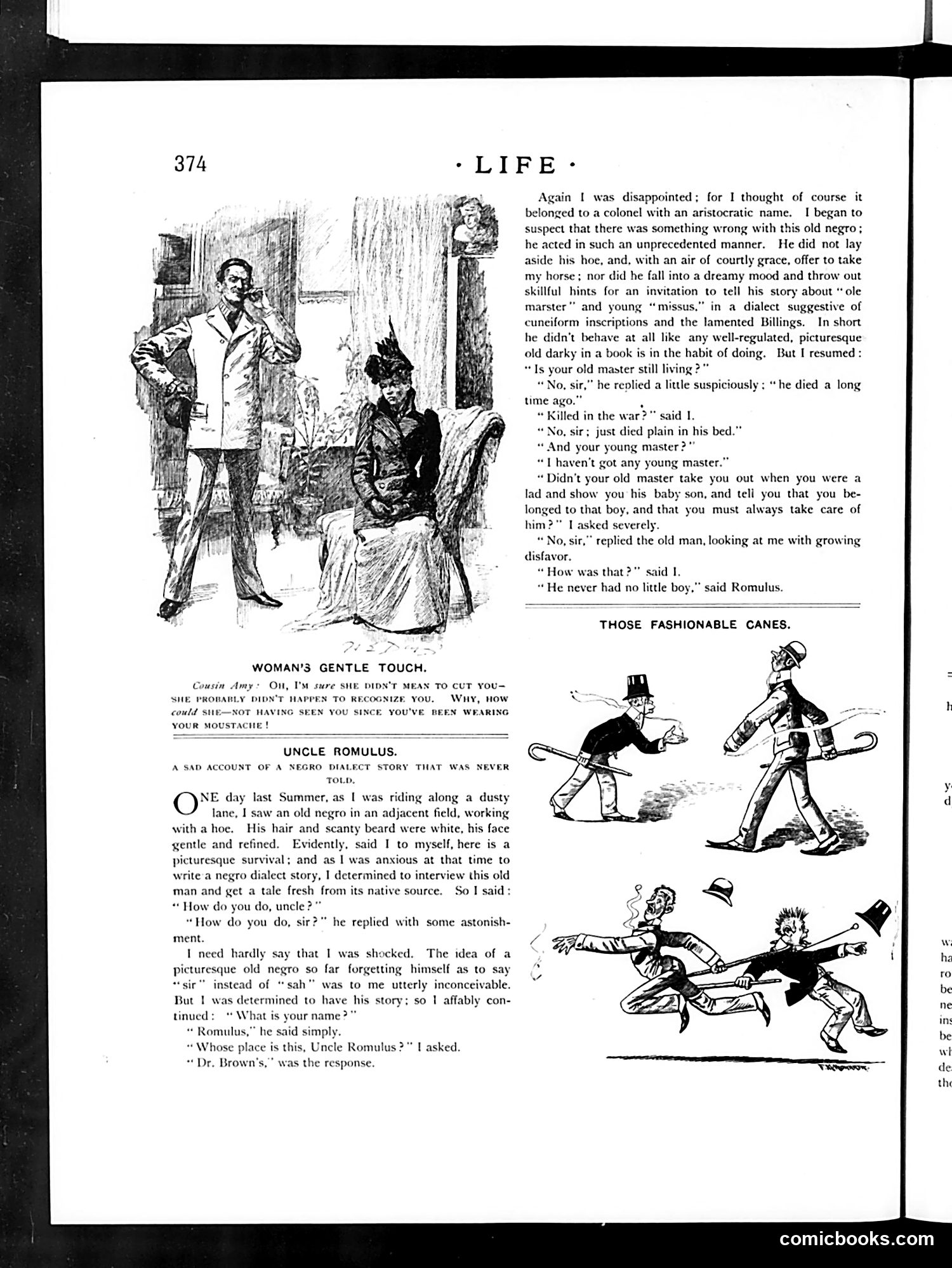
This page contains two distinct sections: **"Woman's Gentle Touch"** (top left): A sketch showing a woman confronting a man about his mustache, with dialogue suggesting she doesn't recognize him without it. This is light domestic satire about changing appearance. **"Uncle Romulus"** (main text): A longer narrative story about the author interviewing an elderly Black man working in a field. The text describes the author's shock at the man's refined speech and manner, expecting dialect stereotypes instead. The story appears to critique (or perhaps reinforce) racial assumptions of the era. **"Those Fashionable Canes"** (right): A satirical illustration sequence mocking exaggerated cane-wielding fashions, showing men in absurd poses with oversized walking sticks—social satire about male fashion affectation. The page reflects early 20th-century Life magazine's mix of domestic humor, racial attitudes, and fashion mockery.
📄 Transcribed text from this page (OCR, searchable)
Machine-transcribed from the original scan — historical spelling and the odd misread are preserved.
* LIFE: Again [ was disappointed; for I thought of course it belonged to a colonel with an aristocratic name. I began to suspect that there was something wrong with this old negro; he acted in such an unprecedented manner. He did not lay aside his hoe, and, with an air of courtly grace, offer to take my horse; nor did he fall into a dreamy mood and throw out skillful hints for an invitation to tell his story about “ole marster" and young “missus.” in a dialect suggestive of cuneiform inscriptions and the lamented Billings. In short he didn’t behave at all like any well-regulated, picturesque old darky in a book is in the habit of doing. But [ resumed : “Is your old master still living ?” “No, sir,” he replied a little suspiciously ; “he died a long time ago.” : “Killed in the war?” said I. “No, sir; just died plain in his bed.” “And your young master?” I haven't got any young master.” “Didn't your old master take you out when you were a lad and show you his baby son, and tell you that you be- longed to that boy, and that you must always take care of him?” I asked severely. “No, sir,” replied the old man, looking at me with growing disfavor, “ How was that?" said I. “ He never had no little boy,” said Romulu: WOMAN’S GENTLE TOUCH. Cousin Amy» On, PM sure sue DIDN'T SHE PROBABLY DIDN'T HAPPEN TO RECOGN could SHE—NOT HAVING SEEN YOU St Your Mousractte ! UNCLE ROMULUS. A SAD ACCOUNT OF A NEGRO DIALECT STORY THAT WAS NEVER TOLD. NE day last Summer, as I was riding along a dusty lane, 1 saw an old negro in an adjacent field, working with a hoe. His hair and scanty beard were white, his face gentle and refined. Evidently, said I to myself, here is a picturesque survival; and as I was anxious at that time to write a negro dialect story, | determined to interview this old man and get a tale fresh from its native source. So I said: “How do you do, uncle?” “How do you do, sir?” he replied with some astonish- ment. 1 need hardly say that I was shocked. The idea of a picturesque old negro so far forgetting himself as to say “sir instead of “sah” was to me utterly inconceivable. But | was determined to have his story; so | affably con- tinued: * What is your name?” “ Romulus,” he said simply. “ Whose place is this, Uncle Romulus?” | asked. ~ Dr. Brown's,” was the response. comicbooks.com