
Life, 1891-12-24 · page 4 of 16
Life — December 24, 1891 — page 4: what you’re looking at
What you’re looking at
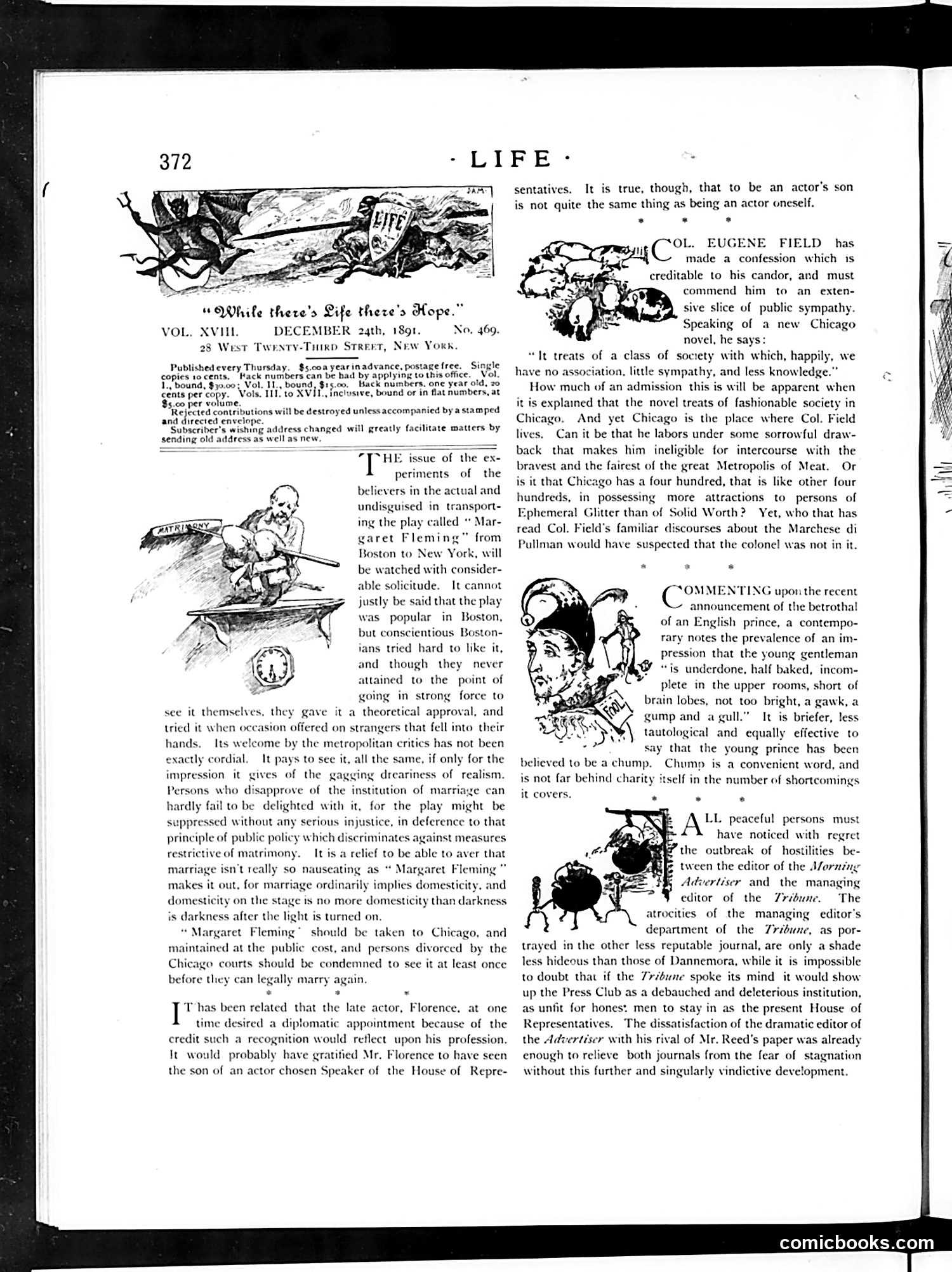
This page contains three satirical illustrations with accompanying commentary on theatrical and social matters from the 1880s. The top cartoon depicts a theatrical scene, likely referencing the play "Margaret Fleming," which the text discusses as controversial for its realistic portrayal of marriage and domestic issues—unusual for Boston theater audiences at the time. The middle illustration appears to show a dramatic figure in an exaggerated pose, commenting on theatrical performance styles. The bottom cartoon caricatures what appears to be a young aristocratic figure, accompanying text mocking recent British press descriptions of an English prince as "undersized, half-baked" and generally unsuitable—a satirical jab at both the prince and sensationalist journalism. The overall page satirizes theatrical tastes, dramatic realism, and contemporary press excess in the Gilded Age.
📄 Transcribed text from this page (OCR, searchable)
Machine-transcribed from the original scan — historical spelling and the odd misread are preserved.
- LIFE: XVIL DECEMBER 24th, 1891. No, 469. 28 West Twexty-Tirp Street, New York. Published every Thursday. $5.coa year inadvance, postage free, Single copies 1ocents, Hack numbers can be bad by applying to this office. Vol. 1., Bound, $30.00; Vol. II., bound, $15.00. Back numbers. one year old, 20 cents per'copy. Vols. III to XVIL., inclusive, bound or in flat numbers, at $5.co per volume. ‘Rejected contributions will be destroyed unless accompanied by a stamped and directed envelope ‘Subscriber's wishing address changed will greatly facilitate matters by sending old address as well as new | sue of the ex- periments of the believers in the actual and undisguised in transport- ing the play called * Mar- garet Fleming” from Boston to New York, will be watched with consider- able solicitude. It cannot justly be said that the play was popular in Boston, but conscientious Boston- ians tried hard to like it, and though they attained to the point of going in strong force to see it themselves, they gave it a theoretical approval, and tried it when occasion offered on strangers that fell into their never hands. Its welcome by the metropolitan critics has not been exactly cordial. It pays to s impression it gives of the y for the agging dreariness of realism. Persons who disapprove of the institution of marriage can hardly fail to be delighted with it, for the play might be suppressed without any [the same, if on’ rious injustice, in deference to that principle of public policy which discriminates against measure restrictive of matrimony. It is a relief to be able to aver that iage isn't really so nauseating as it out, for marriage ordina domesticit et Fleming ” ily implies domesticity, and is no more domesticity than darkness. is darkness after the light is turned on yaret Fleming’ should be taken to Chicago, and maintained at the public cost, and persons divorced by the Chicago courts should be condemned to see it at least once before they can legally marry again. on the Thas been related that the late actor, Florence, at one time desired a diplomatic appointment because of the credit such a recognition would reflect. upon his profession. It would probably have gratitied Mr, Florence to have seen the son of an actor chosen Speaker of the House of Repre- sentativ It is true, though, that to be an actor’s son is not quite the same thing as being an actor oneself. . . . OL. EUGENE FIELD ha i made a confession which 1s . creditable to his candor, and must commend him to an_ exten- ah" sive slice of public sympathy. Speaking of a new Chicago novel, he says: “It treats of a class of soctety with which, happily, we have no association, little sympathy, and less knowledge.” How much of an admission this is will be apparent when it is explained that the novel treats of fashionable society in Chicago. And yet Chicago is the place where Col. Field lives. Can it be that he labors under some sorrowful draw- back that makes him ineligible for intercourse with the bravest and the fairest of the great Metropolis of Meat. Or is it that Chicago has a four hundred, that is like other four hundreds, in possessing more attractions to persons of Epheme Glitter than of Solid Worth? Yet, who that has read Col. Field’s familiar discourses about the Marchese di Pullman would have suspected that the colonel was not in it. Co MENTING upon the recent ~ announcement of the betrothal of an English prince, a contempo- rary notes the prevalence of an im- pression that the young gentleman s% “is underdone, half baked, incom- plete in the upper rooms, short of brain lobes, not too bright, a gawk, a gump and a gull.” tautologi It is briefer, less al and equally effective to say that the young prince has been chump. Chump is a convenient word, and is not far behind charity itself in the number of shortcomings it covers. . At peaceful persons must have noticed with regret the outbreak of hostilities be- tween the editor of the Mornin: Advertiser and the managin; editor of the 7rvéute. The atrocities of the managing editor's department of the 7yvéune, as por- din the other less reputable journal, are only a shade less hideous than those of Dannemora, while it is impossible to doubt that if the 7#bune spoke its mind it would show up the Press Club as a debauched and deleterious institution, as unfit for hones: men to stay in as the present House of Representatives. The dissatisfaction of the dramatic editor of the Advertiser with his rival of Mr. Reed's paper was already enough to relieve both journals from the fear of stagnation without this further and singularly vindictive development. comicbooks.com