
A complete issue · 14 pages · 1891
Life — December 17, 1891
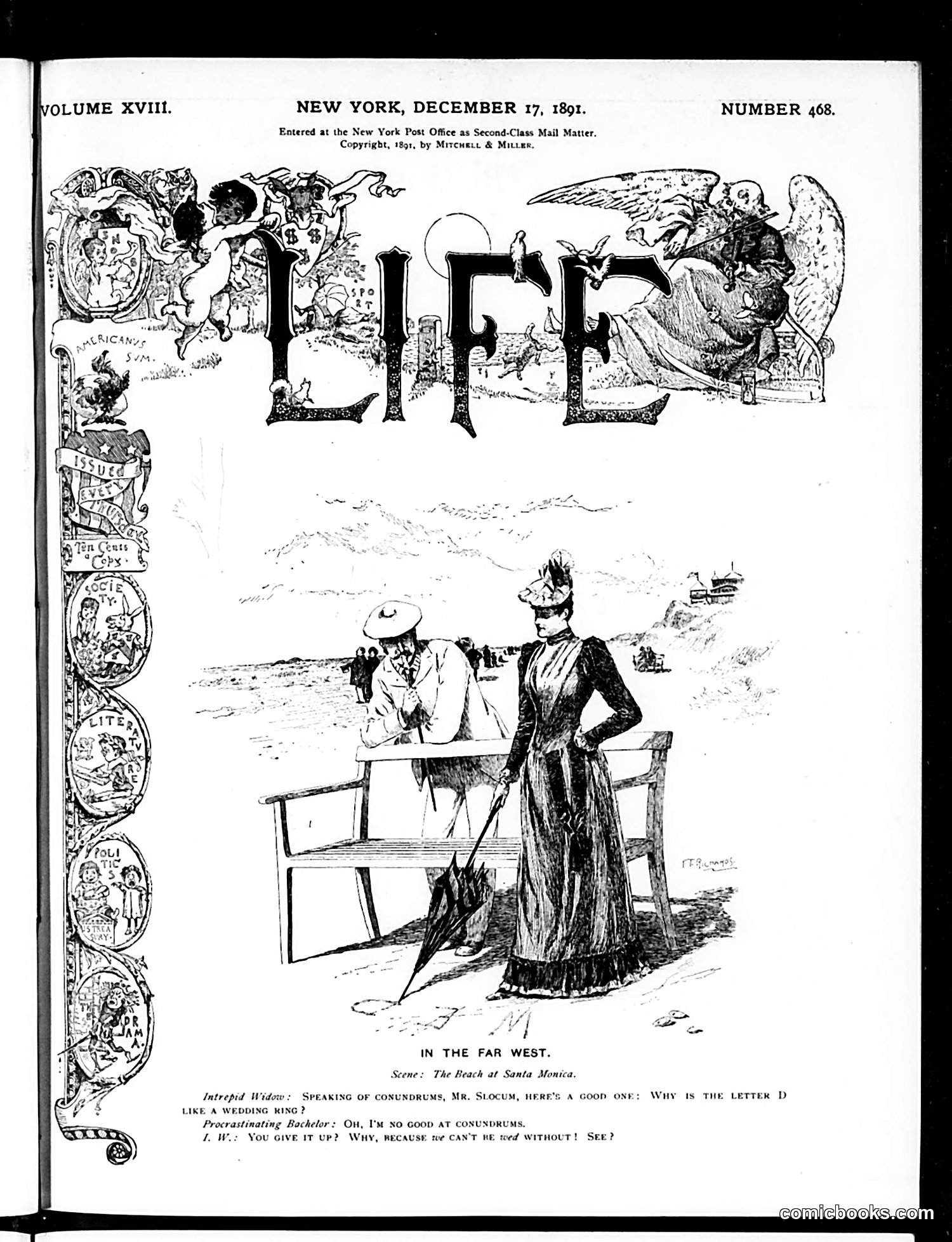
This page features a satirical cartoon titled "In the Far West," set at Santa Monica beach. The scene depicts two figures discussing conundrums—riddle-like wordplay puzzles that were popular entertainment of the era. The "Intrepid Widow" poses a riddle: "Why is the letter D like a wedding ring?" A "Procrastinating Bachelor" responds, unable to solve it, saying he's "no good at conundrums" and gives up. The joke appears to be a pun: the answer is likely "because you can't be wed without it" (D sounds like "the"). This is typical of Victorian-era parlor humor and word games. The cartoon satirizes the bachelor's romantic reluctance and the widow's persistence in romantic matters through the device of riddling.
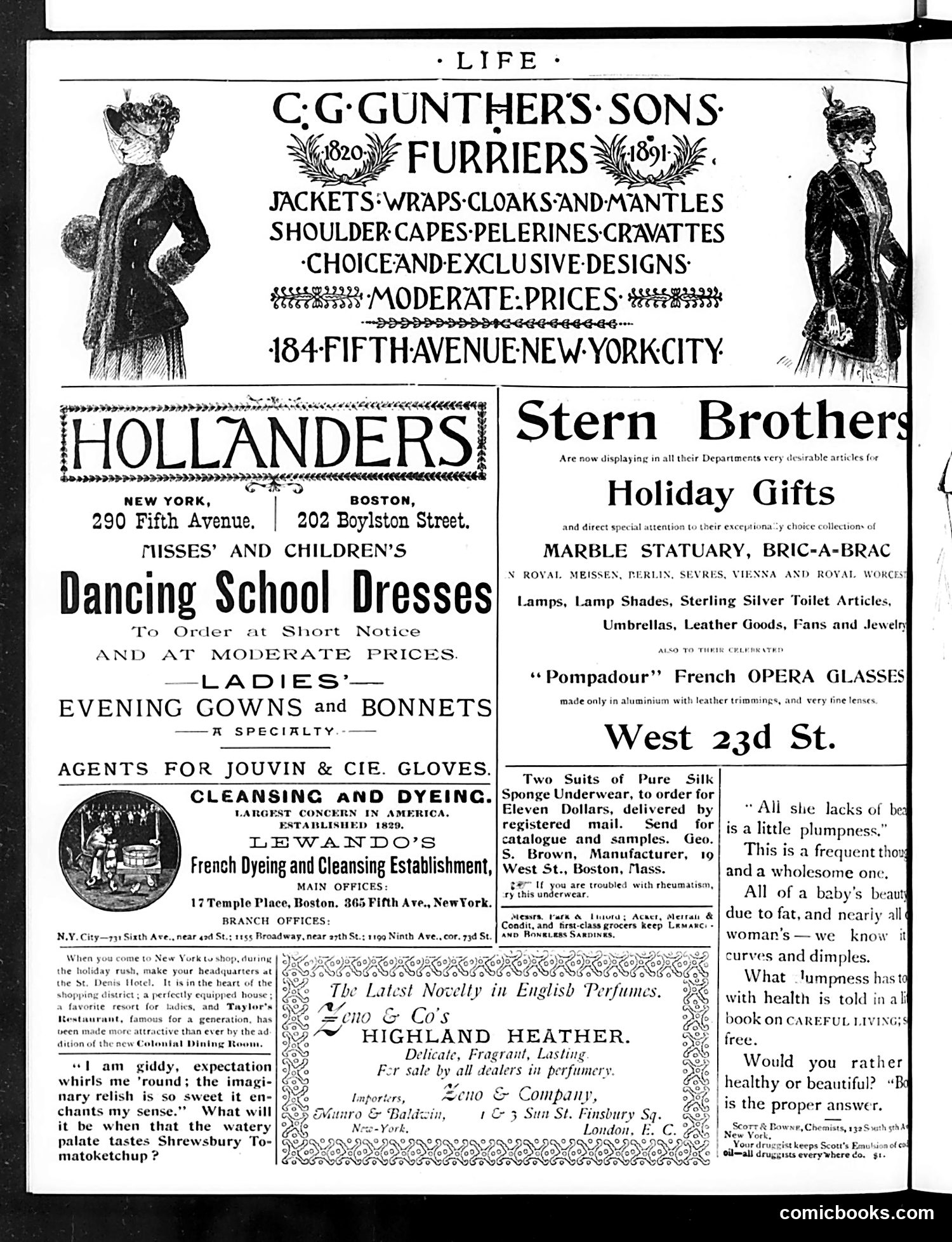
This page is **primarily advertising**, not satire or political commentary. It contains multiple commercial advertisements from circa 1891 (based on the magazine's date marker "1891"): - **C.G. Gunthers Sons**: Fur clothing retailer on Fifth Avenue - **Hollanders**: Dancing school dresses and evening wear in New York and Boston - **Stern Brothers**: Department store advertising holiday gifts, including marble statuary and "Pompadour" opera glasses - **Lewando's**: French dyeing and cleansing service - **Zeno & Co**: Perfume advertiser The only non-advertising content appears to be a brief text snippet about babies' beauty on the right side, likely editorial filler. There are no political cartoons, caricatures, or satirical commentary visible. This is a typical late-19th-century magazine page mixing commercial notices with minimal editorial content.
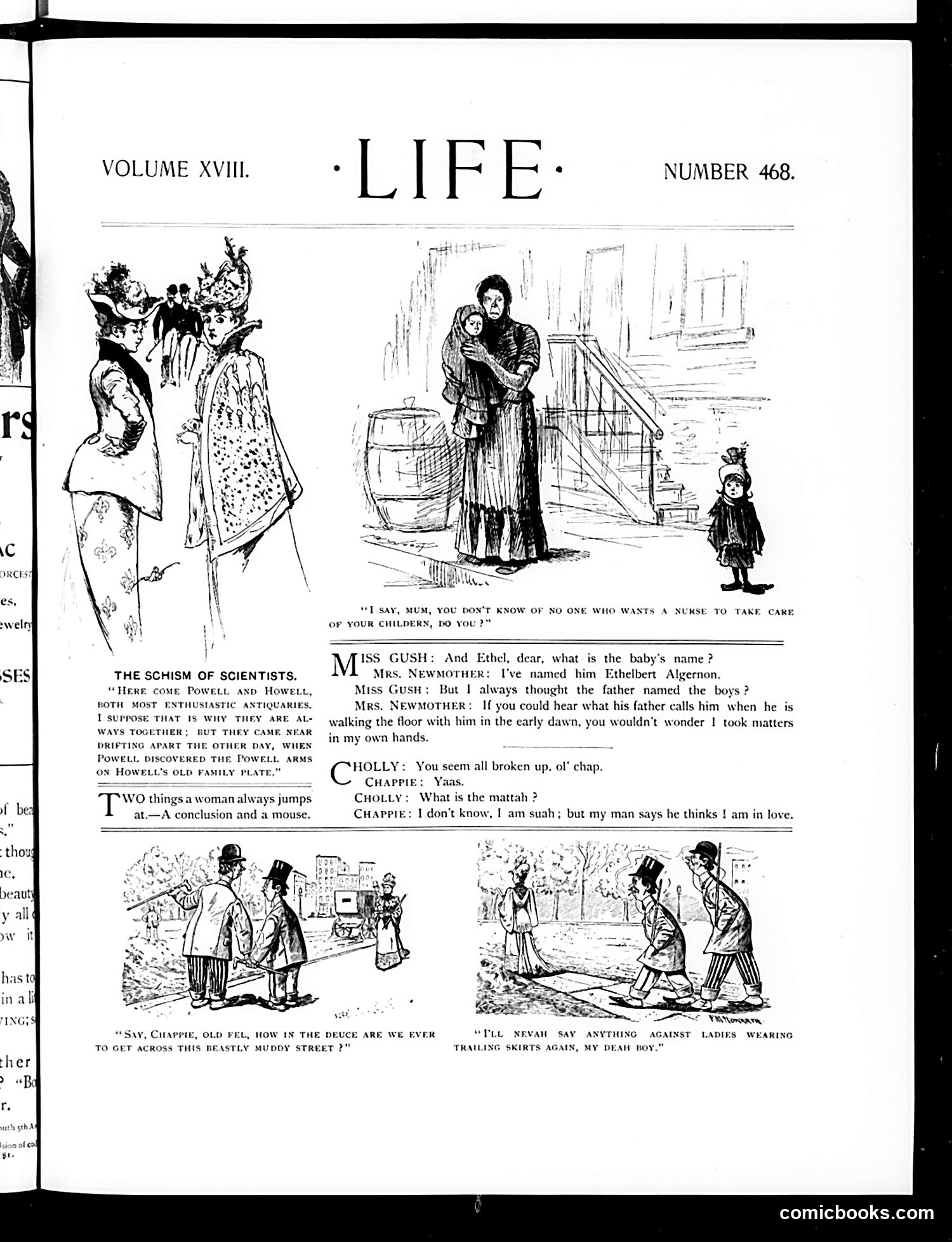
This page contains several satirical sketches on early 1900s social themes: **"The Schism of Scientists"** mocks two wealthy antiquarians who claim erudition while being oblivious—a jab at pseudo-intellectualism among the upper classes. **The dialogue exchanges** feature working-class characters discussing domestic hardships: a mother struggling to find childcare, and a man complaining about muddy streets and women's trailing skirts (a contemporary fashion debate). **The bottom cartoons** depict street scenes with men in top hats navigating poor conditions, one complaining about mud while another declares opposition to women wearing trailing skirts. The humor targets class contrasts—wealthy pretension versus working-class realities—and contemporary fashion debates that annoyed practical-minded men. The satire is gentle social commentary typical of LIFE's early era.
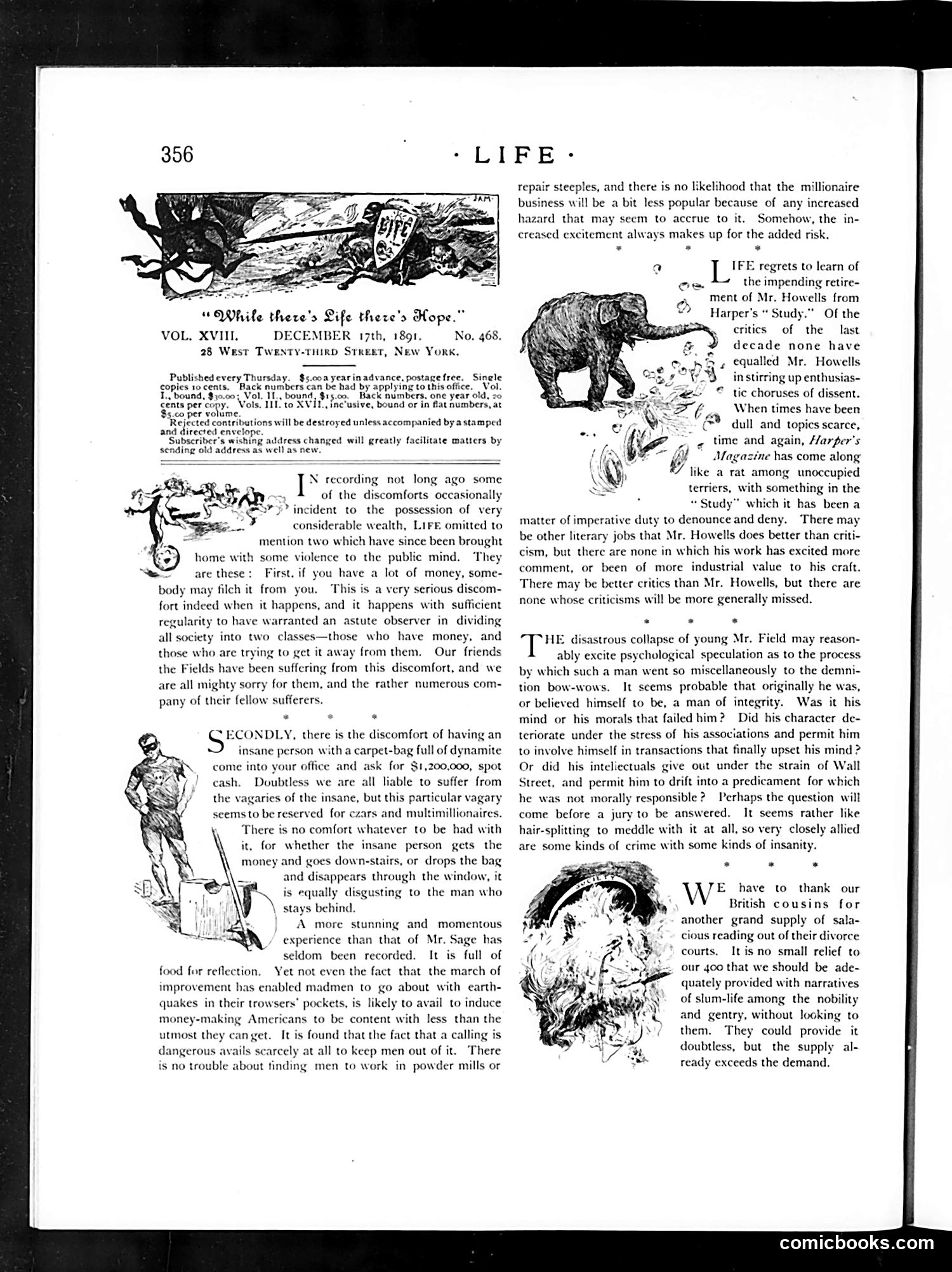
This page contains editorial commentary rather than political cartoons. The illustrations are decorative vignettes accompanying essays about social issues. The main topics discussed are: 1. **Wealth inequality and crime**: Commentary on wealthy individuals losing money and the societal divisions this creates between rich and poor classes. 2. **Mr. Howells' retirement from Harper's**: The text regrets the impending retirement of a literary critic known for stirring "enthusiastic choruses of dissent" in Harper's Magazine—suggesting he was a controversial but respected voice. 3. **Criminal psychology**: Discussion of how stress and association might drive moral collapse, using an unnamed case of someone's alleged deterioration. 4. **British divorce narratives**: Comment on British sources providing sensational divorce court stories to American readers, noting supply exceeds demand. The illustrations feature sketched figures but appear primarily decorative rather than satirical.
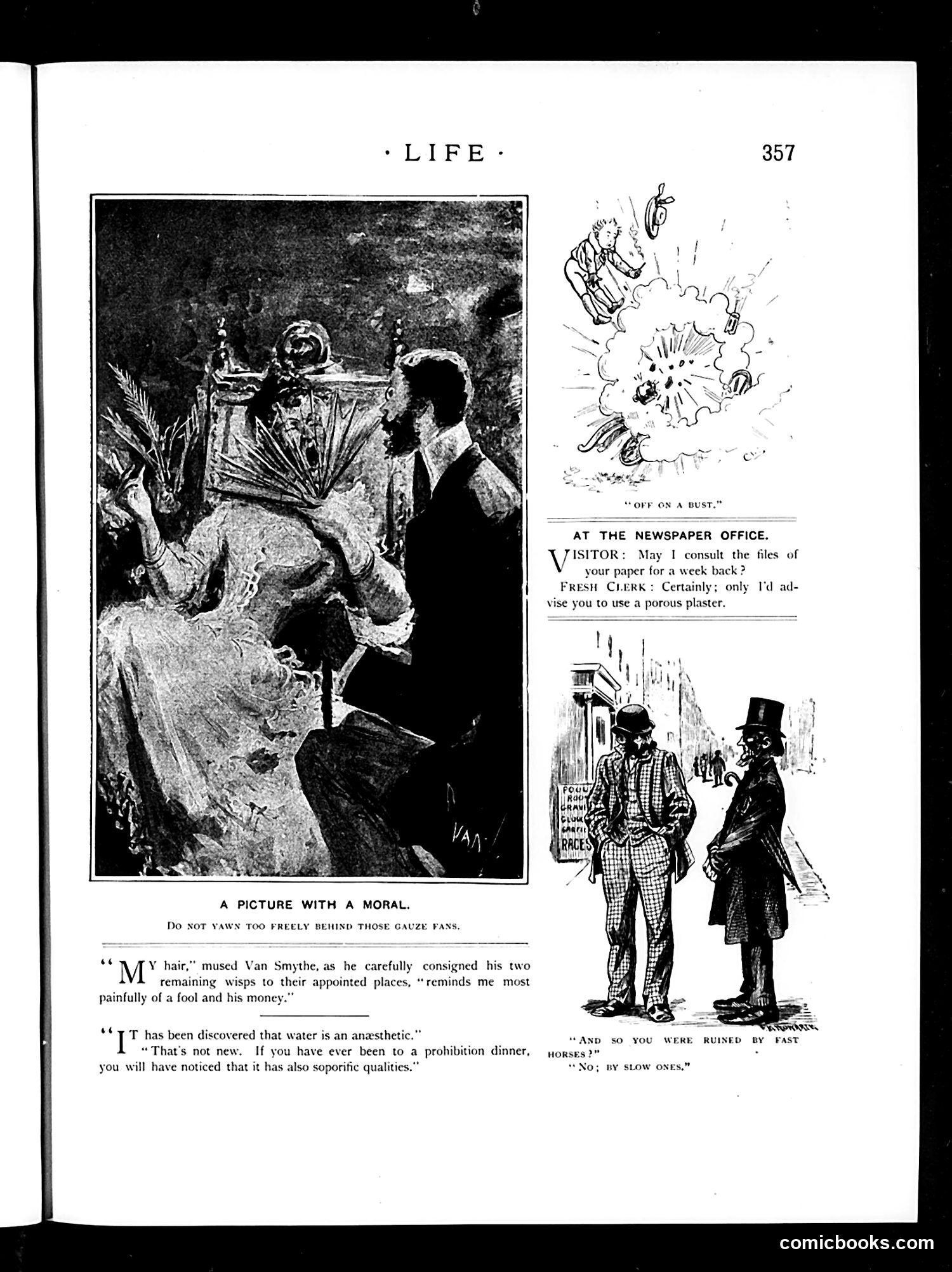
This page contains three distinct satirical pieces: 1. **"A Picture with a Moral"**: A large illustration warns against "yawns too freely behind those gauze fans." Van Smythe is disposing of his last two mustache whisps, musing that hair reminds him "most painfully of a fool and his money." 2. **"Off On a Bust"**: A cartoon showing an explosion, likely satirizing reckless behavior or excess. 3. **"At the Newspaper Office"**: A dialogue joke where a visitor requests old newspaper files. The fresh clerk advises using "a porous plaster," making a pun on "files" (documents versus parasitic insects). 4. **"And So You Were Ruined by Fast Horses?"**: A street scene where someone attributes their downfall to fast horses; the response "No; by slow ones" delivers the punchline through ironic reversal. The page exemplifies early 20th-century American magazine humor—wordplay, physical comedy, and social observation.
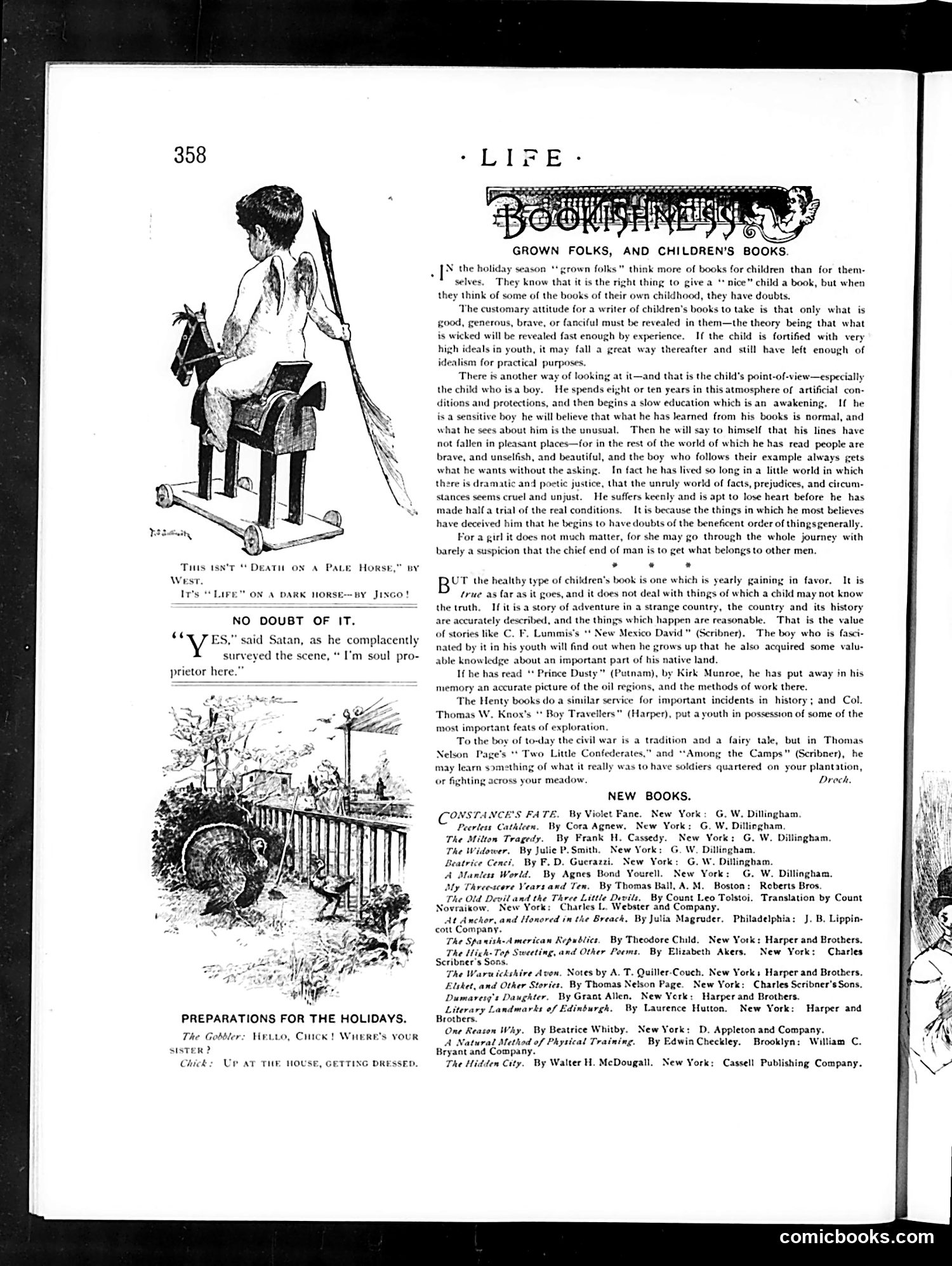
This page contains two distinct editorial cartoons about children's literature and holiday preparations. The top cartoon, titled "This Isn't 'Death on a Pale Horse,' by War; It's 'Life' on a Dark Horse—by Jingo!," appears to be a satirical comment on a children's book, though the specific reference is unclear without more context. The bottom cartoon, captioned "Preparations for the Holidays" with the dialogue "The Gobbler: 'Hello, Chuck! Where's your sister? Chuck: Up at the house, getting dressed,'" shows a turkey speaking to a chicken. This is dark holiday humor—the turkey is oblivious that it will be dinner, while the chicken's sister is being "dressed" (prepared for cooking). It's gallows humor about Thanksgiving preparations. The page also features a substantial book review section titled "Bookishness" discussing children's literature.
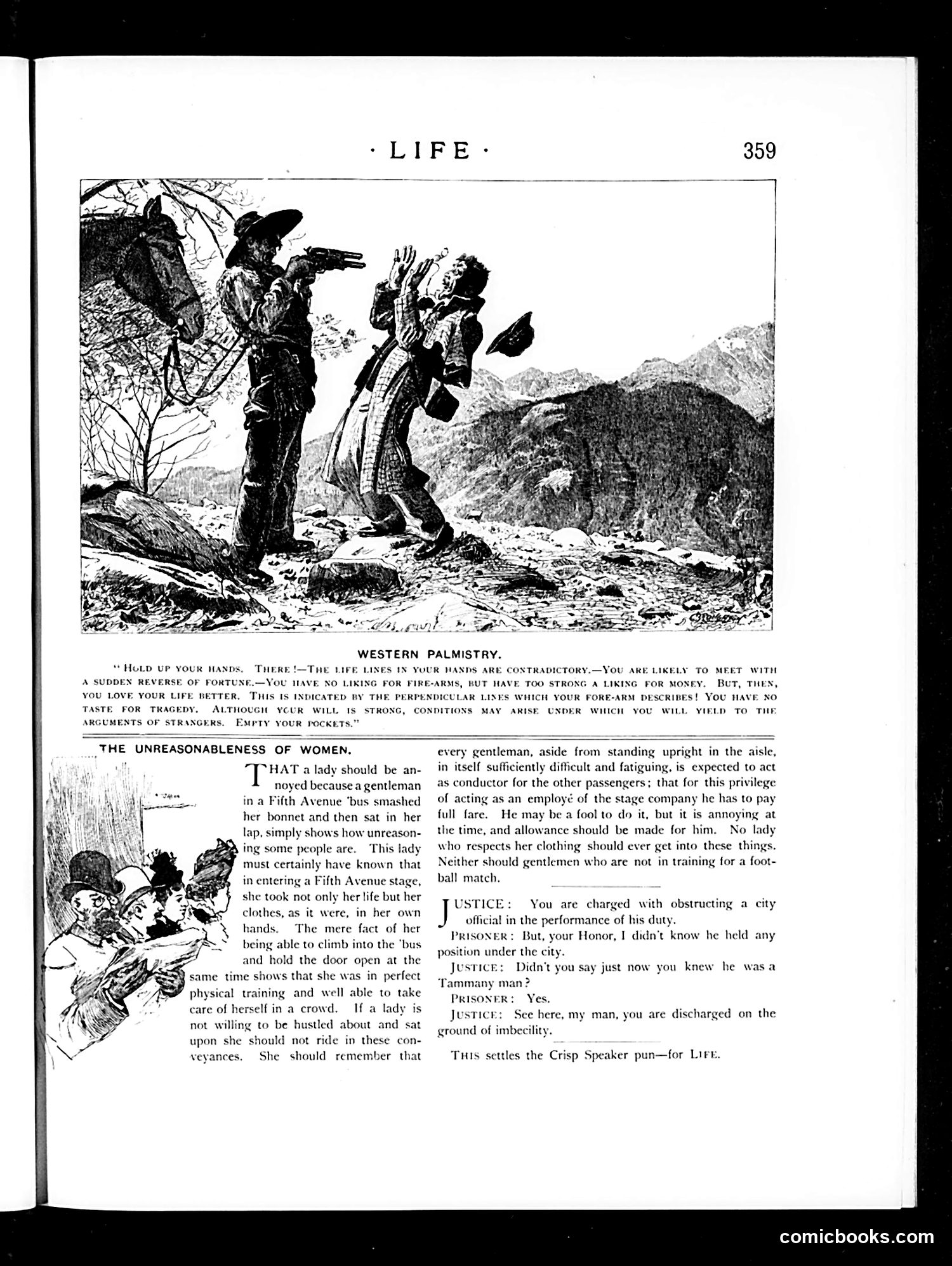
**Top cartoon**: Two figures in Western attire (appearing to be cowboys or frontiersmen) consult a fortune teller about their futures. The palmist delivers dark predictions about sudden reversals, loss of firearms, and strong desire for money—ending with a warning about "taste for tragedy." This satirizes both fortune-telling charlatans and anxieties about frontier life's unpredictability. **Bottom section**: A humorous essay criticizes women who complain about mistreatment while lacking physical training to manage themselves independently in public spaces like streetcars. The accompanying cartoon shows a woman being jostled in crowded transit. The piece sarcastically suggests women demanding equal treatment should accept the physical discomforts that accompany public life. This reflects early-20th-century debates about women's independence and "separate spheres" ideology.
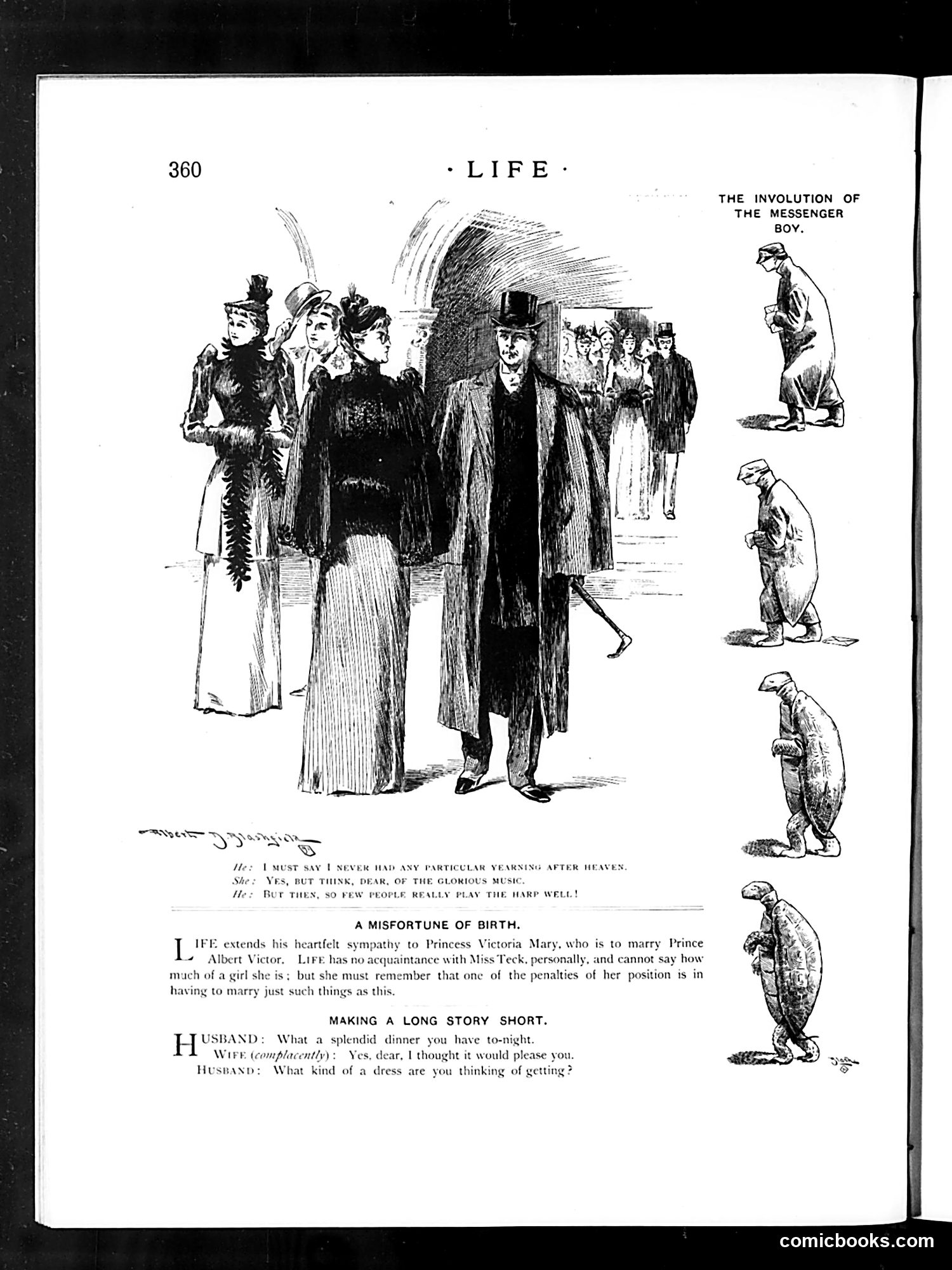
This page contains two distinct satirical pieces: **"The Involution of the Messenger Boy"** (right side): A sequence of four illustrations showing a young messenger boy in progressively more hunched, degraded postures. This appears to be social commentary on how working-class employment deforms and diminishes youth—a critique of labor conditions. **Main cartoon and text sections** (left): - A drawing shows well-dressed figures, with dialogue suggesting commentary on Princess Victoria Mary's impending marriage to Prince Albert Victor - "A Misfortune of Birth" section references the couple's marriage - "Making a Long Story Short" presents marital banter about dinner and dress purchases The satire targets both aristocratic marriage politics and middle-class domestic dynamics, typical of Life's social criticism during this era.
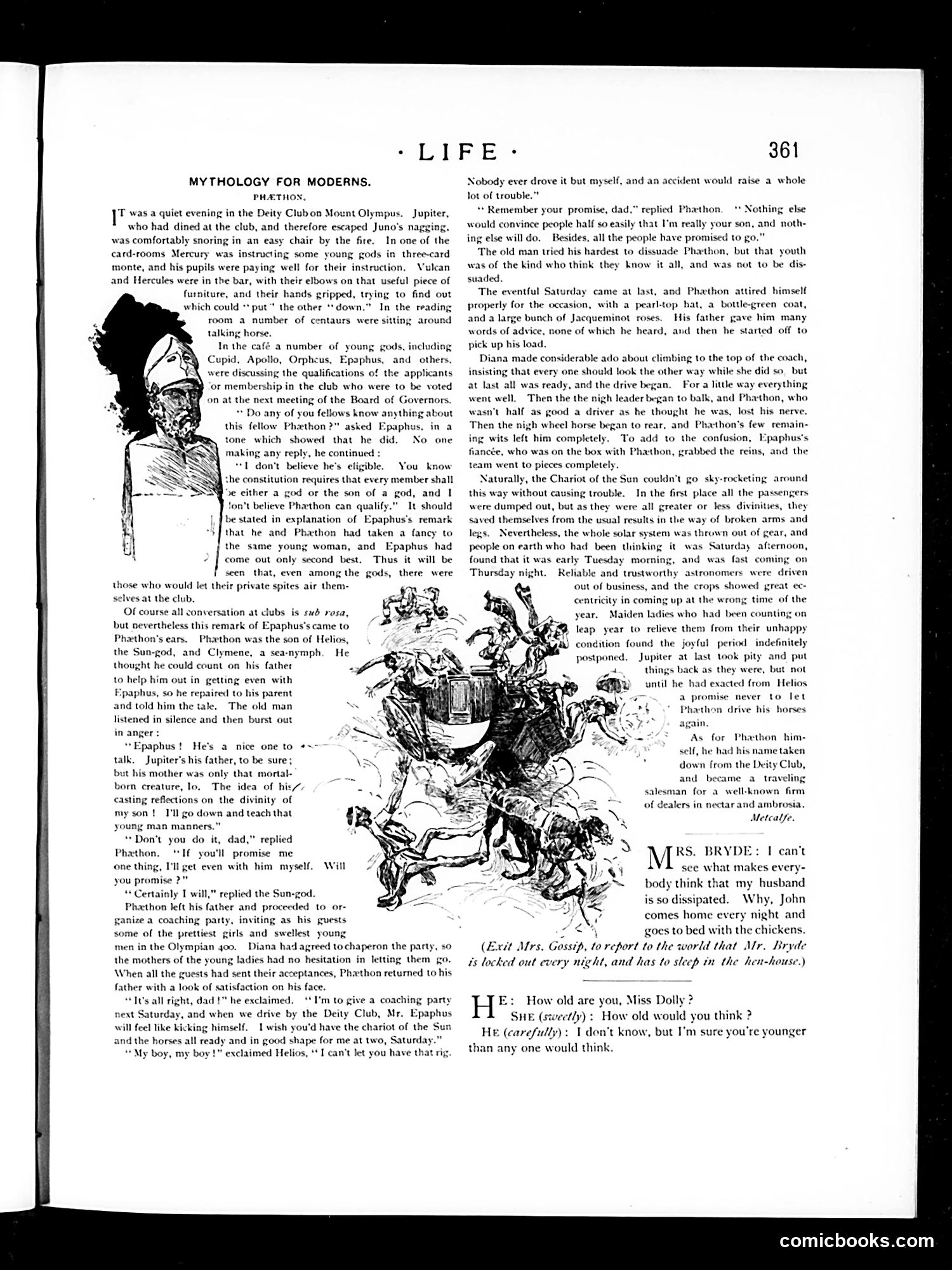
This page presents a satirical retelling of the classical myth of Phaëthon adapted to modern (early 20th-century) settings. The story involves young gods discussing membership qualifications at what appears to be an exclusive club, then follows Phaëthon's disastrous attempt to drive the "Chariot of the Sun"—reimagined as a high-performance automobile. The satire mocks the wealthy elite's obsession with exclusive clubs, reckless youth, and dangerous driving. The chaos depicted in the illustration (horses and vehicle in disarray) mirrors the original myth's catastrophe, suggesting that modernity's "progress" merely recreates ancient human follies. The humor targets both aristocratic pretension and the automobile era's new dangers.
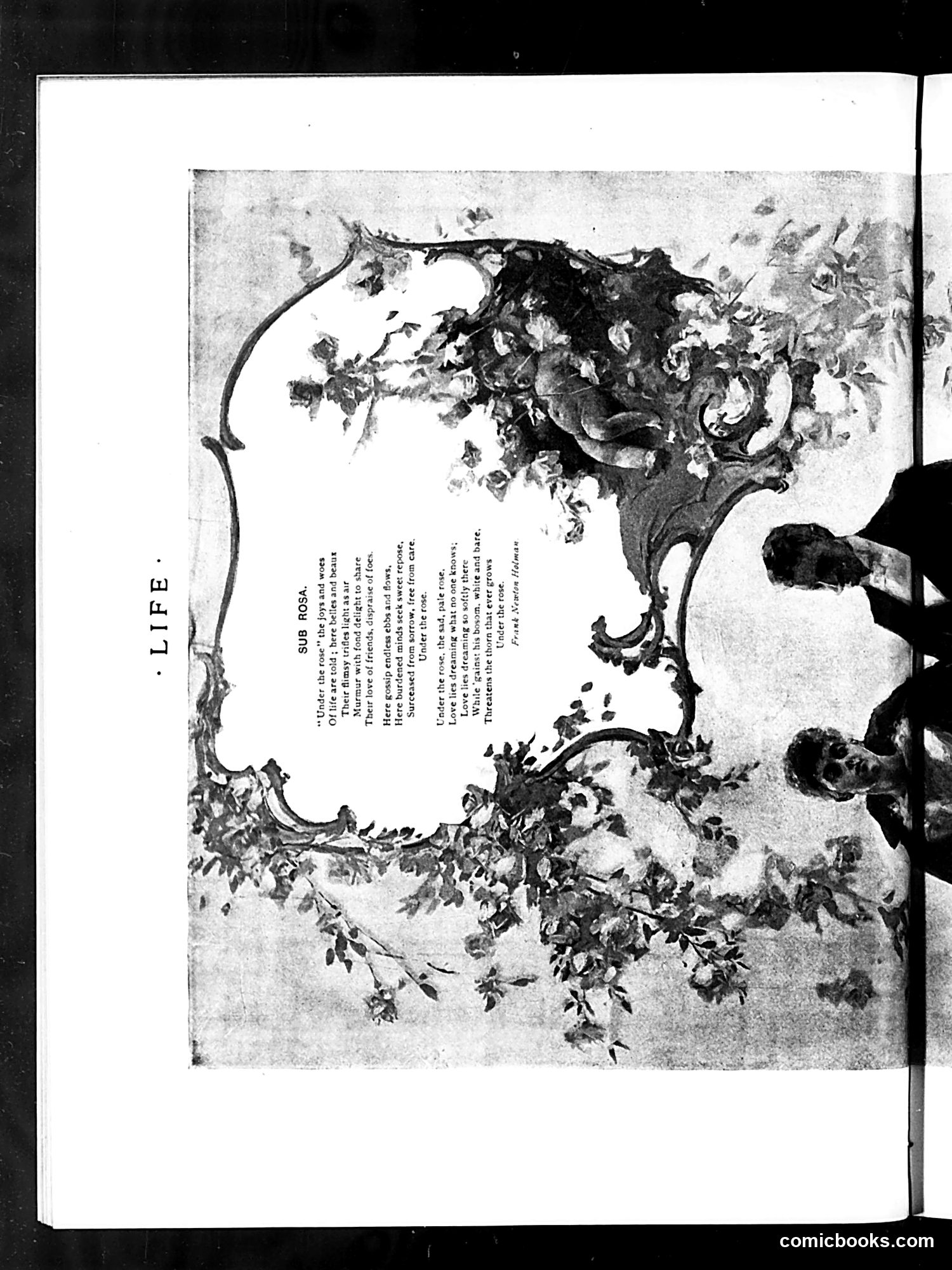
This page features a satirical illustration titled "SUB ROSA" (Latin for "under the rose," meaning in secret). The image shows a human profile in silhouette with flowering vines and botanical growth erupting from the head—a visual metaphor for secret thoughts or hidden schemes blooming unseen. The accompanying text (partially legible in the OCR) appears to comment on something being conducted secretly or hypocritically. The artistic style is typical of early-to-mid 20th century American political satire from *Life* magazine. Without clearer text visibility, the specific political target remains unclear, but the composition suggests criticism of concealed governmental or social activities—a common *Life* magazine theme satirizing hypocrisy between public statements and private actions.
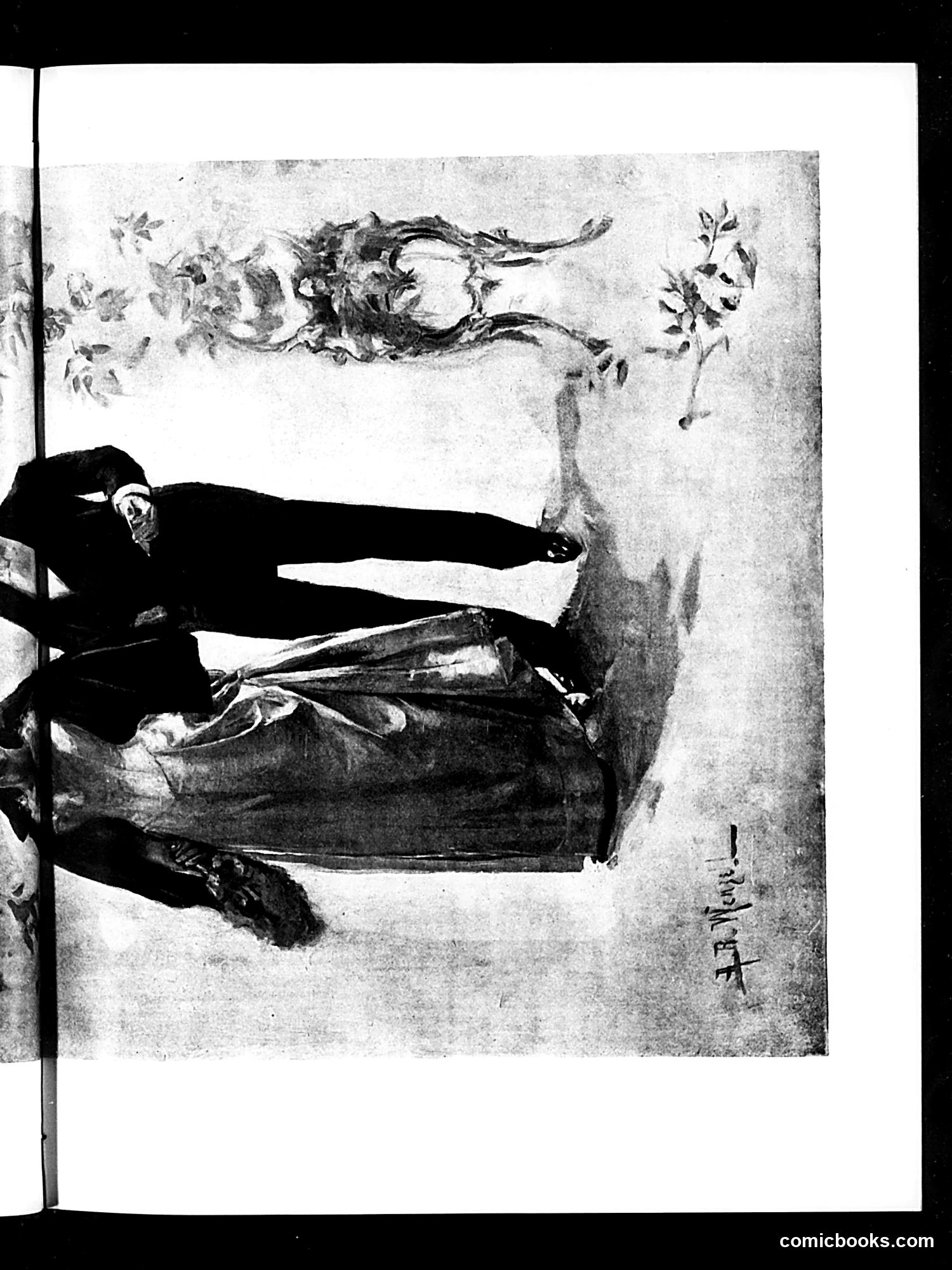
I can see this is a black and white illustration showing a person in formal attire (suit and hat) reclining or falling backward in an exaggerated pose, with their leg extended upward. Above them are sketches of plants or foliage. The style suggests satirical commentary typical of Life magazine's political cartoons. However, without legible text or clear identifying labels in the image itself, I cannot definitively determine: - Who this figure represents - What specific political or social event is being satirized - The intended joke or message The OCR text provided appears incomplete or unreadable. To accurately explain this cartoon's meaning and context to a modern reader, I would need either clearer text from the page or additional identifying information visible in the illustration itself.
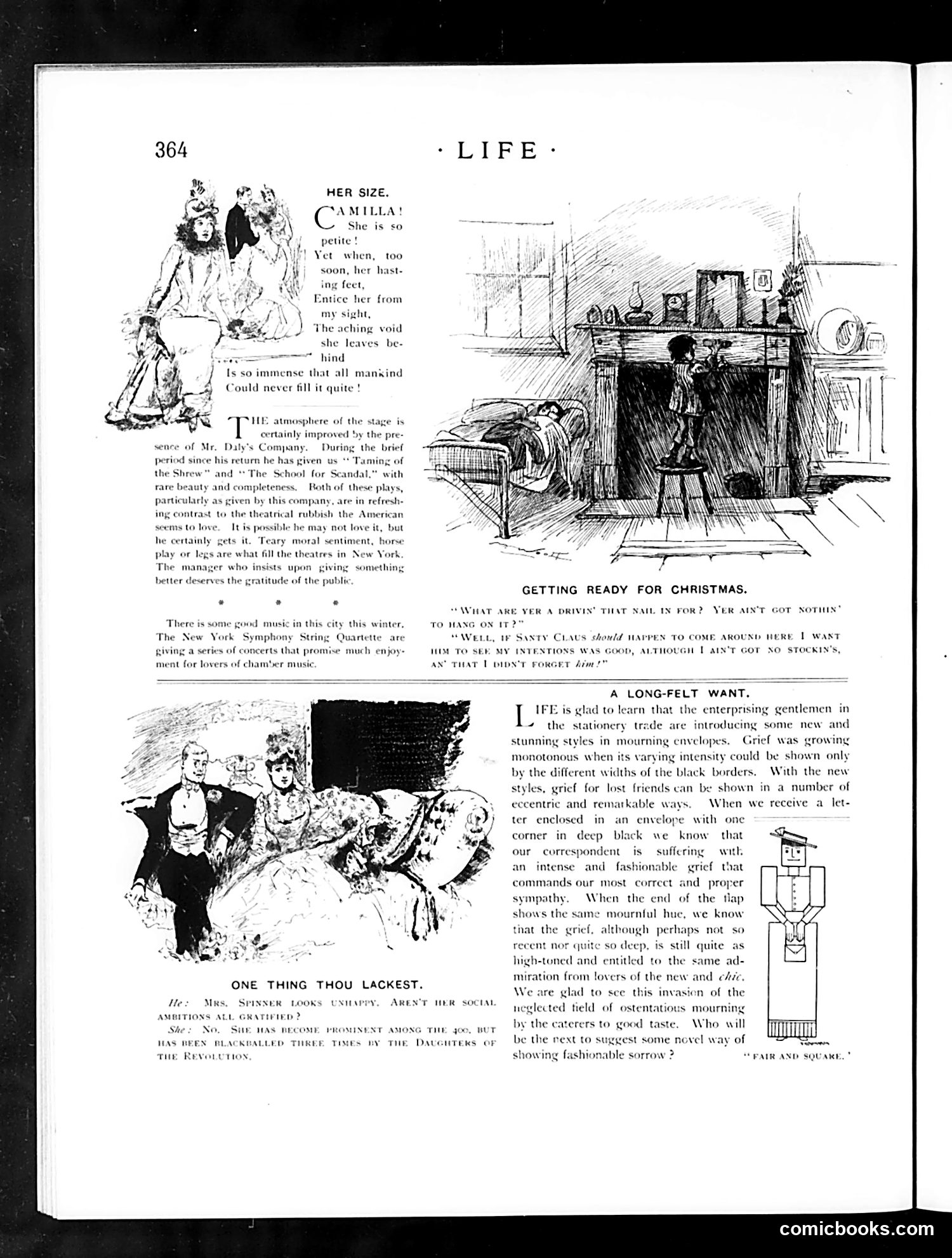
This page contains several satirical pieces typical of early-20th-century American humor: **"Her Size"** mocks overwrought romantic sentiment—a man dramatically pines for a tiny woman ("Camilla") whose absence creates an "immense" void, playing on Victorian excess and affected emotion. **Theater commentary** critiques American audiences' taste, noting that while manager Daly produces serious classics like *The Taming of the Shrew*, audiences prefer spectacle ("legs") over moral substance. **Christmas cartoon** depicts working-class characters preparing for the holiday with practical cynicism rather than sentiment. **"One Thing Thou Lackest"** jokes about social climbing: Mrs. Spinnaker has become prominent but faces repeated rejection ("blackballed three times") from exclusive groups—likely Daughters of the American Revolution—suggesting old-money elites resist nouveau-riche membership. **"A Long-Felt Want"** satirizes mourning culture by praising new "fashionable" black-bordered envelopes in varying widths to display grief's intensity—mocking how the wealthy performatively display emotion through consumer goods. The humor targets pretension, materialism, and social aspiration among the wealthy and middle classes.
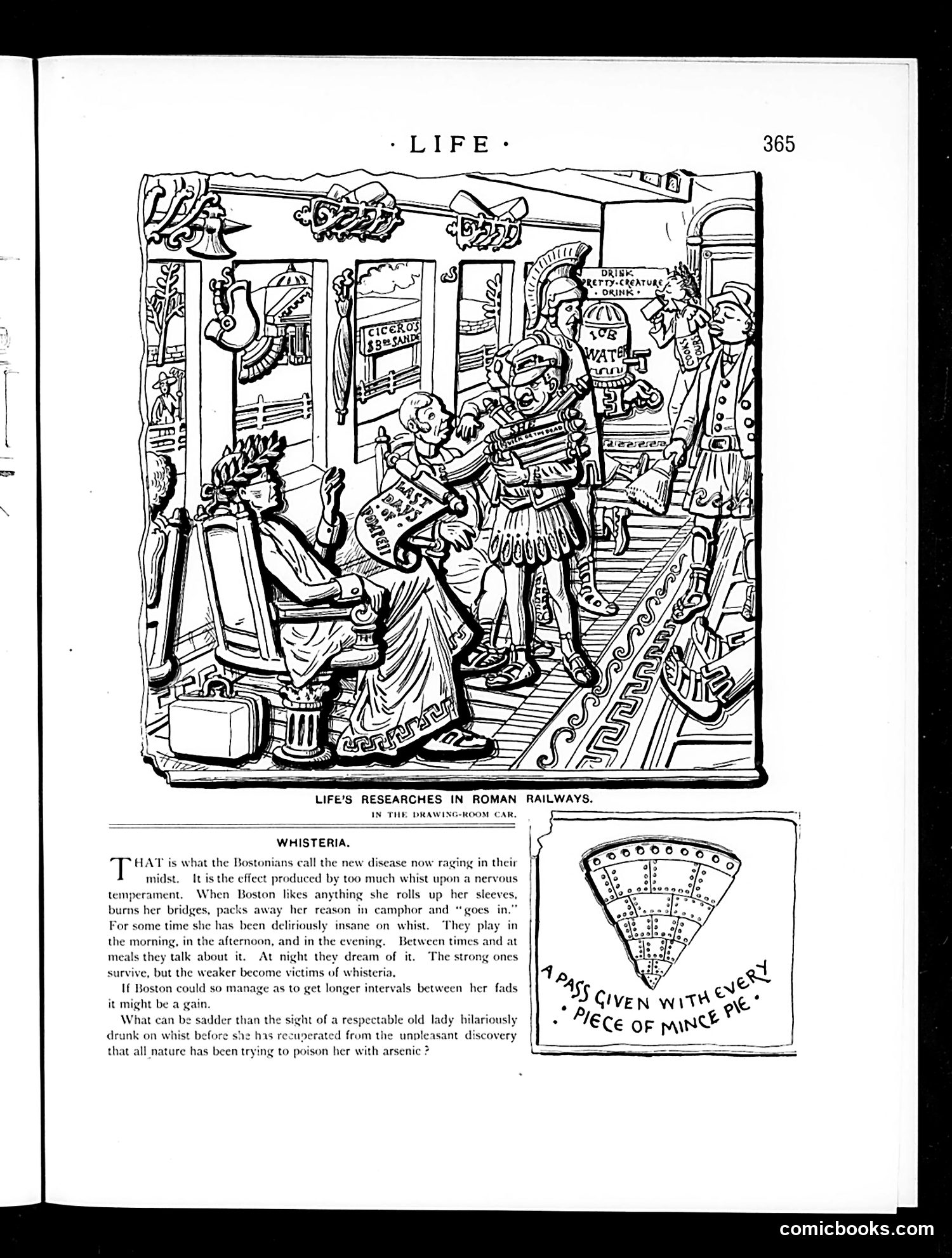
This 1890s Life magazine satirizes Boston's obsession with the card game whist. The cartoon depicts a luxurious train car where wealthy Bostonians play cards obsessively—morning, afternoon, evening, and even during meals. The satire mocks: 1. **Boston's extreme fad-chasing**: The text claims Bostonians abandon reason entirely when adopting trends, "rolling up sleeves" and "going in" with reckless enthusiasm. 2. **"Whisteria"**: A invented disease name (pun on wisteria flowers) describing nervous exhaustion from excessive whist-playing, particularly affecting the city's elite. 3. **Social excess**: The closing jab suggests Bostonians replace one obsession with another so quickly they never recover—comparing a woman "hilariously drunk on whist" to one still traumatized by arsenic poisoning (likely a contemporaneous scare). The cartoon ridicules upper-class Boston culture as shallow, addiction-prone, and prone to mass hysteria over fashionable pastimes.
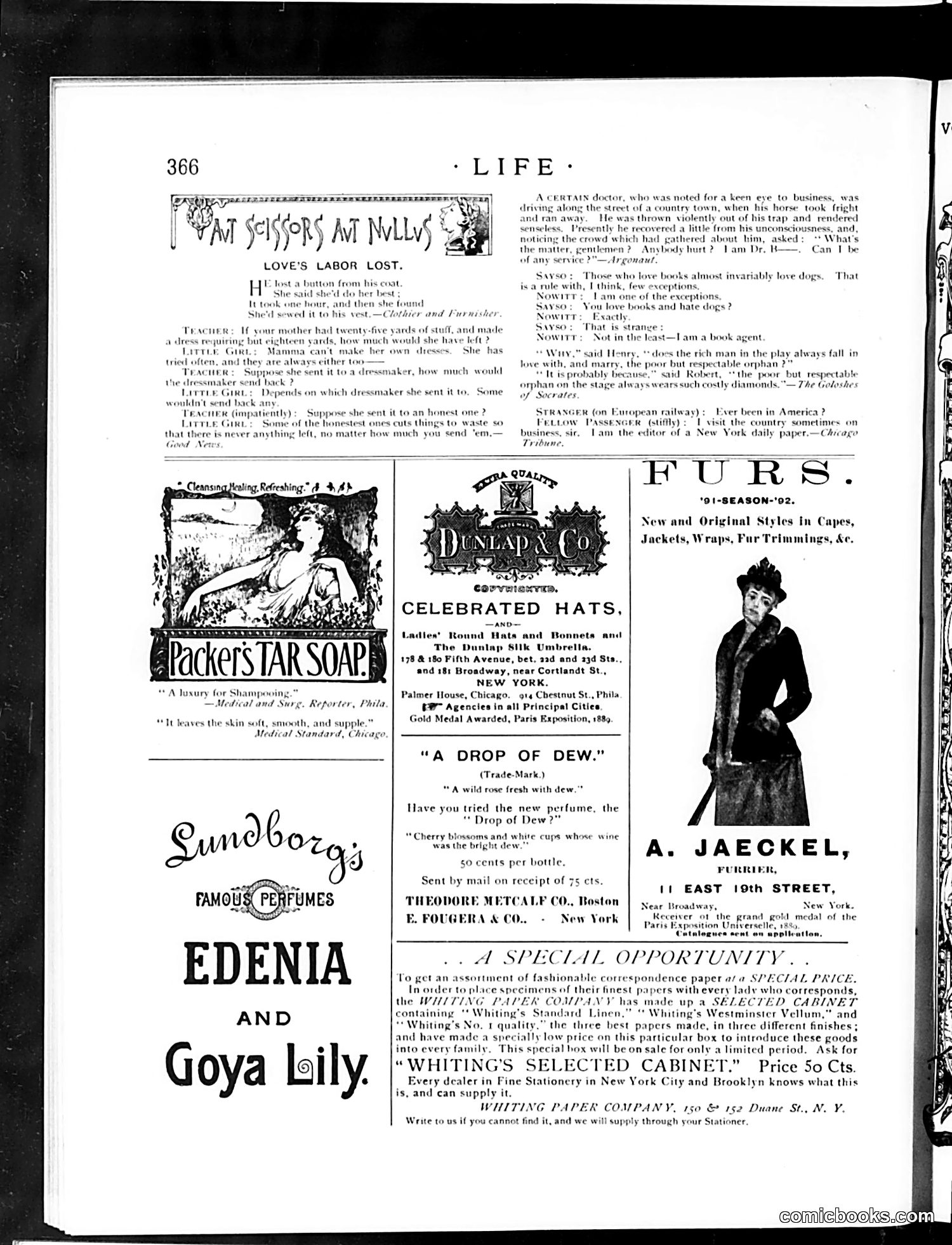
This page is primarily **advertising with embedded humor** rather than political satire. The main content consists of several short comic anecdotes in the upper portion, followed by period advertisements. The jokes illustrate social attitudes of the era (circa 1902, based on "Season '02" notation): - A doctor's absent-minded response to a carriage accident - A teacher's lesson about honest dressmakers - Contrasting attitudes toward books and dogs (a "book agent" joke) - An exchange between a wealthy man and newspaper editor about social class and orphans on stage These anecdotes mock pretension, absent-mindedness, and social climbing—common targets in *Life* magazine's satirical humor of this period. The remainder is **legitimate commercial advertising**: Packer's Star Soap, Lundborg's perfumes, Dunlap Hats, "A Drop of Dew" perfume, A. Jaeckel Furs, and Whiting Paper Company. The ads emphasize luxury goods and social refinement typical of the era's consumer culture.