
Life, 1891-12-17 · page 6 of 14
Life — December 17, 1891 — page 6: what you’re looking at
What you’re looking at
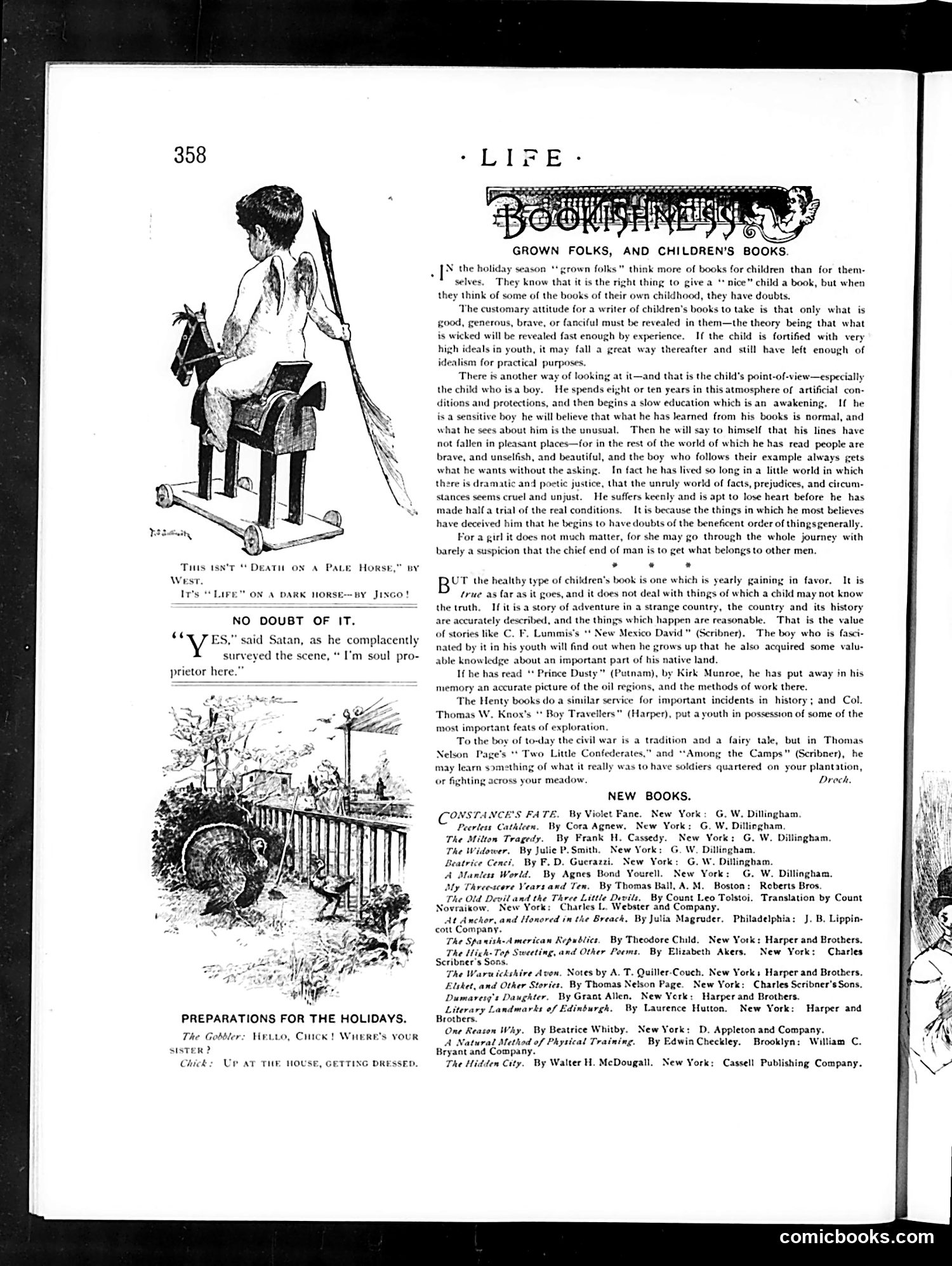
This page contains two distinct editorial cartoons about children's literature and holiday preparations. The top cartoon, titled "This Isn't 'Death on a Pale Horse,' by War; It's 'Life' on a Dark Horse—by Jingo!," appears to be a satirical comment on a children's book, though the specific reference is unclear without more context. The bottom cartoon, captioned "Preparations for the Holidays" with the dialogue "The Gobbler: 'Hello, Chuck! Where's your sister? Chuck: Up at the house, getting dressed,'" shows a turkey speaking to a chicken. This is dark holiday humor—the turkey is oblivious that it will be dinner, while the chicken's sister is being "dressed" (prepared for cooking). It's gallows humor about Thanksgiving preparations. The page also features a substantial book review section titled "Bookishness" discussing children's literature.
📄 Transcribed text from this page (OCR, searchable)
Machine-transcribed from the original scan — historical spelling and the odd misread are preserved.
GROWN FOLKS, AND CHILDREN’S BOOKS. _ [8 the hotiday season ** grown folks” think more of books for children than for them- selves, They know that it is the right thing to give a ‘ nice” child a book, but when they think of some of the books of their own childhood, they have doubts. The customary attitude for a writer of children's books to take is that only what is good, generous, brave, or fanciful must be revealed in them—the theory being that what is wicked will be revealed fast enough by experience. If the child is fortified with very high ideals in youth, it may fall a great way thereafter and still have left enough of idealism for practical purposes. There is another way of looking at it—and that is the child's point-of-view—especially the child who isa boy. He spends eight or ten years in this atmosphere of artificial con- ditions and protections, and then begins a slow education which isan awakening. If he is a sensitive boy he will believe that what he has learned from his books is normal, and what he sees about him is the unusual, Then he will say to himself that his lines have not fallen in pleasant places—for in the rest of the world of which he has read people are brave, and unselfish, and beautiful, and the boy who follows their example always gets what he wants without the asking. In fact he has lived so long in a little world in which there is dramatic and poetic justice, that the unruly world of facts, prejudices, and citcum- stances seems cruel and unjust. He suffers keenly and is apt to lose heart before he has made half a trial of the real conditions. It is because the things in which he most believes have deceived him that he begins to have doubts of the beneficent order of things generally. For a girl it does not much matter, for she may go through the whole journey with barely a suspicion that the chief end of man is to get what belongs to other men. . . * Tus isn't“ DEATH ON A PALE Horse,” ny West. BUT the healthy type of children’s book is one which is yearly gaining in favor. It is . true as {ar as it goes, and it does not deal with things of which a child may not know the truth, If it is a story of adventure in a strange country, the country and its history NO DOUBT OF IT. are accurately described, and the things which happen are reasonable. That is the value of stories like C. F, Lummis's ** New Mexico David” (Scribner), The boy who is fasci- nated by it in his youth will find out when he grows up that he also acquired some valu- urveyed the scene, “I'm soul pro- ite knowledge about an important part of his native land. prietor here If he has read ** Prince Dusty" (Putnam), by Kirk Munroe, he has put away in his memory an accurate picture of the oil regions, and the methods of work there. The Henty books do a similar service for important incidents in history; and Col. Thomas W. Knox's ** Boy Travellers" (Harper), put a youth in possesston of some of the It's “LIFE ON A DARK HORSE—BY JIN said Satan, as he complacently most important feats of exploration To the boy of to-day the civil war is a tradition and a fairy tale, but in Thomas Nelson Page’s ** Two Little Confederates,” and “Among the Camps" (Scribner), he may learn something of what it really was to have soldiers quartered on your plantation, or fighting across your meadow. Drech. NEW BOOKS. ONSTANCE'S FATE. By Violet Fane. New York: G, W. Dillingham. Peerless Cathleen. By Cora Agnew, New York: G. W. Dillingham, The Milton Tragedy. By Frank H. Cassedy. New York: G. W. Dillingham. The Widower, By Julie P.Smith. New York: G. W. Dillingham. Beatrice Cenci, By F,D. Guerazzi. New York: G. W. Dillingham. A Mantess World. By Agnes Bond Yourell. New York: G. W. Dillingham. My Three-scere Years and Ten, By Thomas Ball, A. M. Boston: Roberts Bros. The Old Devil and the Three Little Divils, By Count Leo Tolstoi. Translation by Count Novraikow. New York: Charles L. Webster and Company. At Anchor, and Honored in the Breack, By Julia Magruder, Philadelphia: J. B. Lippin- cott Company. The Spanish-American Kepublics. By Theodore Child. New York: Harper and Brothers. The Hich-Top Sweeting, and Other Poems. By Elizabeth Akers. New York: Charles Scribner's Sons. The Warwickshire Aven. Notes by A. T. Quiller-Couch. New York s Harper and Brothers. Elsket, and Other Stories, By Thomas Nelson Page. New York: Charles Scribner's Sons, Dumaresg's Daughter, By Grant Allen, New Yerk: Harper and Brothers, Literary Landmarks of Edinburgh, By Laurence Hutton. New York: Harper and PREPARATIONS FOR THE HOLIDAYS. Brothers. a Me Sr ayriiehe's One Keaton Why. By Beatrice Whitby. New York: D. Appleton and Company. The Gobbler: We..to, Cuick ! WHERE'S YOUR 4 "Natural Method of Physical Training. By Edwin Checkley. Brooklyn: William C. SISTER ? Bryant and Company. Chick: Ut AT THE MOUSE, GETTING DRESSED. The Hidden City. By Walter H. McDougall. New York: Cassell Publishing Company. comicbooks.com