
Life, 1891-12-17 · page 4 of 14
Life — December 17, 1891 — page 4: what you’re looking at
What you’re looking at
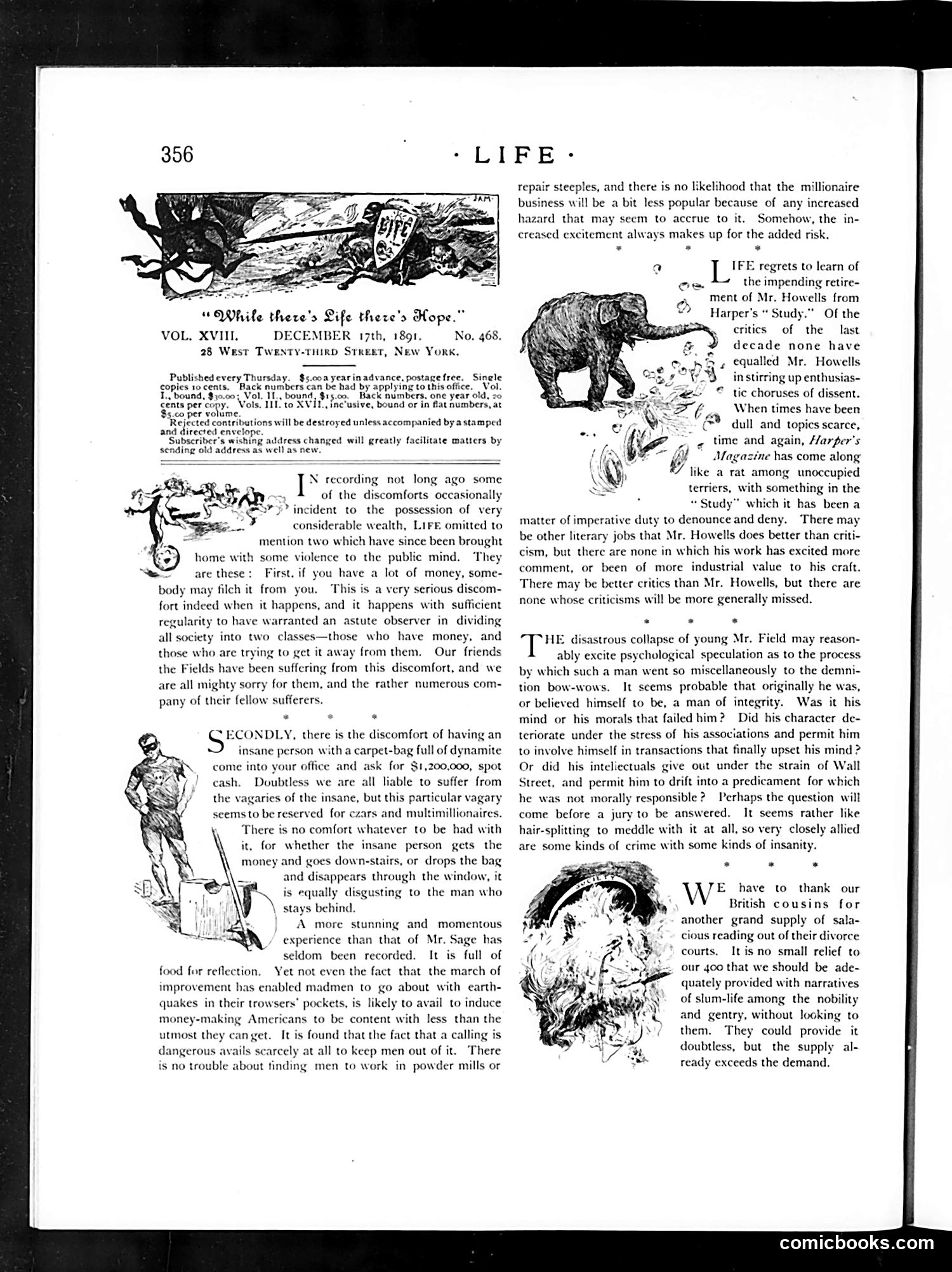
This page contains editorial commentary rather than political cartoons. The illustrations are decorative vignettes accompanying essays about social issues. The main topics discussed are: 1. **Wealth inequality and crime**: Commentary on wealthy individuals losing money and the societal divisions this creates between rich and poor classes. 2. **Mr. Howells' retirement from Harper's**: The text regrets the impending retirement of a literary critic known for stirring "enthusiastic choruses of dissent" in Harper's Magazine—suggesting he was a controversial but respected voice. 3. **Criminal psychology**: Discussion of how stress and association might drive moral collapse, using an unnamed case of someone's alleged deterioration. 4. **British divorce narratives**: Comment on British sources providing sensational divorce court stories to American readers, noting supply exceeds demand. The illustrations feature sketched figures but appear primarily decorative rather than satirical.
📄 Transcribed text from this page (OCR, searchable)
Machine-transcribed from the original scan — historical spelling and the odd misread are preserved.
‘LIFE: “Mhile there's Life there's Hope.” VOL. XVIII. DECEMBER 17th, 1891. No. 468. 28 West Twenty-tTiirD Street, New York, Published every Thursday. $s.o0a yearin advance, postage free. Single copies 10 cents, Back numbers can be had by applying to this office. Vol. I, bound, $30.00; Vol. II, bound, $15.00. Back numbers, one year old, 20 cents per copy. Vols. III! to XVIL., inc'usive, bound of in flat numbers, at $5.co per volume. Rejected contributions will be destroyed unless accompanied by a stamped and directed envelope. Subscriber's wishing address changed will greatly facilitate matters by sending old address as well as new. ah N recording not long ago some of the discomforts occasionally * incident to the possession of very considerable wealth, LIFE omitted to mention two which have since been brought home with some violence to the public mind. They First. if you have a lot of money, some- This is a very serious discom- are these : body may filch it from you. fort indeed when it happens, and it happens with sufficient regularity to have warranted an astute observer in dividing all society into two classes—those who have money, and those who are trying to get it away from them. Our friends the Fields have been suffering from this discomfort, and we are all mighty sorry for them, and the rather numerous com- pany of their fellow sufferers. S SONDLY, there is the discomfort of having an insane person with a carpet-bag full of dynamite come into your office and ask for $1,200,000, spot Doubtless we are all liable to suffer from ne, but this particular vagary seems to be reserved for czars and multimillionaires. There is no comfort whatever to be had with it, for whether the insane person gets the money and goes down-stairs, or drops the bag _ and disappears through the window, it & ify is equally disgusting to the man who f \ stays behind. experience than that of Mr. Sage has Idom been recorded. It full of Yet not even the fact that the march of improvement has enabled madmen to go about with earth- cash. the vagaries of the in A more stunning and momentous food for reflection. quakes in their trowsers’ pockets, is likely to avail to induce money-making Americans to be content with less than the It is found that the fact that a calling is angerous avails scarcely at all to keep men out of it. There no trouble about finding men to work in powder mills or utmost they can get. repair steeples, and there is no likelihood that the millionaire business will be a bit less popular because of any increased hazard that may seem to accrue to it. Somehow, the in- creased excitement always makes up for the added risk. IFE regrets to learn of the impending retire- ment of Mr. Howells from Harper's “ Study.” Of the critics of the last decade none have equalled Mr. Howells in stirring up enthusias- tic choruses of dissent. When times have been dull and topics scarce, ; « time and again, Harper's Magazine has come along like a rat among unoccupied terriers, with something in the “ Study” which it has been a matter of imperative duty to denounce and deny. There may be other literary jobs that Mr. Howells does better than criti- cism, but there are none in which his work has excited more comment, or been of more industrial value to his craft. There may be better critics than Mr. Howells, but there are none whose criticisms will be more generally missed. * * * HE disastrous collapse of young Mr. Field may reason- ably excite psychological speculation as to the process by which such a man went so miscellaneously to the demni- tion bow-wows. It seems probable that originally he was, or believed himself to be, a man of integrity. Was it his mind or his morals that failed him? Did his character de- teriorate under the stress of his associations and permit him to involve himself in transactions that finally upset his mind ? Or did his inteliectuals give out under the strain of Wall Street, and permit him to drift into a predicament for which he was not morally responsible ?_ Perhaps the question will come before a jury to be answered. It seems rather like hair-splitting to meddle with it at all, so very closely allied are some kinds of crime with some kinds of insanity. * . W* have to thank our , y British cousins for + - another grand supply of sala- cious reading out of their divorce courts, It is no small relief to our 4oo that we should be ade- quately provided with narratives. of slum-life among the nobility and gentry, without looking to them. They could provide it doubtless, but the supply al- ready exceeds the demand. comicbooks.com