
A complete issue · 16 pages · 1891
Life — December 3, 1891
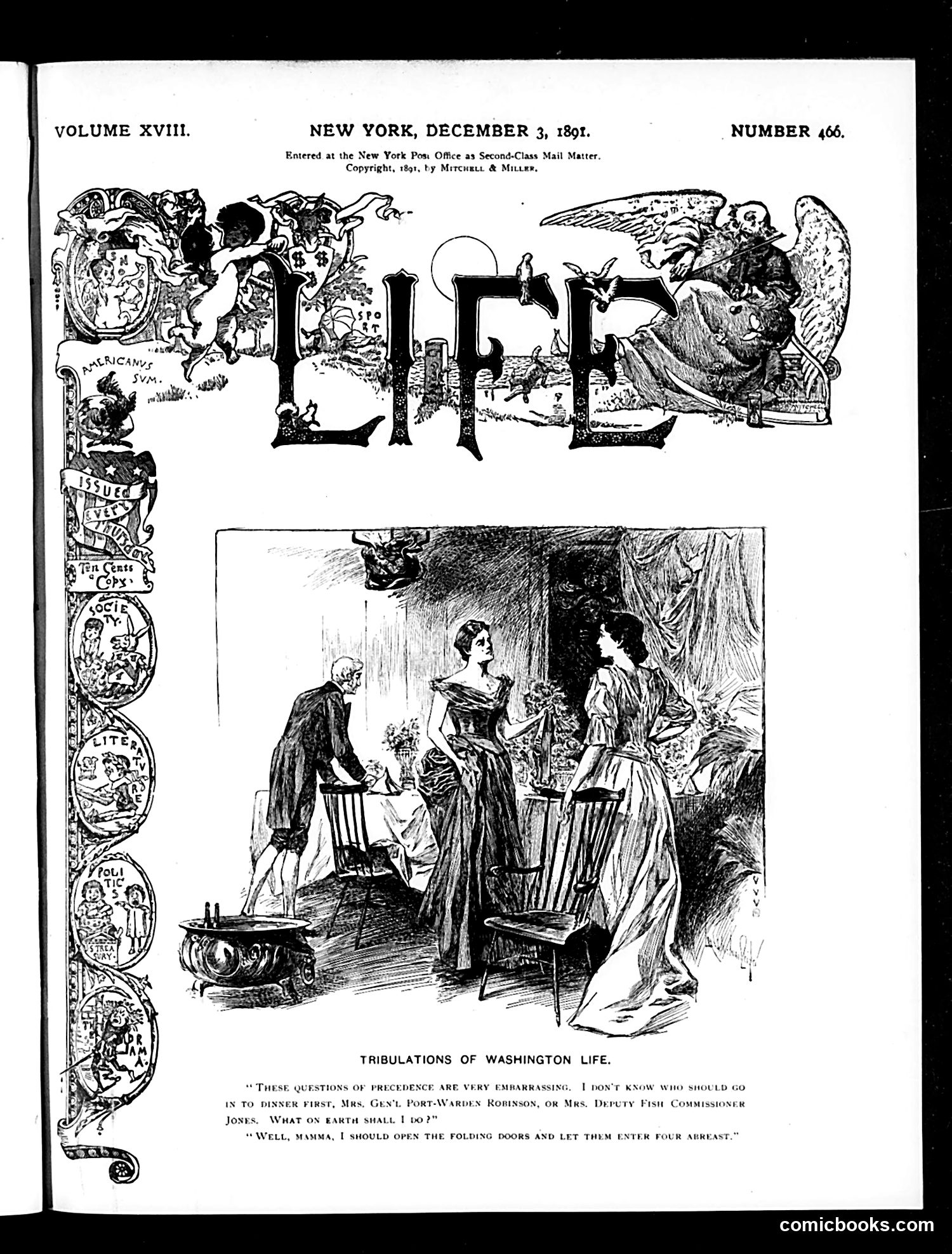
This satirical cartoon depicts a social dilemma facing Washington's elite circa 1891. A woman hosts a dinner party but faces an awkward problem: she's uncertain about proper protocol for seating three prominent women—Mrs. General Fort-Warren Robinson, Mrs. Deputy Fish Commissioner Jones, and an unnamed third guest. The humor lies in the absurdity of Washington's rigid social hierarchy. The titles are deliberately pompous yet somewhat ridiculous (particularly "Deputy Fish Commissioner"), suggesting the magazine mocks both the pretension of Washington society and the confusion caused by the growing number of women holding quasi-official positions or married to officials. The punchline—opening folding doors to seat them separately—satirizes how Washington society resolves such rank conflicts through physical separation rather than genuine social progress.
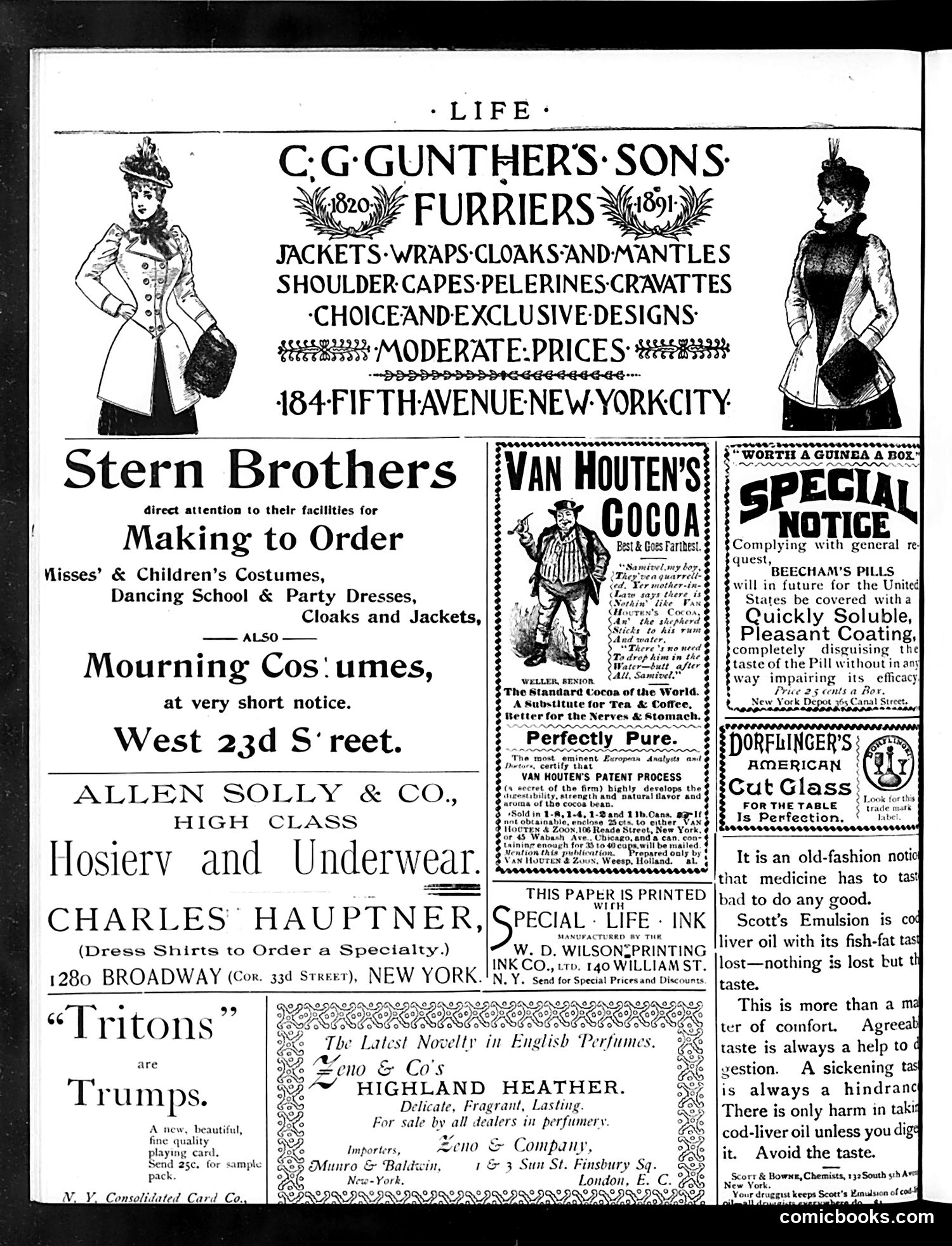
This page is primarily **advertising**, not editorial content or satire. It contains period commercial advertisements (circa 1891, based on the dates in the header) for: - C.G. Gunther's Sons Furriers (women's clothing) - Stern Brothers (custom costumes and mourning wear) - Van Houten's Cocoa - Beecham's Pills - Dorflinger's Cut Glass - Allen Solly & Co. (hosiery) - Charles Hauptner (dress shirts) - Tritons playing cards - Zeno & Co.'s perfume There is **no political cartoon or satire visible**. The page reflects late-19th-century consumer culture and advertising practices, with illustrated women modeling fashions being the primary visual content. The advertisements emphasize luxury goods and "moderate prices"—typical marketing language for affluent urban audiences of the Gilded Age.
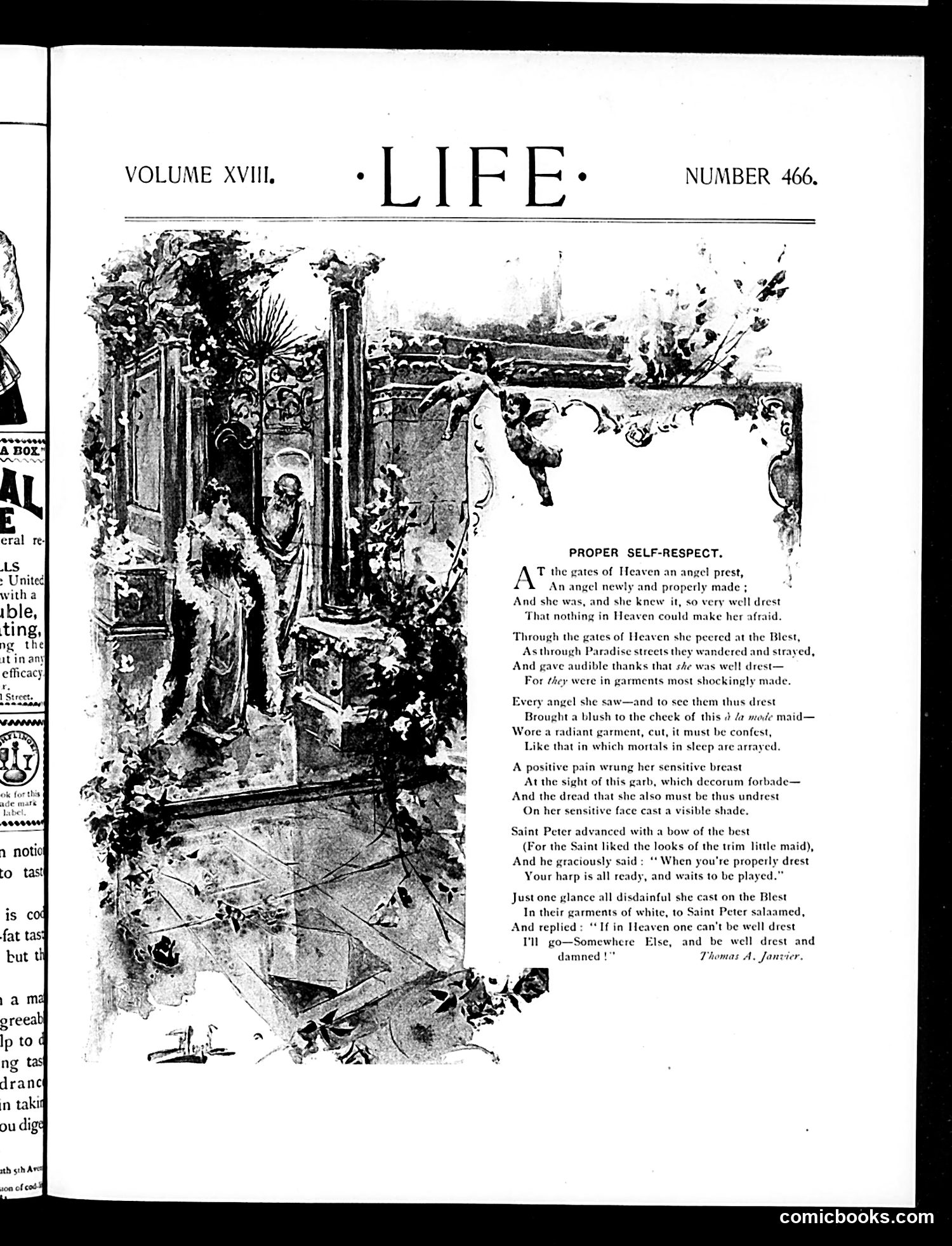
This page features a poem by Thomas A. Janvier accompanying an illustration of the Gates of Heaven. The satire concerns a female angel's concern about her clothing in Paradise. Saint Peter informs the angel that her garments are "shocking" and "most indecent," while the angel worries she'll be "undrest" in Heaven. Peter then reassures her that in Heaven, one can't be "well drest" without being "damned." The joke satirizes Victorian-era anxieties about modesty and propriety—suggesting that rigid earthly standards of dress and morality are absurdly irrelevant in the afterlife. It mocks both excessive concern with appearance and the tension between religious piety and social convention that characterized the era.
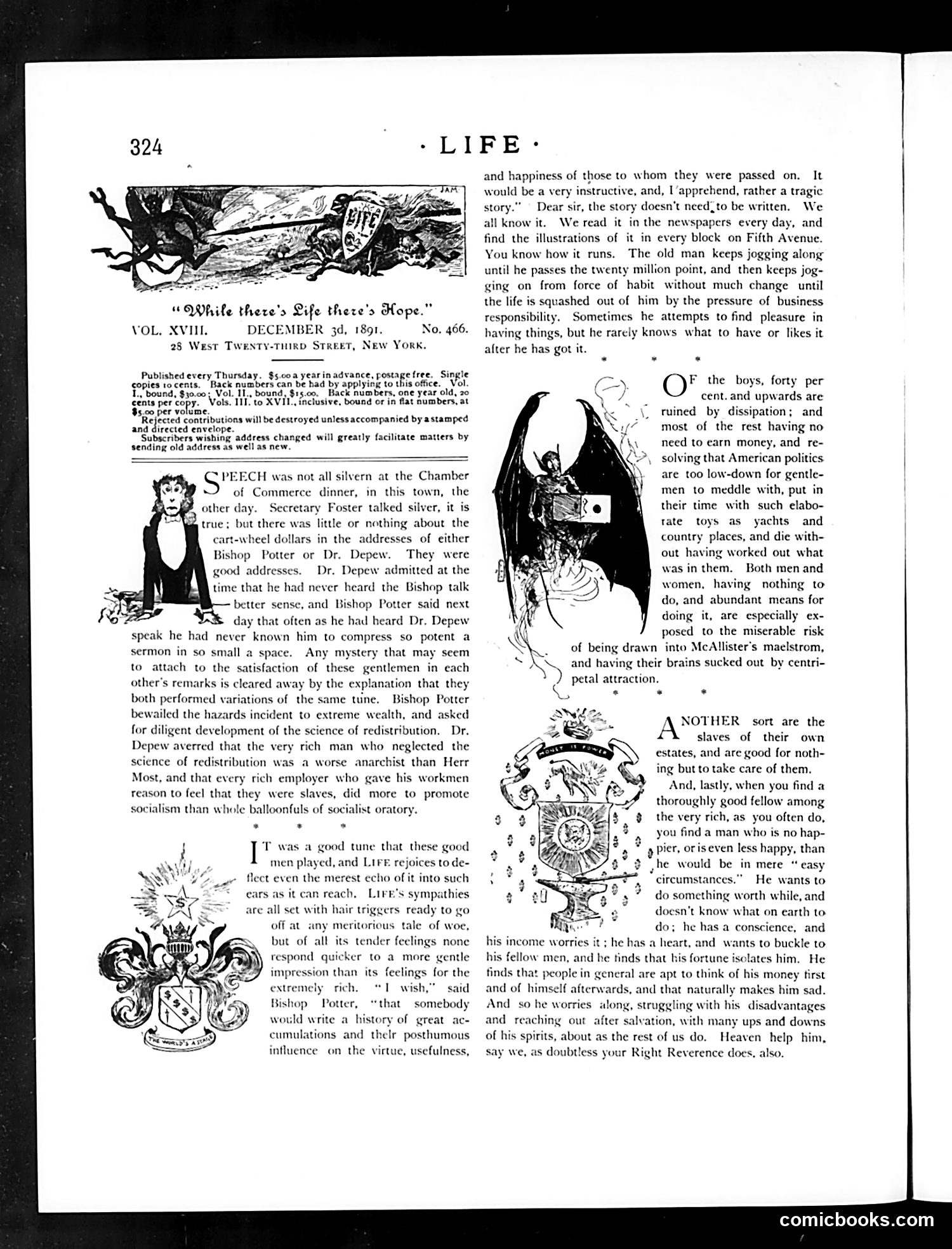
This page contains satirical editorial commentary rather than political cartoons. The text discusses social criticism of wealthy Americans, particularly targeting their lack of meaningful purpose and contribution to society. The main argument critiques how wealthy men and women squander their advantages on frivolous pursuits—yachts, country estates, and toys—while neglecting serious civic engagement. The author suggests that even the wealthy who recognize their moral obligations struggle to find genuine satisfaction or make real difference. The decorative illustrations (heraldic emblems, a demon-like figure) are typical period ornaments rather than specific political caricatures. The piece reflects Gilded Age anxieties about wealth inequality and the responsibility of the rich, concerns that remained central to American social debate in the 1890s.
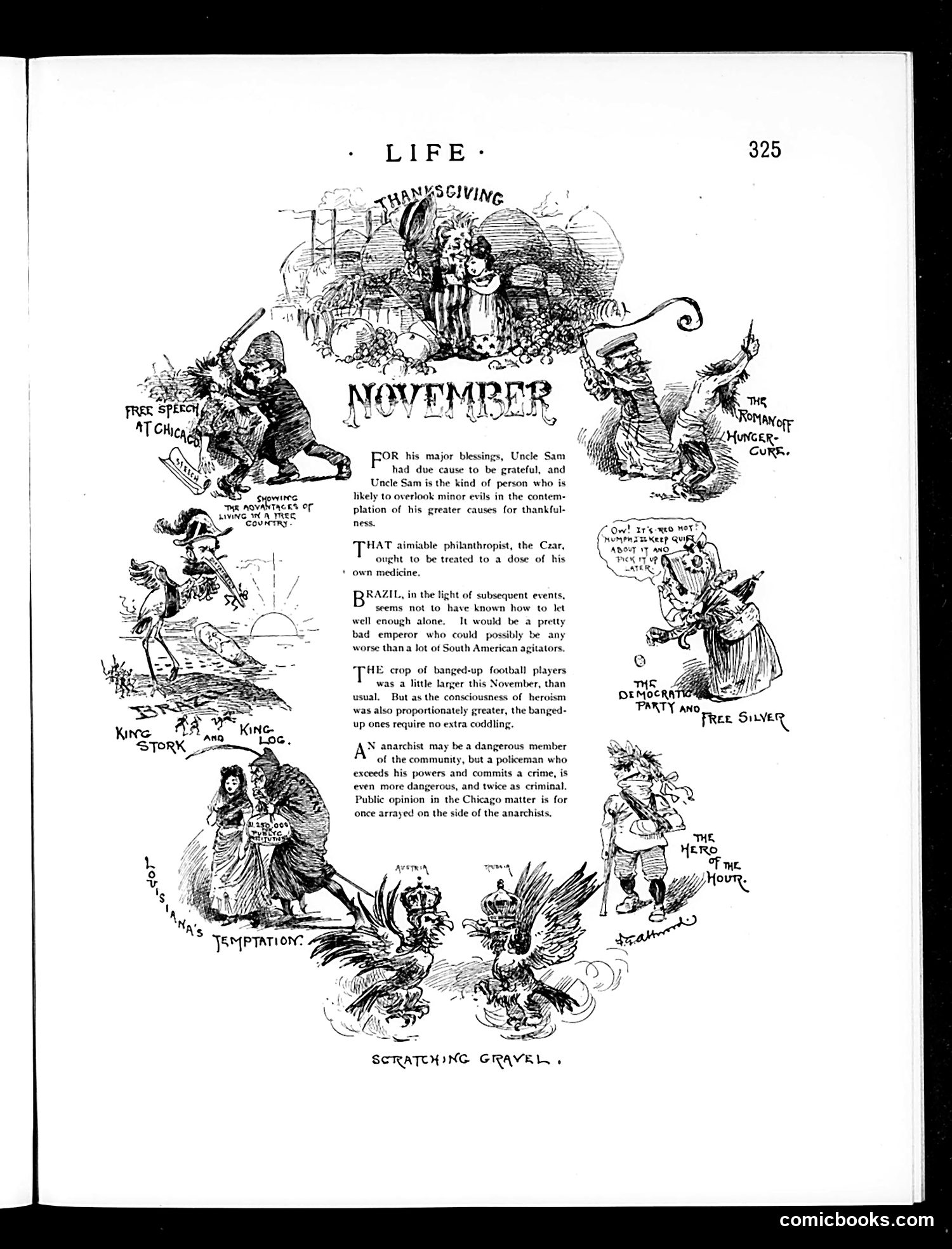
This November issue of Life employs satirical vignettes around the calendar page. The text discusses gratitude, contrasting Uncle Sam's capacity for thankfulness with other figures' failures. References include: - **The Czar**: Criticized as needing "a dose of his own medicine" - **Brazil**: Mocked for instability among "South American agitators" - **Chicago anarchists**: The page references a policeman exceeding anarchists' danger—likely alluding to the Haymarket affair context - **Football players**: Satirized for requiring "extra coddling" The surrounding illustrated vignettes (King Stork, Temptation, Scratching Gravel) appear to be thematic November commentary on various social follies. The overall message frames American gratitude against international and domestic chaos.
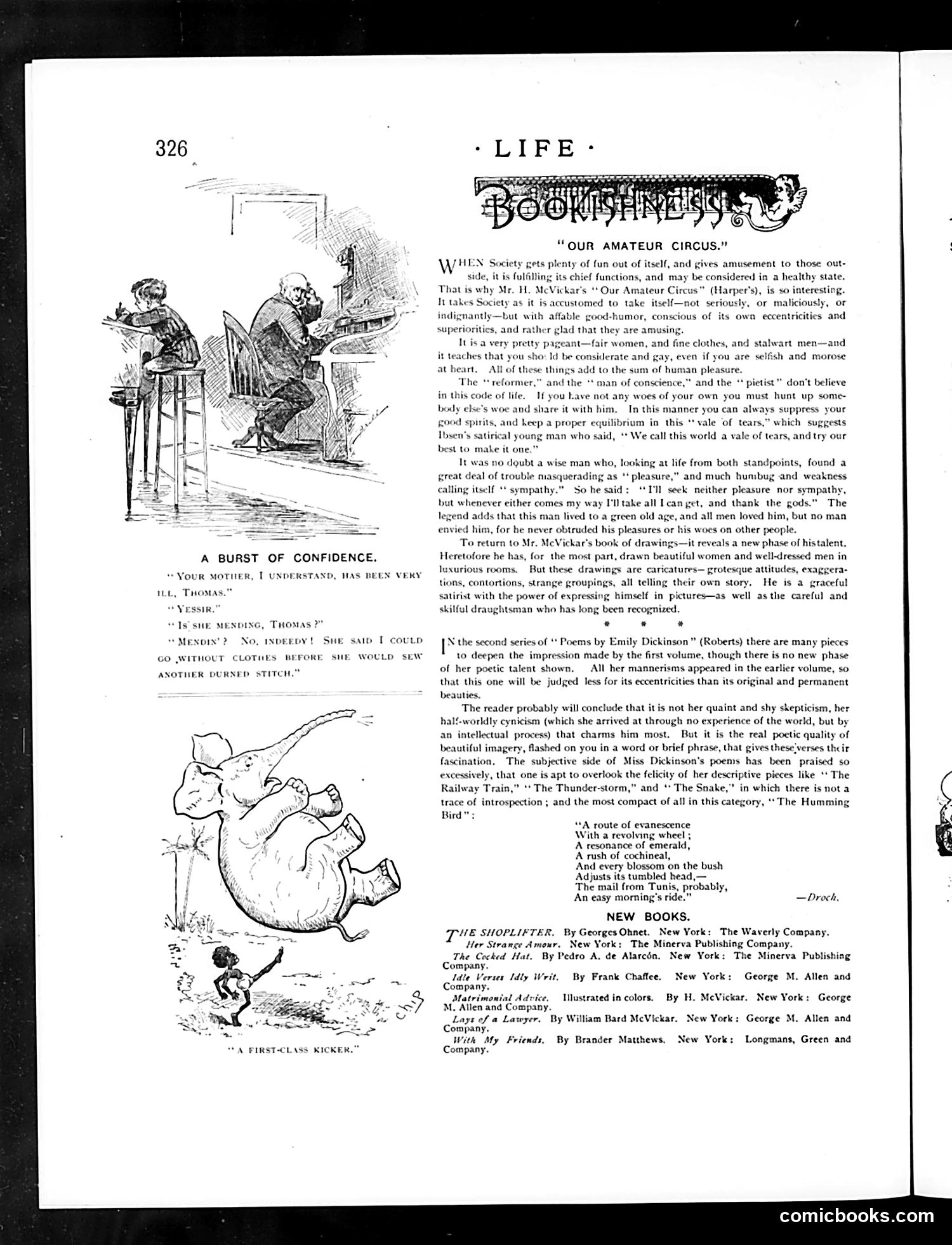
This page features a book review section titled "Bookshelf" reviewing H. H. McVickar's "Our Amateur Circus" (Harper's). The text praises McVickar's satirical drawings for their ability to express human foibles through exaggerated caricatures and grotesque attitudes. The two accompanying illustrations appear to be samples from McVickar's work: "A Burst of Confidence" (top) depicts social interaction, while "A First-Class Kicker" (bottom) shows a rotund figure in an exaggerated pose, likely satirizing human vanity or pretension. The review emphasizes that McVickar's strength lies in capturing satirical observations about society through skillful draftsmanship and humorous exaggeration—a hallmark of Life magazine's own editorial approach.
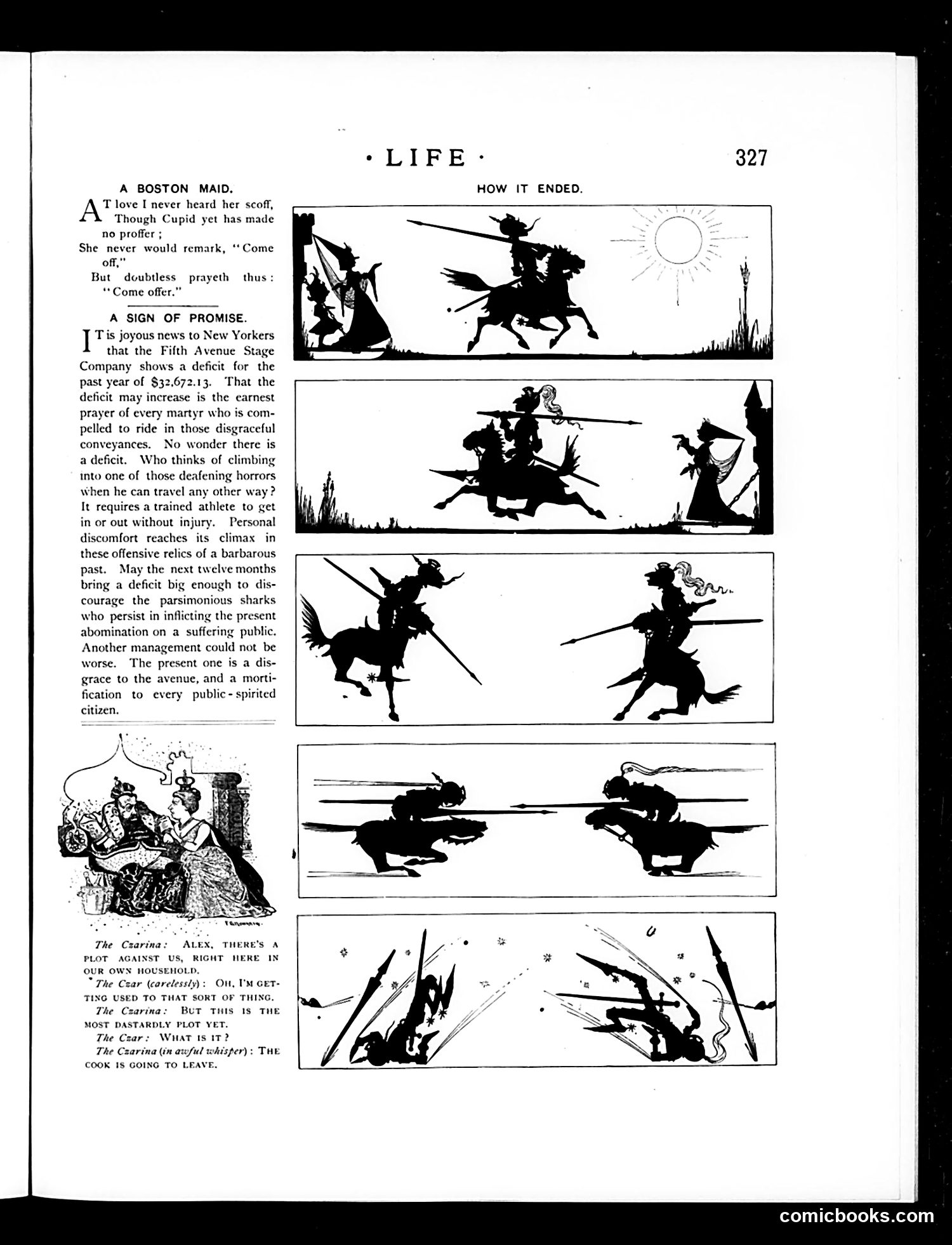
This page contains two distinct pieces: 1. **"A Boston Maid"** (top left): A short poem mocking a Bostonian woman's coldness toward courtship, playing on Boston stereotypes about reserved propriety. 2. **"A Sign of Promise"** (center-left): Commentary criticizing the Fifth Avenue Stage Company's financial deficit of $32,672.13. The author sarcastically questions why anyone would subject themselves to the discomfort of riding in these "deafening horrors" (early motor coaches), arguing the management is disgraced and the situation is absurd. 3. **"How It Ended"** (right): A sequential silhouette comic strip depicting what appears to be a knight or mounted figure in increasingly chaotic action scenes, culminating in a battle or violent confrontation. The narrative context remains unclear from the image alone.
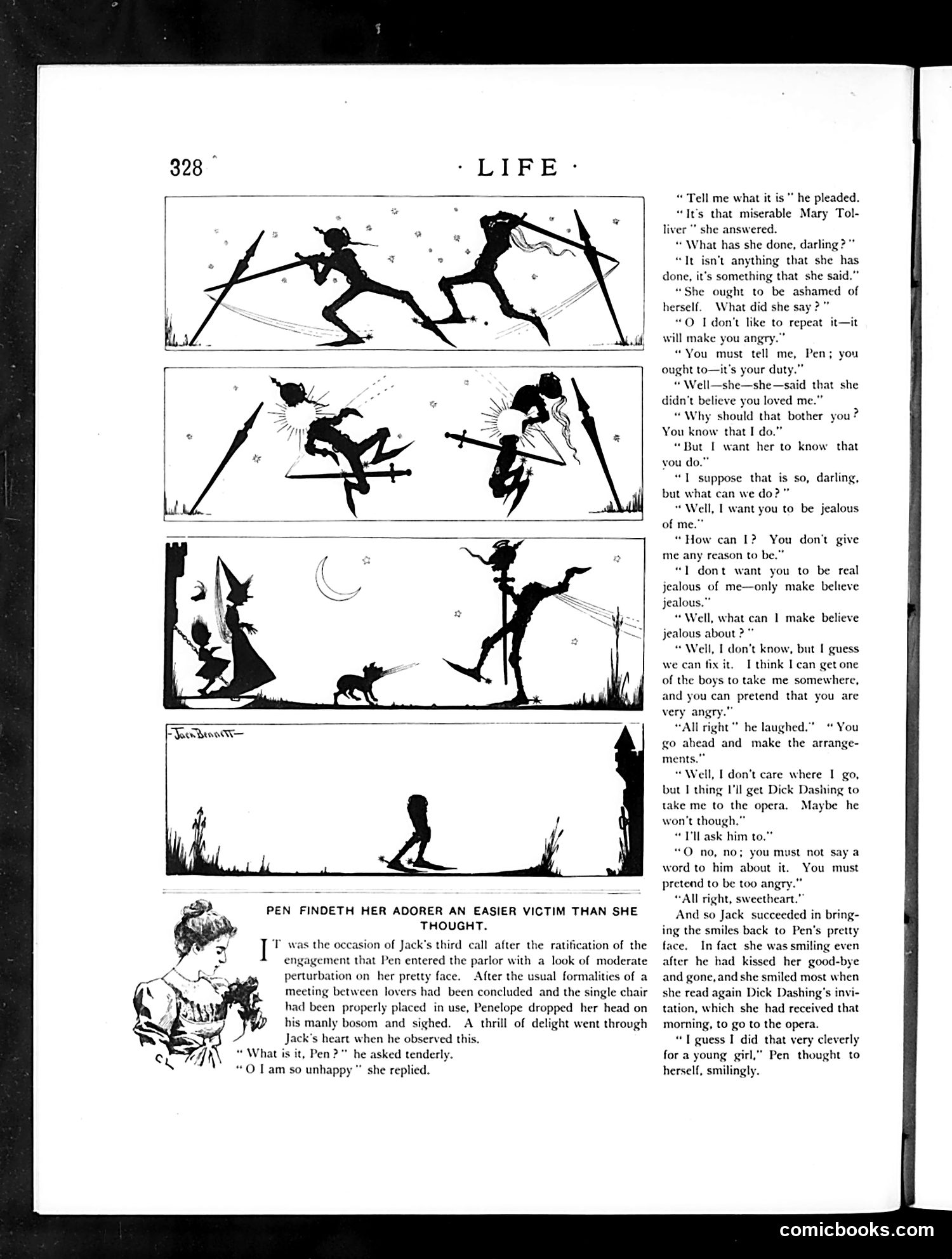
This page contains **silhouette comic strips** (a popular early 20th-century format) depicting fairy-tale characters, likely Peter Pan and related figures, shown in whimsical flying scenes. The narrative below focuses on a romantic subplot involving characters named Pen, Mary Toby, Dick Dashing, and Jack. The humor centers on **romantic jealousy and manipulation**: Jack persuades Pen to make his love interest jealous by arranging a date with another boy. The satire gently mocks the emotional games young people play in courtship—Pen agrees to the scheme despite recognizing its absurdity. The overall tone is lighthearted domestic comedy targeting readers familiar with popular fantasy literature and contemporary romance conventions. The silhouette art style emphasizes theatrical, playful action over realistic detail.
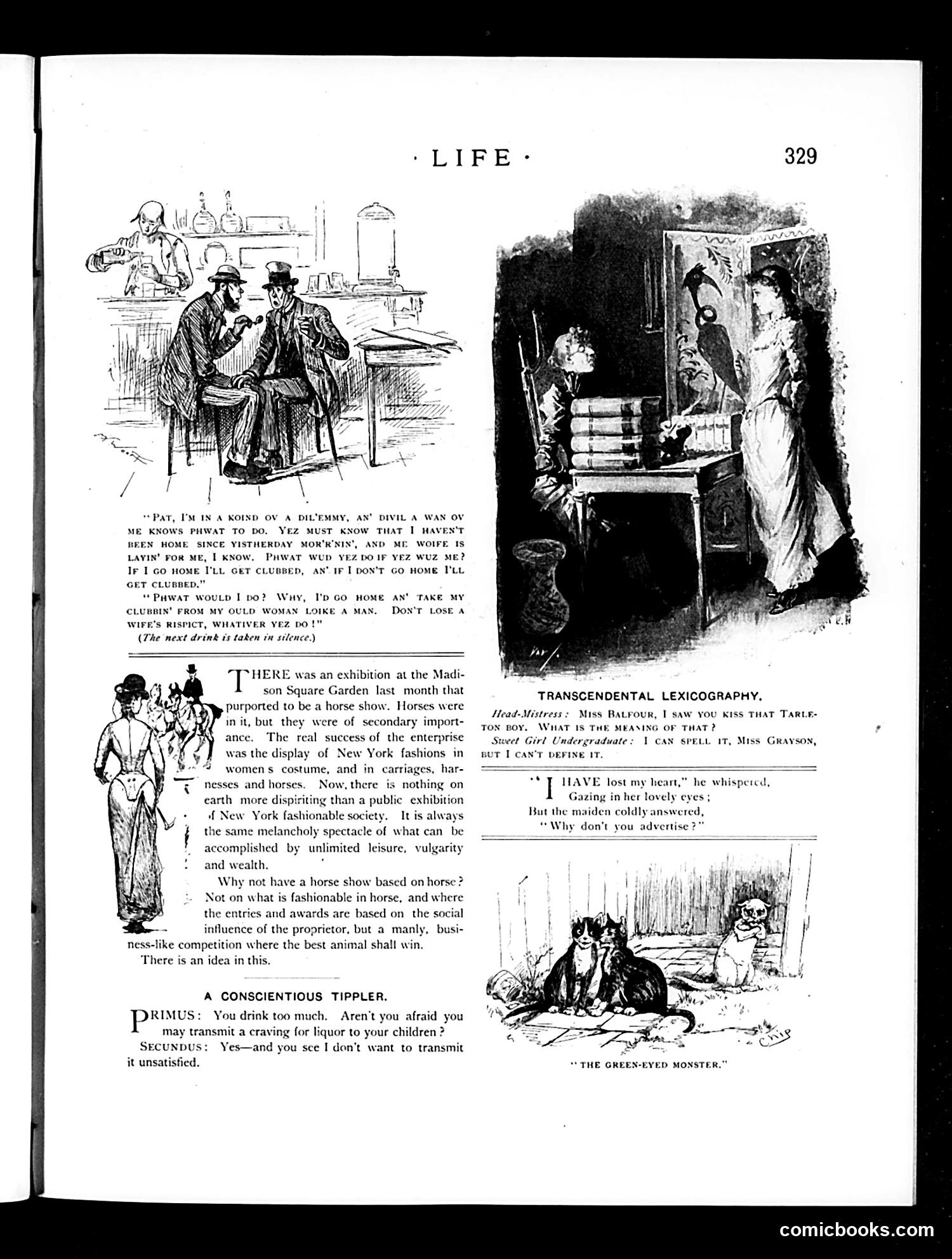
This page contains three separate humor pieces: 1. **Top left sketch**: Two men in a bar discuss domestic troubles. One admits staying away from home because his wife nags him constantly, joking he'll "get clubbed" if he returns. 2. **"Transcendental Lexicography"**: A social satire where a fashionable woman asks her maid what kissing a servant boy means. The maid responds with faux-innocent bewilderment, implying the mistress's own improper conduct while pretending not to understand. 3. **"A Conscientious Tippler"** and **"The Green-Eyed Monster"**: Brief witty exchanges about alcoholism and jealousy respectively. The illustrations satirize domestic relations, class hierarchies, and moral hypocrisy among New York's fashionable society—common Life magazine targets. The humor relies on innuendo and the gap between proper appearance and actual behavior.
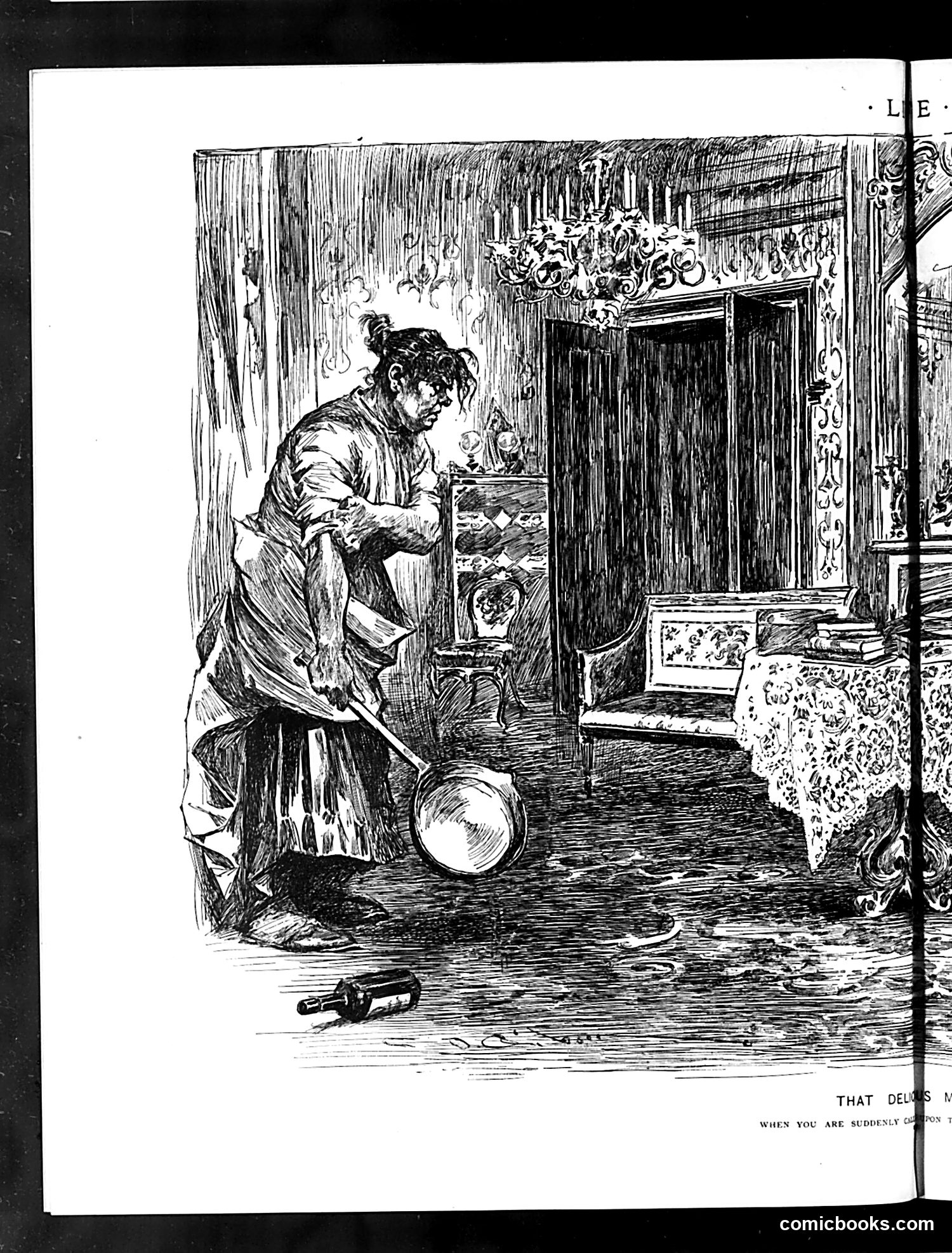
This is a satirical illustration from *Life* magazine showing a domestic servant or janitor cleaning an ornate interior room. The figure appears disheveled and is sweeping or cleaning with a broom and pan, surrounded by fancy furniture, decorative wallpaper, and elaborate furnishings. The partially visible caption at bottom reads "THAT DELI..." and "WHEN YOU ARE SUDDENLY O..." (text cut off). Without the complete caption, the specific satirical point is unclear. However, the general satire likely contrasts the working-class laborer's humble status with the wealthy, ornate surroundings they maintain—a common *Life* magazine theme critiquing class disparities or the absurdities of servant labor in wealthy households. The illustration style and subject matter suggest this addresses either domestic work conditions or social class commentary typical of early 20th-century American satire.
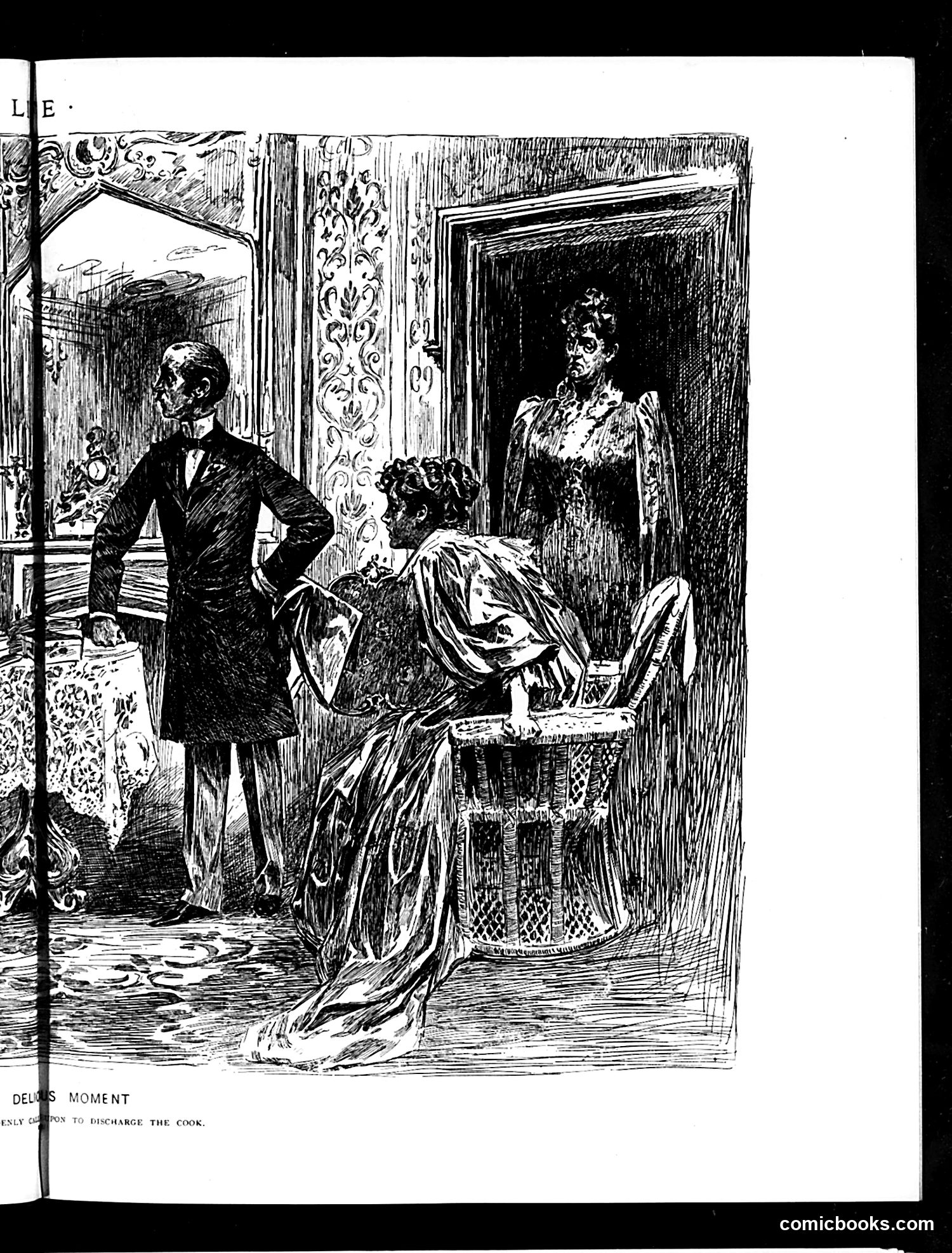
This illustration titled "A Delous Moment" depicts a domestic scene with the caption "Leisly Boon to Discharge the Cook." The image shows three figures in an elegant interior: a man in formal dress standing near a mirror, a seated woman in elaborate clothing, and another woman (likely a servant) standing in a doorway. The satire appears to target upper-class domestic life, specifically the awkward social situation of dismissing household staff. The phrase "delous moment" (likely meant as "delicate moment") suggests the discomfort wealthy employers faced when firing servants. The humor lies in the tension between maintaining polite social pretenses and the unpleasant business of terminating employment—a recurring theme in period social comedy about class relations.
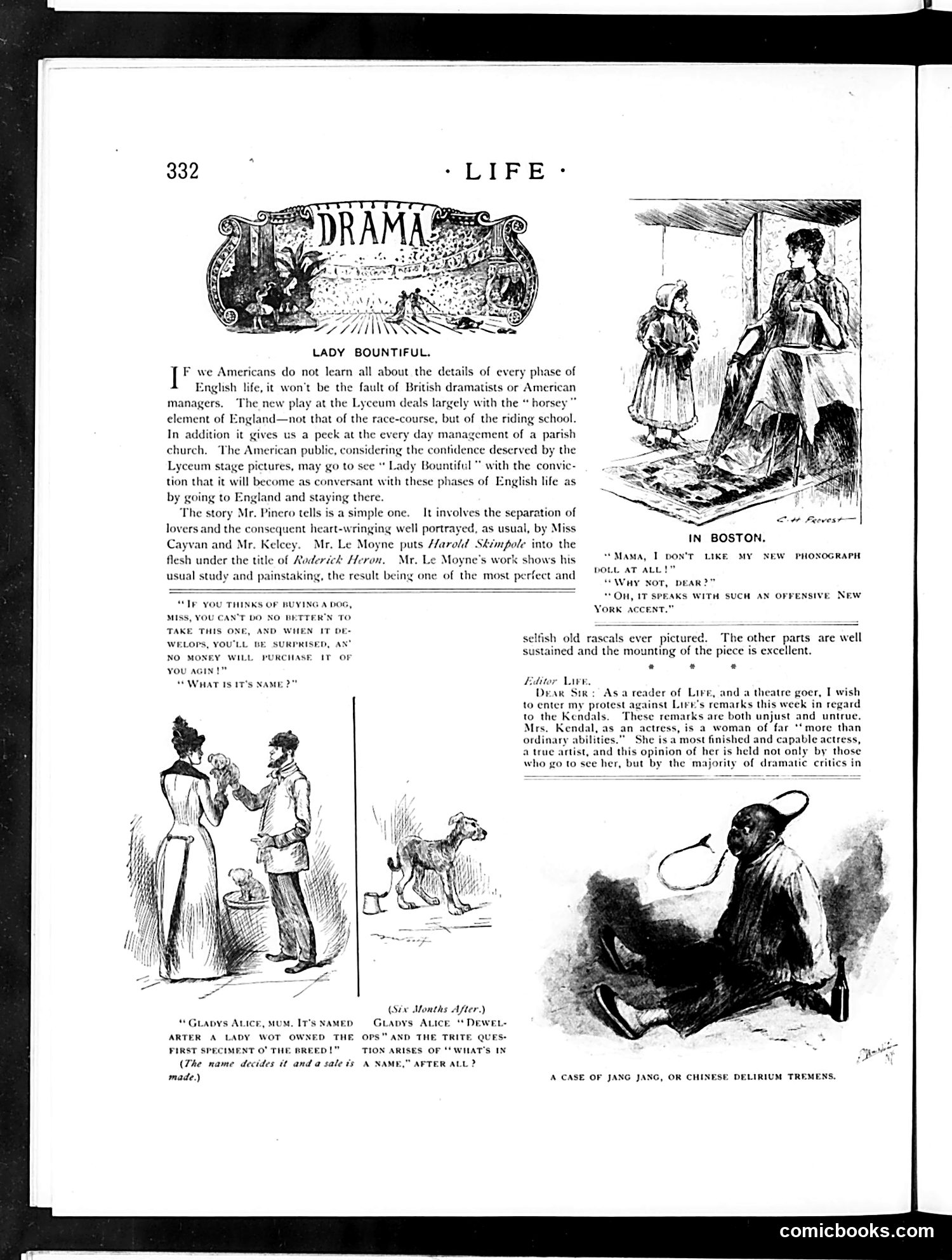
This page reviews a new play at the Lyceum theater about English country life, focusing on horseback riding and parish church management. The text sarcastically suggests Americans can learn authentic English culture from British stage productions. The cartoons illustrate social comedy: One depicts a woman being sold a dog, with the vendor assuring her it will become valuable—a satire on gullible purchases. Another shows a Boston woman with a phonograph doll that speaks with a "New York accent," mocking both new technology and regional stereotypes. The final cartoon titled "A Case of Jang Jang, or Chinese Delirium Tremens" appears to reference exotic or intoxicated behavior, though the specific reference is unclear to modern readers. A reader's letter defends actress Mrs. Kendal against Life's criticism, suggesting the magazine had made disparaging remarks about her performance.
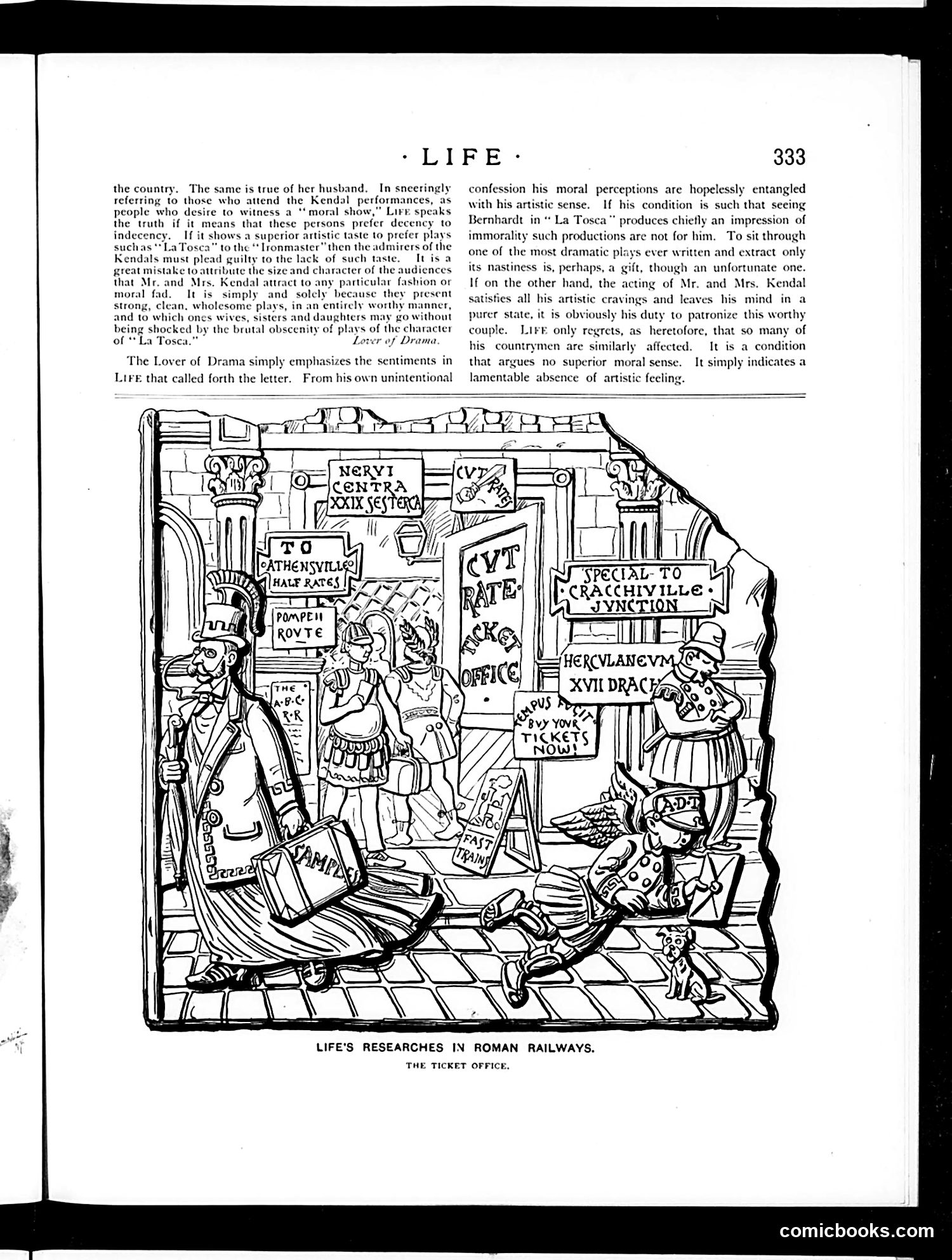
This is a humorous cartoon satirizing the chaos of a Roman railway ticket office. The illustration depicts a crowded, disorganized scene with classical Roman architectural elements (columns, togas) mixed absurdly with modern railway infrastructure (ticket windows, signs reading "TO ATHENSVILLE," "SPECIAL TO CRACHICHILLE JUNCTION"). The joke plays on the anachronism of applying modern bureaucratic systems to ancient Rome—showing Romans attempting to navigate ticket purchasing, presumably with typical delays and confusion. Various characters display frustration, while signs advertise different destinations and "TICKETS NOW!" This type of satire was common in *Life* magazine: taking a contemporary annoyance (railroad ticketing bureaucracy) and humorously transplanting it into an incongruous historical setting to mock modern inefficiency. The accompanying text discusses theatrical matters unrelated to the cartoon, suggesting this is a standalone satirical illustration commenting on transportation frustrations of the era.
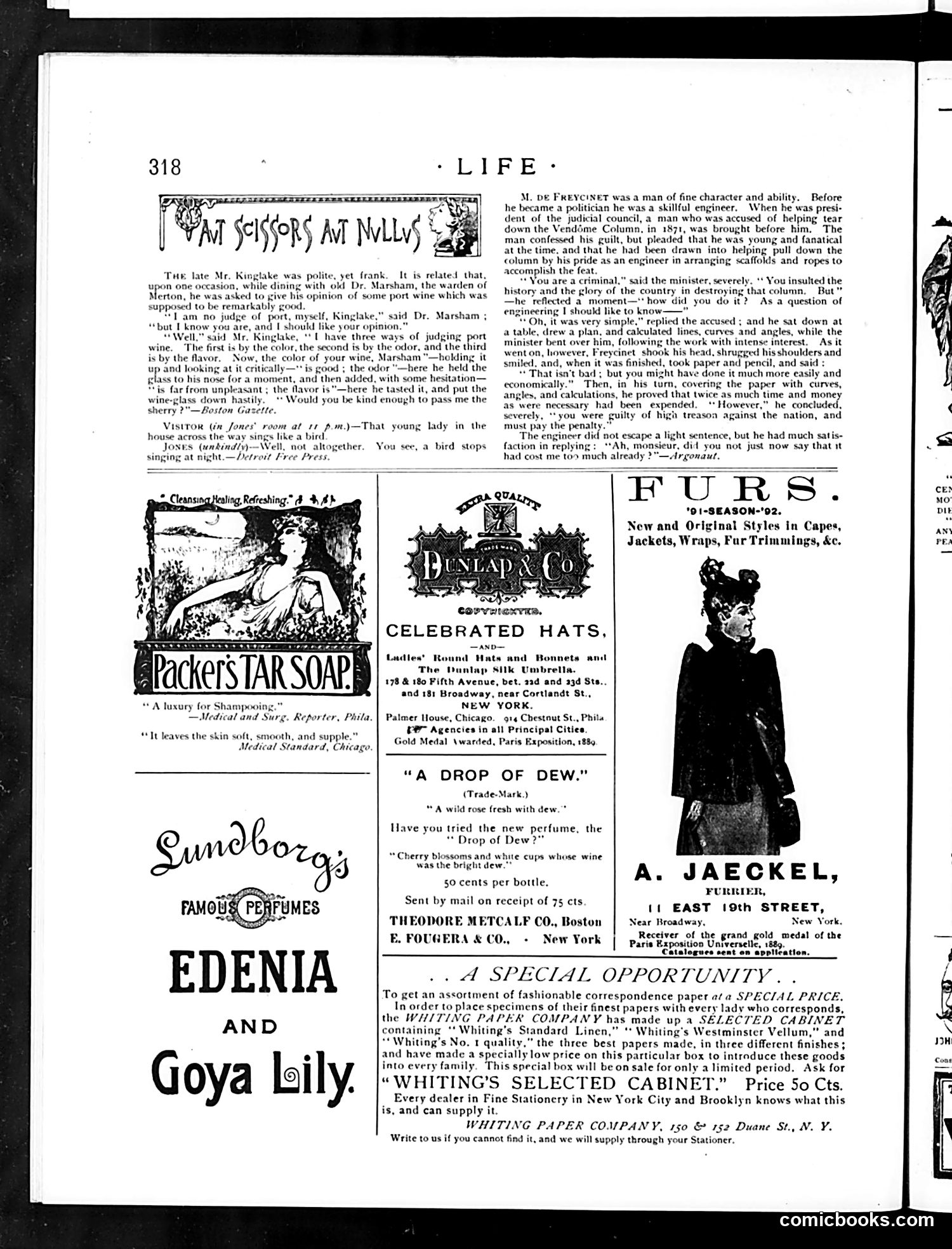
This page from *Life* magazine is primarily **advertising with anecdotal filler content**. The cartoons are minimal; instead, it features three separate historical anecdotes: 1. **Freycinet story**: A French statesman encounters an engineer who helped demolish Paris's Vendôme Column in 1871. Rather than harshly judge him, the engineer and minister bond over the technical challenge, ultimately debating the *efficiency* of the demolition—a satirical contrast between moral gravity and professional pedantry. 2. **Kinglake anecdote**: A witty Englishman tactfully insults poor port wine through deliberate, elaborate praise of its color and smell before admitting the taste is unpleasant. 3. **Jones joke**: A visitor complains about a neighbor's bird-like singing; Jones replies the bird itself stops before finishing her song. All three deploy humor around **politeness masking criticism**—a common Victorian literary theme. The bulk of the page advertises soaps, hats, perfume, and furs typical of the 1891-92 era.
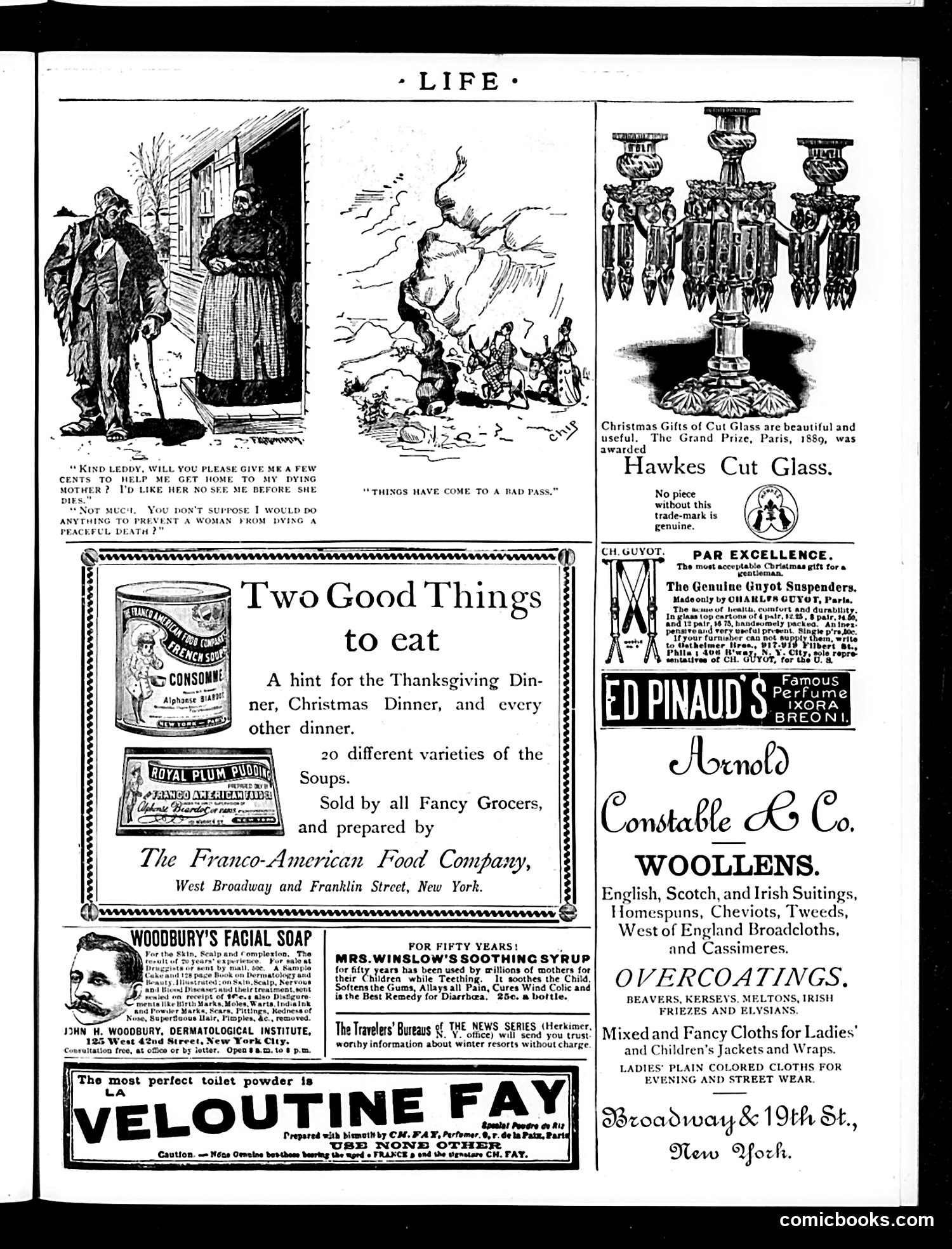
The left cartoon depicts a beggar—drawn with exaggerated, stereotypical features—appealing to a well-dressed woman for spare change to reach his dying mother. She refuses, claiming she cannot "prevent a woman from dying a peaceful death." The satire targets **middle-class hypocrisy regarding poverty and charity**. The woman's callous logic—that preventing someone's death would be wrong—is absurd on its face, exposing how the comfortable classes rationalized indifference to suffering. By denying a few cents, she effectively chooses the beggar's mother's death. The caption "Things Have Come to a Bad Pass" frames this as social commentary: respectable people now openly justify withholding aid from the desperate. This critiques the era's **hardening attitudes toward the poor** and suggests society's moral degradation when compassion becomes openly shameful. The page is primarily **advertisements** for period products (soups, soap, cut glass), making the sardonic contrast between commercial consumption and human desperation part of the joke.
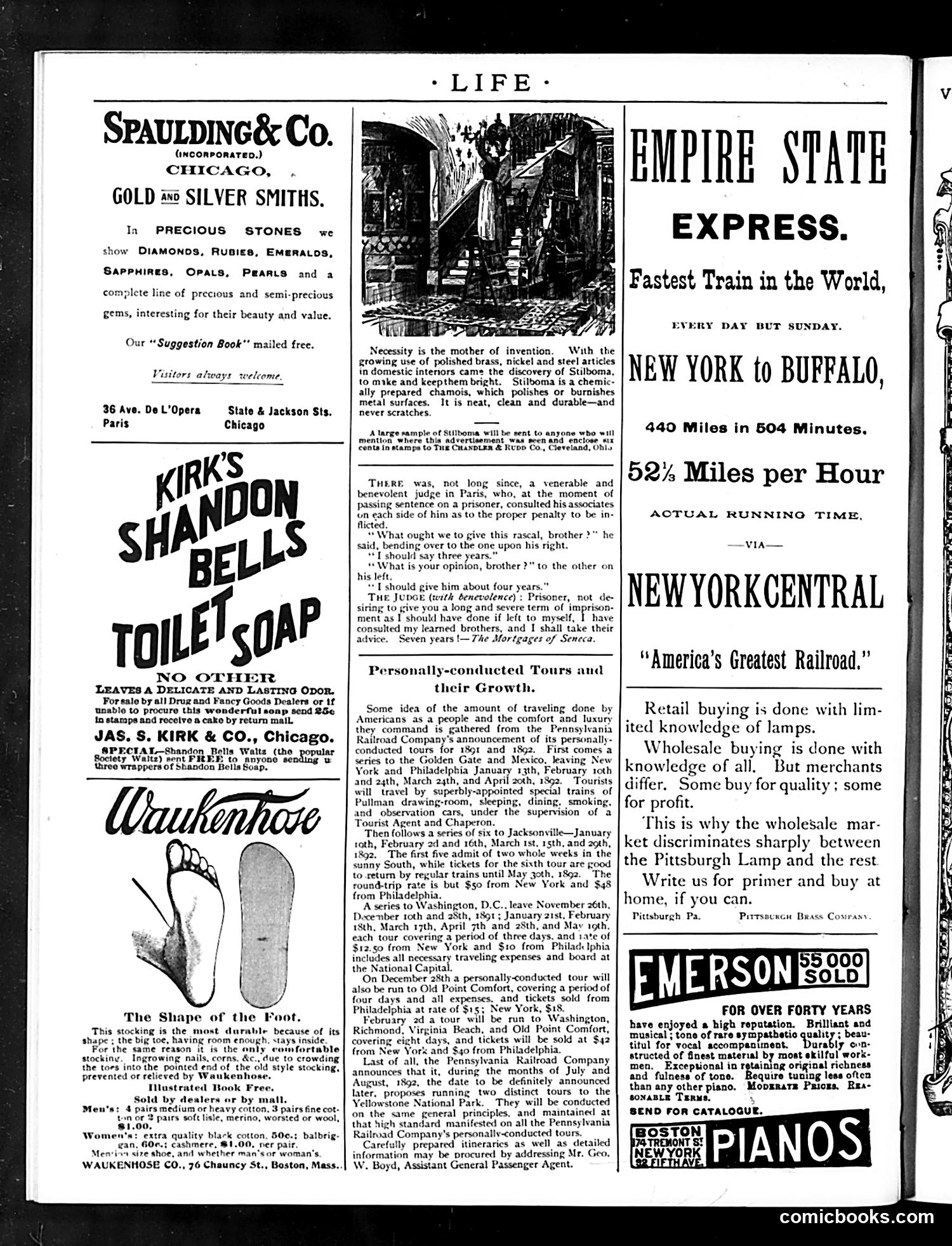
This page is primarily **advertising**, not political satire. It contains several product advertisements typical of 1891-1892: 1. **Spaulding & Co.** (jewelry) and **Kirk's Shandon Bells Toilet Soap** ads occupy the left side 2. **Waukenhose** (specialized stockings) features a diagram explaining their ergonomic toe design—marketed as more comfortable than standard stockings that bunch at the toes 3. **Stilboma** (metal polish) is advertised as a solution for maintaining brass, nickel, and steel home furnishings 4. The center contains a **brief humorous anecdote** (not a cartoon) about a benevolent French judge who, consulting colleagues before sentencing, ends up giving harsher punishment (7 years) than any individual suggested 5. **Empire State Express** and **New York Central Railroad** advertisements promote fast train service 6. **Emerson Pianos** and other luxury goods round out the page There is **no political cartoon** present. This represents typical late-Victorian consumer advertising and light humor.