
Life, 1891-12-03 · page 6 of 16
Life — December 3, 1891 — page 6: what you’re looking at
What you’re looking at
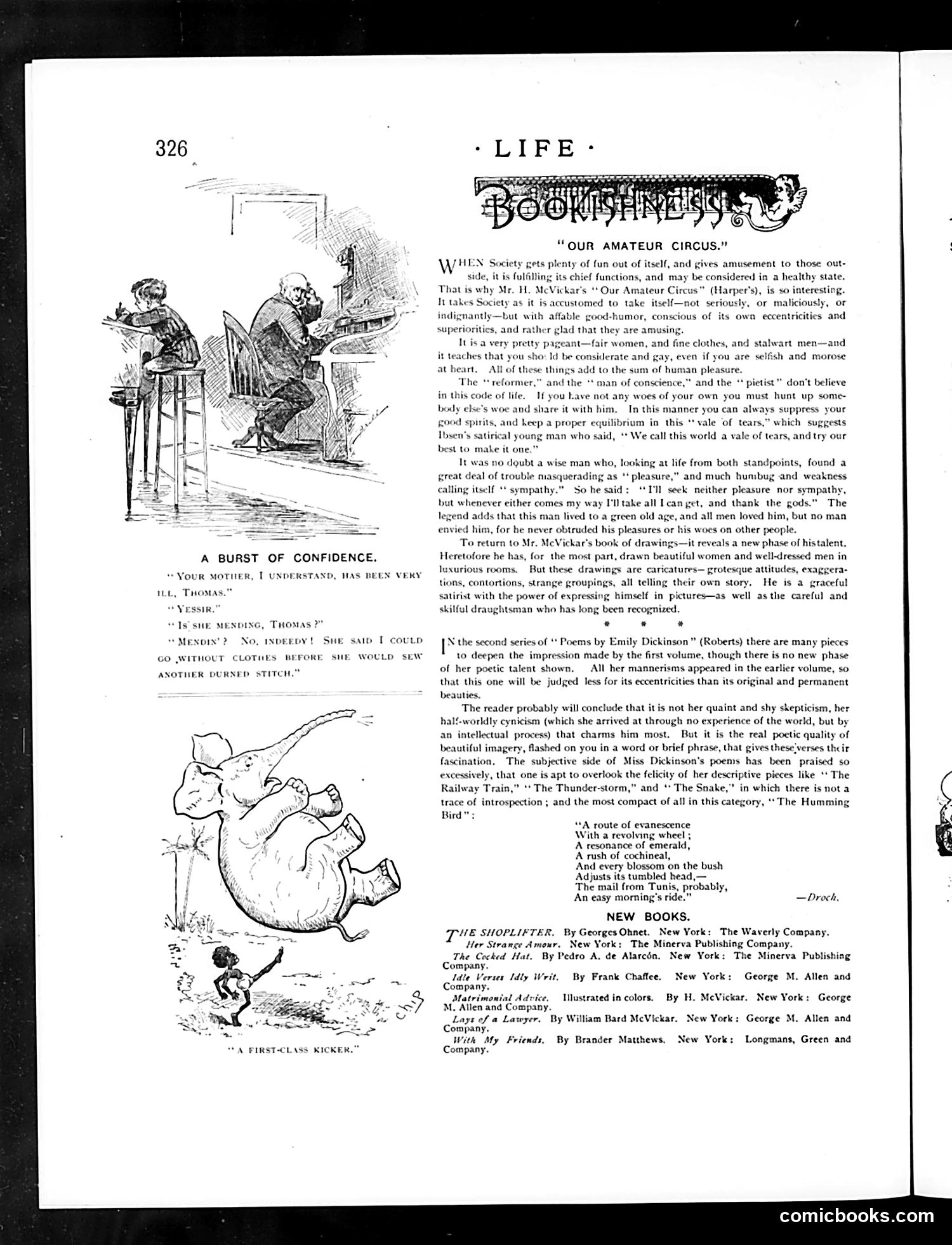
This page features a book review section titled "Bookshelf" reviewing H. H. McVickar's "Our Amateur Circus" (Harper's). The text praises McVickar's satirical drawings for their ability to express human foibles through exaggerated caricatures and grotesque attitudes. The two accompanying illustrations appear to be samples from McVickar's work: "A Burst of Confidence" (top) depicts social interaction, while "A First-Class Kicker" (bottom) shows a rotund figure in an exaggerated pose, likely satirizing human vanity or pretension. The review emphasizes that McVickar's strength lies in capturing satirical observations about society through skillful draftsmanship and humorous exaggeration—a hallmark of Life magazine's own editorial approach.
📄 Transcribed text from this page (OCR, searchable)
Machine-transcribed from the original scan — historical spelling and the odd misread are preserved.
“OUR AMATEUR CIRCUS.” WHEN Society gets plenty of fun out of itself, and gives amusement to those out- side, it is fulilling its chief functions, and may be considered in a healthy state. That is why Mr. H. McVickar’s * Our Amateur Circus” (Harper's), is so intere: It takes Society as it is accustomed to take itself—not seriously, or maliciously, or indignantly—but with affable good-humor, conscious of its own eccentricities and superioritics, and rather glad that they are amusing. It isa very pretty pageant—fair women, and fine clothes, and stalwart men—and it teaches that you sho: Id be considerate and gay, even if you are selfish and morose at heart. All of these things add to the sum of human pleasu The * reformer,” and the ** man of conscience,” and the “ pietist” don’t believe in this code of life. If you Lave not any woes of your own you must hunt up some- body else’s woe and share it with him, In this manner you can always suppress your good spirits, and keep a proper equilibrium in this “vale of tears,” which suggests Ibsen's satirical young man who said, ‘* We call this world a vale of tears, and try our best to make it one.” It was no doubt a wise man who, looking at life from both standpoints, found a great deal of trouble masquerading as * pleasure,” and much humbug and weakness calling itself “ sympathy.” So he said: “Tl seek neither pleasure nor sympathy, but whenever either comes my way I'll take all Ican get, and thank the gods.” The d adds that this man lived to a green old age, and all men Joved him, but no man envied him, for he never obtruded his pleasures or his woes on other people. To return to Mr. MeVickar’s book of drawings—it reveals a new phase of histalent. A BURST OF CONFIDENCE. Heretofore he has, for the most part, drawn beautiful women and well-dressed men in luxurious rooms. But these drawings are caricatures— grotesque attitudes, exaggera- tions, contortions, strange groupings, all telling their own story. He is a graceful satirist with the power of expressing himself in pictures—as well asthe careful and “Yessir, skilful draughtsman who has long been recognized. “1s SHE MENDING, THOMAS 2?” * * * “YOUR MOTHER, T UNDERSTAND, HAS DEEN VERY HLL, Thomas.” Menpix'? No, ispeeDy! SHE Sal T COULD — |N the second series of ‘* Poems by Emily Dickinson" (Roberts) there are many pieces WITHOUT CLOTHES BEFORE SNE WOULD sew to deepen the impression made by the first volume, though there is no new phase ANOTHER DURNED sttTcH." of her poetic talent shown, All her mannerisms appeared in the earlier volume, 60 that this one will be judged less for its eccentricities than its original and permanent beauties. The reader probably will conclude that it is not her quaint and shy skepticism, her half-worldly cynicism (which she arrived at through no experience of the world, but by an intellectual process) that charms him most, But it is the real poetic quality of beautiful imagery, flashed on you in a word or brief phrase, that gives these'verses their fascination. The subjective side of Miss Dickinson's poems has been praised so excessively, that one is apt to overlook the felicity of her descriptive pieces like * The Railway Train,” “The Thunder-storm,” and ** The Snake,” in which there is not a trace of introspection ; and the most compact of all in this category, “The Humming Bird": “A route of evanescence With a revolving wheel ; A resonance of emerald, A rush of cochineal, ‘And every blossom on the bush Adjusts its tumbled head,— ‘The mail (rom Tunis, probably, An easy morning's ride, —Droch. NEW BOOKS. THE SHOPLIFTER. By Georges Ohnet. New York: ‘The Waverly Company. Her Strange Amour, New York: The Minerva Publishing Company. The Cocked Hat, By Pedro A, de Alarcén, New York: The Minerva Publishing Company. Idle Verses Idty Writ, By Frank Chaffee. New York: George M. Allen and Company. Matrimonial Advice, Mlustrated in colors. By H. McVickar, New York: George M, Allen and Company. Lays of a Lawyer, By William Bard McVickar. New York: George M. Allen and Company. With My Friends, By Brander Matthews, New Yor: Longmans, Green and SA FIRST-CLASS KICKER.” Company. comicbooks.com